
 Download PDF
Market Overview
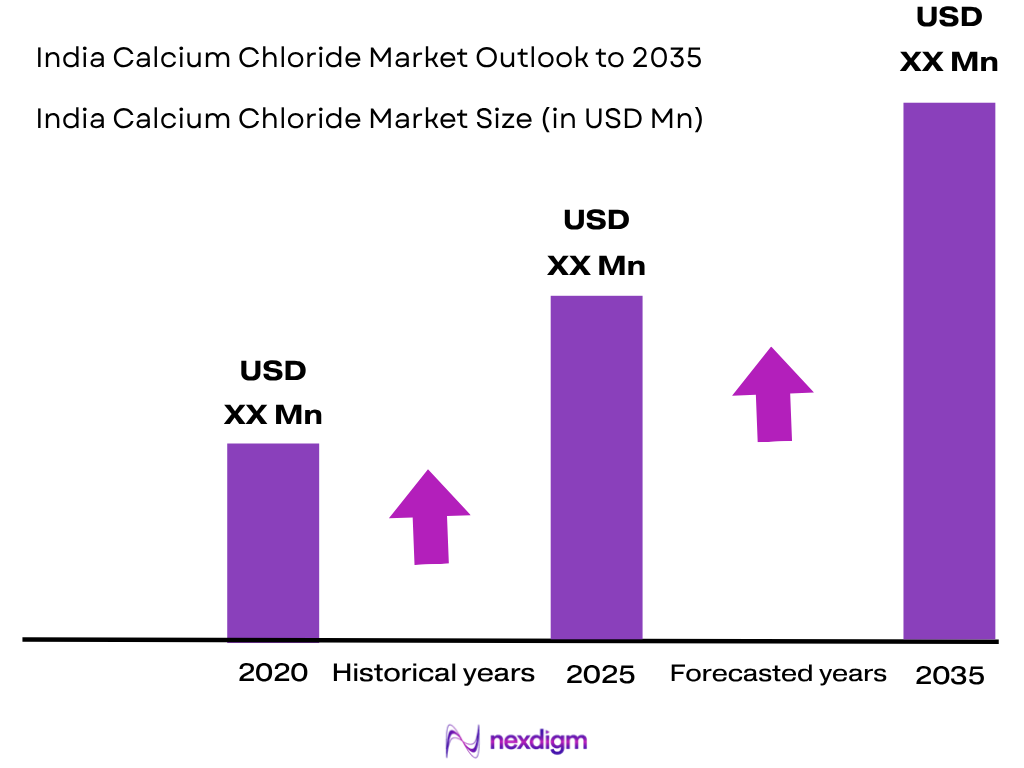
The India Calcium Chloride Market was valued at approximately ~USD XX million in 2024 and is projected to reach ~USD XX million by 2035, registering a ~XX% CAGR during 2026-2035. Publicly available industry sources indicate that India consumed approximately 57.32 thousand tonnes in 2025, providing a reference point for the scale of domestic consumption. India also exported 83.58 million kg of calcium chloride worth USD 16.53 million in 2024, demonstrating the country’s role as both a domestic consumer and export supplier.
Gujarat represents a major calcium chloride production and chemical-processing center because of its concentration of chlor-alkali, petrochemical and specialty chemical infrastructure, particularly around Dahej, Bharuch, Vapi and related industrial clusters. Maharashtra, Madhya Pradesh, Rajasthan, Tamil Nadu and other industrial states provide additional demand from chemicals, construction, food processing and manufacturing. Gujarat-based producers report substantial calcium chloride capacities, including liquid, lumps, powder and prill forms, while established suppliers operate manufacturing and distribution networks serving industrial customers across India.
Market Segmentation
By Product Form
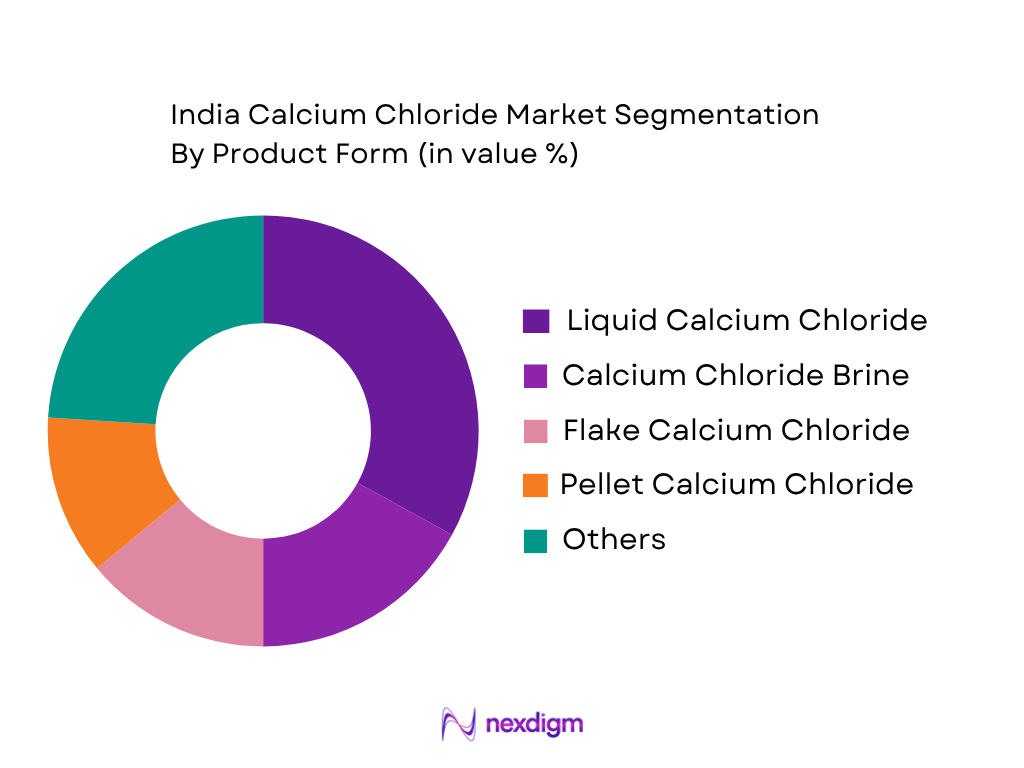
The India Calcium Chloride Market is segmented by product form into liquid calcium chloride, calcium chloride brine, flake calcium chloride, pellet calcium chloride, granulated calcium chloride, briquette calcium chloride, anhydrous calcium chloride and powdered calcium chloride. Liquid calcium chloride is expected to represent the leading product-form segment because it can be supplied directly to industrial users and integrated into applications requiring controlled concentration. Liquid calcium chloride is particularly relevant to chemical processing, drilling-fluid preparation, dust control and industrial applications. Indian manufacturers have invested in substantial liquid production capacity; OPJ Group reports 360,000 tonnes per annum of liquid calcium chloride capacity at its flagship facility, alongside 130,000 tonnes per annum of installed capacity for dry forms across its group. Solid formats remain important for customers requiring concentrated products, storage flexibility and transportation efficiency. Flakes, lumps, powder and prills serve different purity and handling requirements, including industrial processing, water treatment, food applications and chemical manufacturing. The availability of multiple physical formats allows Indian producers to serve customers according to concentration, purity, application and logistics requirements.
By Application
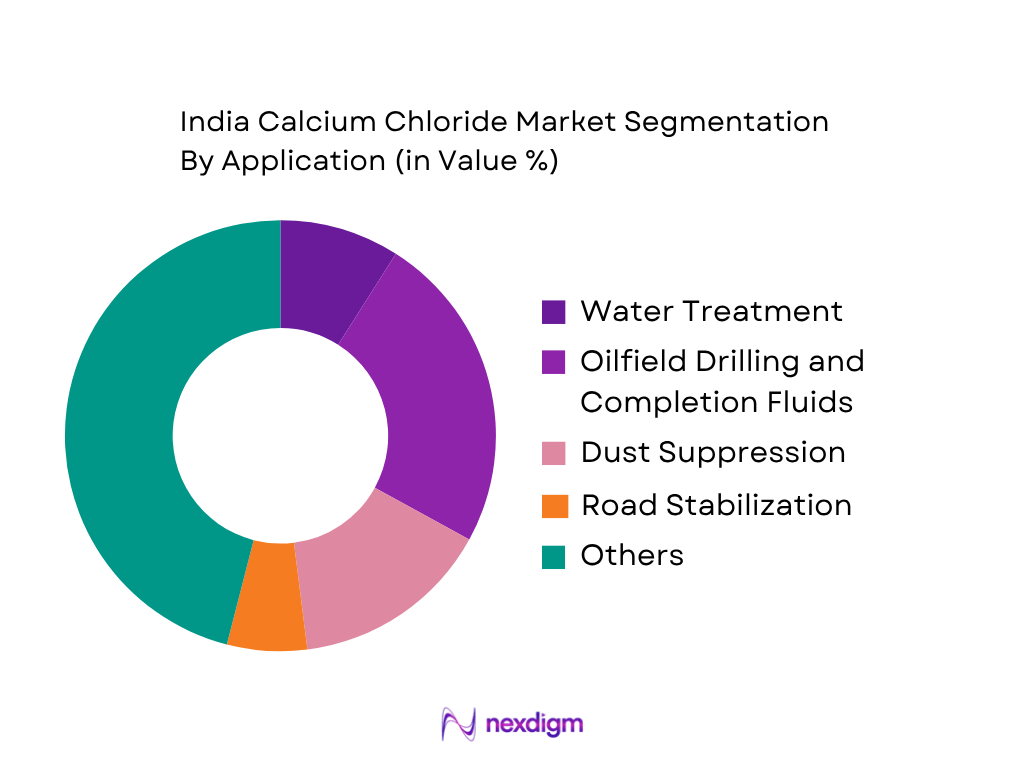
The India Calcium Chloride Market is segmented by application into oilfield drilling and completion fluids, construction, dust suppression, road stabilization, water treatment, food processing, refrigeration brine, chemical processing, agriculture, mining and mineral processing, pharmaceuticals and other industrial applications. Oilfield drilling and completion fluids represent a key application segment because calcium chloride is used in brine systems where density control, formation-pressure management and shale stabilization are required. India’s large energy-consumption base supports this application ecosystem, while industrial and infrastructure development creates additional demand from construction and road-related applications. India’s national highway network reached 146,195 km, and 12,349 km of national highways were constructed during 2023-24, illustrating the scale of infrastructure activity associated with road construction and maintenance. Food-grade calcium chloride provides another specialized demand channel for food processing, while water treatment and industrial processing diversify the customer base. The broad application mix reduces dependence on a single downstream industry and creates opportunities for manufacturers offering customized concentrations, grades and physical forms.
Competitive Landscape
The India Calcium Chloride Market comprises domestic calcium chloride manufacturers, integrated chemical producers, specialty chemical companies, exporters and regional distributors. Competition is differentiated by manufacturing capacity, product concentration, solid-versus-liquid portfolio, purity levels, feedstock integration, geographic coverage and ability to serve industrial, food, oilfield and water-treatment customers. Gujarat and Madhya Pradesh are particularly relevant production locations, while large industrial markets across western, northern and southern India create broad downstream distribution requirements. OPJ Group alone reports multiple manufacturing units and substantial liquid and dry-form calcium chloride capacity.
| Company | Establishment | Headquarters | Product Forms | Grade Portfolio | Production Capability | Key Applications | Export Exposure | Distribution Footprint |
| OPJ Group | 1982 | Gujarat, India | ~ | ~ | ~ | ~ | ~ | ~ |
| Panoli Intermediates | 1990s | Gujarat, India | ~ | ~ | ~ | ~ | ~ | ~ |
| Gujarat Alkalies and Chemicals | 1973 | Vadodara, India | ~ | ~ | ~ | ~ | ~ | ~ |
| SaiChem Industries | 1985 | Mumbai, India | ~ | ~ | ~ | ~ | ~ | ~ |
| Pandora Industries | 1990s | Delhi, India | ~ | ~ | ~ | ~ | ~ | ~ |
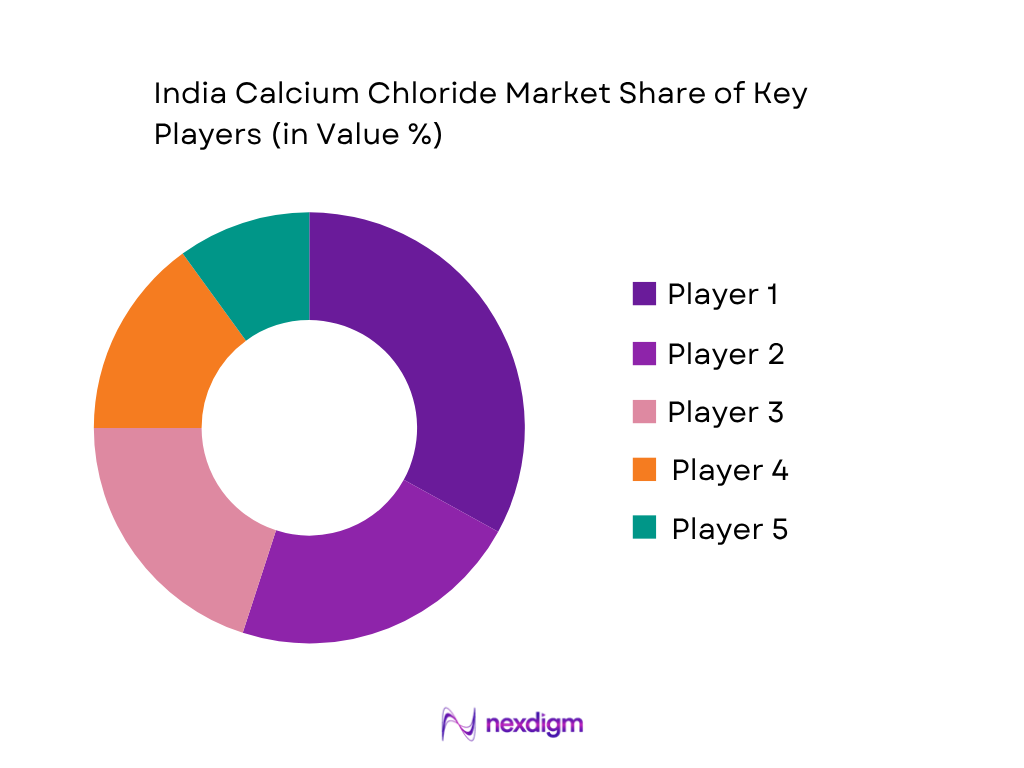
India Calcium Chloride Market Analysis
Growth Drivers
Expansion of Chemical Manufacturing
Expansion of India’s chemical manufacturing base supports calcium chloride demand because the product is used across chemical processing, moisture control, water treatment, drilling fluids and other industrial applications. The Department of Chemicals and Petrochemicals reported that India’s chemical and chemical-products output index reached 130.8 during April–October 2024, compared with 128.1 in the corresponding period, indicating continued industrial activity in a major downstream sector. The Department’s Chemical and Petrochemical Statistics at a Glance 2024 also reported that India’s chemical-sector output was ₹15.14 lakh crore at current prices in FY2023-24, while the broader chemical and chemical-products industry accounted for a substantial manufacturing base. Calcium chloride benefits from this industrial ecosystem because hydrochloric acid, chlor-alkali operations and integrated chemical production can provide feedstock or production-route linkages. Demand is particularly relevant for industrial-grade calcium chloride used in chemical processing, brine preparation and moisture-control applications. The Department also launched the ChemIndia portal in February 2024 to collect production, installed-capacity, import, export, purchase and sales information from chemical manufacturers, demonstrating the breadth of the domestic chemical manufacturing ecosystem. Continued expansion of chemical production, processing capacity and industrial clusters therefore provides a structural demand platform for calcium chloride.
Highway and Infrastructure Development
India’s continuing highway expansion creates a market-specific demand environment for calcium chloride applications including dust suppression, road-base stabilization and selected construction processes. The Ministry of Road Transport and Highways reported that India’s National Highway network reached 146,145 km in 2024, compared with 91,287 km in 2014. The length of National Highways with four lanes or more reached 48,422 km, while operational high-speed corridors increased to approximately 2,138 km. During FY2023-24, the ministry also reported 7,658 km of National Highway construction through January 2024, compared with 6,803 km during the corresponding period of the previous year. This expanding road network increases the operational base requiring construction, maintenance and surface-management materials. Calcium chloride is used in specific road applications because its hygroscopic properties help suppress dust and its brine characteristics can support stabilization of unpaved or granular surfaces. Demand can therefore emerge from road contractors, infrastructure developers, mining-road operators and industrial sites rather than only conventional highway deicing, which has limited relevance in India’s climate. The scale of highway construction also creates opportunities for regional distributors to supply calcium chloride to infrastructure projects located near major industrial and logistics corridors.
Market Challenges
Limited Domestic Availability of Certain High-Purity Grades
Limited availability of specialized and high-purity calcium chloride grades can constrain applications requiring tighter specifications, particularly pharmaceutical, food, laboratory and specialty industrial uses. India’s chemical industry has a large manufacturing base, but the Department of Chemicals and Petrochemicals distinguishes basic, specialty and other chemical categories and maintains separate production, capacity, import and export datasets, reflecting considerable variation in domestic manufacturing capabilities. Its 2024 statistics publication reported chemical-sector output of ₹15.14 lakh crore at current prices in FY2023-24, while the chemicals and chemical-products IIP recorded an index of 130.8 during April–October 2024, demonstrating a broad industrial ecosystem but not necessarily domestic availability of every specialty grade. Calcium chloride users requiring high purity may therefore face qualification requirements involving impurity limits, moisture content, concentration and application-specific standards. This creates an opportunity cost for manufacturers because producing specialized grades can require additional purification, drying, testing and quality-control infrastructure. Imported material may consequently remain relevant for selected applications even where standard industrial calcium chloride is domestically available. The challenge is especially significant for smaller customers that require modest quantities but strict specifications, as they may depend on distributors or imported specialty material. Domestic producers seeking to move toward higher-value applications must therefore establish reliable purification, analytical testing, certification and batch-consistency capabilities.
Environmental Concerns Associated with Chloride Discharge
Chloride discharge and management requirements create a challenge for calcium chloride users because applications involving large quantities of dissolved calcium chloride can increase chloride loading in industrial wastewater or receiving water systems. The challenge is particularly relevant to water-treatment operations, industrial processing and applications where calcium chloride is introduced directly into aqueous systems. India’s Central Pollution Control Board and State Pollution Control Boards regulate industrial effluent discharge through sector-specific environmental requirements, meaning industrial users must manage wastewater characteristics alongside chemical consumption. The broader chemical sector provides an indication of the scale of regulated industrial activity: the Department of Chemicals and Petrochemicals reported an IIP index of 130.8 for chemicals and chemical products during April–October 2024, while the manufacturing sector continued to constitute the largest component of India’s industrial production system. Calcium chloride suppliers therefore need to consider not only product performance but also application dosage, wastewater management and customer compliance requirements. For industrial users, uncontrolled chloride accumulation can affect water reuse systems and discharge management, encouraging tighter chemical dosing and process optimization. This may constrain indiscriminate use while simultaneously creating demand for more controlled formulations, monitoring systems and application-specific dosing practices. The environmental challenge is therefore linked to both regulatory compliance and operational water-management requirements.
Market Opportunities
Domestic Calcium Chloride Capacity Expansion
Expansion of domestic calcium chloride manufacturing capacity can create future opportunities by reducing dependence on external supply for standard and specialized applications while strengthening India’s position as an export-oriented chemical producer. Government chemical statistics show that India’s broader chemical and petrochemical production reached 58,617 thousand tonnes in FY2024-25, compared with 45,638 thousand tonnes in FY2015-16, demonstrating the expansion of the industrial chemical ecosystem. Alkali chemicals accounted for 71.1% of major chemical production in FY2024-25, providing a substantial integrated manufacturing base relevant to calcium chloride production routes and feedstock availability. The Department of Chemicals and Petrochemicals also reported that chemical and chemical-products output had an IIP index of 129.3 in FY2024-25, while the manufacturing sector recorded an index growth of 4.1%. These indicators support opportunities for integrated calcium chloride facilities located near chlor-alkali and hydrochloric-acid production clusters. Producers can expand beyond commodity material into liquid solutions, concentrated brines, food-grade products and higher-purity grades, allowing them to serve oilfield, industrial, construction, food and water-treatment customers. Domestic capacity development can also strengthen bulk logistics and regional distribution, particularly around western Indian chemical clusters. The combination of an established chemical manufacturing base and growing downstream industrial requirements creates a platform for additional calcium chloride production and application-specific processing.
Oilfield Brine Applications
Oilfield brine applications provide an opportunity for calcium chloride suppliers because India’s upstream petroleum sector requires specialized brines for drilling, completion, workover and well-servicing activities. The opportunity is supported by India’s continuing hydrocarbon-production infrastructure and the government’s focus on domestic exploration and production. Calcium chloride is particularly relevant where high-density brine formulations are required for well-control and completion operations, allowing suppliers to move beyond conventional industrial-grade applications toward technically specified oilfield products. The broader chemical manufacturing ecosystem strengthens this opportunity: the Department of Chemicals and Petrochemicals reported 58,617 thousand tonnes of major chemicals and petrochemicals production in FY2024-25, while the petroleum-refining and petrochemical industries remain major industrial consumers of chemical inputs. Oilfield customers also require dependable bulk availability, consistent concentration and rapid delivery, creating opportunities for suppliers with regional storage and brine-formulation capabilities. Domestic producers can further develop customized calcium chloride concentrations suited to drilling-fluid and completion-fluid requirements rather than relying exclusively on standardized solid products. This application can therefore support higher-value sales through technical specifications, bulk supply contracts and integrated logistics. Expansion of domestic exploration, well intervention and servicing activity would provide additional downstream opportunities for calcium chloride manufacturers capable of meeting oilfield quality, concentration and delivery requirements.
Future Outlook
Over the next decade, the India Calcium Chloride Market is expected to be influenced by infrastructure development, chemical manufacturing expansion, oil and gas activity, food processing and industrial water treatment. Domestic manufacturers are expanding liquid and dry-form production capabilities, while India’s export activity provides an additional outlet for locally manufactured material. Application-specific grades, high-purity calcium chloride, food-grade products and customized concentration formulations are expected to receive greater attention. Growing industrialization should also support demand from construction, mining, refrigeration and specialty chemical applications.
Major Players
- OPJ Group
- Panoli Intermediates
- Gujarat Alkalies and Chemicals Limited
- Kutch Chemical Industries
- Gurave Chemicals
- Shri Hari Chemicals
- Sangfroid Chloride
- Metro Chem Industries
- Filtron Envirotech India
- Hindustan Dyes & Chemicals
- Pandora Industries
- Shree Madhav Chemtech
- Drashti Chemicals
- Novosil Industries
- SaiChem Industries
Key Target Audience
- Calcium Chloride Manufacturers and Chemical Producers
- Oilfield Service Companies and Drilling Contractors
- Construction, Road Infrastructure and Dust-Control Companies
- Food Processing and Food Ingredient Manufacturers
- Water Treatment and Industrial Chemical Companies
- Investments and Venture Capitalist Firms
- Government and Regulatory Bodies (Ministry of Chemicals and Fertilizers, Central Pollution Control Board, Food Safety and Standards Authority of India, Ministry of Petroleum and Natural Gas)
- Industrial Chemical Distributors and Bulk Logistics Companies
Research Methodology
Step 1: Identification of Key Variables
The initial phase involves constructing an ecosystem map covering calcium chloride producers, chemical feedstock suppliers, distributors, oilfield service companies, construction companies, food processors and industrial consumers. Key variables include product form, concentration, grade, production route, application, end-use industry, regional demand, domestic capacity, imports and exports.
Step 2: Market Analysis and Construction
This phase involves compiling historical information on calcium chloride production, consumption, imports, exports and downstream applications. Product-form demand is assessed alongside oil and gas activity, infrastructure development, chemical manufacturing, food processing, water treatment and industrial requirements to construct the market’s demand and supply framework.
Step 3: Hypothesis Validation and Expert Consultation
Market hypotheses are validated through engagement with calcium chloride manufacturers, distributors, oilfield-service companies, chemical processors, construction users and industrial customers. Discussions focus on grade preferences, concentration requirements, procurement practices, production utilization, application specifications, domestic supply and imported-product substitution.
Step 4: Research Synthesis and Final Output
The final phase integrates supply-side, demand-side, trade and competitive information into the India Calcium Chloride Market assessment. Bottom-up application estimates are reconciled with top-down industrial indicators, while company-level information is used to validate production capabilities, product portfolios, distribution coverage and competitive positioning.

- Executive Summary
- Research Methodology (Market Definition and Scope, India Calcium Chloride Market Classification, Calcium Chloride Production Route Assessment, Hydrochloric Acid and Limestone Route Analysis, Chlor-Alkali and Soda Ash By-Product Recovery Assessment, Solid and Liquid Calcium Chloride Production Mapping, Domestic Capacity Assessment, Import Dependency Analysis, Deicing Demand Assessment, Oilfield Brine Requirement Analysis, Dust Suppression and Road Stabilization Assessment, Food Grade Calcium Chloride Demand Assessment, Water Treatment Application Assessment, Industrial and Construction Demand Mapping, Primary Industry Interviews, Data Triangulation, Forecasting Framework, Limitations and Future Conclusions)

- Definition and Scope
- India Calcium Chloride Industry Evolution
- India Calcium Chloride Value Chain Analysis
- India Calcium Chloride Supply Chain Analysis

- Growth Drivers (Expansion of Chemical Manufacturing, Growth of Oil and Gas Exploration, Highway and Infrastructure Development, Rising Industrial Water Treatment Demand, Expansion of Food Processing, Growth of Construction Activity, Increasing Dust Suppression Requirements, Expanding Refrigeration and Cold Chain Infrastructure)
- Market Challenges (Limited Domestic Availability of Certain High-Purity Grades, Dependence on Imported Calcium Chloride in Selected Applications, Raw Material Availability Constraints, Hydrochloric Acid Supply Dependence, Environmental Concerns Associated with Chloride Discharge, Regional Supply Concentration, Transportation and Storage Requirements, Competition from Alternative Chloride Chemicals)
- Market Opportunities (Domestic Calcium Chloride Capacity Expansion, High-Purity and Food Grade Production, Oilfield Brine Applications, Infrastructure and Road Stabilization, Industrial Water Treatment, Food Processing Applications, Mining and Mineral Processing, Refrigeration and Cold Chain Applications)
- Market Trends (Liquid Calcium Chloride Adoption, High-Purity Grade Development, Food Grade Calcium Chloride Demand, Customized Concentration Formulations, Bulk Chemical Distribution, Oilfield Brine Optimization, Dust Suppression Applications, Industrial Water Treatment Integration, Domestic Manufacturing Expansion, Integrated Chemical Production)
- Government Regulations and Standards (Bureau of Indian Standards Requirements, Food Safety and Standards Authority of India Requirements, Central Pollution Control Board Environmental Requirements, State Pollution Control Board Compliance, Petroleum and Natural Gas Regulatory Framework, Directorate General of Mines Safety Requirements, Chemical Handling and Storage Requirements, Hazardous Chemical Management Requirements, Industrial Effluent Discharge Requirements)
- SWOT Analysis
- Porter’s Five Forces Analysis
- PESTLE Analysis
- Stakeholder Ecosystem
- Competition Ecosystem

- By Market Value (2020-2025)
- By Calcium Chloride Consumption Volume (2020-2025)
- By Solid Calcium Chloride Consumption Volume (2020-2025)
- By Liquid Calcium Chloride Consumption Volume (2020-2025)
- By Calcium Chloride Brine Consumption Volume (2020-2025)

- By Product Form (In Value %)
Liquid Calcium Chloride
Calcium Chloride Brine
Flake Calcium Chloride
Pellet Calcium Chloride
Granulated Calcium Chloride
Briquette Calcium Chloride
Anhydrous Calcium Chloride
Powdered Calcium Chloride - By Concentration and Grade (In Value %)
Calcium Chloride 30–35% Solution
Calcium Chloride 35–40% Solution
Calcium Chloride 70–75% Solid
Calcium Chloride 77–80% Solid
Calcium Chloride 83–87% Solid
Calcium Chloride 90% Grade
Calcium Chloride 94–97% Anhydrous Grade
Technical Grade Calcium Chloride
Industrial Grade Calcium Chloride
Food Grade Calcium Chloride
Pharmaceutical and High-Purity Calcium Chloride - By Application (In Value %)
Oilfield Drilling and Completion Fluids
Road Stabilization
Dust Suppression
Construction and Concrete Acceleration
Water Treatment
Food Processing
Refrigeration and Brine Systems
Chemical Processing
Agriculture
Mining and Mineral Processing
Pulp and Paper Processing
Pharmaceutical Applications
Rubber and Tire Processing
Industrial Moisture Control
Deicing and Snow Removal - By End-Use Industry (In Value %)
Oil and Gas
Construction and Infrastructure
Chemical Manufacturing
Food and Beverage Processing
Water Treatment
Mining and Minerals
Agriculture
Pharmaceuticals
Pulp and Paper
Rubber and Tires
Refrigeration and Cold Storage
Road Infrastructure
Textiles
Industrial Manufacturing
Paints and Coatings - By Production Route (In Value %)
Hydrochloric Acid and Limestone Process
Chlor-Alkali By-Product Recovery
Soda Ash By-Product Recovery
Natural Brine Processing
Industrial Brine Concentration
Integrated Chemical Manufacturing
Recycled and Secondary Calcium Chloride Recovery - By Customer Type (In Value %)
Chemical Manufacturers
Oilfield Service Companies
Drilling Contractors
Construction Companies
Road Infrastructure Contractors
Food Processing Companies
Water Treatment Companies
Industrial Chemical Distributors
Mining Companies
Pharmaceutical Manufacturers
Refrigeration Operators
Agricultural Enterprises
Industrial Manufacturers - By Region (In Value %)
North India
Delhi NCR
Rajasthan
Punjab and Haryana
Uttar Pradesh
West India
Gujarat
Maharashtra
Central India
Madhya Pradesh
East India
West Bengal
Odisha
South India
Tamil Nadu
Karnataka
Andhra Pradesh and Telangana

- Market Share of Major Players (By India Revenue, Calcium Chloride Sales Volume, Solid Product Sales Volume, Liquid Product Sales Volume, Industrial Grade Sales, Food Grade Sales, Oilfield Exposure, Domestic Manufacturing Footprint)
- Cross Comparison Parameters (India Calcium Chloride Revenue, Product Form and Concentration Portfolio Breadth, Domestic Production Capacity, Hydrochloric Acid and Feedstock Integration, Oilfield Brine Capability, Food Grade and High-Purity Grade Capability, Regional Distribution Network, Bulk Storage and Logistics Infrastructure)
- SWOT Analysis of Major Players
- Detailed Profiles of Major Companies
Aditya Birla Chemicals
OPJ Group
Panoli Intermediates
Gujarat Alkalies and Chemicals Limited
Kutch Chemical Industries
Gurave Chemicals
Shri Hari Chemicals
Sangfroid Chloride
Metro Chem Industries
Filtron Envirotech India
Hindustan Dyes & Chemicals
Pandora Industries
Shree Madhav Chemtech
Drashti Chemicals
Merck KGaA

- Oilfield Service Company Calcium Chloride Brine Requirement Assessment
- Chemical Manufacturer Calcium Chloride Procurement Analysis
- Construction Contractor Calcium Chloride Accelerator Requirement Assessment
- Road Infrastructure Contractor Dust Suppression Requirement Analysis
- Food Processing Company Food Grade Calcium Chloride Procurement Assessment
- Water Treatment Operator Calcium Chloride Application Assessment

- By Market Value (2026-2035)
- By Calcium Chloride Consumption Volume (2026-2035)
- By Solid Calcium Chloride Consumption Volume (2026-2035)
- By Liquid Calcium Chloride Consumption Volume (2026-2035)
- By Calcium Chloride Brine Consumption Volume (2026-2035)


 Request a Sample
 Ask for Customization
 Get a Quote
 Enquire Now