

 Download PDF
 Download PDF
Market Overview
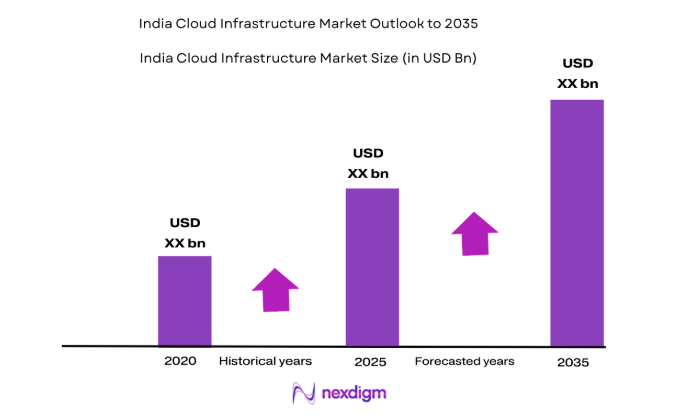
India Cloud Infrastructure market reached approximately USD ~ billion based on recent industry assessments from IDC and NASSCOM, driven by accelerated enterprise migration to cloud platforms, expansion of hyperscale data center capacity, and rising demand for AI-ready compute infrastructure. Growth is supported by large-scale digital public infrastructure adoption, rapid SaaS ecosystem expansion, and sustained investments from global cloud providers establishing regional cloud zones and data center campuses across major Indian technology corridors.
India Cloud Infrastructure market is geographically dominated by Mumbai, Chennai, Hyderabad, Bengaluru, and Delhi NCR due to proximity to subsea cable landing stations, enterprise clusters, financial institutions, and technology firms requiring low-latency computing environments. Mumbai leads through financial sector and colocation density, Chennai through connectivity hubs, Hyderabad through hyperscale campuses, Bengaluru through digital enterprise demand, and NCR through government and telecom cloud adoption supported by policy incentives and infrastructure readiness.
Market Segmentation
By Product Type
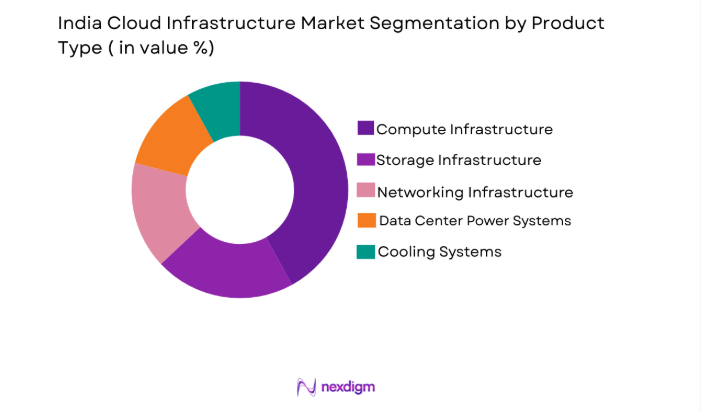
India Cloud Infrastructure market is segmented by product type into compute infrastructure, storage infrastructure, networking infrastructure, data center power systems, and cooling systems. Recently, compute infrastructure has a dominant market share due to hyperscale expansion, AI workload growth, GPU server adoption, and enterprise virtualization demand. Cloud providers prioritize high-density compute to support SaaS, analytics, and digital services, while data center operators expand server capacity to attract cloud tenants. Consequently, compute infrastructure remains the largest investment component in India cloud infrastructure deployment.
By Platform Type
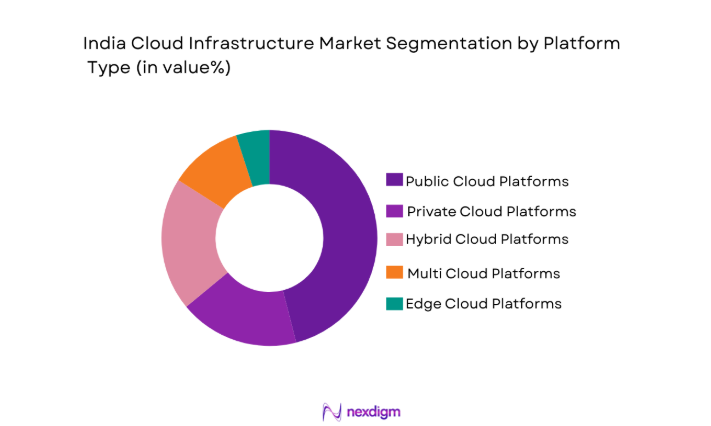
India Cloud Infrastructure market is segmented by platform type into public cloud platforms, private cloud platforms, hybrid cloud platforms, multi cloud platforms, and edge cloud platforms. Recently, public cloud platforms have a dominant market share due to hyperscale investments, scalable pricing, and rapid enterprise migration from legacy IT. Enterprises adopt public cloud to reduce capital expenditure and access AI and analytics services at scale. Expanding cloud regions and strong startup reliance further reinforce public cloud dominance in India cloud infrastructure deployment.
Competitive Landscape
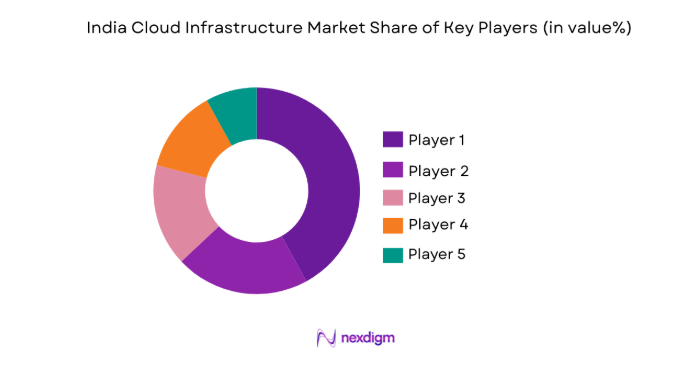
India Cloud Infrastructure market is moderately consolidated, with global hyperscale’s and large domestic data center operators controlling major capacity while regional providers serve niche enterprise and government workloads. Large capital requirements, land availability, connectivity access, and energy sourcing create high entry barriers, strengthening incumbents. Strategic partnerships between telecom operators, infrastructure conglomerates, and global cloud providers further reinforce competitive positioning and capacity expansion across major metropolitan data center hubs.
| Company Name | Establishment Year | Headquarters | Technology Focus | Market Reach | Key Products | Revenue | Data Center Capacity India |
| Amazon Web Services | 2006 | USA | ~ | ~ | ~ | ~ | ~ |
| Microsoft Azure | 2010 | USA | ~ | ~ | ~ | ~ | ~ |
| Google Cloud | 2008 | USA | ~ | ~ | ~ | ~ | ~ |
| Tata Communications | 1986 | India | ~ | ~ | ~ | ~ | ~ |
| CtrlS Datacenters | 2007 | India | ~ | ~ | ~ | ~ | ~ |
India Cloud Infrastructure Market Analysis
Growth Drivers
Hyperscale Data Center Expansion and AI Workload Demand
India cloud infrastructure growth is strongly driven by hyperscale data center expansion aligned with exponential growth in artificial intelligence, analytics, and digital services workloads across enterprises and digital platforms. Global hyperscalers are deploying large-scale campuses across Mumbai, Chennai, and Hyderabad to meet rising compute demand from generative AI, SaaS platforms, fintech ecosystems, and streaming services that require high-density GPU clusters and scalable storage systems. AI adoption across banking, retail, healthcare, and manufacturing sectors significantly increases compute intensity per workload, pushing cloud providers to invest in advanced servers, accelerators, and networking infrastructure. Government digital public infrastructure programs and digital identity platforms also create massive cloud processing requirements at national scale. The startup ecosystem further accelerates demand for elastic compute and development platforms. Enterprises migrating mission-critical applications from on-premise environments require resilient and scalable cloud capacity. International cloud providers are partnering with domestic infrastructure firms to accelerate land acquisition and power sourcing for hyperscale campuses. The combination of AI workload growth, enterprise cloud migration, and hyperscale capital investment establishes data center expansion as a primary structural driver of India cloud infrastructure market growth.
Enterprise Digital Transformation and Cloud Native Adoption
Enterprise digital transformation across Indian industries continues to drive cloud infrastructure demand as organizations modernize legacy IT systems, adopt cloud-native architectures, and deploy data-driven business models requiring scalable computing environments. Financial institutions, telecom operators, retail platforms, and manufacturing firms increasingly migrate core applications to hybrid and public cloud to improve agility, resilience, and operational efficiency. Cloud-native development using containers, microservices, and DevOps practices requires dynamic compute, storage, and networking infrastructure delivered through cloud platforms. The rapid expansion of SaaS adoption across enterprise functions including ERP, CRM, analytics, and cybersecurity increases dependence on cloud infrastructure layers. Digital commerce and mobile application ecosystems generate continuous transaction and data processing workloads that require elastic scaling. Enterprises also adopt multi-cloud strategies for redundancy and vendor diversification, increasing infrastructure consumption across providers. Regulatory compliance frameworks allowing cloud deployment for regulated sectors accelerate adoption. Consequently, enterprise digital transformation and cloud-native architecture adoption create sustained long-term demand for India cloud infrastructure capacity and services.
Market Challenges
Power Availability Constraints and Energy Cost Volatility
India cloud infrastructure deployment faces significant challenges due to power availability constraints, grid reliability issues, and rising energy costs that directly affect data center operational viability and expansion economics across major metropolitan regions. Hyperscale and colocation data centers require uninterrupted high-capacity power supply and redundancy infrastructure, but urban power networks often face capacity bottlenecks and land constraints for substation development. Renewable energy sourcing commitments by global cloud providers add complexity due to variability and transmission limitations in certain regions. Electricity tariffs vary significantly across states, creating cost uncertainty for long-term data center operations. High power intensity of AI compute clusters further increases consumption per rack, amplifying energy requirements and cooling loads. Power infrastructure delays can slow data center commissioning timelines. Grid outages or reliability issues increase dependence on diesel backup generation, raising costs and sustainability concerns. The combination of energy availability, pricing volatility, and infrastructure constraints represents a structural barrier to rapid cloud infrastructure scaling in India.
Land Acquisition, Permitting, and Urban Infrastructure Limitations
Development of large-scale cloud infrastructure campuses in India is constrained by complex land acquisition processes, zoning regulations, environmental clearances, and urban infrastructure limitations that extend project timelines and increase capital costs for data center operators and hyperscale providers. Suitable land parcels must meet requirements for connectivity, flood safety, seismic stability, and proximity to fiber routes and power substations, which are scarce in dense metropolitan regions. Regulatory approvals across state and municipal agencies can be fragmented and time-consuming. Infrastructure readiness including road access, water supply, and drainage often requires additional investment. Environmental compliance for cooling systems and power infrastructure adds permitting complexity. Urban expansion pressures increase land prices in established data center clusters. Delays in permitting or land transfer can disrupt capacity planning for cloud providers. These structural development constraints slow expansion of hyperscale campuses and regional cloud zones. Consequently, land and regulatory barriers remain a persistent challenge in scaling India cloud infrastructure capacity.
Opportunities
Edge Cloud Deployment Across Tier II and Tier III Cities
Expansion of digital services, 5G connectivity, and real-time applications across India’s tier II and tier III cities creates substantial opportunity for distributed edge cloud infrastructure deployment that complements hyperscale data center hubs and reduces latency for regional users and enterprises. Growth in digital payments, e-commerce, telemedicine, online education, and smart city services increases demand for localized compute nodes closer to end users. Telecom operators deploying 5G networks require edge data centers to support low-latency applications including IoT analytics and autonomous systems. Enterprises operating geographically distributed operations benefit from regional edge cloud capacity for faster data processing and regulatory data residency compliance. Government digital infrastructure programs extending to smaller cities also create demand for localized cloud hosting. Edge deployments require modular data center units and micro cloud nodes, opening new infrastructure segments. Regional connectivity improvements further support distributed cloud architectures. Thus, edge cloud expansion across emerging urban centers represents a major growth opportunity for India cloud infrastructure providers.
Green Data Center and Renewable Powered Cloud Infrastructure
Increasing emphasis on sustainability, energy efficiency, and carbon reduction targets among global hyperscalers and enterprises presents a significant opportunity for development of green data centers powered by renewable energy and advanced cooling technologies within India cloud infrastructure ecosystem. Cloud providers are committing to carbon neutrality and renewable energy sourcing, driving investment in solar, wind, and hybrid energy procurement for data center operations. India’s renewable energy capacity expansion enables long-term power purchase agreements supporting green cloud infrastructure. Advanced cooling systems including liquid cooling and free-air cooling improve energy efficiency and reduce power usage effectiveness. Enterprises seeking environmentally compliant cloud services prefer providers with green infrastructure credentials. Government incentives for renewable energy and energy-efficient infrastructure support adoption. Sustainable data center design reduces operational costs over time while meeting ESG requirements. The convergence of renewable energy growth and sustainability mandates creates strong opportunity for green cloud infrastructure development in India.
Future Outlook
India cloud infrastructure market is expected to expand steadily over the next five years driven by hyperscale capacity additions, enterprise cloud migration, and AI infrastructure demand. Edge computing deployments and green data center investments will diversify infrastructure architecture. Policy support for data localization and digital economy growth will sustain enterprise adoption. Connectivity expansion and 5G rollout will increase regional cloud penetration. Overall, infrastructure scale and technological sophistication will continue rising across India.
Major Players
- Amazon Web Services India
- Microsoft Azure India
- Google Cloud India
- Tata Communications
- CtrlS Datacenters
- STT GDC India
- Sify Technologies
- AdaniConneX
- YottaInfrastructure
- NTT Global Data Centers India
- Netmagic Solutions
- Bharti AirtelNxtra
- Reliance Jio Cloud
- Equinix India
- Oracle Cloud India
Key Target Audience
- Hyperscale cloud providers
- Data center operators
- Telecom operators
- Enterprise IT infrastructure buyers
- Financial institutions
- Investments and venture capitalist firms
- Government and regulatory bodies
- Digital platform companies
Research Methodology
Step 1: Identification of Key Variables
Key market variables including data center capacity, cloud adoption levels, enterprise IT spending, hyperscale investments, and regulatory factors were identified through secondary industry databases and policy sources.
Demand drivers and infrastructure constraints were mapped across regions and end-user industries.
Step 2: Market Analysis and Construction
Market size was constructed using bottom-up analysis of cloud infrastructure revenues, data center capacity deployment, and enterprise cloud spending across India.
Segment shares were derived from provider capacity distribution and deployment models.
Step 3: Hypothesis Validation and Expert Consultation
Findings were validated through consultations with cloud providers, data center operators, and enterprise IT stakeholders across major Indian infrastructure hubs.
Assumptions regarding deployment trends and technology adoption were refined accordingly.
Step 4: Research Synthesis and Final Output
All data points and qualitative insights were synthesized into a structured market model covering segmentation, competition, and growth dynamics.
Final outputs were cross-verified with industry benchmarks and published infrastructure datasets.

- Executive Summary
- Research Methodology (Definitions, Scope, Industry Assumptions, Market Sizing Approach, Primary & Secondary Research Framework, Data Collection & Verification Protocol, Analytic Models & Forecast Methodology, Limitations & Research Validity Checks)

- Market Definition and Scope
- Value Chain & Stakeholder Ecosystem
- Regulatory / Certification Landscape
- Sector Dynamics Affecting Demand
- Strategic Initiatives & Infrastructure Growth

- Growth Drivers
Rapid enterprise digital transformation across industries
Expansion of hyperscale data center investments
Growth of data intensive technologies including AI and analytics
Government data localization and cloud adoption initiatives
Rising internet and digital service consumption - Market Challenges
High capital expenditure for data center infrastructure
Power availability and energy cost constraints
Land acquisition and permitting complexities
Cybersecurity and data sovereignty risks
Skill shortages in cloud infrastructure operations - Market Opportunities
Edge infrastructure deployment in tier II and tier III cities
Sovereign and regulated industry cloud platforms
Green data center and renewable powered infrastructure - Trends
Shift toward hyperscale and mega data center campuses
Adoption of liquid and advanced cooling technologies
Integration of AI optimized compute infrastructure
Hybrid and multi cloud architecture standardization
Sustainability driven data center design and operations - Government Regulations & Defense Policy
Data protection and localization compliance frameworks
Incentives for domestic data center infrastructure investment
Energy efficiency and green data center policy standards - SWOT Analysis
- Stakeholder and Ecosystem Analysis
- Porter’s Five Forces Analysis
- Competition Intensity and Ecosystem Mapping

- By Market Value, 2020-2025
- By Installed Units, 2020-2025
- By Average System Price, 2020-2025
- By System Complexity Tier, 2020-2025

- By System Type (In Value%)
Hyperscale Cloud Infrastructure
Colocation Data Center Infrastructure
Edge Computing Infrastructure
Managed Hosting Infrastructure
Private Cloud Infrastructure - By Platform Type (In Value%)
Public Cloud Platforms
Hybrid Cloud Platforms
Multi Cloud Platforms
Edge Cloud Platforms
Industry Specific Cloud Platforms - By Fitment Type (In Value%)
Greenfield Data Center Deployments
Brownfield Capacity Expansion
Modular Data Center Units
Containerized Edge Nodes
On Premise Cloud Stacks - By End User Segment (In Value%)
Large Enterprises
Digital Native Companies
Government and Public Sector
Telecom and Media Providers
Financial Services Institutions - By Procurement Channel (In Value%)
Direct Enterprise Contracts
System Integrator Partnerships
Managed Service Providers
Cloud Marketplaces
Government Procurement Programs - By Material / Technology (in Value %)
Advanced Server and Storage Hardware
High Density Cooling Systems
Software Defined Networking
AI Optimized Compute Accelerators
Renewable Energy Integrated Power Systems

- Market structure and competitive positioning
Market share snapshot of major players - Cross Comparison Parameters (Data center capacity, Service portfolio breadth, Geographic presence, Pricing model flexibility, SLA performance, Security certifications, Interconnect ecosystem strength, Energy efficiency metrics, Edge deployment capability)
- SWOT Analysis of Key Competitors
- Pricing & Procurement Analysis
- Key Players
Amazon Web Services India
Microsoft Azure India
Google Cloud India
Reliance Jio Cloud
Tata Communications
NTT Global Data Centers India
CtrlS Datacenters
ST Telemedia Global Data Centres India
Sify Technologies
AdaniConneX
Yotta Infrastructure
Netmagic Solutions
Bharti Airtel Nxtra Data
Equinix India
Oracle Cloud India

- Enterprises migrating mission critical workloads to cloud platforms
- Government agencies building sovereign and secure cloud environments
- Telecom operators integrating edge and 5G cloud infrastructure
- Financial institutions adopting compliant hybrid cloud architectures

- Forecast Market Value, 2026-2035
- Forecast Installed Units, 2026-2035
- Price Forecast by System Tier, 2026-2035
- Future Demand by Platform, 2026-2035


 Request a Sample
 Ask for Customization
 Get a Quote
 Enquire Now