
 Download PDF
Market Overview
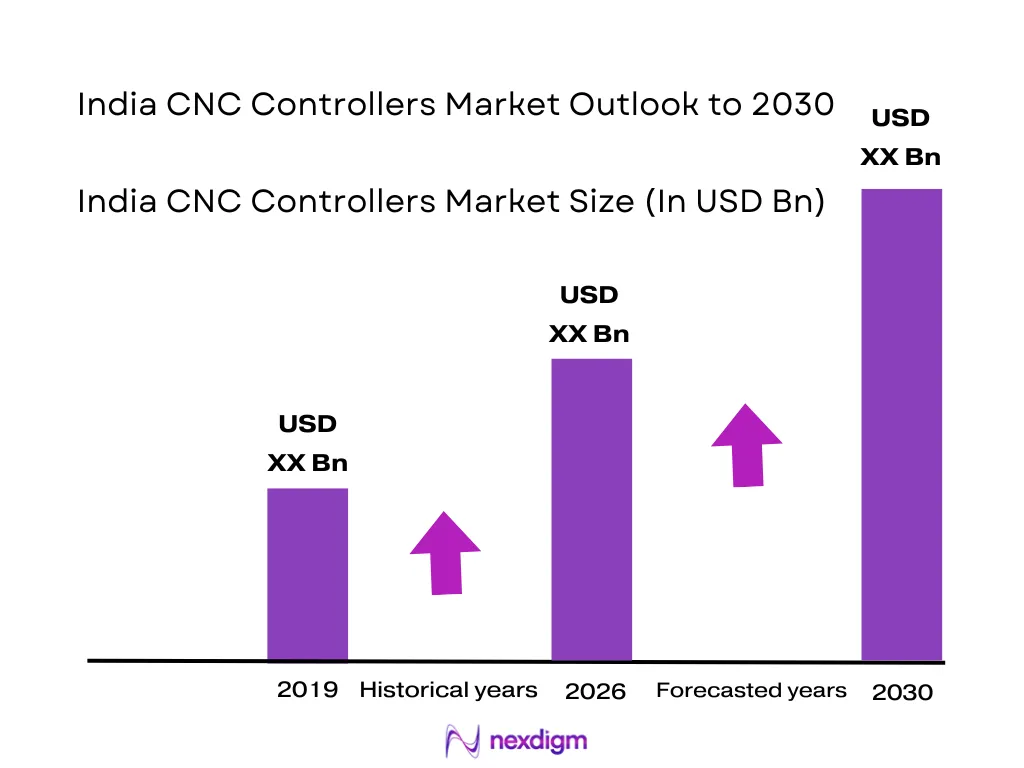
The India CNC Controllers Market is supported by increasing industrial automation investments, smart manufacturing adoption, and growing deployment of precision machining systems across automotive, aerospace, electronics, semiconductor, packaging machinery, and heavy engineering industries. India’s manufacturing Gross Value Added exceeded INR 27.5 trillion during FY2024 according to the Ministry of Statistics and Programme Implementation, while engineering goods exports crossed USD 109 billion according to EEPC India. Rising deployment of CNC-enabled machining centers, servo systems, and industrial motion control platforms across OEM facilities is strengthening demand for advanced CNC controllers. Expanding localization initiatives and Industry 4.0 integration are further accelerating hardware, software, and aftermarket service adoption across India’s manufacturing ecosystem. The India CNC Controllers Market is valued at approximately USD ~ million based on industrial automation revenues, machine tool production analysis, and CNC controller integration trends across organized manufacturing sectors.
Cities and industrial regions such as Pune, Bengaluru, Chennai, Rajkot, Ahmedabad, Faridabad, Coimbatore, and Sanand dominate the India CNC Controllers Market due to their concentration of automotive OEMs, machine tool manufacturers, aerospace suppliers, electronics manufacturing facilities, and industrial automation clusters. Maharashtra and Tamil Nadu remain leading markets because of strong automotive and precision engineering production ecosystems, while Gujarat continues witnessing expansion in heavy engineering and semiconductor investments. Karnataka benefits from electronics manufacturing and industrial software integration capabilities. Northern industrial corridors support demand from HVAC, packaging machinery, and metal fabrication industries. These regions collectively drive machine tool consumption, factory automation investments, and CNC retrofitting activities across India’s industrial infrastructure. \
Market Segmentation
By Controller Type
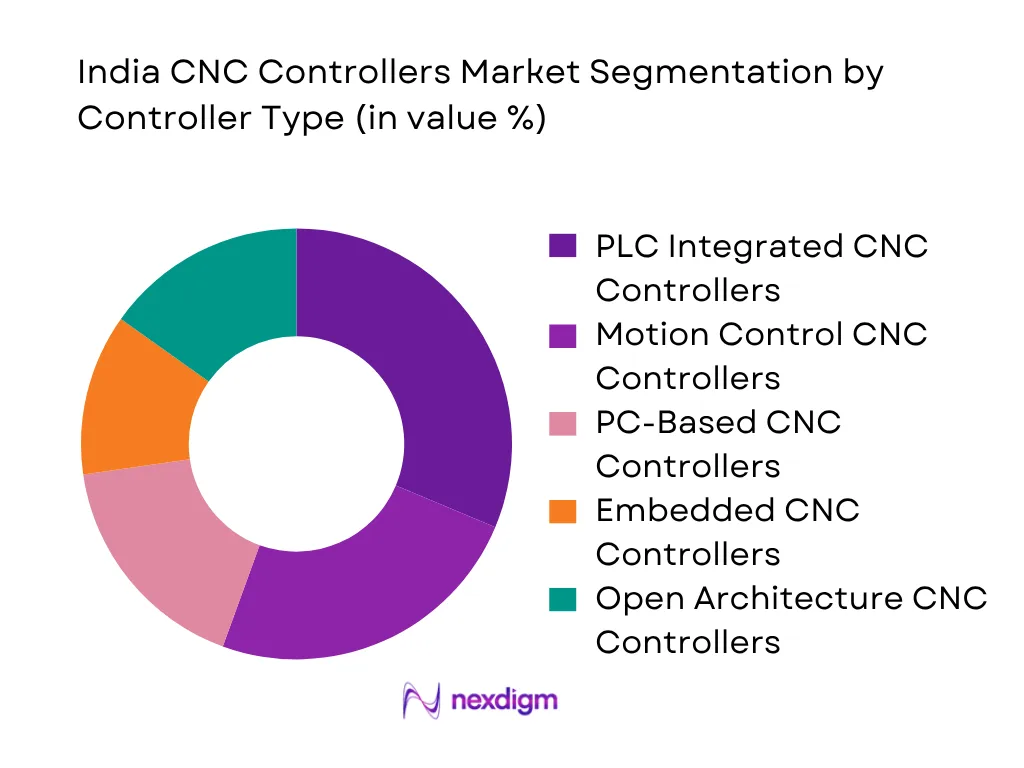
The India CNC Controllers Market is segmented by controller type into PLC Integrated CNC Controllers, Motion Control CNC Controllers, PC-Based CNC Controllers, Embedded CNC Controllers, Open Architecture CNC Controllers, and Closed Architecture CNC Controllers. PLC Integrated CNC Controllers dominate the India CNC Controllers Market because they provide superior synchronization between machine operations, programmable logic systems, and industrial automation networks. These systems are extensively used across automotive manufacturing, machine tools, packaging machinery, semiconductor fabrication, and material handling industries where high precision, operational efficiency, and real-time diagnostics are critical. Manufacturers increasingly prefer integrated controller architectures due to reduced downtime, simplified machine integration, and compatibility with Industry 4.0-enabled production environments. Additionally, increasing deployment of connected manufacturing systems and industrial IoT infrastructure across Indian factories is accelerating demand for intelligent PLC-integrated CNC platforms capable of supporting predictive maintenance and cloud-based machine monitoring.
By End-Use Industry
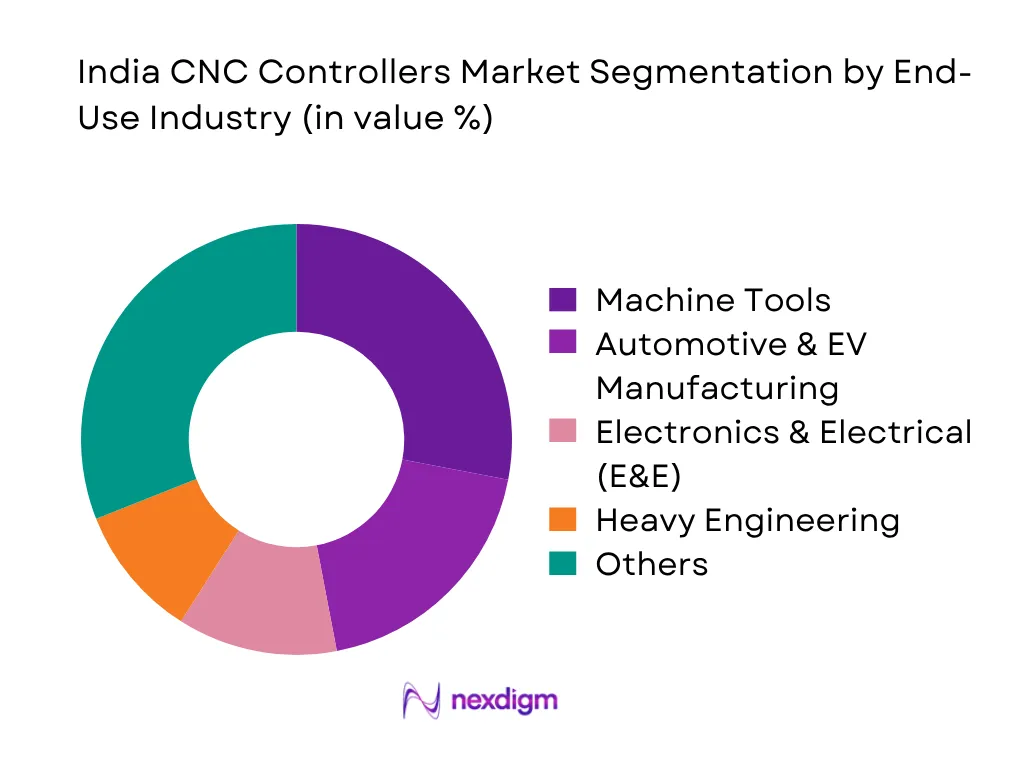
The India CNC Controllers Market is segmented by end-use industry into Machine Tools, Automotive and EV Manufacturing, Electronics & Electrical (E&E), Aerospace & Defense, Packaging Machinery, Plastics Processing, Textile Machinery, Pharmaceuticals, Food & Beverage Processing, HVAC Equipment Manufacturing, Semiconductor Manufacturing, and Heavy Engineering. Machine Tools dominate the India CNC Controllers Market due to increasing deployment of CNC-enabled machining centers, lathes, grinders, and precision cutting systems across industrial manufacturing facilities. India’s expanding engineering exports, rising precision manufacturing requirements, and increasing industrial automation penetration are driving machine tool modernization across organized and MSME sectors. Automotive component manufacturing, aerospace machining, semiconductor tooling, and electronics fabrication industries continue investing in high-speed multi-axis machining infrastructure integrated with advanced CNC controllers. The strong concentration of machine tool production clusters in Pune, Rajkot, Bengaluru, and Coimbatore further strengthens segment dominance through localized manufacturing ecosystems and increasing factory automation investments.
Competitive Landscape
The India CNC Controllers Market is moderately consolidated with the presence of global industrial automation companies and select domestic machine tool manufacturers competing through technology innovation, OEM partnerships, localization strategies, software integration capabilities, and aftermarket service networks. Market participants are increasingly focusing on Industry 4.0 integration, predictive maintenance platforms, AI-based diagnostics, and cloud-connected CNC ecosystems to strengthen competitive positioning across automotive, aerospace, semiconductor, electronics, and machine tool industries. Localization initiatives and smart manufacturing adoption are further intensifying competition among automation vendors operating across India’s industrial corridors and manufacturing clusters.
| Company | Establishment Year | Headquarters | CNC Controller Portfolio | OEM Partnerships | Industrial Vertical Focus | Localization Capability | Industry 4.0 Readiness | Aftermarket Service Network |
| Siemens AG | 1847 | Germany | ~ | ~ | ~ | ~ | ~ | ~ |
| FANUC Corporation | 1956 | Japan | ~ | ~ | ~ | ~ | ~ | ~ |
| Mitsubishi Electric Corporation | 1921 | Japan | ~ | ~ | ~ | ~ | ~ | ~ |
| Bosch Rexroth AG | 2001 | Germany | ~ | ~ | ~ | ~ | ~ | ~ |
| Bharat Fritz Werner Limited | 1961 | India | ~ | ~ | ~ | ~ | ~ | ~ |
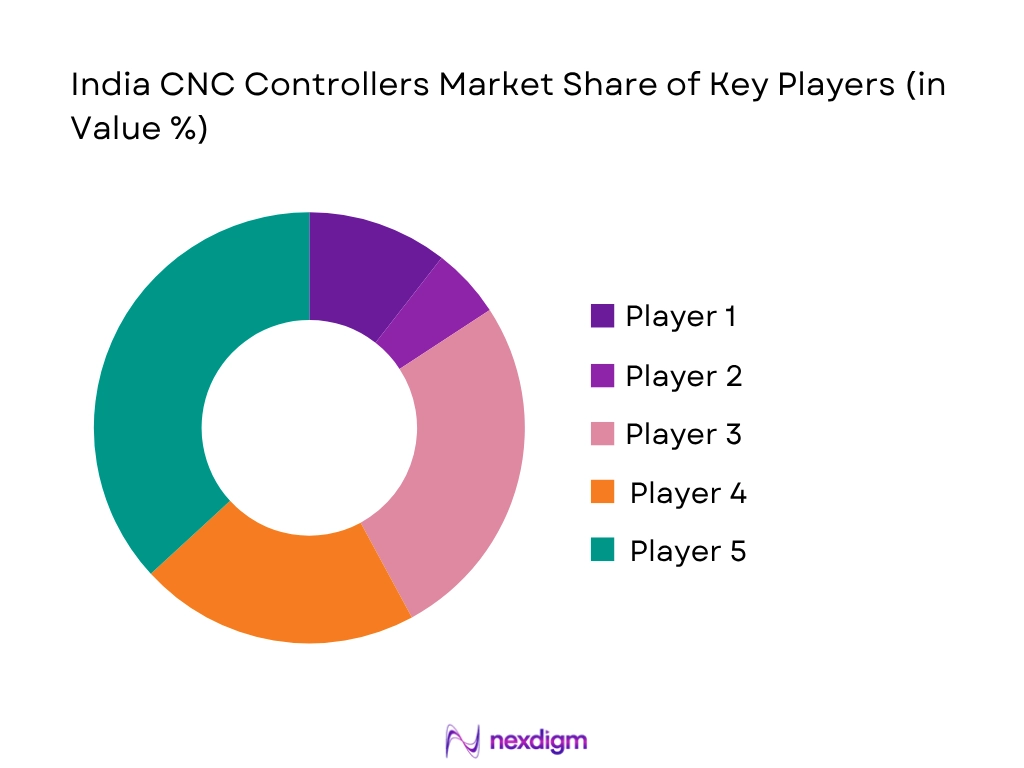
India CNC Controllers Market Analysis
Growth Drivers
Rising Industrial Automation and Manufacturing Output
India’s manufacturing expansion is significantly driving demand for CNC controllers across machine tools, automotive, aerospace, electronics, packaging machinery, and heavy engineering industries. According to the Ministry of Statistics and Programme Implementation, manufacturing Gross Value Added exceeded INR 27.5 trillion during FY2024, while the Index of Industrial Production for manufacturing recorded growth of 5.5 during the same period. Engineering goods exports crossed USD 109 billion according to EEPC India, strengthening demand for precision machining systems integrated with advanced CNC controllers. Automotive production exceeded 28 million vehicles during FY2024 according to SIAM, accelerating deployment of multi-axis machining centers and industrial motion control systems across OEM production facilities and component manufacturing units.
Expansion of Electronics, Semiconductor and EV Manufacturing
The rapid expansion of India’s electronics manufacturing and EV ecosystem is accelerating deployment of advanced CNC controllers used in precision machining, semiconductor tooling, PCB fabrication, and battery component manufacturing. According to MeitY, India’s electronics production exceeded USD 115 billion during FY2024, while smartphone exports crossed USD 15 billion. The Ministry of Heavy Industries approved investments exceeding INR 18,000 crore under the automobile and auto component PLI scheme, strengthening demand for advanced manufacturing equipment. EV registrations exceeded 1.67 million units during FY2024 according to VAHAN statistics, increasing installations of CNC-enabled machining systems used for drivetrain, motor housing, and battery enclosure production across industrial manufacturing clusters.
Market Challenges
High Import Dependency for Advanced CNC Components
India’s CNC controllers ecosystem continues to depend heavily on imported industrial semiconductors, servo systems, precision drives, and communication modules. According to the Ministry of Commerce and Industry, India imported electronic components worth more than USD 72 billion during FY2024, including industrial electronics and automation systems. Dependence on imports from East Asia and Europe exposes manufacturers to supply chain disruptions, lead-time volatility, and currency fluctuations. Limited domestic production of high-performance industrial processors and advanced semiconductor systems also restricts localization of next-generation CNC control architectures and advanced automation infrastructure within India’s manufacturing ecosystem.
Shortage of Skilled Automation Workforce
The shortage of skilled CNC programmers, mechatronics engineers, and industrial automation specialists remains a major challenge for the India CNC Controllers Market. According to the India Skills Report 2024, only 51.25 of graduates were considered employable for industry-specific technical roles. The Ministry of Skill Development and Entrepreneurship also highlighted increasing demand for advanced manufacturing talent capable of operating smart factories and Industry 4.0-enabled systems. MSMEs particularly face operational difficulties in deploying advanced CNC systems due to limited availability of skilled operators capable of machine calibration, predictive diagnostics, industrial software integration, and connected manufacturing operations.
Market Opportunities
Localization Initiatives and Make in India Expansion
India’s localization initiatives and manufacturing incentives are creating substantial opportunities for domestic CNC controller production and industrial automation assembly. According to DPIIT, cumulative FDI inflows into manufacturing exceeded USD 165 billion between 2022 and 2024. Production Linked Incentive schemes across automotive, electronics, and semiconductors exceeded INR 1.97 trillion in allocation, supporting industrial infrastructure expansion and localized automation manufacturing. Industrial corridors including DMIC and Chennai-Bengaluru Industrial Corridor are accelerating establishment of new factories requiring CNC-enabled machining systems, industrial motion controllers, and automation software solutions tailored for Indian manufacturing operations.
Growing Smart Factory Adoption and Industry 4.0 Integration
Increasing adoption of smart manufacturing technologies presents major growth opportunities for CNC controller vendors offering IIoT integration, predictive maintenance, digital twin capabilities, and cloud-connected machine monitoring systems. According to the International Federation of Robotics, India recorded more than 8,500 industrial robot installations during 2023 across automotive, electronics, and engineering sectors. NITI Aayog also identified industrial digitalization as a critical component of India’s manufacturing competitiveness roadmap. Semiconductor fabrication projects, electronics assembly plants, and aerospace machining facilities are increasingly deploying connected CNC ecosystems integrated with industrial analytics, AI-based diagnostics, and factory-wide automation infrastructure.
Future Outlook
The India CNC Controllers Market is expected to witness strong expansion over the coming years due to increasing industrial automation investments, semiconductor manufacturing growth, EV production expansion, and rising penetration of Industry 4.0 technologies across Indian factories. Manufacturers are expected to focus on AI-enabled CNC systems, predictive maintenance platforms, open architecture controllers, and cloud-connected machining ecosystems to improve operational efficiency and production precision. Increasing localization initiatives under Make in India and Production Linked Incentive schemes are likely to strengthen domestic manufacturing of industrial automation equipment and precision electronics. The expansion of aerospace, electronics, automotive, and semiconductor manufacturing clusters is expected to accelerate demand for multi-axis CNC systems, intelligent motion control platforms, and integrated factory automation solutions across India’s industrial ecosystem.
Major Players
- Siemens AG
- FANUC Corporation
- Mitsubishi Electric Corporation
- Yaskawa Electric Corporation
- Bosch Rexroth AG
- Heidenhain GmbH
- Schneider Electric
- Delta Electronics
- Omron Corporation
- Beckhoff Automation
- Fagor Automation
- Haas Automation
- HNC Electric
- GSK CNC Equipment
- Bharat Fritz Werner Limited
Key Target Audience
- Industrial Automation Manufacturers
- Machine Tool OEMs and Precision Engineering Companies
- Automotive and EV Manufacturers
- Semiconductor and Electronics Manufacturing Companies
- Industrial System Integrators and Smart Factory Providers
- Investments and Venture Capitalist Firms
- Government and Regulatory Bodies
- Industrial Component and Motion Control Suppliers
Research Methodology
Step 1: Identification of Key Variables
The initial phase involved identifying critical variables influencing the India CNC Controllers Market, including machine tool production, industrial automation penetration, semiconductor investments, OEM partnerships, localization trends, and Industry 4.0 adoption. Extensive secondary research was conducted using industrial databases, trade publications, government statistics, and industrial automation reports to map the ecosystem and value chain.
Step 2: Market Analysis and Construction
Historical market analysis was conducted using shipment volumes, installed base assessments, industrial automation spending, import-export trade data, and machine tool consumption trends across India. Revenue estimations were derived through bottom-up calculations covering hardware, software, and aftermarket service revenues associated with CNC controller deployments across manufacturing industries.
Step 3: Hypothesis Validation and Expert Consultation
The preliminary findings were validated through interviews with machine tool manufacturers, CNC controller suppliers, industrial automation experts, OEM procurement teams, and system integrators. These interactions provided operational insights regarding product demand, localization capabilities, technology adoption trends, and industrial automation requirements across key end-use industries.
Step 4: Research Synthesis and Final Output
The final stage involved consolidation and triangulation of qualitative and quantitative findings to develop a comprehensive market assessment. Cross-validation was conducted using industrial trade statistics, government manufacturing data, automation infrastructure analysis, and company disclosures to ensure reliability and consistency of market estimates and strategic opportunity mapping.

- Executive Summary
- Research Methodology (Market Definitions and Assumptions, Abbreviations, Research Framework, Bottom-Up Market Estimation, Top-Down Validation, OEM Revenue Benchmarking, Installed Base Analysis, Import-Export Trade Assessment, Automation Penetration Mapping, Primary Interviews with OEMs and System Integrators, Forecasting Model, Limitations and Assumptions)

- Definition and Scope
- Evolution of CNC Automation in India
- Industry Ecosystem and Stakeholder Mapping
- Supply Chain and Value Chain Analysis
- Industrial Automation Infrastructure Assessment

- Growth Drivers
Rising Industrial Automation and Manufacturing Output
Expansion of Electronics, Semiconductor and EV Manufacturing
Growth in Smart Factory and Industry 4.0 Adoption
Increasing Precision Engineering Demand
Expansion of Machine Tool Manufacturing Ecosystem - Market Challenges
High Import Dependency for Advanced CNC Components
Shortage of Skilled Automation Workforce
Supply Chain Volatility in Industrial Electronics
High Integration Cost for MSMEs
Cybersecurity Risks in Connected Manufacturing - Market Opportunities
Localization Initiatives and Make in India Expansion
Growing Smart Factory Adoption and IIoT Integration
Expansion of Semiconductor Manufacturing Infrastructure
Increasing Demand for Predictive Maintenance Solutions
Growth in Multi-Axis CNC Machining Applications - Market Trends
AI-Based CNC Programming and Toolpath Optimization
Digital Twin Integration in Manufacturing
Remote Monitoring and Diagnostics Adoption
Cloud-Connected CNC Platforms
Open Architecture CNC Controller Adoption - Government Regulations
Make in India Manufacturing Policies
PLI Scheme for Electronics and Automotive Manufacturing
Industrial Automation and MSME Digitization Programs
BIS Industrial Electronics Standards
Import Tariffs and Localization Incentives - Porter’s Five Forces Analysis
- PESTLE Analysis
- Pricing Analysis
- Competition Ecosystem

- By Revenue, 2020-2025
- By Shipment Volume, 2020-2025
- By Installed Base, 2020-2025
- By Average Selling Price, 2020-2025

- By Controller Type (in Value %)
Axis Synchronization Capability
Precision Tolerance
Industrial Connectivity
Processing Speed - By Machine Type (in Value %)
Machine Utilization Rate
Machining Precision
Factory Automation Integration
Operating Efficiency - By Component Type (in Value %)
Hardware Localization
Software Integration Capability
Aftermarket Service Penetration
Industrial Compatibility - By End-Use Industry (in Value %)
Automation Penetration
Machine Density
Production Throughput
Capex Allocation - By Sales Channel (in Value %)
OEM Partnerships
Distributor Reach
Technical Support Capability
Inventory Availability - By Region (in Value %)
Pune Metropolitan Region
Bengaluru Urban Region
Chennai Industrial Region
Ahmedabad–Sanand Industrial Belt
Rajkot Engineering Cluster
Delhi NCR–Faridabad Industrial Belt

- Market Share Analysis of Major Players on the Basis of Revenue and Shipment Volume
- Cross Comparison Parameters (Company Overview, CNC Controller Portfolio, Axis Capability, Open Architecture Offering, Industrial Vertical Focus, Installed Base, Localization Capability, OEM Partnerships, Manufacturing Facilities, Distribution Reach, Software Integration Capability, Aftermarket Services, Industry 4.0 Readiness, Product Innovation, Strategic Collaborations, EBITDA Margins)
- Competitive Benchmarking Matrix
- SWOT Analysis of Major Players
- Pricing Analysis by Controller Type and Axis Configuration
- Detailed Profiles of Major Companies
Siemens AG
FANUC Corporation
Mitsubishi Electric Corporation
Yaskawa Electric Corporation
Bosch Rexroth AG
Heidenhain GmbH
Schneider Electric
Delta Electronics
Omron Corporation
Beckhoff Automation
Fagor Automation
Haas Automation
HNC Electric
GSK CNC Equipment
Bharat Fritz Werner Limited

- Factory Automation Adoption Analysis
- OEM Procurement and Vendor Selection
- Industrial Capex and Spending Analysis
- Machine Replacement and Retrofit Trends
- Production Efficiency and Downtime Mapping

- By Revenue, 2026-2030
- By Shipment Volume, 2026-2030
- By Installed Base, 2026-2030
- By Average Selling Price, 2026-2030


 Request a Sample
 Ask for Customization
 Get a Quote
 Enquire Now