

 Download PDF
Market Overview
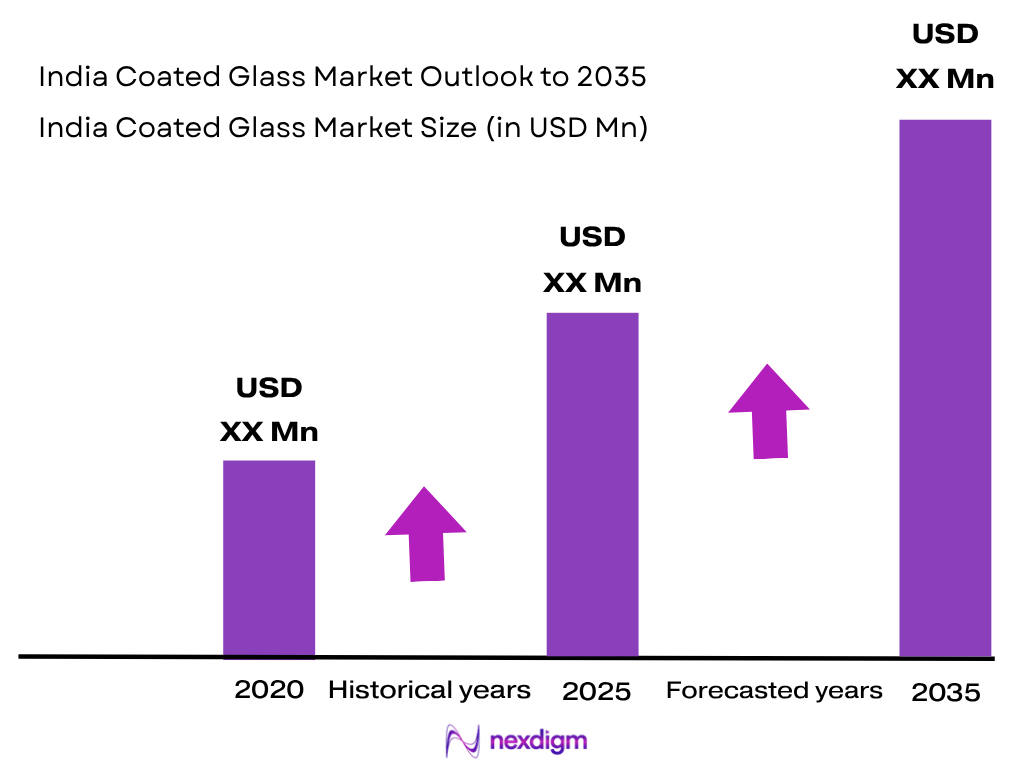
The India coated glass market is valued at approximately ~USD XX million in 2024, based on analysis of architectural glazing demand, automotive applications, and energy-efficient building material consumption. The market has expanded from ~USD XX million in 2023, supported by increasing adoption of solar control glass, low-E glazing systems, and advanced façade solutions. According to industry data from the Ministry of Statistics and Programme Implementation (MoSPI), India’s construction sector continued expansion with infrastructure investment and urban development activities supporting demand for advanced building materials. Growth is driven by commercial real estate development, green buildings, data centers, and premium residential projects requiring improved thermal performance.
The India coated glass market is concentrated across major urban and industrial regions including Delhi NCR, Mumbai, Bengaluru, Chennai, Hyderabad, Pune, and Ahmedabad due to their strong commercial construction activity, IT infrastructure development, automotive manufacturing ecosystem, and premium real estate projects. Delhi NCR and Mumbai represent major demand centers due to extensive high-rise construction, corporate office developments, and large-scale commercial complexes. Bengaluru and Hyderabad contribute significantly through IT parks and data center construction, while Chennai and Pune support automotive manufacturing demand. Gujarat and Maharashtra also play important roles due to industrial expansion, manufacturing facilities, and infrastructure investments.
Market Segmentation
By Product Type
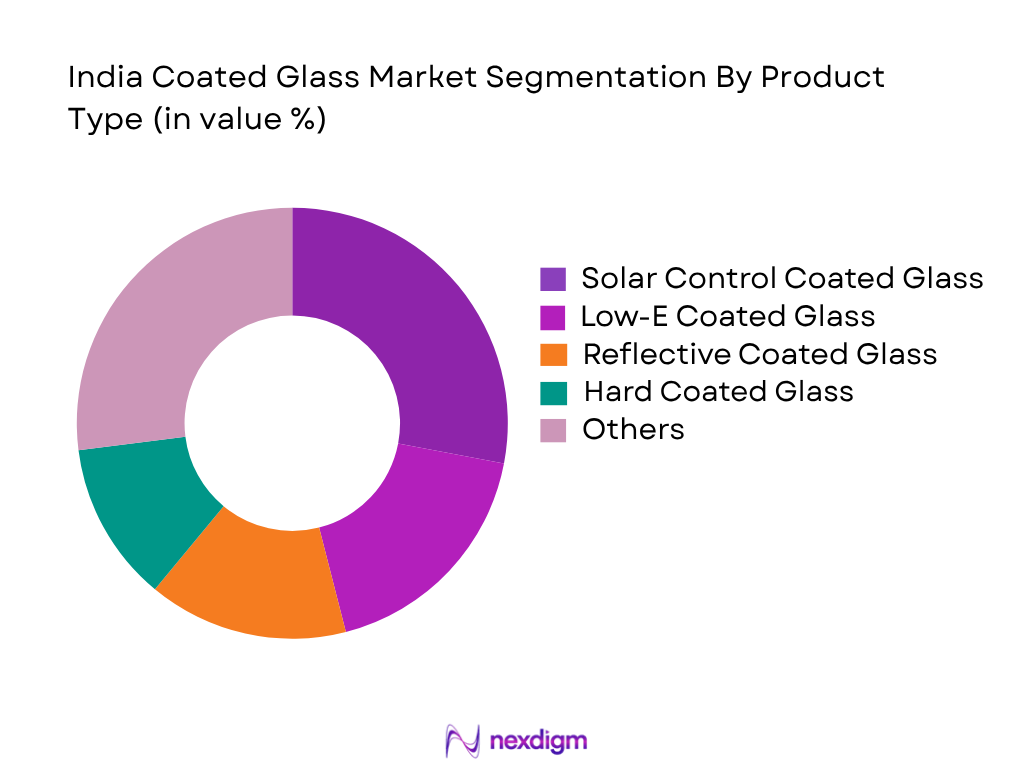
India coated glass market is segmented by product type into solar control coated glass, low-E coated glass, reflective coated glass, hard coated glass, soft coated glass, anti-reflective coated glass, self-cleaning coated glass, and smart coated glass. Solar control coated glass holds the dominant market share within the product type segmentation in India due to its extensive application in commercial buildings, office complexes, airports, hotels, and high-rise residential developments. The segment is preferred because it reduces solar heat gain, improves indoor comfort, and supports energy efficiency requirements in buildings. Increasing temperatures across Indian cities and rising demand for reduced cooling loads have encouraged architects and developers to adopt solar control glazing solutions. Government initiatives promoting energy-efficient buildings through the Energy Conservation Building Code (ECBC) have further supported adoption. Although low-E coated glass is gaining demand due to thermal insulation benefits, solar control glass remains widely used because of its suitability for India’s climatic conditions.
By Application
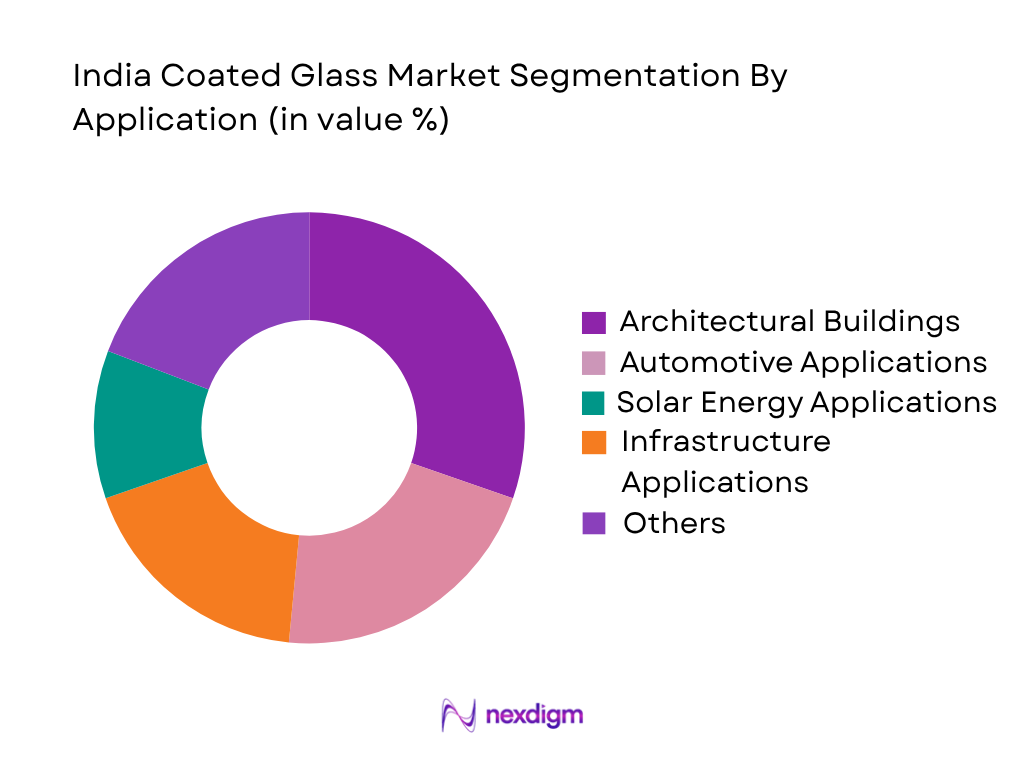
India coated glass market is segmented by application into architectural buildings, automotive, solar energy, infrastructure, industrial facilities, and specialty applications. Architectural applications account for the leading market share under the application segmentation in India due to increasing demand for energy-efficient façades, commercial buildings, and premium residential developments. Coated glass is extensively used in curtain walls, windows, façades, skylights, and building envelopes because of its ability to improve thermal performance and enhance aesthetic appeal. Growth of commercial real estate, IT parks, airports, metro infrastructure, and green-certified buildings has accelerated adoption of coated glazing systems. The expansion of data centers in India is also increasing demand for energy-efficient building materials that support cooling efficiency. Automotive and solar applications are emerging growth areas, but architectural construction remains the primary demand contributor due to large-scale urban development and infrastructure modernization.
Competitive Landscape
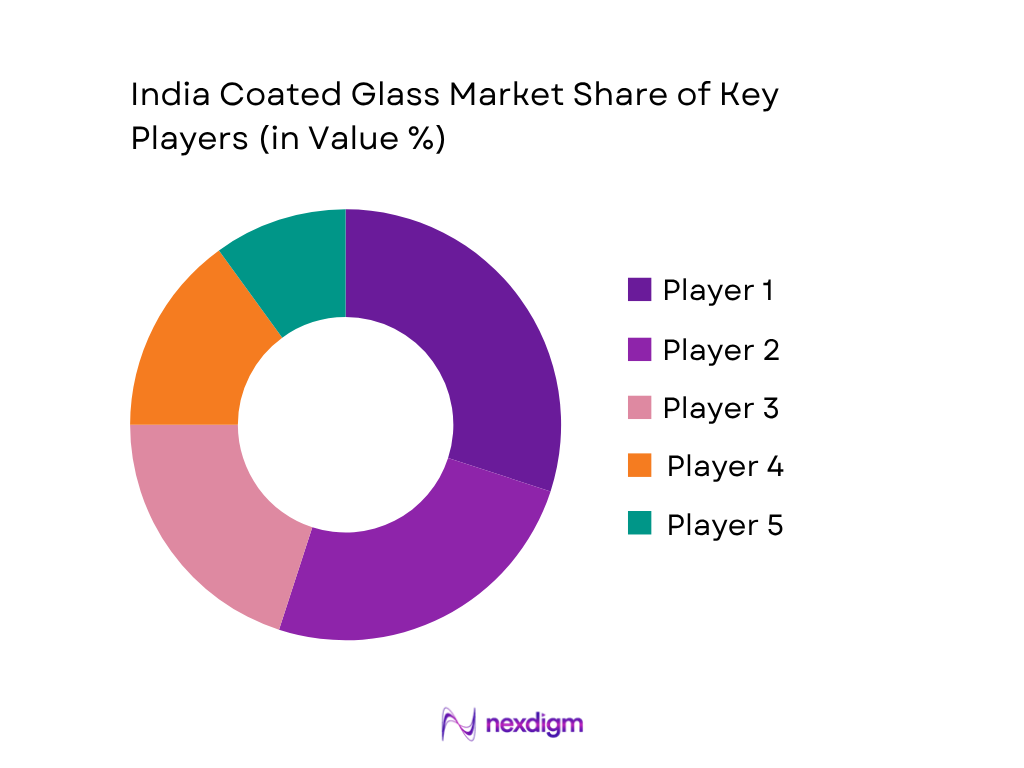
The India coated glass market is moderately consolidated with participation from global glass manufacturers, domestic producers, and specialized glass processors. Companies compete based on coating technology, manufacturing capacity, product performance, project approvals, distribution networks, and relationships with architects, developers, and automotive manufacturers. Major players are investing in advanced coating facilities, low-E glass production, and energy-efficient glazing technologies to capture demand from commercial construction, infrastructure, and automotive industries.
| Company | Establishment Year | Headquarters | Coated Glass Product Portfolio | Manufacturing Capability | Key Application Presence | Coating Technology Capability | Distribution Network | Sustainability Focus |
| Saint-Gobain India | 1665 | Paris, France | ~ | ~ | ~ | ~ | ~ | ~ |
| Asahi India Glass Limited (AIS) | 1984 | Gurugram, India | ~ | ~ | ~ | ~ | ~ | ~ |
| AGC Glass India | 1907 | Tokyo, Japan | ~ | ~ | ~ | ~ | ~ | ~ |
| Gold Plus Glass Industry Limited | 1995 | New Delhi, India | ~ | ~ | ~ | ~ | ~ | ~ |
| Guardian Industries | 1932 | Michigan, USA | ~ | ~ | ~ | ~ | ~ | ~ |
India Coated Glass Market Analysis
Growth Drivers
Expansion of Green Buildings and Energy Efficient Construction Demand
The increasing adoption of energy-efficient building practices is a major growth driver for the India coated glass market, as coated glass is widely used in façades, windows, curtain walls, and building envelopes to reduce solar heat gain and improve indoor thermal comfort. India’s construction sector continues to expand with infrastructure and real estate development contributing significantly to economic activity. According to the World Bank, India’s GDP reached approximately USD 3.89 trillion in 2024, supported by urbanization, infrastructure investment, and industrial development. The Ministry of Statistics and Programme Implementation (MoSPI) reported continued growth in construction-related activities, strengthening demand for advanced building materials. The Bureau of Energy Efficiency (BEE) implemented the Energy Conservation Building Code (ECBC), encouraging adoption of efficient glazing systems in commercial buildings. India added more than 2,000 registered green building projects covering over 2.8 billion square feet of built-up area, according to the Indian Green Building Council (IGBC), creating demand for solar control glass and low-E coated glass solutions. Increasing development of office complexes, IT parks, airports, and premium residential towers is accelerating the requirement for high-performance coated glazing systems.
Growth of Commercial Real Estate, Data Centers, and Premium Architectural Infrastructure
The expansion of commercial real estate and digital infrastructure is supporting demand for coated glass solutions in India due to requirements for energy management, aesthetics, and advanced façade performance. India’s services sector remains a major contributor to economic activity, with the World Bank reporting continued expansion of service-based industries supporting demand for office infrastructure. The Ministry of Commerce and Industry recorded India’s services exports at approximately USD 341 billion in 2024, reflecting growth in technology-driven sectors that require office spaces and data infrastructure. The demand for coated glass is increasing in IT parks, corporate campuses, airports, hotels, and data centers where thermal control and natural lighting efficiency are critical. India’s data center capacity exceeded 1,000 MW in 2024, according to industry infrastructure assessments, increasing demand for efficient building materials that support cooling optimization. Cities including Bengaluru, Hyderabad, Mumbai, Chennai, and Delhi NCR are witnessing increased development of premium commercial facilities, creating opportunities for solar control coated glass, low-E glass, and advanced façade glazing systems.
Market Challenges
High Dependence on Imported Advanced Coating Technologies and Specialty Glass Inputs
The India coated glass market faces challenges due to dependence on imported advanced coating technologies, specialized equipment, and certain high-performance glass inputs required for manufacturing premium products. While domestic glass manufacturers have expanded production capabilities, advanced solutions such as soft-coated low-E glass, multifunctional coatings, and smart glazing technologies require sophisticated coating lines and technology partnerships. India’s merchandise trade structure indicates significant dependence on imported industrial machinery and specialized manufacturing equipment, with the Ministry of Commerce and Industry reporting total merchandise imports exceeding USD 700 billion in 2024. The coated glass industry requires advanced magnetron sputtering systems, coating materials, and precision manufacturing technologies that involve substantial technical expertise. According to the Department for Promotion of Industry and Internal Trade (DPIIT), India continues to encourage domestic manufacturing through industrial investment initiatives, but certain high-value technology segments remain dependent on global suppliers. This dependence can affect technology adoption speed, production flexibility, and availability of advanced coated glass products for premium architectural and specialty applications.
Limited Adoption in Price-Sensitive Construction Segments
The India coated glass market faces adoption challenges in price-sensitive construction segments due to higher technical requirements and limited awareness regarding long-term energy efficiency benefits. Although coated glass provides advantages such as reduced cooling requirements, improved comfort, and enhanced building performance, many residential and mid-scale construction projects continue to prioritize initial material costs. India’s urban housing demand remains significant, with the Ministry of Housing and Urban Affairs highlighting continued expansion of urban infrastructure requirements across cities. The country’s urban population exceeded 500 million people in 2024, according to World Bank demographic indicators, increasing demand for affordable residential and commercial development. Developers operating in cost-sensitive segments often select conventional glazing solutions due to budget considerations. Additionally, the adoption of coated glass requires coordination among architects, façade consultants, developers, and contractors to ensure correct specification and installation. Limited technical awareness among smaller developers and contractors can restrict wider penetration of advanced coated glass products beyond premium construction projects.
Market Opportunities
Increasing Demand for Low-E Glass and Sustainable Building Envelope Solutions
The growing focus on sustainable buildings and energy conservation creates opportunities for coated glass manufacturers to expand low-E glass and advanced glazing solutions in India. Low-E coated glass helps reduce heat transfer, improve indoor comfort, and support energy-efficient building designs. India’s Energy Conservation Building Code (ECBC) framework promotes efficient building materials and performance-based construction practices, encouraging adoption of advanced glazing technologies. According to the Bureau of Energy Efficiency, the ECBC applies to commercial buildings with connected loads of 100 kW or more or contract demand of 120 kVA or more, creating a significant addressable segment for energy-efficient materials. The Indian Green Building Council reported continued growth in certified sustainable buildings, with registered green projects exceeding 2.8 billion square feet, supporting demand for performance-oriented glass solutions. Expansion of corporate offices, IT parks, airports, and premium residential projects is increasing requirements for solar control and low-E coated glass. Manufacturers can benefit by developing customized glazing systems aligned with regional climate conditions and building energy requirements.
Growth Potential from Electric Vehicles, Automotive Glazing, and Advanced Mobility Applications
The expansion of electric vehicles and advanced automotive manufacturing presents new opportunities for coated glass suppliers in India. Automotive manufacturers are increasingly adopting advanced glass solutions that improve thermal comfort, reduce vehicle weight, and enhance passenger experience. According to the Ministry of Heavy Industries, India’s electric vehicle ecosystem has expanded through government-supported initiatives including the Faster Adoption and Manufacturing of Electric Vehicles (FAME) program. The Ministry of Road Transport and Highways recorded continued growth in electric vehicle registrations, with total EV registrations crossing 5 million vehicles by 2024, strengthening demand for specialized automotive components. Coated automotive glass technologies, including solar control glazing and infrared-reflective coatings, can improve cabin temperature management and energy efficiency in electric vehicles. India’s automobile production ecosystem, supported by manufacturers in Tamil Nadu, Maharashtra, Gujarat, and Haryana, provides opportunities for coated glass suppliers to collaborate with OEMs and component manufacturers. The increasing focus on premium vehicles and EV adoption is expected to encourage greater integration of advanced coated glass technologies in automotive applications.
Future Outlook
Over the next decade, the India coated glass market is expected to witness significant growth driven by increasing green building adoption, expansion of commercial infrastructure, rising demand for energy-efficient façades, and growth of premium architectural projects. The market will benefit from increasing implementation of energy conservation standards, development of smart buildings, and rising investments in data centers and industrial infrastructure. Advancements in low-E coatings, solar control technologies, and smart glazing solutions are expected to create new growth opportunities. The India coated glass market is projected to grow at a CAGR of approximately ~XX% during 2026-2035.
Major Players
- Saint-Gobain India
- AGC Glass India
- Asahi India Glass Limited (AIS)
- Gold Plus Glass Industry Limited
- Guardian Industries
- NSG Group
- Sisecam
- Xinyi Glass Holdings Limited
- Vitro
- Taiwan Glass Industry Corporation
- Kibing Group
- Fuyao Glass Industry Group
- China Glass Holdings
- Kochhar Glass India
- SCHOTT AG
Key Target Audience
- Architectural Glass Manufacturers and Coated Glass Processing Companies
- Real Estate Developers and Construction Companies
- Automotive OEMs and Automotive Glass Suppliers
- Façade Engineering Companies and Building Material Suppliers
- Investments and Venture Capitalist Firms (Khazanah Nasional Berhad, Temasek Holdings, Blackstone)
- Government and Regulatory Bodies (Bureau of Energy Efficiency, Ministry of Housing and Urban Affairs, Bureau of Indian Standards, Ministry of Road Transport and Highways)
- Infrastructure Development Companies and Public Project Contractors
- Solar Energy Developers and Renewable Energy Companies
Research Methodology
Step 1: Identification of Key Variables
The initial phase involves developing an ecosystem map covering coated glass manufacturers, raw material suppliers, glass processors, construction developers, automotive companies, and end users. Extensive secondary research is conducted through industry databases, government publications, company reports, trade information, and regulatory sources. The objective is to identify key variables influencing market demand, supply structure, technology adoption, and application growth.
Step 2: Market Analysis and Construction
This phase involves analyzing historical and current information related to coated glass production, consumption patterns, application demand, manufacturing capacity, imports, and technology adoption. The assessment covers architectural, automotive, solar, and infrastructure applications to understand demand contribution. Market estimation is developed through supply-side evaluation and application-level consumption analysis.
Step 3: Hypothesis Validation and Expert Consultation
Market assumptions are validated through discussions with manufacturers, glass processors, architects, façade contractors, automotive suppliers, and industry participants. These consultations provide insights into product preferences, coating technology adoption, customer requirements, and competitive positioning. Expert inputs are incorporated to refine market understanding and validate industry trends.
Step 4: Research Synthesis and Final Output
The final phase integrates primary and secondary research findings to develop a comprehensive assessment of the India coated glass market. Industry insights are cross-verified with construction trends, manufacturing developments, application demand, and regulatory factors. The final analysis provides detailed market insights, competitive assessment, and future growth opportunities.

- Executive Summary
- Research Methodology (Market Definition and Scope, India Coated Glass Market Classification, Architectural Coated Glass Demand Assessment, Solar Control Coated Glass Consumption Mapping, Low-E Coated Glass Adoption Analysis, Commercial Building Energy Efficient Glazing Assessment, Residential Green Building Glass Requirement Analysis, High-Rise Façade Coated Glass Demand Mapping, Automotive Coated Glass Application Assessment, Solar Photovoltaic Glass Coating Demand Analysis, Domestic Glass Coating and Processing Capacity Assessment, Float Glass Manufacturing Ecosystem Analysis, Import Dependency Analysis, Magnetron Sputter Vacuum Deposition and Pyrolytic Coating Technology Assessment)

- Definition and Scope
- India Coated Glass Industry Evolution and Development
- India Coated Glass Value Chain Analysis
- India Coated Glass Supply Chain Analysis
- Silica Sand Supplier, Soda Ash Supplier, Float Glass Manufacturer, Glass Coating Technology Provider, Sputter Coating Equipment Supplier, Glass Processor, Façade Contractor, Architectural Glass Fabricator, Automotive Glass Supplier, Construction Material Distributor
- Coated Glass Integration Across Commercial Buildings, IT Parks, Data Centers, Airports, Metro Infrastructure, Residential Towers, Automotive Manufacturing, Solar Energy Applications, Industrial Facilities and Institutional Buildings

- Growth Drivers (Expansion of Green Buildings, Increasing Demand for Energy Efficient Glazing, Growth of Commercial Real Estate Development, Rising High-Rise Construction Activities, Government Energy Conservation Initiatives, Increasing Automotive Manufacturing, Data Center Construction Growth, Infrastructure Modernization Projects, Demand for Premium Façade Systems)
- Market Challenges (High Investment Requirement for Coating Facilities, Limited Domestic Manufacturing of Advanced Coated Glass Products, Dependence on Imported Coating Equipment, High Energy Consumption in Manufacturing, Skilled Workforce Requirement, Price Sensitivity in Residential Construction, Limited Awareness of Long-Term Energy Savings)
- Market Opportunities (Growth of Green Building Projects, Increasing Low-E Glass Adoption, Expansion of Smart Glass Applications, Rising Data Center Construction, Electric Vehicle Manufacturing Growth, Premium Architectural Glazing Demand, Solar Energy Glass Coating Applications, Sustainable Building Material Adoption)
- Market Trends (Low-E Glass Adoption, Solar Heat Gain Reduction Solutions, Smart Glass Integration, Sustainable Building Envelope Development, Advanced Façade Engineering, Automated Glass Processing, Digital Building Design Integration, Premium Architectural Glass Demand, Energy Efficient Building Regulations, Advanced Coating Technology Development)
- Regulatory and Standards Landscape (Bureau of Energy Efficiency Energy Conservation Building Code, Indian Green Building Council Requirements, Bureau of Indian Standards Glass Standards, Automotive Safety Glass Regulations, Construction Quality Standards, Import Compliance Requirements, Environmental Regulations for Glass Manufacturing)
- SWOT Analysis
- Porter’s Five Forces Analysis
- PESTLE Analysis
- Stakeholder Ecosystem
- Competition Ecosystem

- By Market Value (2020-2025)
- By Coated Glass Consumption Volume (2020-2025)
- By Architectural Coated Glass Consumption Volume (2020-2025)
- By Solar Control Coated Glass Consumption Volume (2020-2025)
- By Low-E Coated Glass Consumption Volume (2020-2025)
- By Automotive Coated Glass Consumption Volume (2020-2025)
- By Solar Energy Coated Glass Consumption Volume (2020-2025)
- By Domestic Coated Glass Production Volume (2020-2025)
- By Coated Glass Import Value (2020-2025)
- By Average Selling Price (2020-2025)

- By Product Type (In Value %)
Solar Control Coated Glass
Low-E Coated Glass
Reflective Coated Glass
Hard Coated Glass
Soft Coated Glass
Anti-Reflective Coated Glass
Self-Cleaning Coated Glass
Hydrophobic Coated Glass
Decorative Coated Glass
Smart Coated Glass - By Coating Technology (In Value %)
Magnetron Sputter Vacuum Deposition (MSVD) Coating
Pyrolytic Coating Technology
Chemical Vapor Deposition (CVD) Coating
Online Coating Technology
Offline Coating Technology
Vacuum Coating Technology - By Application (In Value %)
Architectural Applications
Commercial Buildings
Corporate Offices
IT Parks and Data Centers
Shopping Malls
Hotels and Hospitality Buildings
High-Rise Residential Towers
Institutional Buildings
Industrial Facilities
Automotive Applications
Passenger Vehicles
Commercial Vehicles
Electric Vehicles
Automotive Windshields
Side and Rear Vehicle Glass
Solar Energy Applications
Photovoltaic Glass Applications
Solar Control Applications
Infrastructure Applications
Airports
Metro Stations
Railway Infrastructure
Government Buildings - By End-Use Industry (In Value %)
Construction and Real Estate
Automotive Manufacturing
Renewable Energy
Infrastructure Development
Commercial Real Estate
Hospitality Industry
Industrial Manufacturing
Institutional Buildings
Government Infrastructure Projects
Data Center Facilities - By Region (In Value %)
North India
Delhi NCR
Haryana
Uttar Pradesh
Punjab
West India
Maharashtra
Gujarat
Rajasthan
South India
Karnataka
Tamil Nadu
Telangana
Andhra Pradesh
East India
West Bengal
Odisha

- Market Share of Major Players (By India Revenue, Coated Glass Sales Volume, Solar Control Glass Sales Volume, Low-E Glass Sales Volume, Architectural Project Presence, Automotive Glass Supply Exposure, Manufacturing Capacity, Domestic Processing Network, Distribution Coverage)
- Cross Comparison Parameters (India Coated Glass Revenue, Solar Control and Low-E Product Portfolio Breadth, Coating Technology Capability, Domestic Manufacturing and Processing Capacity, High-Rise Façade Project Exposure, Automotive Coated Glass Supply Capability, Energy Efficient Glass Innovation Capability, Distribution and Technical Support Network)
- SWOT Analysis of Major Players
- Competitive Positioning Matrix
- Coated Glass Product Portfolio and Performance Benchmarking
- Detailed Profiles of Major Companies
Saint-Gobain India
AGC Glass India
Asahi India Glass Limited (AIS)
Gold Plus Glass Industry Limited
Guardian Industries
NSG Group
Sisecam
Xinyi Glass Holdings Limited
Vitro
Taiwan Glass Industry Corporation
Kibing Group
Fuyao Glass Industry Group
China Glass Holdings
Kochhar Glass India
SCHOTT AG

- Commercial Real Estate Developer Coated Glass Procurement Assessment
- High-Rise Residential Developer Energy Efficient Glass Requirement Analysis
- Architect and Façade Consultant Glass Specification Preference Assessment
- IT Park and Data Center Cooling Efficiency Glass Requirement Analysis
- Automotive OEM Coated Glass Application Assessment
- Solar Energy Developer Coated Glass Demand Analysis
- Airport and Metro Infrastructure Glass Procurement Analysis
- Government Building Energy Efficient Glazing Assessment
- Industrial Facility Coated Glass Requirement Analysis
- Architectural Glass Fabricator Procurement Analysis

- By Market Value (2026-2035)
- By Coated Glass Consumption Volume (2026-2035)
- By Architectural Coated Glass Consumption Volume (2026-2035)
- By Solar Control Coated Glass Consumption Volume (2026-2035)
- By Low-E Coated Glass Consumption Volume (2026-2035)
- By Automotive Coated Glass Consumption Volume (2026-2035)
- By Solar Energy Coated Glass Consumption Volume (2026-2035)
- By Domestic Coated Glass Production Volume (2026-2035)
- By Coated Glass Import Value (2026-2035)
- By Average Selling Price (2026-2035)


 Request a Sample
 Ask for Customization
 Get a Quote
 Enquire Now