

 Download PDF
Market Overview
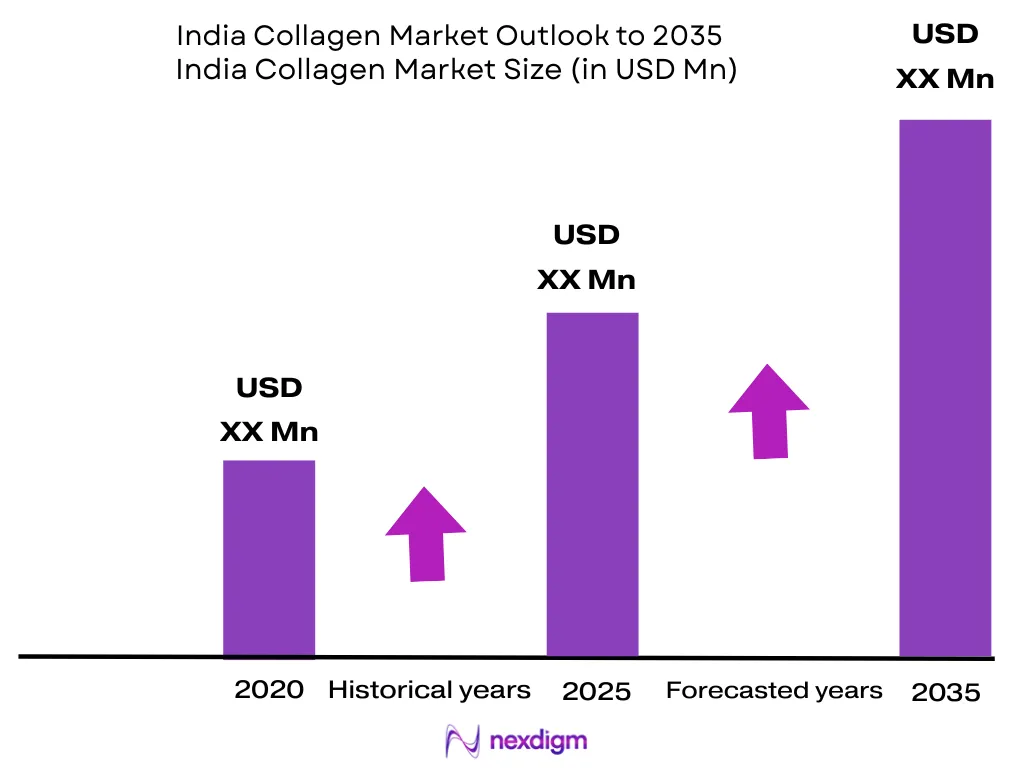
The India collagen market is valued at USD ~ million, based on a five-year historical analysis, and India is expected to record a 13.0% CAGR through 2035 in the collagen market outlook. Demand is driven by gelatin, hydrolyzed collagen, beauty supplements, food applications, nutraceuticals and pharmaceutical usage. India’s GDP increased from USD 3.57 trillion in the previous base year to USD 3.91 trillion in the latest base year, supporting health, beauty and wellness consumption. Mumbai, Delhi NCR, Bengaluru, Hyderabad, Chennai, Pune and Ahmedabad dominate India collagen demand because they combine e-commerce adoption, beauty retail, dermatology clinics, sports nutrition outlets, pharmaceutical manufacturing and premium urban wellness consumption. India’s population increased from 1.438 billion in the previous base year to 1.451 billion in the latest base year, while GDP per capita reached USD 2,694.7, widening the addressable base for collagen powders, sachets, gummies, capsules and beauty supplements.
Market Segmentation
By Product Type
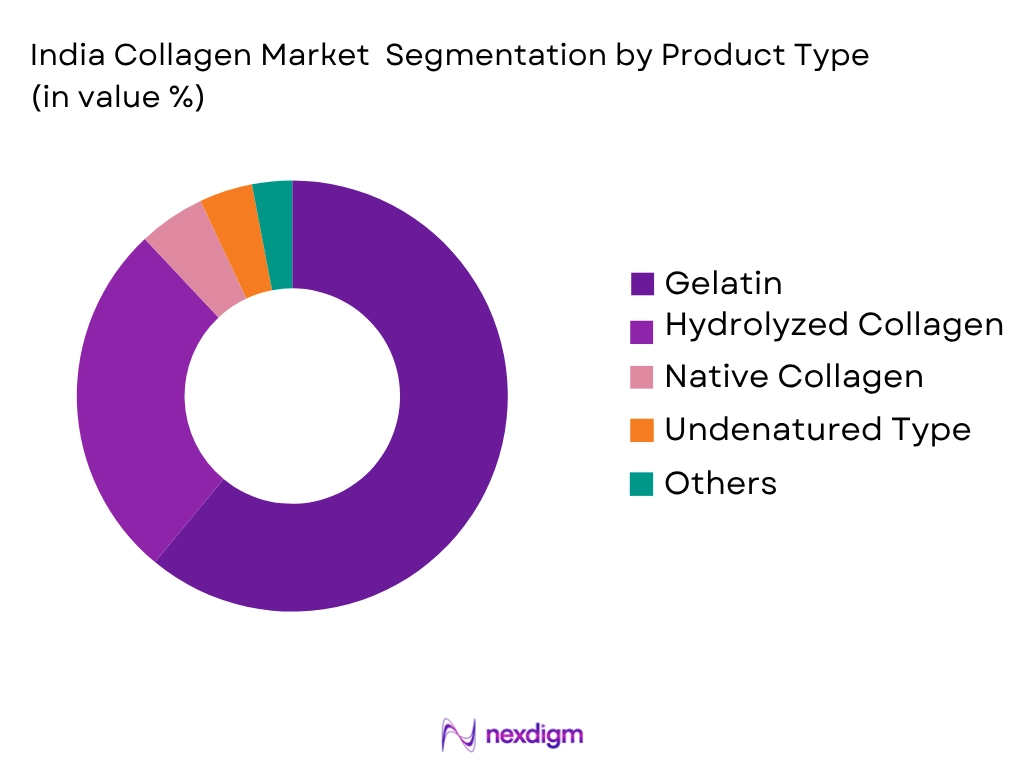
India collagen market is segmented by product type into gelatin, hydrolyzed collagen, native collagen, undenatured Type II collagen and other collagen products. Recently, gelatin has a dominant market share in India under product type, primarily because it is used across pharmaceutical capsules, softgels, gummies, confectionery, dairy desserts, meat processing, bakery, nutraceutical delivery formats and food texturizing applications. Gelatin has stronger B2B penetration than premium collagen peptides because it functions as a gelling, stabilizing, thickening, binding and film-forming ingredient. India’s pharmaceutical base also supports gelatin demand because capsule manufacturing remains a major application area. Hydrolyzed collagen is growing faster in beauty, skin health, joint mobility and sports nutrition, but gelatin remains broader in industrial usage. Grand View Research identifies gelatin as the largest revenue-generating product segment in India collagen market and hydrolyzed collagen as the fastest-growing product segment.
By Source
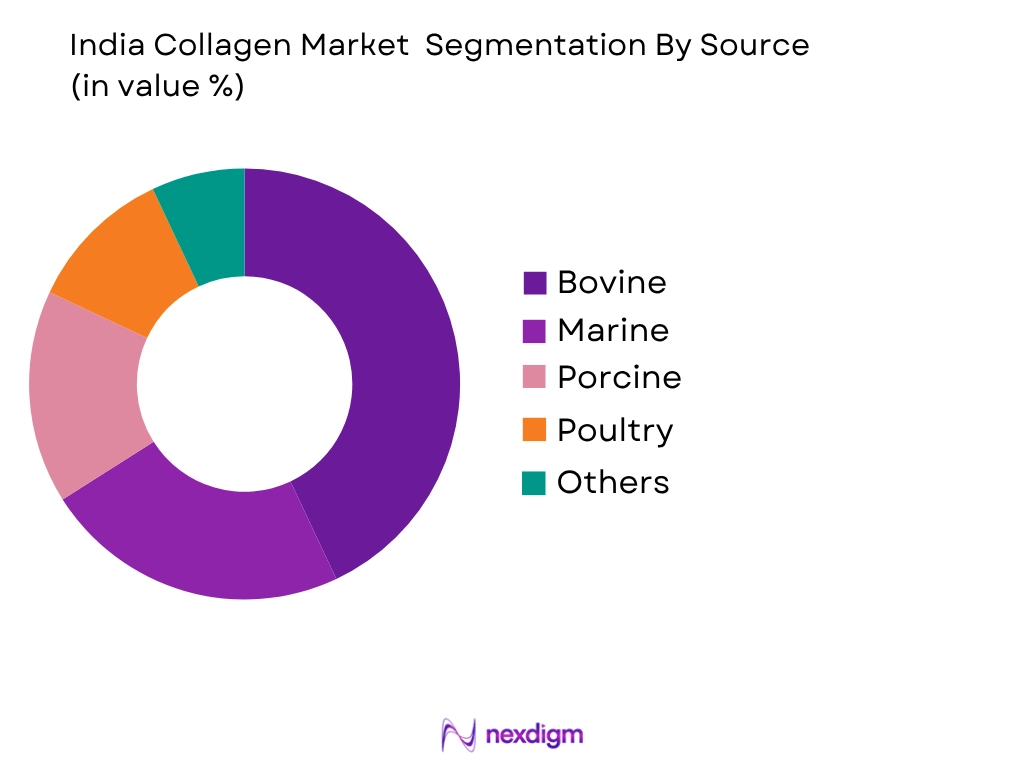
India collagen market is segmented by source into bovine, marine, porcine, poultry and other sources. Recently, bovine collagen has a dominant market share in India under source segmentation because it is cost-efficient, scalable and widely used in gelatin, hydrolyzed collagen powders, capsules, gummies and food applications. Bovine collagen provides Type I and Type III collagen, which allows brands to position products for skin, hair, nails, joints, bone support and sports recovery. Marine collagen is gaining premium visibility in beauty-from-within products because it is associated with Type I collagen and skin-health claims, but it is more dependent on imported peptide supply and premium pricing. Porcine collagen faces stronger religious and dietary constraints in India, while poultry collagen is more focused on Type II joint-health products. The global collagen market also identifies bovine collagen as the largest source category, supported by availability and established extraction processes.
Competitive Landscape
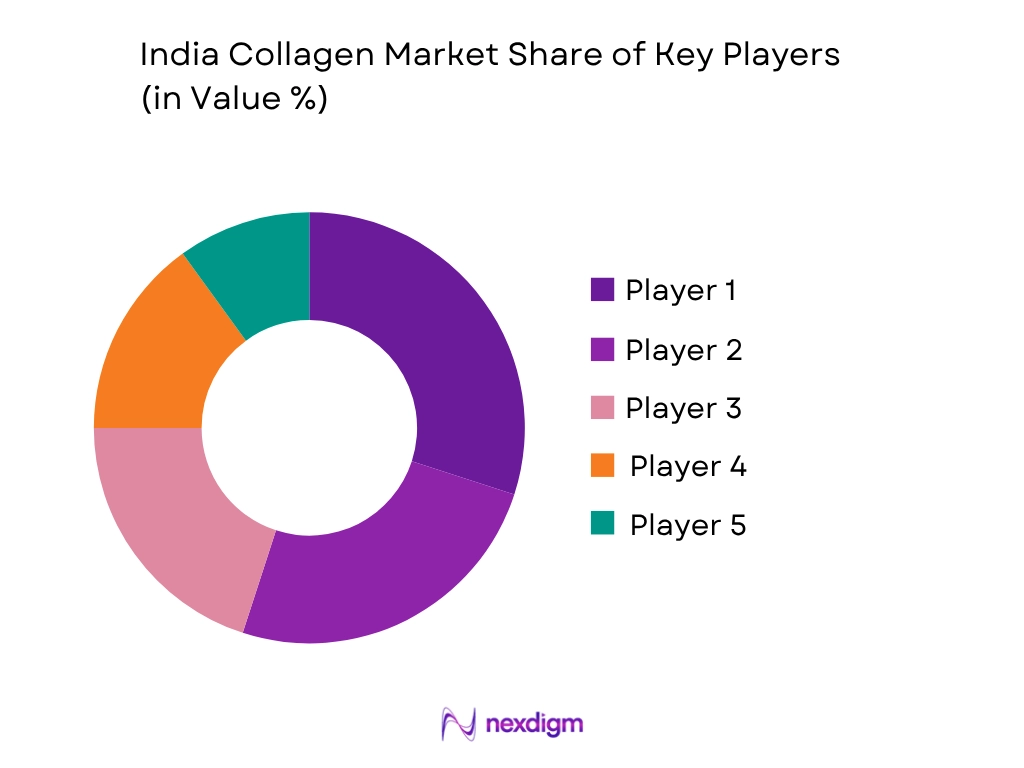
The India collagen market is competitive across B2B ingredient supply, gelatin manufacturing, pharmaceutical inputs and branded consumer supplements. Ingredient-level competition includes global suppliers such as GELITA, Rousselot, PB Leiner and Weishardt, while local players such as Nitta Gelatin India, Titan Biotech, India Gelatine & Chemicals and Sterling Biotech support domestic gelatin and ingredient supply. Consumer-facing competition is shaped by online supplement brands such as HK Vitals, GNC India, OZiva, Wellbeing Nutrition and Carbamide Forte, which compete through marine collagen, collagen builders, gummies, sachets, e-commerce reach and influencer-led beauty positioning.
| Company | Establishment Year | Headquarters | Collagen Portfolio | Main Source Focus | Application Coverage | India Market Role | Distribution Model | Strategic Strength |
| Nitta Gelatin India | 1975 | Kochi, India | ~ | ~ | ~ | ~ | ~ | ~ |
| GELITA | 1875 | Eberbach, Germany | ~ | ~ | ~ | ~ | ~ | ~ |
| Rousselot / Darling Ingredients | 1891 | Son, Netherlands / Irving, Texas | ~ | ~ | ~ | ~ | ~ | ~ |
| Titan Biotech | 1992 | Delhi NCR, India | ~ | ~ | ~ | ~ | ~ | ~ |
| HealthKart / HK Vitals | 2011 | Gurugram, India | ~ | ~ | ~ | ~ | ~ | ~ |
India Collagen Market Analysis
Growth Drivers
Urban Consumer Scale Supporting Beauty and Joint-Health Collagen Adoption
India collagen market is supported by a large consumer economy where collagen powders, sachets, capsules and gummies are positioned for skin glow, hair support, nail health, joint mobility and sports recovery. World Bank reports India’s population at 1.45 billion in 2024 and GDP at USD 3.91 trillion in 2024, giving collagen brands a large addressable urban and semi-urban base. GDP per capita reached USD 2,694.7 in 2024, supporting premium nutraceutical adoption in metro clusters. IMF also projects India’s population at 1,476.626 million in 2026, widening demand for health-positioned supplement formats.
Food Processing and Pharmaceutical Base Supporting Gelatin-Led Collagen Demand
India collagen market is driven by gelatin usage in capsules, softgels, gummies, confectionery, dairy desserts and functional food systems. The Ministry of Food Processing Industries reports food processing GVA at Rs. 2.24 lakh crore in 2023-24, confirming a large manufacturing base for collagen and gelatin applications. Government data also states India’s pharmaceutical market for FY 2023-24 was valued at USD 50 billion, with domestic consumption at USD 23.5 billion and exports at USD 26.5 billion, supporting gelatin capsule shells, excipients and nutraceutical dosage formats. GDP growth reached 6.5 in 2024, strengthening industrial demand.
Market Challenges
Animal-Origin Sensitivity and Source-Traceability Pressure
India collagen market faces a challenge from animal-origin sensitivity because bovine, porcine, marine and poultry collagen products require clear source declaration for consumer trust. India’s total cattle population was 192.49 million in the 2019 Livestock Census, and buffalo population was 109.85 million, creating a large animal-derived input base but also requiring source control and certification for gelatin and collagen products. Meat production reached 10.50 million tonnes in 2024-25, increasing animal by-product availability but raising traceability needs across hides, bones, skin and connective tissues. GDP per capita stood at USD 2,694.7 in 2024, making trust-led premiumization important.
FSSAI Compliance Burden for Health Supplement and Nutraceutical Brands
India collagen market faces regulatory pressure because collagen supplements must comply with FSSAI health supplement and nutraceutical standards, especially for labels, permitted ingredients, quality requirements and claims. FSSAI states these regulations cover 8 categories of functional foods, including health supplements, nutraceuticals, food for special dietary use, food for special medical purpose, specialty foods, probiotic foods, prebiotic foods and novel foods. FSSAI’s nutraceutical rules also state that tablets, capsules and syrups must meet pharmacopoeial quality requirements. In a USD 3.91 trillion economy, this raises compliance expectations for collagen powders, gummies, capsules and sachets sold online and offline.
Market Opportunities
Marine Collagen Opportunity Through India’s Fisheries and Seafood Base
India collagen market has an opportunity in marine collagen because fish skin, scales and fish-processing by-products can support premium Type I collagen used in beauty-from-within powders, sachets, gummies and ready-to-drink formats. The Department of Fisheries reports fish production at 197.75 lakh tonnes in FY 2024-25, while average aquaculture productivity reached 4.77 tonnes per hectare. Government data also reports seafood exports of 16.98 lakh tons in 2023-24, indicating a sizeable marine-processing ecosystem that can support fish-derived collagen ingredient development. India’s GDP reached USD 3.91 trillion in 2024, supporting premium urban beauty products.
E-Commerce Reach Supporting D2C Collagen Powders, Sachets and Gummies
India collagen market has an opportunity in e-commerce-led nutraceutical distribution because collagen brands depend heavily on marketplace discovery, influencer-led beauty education, reviews and subscription purchases. TRAI reports total internet subscribers increased from 954.40 million at the end of March 2024 to 969.10 million at the end of March 2025, giving collagen sellers a broad digital consumer base. Total wireline subscribers increased from 33.79 million to 37.04 million in the same period, improving connected-commerce access. IMF projects real GDP growth at 6.5 in 2026, supporting digital-first health, wellness and beauty-product purchasing.
Future Outlook
India collagen market is expected to grow strongly over the long-term outlook period, supported by beauty-from-within adoption, e-commerce-led supplement sales, sports nutrition expansion, pharmaceutical capsule demand and functional food innovation. The market is forecast to benefit from rising use of hydrolyzed collagen peptides in powders, sachets, capsules, gummies, skin-health products, joint-health supplements and protein-fortified formats. The published country-level market outlook indicates that India collagen generated USD 422.7 million in revenue and is expected to reach USD 813.5 million by the available forecast endpoint, while a separate long-term collagen outlook identifies India as one of the fastest-growing countries with 13.0% CAGR through 2035.
Over the next several years, premium demand will be concentrated in marine collagen, hydrolyzed collagen peptides, collagen gummies, collagen drinks, Type II joint-health capsules, plant-based collagen builders and combination formulas with vitamin C, hyaluronic acid, biotin, glutathione, zinc, silica and amla. Urban women’s wellness, dermatology-linked beauty products, sports recovery products and active-aging nutrition will remain key growth pockets. India’s market will also be shaped by regulatory and dietary realities. FSSAI compliance, ingredient documentation, labeling clarity, source disclosure, vegetarian preferences, halal requirements, porcine sensitivity and heavy-metal testing will increasingly influence brand trust. Companies that combine compliant claims, traceable ingredients, convenient formats and credible digital education will gain stronger positions across Amazon India, Nykaa, HealthKart, Tata 1mg, pharmacies, dermatology clinics and D2C platforms.
Major Players
- GELITA
- Rousselot / Darling Ingredients
- Nitta Gelatin India
- PB Leiner / Tessenderlo Group
- Weishardt
- Titan Biotech
- Sterling Biotech
- India Gelatine & Chemicals
- HealthKart / HK Vitals
- GNC India
- OZiva
- Wellbeing Nutrition
- INLIFE Healthcare
- Kapiva
- Carbamide Forte
Key Target Audience
- Collagen ingredient manufacturers
- Gelatin manufacturers
- Dietary supplement and nutraceutical brands
- Beauty and nutricosmetic brands
- Pharmaceutical capsule and excipient manufacturers
- Functional food and beverage manufacturers
- Investments and venture capitalist firms
- Government and regulatory bodies, Food Safety and Standards Authority of India, Central Drugs Standard Control Organization, Ministry of Food Processing Industries, Department of Animal Husbandry and Dairying
Research Methodology
Step 1: Identification of Key Variables
The initial phase involves constructing an ecosystem map of India collagen market, covering ingredient suppliers, gelatin manufacturers, importers, nutraceutical brands, beauty supplement companies, food manufacturers, pharmaceutical capsule producers, contract manufacturers, e-commerce platforms and regulators. The objective is to define variables such as source, product type, application, grade, form factor, claims, channel and consumer suitability.
Step 2: Market Analysis and Construction
In this phase, historical and current data is compiled across collagen revenue, gelatin demand, hydrolyzed peptide adoption, supplement penetration, pharmaceutical gelatin usage, import-linked ingredient supply and marketplace SKU presence. The analysis evaluates how bovine, marine, porcine and poultry collagen are used across beauty, food, pharma, sports nutrition and joint-health applications.
Step 3: Hypothesis Validation and Expert Consultation
Market hypotheses are validated through computer-assisted interviews with ingredient importers, collagen peptide suppliers, gelatin manufacturers, supplement brands, pharmacy buyers, food formulators, dermatology-led wellness brands and e-commerce category managers. These consultations help validate assumptions around gelatin dominance, marine collagen premiumization, vegetarian constraints and FSSAI-compliant claim positioning.
Step 4: Research Synthesis and Final Output
The final phase synthesizes top-down macroeconomic and industry indicators with bottom-up SKU, channel and company-level checks. This approach validates India collagen market size, segmentation, competitive intensity, demand outlook, regulatory risk and future opportunities, producing a structured market view for manufacturers, investors, retailers, ingredient suppliers and consumer-health companies.

- Executive Summary
- Research Methodology (Market Definitions and Assumptions, Abbreviations, Market Sizing Approach, Top-Down Validation, Bottom-Up Validation, Import Mapping, SKU Benchmarking, Primary Interviews, Regulatory Review, Competitive Mapping, Forecast Model, Limitations)

- Definition and Scope
- Market Genesis and Evolution
- Timeline of Major Players
- Business Cycle and Consumption Seasonality

- Growth Drivers (Beauty-from-Within Demand, Sports Nutrition Adoption, Aging Population, Pharmaceutical Capsule Demand, E-Commerce Penetration, Functional Food Innovation, Urban Wellness Consumption)
- Market Challenges (Vegetarian Consumer Constraint, Religious Source Sensitivity, Imported Peptide Dependency, FSSAI Compliance, Heavy Metal Testing, Price Competition, Claim Scrutiny)
- Market Opportunities (Premium Marine Collagen, Vegetarian Collagen Builders, Clinical Joint Formulas, Collagen Beverages, Women’s Beauty Supplements, Pet Collagen, Medical-Grade Collagen, Export-Oriented Gelatin)
- Market Trends (Marine Collagen Premiumization, Collagen Gummies, Sachet Packaging, K-Beauty Influence, Ingredient Stacking, Third-Party Testing, Clean Label, Plant-Based Collagen Builders)
- SWOT Analysis
- Porter’s Five Forces
- PESTLE Analysis

- By Value (2020-2025)
- By Volume (2020-2025)
- By Average Selling Price (2020-2025)

- By Source (In Value %)
Bovine Collagen
Marine Collagen
Porcine Collagen
Poultry Collagen
- By Product Type (In Value %)
Gelatin
Hydrolyzed Collagen Peptides
Native Collagen
Undenatured Type II Collagen
Collagen Casings - By Distribution Channel (In Value %)
B2B Ingredient Supply
Contract Manufacturing and Private Label
Pharmacies and Drugstores
Health and Wellness Retail
Modern Trade and Supermarkets - By Region (In Value %)
North India
West India
South India
East India
Central India

- Market Share of Major Players on the Basis of Value and Volume
- Cross Comparison Parameters (Collagen Source Portfolio, Product Format Portfolio, Application Coverage, FSSAI Regulatory Readiness, Retail and E-Commerce Reach, Certification and Traceability, Clinical Evidence Support, D2C and Influencer Capability)
- SWOT Analysis of Major Players
- Detailed Profiles of Major Companies
GELITA
Rousselot / Darling Ingredients
Nitta Gelatin India
PB Leiner / Tessenderlo Group
Weishardt
Titan Biotech
Sterling Biotech
India Gelatine & Chemicals
HealthKart / HK Vitals
GNC India
OZiva
Wellbeing Nutrition
INLIFE Healthcare
Kapiva
Carbamide Forte

- Dietary Supplement Brand Demand
- Beauty and Nutricosmetic Brand Demand
- Food and Beverage Manufacturer Demand
- Pharmaceutical Manufacturer Demand
- Medical Device Buyer Demand

- By Value (2026-2035)
- By Volume (2026-2035)
- By Average Selling Price (2026-2035)


 Request a Sample
 Ask for Customization
 Get a Quote
 Enquire Now