
 Download PDF
Market Overview
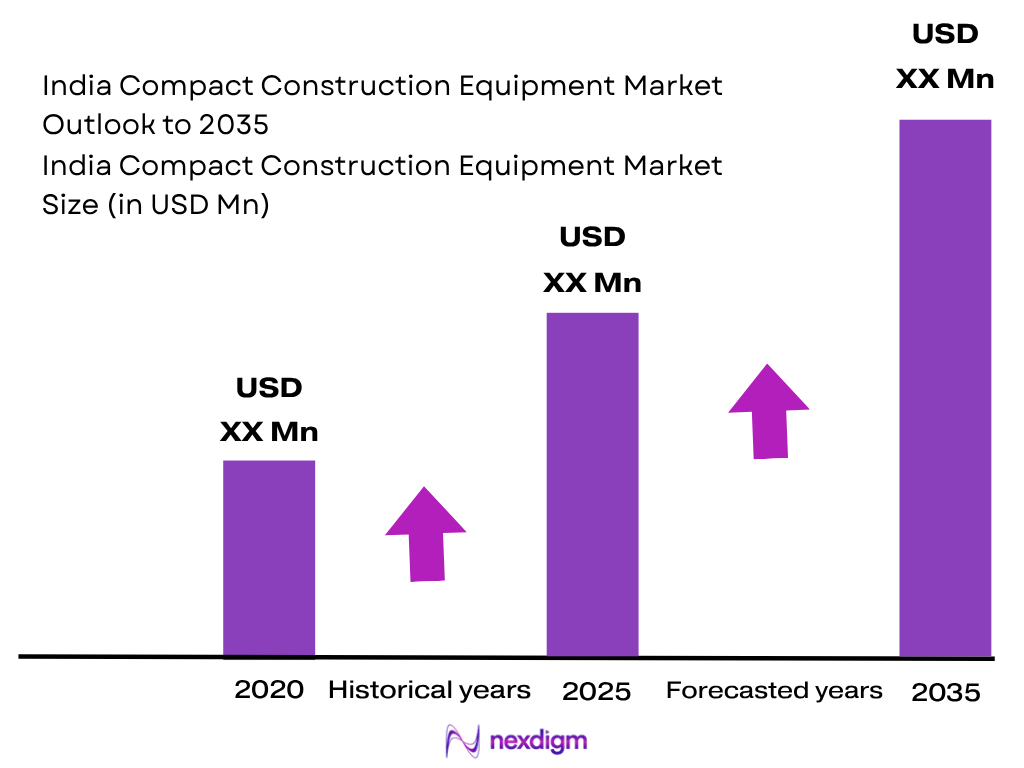
The India Compact Construction Equipment Market is valued at approximately USD ~ billion in 2024, with market development closely linked to infrastructure construction, urbanization, equipment mechanization and increasing demand for machines capable of operating in confined construction environments. Government capital expenditure for FY2024-25 was budgeted at ₹11,11,111 crore, while road transport and highways received ₹2.64 lakh crore of central capital expenditure in FY2024, creating substantial equipment requirements across excavation, loading, grading and utility works.
The India Compact Construction Equipment Market is concentrated around major construction and industrial centres including Mumbai, Delhi-NCR, Bengaluru, Chennai, Hyderabad, Pune and Ahmedabad, where infrastructure development, commercial construction, industrial investment and urban redevelopment generate recurring demand for compact machinery. Delhi-NCR benefits from large-scale urban and transport projects, while Maharashtra, Gujarat, Tamil Nadu and Karnataka combine industrial activity with extensive construction ecosystems. India’s road infrastructure also recorded about ₹3.01 lakh crore of capital investment in FY2024, reinforcing demand across project sites requiring maneuverable equipment.
Market Segmentation
By Equipment Type
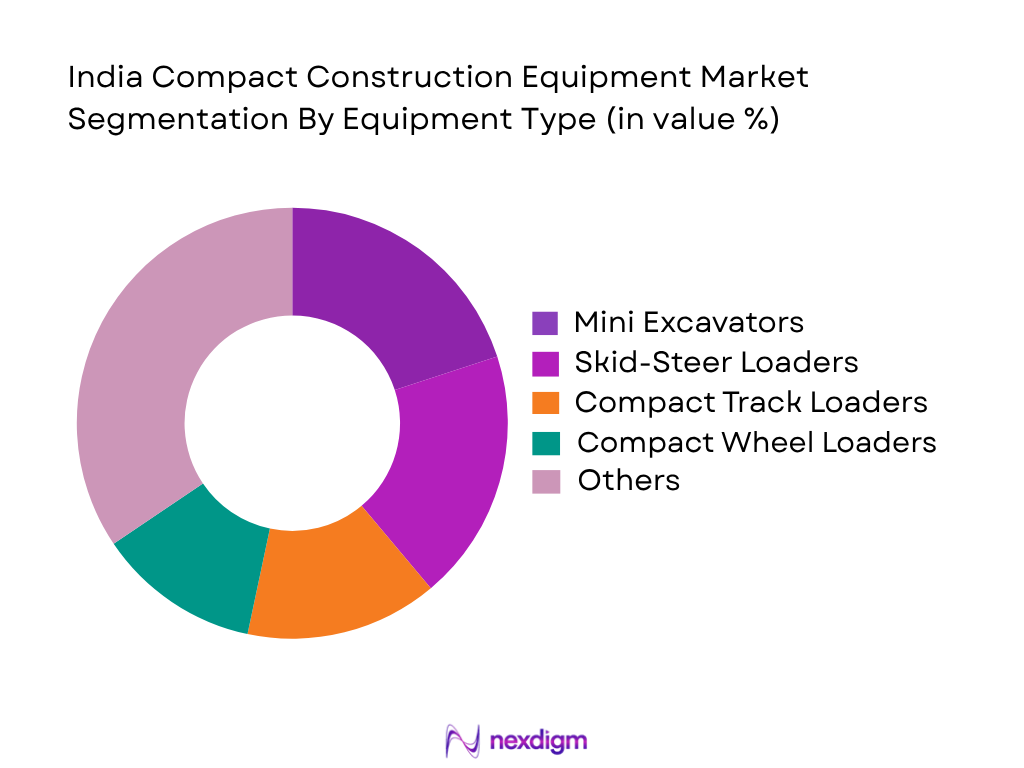
The India Compact Construction Equipment Market is segmented by equipment type into mini excavators, skid-steer loaders, compact track loaders, compact wheel loaders, compact backhoe loaders, mini loaders, compact rollers and small articulated loaders. Mini excavators represent a leading sub-segment within the market framework because their compact dimensions, maneuverability and excavation capabilities make them suitable for urban construction, utility trenching, landscaping and confined worksites. Their application extends across residential construction, road maintenance, drainage, water infrastructure and industrial projects where larger excavators can face site-access limitations. Modern mini excavators are increasingly designed around attachment flexibility, hydraulic efficiency and operator control, allowing one machine to perform multiple tasks. Bobcat’s India portfolio, for example, includes mini excavators in the 0–3 tonne and 3–6 tonne categories, demonstrating the equipment industry’s emphasis on compact operating classes. The broader shift toward mechanized construction and higher equipment utilization is also supporting demand for smaller machines that can be transported between sites and deployed with comparatively limited working space.
By Application
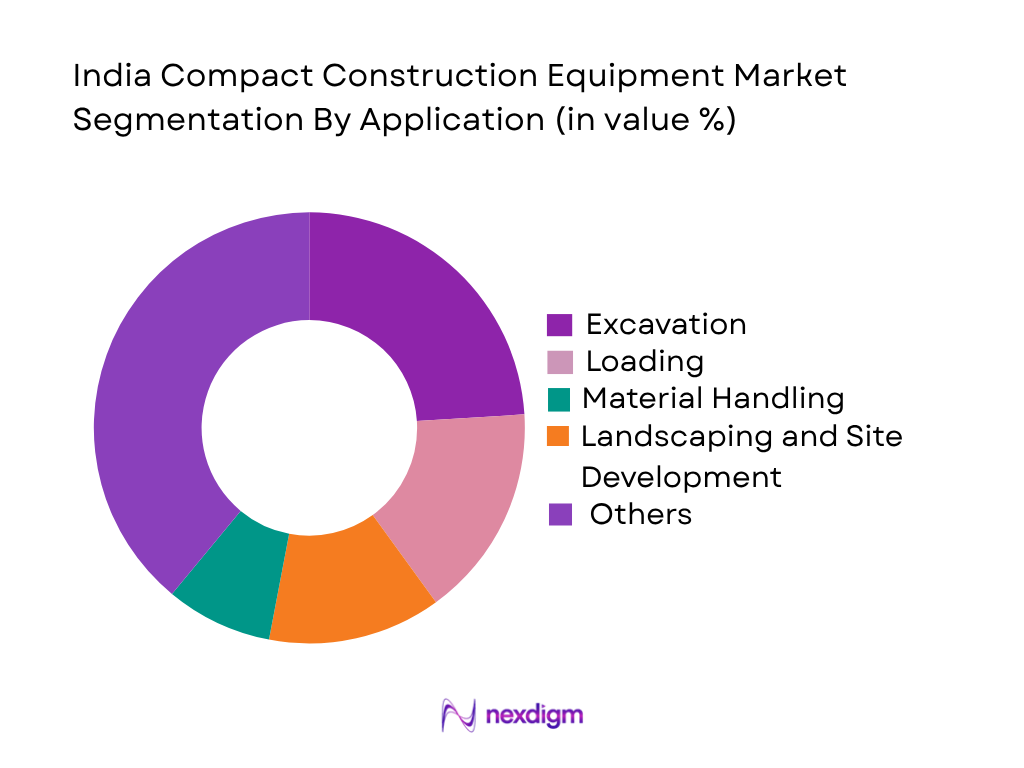
The India Compact Construction Equipment Market is segmented by application into excavation, loading, material handling, landscaping and site development, trenching and utility installation, demolition, road construction and maintenance, lifting and hoisting, grading and levelling, and agricultural and land-development applications. Excavation is positioned as a leading application because digging, trenching and earth preparation remain fundamental activities across construction and infrastructure projects. Compact excavators are particularly suited to utility installation, residential development and urban maintenance where maneuverability and controlled digging are important. Compact loaders and multi-functional machines further extend equipment utilization through attachments for grading, material movement, sweeping and demolition. India’s infrastructure pipeline provides a broad demand base: the National Infrastructure Pipeline encompasses more than 9,766 projects across 37 sub-sectors, while road and highway capital expenditure reached ₹2.64 lakh crore in FY2024. The combination of infrastructure expansion and increasingly mechanized site operations supports the adoption of compact equipment across multiple application environments.
Competitive Landscape
The India Compact Construction Equipment Market comprises established global equipment manufacturers, diversified Indian construction-equipment companies and specialist compact-equipment brands. Competition is shaped by equipment portfolio breadth, domestic manufacturing, dealer reach, financing availability, attachment compatibility, operator support and after-sales service. JCB India operates five manufacturing facilities and produces more than 60 products across nine categories, including skid-steer loaders and other construction equipment, with exports to more than 125 countries. Bobcat’s India portfolio covers mini excavators, loaders, backhoe loaders and attachments, while CASE maintains an India portfolio spanning backhoe loaders, compactors, crawler excavators, graders, dozers and attachments.
| Company | Establishment Year | Headquarters | Compact Equipment Portfolio | Manufacturing Presence | Dealer & Service Network | Attachment Capability | Telematics / Digital Capability | Key Application Coverage |
| JCB India Limited | 1979 | Ballabgarh, Haryana, India | ~ | ~ | ~ | ~ | ~ | ~ |
| Tata Hitachi Construction Machinery | 1961 | Bengaluru, Karnataka, India | ~ | ~ | ~ | ~ | ~ | ~ |
| Bobcat India | 2009* | Chennai, Tamil Nadu, India | ~ | ~ | ~ | ~ | ~ | ~ |
| CASE Construction Equipment India | 1947** | Gurugram, Haryana, India | ~ | ~ | ~ | ~ | ~ | ~ |
| Escorts Kubota Limited | 1944 | Faridabad, Haryana, India | ~ | ~ | ~ | ~ | ~ | ~ |
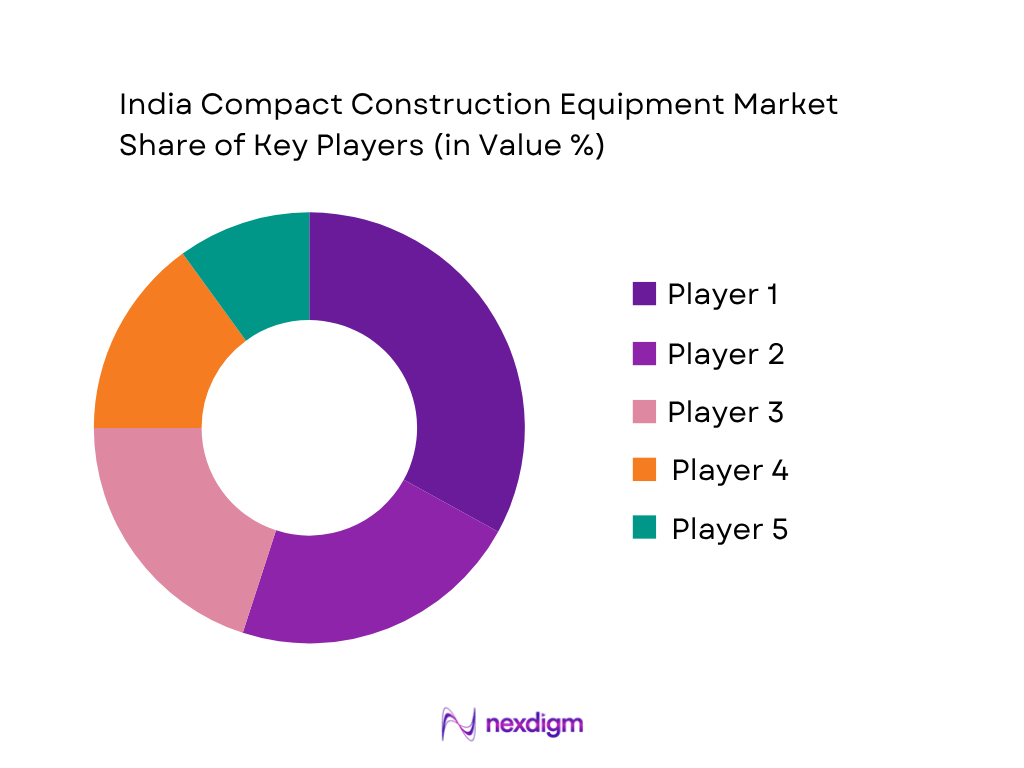
India Compact Construction Equipment Market Analysis
Growth Drivers
Infrastructure-led capital expenditure and construction activity
The India Compact Construction Equipment Market is supported by sustained public infrastructure spending, expansion of road networks and strong construction activity. The Union Budget provides ₹11,11,111 crore of capital expenditure for FY2024-25, including ₹1,50,000 crore of financial assistance to states for capital expenditure. The National Infrastructure Pipeline covers thousands of infrastructure projects across multiple sectors, creating requirements for excavation, loading, grading, compaction and material handling. The national highway network reached 146,145 km in 2024, providing a broad operating base for construction-equipment deployment. Four-lane-and-above national highways reached 48,422 km, while approximately 2,138 km of high-speed corridors were operational. The Ministry of Road Transport and Highways also reported 9,642 km of national-highway lane augmentation during FY2023-24. Construction activity remained an important contributor to economic activity, with construction GVA growth recorded at 7.3 in FY2024-25 and 7.1 in FY2025-26. These conditions support demand for mini excavators, skid-steer loaders, compact track loaders, compactors and other maneuverable equipment. Compact machinery is particularly applicable to urban roads, utilities, drainage, residential construction and smaller infrastructure works where restricted access requires smaller operating footprints.
Manufacturing expansion and increasing industrial investment
Manufacturing expansion is strengthening the underlying requirement for the India Compact Construction Equipment Market across factory development, industrial parks, logistics facilities, warehouses and supporting infrastructure. Manufacturing GVA increased 9.3 in FY2024-25 and 11.5 in FY2025-26, while construction GVA grew 7.3 and 7.1 during the same periods. The latest Annual Survey of Industries recorded 260,061 factories in 2023-24, with fixed capital of ₹46,24,09,035 lakh, output of ₹1,53,27,16,609 lakh and GVA of ₹24,58,33,605 lakh. These industrial assets generate requirements for land preparation, foundation work, internal roads, material movement, landscaping and facility maintenance. Compact machines can address these requirements where maneuverability, transportability and attachment flexibility are important. The industrial base also creates opportunities beyond conventional building construction because manufacturing facilities require equipment during both initial development and ongoing maintenance. The presence of manufacturing clusters in automotive, chemicals, metals, food processing, pharmaceuticals, electronics and plastics further broadens potential applications. Increasing industrial investment can therefore support demand for compact excavators, loaders, rollers and other small-format machines, while also creating opportunities for equipment rental companies and specialized attachment suppliers.
Market Challenges
Financing constraints and equipment affordability for smaller contractors
Financing availability remains an important challenge for the India Compact Construction Equipment Market because contractors operate across a wide range of business sizes and project scales. The Union Budget provides ₹11,11,111 crore of capital expenditure for FY2024-25, while total government expenditure was budgeted at ₹47,65,768 crore, creating substantial infrastructure activity but not ensuring equivalent equipment-purchasing capacity for every contractor. Compact-equipment buyers must allocate capital toward machinery, attachments, insurance, maintenance, operator training and replacement parts. Smaller contractors may therefore prefer rental, leasing or used-equipment channels when utilization is uncertain. The financing challenge is particularly relevant for newer equipment incorporating telematics, electronically controlled hydraulic systems and alternative powertrains. India’s economic scale provides a substantial potential customer base, but equipment acquisition decisions remain closely connected with contractor cash flows, project duration and expected machine utilization. The FY2024-25 budget also included ₹3,90,778 crore in grants-in-aid for creation of capital assets, demonstrating the scale of public investment mechanisms supporting infrastructure development. For equipment manufacturers, the challenge creates a requirement for accessible financing partnerships, rental channels and localized service networks. Dealers that can combine equipment sales with financing, maintenance and attachment packages may address some barriers faced by smaller fleet operators.
Dependence on specialized components and supply-chain complexity
The India Compact Construction Equipment Market faces supply-chain complexity because modern compact machinery depends on coordinated availability of engines, hydraulic systems, transmissions, electronic control units, sensors, steel components and specialized attachments. India’s goods and services trade remains substantial relative to domestic economic activity, while manufacturing GVA increased 9.3 in FY2024-25 and 11.5 in FY2025-26. The industrial ecosystem itself is large, with the Annual Survey of Industries identifying 260,061 factories in 2023-24. However, a large manufacturing ecosystem does not remove the requirement for specialized international components and technologies. Supply interruptions involving hydraulic components, electronic systems or specialized powertrain parts can affect machine production, spare-parts availability and service turnaround. The challenge becomes more relevant as equipment manufacturers introduce connected-machine systems, advanced hydraulic controls, electric drivetrains and operator-assistance technologies that require additional electronic and software components. Localization can reduce exposure to international supply disruptions, but domestic suppliers must meet demanding requirements for reliability, dimensional consistency and durability. Manufacturers therefore need resilient sourcing arrangements, adequate inventories and qualified domestic suppliers while maintaining access to specialized global technologies. These supply-chain considerations can influence equipment lead times, aftermarket service levels and fleet uptime, making component availability an important consideration for manufacturers and end users.
Market Opportunities
Urban infrastructure, utility construction and space-constrained worksites
Urban infrastructure development creates opportunities for the India Compact Construction Equipment Market because dense construction environments require machinery capable of working in confined areas. Urban development and infrastructure remain important areas requiring continued investment, while a World Bank-supported urban development program for Amaravati involves US$800 million, demonstrating ongoing financing activity around urban infrastructure. Compact excavators, skid-steer loaders, compact track loaders and small wheel loaders can support trenching, drainage, landscaping, demolition, utility installation and material movement where larger machines may face access constraints. The national highway network reached 146,145 km in 2024, creating additional requirements for maintenance, roadside works and utility-related construction around transportation infrastructure. Approximately 2,138 km of high-speed corridors were operational, further expanding the infrastructure ecosystem in which compact equipment can be deployed. Urban construction also involves recurring work rather than only large greenfield projects, including road repair, water infrastructure, sewage networks, electrical installations and building maintenance. This creates opportunities for manufacturers to develop machines with narrow operating widths, compact transport dimensions, attachment flexibility and specialized hydraulic configurations. Rental providers can also target short-duration municipal and utility projects where contractors require equipment without maintaining permanent ownership of the machine.
Equipment rental, digital fleet management and lower-emission machinery
The India Compact Construction Equipment Market has opportunities across equipment rental, connected fleet management and lower-emission machinery as contractors seek greater flexibility and equipment utilization. India’s economy recorded growth of 7.6 in FY2025-26, while manufacturing GVA increased 11.5 during the same period. This economic and industrial activity provides a broad environment for construction-equipment utilization across infrastructure, factories, logistics facilities and commercial developments. Telematics systems can provide fleet operators with information on machine hours, location, utilization, maintenance requirements and operating conditions, allowing equipment to be deployed across projects more systematically. Rental companies can use connected data to coordinate machine movement, maintenance scheduling and utilization across geographically distributed sites. Lower-emission and electric compact machines also provide opportunities in selected applications where exhaust emissions and noise are operational considerations, including indoor facilities, warehouses and densely populated urban areas. The FY2024-25 budget allocated ₹11,11,111 crore to capital expenditure, while 9,642 km of national-highway lane augmentation was recorded during FY2023-24, indicating substantial infrastructure activity supporting equipment utilization. Manufacturers can therefore combine compact machinery with telematics, attachments, rental partnerships, financing and lifecycle service packages to address different contractor requirements and expand the range of applications served by compact equipment.
Future Outlook
The India Compact Construction Equipment Market is expected to expand through 2026-2035, supported by infrastructure development, urban construction, equipment mechanization and increasing requirements for flexible machinery. Government infrastructure investment remains a major demand catalyst, with central capital expenditure budgeted at ₹11,11,111 crore for FY2024-25. The market is also likely to experience greater adoption of telematics, attachments, electric powertrains and rental-oriented equipment models. Compact machinery should remain relevant for projects where restricted access, transportability, lower operating footprint and multi-functionality are important procurement considerations.
Major Players
- JCB India Limited
- Tata Hitachi Construction Machinery Company Private Limited
- Caterpillar India Private Limited
- Bobcat India
- Escorts Kubota Limited
- CASE New Holland Construction Equipment India
- Mahindra Construction Equipment
- Volvo Construction Equipment India
- Komatsu India Private Limited
- LiuGong India Private Limited
- SANY India
- Hyundai Construction Equipment India
- Action Construction Equipment Limited
- BEML Limited
- Doosan Bobcat India
Key Target Audience
- Construction Equipment OEMs and Manufacturers
- Construction Contractors and Infrastructure Developers
- Equipment Rental and Leasing Companies
- Construction Equipment Dealers and Distributors
- Equipment Financing and Asset-Financing Institutions
- Investments and Venture Capitalist Firms
- Government and Regulatory Bodies (Ministry of Heavy Industries, Ministry of Road Transport and Highways, Ministry of Housing and Urban Affairs)
- Industrial Equipment Component and Attachment Manufacturers
Research Methodology
Step 1: Identification of Key Variables
The initial phase involves constructing an ecosystem map covering compact-equipment manufacturers, component suppliers, dealers, rental operators, financing institutions, contractors and end-use industries. Secondary research will establish the equipment taxonomy, operating-weight categories, power classes, application groups and regional demand structure. Key variables will include equipment sales, installed fleet, replacement demand, rental penetration, utilization and application intensity.
Step 2: Market Analysis and Construction
Historical market information will be compiled across equipment categories including mini excavators, skid-steer loaders, compact track loaders, compact wheel loaders and compact backhoe loaders. The analysis will evaluate equipment sales, production, imports, exports, installed fleet additions and replacement cycles. Application-level assessment will connect equipment demand with infrastructure, residential, commercial, industrial, utility, agricultural and road-construction activity.
Step 3: Hypothesis Validation and Expert Consultation
Market hypotheses will be validated through structured consultations with equipment manufacturers, dealers, rental companies, contractors, fleet operators and component suppliers. Discussions will focus on procurement criteria, equipment utilization, financing preferences, attachment requirements, service intervals, replacement decisions and emerging technology adoption. Industry inputs will be compared against documented secondary information to identify inconsistencies and refine market assumptions.
Step 4: Research Synthesis and Final Output
The final stage will integrate top-down and bottom-up estimates to establish the India Compact Construction Equipment Market framework. Company-level product portfolios, equipment categories, application exposure and distribution capabilities will be cross-checked against industry information. The resulting analysis will provide market segmentation, competitive assessment, demand drivers, challenges, opportunities and future market projections through the forecast period.

- Executive Summary
- Research Methodology (Market Definition and Scope, India Compact Construction Equipment Market Classification, Compact Equipment Technology Mapping, Mini Excavator Assessment, Skid-Steer Loader Evaluation, Compact Track Loader Analysis, Compact Wheel Loader Assessment, Compact Backhoe Loader Evaluation, Electric Compact Equipment Assessment, Hybrid Equipment Analysis, Telematics and IoT Technology Assessment, Hydraulic System Evaluation, Attachment Compatibility Assessment, Operating Weight Analysis, Power Output Assessment, Equipment Utilization Analysis, Fleet Deployment Assessment, Rental and Leasing Assessment, OEM Manufacturing Capability Assessment, Domestic Production Assessment, Import Dependency Assessment, Dealer Network Assessment, After-Sales Service Assessment, Demand-Side Assessment, Supply-Side Assessment, Top-Down Market Sizing, Bottom-Up Market Sizing, Primary Industry Interviews, Data Triangulation, Forecasting Framework)

- Definition and Scope
- India Compact Construction Equipment Industry Evolution and Development of Mini Excavators, Skid-Steer Loaders, Compact Track Loaders, Compact Wheel Loaders, Compact Backhoe Loaders, Mini Loaders, Compact Rollers, Small Articulated Loaders, Electric Compact Construction Equipment, Low-Emission Compact Machinery, Telematics-Enabled Compact Equipment, Attachment-Based Compact Equipment, Urban Construction Equipment, Infrastructure Compact Equipment, Agricultural Compact Equipment, Rental-Oriented Compact Equipment, Smart Construction Equipment
- Compact Construction Equipment Value Chain Analysis
- Compact Construction Equipment Supply Chain Analysis
- Construction Equipment OEMs, Engine Manufacturers, Hydraulic Component Suppliers, Transmission Suppliers, Attachment Manufacturers, Undercarriage Component Suppliers, Tyre Manufacturers, Steel and Fabrication Suppliers, Electronics and Telematics Providers, Equipment Dealers, Rental Companies, Leasing Companies, Financing Institutions, Construction Contractors, Infrastructure Developers, Agricultural Users, Utility Contractors, Mining Contractors, Industrial End Users

- Growth Drivers (Infrastructure Development Expansion, Urban Construction Growth, Rising Demand for Maneuverable Machinery, Increasing Equipment Rental Adoption, Growth of Tier-II and Tier-III Construction Activity, Expansion of Utility and Municipal Projects, Increasing Equipment Mechanization, Demand for Multi-Functional Machinery)
- Market Challenges (High Initial Acquisition Cost, Financing Constraints for Small Contractors, Shortage of Skilled Operators, Maintenance and Spare Parts Requirements, Dependence on Imported Components, Limited Awareness of Compact Equipment Categories, Fragmented Rental Ecosystem, Residual Value Uncertainty)
- Market Opportunities (Electric Compact Equipment Adoption, Smart Construction Equipment Integration, Equipment Rental and Leasing Expansion, Urban Infrastructure Modernization, Agricultural Mechanization, Utility Construction Applications, Tier-II and Tier-III City Penetration, Low-Emission Equipment Development)
- Market Trends (Mini Excavator Adoption, Multi-Functional Equipment Preference, Telematics Integration, Electric Compact Equipment Development, Attachment-Based Equipment Utilization, Equipment Rental Growth, Operator-Assistance Technology, Remote Fleet Monitoring, Fuel-Efficient Hydraulic Systems, Compact Equipment Localization)
- Government Regulations and Standards (Construction Equipment Emission Standards, Bharat Stage Emission Requirements, Central Motor Vehicle Rules, Occupational Safety Requirements, Equipment Certification Requirements, Machinery Safety Standards, Noise and Environmental Regulations, Road Transport Compliance, Equipment Import Regulations, Domestic Manufacturing Policies)
- SWOT Analysis
- Porter’s Five Forces Analysis
- PESTLE Analysis
- Stakeholder Ecosystem
- Competition Ecosystem
- Construction Equipment Manufacturing Ecosystem
- Compact Equipment Rental and Financing Ecosystem

- By Market Value (2020-2025)
- By Equipment Sales Volume (2020-2025)
- By Domestic Sales Volume (2020-2025)
- By Export Volume (2020-2025)
- By Installed Equipment Fleet (2020-2025)
- By New Equipment Additions (2020-2025)
- By Equipment Replacement Volume (2020-2025)
- By Average Equipment Utilization (2020-2025)
- By Rental Fleet Volume (2020-2025)
- By Equipment Financing Volume (2020-2025)
- By Mini Excavator Sales Volume (2020-2025)
- By Skid-Steer Loader Sales Volume (2020-2025)
- By Compact Track Loader Sales Volume (2020-2025)
- By Compact Wheel Loader Sales Volume (2020-2025)
- By Compact Backhoe Loader Sales Volume (2020-2025)

- By Equipment Type (In Value %)
Mini Excavators
Skid-Steer Loaders
Compact Track Loaders
Compact Wheel Loaders
Compact Backhoe Loaders
Mini Loaders
Compact Rollers
Small Articulated Loaders
Others - By Application (In Value %)
Excavation
Loading
Material Handling
Landscaping and Site Development
Trenching and Utility Installation
Demolition
Road Construction and Maintenance
Lifting and Hoisting
Grading and Levelling
Agricultural and Land Development Applications - By End-Use Industry (In Value %)
Residential Construction
Commercial Construction
Infrastructure Development
Road and Highway Construction
Railway and Metro Construction
Agriculture
Utility and Municipal Works
Mining and Quarrying
Industrial Construction
Landscaping and Site Development - By Operating Capacity (In Value %)
Below 2 Ton
2 to 5 Ton
6 to 8 Ton
Above 8 Ton
Operating Weight-Based Equipment Classification
Compact Footprint Equipment
Urban-Site Equipment - By Power Output (In Value %)
Less than 50 HP
50 to 100 HP
101 to 150 HP
151 to 200 HP
Above 200 HP
Low-Power Compact Equipment
High-Power Compact Equipment - By Powertrain (In Value %)
Diesel-Powered Equipment
Electric-Powered Equipment
Hybrid-Powered Equipment
Battery-Electric Equipment
Alternative-Fuel Compact Equipment - By Technology (In Value %)
Conventional Hydraulic Equipment
Telematics-Enabled Equipment
GPS-Integrated Equipment
IoT-Connected Equipment
Operator-Assistance Systems
Machine-Control Systems
Remote-Monitoring Equipment
Semi-Autonomous Compact Equipment
Electric Drive Systems
Advanced Hydraulic Systems - By Ownership Model (In Value %)
Direct Equipment Ownership
Equipment Rental
Equipment Leasing
Fleet Ownership
Contractor-Owned Equipment
Rental-Fleet Deployment - By Region (In Value %)
North India
South India
East India
West India
Central India
Northeast India
Maharashtra
Gujarat
Karnataka
Tamil Nadu
Uttar Pradesh
Rajasthan
Rest of India

- Market Share of Major Players(By India Revenue, Equipment Sales Volume, Equipment Category, Mini Excavator Presence, Skid-Steer Loader Presence, Compact Track Loader Presence, Compact Wheel Loader Presence, Dealer Network, Manufacturing Footprint, Production Capacity, Product Localization, Rental Fleet Presence, Financing Support, After-Sales Service, Spare Parts Availability, Telematics Capability)
- Cross Comparison Parameters (Equipment Portfolio Breadth, Compact Equipment Operating Weight Range, Maximum Operating Capacity, Powertrain Technology Capability, Hydraulic System Performance, Attachment Compatibility, Telematics and Connectivity Capability, Dealer and After-Sales Network Reach)
- SWOT Analysis of Major Players
- Competitive Positioning Matrix
- Product Portfolio Benchmarking
- Major Companies
JCB India Limited
Tata Hitachi Construction Machinery Company Private Limited
Caterpillar India Private Limited
Bobcat India
Escorts Kubota Limited
CASE New Holland Construction Equipment India
Mahindra Construction Equipment
Volvo Construction Equipment India
Komatsu India Private Limited
LiuGong India Private Limited
SANY India
Hyundai Construction Equipment India
Action Construction Equipment Limited
BEML Limited
Doosan Bobcat India

- Construction Contractor Equipment Requirement Assessment
- Infrastructure Contractor Demand Analysis
- Residential Construction Equipment Demand Assessment
- Commercial Construction Equipment Requirement Assessment
- Road and Highway Contractor Requirement Analysis
- Urban Construction Equipment Demand Assessment
- Agricultural User Requirement Assessment
- Utility Contractor Equipment Requirement Analysis
- Mining and Quarrying Application Assessment
- Rental Company Fleet Requirement Assessment

- By Market Value (2026-2035)
- By Equipment Sales Volume (2026-2035)
- By Domestic Sales Volume (2026-2035)
- By Export Volume (2026-2035)
- By Installed Equipment Fleet (2026-2035)
- By New Equipment Additions (2026-2035)
- By Equipment Replacement Volume (2026-2035)
- By Rental Fleet Volume (2026-2035)
- By Mini Excavator Sales Volume (2026-2035)
- By Skid-Steer Loader Sales Volume (2026-2035)
- By Compact Track Loader Sales Volume (2026-2035)
- By Compact Wheel Loader Sales Volume (2026-2035)
- By Compact Backhoe Loader Sales Volume (2026-2035)
- By Electric Compact Equipment Volume (2026-2035)
- By Telematics-Enabled Equipment Volume (2026-2035)


 Request a Sample
 Ask for Customization
 Get a Quote
 Enquire Now