
 Download PDF
Market Overview
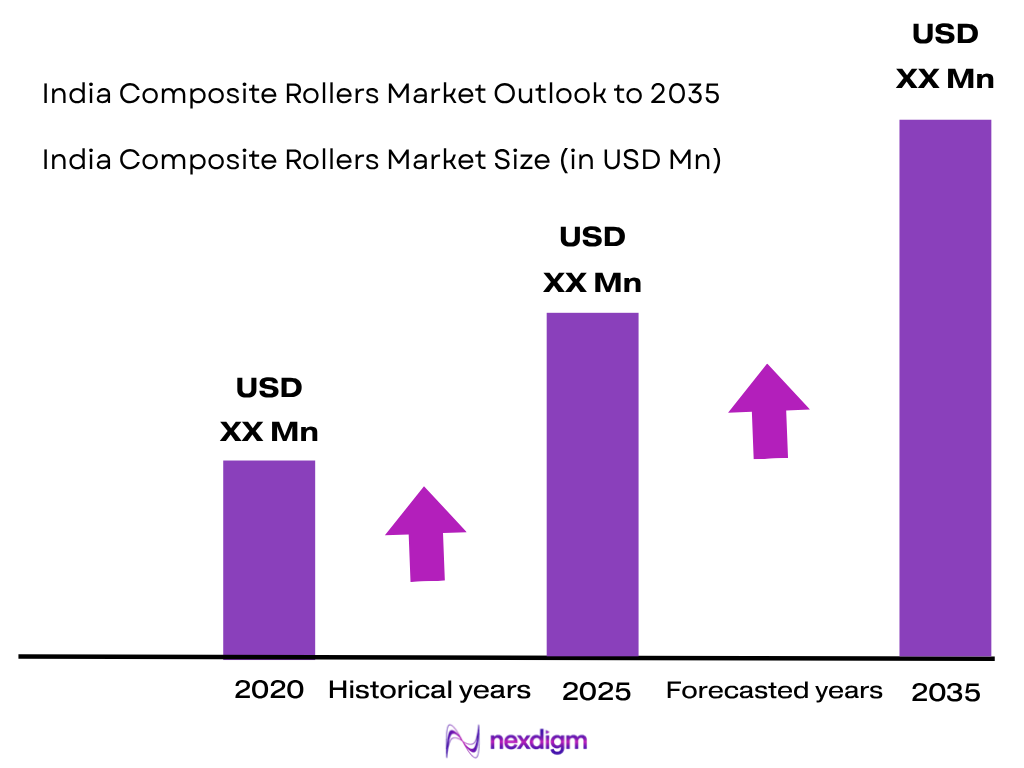
The India Composite Rollers Market is valued at ~USD XX million in 2024 and is projected to expand at a CAGR of ~XX% during 2026-2035. The market growth is supported by increasing adoption of lightweight industrial components, rising demand from printing, packaging, paper processing, textile, and renewable energy equipment manufacturers. The shift from conventional metallic rollers toward composite rollers is driven by requirements for corrosion resistance, reduced machine weight, higher operating speeds, and improved operational efficiency across industrial processing applications.
The India Composite Rollers Market is primarily concentrated across industrial manufacturing hubs including Maharashtra, Gujarat, Tamil Nadu, Karnataka, and Delhi NCR due to the presence of printing machinery manufacturers, packaging industries, automotive production facilities, and engineering clusters. Maharashtra and Gujarat demonstrate strong demand due to their developed manufacturing ecosystem, while Tamil Nadu and Karnataka benefit from automotive, textile, and renewable energy equipment manufacturing activities. These regions have established supply chains for composite materials, precision engineering services, and industrial equipment integration.
Market Segmentation
By Fiber Material Type
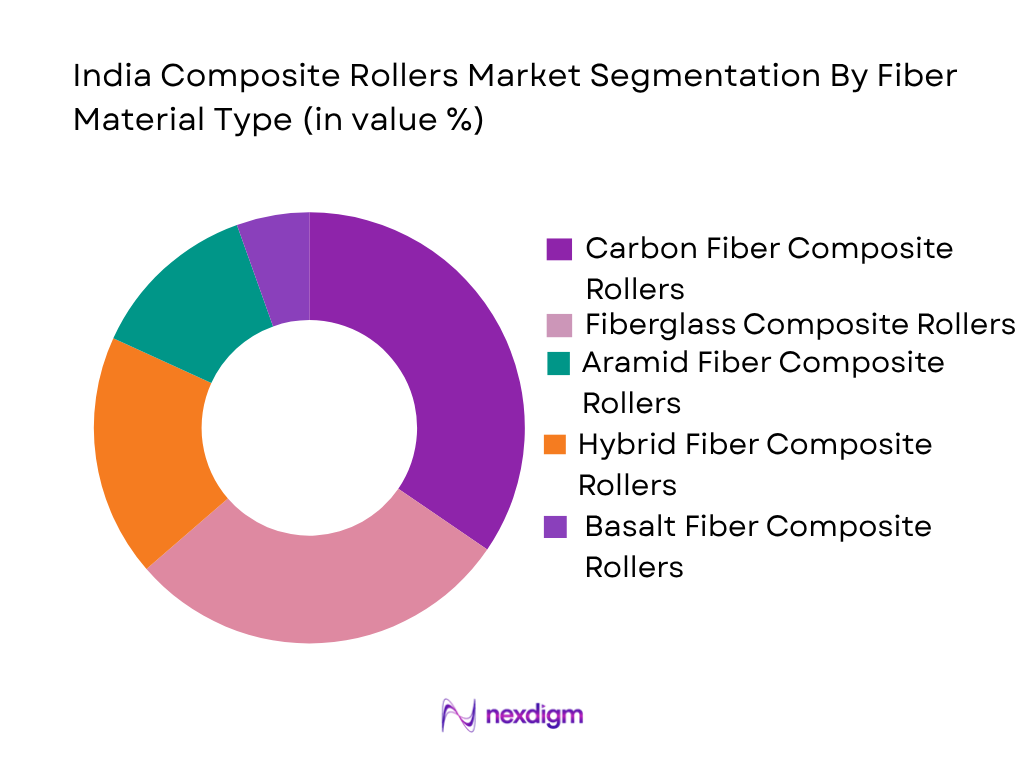
India Composite Rollers Market is segmented by fiber material type into carbon fiber composite rollers, fiberglass composite rollers, aramid fiber composite rollers, hybrid fiber composite rollers, and basalt fiber composite rollers. Carbon fiber composite rollers account for a dominant market share due to their superior strength-to-weight ratio, high stiffness, low rotational inertia, and suitability for high-speed industrial processing applications. These rollers are increasingly preferred in printing, flexible packaging, battery manufacturing, and advanced machinery applications where precision and performance are critical. Fiberglass composite rollers maintain significant adoption due to their cost-effectiveness and durability in general industrial applications. The increasing focus on automation and high-speed production lines is further supporting demand for advanced composite materials.
By Application
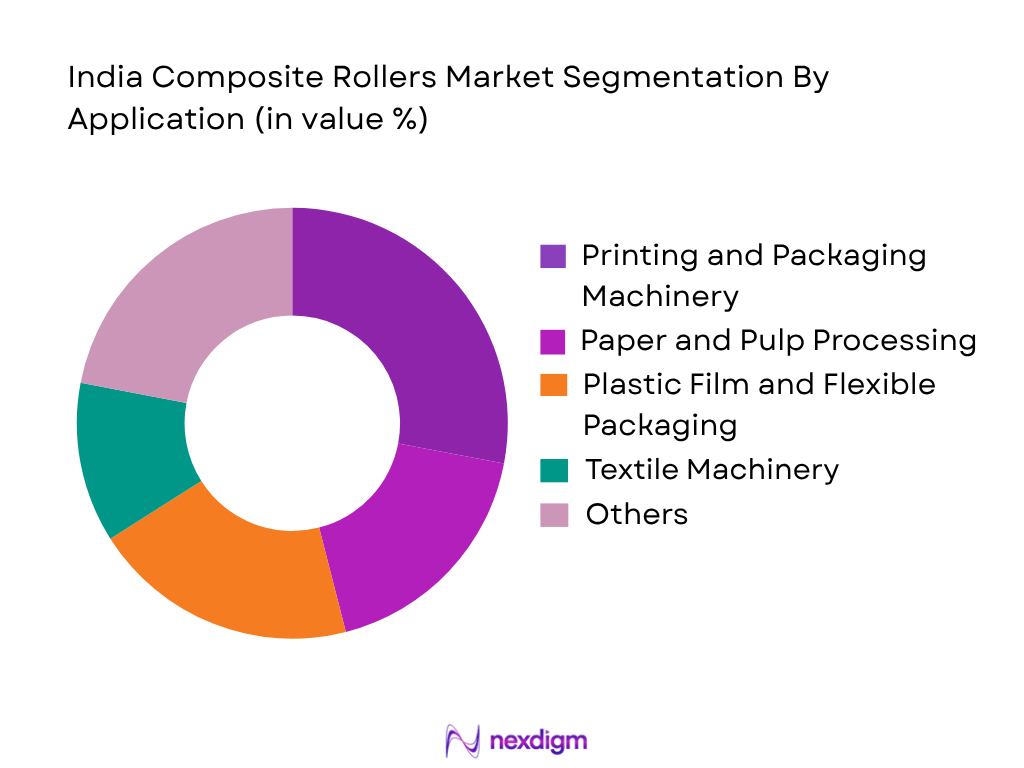
India Composite Rollers Market is segmented by application into printing and packaging machinery, paper and pulp processing, plastic film and flexible packaging, textile machinery, battery manufacturing equipment, automotive manufacturing, and renewable energy equipment. Printing and packaging machinery accounts for a dominant market share due to the rapid expansion of flexible packaging production, digital printing applications, and high-speed converting equipment. Composite rollers are widely used in these industries because they reduce equipment vibration, improve surface quality, and enable faster processing speeds. The growing packaging consumption from food, pharmaceutical, and consumer goods industries is strengthening demand for advanced roller technologies. Battery manufacturing and renewable energy equipment applications are emerging segments due to increasing investments in advanced manufacturing facilities.
Competitive Landscape
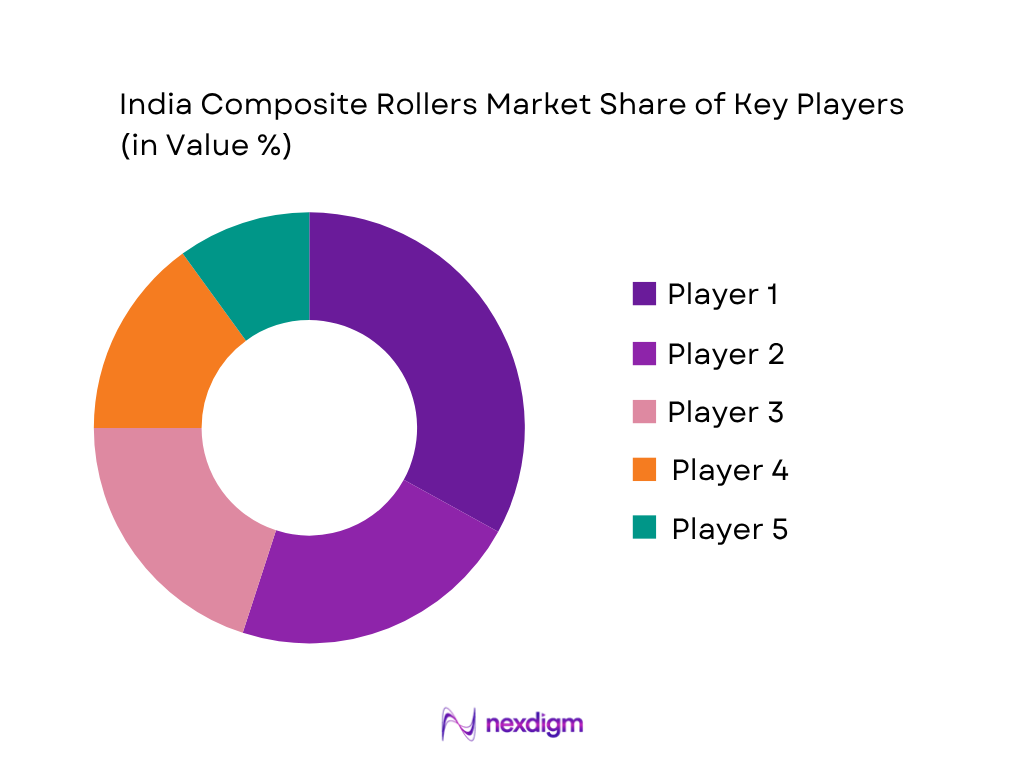
The India Composite Rollers Market consists of domestic composite manufacturers, industrial roller specialists, and international companies providing advanced composite roller technologies. Competition is influenced by material innovation, manufacturing precision, application-specific engineering capabilities, and the ability to supply customized rollers for high-speed industrial processes. Key companies focus on expanding composite material capabilities, improving surface treatment technologies, and developing lightweight solutions for specialized industrial applications.
| Company | Establishment Year | Headquarters | Composite Roller Portfolio | Fiber Technology Capability | Manufacturing Capability | Application Coverage | Customization Capability | Industry Presence |
| Double E Company | 1972 | USA | ~ | ~ | ~ | ~ | ~ | ~ |
| Maxcess International | 1969 | USA | ~ | ~ | ~ | ~ | ~ | ~ |
| American Roller Company LLC | 1938 | USA | ~ | ~ | ~ | ~ | ~ | ~ |
| Voith GmbH & Co. KGaA | 1867 | Germany | ~ | ~ | ~ | ~ | ~ | ~ |
| Kadant Inc. | 1991 | USA | ~ | ~ | ~ | ~ | ~ | ~ |
India Composite Rollers Market Analysis
Growth Drivers
Expansion of Industrial Automation and Advanced Manufacturing Infrastructure
The India Composite Rollers Market is supported by increasing industrial automation across manufacturing sectors such as packaging, printing, paper processing, textiles, automotive components, and renewable energy equipment production. The adoption of automated production lines has increased the requirement for lightweight, high-performance rollers capable of operating at higher speeds with improved precision. India’s manufacturing sector continues to expand, supported by industrial infrastructure development and rising capital expenditure. According to World Bank data, India’s industrial sector contributed approximately USD 890 billion to the economy in 2023, reflecting the large manufacturing base supporting demand for advanced industrial components. The country’s electricity consumption reached around 1,600 billion kWh in 2023, indicating growing industrial activity and equipment utilization. Composite rollers are increasingly preferred in automated systems due to reduced rotational mass, lower maintenance requirements, corrosion resistance, and improved operational efficiency compared with conventional steel rollers. Growth in electronics manufacturing, automotive production, and industrial machinery investments is creating additional application opportunities for composite roller manufacturers supplying customized solutions to high-speed production environments. The increasing focus on Industry 4.0 adoption is encouraging manufacturers to upgrade production equipment with technologically advanced components. Automated processing facilities require rollers with higher dimensional accuracy, improved durability, and lower downtime characteristics. Government initiatives supporting domestic manufacturing and industrial modernization are further strengthening demand for advanced composite solutions. The integration of robotics, digital monitoring systems, and smart production technologies is expected to expand the application scope of composite rollers across multiple industrial sectors.
Growth of Packaging, Printing, and Flexible Manufacturing Industries
The increasing expansion of packaging and printing industries is strengthening demand for composite rollers in India. Composite rollers are extensively used in flexible packaging machinery, converting equipment, printing presses, and film processing systems due to their ability to maintain surface quality, reduce vibration, and support continuous production operations. India’s packaging sector is benefiting from rising consumption of processed foods, pharmaceuticals, consumer goods, and e-commerce deliveries. According to World Bank indicators, India’s urban population exceeded 500 million people, increasing demand for packaged consumer products and modern retail infrastructure. The country’s merchandise exports were valued at approximately USD 437 billion in 2023, supporting industrial production and packaging requirements across multiple sectors. Composite rollers enable manufacturers to improve production efficiency through lightweight construction, enhanced durability, and compatibility with high-speed machinery. Increasing investments in flexible packaging facilities, printing technology upgrades, and automated manufacturing lines are expected to encourage wider adoption of composite roller solutions among industrial users. Growth in pharmaceutical manufacturing, food processing, and consumer product industries is increasing the requirement for advanced packaging machinery. Composite rollers provide operational advantages in these industries by supporting precise material handling and reducing equipment wear. The expansion of organized retail and online commerce is further increasing packaging consumption, creating additional demand for efficient converting and printing systems. Manufacturers are increasingly seeking customized roller solutions that improve productivity, reduce maintenance frequency, and enhance overall production reliability.
Market Challenges
High Manufacturing Complexity and Dependence on Specialized Composite Materials
The India Composite Rollers Market faces challenges due to the complex manufacturing process involved in producing advanced composite rollers. Unlike conventional metal rollers, composite rollers require specialized knowledge of fiber orientation, resin systems, curing processes, surface treatment, and precision balancing. Limited availability of advanced composite manufacturing capabilities can increase production complexity and restrict adoption among small and medium-sized industrial users. According to World Bank data, India’s small and medium enterprises represent a significant portion of industrial activity, with approximately 63 million MSMEs operating across different sectors. Many smaller manufacturers continue to prioritize cost-effective equipment solutions, creating challenges for adoption of premium composite technologies. Additionally, dependence on specialized carbon fibers, high-performance resins, and imported composite materials can create supply chain uncertainties. Fluctuations in global raw material availability and limited domestic production capacity for certain advanced fibers may affect manufacturing efficiency. These factors require increased investment in local composite material development, technical expertise, and manufacturing infrastructure to improve market accessibility. Composite roller production also requires specialized testing facilities for evaluating mechanical strength, thermal performance, and operational reliability. The absence of widespread technical expertise can increase dependency on experienced manufacturers for design and maintenance support. Developing domestic capabilities in composite engineering, material processing, and precision manufacturing will be essential for reducing production limitations. Increased collaboration between material suppliers, machinery manufacturers, and industrial users can improve technology adoption and strengthen the domestic composite roller ecosystem.
Limited Awareness and Competition from Conventional Metal Rollers
The India Composite Rollers Market experiences competition from traditional metallic rollers due to established usage patterns, lower initial costs, and familiarity among industrial operators. Many industries continue using steel and aluminium rollers because of existing machinery compatibility and established maintenance practices. According to government industrial data, India has more than 63 million MSMEs, many of which operate with cost-sensitive production models where upfront equipment investment remains a critical decision factor. Composite rollers provide advantages such as weight reduction, corrosion resistance, and improved operational performance; however, awareness regarding long-term efficiency benefits remains limited among several end users. Additionally, industries with lower-speed processing requirements may continue preferring conventional rollers due to adequate performance in standard applications. The challenge for composite roller manufacturers is demonstrating lifecycle advantages, reducing technology adoption barriers, and providing application-specific solutions. Increased technical education among industrial users and stronger collaboration between machinery manufacturers and composite suppliers can support wider acceptance of composite roller technologies. Industrial customers often evaluate equipment decisions based on immediate capital expenditure rather than long-term operational savings. This creates resistance toward adopting higher-value composite solutions despite performance advantages. Manufacturers need to provide application demonstrations, technical support, and lifecycle cost analysis to improve acceptance. Growing competition from established metal roller suppliers also requires composite manufacturers to focus on innovation, customization, and service capabilities.
Market Opportunities
Increasing Adoption of Lightweight Components in Advanced Manufacturing
The India Composite Rollers Market presents opportunities through the growing requirement for lightweight components across industrial machinery applications. Manufacturers are increasingly focusing on reducing equipment weight, improving energy efficiency, and increasing production speeds, creating demand for composite-based solutions. Composite rollers offer advantages such as lower inertia, higher operating speeds, corrosion resistance, and improved durability, making them suitable for modern manufacturing systems. India’s infrastructure and industrial expansion continue to support demand for advanced manufacturing technologies. According to International Monetary Fund data, India recorded economic growth supported by manufacturing expansion and infrastructure investment, strengthening the requirement for efficient industrial equipment. The country’s renewable energy capacity exceeded 190 GW in 2024, creating additional opportunities for composite rollers used in solar panel manufacturing equipment, processing machinery, and related industrial applications. As industries move toward automation and performance optimization, composite roller adoption is expected to increase in applications requiring precision, lightweight construction, and extended operational life. Increasing investment in industrial modernization and advanced production facilities is creating demand for components that improve machine efficiency. Composite rollers can help manufacturers reduce mechanical stress, improve processing speeds, and minimize energy consumption in rotating equipment. The adoption of sustainable manufacturing practices is also encouraging industries to evaluate lightweight materials with longer service life. As Indian manufacturers expand their technological capabilities, composite rollers are expected to gain adoption across specialized industrial applications.
Expansion of Battery Manufacturing and Renewable Energy Equipment Production
The growth of battery manufacturing and renewable energy equipment production creates significant opportunities for the India Composite Rollers Market. Composite rollers are increasingly relevant in advanced manufacturing environments such as battery electrode processing, film handling, solar module production, and specialized coating applications where precision and material compatibility are essential. India is developing domestic manufacturing capabilities in electric mobility and renewable energy sectors, increasing demand for specialized industrial equipment. According to government energy statistics, India’s installed renewable energy capacity reached more than 190 GW in 2024, highlighting expansion in clean energy infrastructure. The electric vehicle ecosystem is also receiving increased investment, supporting demand for battery production facilities and associated machinery. Composite rollers can support these industries through improved surface quality, reduced contamination risk, and compatibility with high-speed manufacturing processes. Growing emphasis on domestic manufacturing, supply chain localization, and advanced industrial production provides opportunities for composite roller manufacturers to develop customized solutions for emerging sectors. Battery manufacturing requires precise material handling systems where roller performance directly influences product quality and production efficiency. Solar manufacturing facilities also require durable rollers capable of handling sensitive materials during continuous processing. Increasing domestic production initiatives and technology investments are expected to create opportunities for composite roller suppliers specializing in advanced industrial applications. The shift toward clean energy manufacturing is likely to expand the role of composite materials in India’s industrial ecosystem.
Future Outlook
Over the next decade, the India Composite Rollers Market is expected to witness steady expansion driven by industrial automation, increasing adoption of lightweight machinery components, and modernization of manufacturing processes. Demand for carbon fiber and hybrid composite rollers is expected to increase across packaging, automotive, renewable energy, and advanced manufacturing sectors. Growth opportunities will emerge from replacement of conventional metallic rollers, development of high-speed production equipment, and increasing domestic manufacturing capabilities.
Major Players
- Double E Company
- Maxcess International
- American Roller Company LLC
- Voith GmbH & Co. KGaA
- Kadant Inc.
- Webex Inc.
- Menges Roller Company
- Western Machine Works
- C.R. Products Inc.
- Kinetic Co.
- Advance Composite Structures
- Carbon Axis
- Reifenhäuser Group
- TSE Troller AG
- American Roller Bearing Company
Key Target Audience
- Composite roller manufacturers
- Industrial machinery manufacturers
- Printing and packaging equipment manufacturers
- Paper and pulp processing companies
- Automotive manufacturing companies
- Renewable energy equipment manufacturers
- Investments and venture capitalist firms
- Government and regulatory bodies (Ministry of Heavy Industries, Department for Promotion of Industry and Internal Trade, Bureau of Indian Standards)
Research Methodology
Step 1: Identification of Key Variables
The initial phase involves developing an ecosystem map covering composite material suppliers, roller manufacturers, industrial equipment producers, and end-use industries operating within the India Composite Rollers Market. This stage includes extensive secondary research to identify critical market variables such as material adoption, application demand, manufacturing capabilities, and industry trends.
Step 2: Market Analysis and Construction
This phase focuses on analysing historical market performance through demand-side and supply-side assessment. Market evaluation includes composite roller consumption patterns, industrial application penetration, manufacturing capacity analysis, and technology adoption across major end-use industries.
Step 3: Hypothesis Validation and Expert Consultation
Market assumptions are validated through discussions with industry stakeholders including composite manufacturers, machinery producers, and industrial users. These consultations provide insights into product specifications, operational requirements, purchasing behaviour, and future technology adoption.
Step 4: Research Synthesis and Final Output
The final stage involves consolidating primary and secondary findings to develop a comprehensive assessment of the India Composite Rollers Market. Data points are cross-verified through industry feedback, manufacturing analysis, and application-level evaluation to ensure accuracy and reliability.

- Executive Summary
- Research Methodology (Market Definition and Scope, India Composite Rollers Market Classification, Composite Roller Technology Mapping, Carbon Fiber Composite Roller Assessment, Fiberglass Composite Roller Evaluation, Hybrid Fiber Composite Roller Analysis, Polymer Matrix Composite Evaluation, Thermoset and Thermoplastic Composite Assessment, Filament Winding Technology Assessment, Pultrusion Manufacturing Analysis, Compression Molding Evaluation, Roller Design and Engineering Assessment, Surface Coating and Treatment Evaluation, Load Capacity Analysis, Dynamic Performance Assessment, Thermal Resistance Evaluation, Corrosion Resistance Assessment, Weight Reduction Analysis, Industrial Application Mapping, Manufacturing Capability Assessment, Domestic Production Assessment, Import Dependency Assessment, Supply-Side Assessment, Demand-Side Assessment, Top-Down Market Sizing, Bottom-Up Market Sizing, Primary Industry Interviews, Data Triangulation, Forecasting Framework)

- Definition and Scope
- Market Evolution and Industry Development of Carbon Fiber Rollers, Fiberglass Composite Rollers, Lightweight Industrial Rollers, High-Speed Web Processing Rollers, Non-Metallic Rollers, Corrosion-Resistant Composite Rollers, Thermal Processing Rollers, Printing and Converting Rollers, Battery Manufacturing Rollers, Semiconductor Processing Rollers, Aerospace Composite Rollers, Renewable Energy Manufacturing Rollers, Automated Manufacturing Line Rollers, Advanced Composite Manufacturing Technologies
- Composite Rollers Value Chain Analysis
- Composite Rollers Supply Chain Analysis
- Carbon Fiber Suppliers, Glass Fiber Manufacturers, Resin System Suppliers, Epoxy and Polymer Matrix Suppliers, Composite Material Producers, Pultrusion Equipment Manufacturers, Filament Winding Technology Providers, Composite Roller Manufacturers, Precision Machining Providers, Surface Treatment Providers, Industrial Equipment Integrators, Printing Equipment Manufacturers, Battery Manufacturing Equipment Suppliers, Aerospace Component Manufacturers, Automotive Manufacturers, Renewable Energy Equipment Producers, Industrial End Users

- Growth Drivers (Increasing Demand for Lightweight Industrial Components, Expansion of Battery Manufacturing Facilities, Growth of High-Speed Web Processing Industries, Rising Adoption of Corrosion-Resistant Materials, Aerospace Manufacturing Expansion, Automotive Lightweighting Requirements, Industrial Automation Growth)
- Market Challenges (High Composite Material Manufacturing Costs, Limited Awareness Among Traditional Industries, Complex Repair and Maintenance Requirements, Dependence on Specialized Composite Materials, High Initial Investment Compared with Metal Rollers, Limited Standardization Across Applications)
- Market Opportunities (Battery Production Equipment Expansion, Semiconductor Manufacturing Growth, Sustainable Composite Material Development, Replacement of Heavy Metal Rollers, Aerospace Manufacturing Applications, Smart Manufacturing Integration, Automated Composite Roller Production)
- Market Trends (Carbon Fiber Composite Adoption, Hybrid Fiber Material Development, Lightweight Machinery Design, Automated Composite Manufacturing, Precision Surface Engineering, Digital Manufacturing Integration, Longer Service-Life Roller Development, Sustainable Composite Solutions)
- Government Regulations and Standards (Bureau of Indian Standards Composite Material Standards, Ministry of Heavy Industries Manufacturing Requirements, Industrial Safety Regulations, Environmental Regulations, Automotive Material Standards, Manufacturing Quality Standards, Composite Testing Requirements, Industrial Equipment Safety Regulations)
- SWOT Analysis
- Porter’s Five Forces Analysis
- PESTLE Analysis
- Stakeholder Ecosystem
- Competition Ecosystem

- By Market Value (2020-2025)
- By Composite Roller Production Volume (2020-2025)
- By Installed Roller Units (2020-2025)
- By Average Selling Price per Roller Unit (2020-2025)
- By Carbon Fiber Composite Roller Consumption Volume (2020-2025)
- By Fiberglass Composite Roller Consumption Volume (2020-2025)
- By Industrial Web Processing Roller Volume (2020-2025)
- By Printing and Converting Application Volume (2020-2025)
- By Battery Manufacturing Application Volume (2020-2025)
- By Aerospace and Automotive Application Volume (2020-2025)

- By Fiber Material Type (In Value %)
Carbon Fiber Composite Rollers
Fiberglass Composite Rollers
Aramid Fiber Composite Rollers
Hybrid Fiber Composite Rollers
Basalt Fiber Composite Rollers
Natural Fiber Composite Rollers - By Resin Matrix Type (In Value %)
Epoxy Matrix Composite Rollers
Polyester Matrix Composite Rollers
Vinyl Ester Matrix Composite Rollers
Polyurethane Matrix Composite Rollers
Thermoplastic Composite Rollers
High-Temperature Resin Composite Rollers - By Application (In Value %)
Printing and Packaging Machinery
Paper and Pulp Processing
Plastic Film and Flexible Packaging
Battery Manufacturing Equipment
Semiconductor and Electronics Processing
Textile Machinery
Food Processing Equipment
Aerospace Manufacturing
Automotive Manufacturing
Renewable Energy Equipment - By End-Use Industry (In Value %)
Printing Industry
Packaging Industry
Paper Manufacturing Industry
Automotive Industry
Aerospace Industry
Electronics and Semiconductor Industry
Battery Production Industry
Textile Industry
Food and Beverage Industry
Renewable Energy Industry - By Roller Type (In Value %)
Idler Rollers
Guide Rollers
Pressure Rollers
Cooling Rollers
Heating Rollers
Drive Rollers
Tension Control Rollers
Coating Rollers - By Region (In Value %)
North India
South India
West India
East India
Central India
Gujarat
Maharashtra
Tamil Nadu
Karnataka
Rest of India

- Market Share of Major Players (By India Revenue, Composite Roller Product Portfolio, Carbon Fiber Technology Capability, Fiberglass Composite Capability, Manufacturing Capacity, Roller Design Capability, Application Coverage, Industry Presence, Customization Capability, Surface Treatment Capability, Technical Support Capability, Distribution Network, Customer Base)
- Cross Comparison Parameters (Fiber Material Technology Capability, Roller Weight Reduction Performance, Maximum Operating Speed Capability, Thermal Resistance Performance, Corrosion Resistance Capability, Load Bearing Capacity, Manufacturing Process Expertise, Industry-Specific Application Experience)
- SWOT Analysis of Major Players
- Competitive Positioning Matrix
- India Manufacturing Capability and Distribution Assessment
- Major Companies
Double E Company
C.R. Products Inc.
Menges Roller Company
Webex Inc.
Western Machine Works
American Roller Company LLC
Coastal Enterprises Inc.
Kinetic Co.
Advance Composite Structures
Carbon Axis
Reifenhäuser Group
Voith GmbH & Co. KGaA
Kadant Inc.
Maxcess International
TSE Troller AG

- Industrial Equipment Manufacturer Requirement Assessment
- Printing and Packaging Machinery Demand Analysis
- Paper Manufacturing Roller Requirement Assessment
- Battery Manufacturing Equipment Application Assessment
- Aerospace Production Requirement Analysis
- Automotive Manufacturing Application Assessment
- Semiconductor Equipment Requirement Assessment
- Renewable Energy Manufacturing Assessment
- High-Speed Processing Line Requirement Analysis
- Composite Performance Requirement Assessment (Weight Reduction, Durability, Thermal Stability, Corrosion Resistance, Load Capacity)

- By Market Value (2026-2035)
- By Composite Roller Production Volume (2026-2035)
- By Installed Roller Units (2026-2035)
- By Average Selling Price per Roller Unit (2026-2035)
- By Carbon Fiber Composite Roller Consumption Volume (2026-2035)
- By Fiberglass Composite Roller Consumption Volume (2026-2035)
- By Industrial Web Processing Roller Volume (2026-2035)
- By Printing and Converting Application Volume (2026-2035)
- By Battery Manufacturing Application Volume (2026-2035)
- By Aerospace and Automotive Application Volume (2026-2035)


 Request a Sample
 Ask for Customization
 Get a Quote
 Enquire Now