
 Download PDF
Market Overview
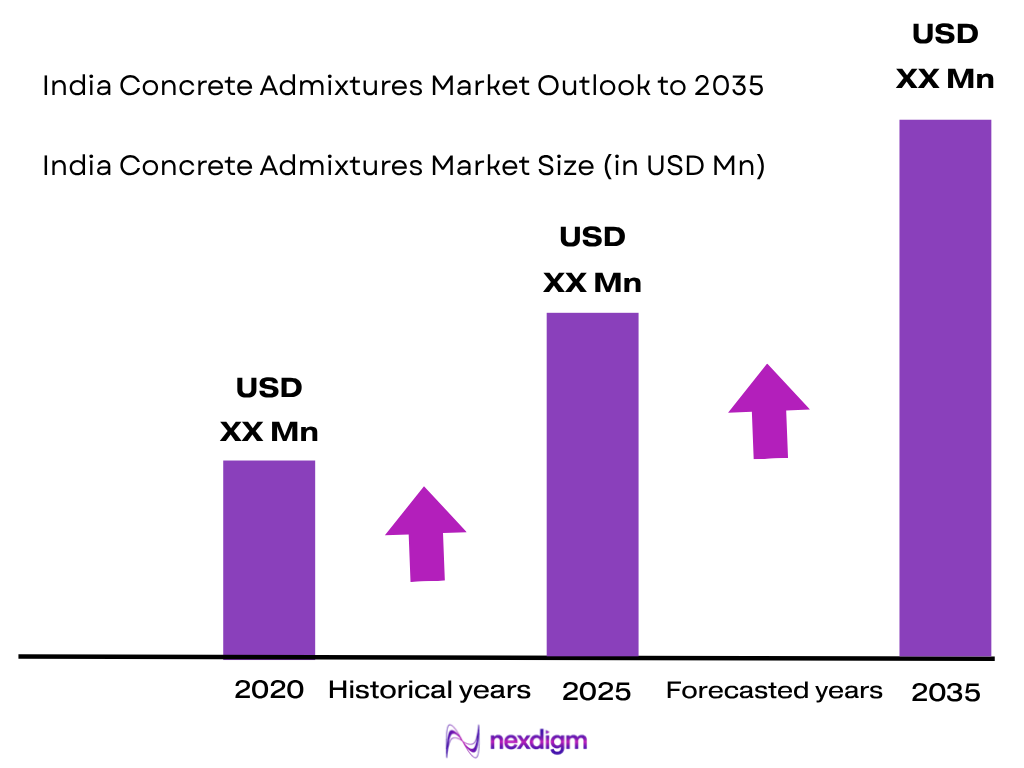
The India Concrete Admixtures Market is valued at approximately ~USD XX million, supported by rising ready-mix concrete consumption, infrastructure execution, high-rise construction and growing use of performance concrete. India’s cement production increased from approximately 374.55 million tonnes in the preceding annual period to around 391 million tonnes in the latest comparable period. Construction GVA for the first half also increased from ₹10.93 lakh crore to ₹11.98 lakh crore, expanding the addressable base for superplasticizers, waterproofing additives and specialty admixtures.
Delhi NCR, Mumbai-Pune, Bengaluru, Hyderabad and Chennai are major concrete-admixture demand centres because they combine metro construction, high-rise housing, commercial development, data centres and extensive ready-mix concrete networks. Infrastructure activity reinforces demand: national highway construction reached 12,349 km in the latest completed financial period, while 5,852 km had already been completed in the subsequent period through December. Metro and RRTS systems are also operational or under development across numerous major Indian urban centres, requiring high-performance, pumpable and durable concrete.
Market Segmentation
By Product Type
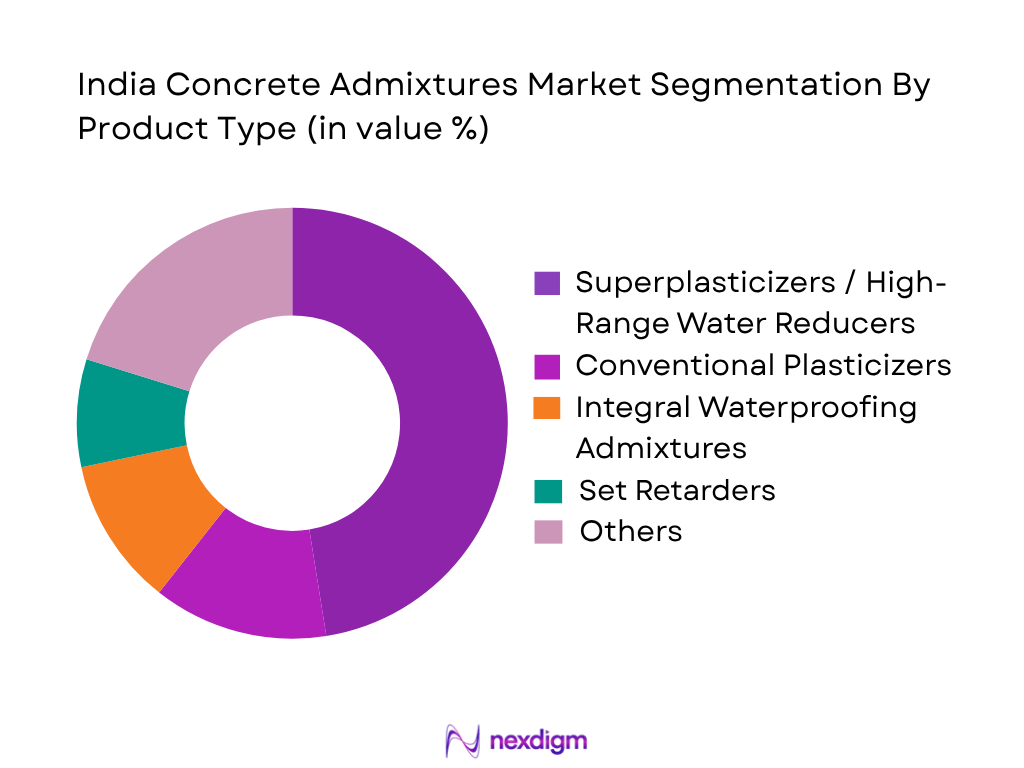
The India Concrete Admixtures Market is segmented into superplasticizers and high-range water reducers, conventional plasticizers, set accelerators, retarders, waterproofing admixtures, viscosity-modifying admixtures, corrosion inhibitors, shrinkage reducers and specialty products. Superplasticizers represent the dominant segment because India’s transition toward ready-mix, pumped, self-compacting and high-strength concrete requires substantial water reduction without compromising workability. Polycarboxylate-ether-based products are increasingly preferred for long slump retention, pumping efficiency and high-strength mixes used in metros, expressways, high-rise buildings and precast components. Ready-mix suppliers also depend on superplasticizers to maintain specified slump during transportation in congested urban markets. SNF-based products remain relevant in conventional infrastructure and price-sensitive concrete mixes. Waterproofing and durability admixtures are gaining importance in basements, water structures, tunnels and coastal construction. Accelerator consumption is concentrated in shotcrete, tunnelling and precast applications, while retarders remain important for mass concrete and projects requiring extended transport or placement windows.
By Application
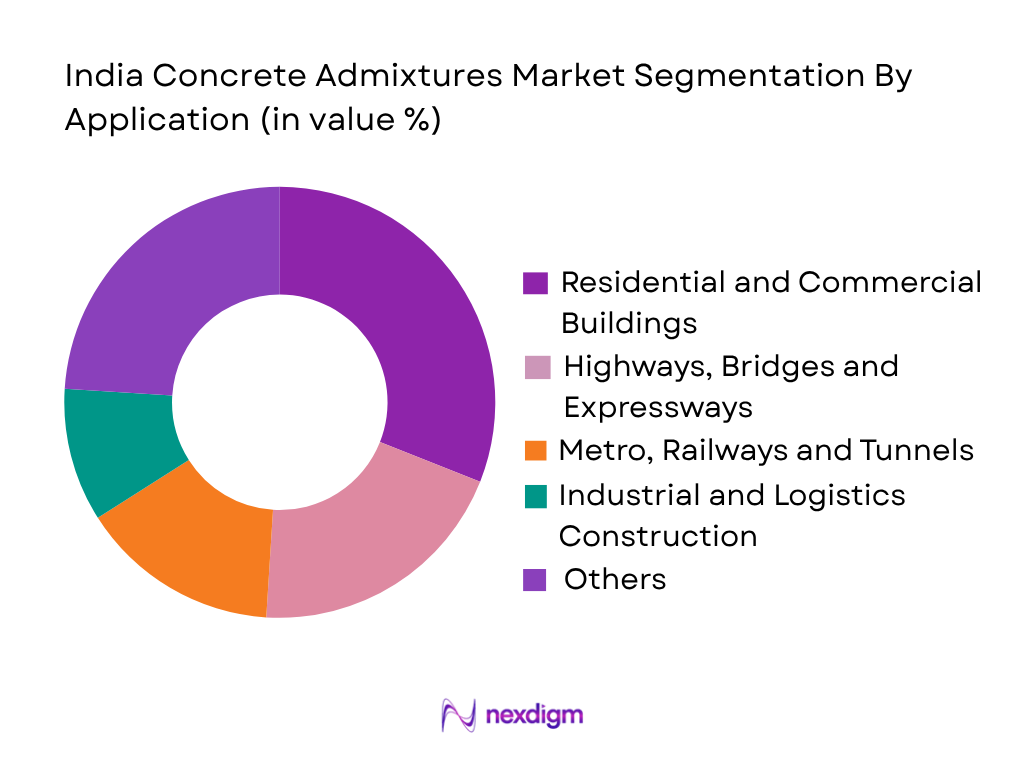
The India Concrete Admixtures Market is segmented into residential and commercial buildings, highways and bridges, metro and railway infrastructure, industrial construction, precast concrete, tunnels, airports, ports, water infrastructure and other civil works. Residential and commercial construction represents the dominant demand segment because large Indian cities increasingly rely on ready-mix concrete for towers, foundations, basements, podiums and large floor plates. These structures require pumpability, extended slump retention, early strength and reduced permeability, supporting significant use of PCE-based superplasticizers and waterproofing admixtures. Infrastructure represents the next major demand pool. National highway construction reached 12,349 km in the latest completed period, while metro systems have expanded across multiple cities, creating requirements for precast girders, segments, stations, viaducts and underground structures. Precast adoption is also strengthening demand for high-early-strength admixtures that shorten mould cycles and improve factory productivity.
Competitive Landscape
The India Concrete Admixtures Market combines multinational construction-chemical companies with established Indian manufacturers operating across ready-mix concrete, infrastructure, waterproofing and precast applications. Competition increasingly centres on PCE formulation expertise, cement compatibility, long slump retention, technical-service capability and regional manufacturing. Sika, Fosroc, Saint-Gobain/CHRYSO, Pidilite and CICO maintain extensive construction-sector exposure, while regional and specialist suppliers compete through customized formulations and site support. Fosroc India operates manufacturing facilities in Bengaluru, Ankleshwar, Kolkata and Keshwana, while Sika maintains multiple manufacturing locations across India.
| Major Player | Establishment Year | Headquarters | Key Admixture Portfolio | PCE / Superplasticizer Capability | Infrastructure Exposure | RMC & Precast Capability | Manufacturing / Supply Presence | Technical Service Capability |
| Sika | 1910 | Baar, Switzerland | ~ | ~ | ~ | ~ | ~ | ~ |
| Fosroc | 1972 | Dubai, UAE | ~ | ~ | ~ | ~ | ~ | ~ |
| Saint-Gobain / CHRYSO | 1942 CHRYSO roots | Courbevoie, France | ~ | ~ | ~ | ~ | ~ | ~ |
| Pidilite Industries | 1959 | Mumbai, India | ~ | ~ | ~ | ~ | ~ | ~ |
| CICO Technologies | 1930 | New Delhi, India | ~ | ~ | ~ | ~ | ~ | ~ |
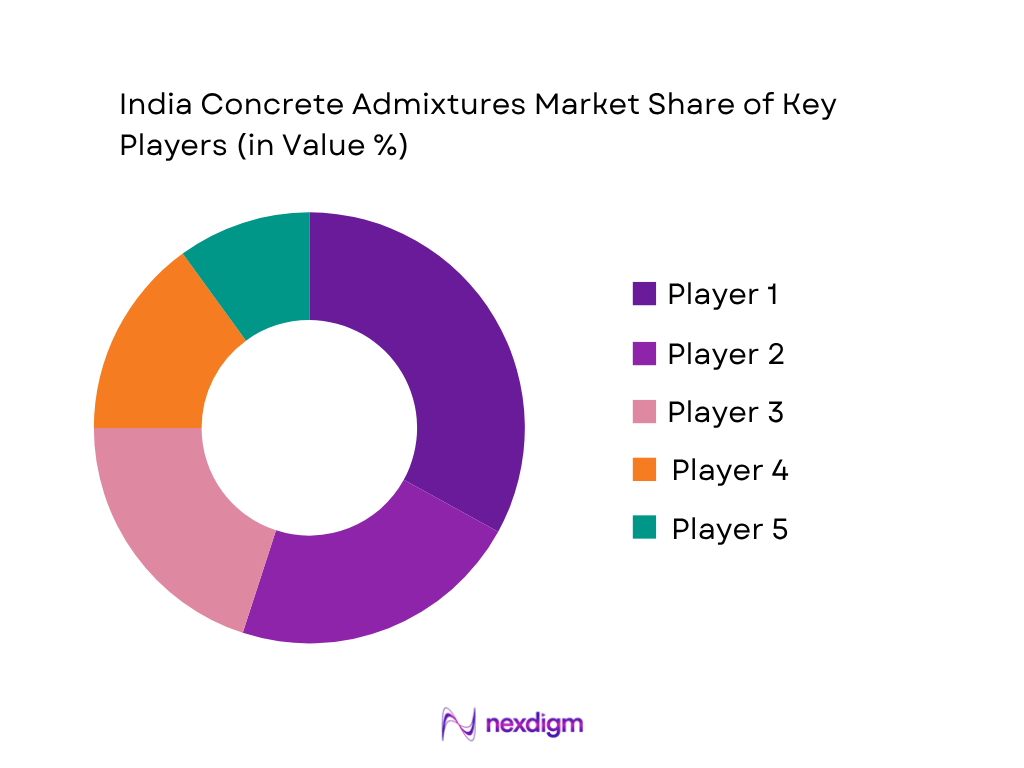
India Concrete Admixtures Market Analysis
Growth Drivers
Large Infrastructure Pipeline Driving High-Performance Concrete Consumption
India’s Concrete Admixtures Market is being supported by sustained public infrastructure execution across highways, railways, metro systems, bridges and urban projects, where concrete must deliver controlled workability, pumping performance, early strength and durability. The Economic Survey reported Central Government capital expenditure of ₹9.49 lakh crore in FY2024, including ₹2.64 lakh crore for road transport and highways and ₹2.43 lakh crore for railways. The Ministry of Road Transport and Highways recorded 12,349 km of National Highway construction during FY2024, generating direct demand for superplasticizers, retarders, waterproofing admixtures and durability-enhancing chemicals used in pavements, bridges, culverts and structures. The Ministry of Housing and Urban Affairs reported 993 km of operational metro network across 23 cities in December 2024, with another 997 km under construction across 28 cities. These concrete-intensive projects favour PCE-based admixtures for precast segments, viaducts, stations and underground structures. The World Bank recorded India’s nominal GDP at USD3,909.9 billion in 2024 and GDP per capita at USD2,694.7, demonstrating the economic scale supporting infrastructure investment. This combination creates a sustained demand base for performance-oriented concrete admixtures.
Rising Cement Output and Ready-Mix Concrete Requirements Strengthen Admixture Usage
Increasing cement production and the shift toward engineered concrete are strengthening consumption of water reducers, superplasticizers, viscosity modifiers and setting-control admixtures across India. The Economic Survey 2024-25 reported approximately 427 million tonnes of cement production during FY2024 from an industry with around 639 million tonnes of annual installed capacity, comprising 159 integrated large cement plants, 128 grinding units, 5 clinkerisation units and 62 mini cement plants. These volumes provide the physical foundation for substantial concrete production across housing, infrastructure and industrial projects. Ready-mix concrete applications require controlled slump over transportation periods, while high-rise projects demand pumpability and low water-binder ratios; both conditions support PCE-based superplasticizers and customized cement-compatible formulations. Metro construction provides an additional performance-driven outlet: the Ministry of Housing and Urban Affairs reported 993 km of operational metro lines in December 2024 and approximately 997 km under construction. At the macroeconomic level, World Bank data place India’s 2024 nominal GDP at USD3,909.9 billion and GDP per capita at USD2,694.7. These figures indicate an economy capable of sustaining large construction volumes and increasingly sophisticated concrete specifications, directly increasing the technical relevance of concrete admixtures.
Market Challenges
Cement Chemistry and Raw-Material Variability Complicate Admixture Formulation
A major challenge for India’s Concrete Admixtures Market is maintaining consistent admixture performance across a highly fragmented cement and raw-material base. The Economic Survey 2024-25 identifies 159 integrated large cement plants, 128 grinding units, 5 clinkerisation units and 62 mini cement plants, with around 639 million tonnes of installed cement capacity and approximately 427 million tonnes of FY2024 production. Cement supplied from different plants can vary in clinker composition, sulphate balance, fineness and supplementary cementitious material content, directly affecting PCE adsorption, slump retention and setting behaviour. Aggregate conditions also vary regionally, particularly where manufactured sand is used, requiring repeated formulation adjustment rather than a single nationwide product specification. This becomes more critical in high-rise pumping, precast production and metro construction, where performance deviations can disrupt placement or early-strength development. India’s construction exposure is substantial: Central capital expenditure stood at ₹9.49 lakh crore in FY2024, increasing the number of technically demanding project environments admixture suppliers must support. World Bank data place India’s nominal GDP at USD3,909.9 billion in 2024 and GDP per capita at USD2,694.7. Consequently, suppliers require broad laboratory networks, compatibility testing and regional formulation capabilities to maintain predictable performance.
Technical Service and Quality Control Remain Critical Across Large Project Networks
India’s Concrete Admixtures Market faces a structural challenge in ensuring consistent dosing, storage, batching and concrete quality across thousands of geographically dispersed construction sites and ready-mix plants. This issue becomes more significant as project complexity rises. The Ministry of Housing and Urban Affairs reported 993 km of operational metro systems across 23 cities and around 997 km under construction across 28 cities in December 2024. Indian Railways also commissioned 3,433 km of railway projects during 2024, comprising 1,158 km of new lines, 259 km of gauge conversion and 2,016 km of doubling. These projects involve large quantities of precast, pumped, structural and mass concrete that require controlled admixture dosing and constant site support. Incorrect dosage can change slump, setting time, pumpability or strength development, while prolonged storage can affect some formulations. The need for technical support extends beyond metropolitan RMC plants into highway, rail and water infrastructure sites. World Bank data record India’s nominal GDP at USD3,909.9 billion in 2024 and GDP per capita at USD2,694.7. For admixture manufacturers, scaling field laboratories, trained application teams and automated dosing support alongside this construction footprint remains a major operational challenge.
Market Opportunities
Metro, Tunnel and Precast Construction Creates Scope for Specialized Admixtures
India’s expanding metro and underground infrastructure creates a strong future opportunity for specialized concrete admixtures used in precast segments, shotcrete, high-early-strength concrete, self-compacting concrete and waterproof underground structures. The Ministry of Housing and Urban Affairs reported 993 km of operational metro network across 23 cities in December 2024, while approximately 997 km was under construction across 28 cities. During 2024, the Cabinet approved Bengaluru Metro Phase 3 covering 44.65 km and 31 stations, alongside the 29 km Thane Integral Ring Metro with 22 stations. Such projects generate differentiated admixture requirements rather than commodity concrete demand. Tunnel linings need permeability control, precast segments require rapid mould turnover, and shotcrete requires fast-setting accelerator systems with controlled rebound and early strength. The wider construction environment is supported by Central capital expenditure of ₹9.49 lakh crore in FY2024, including ₹2.43 lakh crore directed toward railways. World Bank data record India’s nominal GDP at USD3,909.9 billion in 2024 and GDP per capita at USD2,694.7. These current activity levels create future growth opportunities for alkali-free accelerators, advanced PCE systems, viscosity modifiers, crystalline waterproofing admixtures and precast-focused formulations with application-specific technical support.
Low-Carbon and Blended Cement Concrete Opens New Formulation Opportunities
India’s transition toward more resource-efficient concrete creates a substantial future opportunity for admixture suppliers capable of optimizing mixes containing blended cement, fly ash, GGBS and other supplementary cementitious materials. The Economic Survey 2024-25 records Indian cement production at approximately 427 million tonnes in FY2024 and installed capacity at around 639 million tonnes, making cement optimization relevant across a very large construction base. The industry includes 159 integrated large cement plants and 128 grinding units, which creates broad variation in binder composition and therefore strong demand for customized dispersant chemistry. Advanced PCE superplasticizers can help concrete producers reduce mixing water, maintain flowability and accommodate higher supplementary-material loading while meeting strength and pumping requirements. Public infrastructure provides an immediate application platform: Central Government capital expenditure reached ₹9.49 lakh crore in FY2024, while road transport and highways accounted for ₹2.64 lakh crore and railways ₹2.43 lakh crore. World Bank data place India’s nominal GDP at USD3,909.9 billion in 2024 and GDP per capita at USD2,694.7. These current conditions support future development of admixtures designed specifically for low-clinker binders, manufactured sand, high-SCM concrete, reduced water demand and durability-focused concrete specifications.
Future Outlook
The India Concrete Admixtures Market is expected to expand at approximately ~X.X% CAGR during 2026-2035, supported by infrastructure modernization, increasing ready-mix penetration, urban high-rise development and wider specification of high-performance concrete. Growth will increasingly move toward PCE-based chemistry, application-specific admixtures and integrated durability solutions. Highway, bridge and metro construction will remain important demand generators because these structures require controlled workability, durability and predictable strength development. National highway construction reached 12,349 km in the latest completed reporting period, demonstrating the scale of ongoing concrete-intensive infrastructure activity.
Urbanization will support ready-mix and pumped-concrete demand, particularly in Delhi NCR, Mumbai, Bengaluru, Hyderabad, Pune and Chennai. Congested construction sites and taller buildings require longer slump retention, improved pumping performance and lower water-cement ratios, strengthening the role of modern PCE superplasticizers.
Major Players
- Sika India Private Limited
- Fosroc Chemicals (India) Pvt. Ltd.
- Saint-Gobain Construction Chemicals / CHRYSO India
- Master Builders Solutions India
- Pidilite Industries Limited
- CICO Technologies Limited
- ECMAS Construction Chemicals Pvt. Ltd.
- MYK Arment Pvt. Ltd.
- Chembond Chemicals Limited
- MC-Bauchemie India Pvt. Ltd.
- Mapei Construction Products India Pvt. Ltd.
- Kryton Buildmat Co. Pvt. Ltd.
- Fairmate Chemicals Pvt. Ltd.
- Don Construction Products India Pvt. Ltd.
- Perma Construction Aids Pvt. Ltd.
Key Target Audience
- Concrete Admixture and Construction Chemical Manufacturers
- Ready-Mix Concrete Producers
- Precast and Prestressed Concrete Manufacturers
- Infrastructure EPC and Civil Construction Companies
- Real Estate Developers and Industrial Construction Companies
- Investments and Venture Capitalist Firms
- Government and Regulatory Bodies (Bureau of Indian Standards, Ministry of Road Transport and Highways, Ministry of Housing and Urban Affairs, National Highways Authority of India, Ministry of Railways)
- Cement Manufacturers and Concrete Raw Material Suppliers
Research Methodology
Step 1: Identification of Key Variables
The initial phase involves developing an ecosystem map covering admixture manufacturers, raw-material suppliers, ready-mix producers, cement companies, precast manufacturers, contractors and project owners. Secondary research is used to map PCE, SNF, waterproofing, accelerator and specialty-admixture demand. Critical variables include admixture dosage, concrete volume, concrete grade, cement chemistry, RMC penetration, application mix and regional construction activity.
Step 2: Market Analysis and Construction
Historical concrete consumption is evaluated across residential, commercial, highway, metro, railway, tunnel, industrial and precast applications. The top-down methodology estimates addressable admixture consumption from concrete and cement usage, while the bottom-up approach evaluates manufacturer revenues, plant capacity, sales volumes, RMC customers and project references. Results are reconciled across product chemistry, application and region to develop the market structure.
Step 3: Hypothesis Validation and Expert Consultation
Market assumptions are validated through structured interviews and computer-assisted telephone interviews with admixture manufacturers, ready-mix producers, concrete technologists, contractors and cement companies. Discussions assess product dosage, PCE adoption, cement compatibility, slump-retention requirements, procurement criteria and regional price competition. Expert input also helps distinguish organized branded demand from local and project-specific formulations.
Step 4: Research Synthesis and Final Output
The final stage triangulates supplier information, cement and construction statistics, infrastructure pipelines and primary interviews. Admixture demand is cross-checked against concrete volumes, cement production, construction GVA and project execution. Forecast scenarios incorporate infrastructure development, RMC adoption, precast construction, high-rise projects, low-carbon concrete and PCE localization to establish the final India Concrete Admixtures Market outlook.

- Executive Summary
- Research Methodology (Market Definitions and Assumptions, India Concrete Admixtures Market Classification, Chemical Admixtures Market Boundary, Product Chemistry Mapping, PCE Superplasticizer Assessment, SNF Superplasticizer Assessment, Lignosulphonate Plasticizer Assessment, Accelerator Assessment, Retarder Assessment, Air-Entraining Admixture Assessment, Viscosity-Modifying Admixture Assessment, Shrinkage-Reducing Admixture Assessment, Corrosion-Inhibiting Admixture Assessment, Integral Waterproofing Admixture Assessment, Ready-Mix Concrete Assessment, Precast Concrete Assessment, Self-Compacting Concrete Assessment, High-Performance Concrete Assessment, Pumped Concrete Assessment, Shotcrete Assessment, Mass Concrete Assessment, Manufactured Sand Concrete Assessment, Low-Carbon Concrete Assessment, Cement-Admixture Compatibility Assessment, Slump Retention Assessment, Water Reduction Assessment, Setting Time Assessment, Compressive Strength Assessment, IS 9103 Compliance Assessment, IS 456 Compatibility Assessment, IS 4926 Ready-Mix Concrete Assessment, Top-Down Market Sizing, Bottom-Up Market Sizing, Demand-Side Assessment, Supply-Side Assessment, Manufacturer Mapping, Primary Industry Interviews, Infrastructure Project Pipeline Assessment, Data Triangulation, Forecasting Framework)

- Definition and Scope
- India Concrete Admixtures Industry Evolution and Development of Conventional Lignosulphonate Plasticizers, SNF-Based Superplasticizers, Polycarboxylate Ether-Based High-Range Water Reducers, Extended Slump Retention Admixtures, Self-Compacting Concrete Admixtures, High-Strength Concrete Admixtures, Precast Concrete Solutions, Shotcrete Accelerators, Integral Waterproofing Admixtures, Crystalline Admixtures, Corrosion Inhibitors, Shrinkage-Reducing Admixtures, Manufactured Sand-Compatible Admixtures, Low-Carbon Concrete Solutions, High-SCM Concrete Admixtures, Automated Concrete Dosing Systems
- Concrete Admixtures Value Chain Analysis
- Concrete Admixtures Supply Chain Analysis
- PCE Macromonomer Suppliers, Acrylic Acid and Specialty Monomer Suppliers, Naphthalene Feedstock Suppliers, Lignosulphonate Suppliers, Specialty Chemical Manufacturers, Admixture Formulators, Polymerization Facilities, Toll Manufacturers, Bulk Storage Operators, Packaging Suppliers, Ready-Mix Concrete Producers, Cement Manufacturers, Precast Concrete Producers, Infrastructure EPC Contractors, Highway Contractors, Metro Rail Contractors, Tunnel Contractors, Real Estate Developers, Government Construction Agencies, Structural Consultants, Concrete Testing Laboratories

- Growth Drivers (Highway and Expressway Construction, Metro Rail Expansion, Railway Modernization, Urban Infrastructure Development, Ready-Mix Concrete Penetration, High-Rise Residential Construction, Industrial Corridor Development, Data Centre Construction, Precast Adoption, High-Performance Concrete Demand, Low-Carbon Concrete Adoption, Manufactured Sand Usage)
- Market Challenges (Cement-Admixture Compatibility Variability, PCE Feedstock Dependence, Raw Material Price Volatility, Unorganized Regional Competition, Site Dosage Control Issues, Variable Aggregate and M-Sand Quality, Skilled Concrete Technologist Availability, Counterfeit and Low-Quality Products, Regional Logistics Complexity, Specification Awareness Gaps, Project Delays, Product Performance Consistency)
- Market Opportunities (PCE Superplasticizers, Precast Concrete Admixtures, Alkali-Free Shotcrete Accelerators, Crystalline Waterproofing Admixtures, Low-Carbon Concrete Solutions, Manufactured Sand-Compatible Admixtures, High-SCM Concrete Admixtures, Data Centre Concrete, Industrial Flooring, Ultra-High-Performance Concrete, Corrosion-Inhibiting Admixtures, Digital Concrete Dosing)
- Market Trends (PCE Dominance, Extended Slump Retention, Customized Cement Compatibility, Low-Dosage High-Efficiency Admixtures, Self-Compacting Concrete, High Early Strength, Sustainable Concrete Chemistry, Automated Dosing, Digital Concrete Quality Control, Low-Chloride Admixtures, Integrated Waterproofing, Precast Cycle-Time Optimization)
- Government Regulations and Standards (IS 9103 Concrete Admixtures Specification, IS 456 Plain and Reinforced Concrete Code, IS 4926 Ready-Mixed Concrete Code, IS 383 Aggregate Requirements, IS 10262 Concrete Mix Proportioning Guidelines, IS 16714 GGBS Requirements, IS 15388 Silica Fume Requirements, BIS Product Testing Requirements, IRC Concrete Specifications, MoRTH Concrete Works Specifications)
- SWOT Analysis
- Porter’s Five Forces Analysis
- PESTLE Analysis
- Stakeholder Ecosystem
- Concrete Admixture and Construction Chemicals Competition Ecosystem

- By Market Value (2020-2025)
- By Consumption Volume (2020-2025)
- By Superplasticizer Consumption Volume (2020-2025)
- By PCE-Based Admixture Consumption Volume (2020-2025)
- By SNF-Based Admixture Consumption Volume (2020-2025)
- By Plasticizer Consumption Volume (2020-2025)
- By Accelerator Consumption Volume (2020-2025)
- By Retarder Consumption Volume (2020-2025)
- By Waterproofing Admixture Consumption Volume (2020-2025)
- By Viscosity-Modifying Admixture Consumption Volume (2020-2025)
- By Corrosion-Inhibiting Admixture Consumption Volume (2020-2025)
- By Ready-Mix Concrete Admixture Demand (2020-2025)
- By Precast Concrete Admixture Demand (2020-2025)
- By Infrastructure Concrete Admixture Demand (2020-2025)
- By Residential and Commercial Concrete Admixture Demand (2020-2025)

- By Product Type (In Value %)
High-Range Water-Reducing Admixtures
Superplasticizers
Plasticizers
Water-Reducing Admixtures
Set Accelerators
Set Retarders
Air-Entraining Admixtures
Viscosity-Modifying Admixtures
Shrinkage-Reducing Admixtures
Corrosion-Inhibiting Admixtures
Integral Waterproofing Admixtures
Crystalline Waterproofing Admixtures
Pumping Aids
Anti-Washout Admixtures
Bonding Admixtures
Other Specialty Concrete Admixtures - By Chemistry Type (In Value %)
Polycarboxylate Ether-Based Admixtures
Sulphonated Naphthalene Formaldehyde-Based Admixtures
Sulphonated Melamine Formaldehyde-Based Admixtures
Lignosulphonate-Based Admixtures
Acrylic Polymer-Based Admixtures
Silane and Siloxane-Based Admixtures
Calcium Nitrate-Based Admixtures
Calcium Formate-Based Accelerators
Alkali-Free Accelerators
Crystalline Chemical Systems
Organic Corrosion Inhibitors
Inorganic Corrosion Inhibitors
Hybrid Polymer Systems
Other Specialty Chemistries - By Concrete Type (In Value %)
Normal-Strength Concrete
High-Strength Concrete
High-Performance Concrete
Ultra-High-Performance Concrete
Self-Compacting Concrete
Ready-Mix Concrete
Pumped Concrete
Precast Concrete
Prestressed Concrete
Mass Concrete
Shotcrete
Roller-Compacted Concrete
Fiber-Reinforced Concrete
Waterproof Concrete
Low-Carbon Concrete
Geopolymer and Alternative Binder Concrete - By Application (In Value %)
Residential Buildings
Commercial Buildings
High-Rise Buildings
Industrial Buildings
Warehouses and Logistics Facilities
Highways and Expressways
Bridges and Flyovers
Metro Rail Infrastructure
Railway Infrastructure
Tunnels and Underground Structures
Airports
Ports and Marine Structures
Dams and Hydropower Projects
Water and Wastewater Infrastructure
Urban Infrastructure
Industrial Flooring
Data Centres
Precast Infrastructure Components - By End User (In Value %)
Ready-Mix Concrete Producers
Precast Concrete Manufacturers
Cement Companies
Infrastructure EPC Contractors
Real Estate Developers
Government Infrastructure Contractors
Industrial Flooring Contractors
Tunnel and Mining Contractors
Metro Rail Contractors
Highway Contractors
Water Infrastructure Contractors
General Building Contractors - By Region (In Value %)
North India
South India
West India
East India
Central India
Delhi NCR
Maharashtra
Gujarat
Karnataka
Tamil Nadu
Telangana
Andhra Pradesh
Uttar Pradesh
Rajasthan
West Bengal
Odisha
Other States and Union Territories

- Market Share of Major Players (By India Revenue, Admixture Sales Volume, Superplasticizer Revenue, PCE Sales Volume, Ready-Mix Concrete Customer Base, Infrastructure Project Exposure, Precast Concrete Presence, Manufacturing Capacity, Regional Distribution Coverage, Technical Service Network, Product Qualification Capability, Waterproofing Admixture Portfolio, Shotcrete Admixture Capability, Low-Carbon Concrete Capability)
- Cross Comparison Parameters (Concrete Admixture Chemistry Portfolio Breadth, PCE Polymerization and Formulation Capability, Cement-Admixture Compatibility Expertise, Ready-Mix and Precast Customer Penetration, Infrastructure and Mega-Project Reference Base, India Manufacturing and Regional Supply Network, On-Site Technical Service and Mix Optimization Capability, Sustainable and Low-Carbon Concrete Solution Capability)
- SWOT Analysis of Major Players
- Competitive Positioning Matrix
- Major Companies
Sika India Private Limited
Fosroc Chemicals (India) Pvt. Ltd.
Saint-Gobain Construction Chemicals / CHRYSO India
Master Builders Solutions India
Pidilite Industries Limited
CICO Technologies Limited
ECMAS Construction Chemicals Pvt. Ltd.
MYK Arment Pvt. Ltd.
Chembond Chemicals Limited
MC-Bauchemie India Pvt. Ltd.
Mapei Construction Products India Pvt. Ltd.
Kryton Buildmat Co. Pvt. Ltd.
Fairmate Chemicals Pvt. Ltd.
Don Construction Products India Pvt. Ltd.
Perma Construction Aids Pvt. Ltd.

- Ready-Mix Concrete Producer Requirement Assessment
- Precast Concrete Manufacturer Requirement Assessment
- Infrastructure Contractor Requirement Assessment
- Highway Contractor Requirement Assessment
- Metro and Tunnel Contractor Requirement Assessment
- Real Estate Developer Requirement Assessment
- Structural Consultant Specification Assessment
- Concrete Technologist Requirement Assessment
- Cement Company Compatibility Assessment
- Industrial Flooring Contractor Requirement Assessment
- Waterproofing Contractor Requirement Assessment
- Government Project Specification Assessment
- Performance Guarantee Requirement Assessment
- Technical Service Requirement Assessment

- By Market Value (2026-2035)
- By Consumption Volume (2026-2035)
- By Superplasticizer Consumption Volume (2026-2035)
- By PCE-Based Admixture Consumption Volume (2026-2035)
- By SNF-Based Admixture Consumption Volume (2026-2035)
- By Plasticizer Consumption Volume (2026-2035)
- By Accelerator Consumption Volume (2026-2035)
- By Retarder Consumption Volume (2026-2035)
- By Waterproofing Admixture Consumption Volume (2026-2035)
- By Viscosity-Modifying Admixture Consumption Volume (2026-2035)
- By Corrosion-Inhibiting Admixture Consumption Volume (2026-2035)
- By Ready-Mix Concrete Admixture Demand (2026-2035)
- By Precast Concrete Admixture Demand (2026-2035)
- By Infrastructure Concrete Admixture Demand (2026-2035)
- By Residential and Commercial Concrete Admixture Demand (2026-2035)


 Request a Sample
 Ask for Customization
 Get a Quote
 Enquire Now
