
 Download PDF
Market Overview
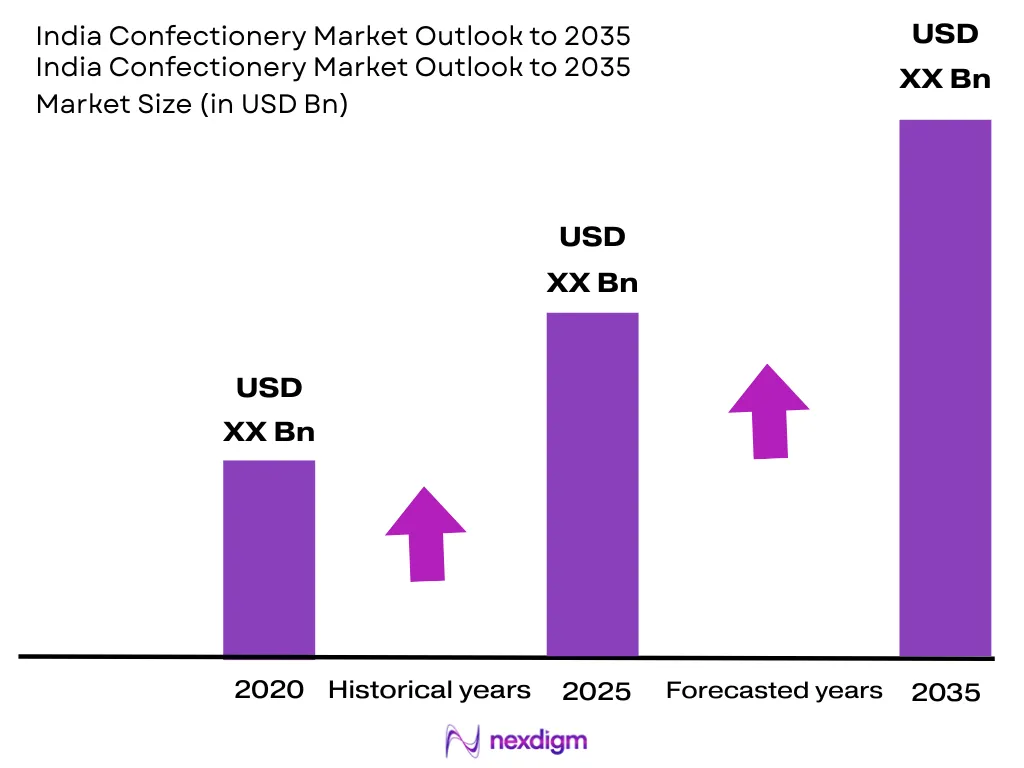
The India confectionery market was valued at USD ~ billion in 2024 and is projected to expand at a CAGR of ~% during the 2026–2035 forecast period. According to industry statistics published by the Indian Beverage and Food Processing Association and the Confederation of Indian Industry (CII), India’s confectionery industry continues to be one of the fastest-growing segments within the broader packaged food sector, supported by a population exceeding 1.44 billion people. Data from market research agencies including Euromonitor indicates that sugar confectionery and affordable mass-market chocolate continue to account for the largest volume share, while premium chocolate, functional confectionery, and festive gifting products are growing at a significantly faster rate among India’s expanding urban middle class. Growth is supported by rising disposable income, deep rural distribution through India’s vast kirana store network, strong festive and gifting traditions, product innovation, and rapidly expanding quick commerce penetration.
Market Segmentation
By Product Type
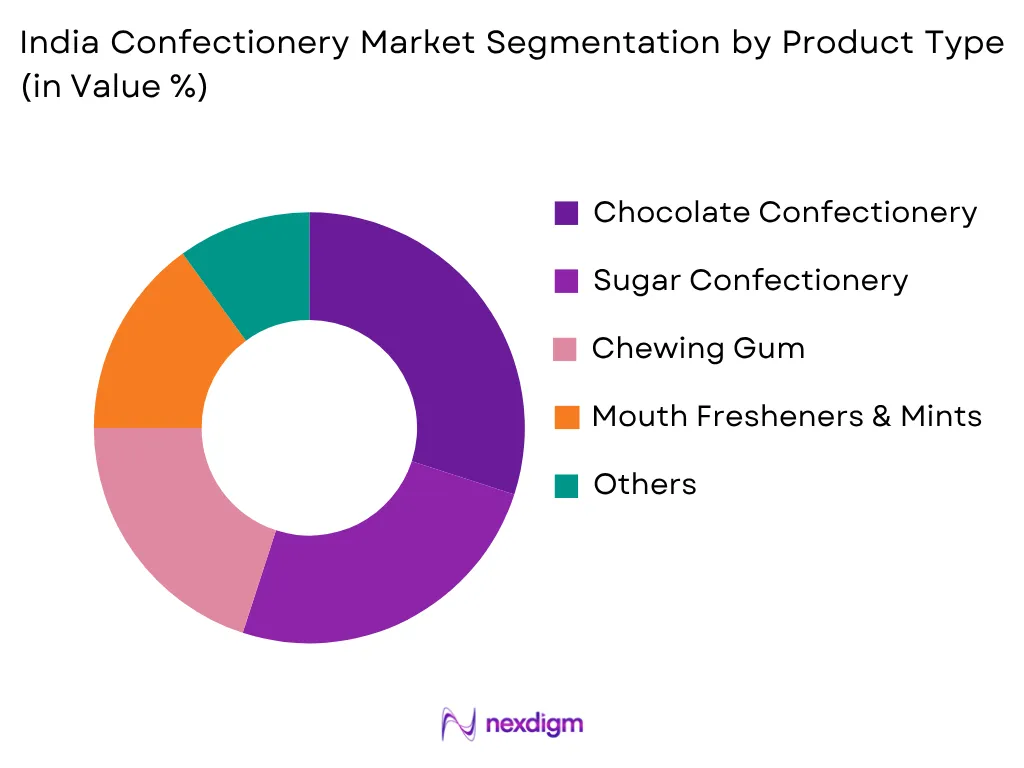
Chocolate confectionery and sugar confectionery jointly dominate the Indian confectionery market, with sugar confectionery historically commanding the larger volume share owing to its affordability, broad accessibility across all income segments, and deep penetration through India’s extensive kirana store and paan shop network. Chocolate confectionery, however, continues to grow at a faster pace driven by rising disposable income, increasing urbanisation, and the cultural embedding of chocolate gifting during major festivals including Diwali, Raksha Bandhan, and weddings. Large domestic and multinational manufacturers including Mondelez India (Cadbury), Nestlé India, Parle Products, and Perfetti Van Melle India continue introducing innovative flavours, regionally adapted products, and limited-edition festive offerings that attract both price-sensitive rural consumers and premium urban demographics. India’s domestic cocoa cultivation, concentrated in Kerala, Karnataka, Andhra Pradesh, and Tamil Nadu, supports a portion of local manufacturing, though the country remains a net importer of cocoa to meet growing chocolate demand. Continuous investments in premium chocolates, affordable single-serve formats, regional flavour variants, and festive gifting collections have further strengthened the segment’s growth while expanding its presence across kirana stores, modern retail, paan shops, and rapidly growing online and quick commerce platforms.
By Distribution Channel
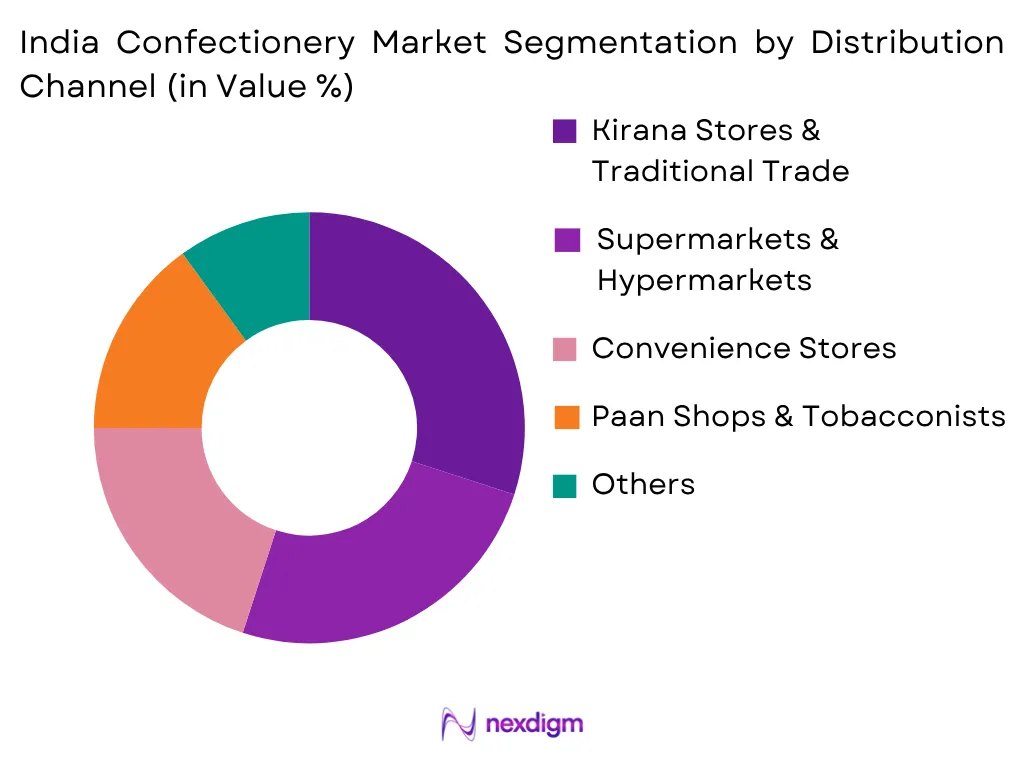
Kirana stores and traditional trade account for the largest share of confectionery sales in India because they provide deep, hyperlocal distribution reach across urban, semi-urban, and rural markets that organised retail has yet to match. According to industry estimates, India has more than 13 million kirana stores nationwide, forming the backbone of confectionery distribution and ensuring product availability even in the country’s most remote villages. These stores maintain strong procurement relationships with both domestic and multinational confectionery manufacturers through extensive multi-tier distributor networks, and capitalise on impulse purchasing through prominent counter-top and shelf placement of low-unit-price confectionery items. Paan shops and tobacconists represent a uniquely important channel in India for mouth fresheners, mints, and small-format sugar confectionery, particularly in urban centres. Modern retail, including supermarkets and hypermarkets such as Reliance Retail, Big Bazaar, and DMart, continues to expand its share in major metropolitan areas, offering consumers extensive product assortments and premium confectionery sections. Quick commerce platforms including Blinkit, Zepto, and Swiggy Instamart have emerged as a rapidly growing channel for confectionery in urban India, particularly for impulse and festive purchases, given their ability to deliver products within minutes. Festive season merchandising during Diwali and other major occasions further boosts sales volumes significantly across both traditional and modern retail formats.
Competitive Landscape
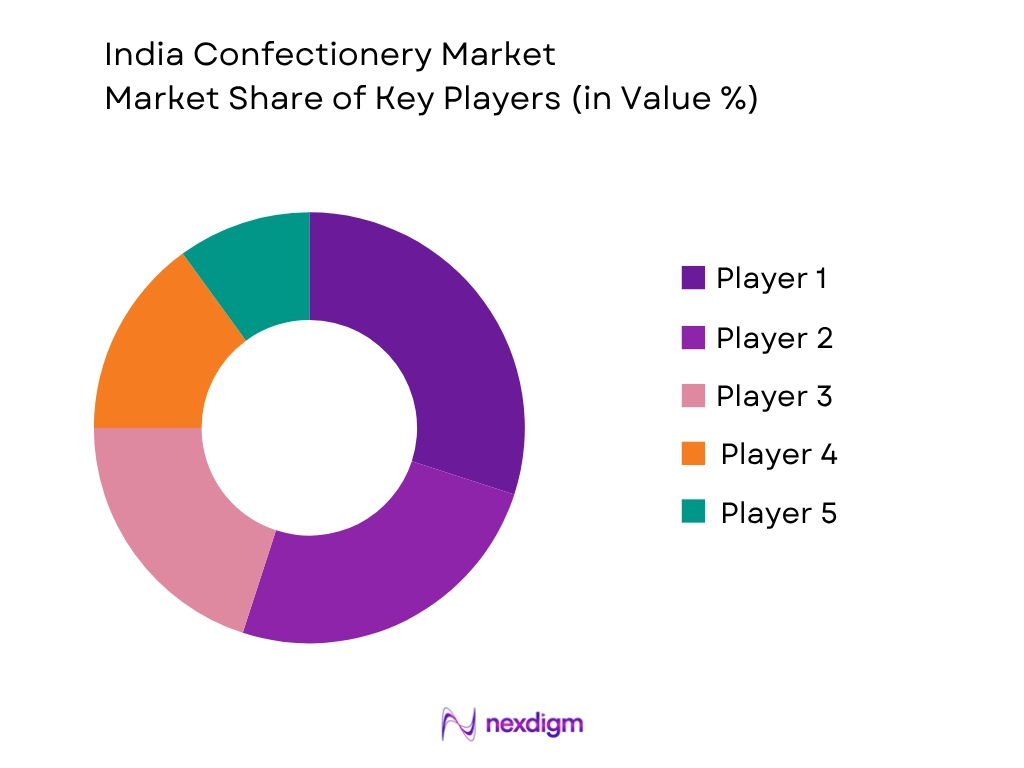
The India confectionery market is moderately fragmented, with multinational manufacturers competing alongside well-established domestic companies and a significant base of regional and unorganised players, particularly in the sugar confectionery segment. Global companies such as Mondelez India, Nestlé India, Perfetti Van Melle India, and Ferrero India leverage extensive distribution networks and brand recognition built over decades, while domestic companies including Parle Products, ITC Limited, DS Group, and Amul maintain strong consumer loyalty through affordable pricing, regional flavour adaptation, and deep rural distribution penetration. Continuous investments in premium chocolates, affordable indulgence formats, regional product innovation, and omnichannel retail strategies, including rapid expansion into quick commerce, remain key competitive differentiators.
| Company | Establishment Year | Headquarters | Primary Protein Focus | Processing Facilities
|
Export Presence | Production Integration | Sustainability Programs | Value-Added Product Portfolio |
| Mondelez India | 1948 | ~ | ~ | ~ | ~ | ~ | ~ | ~ |
| Nestlé India | 1959 | ~ | ~ | ~ | ~ | ~ | ~ | ~ |
| Parle Products | 1929 | ~ | ~ | ~ | ~ | ~ | ~ | ~ |
| Perfetti Van Melle India | 1995 | ~ | ~ | ~ | ~ | ~ | ~ | ~ |
| Ferrero India | 2004 | ~ | ~ | ~ | ~ | ~ | ~ | ~ |
India Confectionary Market Analysis
Growth Drivers
Rising Disposable Income and Strong Festive Gifting Culture
India’s rapidly expanding middle class and deeply embedded festive gifting traditions continue to be among the primary growth drivers for the confectionery market. According to the United Nations Population Division, India surpassed 1.44 billion people in 2024, overtaking China to become the world’s most populous nation, creating an immense and growing consumer base for confectionery products. The World Bank estimated India’s GDP at approximately USD 3.9 trillion in 2024, with per capita income rising steadily and an expanding middle class increasingly shifting spending patterns toward branded and premium packaged food categories. Confectionery gifting is deeply embedded in Indian festive and social culture, with occasions such as Diwali, Raksha Bandhan, Holi, and wedding season generating substantial seasonal demand spikes for chocolate gift boxes, assorted sweets, and premium confectionery hampers. The National Sample Survey Office (NSSO) has consistently documented a positive correlation between rising household incomes and increased expenditure on packaged snacks and confectionery, particularly among urban households. The International Monetary Fund (IMF) projects India to remain one of the world’s fastest-growing major economies through 2035, underpinning sustained expansion in domestic demand for both affordable mass-market confectionery and premium chocolate products across urban and increasingly rural markets. Rising affluence among India’s growing population of nuclear urban households, combined with increasing exposure to global confectionery trends through social media and travel, continues to drive demand for premium and internationally inspired confectionery formats.
Deep Rural Distribution Penetration and Affordable Single-Serve Innovation
India’s confectionery industry benefits from one of the world’s most extensive and deeply penetrated rural and semi-urban distribution networks, providing a structural growth advantage that few global markets can replicate. According to industry estimates, India’s kirana store network exceeds 13 million outlets, supported by sophisticated multi-tier distribution systems that enable even the smallest single-rupee confectionery items to reach the most remote villages across the country. Manufacturers including Parle Products, Perfetti Van Melle India, and Mondelez India have built extensive rural distribution capabilities over decades, often reaching markets that larger packaged food categories struggle to penetrate profitably. The affordability of single-serve and low-unit-price confectionery formats, frequently priced at INR 1, 2, 5, or 10 per unit, has been a defining innovation enabling mass-market accessibility across India’s vast population of price-sensitive rural and lower-income urban consumers. The Reserve Bank of India (RBI) has reported steady growth in rural disposable income supported by agricultural income growth and government rural development programmes, further strengthening rural consumption capacity for branded confectionery products. Government initiatives promoting rural road connectivity and electrification under programmes such as the Pradhan Mantri Gram Sadak Yojana have also progressively improved last-mile distribution logistics, enabling manufacturers to expand their rural footprint and introduce new products to previously underserved markets, thereby supporting sustained long-term volume growth across the Indian confectionery sector.
Market Challenges
Cocoa Supply Volatility and Import Dependency
Indian confectionery manufacturers continue facing significant challenges arising from cocoa supply volatility and substantial dependency on imported cocoa beans and derivatives, despite limited domestic cultivation in southern states. According to the International Cocoa Organization (ICCO), global cocoa production fell to approximately 4.37 million tonnes during the latest reporting period, with end-of-season stocks declining to nearly 1.27 million tonnes, the lowest stock-to-grinding ratio recorded in decades. Cocoa futures prices on the ICE exchange reached record highs during 2024, more than doubling year-over-year, directly increasing input costs for Indian chocolate manufacturers. India’s domestic cocoa cultivation, concentrated in Kerala, Karnataka, Andhra Pradesh, and Tamil Nadu, remains insufficient to meet the country’s growing chocolate manufacturing requirements, with the Directorate of Cashewnut and Cocoa Development (DCCD) reporting domestic production levels well below industrial demand. The shortage has forced Indian processors to increase imports primarily from West African origins, exposing manufacturers to global price volatility, currency fluctuation risk on the Indian Rupee, and West African supply disruption risks including crop disease and adverse weather conditions. Manufacturers must therefore manage procurement risks, diversify sourcing strategies, improve supply-chain resilience through forward contracting, and invest in long-term partnerships with both domestic cocoa farmers and international cocoa-producing cooperatives to maintain stable production and competitive pricing for India’s highly price-sensitive consumer base.
Extreme Climate Conditions and Distribution Infrastructure Constraints
India’s extreme and diverse climate conditions create distinctive operational challenges for confectionery manufacturers and distributors that are less pronounced in temperate markets. According to the India Meteorological Department (IMD), large parts of the country experience sustained summer temperatures exceeding 40 degrees Celsius for several months each year, creating significant chocolate product stability, melting, and bloom-related quality challenges throughout the supply chain, from manufacturing and warehousing through to last-mile kirana store distribution, where temperature-controlled storage is frequently unavailable. This climate constraint has historically limited chocolate confectionery penetration in many parts of India relative to less temperature-sensitive sugar confectionery, requiring manufacturers to invest in specialised heat-stable chocolate formulations, reinforced packaging, and cold chain logistics solutions, particularly during peak summer months. Additionally, the Confederation of Indian Industry (CII) and various industry associations have highlighted that India’s cold chain and refrigerated transport infrastructure, while improving steadily, remains underdeveloped relative to the scale of the country’s geography and population, creating particular challenges for premium and filled chocolate products requiring strict temperature control. Manufacturers must balance the cost of climate-resilient packaging and logistics investment against price sensitivity in India’s mass-market confectionery segment, where even marginal cost increases can significantly affect product accessibility for lower-income consumers. These climate and infrastructure constraints continue to shape product formulation strategies, regional distribution prioritisation, and seasonal demand planning across the Indian confectionery industry.
Market Opportunities
Premium, Functional and Better-for-You Confectionery
India’s evolving consumer preferences are creating substantial opportunities for premium, functional, and health-oriented confectionery products, particularly among the country’s rapidly expanding urban middle and upper-income consumer segments. With a population of more than 1.44 billion and an increasingly affluent urban consumer base, India provides one of the world’s largest addressable markets for manufacturers introducing premium chocolates, sugar-free confectionery, functional gummies, and clean-label innovations. Rising disposable income and growing health consciousness, particularly among younger urban consumers, have encouraged greater spending on indulgent products with perceived quality and functional health benefits. The International Monetary Fund estimates India’s GDP at approximately USD 3.9 trillion in 2024, supporting stronger household expenditure on premium packaged foods, particularly across India’s major metropolitan centres. Simultaneously, increasing awareness of nutrition has begun to accelerate demand for confectionery containing natural ingredients, higher cocoa content, reduced sugar formulations, and functional additives such as vitamins, minerals, and probiotics, particularly within India’s growing organised retail and e-commerce channels. Premium gifting has also become increasingly important during festive occasions including Diwali, Raksha Bandhan, and wedding season, creating opportunities for manufacturers to introduce artisanal collections, personalised gift boxes, and limited-edition festive products. Expansion of specialty chocolate boutiques and direct-to-consumer digital platforms further enables companies to target affluent urban consumers with differentiated offerings. Manufacturers investing in product innovation, premium packaging, and healthier ingredient profiles are therefore well positioned to capture future demand while strengthening brand loyalty across India’s rapidly evolving consumer landscape.
Quick Commerce Expansion and Rural Market Penetration
The rapid emergence of quick commerce platforms and continued deepening of rural market penetration present significant long-term opportunities for the Indian confectionery industry. According to industry estimates, India’s quick commerce sector — led by platforms such as Blinkit, Zepto, and Swiggy Instamart — has experienced exceptional growth, fundamentally transforming how urban Indian consumers access impulse and festive confectionery purchases through ten-to-twenty-minute delivery capabilities. This channel has proven particularly effective for premium and gifting-oriented confectionery products, as well as last-minute festive purchases during occasions such as Diwali and Valentine’s Day. Simultaneously, India’s vast rural market — encompassing the majority of the country’s population — continues to offer substantial untapped growth potential as rural incomes rise and distribution infrastructure improves. Government initiatives including rural road connectivity programmes and financial inclusion efforts under schemes such as the Pradhan Mantri Jan Dhan Yojana are progressively strengthening rural consumers’ purchasing capacity and access to formal retail channels. Manufacturers investing in extending kirana store distribution into previously underserved rural pockets, while simultaneously building quick commerce capabilities in urban centres, are well positioned to capture growth across both ends of India’s diverse and rapidly evolving consumer spectrum. These complementary channel strategies, combined with continued investment in affordable single-serve formats for rural markets and premium offerings for urban quick commerce consumers, are expected to create substantial incremental growth opportunities for confectionery manufacturers through 2035.
Future Outlook
The India confectionery market is expected to witness sustained and robust growth throughout the forecast period, supported by rising disposable incomes, deepening urbanisation, and India’s deeply embedded festive and gifting culture. Manufacturers are increasingly investing in premium chocolate formats, affordable single-serve innovations, regional flavour adaptation, and rapidly expanding quick commerce distribution channels. Growing penetration of organised and modern retail in urban centres, continued deepening of kirana store distribution in rural markets, and innovation in festive gifting products are expected to create additional growth opportunities. Continued investments in heat-stable chocolate formulations, cold chain infrastructure, and climate-resilient packaging will further strengthen long-term market competitiveness across India’s diverse climatic and geographic landscape.
Major Players
- Mondelez India
- Nestlé India
- Parle Products
- Perfetti Van Melle India
- Ferrero India
- ITC Limited (Confectionery Division)
- Mars International India
- Amul (GCMMF)
- Lotte India Corporation
- DS Group (Pulse, Pass Pass)
- Ravalgon India
- CRAVE by Sumeru
- Hershey India
- Wow Momo (Candyman)
- Campco Chocolates
Key Target Audience
- Confectionery Manufacturers
- Chocolate Manufacturers
- Cocoa Processors
- Sugar and Ingredient Suppliers
- Modern Retail Chains, Kirana Networks and Food Distributors
- Packaging Material Manufacturers
- Investments and Venture Capitalist Firms
- Government and Regulatory Bodies (Food Safety and Standards Authority of India (FSSAI), Ministry of Food Processing Industries (MoFPI), Directorate of Cashewnut and Cocoa Development (DCCD))
Research Methodology
Step 1: Identification of Key Variables
The research begins by identifying the major stakeholders across the India confectionery value chain, including cocoa suppliers, ingredient manufacturers, confectionery producers, distributors, retailers, and consumers. Extensive secondary research is conducted using government publications, industry associations, trade databases, company reports, and proprietary databases to establish the key variables influencing market performance.
Step 2: Market Analysis and Construction
Historical market information is compiled and evaluated to estimate the overall market size, product penetration, production volumes, consumption trends, pricing dynamics, and revenue generation across major confectionery categories. Both demand-side and supply-side indicators are analyzed using bottom-up and top-down market sizing approaches to ensure comprehensive market coverage.
Step 3: Hypothesis Validation and Expert Consultation
Preliminary market estimates and analytical assumptions are validated through Computer Assisted Telephone Interviews (CATIs) and structured discussions with confectionery manufacturers, cocoa processors, distributors, retail executives, procurement specialists, and industry experts. These interviews provide valuable commercial insights that strengthen the reliability of market estimates.
Step 4: Research Synthesis and Final Output
The final stage integrates primary research findings with secondary information to develop a comprehensive assessment of market size, segmentation, competitive landscape, consumer behavior, and future opportunities. Multiple validation techniques, including data triangulation and cross-verification, are employed to ensure the consistency, accuracy, and credibility of the final market report.

- Executive Summary
- Research Methodology (Market Definitions and Assumptions, Abbreviations, Market Taxonomy, Market Sizing Approach, Top-Down Analysis, Bottom-Up Analysis, Demand-Side Assessment, Supply-Side Assessment, Primary Industry Interviews, Secondary Research Validation, Data Triangulation, Forecasting Framework, Limitations and Future Conclusions)

- Definition and Scope
- Market Evolution and Industry Genesis
- Timeline of Major Industry Developments
- Industry Value Chain Analysis
- Supply Chain Analysis

- Growth Drivers (Rising Disposable Income and Expanding Middle Class, Strong Festive and Gifting Culture, Deep Rural and Kirana Store Penetration, Product Innovation and Regional Flavour Adaptation, Rising Demand for Premium and Affordable Indulgence Products, Expanding Quick Commerce and E-Commerce Sales)
- Market Challenges (Volatility in Cocoa Prices, Sugar Price Fluctuations, Extreme Climate and Heat-Related Distribution Constraints, Fragmented Unorganised Sector Competition, Health Concerns Regarding Sugar Intake, Import Dependency for Cocoa Derivatives, Counterfeit and Local Imitation Products, Shelf-Life Management in Tropical Conditions)
- Market Opportunities (Sugar-Free Confectionery Expansion, Functional Gummies and Health-Oriented Sweets, Premium Chocolate Gifting, Rural Market Penetration, Affordable Single-Serve Formats, Plant-Based Chocolate, Quick Commerce Expansion, Regional Flavour Innovation)
- Market Trends (Premiumisation Among Urban Consumers, Regional and Festive Flavour Variants, Clean Label Ingredients, Limited Edition Festive Products, Functional and Fortified Confectionery, Sustainable Packaging Adoption, Affordable Indulgence Formats, Premium Filled Chocolates)
- Government Regulations (Food Safety and Standards Authority of India (FSSAI) Standards, Nutritional Labelling Requirements, Sugar Content Disclosure, Allergen Declaration Requirements, Food Additive Regulations, Packaging Compliance Standards, Import Duty Regulations, Goods and Services Tax (GST) on Confectionery)
- Cocoa Supply and Pricing Analysis (Domestic Cocoa Production in South India, Cocoa Bean Imports, Cocoa Butter Prices, Cocoa Liquor Supply, Processing Capacity, Price Transmission Analysis)
- Sugar Supply Analysis (Domestic Sugarcane Availability, Sugar Cost Trends, Alternative Sweetener Adoption)
- Seasonal Demand Analysis (Diwali, Raksha Bandhan, Holi, Eid, Christmas, Valentine’s Day, Wedding Season Gifting)
- Retail Shelf Space Analysis (Kirana Store Penetration, Modern Trade Category Allocation, Promotional Displays, Checkout Placement)
- Innovation Landscape (Flavour Innovation, Texture Innovation, Functional Ingredients, Packaging Innovation, Premium Launches)
- Sustainability Analysis (Rainforest Alliance Adoption, Cocoa Traceability, Sustainable Packaging, Carbon Reduction Initiatives)
- SWOT Analysis
- Porter’s Five Forces Analysis
- PESTLE Analysis
- Stakeholder Ecosystem
- Competition Ecosystem

- By Market Value (2020-2025)
- By Volume Consumption (2020-2025)
- By Average Selling Price (2020-2025)

- By Product Type (In Value %)
Chocolate Confectionery
Sugar Confectionery (Candies & Toffees)
Chewing Gum
Mouth Fresheners & Mints
Seasonal & Festive Confectionery
Premium & Gourmet Confectionery
Filled and Molded Chocolates
Countlines and Chocolate Bars - By Ingredient Type (In Value %)
Cocoa-Based Confectionery
Sugar-Based Confectionery
Sugar-Free Confectionery
Functional & Fortified Confectionery
Organic & Natural Confectionery
Plant-Based & Vegan Confectionery
- By Distribution Channel (In Value %)
Kirana Stores & Traditional Trade
Supermarkets & Hypermarkets
Convenience Stores
Paan Shops & Tobacconists
Specialty Chocolate Stores
Cash & Carry Wholesale
E-Commerce & Quick Commerce
Direct-to-Consumer - By Packaging Type (In Value %)
Flexible Packs
Flow Wraps
Boxes
Pouches
Gift Packs
Multipacks
Sustainable Packaging - By Region (In Value %)
North India
South India
West India
East India

- Market Share Analysis (By Value, Volume, Product Category, Distribution Channel, Price Segment)
- Cross Comparison Parameters (Chocolate Portfolio Breadth, Sugar Confectionery Portfolio, Annual New Product Launches, Cocoa Processing Capability, Distribution Reach Across India, Festive Product Portfolio Strength, Premium Product Mix, Manufacturing Capacity)
- SWOT Analysis of Major Players
- Pricing Analysis (By SKU, Product Type, Cocoa Content, Premium Positioning, Pack Size)
- Detailed Profiles of Major Companies
Mondelez India
Nestlé India
Parle Products
Perfetti Van Melle India
Ferrero India
ITC Limited (Confectionery Division)
Mars International India
Amul (GCMMF)
Lotte India Corporation
DS Group (Pulse, Pass Pass)
Ravalgon India
CRAVE by Sumeru
Hershey India
Wow Momo (Candyman)
Campco Chocolates

- Consumption Pattern Analysis (Consumption Frequency, Chocolate Preference, Sugar Confectionery Preference, Festive Buying Behaviour, Household Penetration)
- Demographic Consumption Analysis (Age, Gender, Income Level, Household Size, Urban-Rural Distribution)
- Household Expenditure Analysis
- Premium vs Mass Market Consumption Analysis
- Brand Loyalty Analysis
- Health & Wellness Purchase Behaviour
- Product Attribute Preference Analysis (Taste, Cocoa Content, Texture, Sugar Content, Brand Reputation, Packaging, Price, Ingredients)
- Impulse Purchase Behaviour
- Online vs Offline Purchase Behaviour
- Consumer Pain Point Analysis
- Purchase Decision-Making Process

- By Market Value (2026-2035)
- By Volume Consumption (2026-2035)
- By Average Selling Price (2026-2035)


 Request a Sample
 Ask for Customization
 Get a Quote
 Enquire Now