

 Download PDF
Market Overview
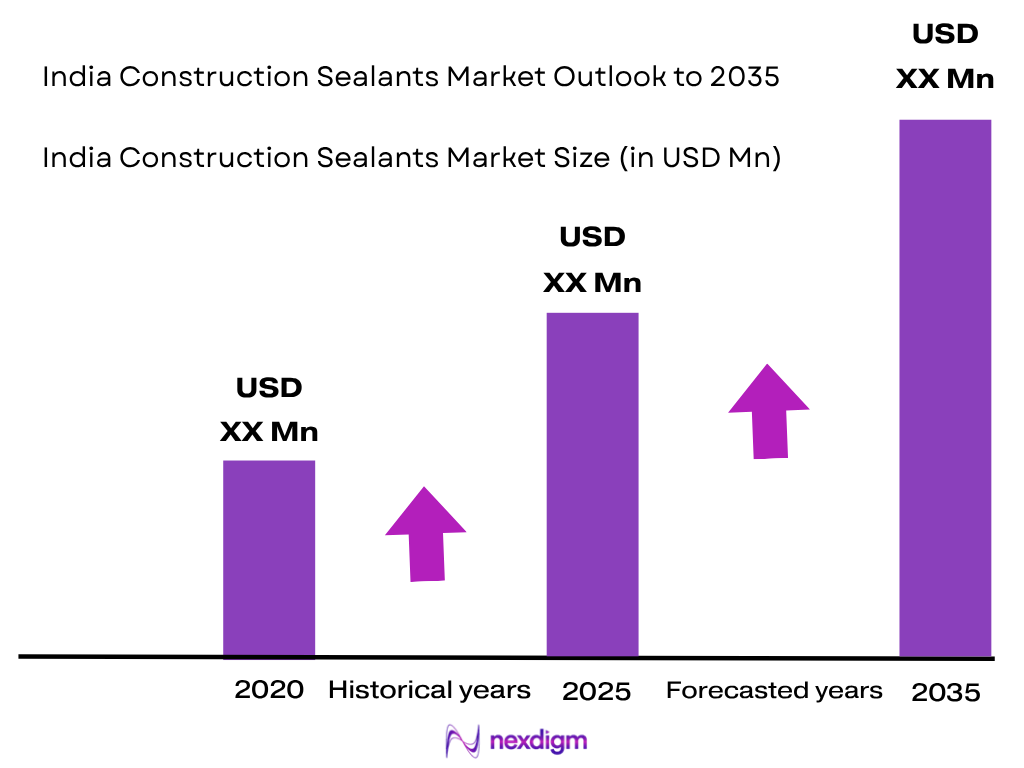
The India Construction Sealants Market is valued at approximately ~USD XX million, supported by building construction, façade systems, infrastructure joints and repair activity. India’s real GDP moved from ₹280.01 lakh crore to ₹299.89 lakh crore, while nominal GDP increased from ₹289.84 lakh crore to ₹318.07 lakh crore across the latest two fiscal observations. Construction remained among the major contributors to GVA expansion, supporting silicone, polyurethane, polysulfide and hybrid sealant demand.
Mumbai–Navi Mumbai, Delhi NCR, Bengaluru, Hyderabad, Chennai and Pune are major India Construction Sealants Market demand centers because they combine high-rise construction, commercial façades, metro infrastructure, airports, data centres and industrial buildings. India already had more than 130 operating data centres, over 12.5 million square feet of data-centre space and more than 1,180 MW of IT load, concentrated primarily in these major cities, strengthening demand for façade, firestop, perimeter and movement-joint sealants.
Market Segmentation
By Sealant Chemistry
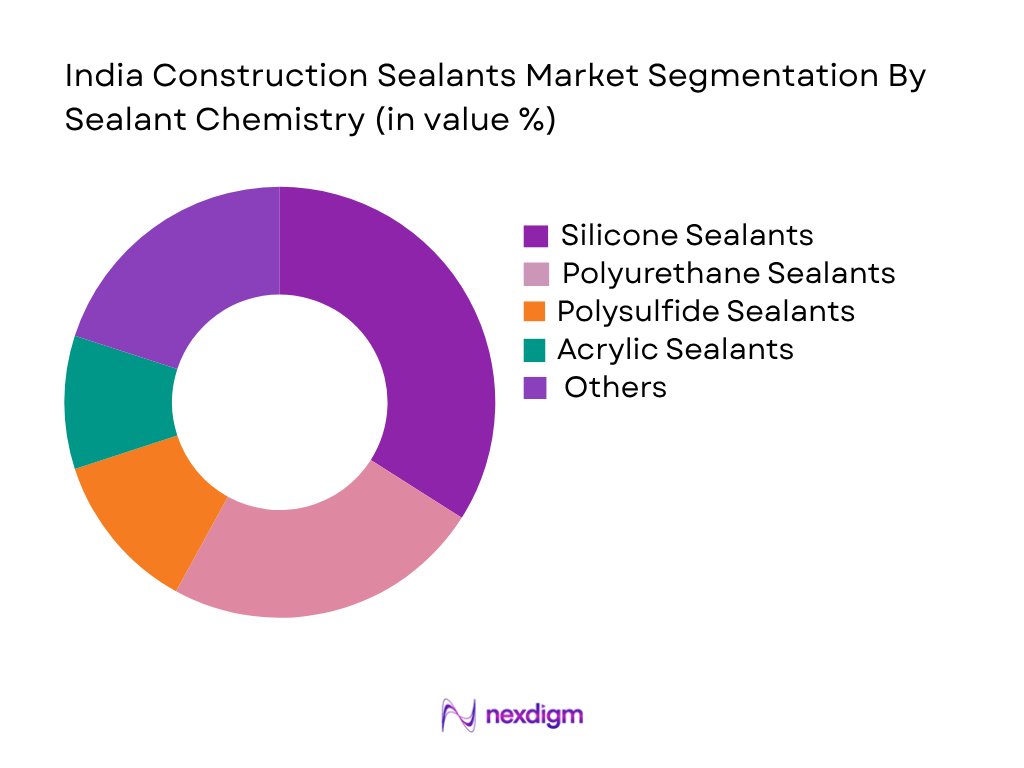
The India Construction Sealants Market is segmented into silicone, polyurethane, polysulfide, acrylic, MS polymer and hybrid, butyl, epoxy and specialty sealants. Silicone sealants hold the dominant modeled share because they are extensively specified for curtain walls, structural glazing, glass-to-metal interfaces, window perimeters, sanitary applications and weathersealing. India’s rapid development of commercial buildings, airports, metros and data centres particularly supports neutral-cure and high-movement silicone systems because these products provide UV resistance, weatherability and long-term elasticity. Structural glazing is especially significant in metropolitan office, retail and hospitality projects where large glass façades require durable adhesion to aluminium and glass. Silicone demand is also supported by renovation and façade maintenance because perimeter joints require periodic replacement over a building’s operating life. The growing data-centre base—already exceeding 12.5 million square feet across more than 130 facilities—also expands applications for façade, fire-rated penetration and air-leakage control systems.
By Application
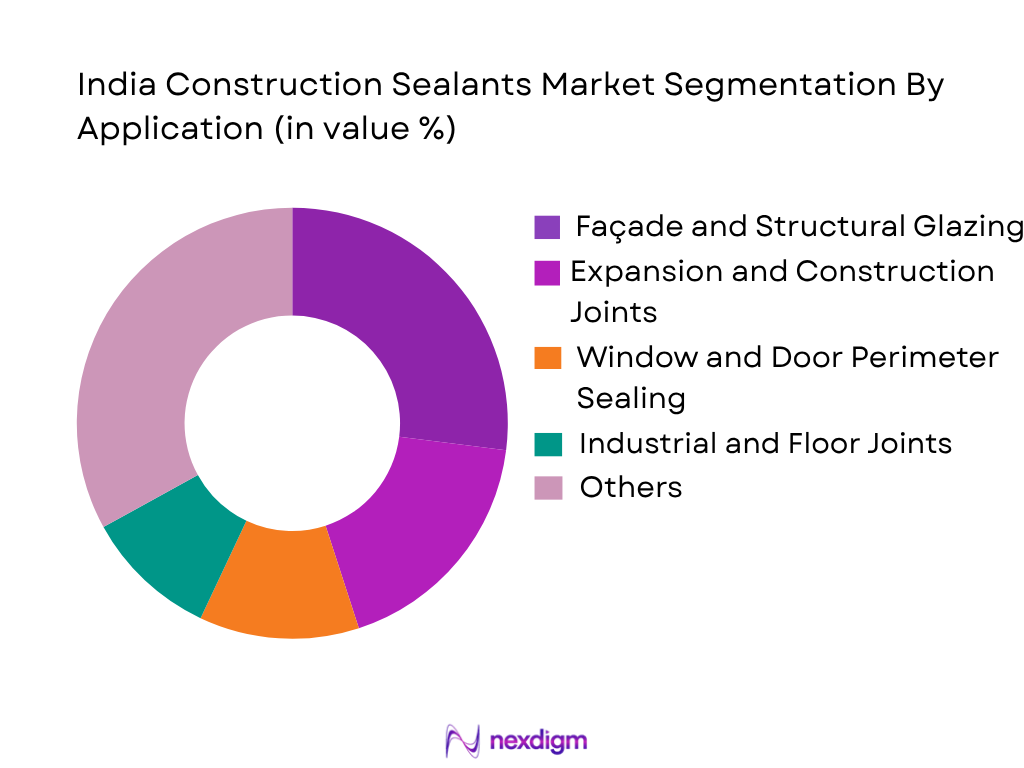
The India Construction Sealants Market is segmented into façades and structural glazing, expansion and construction joints, windows and doors, industrial flooring, precast concrete, infrastructure, roofing, wet areas and firestopping. Façade and glazing applications hold the dominant modeled share because India’s metropolitan construction increasingly uses aluminium curtain walls, unitized façades, ACP assemblies and large glazed elevations. These systems require structural silicone for load transfer and weatherseal silicone for water and air tightness. Data centres, airports and office towers further increase demand for tested perimeter-joint systems. India had 157 operational airports in 2024, compared with 74 a decade earlier, while airport-sector capital expenditure reached around ₹72,000 crore over the five years through FY2024, creating an expanding base of terminals, façades, runways and related infrastructure requiring sealants. India’s operational metro network also exceeded 1,000 km across 23 cities, supporting high-performance movement-joint and weatherproofing applications.
Competitive Landscape
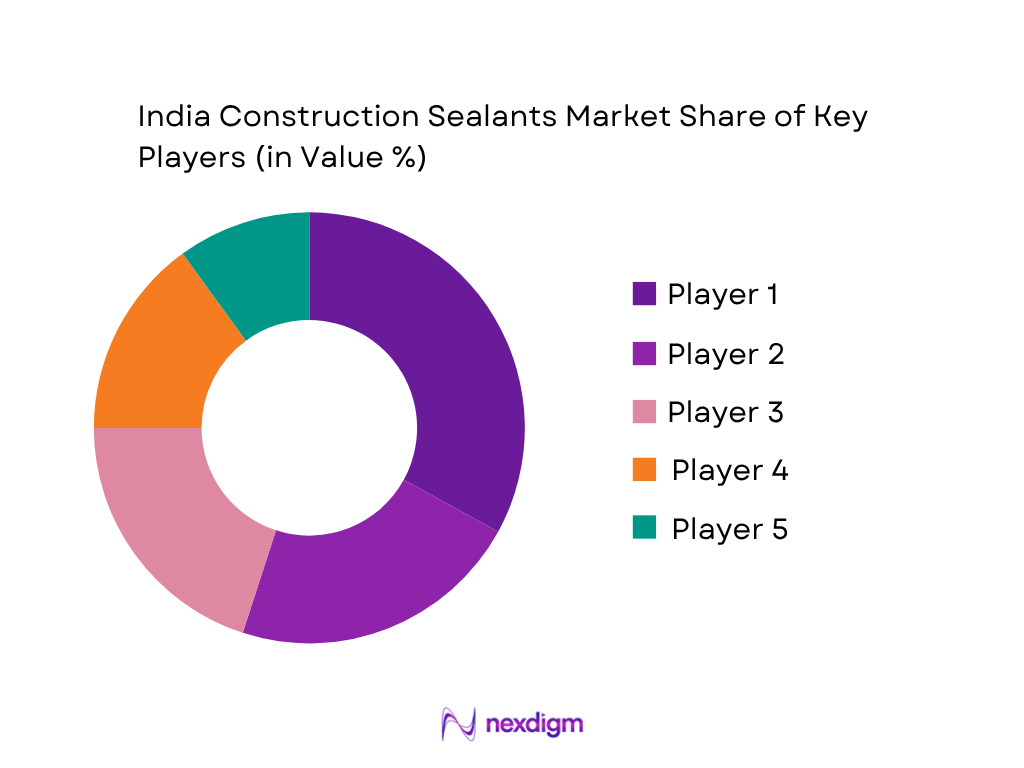
The India Construction Sealants Market includes multinational construction-chemical companies, global silicone specialists and established domestic adhesive and waterproofing manufacturers. Pidilite, Sika, Fosroc, MAPEI and Dow are among the major participants, competing through silicone, polyurethane, polysulfide, hybrid and structural-glazing technologies. Competitive differentiation depends on façade specification capability, infrastructure references, domestic formulation and packaging, distributor reach, compatibility testing and applicator support.
| Major Player | Establishment Year | Headquarters | Silicone Capability | PU / Polysulfide Capability | Façade & Structural Glazing | Infrastructure Joint Systems | India Manufacturing / Formulation | Technical Support |
| Pidilite Industries | 1959 | Mumbai, India | ~ | ~ | ~ | ~ | ~ | ~ |
| Sika | 1910 | Baar, Switzerland | ~ | ~ | ~ | ~ | ~ | ~ |
| Fosroc | 1972 | Dubai, UAE | ~ | ~ | ~ | ~ | ~ | ~ |
| MAPEI | 1937 | Milan, Italy | ~ | ~ | ~ | ~ | ~ | ~ |
| Dow | 1897 | Midland, Michigan, USA | ~ | ~ | ~ | ~ | ~ | ~ |
India Construction Sealants Market Analysis
Growth Drivers
Urban Housing and High-Rise Construction Expand Building Joint and Perimeter Sealant Demand
India’s large housing and urban-building pipeline is sustaining demand for silicone, polyurethane, acrylic and hybrid construction sealants used in window perimeters, bathrooms, façades, precast joints and expansion joints. The Ministry of Housing and Urban Affairs reported 118.64 lakh houses sanctioned, 114.40 lakh houses grounded and 85.43 lakh houses completed or delivered under PMAY-U as of August 2024, backed by total investment of ₹8.07 lakh crore and Central assistance of ₹2.00 lakh crore. PMAY-U 2.0 subsequently approved 8.56 lakh houses by August 2025, while more than 93.81 lakh pucca urban houses had been delivered under the broader programme. Each additional building increases linear joint length across windows, façade interfaces, bathrooms, balconies, parapets and concrete movement joints, directly expanding professional sealant applications. India’s macroeconomic scale supports this construction base: the World Bank recorded 2024 GDP of USD 3.91 trillion, GDP per capita of USD 2,694.7 and population of 1.451 billion; IMF data place 2024/25 nominal GDP at ₹324,528 billion. These indicators reinforce the depth of the residential and urban asset base available to construction-sealant suppliers.
Metro, Highway and Airport Infrastructure Creates Large-Scale Movement-Joint Requirements
India’s transport-infrastructure build-out is increasing demand for polyurethane, polysulfide, silicone and pavement sealants designed for high movement, weather exposure, water ingress control and traffic loading. The Ministry of Housing and Urban Affairs reported 945 km of operational metro rail across 21 cities in August 2024, expanding beyond 1,000 km across 23 cities by January 2025 and reaching 1,095 km across 26 cities during 2025. National Highways covered 146,195 km, while 12,349 km were constructed in FY2023-24 and NHAI added another 5,614 km in FY2024-25. NHAI capital expenditure reached more than ₹2,50,000 crore in FY2024-25, providing a substantial civil-engineering project base for bridge, pavement and structure joint sealants. The infrastructure pipeline remained active in FY2025-26, when NHAI constructed 5,313 km and deployed ₹2,44,362 crore in capital expenditure. World Bank data place India’s 2024 GDP at USD 3.91 trillion and population at 1.451 billion, while IMF nominal GDP reached ₹324,528 billion in 2024/25, giving public infrastructure investment a large macroeconomic base and supporting long-duration sealant demand.
Market Challenges
Application Quality and Joint-Design Errors Raise Failure Risk Across Large Project Volumes
The India Construction Sealants Market faces a technical execution challenge because sealant performance depends heavily on correct joint geometry, substrate preparation, primer selection, backer-rod placement and prevention of three-sided adhesion. The issue becomes more material as project volumes rise: PMAY-U had 114.40 lakh houses grounded and 85.43 lakh completed or delivered by August 2024, while India’s metro network already covered 945 km across 21 cities. These projects generate millions of individual perimeter, façade, bathroom, expansion and precast joints that must be executed consistently. BIS maintains dedicated specifications such as IS 11433 Part 1 for one-part gun-grade polysulfide joint sealants and IS 12118 Part 1 for two-part polysulfide systems; IS 11433 was reviewed again in 2025, highlighting the continued relevance of standardized performance requirements. Poor joint-depth control or contaminated substrates can cause adhesive failure even when the sealant formulation itself is compliant, creating a strong requirement for site supervision and applicator training. The macroeconomic consequence is amplified by India’s 2024 GDP of USD 3.91 trillion, GDP per capita of USD 2,694.7 and population of 1.451 billion, according to the World Bank, because construction quality must be managed across an exceptionally large installed asset base.
Imported Specialty Feedstocks and Chemical Compliance Increase Formulation Complexity
Construction sealant manufacturers in India remain exposed to imported specialty chemicals used in silicone, polyurethane, hybrid and high-performance joint systems, creating supply-chain and formulation complexity even where final blending or cartridge filling is localized. Department of Commerce data show India imported USD 416.94 billion of merchandise during April–October 2024-25, while ASEAN imports alone reached USD 48.90 billion; plastics and articles and organic chemicals were among the major imported commodity groups from the region. Government trade data also recorded ₹45,897.59 crore of artificial resins and plastic materials imports during April–June 2024 and ₹60,332.63 crore of organic and inorganic chemical imports over the same period, categories relevant to polymeric sealant and specialty additive supply chains. At the same time, the Department of Chemicals and Petrochemicals reported 72 Quality Control Orders covering chemicals and petrochemicals, requiring both domestic and imported materials to meet mandatory BIS specifications. For sealant formulators, variation in polymer, plasticizer, catalyst and adhesion-promoter sourcing can affect cure rate, modulus and substrate adhesion. India’s 2024 GDP stood at USD 3.91 trillion, with GDP per capita of USD 2,694.7, while IMF nominal GDP for 2024/25 was ₹324,528 billion, demonstrating the scale of the construction economy exposed to these chemical-supply dependencies.
Market Opportunities
Data Centre Expansion Creates Future Demand for Firestop, Façade and Air-Sealing Systems
India’s expanding data-centre infrastructure provides a strong future opportunity for premium construction sealants because these facilities require tightly controlled fire, air, water and façade interfaces rather than basic general-purpose caulks. Government information published in 2026 states that India had around 1,280 MW of installed data-centre capacity as of June 2025, supported by approximately 130 privately operated data centres and 49 government-operated facilities. This active base creates immediate demand for fire-rated acrylic and silicone sealants around cable trays and pipe penetrations, façade weatherseals, roof joints, raised-floor perimeters and airtight internal interfaces. Data centres also rely on controlled environments, making low-VOC formulations, durable elastic joints and tested firestop assemblies more important than in conventional low-specification buildings. As capacity additions continue within Mumbai, Chennai, Delhi NCR, Bengaluru, Hyderabad and other hubs, suppliers with structural silicone, firestop and hybrid polymer capabilities can capture higher-value specification-driven demand. The opportunity is supported by India’s broader macroeconomic platform: World Bank data put 2024 GDP at USD 3.91 trillion, population at 1.451 billion and GDP per capita at USD 2,694.7, while IMF nominal GDP reached ₹324,528 billion in 2024/25, supporting continued digital infrastructure investment.
Highway and Metro Rehabilitation Opens a Durable Infrastructure Sealant Opportunity
India’s extensive and increasingly mature transport network creates a future opportunity not only from new construction but also from joint replacement, rehabilitation and preventive maintenance. The National Highway network measured 146,195 km in early 2025, including 45,947 km of four-lane and above highways excluding high-speed corridors and 2,474 km of high-speed corridors. During FY2024-25, NHAI constructed 5,614 km and deployed more than ₹2,50,000 crore in capital expenditure; in FY2025-26 it constructed another 5,313 km with ₹2,44,362 crore of capital expenditure. Separately, the metro network reached 1,095 km across 26 cities during 2025, supported by an annual metro budget of ₹29,550 crore for FY2025-26. This installed infrastructure creates long-term demand for polysulfide, polyurethane, silicone and specialized pavement-joint sealants in bridge decks, viaducts, metro stations, tunnels, runways and concrete pavements where water ingress and cyclical movement must be controlled. The opportunity is backed by India’s 2024 GDP of USD 3.91 trillion and population of 1.451 billion, while IMF nominal GDP of ₹324,528 billion in 2024/25 indicates substantial fiscal and economic capacity to support continued transport asset construction and maintenance.
Future Outlook
The India Construction Sealants Market is forecast to expand at approximately ~X.X% CAGR during 2026–2035. Growth is expected to shift progressively from basic caulking compounds toward neutral-cure silicone, high-movement polyurethane, MS polymer, firestop and specification-driven infrastructure sealants. Metro, airport, data-centre, industrial and façade construction will increasingly favor tested systems capable of managing thermal movement, weather exposure, water ingress and air leakage.
India’s construction base remains a major structural support. Under the latest revised national accounts, real GDP increased from ₹280.01 lakh crore to ₹299.89 lakh crore, and construction was identified among the sectors contributing strongly to real GVA expansion. This creates a broad demand environment for building joints, façade sealing, precast joints and infrastructure applications.
Major Players
- Pidilite Industries Limited
- Sika India Private Limited
- Fosroc Chemicals India Private Limited
- MAPEI Construction Products India Private Limited
- Dow Chemical International Private Limited
- Wacker Metroark Chemicals Private Limited
- Henkel Adhesives Technologies India Private Limited
- Tremco CPG India
- Saint-Gobain Construction Chemicals India
- H.B. Fuller India
- 3M India Limited
- Astral Adhesives
- Anabond Limited
- McCoy Soudal Sealants Adhesives & Foams Private Limited
- Choksey Chemicals Private Limited
Key Target Audience
- Construction Sealant and Construction Chemical Manufacturers
- Façade, Glazing and Building Envelope Contractors
- Infrastructure, Metro and Airport Contractors
- Property Developers and Real Estate Companies
- Industrial, Data Centre and Logistics Facility Developers
- Construction Chemical Distributors and Specialist Applicators
- Investments and Venture Capitalist Firms
- Government and Regulatory Bodies (Bureau of Indian Standards, Central Public Works Department, Ministry of Road Transport and Highways, National Highways Authority of India, Airports Authority of India, Ministry of Housing and Urban Affairs)
Research Methodology
Step 1: Identification of Key Variables
The initial phase involves constructing an ecosystem map covering sealant raw-material suppliers, manufacturers, façade contractors, applicators, distributors, property developers and infrastructure contractors. Secondary research identifies key demand variables such as construction activity, façade area, expansion-joint requirements, chemistry penetration, metro and airport infrastructure, data-centre construction and renovation demand.
Step 2: Market Analysis and Construction
Historical India Construction Sealants Market demand is assessed through top-down and bottom-up methodologies. Top-down analysis evaluates construction GVA, housing delivery, commercial construction, metro networks, airports and infrastructure activity, while bottom-up analysis estimates sealant consumption using joint lengths, cartridge or sausage consumption, application rates, façade area and project-specific sealant requirements.
Step 3: Hypothesis Validation and Expert Consultation
Market hypotheses are validated through computer-assisted telephone interviews with sealant manufacturers, façade contractors, applicators, distributors, structural glazing specialists and infrastructure contractors. These consultations assess silicone versus PU usage, structural glazing specifications, joint movement requirements, polysulfide demand, package preferences, technical failures and regional competitive dynamics.
Step 4: Research Synthesis and Final Output
The final phase triangulates government construction statistics, infrastructure data, company disclosures and primary interviews. Bottom-up consumption estimates are reconciled with top-down construction indicators to establish product mix, application structure, competitive positioning and regional demand. The resulting analysis incorporates façade, infrastructure, industrial and repair applications to develop a validated outlook for the India Construction Sealants Market.

- Executive Summary
- Research Methodology (Market Definitions and Assumptions, India Construction Sealants Market Classification, Silicone Sealant Scope, Polyurethane Sealant Assessment, Polysulfide Sealant Assessment, Acrylic Sealant Assessment, MS Polymer and Hybrid Sealant Assessment, Butyl Sealant Assessment, Epoxy Joint Sealant Assessment, Firestop Sealant Assessment, Structural Glazing Sealant Assessment, Weatherseal Sealant Assessment, Expansion Joint Sealant Assessment, Precast Joint Sealant Assessment, Concrete Pavement Joint Sealant Assessment, Wet-Area Sealant Assessment, Window and Door Perimeter Sealant Assessment, Roofing and Cladding Joint Sealant Assessment, IS 11433 Assessment, IS 12118 Assessment, IS 3414 Joint Design Assessment, IS 6509 Pavement Joint Sealant Assessment, Joint Movement Assessment, Substrate Compatibility Assessment)

- Definition and Scope
- India Construction Sealants Industry Evolution and Development of Conventional Mastic Sealants, Acrylic Gap Sealants, Butyl Sealants, Polysulfide Joint Sealants, One-Component Polyurethane Sealants, Two-Component Polyurethane Sealants, Acetoxy Silicone Sealants, Neutral-Cure Silicone Sealants, Structural Silicone Glazing Systems, Low-Modulus Weatherseal Silicones, MS Polymer Sealants, Hybrid Polymer Sealants, Firestop Sealants, High-Movement Expansion Joint Sealants, Precast Joint Sealants, Concrete Pavement Sealants, Window and Door Perimeter Sealants, Roofing and Cladding Sealants, Low-VOC Sealants and High-Durability Building Envelope Systems
- Construction Sealants Value Chain Analysis
- Construction Sealants Supply Chain Analysis
- Silicone Polymer Suppliers, Polyurethane Raw Material Suppliers, Polysulfide Polymer Suppliers, Acrylic Polymer Suppliers, Silane-Terminated Polymer Suppliers, Plasticizer Suppliers, Mineral Filler Suppliers, Adhesion Promoter Suppliers, Pigment Suppliers, Packaging Suppliers, Construction Sealant Manufacturers, Local Formulators

- Growth Drivers (High-Rise Residential Development, Commercial Façade Construction, Data Centre Expansion, Airport Infrastructure, Metro Rail Development, Industrial and Logistics Construction, Precast Concrete Adoption, Glass Curtain Wall Penetration, Building Refurbishment, Expansion Joint Maintenance, Waterproofing Integration, Urban Infrastructure Development)
- Market Challenges (Unorganized Applicator Base, Incorrect Joint Design, Poor Surface Preparation, Primer Misuse, Sealant Underfilling, Three-Sided Adhesion, Joint Movement Miscalculation, Product Substitution, Low-Cost Sealant Competition, Imported Raw Material Dependence, Silicone Compatibility Issues, Natural Stone Staining Risk, Backer-Rod Selection Errors, Inadequate Cure Conditions, Specification Enforcement)
- Market Opportunities (Structural Glazing Silicone, High-Movement Façade Sealants, MS Polymer Sealants, Hybrid Polymer Sealants, Firestop Sealants, Data Centre Joint Sealing, Airport and Runway Sealants, Metro and Tunnel Joint Systems, Precast Joint Sealants, Industrial Floor Joint Sealants, Façade Refurbishment, Window Replacement Sealants, Low-VOC Sealants, Sustainable Building Envelope Systems, Specialty Infrastructure Sealants)
- Market Trends (Neutral-Cure Silicone Adoption, MS Polymer Growth, Hybrid Sealant Technologies, Low-Modulus Façade Sealants, Primerless Adhesion Systems, Structural Glazing Certification, Low-VOC Sealants, Non-Staining Stone Sealants, Fire-Rated Sealants, Cartridge-to-Sausage-Pack Migration, Factory-Applied Precast Sealants, Façade Restoration Systems, Digital Joint Design Support, System-Based Building Envelope Solutions)
- Government Regulations and Standards (National Building Code of India, IS 11433 One-Part Polysulfide Joint Sealant Requirements, IS 12118 Two-Part Polysulfide Sealant Requirements, IS 3414 Code of Practice for Design and Installation of Joints in Buildings, IS 1838 Expansion Joint Filler Requirements, IS 6509 Hot-Applied Joint Sealing Compound Requirements, IS 11817 Joint Classification Requirements, CPWD Specifications for Sealants and Joints, MoRTH Concrete Pavement Joint Requirements, NHAI Project Specifications, Airport Authority of India Airfield Joint Requirements, Firestop and Building Fire-Safety Compliance, VOC and Chemical Safety Requirements)
- SWOT Analysis
- Porter’s Five Forces Analysis
- PESTLE Analysis
- Stakeholder Ecosystem
- Construction Sealants Manufacturing and Project Ecosystem

- By Market Value (2020-2025)
- By Sealant Consumption Volume (2020-2025)
- By Silicone Sealant Consumption (2020-2025)
- By Polyurethane Sealant Consumption (2020-2025)
- By Polysulfide Sealant Consumption (2020-2025)
- By Acrylic Sealant Consumption (2020-2025)
- By MS Polymer and Hybrid Sealant Consumption (2020-2025)
- By Façade and Glazing Sealant Consumption (2020-2025)
- By Expansion Joint Sealant Consumption (2020-2025)
- By Flooring and Industrial Joint Sealant Consumption (2020-2025)
- By Concrete Pavement Sealant Consumption (2020-2025)

- By Sealant Chemistry (In Value %)
Silicone Sealants
Neutral-Cure Silicone Sealants
Acetoxy Silicone Sealants
Polyurethane Sealants
Polysulfide Sealants
Acrylic Sealants
MS Polymer Sealants
Hybrid Polymer Sealants
Butyl Sealants
Epoxy Joint Sealants
Bituminous Sealants
Fire-Resistant Sealants
Other Specialty Construction Sealants - By Product Type (In Value %)
Façade Weatherseal Sealants
Structural Glazing Sealants
Expansion Joint Sealants
Construction Joint Sealants
Floor Joint Sealants
Precast Joint Sealants
Window and Door Perimeter Sealants
Roof and Cladding Joint Sealants
Wet-Area Sealants
Sanitary Sealants
Firestop Sealants
Pavement Joint Sealants
Concrete Crack and Joint Sealants
Marine and Infrastructure Sealants
General-Purpose Construction Sealants - By Application (In Value %)
Glass Façades
Curtain Wall Systems
Aluminium Composite Panel Joints
Rainscreen and Cladding Joints
Window and Door Perimeters
Precast Concrete Joints
Expansion and Movement Joints
Floor Joints
Industrial Floor Joints
Roofing Joints
Bathrooms and Wet Areas
Concrete Pavements
Bridges and Flyovers
Metro Stations and Tunnels
Airports and Runways
Water-Retaining Structures - By Performance Requirement (In Value %)
High Movement Accommodation
Low Modulus
High Elastic Recovery
High Tensile Strength
Structural Glazing Performance
Weather Resistance
UV Resistance
Water Resistance
Chemical Resistance
Fuel Resistance
Fire Resistance
Paintability
Low-VOC Performance
Non-Staining Performance
Primerless Adhesion - By Region (In Value %)
Delhi NCR
Mumbai Metropolitan Region
Pune
Bengaluru
Hyderabad
Chennai
Ahmedabad
Surat
Kolkata
Western India
Southern India
Northern India
Eastern India
Central India
Other India

- Market Share of Major Players (By India Revenue, Sealant Consumption Volume, Silicone Sealant Portfolio, Polyurethane Sealant Portfolio, Polysulfide Sealant Portfolio, MS Polymer and Hybrid Sealant Portfolio, Structural Glazing Exposure, Façade Weatherseal Exposure, Expansion Joint Exposure, Infrastructure Project Exposure, Local Manufacturing Capacity, Cartridge and Sausage Filling Capability, Distributor Network, Applicator Support, Technical Laboratory Capability)
- Cross Comparison Parameters (Silicone PU Polysulfide and Hybrid Sealant Portfolio Breadth, Structural Glazing and Façade Weatherseal Capability, Expansion Joint and High-Movement Sealant Capability, Airport Metro Pavement and Infrastructure Sealant Capability, India Manufacturing Formulation and Packaging Footprint, Nationwide Distributor Façade-Contractor and Applicator Network Reach, BIS CPWD MoRTH and Project-Specification Compliance Capability, Technical Laboratory Joint-Design Compatibility Testing and Site-Support Capability)
- SWOT Analysis of Major Players
- Competitive Positioning Matrix
- Major Companies
Pidilite Industries Limited
Sika India Private Limited
Fosroc Chemicals India Private Limited
MAPEI Construction Products India Private Limited
Dow Chemical International Private Limited
Wacker Metroark Chemicals Private Limited
Henkel Adhesives Technologies India Private Limited
Tremco CPG India
Saint-Gobain Construction Chemicals India
H.B. Fuller India
3M India Limited
Astral Adhesives
Anabond Limited
McCoy Soudal Sealants Adhesives & Foams Private Limited
Choksey Chemicals Private Limited

- Façade and Glazing Contractor Requirement Assessment
- Main Contractor Procurement Assessment
- Waterproofing Contractor Requirement Assessment
- Expansion-Joint Applicator Requirement Assessment
- Property Developer Sealant Specification Assessment
- Infrastructure Contractor Requirement Assessment
- Airport Contractor Requirement Assessment
- Metro and Tunnel Contractor Requirement Assessment
- Data Centre Contractor Requirement Assessment
- Industrial Facility Requirement Assessment
- Building Owner and Facility Manager Requirement Assessment
- Technical Service and Applicator Training Requirement Assessment

- By Market Value (2026-2035)
- By Sealant Consumption Volume (2026-2035)
- By Silicone Sealant Consumption (2026-2035)
- By Polyurethane Sealant Consumption (2026-2035)
- By Polysulfide Sealant Consumption (2026-2035)
- By Acrylic Sealant Consumption (2026-2035)
- By MS Polymer and Hybrid Sealant Consumption (2026-2035)
- By Façade and Glazing Sealant Consumption (2026-2035)
- By Expansion Joint Sealant Consumption (2026-2035)
- By Flooring and Industrial Joint Sealant Consumption (2026-2035)
- By Concrete Pavement Sealant Consumption (2026-2035)


 Request a Sample
 Ask for Customization
 Get a Quote
 Enquire Now
