
 Download PDF
Market Overview
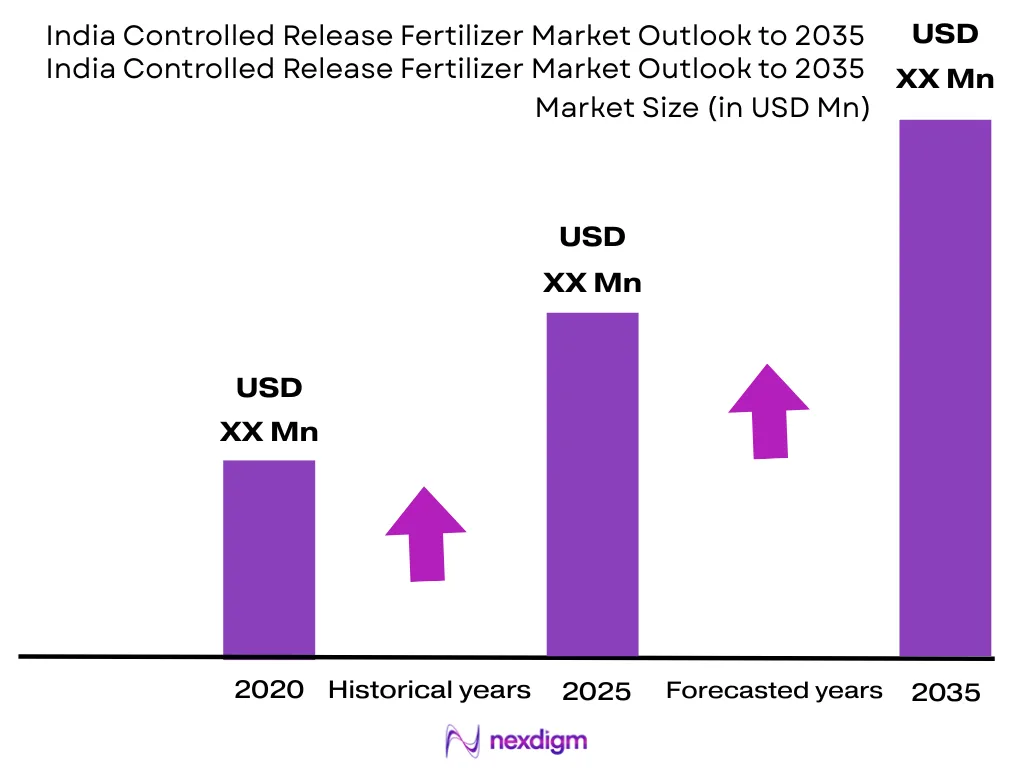
The India Controlled Release Fertilizer Market was valued at approximately USD ~ Million in 2024, compared to USD ~ Million in 2023. The market expansion is closely linked to India’s large agricultural sector, which contributed approximately INR 27.5 trillion to the national economy, while total foodgrain production exceeded 330 million metric tons. Rising adoption of specialty fertilizers, increasing focus on nutrient-use efficiency, expansion of micro-irrigation coverage, and government support for balanced fertilization practices are strengthening demand. The growing cultivation of horticultural crops across more than 28 million hectares and increasing awareness regarding soil health management are further accelerating controlled release fertilizer utilization across commercial farming operations.
Market Segmentation
By Nutrient Type
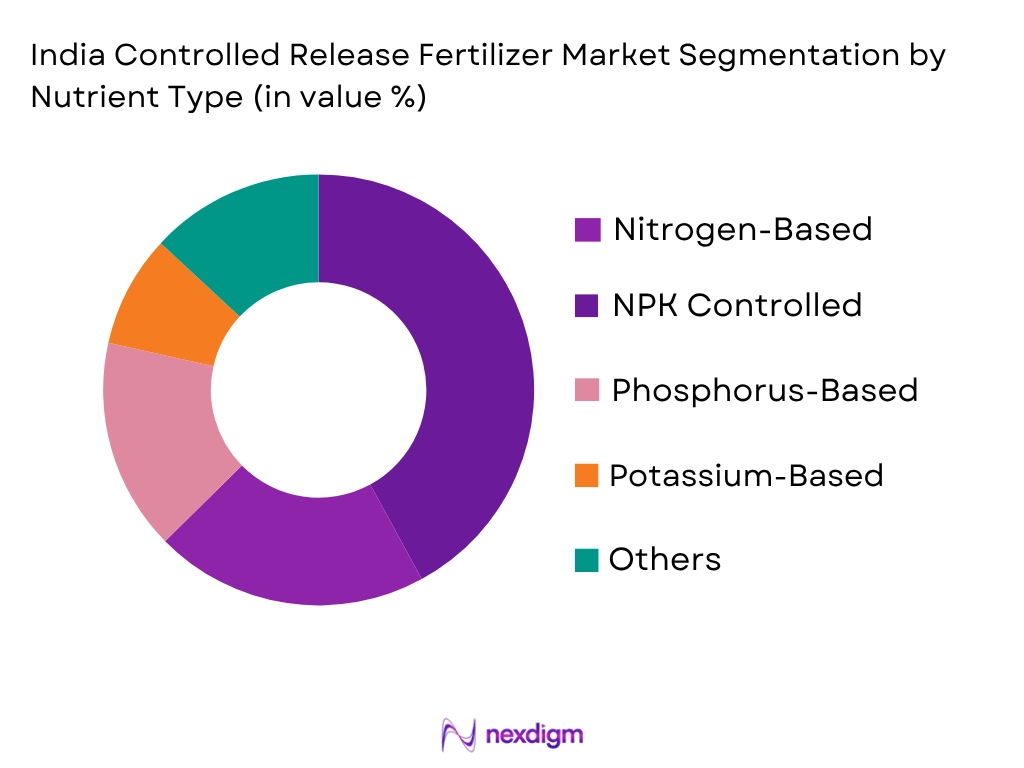
India Controlled Release Fertilizer Market is segmented into nitrogen-based, phosphorus-based, potassium-based, NPK-based, micronutrient-based, and secondary nutrient-based fertilizers. Recently, nitrogen-based controlled release fertilizers have held the dominant market share due to the widespread cultivation of nitrogen-intensive crops such as rice, wheat, maize, sugarcane, and cotton. Nitrogen remains the most consumed plant nutrient in India, making controlled-release nitrogen products highly attractive for reducing nutrient losses through volatilization and leaching. The segment is further supported by increasing awareness regarding nitrogen use efficiency, rising labor costs, and the need for fewer fertilizer applications. Farmers are increasingly adopting polymer-coated urea and enhanced-efficiency fertilizers to optimize crop yields while reducing environmental impact. The government’s focus on balanced fertilization and sustainable agriculture has further strengthened adoption, making nitrogen-based controlled release fertilizers the leading nutrient category across both field crops and horticultural applications.
By Crop Type
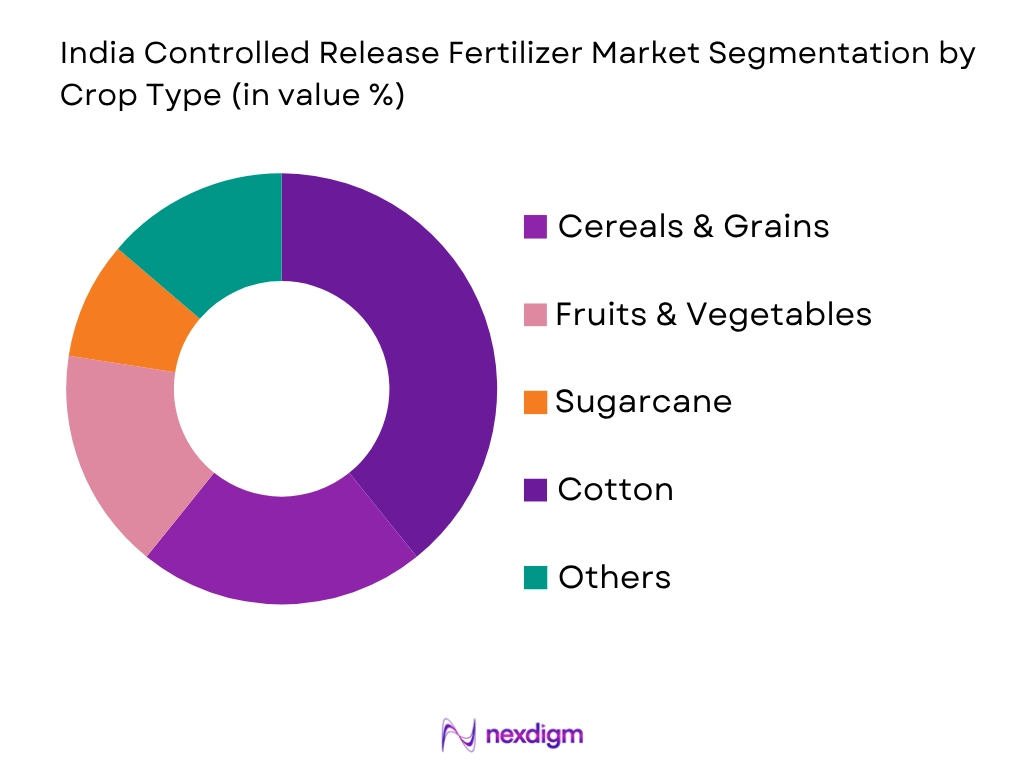
India Controlled Release Fertilizer Market is segmented into cereals & grains, fruits & vegetables, sugarcane, cotton, oilseeds & pulses, horticultural crops, plantation crops, and floriculture crops. Recently, cereals and grains have maintained the dominant market share due to their extensive cultivation area and strategic importance in national food security. Rice, wheat, and maize collectively account for a substantial portion of fertilizer consumption across India. Controlled release fertilizers are increasingly being adopted in cereal cultivation to improve nutrient availability throughout crop growth stages while reducing nutrient losses. Large-scale government support programs, increasing mechanization, and growing emphasis on yield enhancement are driving adoption in this segment. Additionally, farmers cultivating cereals are seeking solutions that lower application frequency and improve operational efficiency, making controlled release fertilizers a practical choice. Their compatibility with precision farming techniques further reinforces the segment’s leadership position within the Indian market.
Competitive Landscape
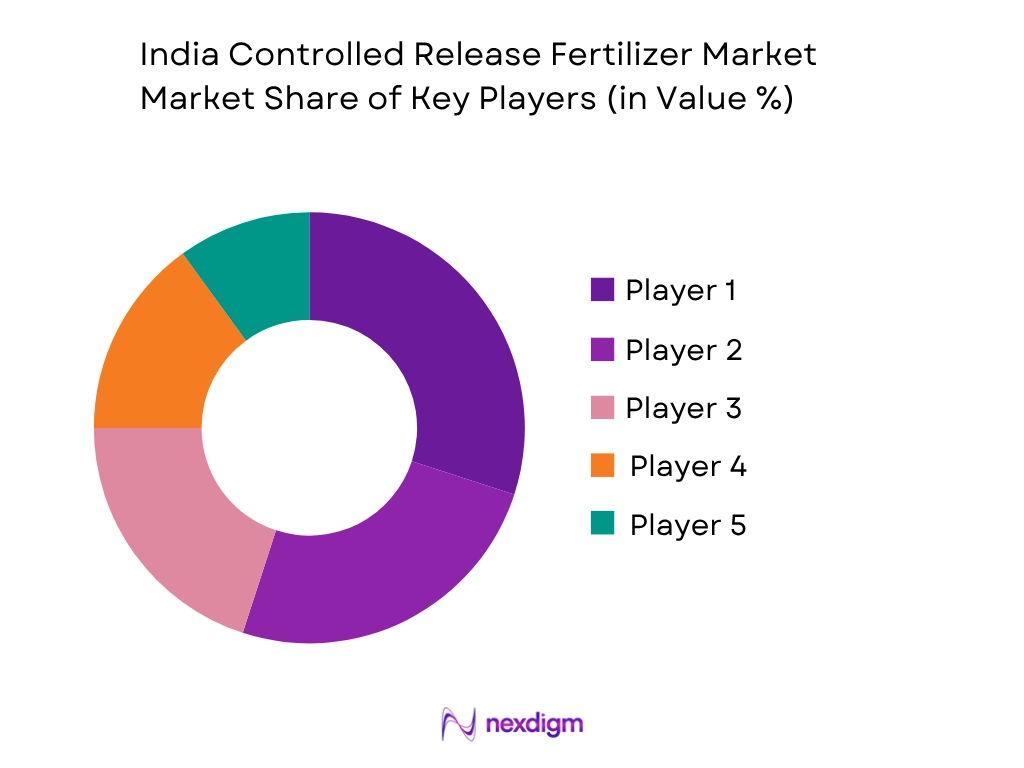
The India Controlled Release Fertilizer Market is moderately consolidated with participation from domestic fertilizer producers and international specialty fertilizer manufacturers. Companies compete through product innovation, coating technology advancements, agronomic support services, distribution network expansion, and crop-specific nutrient management solutions. Strategic collaborations, manufacturing capacity expansion, and specialty fertilizer portfolio diversification remain key competitive strategies shaping market development.
| Company | Establishment Year | Headquarters | CRF Portfolio | Coating Technology Capability | Production Presence in India | Crop Focus | Distribution Strength | Sustainability Focus |
| IFFCO | 1967 | ~ | ~ | ~ | ~ | ~ | ~ | ~ |
| Coromandel International | 1961 | ~ | ~ | ~ | ~ | ~ | ~ | ~ |
| Deepak Fertilisers | 1979 | ~ | ~ | ~ | ~ | ~ | ~ | ~ |
| Yara India | 1905 | ~ | ~ | ~ | ~ | ~ | ~ | ~ |
| Chambal Fertilisers | 1985 | ~ | ~ | ~ | ~ | ~ | ~ | ~ |
India Controlled Release Fertilizer Market Analysis
Growth Drivers
Increasing Government Focus on Balanced Fertilization and Nutrient Use Efficiency
India’s controlled release fertilizer market is benefiting from the government’s increasing emphasis on improving nutrient-use efficiency and reducing excessive fertilizer consumption. According to the Ministry of Agriculture & Farmers Welfare, India’s gross cropped area exceeded 198 million hectares, while total foodgrain production remained above 330 million metric tons during the latest agricultural cycle. The Department of Fertilizers reported fertilizer subsidy allocations exceeding INR 1.88 trillion, reflecting continued policy attention toward nutrient management. Simultaneously, India’s agricultural GVA surpassed INR 24 trillion, demonstrating the sector’s economic significance. Controlled release fertilizers align with government objectives because they reduce nutrient losses and improve fertilizer efficiency under intensive cultivation systems. The Soil Health Card programme has already generated over 230 million soil health cards, creating awareness regarding balanced nutrient application. Furthermore, India’s net irrigated area exceeds 77 million hectares, providing a suitable environment for advanced fertilizer technologies. As farmers seek higher productivity from limited land resources and regulators prioritize sustainable fertilizer use, demand for controlled release fertilizers is strengthening across cereals, sugarcane, cotton, fruits, and vegetable cultivation systems. Growing pressure to improve crop productivity while minimizing environmental nutrient losses continues to support adoption across major agricultural states.
Expansion of High-Value Horticulture and Precision Agriculture Practices
The rapid expansion of horticulture production is creating strong demand for controlled release fertilizers across India. According to the Ministry of Agriculture & Farmers Welfare, horticulture production exceeded 350 million metric tons, surpassing foodgrain productivity on a per-hectare basis. Fruits and vegetables account for over 29 million hectares of cultivated area, requiring precise nutrient management to maintain quality and yield consistency. India remains the world’s second-largest producer of fruits and vegetables, creating substantial opportunities for specialty fertilizers. Additionally, the Ministry of Agriculture reported micro-irrigation coverage exceeding 15 million hectares under various government-supported schemes. Controlled release fertilizers are increasingly integrated with drip irrigation systems due to their ability to provide nutrients over extended periods. India’s agricultural exports crossed USD 48 billion, highlighting the growing focus on high-quality produce for domestic and export markets. States such as Maharashtra, Karnataka, Andhra Pradesh, Tamil Nadu, and Gujarat continue expanding cultivation of grapes, pomegranates, bananas, vegetables, and plantation crops. These crops typically generate higher returns and require precise nutrient delivery, making controlled release fertilizers an increasingly attractive solution for commercial growers seeking productivity improvements and better nutrient utilization efficiency.
Market Challenges
High Dependence on Imported Specialty Fertilizer Technologies and Raw Materials
One of the major challenges facing India’s controlled release fertilizer market is dependence on imported coating technologies, specialty polymers, and advanced nutrient-release materials. According to the Ministry of Commerce and Industry, India’s fertilizer imports exceeded USD 15 billion in recent trade statistics, reflecting substantial reliance on external supply chains. Imports include specialty fertilizer components, coating materials, potash-based nutrients, and advanced manufacturing inputs used in controlled release products. Global supply disruptions can directly affect availability and production schedules for domestic manufacturers. India imported more than 7 million metric tons of potash and significant volumes of phosphatic raw materials, highlighting dependence on foreign nutrient resources. Furthermore, international logistics disruptions and geopolitical uncertainties continue affecting agricultural input supply chains. Controlled release fertilizer production requires sophisticated coating systems and technical expertise that remain concentrated among a limited number of manufacturers. The dependence on imported technologies increases operational complexity and limits large-scale adoption among domestic producers. Although India’s fertilizer manufacturing sector remains extensive, scaling advanced controlled release production requires continued investments in research, technology transfer, and domestic raw-material development to reduce reliance on international suppliers.
Limited Farmer Awareness and Uneven Adoption Across Agricultural Regions
Despite increasing interest in specialty fertilizers, awareness regarding controlled release fertilizers remains uneven across India’s agricultural landscape. According to the latest Agriculture Census, India has more than 146 million operational holdings, with approximately 86 million classified as small and marginal farms. These farmers often prioritize immediate input affordability over long-term nutrient-use efficiency benefits. While India’s rural population exceeds 900 million people, extension services and technical advisory networks vary significantly across states. The Ministry of Agriculture has distributed over 230 million Soil Health Cards; however, adoption of advanced nutrient management technologies remains concentrated in horticulture-intensive and commercially developed agricultural regions. Fertilizer consumption exceeds 60 million metric tons annually, but conventional fertilizers continue to dominate usage patterns due to familiarity and established distribution channels. Many growers remain unaware of the agronomic benefits associated with controlled nutrient release, reduced application frequency, and improved nutrient uptake. Furthermore, fragmented landholdings averaging approximately 1.08 hectares create additional barriers to technology adoption. Limited field demonstrations, insufficient agronomic training, and varying regional infrastructure continue restricting widespread penetration of controlled release fertilizers despite their demonstrated benefits for crop productivity and soil health management.
Market Opportunities
Growth of Micro-Irrigation Infrastructure and Precision Farming Ecosystems
India’s expanding micro-irrigation ecosystem presents a significant opportunity for controlled release fertilizer adoption. According to the Ministry of Agriculture, cumulative micro-irrigation coverage has surpassed 15 million hectares, supported by the Pradhan Mantri Krishi Sinchayee Yojana. Drip and sprinkler irrigation systems require precise nutrient management, making controlled release fertilizers highly compatible with modern irrigation practices. India’s irrigated agricultural area exceeds 77 million hectares, providing a substantial addressable market for advanced fertilizer technologies. Additionally, digital agriculture initiatives are accelerating across major farming states, with increasing deployment of sensors, farm-management software, satellite monitoring, and precision application systems. The government’s Digital Agriculture Mission and AgriStack initiatives are strengthening data-driven farming practices. Agricultural exports exceeding USD 48 billion further encourage growers to adopt productivity-enhancing technologies capable of improving crop quality. Commercial farms cultivating grapes, pomegranates, bananas, vegetables, tea, coffee, and spices increasingly seek efficient nutrient solutions that reduce labor requirements and improve crop performance. As precision farming infrastructure expands across India, controlled release fertilizers are well positioned to benefit from integration with modern irrigation and nutrient-management systems.
Rising Focus on Sustainable Agriculture and Soil Health Restoration
India’s emphasis on sustainable agriculture and soil restoration creates long-term opportunities for controlled release fertilizer adoption. The Soil Health Card programme has analyzed more than 230 million soil samples, generating widespread awareness regarding nutrient deficiencies and imbalanced fertilization practices. According to the Ministry of Agriculture, net sown area remains around 140 million hectares, making soil productivity a critical national priority. Controlled release fertilizers help address nutrient losses associated with conventional fertilizers, supporting improved nutrient-use efficiency and reduced environmental impact. India’s natural farming and sustainable agriculture initiatives are expanding across multiple states, encouraging farmers to adopt practices that preserve soil quality while maintaining productivity. Agricultural GDP exceeding INR 24 trillion highlights the economic importance of sustaining long-term farm output. Furthermore, increasing water stress in several agricultural regions is driving demand for technologies that optimize both nutrient and water utilization. Horticulture production exceeding 350 million metric tons demonstrates the importance of maintaining soil fertility for high-value crops. As policymakers, agronomists, and commercial growers prioritize sustainability, controlled release fertilizers are increasingly viewed as a practical solution for achieving productivity, environmental stewardship, and long-term soil health objectives.
Future Outlook
The India Controlled Release Fertilizer Market is expected to demonstrate strong growth throughout the forecast period with a projected CAGR of approximately ~% during 2026-2035. Growth will be supported by increasing adoption of precision agriculture, expanding horticulture production, rising awareness regarding nutrient-use efficiency, and growing implementation of sustainable farming practices. Government initiatives promoting balanced fertilization, improvements in irrigation infrastructure, and rising demand for high-value crops are expected to create favorable conditions for market expansion. Additionally, innovations in polymer coatings, biodegradable release technologies, and nano-enabled fertilizers will further strengthen future demand across both commercial and smallholder farming segments.
Major Players
- Indian Farmers Fertiliser Cooperative Limited (IFFCO)
- Coromandel International Limited
- Chambal Fertilisers and Chemicals Limited
- Deepak Fertilisers and Petrochemicals Corporation Limited
- National Fertilizers Limited (NFL)
- Rashtriya Chemicals and Fertilizers Limited (RCF)
- Paradeep Phosphates Limited
- Gujarat State Fertilizers & Chemicals Limited (GSFC)
- Zuari FarmHub Limited
- Yara India
- Indorama India Private Limited
- Haifa Group
- ICL Group
- COMPO Expert
- Nagarjuna Fertilizers and Chemicals Limited
Key Target Audience
- Controlled Release Fertilizer Manufacturers
- Specialty Fertilizer Producers
- Agricultural Input Distributors and Dealers
- Commercial Farming Enterprises
- Horticulture and Plantation Companies
- Precision Agriculture Technology Providers
- Investments and Venture Capitalist Firms
- Government and Regulatory Bodies (Department of Fertilizers, Ministry of Agriculture & Farmers Welfare, Fertilizer Control Order Authorities)
Research Methodology
Step 1: Identification of Key Variables
The research process begins with identifying critical variables influencing the India Controlled Release Fertilizer Market. An ecosystem map is developed covering manufacturers, distributors, agricultural cooperatives, farmers, regulators, and technology providers. Extensive secondary research is conducted to determine market dynamics, demand drivers, nutrient consumption patterns, and technology adoption trends.
Step 2: Market Analysis and Construction
Historical market data is compiled and analyzed using both top-down and bottom-up approaches. Market revenues, consumption patterns, fertilizer utilization rates, crop-wise demand, and specialty fertilizer penetration levels are evaluated. The information is segmented across nutrient types, crop types, regions, and end-user categories.
Step 3: Hypothesis Validation and Expert Consultation
Market assumptions are validated through structured interviews with fertilizer manufacturers, distributors, agronomists, agricultural scientists, and industry stakeholders. These consultations provide practical insights regarding technology adoption, pricing structures, nutrient management practices, and competitive dynamics.
Step 4: Research Synthesis and Final Output
The final phase integrates primary and secondary findings into a consolidated market framework. Data triangulation techniques are employed to ensure consistency and reliability. The output provides a comprehensive assessment of market size, segmentation, competition, growth opportunities, challenges, and future outlook

- Executive Summary
- Research Methodology (Market Definitions and Assumptions, Abbreviations, Market Sizing Approach, Top-Down Analysis, Bottom-Up Analysis, Demand-Side Assessment, Supply-Side Assessment, Primary Industry Interviews, Agronomist Consultations, Fertilizer Dealer Surveys, Data Triangulation, Forecasting Framework, Limitations and Future Conclusions)

- Definition and Scope
- Market Evolution and Industry Genesis
- Timeline of Major Industry Developments
- Controlled Release Fertilizer Industry Ecosystem
- Enhanced Efficiency Fertilizer Technology Landscape

- Growth Drivers (Increasing Fertilizer Use Efficiency Requirements, Government Promotion of Balanced Nutrient Application, Expansion of High-Value Horticulture, Rising Adoption of Precision Agriculture, Growth in Drip Irrigation Coverage, Increasing Specialty Crop Cultivation, Soil Health Management Initiatives, Sustainable Farming Programs)
- Market Challenges (High Product Cost Compared to Conventional Fertilizers, Limited Farmer Awareness, Dependence on Imported Coating Technologies, Uneven Adoption Across States, Distribution Challenges in Rural Areas)
- Market Opportunities (Nano Fertilizer Integration, Protected Cultivation Expansion, Precision Farming Adoption, Organic and Sustainable Agriculture Growth, Smart Irrigation Systems, Specialty Crop Expansion, Agri-Tech Innovation Programs, Climate-Resilient Farming Practices)
- Market Trends (Polymer-Coated Fertilizer Adoption, Nano Nutrient Technologies, Fertigation-Based Nutrient Management, Precision Agriculture Integration, Customized Fertilizer Solutions, Digital Agronomy Platforms, Sustainable Nutrient Management, Biodegradable Coating Development)
- Government Regulations (Fertilizer Control Order Compliance, Department of Fertilizers Policies, Integrated Nutrient Management Programs, Soil Health Card Initiative, PM-KUSUM Impact Assessment, Subsidy Framework Analysis, Specialty Fertilizer Registration Standards)
- PESTLE Analysis
- SWOT Analysis
- Porter’s Five Forces Analysis
- Stakeholder Ecosystem
- Competition Ecosystem

- By Market Value (2020-2025)
- By Volume Consumption (2020-2025)
- By Average Selling Price (2020-2025)

- By Nutrient Type (In Value %)
Nitrogen-Based Controlled Release Fertilizers
Phosphorus-Based Controlled Release Fertilizers
Potassium-Based Controlled Release Fertilizers
NPK Controlled Release Fertilizers
Micronutrient Controlled Release Fertilizers
Secondary Nutrient Controlled Release Fertilizers - By Coating Technology (In Value %)
Polymer-Coated Fertilizers
Sulfur-Coated Fertilizers
Polymer-Sulfur Coated Fertilizers
Resin-Coated Fertilizers
Bio-Based Coated Fertilizers
Nano-Coated Controlled Release Fertilizers - By Distribution Channel (In Value %)
Fertilizer Dealers and Retailers
Cooperative Societies
Direct Company Sales
Agri-Input Distributors
E-Commerce Agricultural Platforms - By Crop Type (In Value %)
Cereals & Grains (Rice, Wheat, Maize)
Fruits & Vegetables
Sugarcane
Oilseeds & Pulses
Cotton
Plantation Crops
Horticultural Crops
Floriculture Crops - By Application Method (In Value %)
Soil Application
Fertigation
Drip Irrigation Application
Foliar Integrated Nutrient Programs
Broadcast Application

- Market Share of Major Players (By Value, Volume, Nutrient Type, Crop Segment, Coating Technology)
- Cross Comparison Parameters (Product Portfolio Breadth, Controlled Release Technology Capability, Nutrient Use Efficiency Performance, Crop-Specific Solutions Portfolio, Dealer Network Strength, Domestic Manufacturing Capacity, Precision Agriculture Compatibility, Agronomic Advisory Support Capability)
- SWOT Analysis of Major Players
- Pricing Analysis by Nutrient Grade and Crop Application
- Detailed Profiles of Major Companies
Indian Farmers Fertiliser Cooperative Limited (IFFCO)
Coromandel International Limited
Chambal Fertilisers and Chemicals Limited
Deepak Fertilisers and Petrochemicals Corporation Limited
National Fertilizers Limited (NFL)
Rashtriya Chemicals and Fertilizers Limited (RCF)
Paradeep Phosphates Limited
Zuari FarmHub Limited
Yara India
Nagarjuna Fertilizers and Chemicals Limited
Gujarat State Fertilizers & Chemicals Limited (GSFC)
Indorama India Private Limited
Haifa Group
ICL Group
COMPO Expert

- Fertilizer Consumption and Utilization Assessment
- Farmer Economics Assessment
- Purchasing Behaviour Analysis
- Precision Agriculture Adoption Analysis
- Soil Health Management Assessment
- End User Pain Point Analysis
- Product Attribute Preference Analysis
- Purchase Decision-Making Framework
- Agronomist and Dealer Influence Analysis

- By Market Value (2026-2035)
- By Volume Consumption (2026-2035)
- By Average Selling Price (2026-2035)


 Request a Sample
 Ask for Customization
 Get a Quote
 Enquire Now