

 Download PDF
Market Overview
The India Copper Foil Market is valued at USD ~ million, while the latest published India-specific forecast indicates USD ~ million in the following base period and USD ~ million by the forecast endpoint, implying a 4.52% CAGR aligned to the forward cycle used for this report. Demand is driven by printed circuit boards, copper clad laminates, EV battery anode current collectors, renewable energy storage and high-conductivity electronics. The market is supported by India’s EV sales base of 2.08 million units, up from 1.61 million units in the prior year.
West and South India dominate copper foil consumption because Gujarat, Maharashtra, Karnataka, Tamil Nadu and Telangana combine copper processing, electronics manufacturing, EV assembly, ports and industrial procurement hubs. Gujarat is strategically important due to copper smelting and the 500,000 metric ton Kutch Copper phase, while Tamil Nadu, Karnataka and Telangana anchor electronics and EV supply chains. Import dependence keeps China, South Korea, Japan and Taiwan important because they lead in electrodeposited foil, rolled foil, PCB foil and ultra-thin battery foil supply.
Market Segmentation
By Product Type
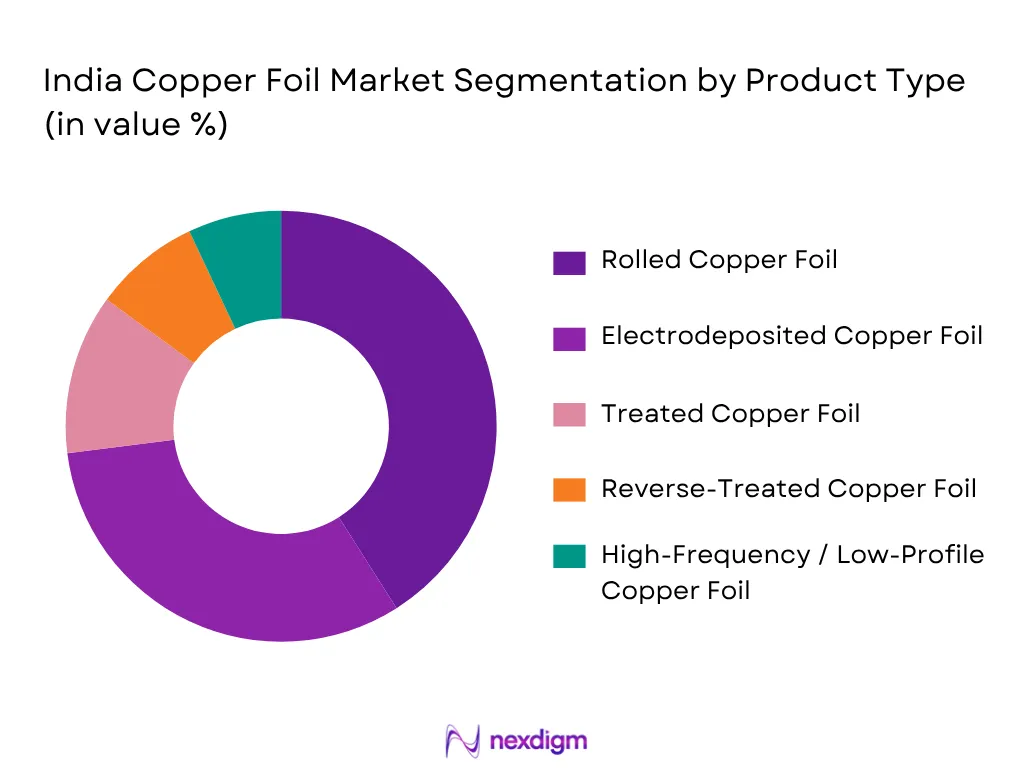
India Copper Foil Market is segmented by product type into rolled copper foil, electrodeposited copper foil, treated copper foil, reverse-treated copper foil and high-frequency/low-profile copper foil. Rolled copper foil holds the dominant market share because India’s present consumption base is still weighted toward electrical, electronics, PCB, shielding, flexible circuit and industrial conductive applications rather than only lithium-ion cell manufacturing. Rolled foil also benefits from established use in flexible printed circuits, heat dissipation, decorative laminates and industrial current-carrying components where dimensional stability and ductility matter. Nexdigm identifies rolled as the largest revenue-generating product segment in India, while electrodeposited foil is the fastest-growing segment due to the shift toward EV battery anode current collectors and advanced PCB laminates.
By Application
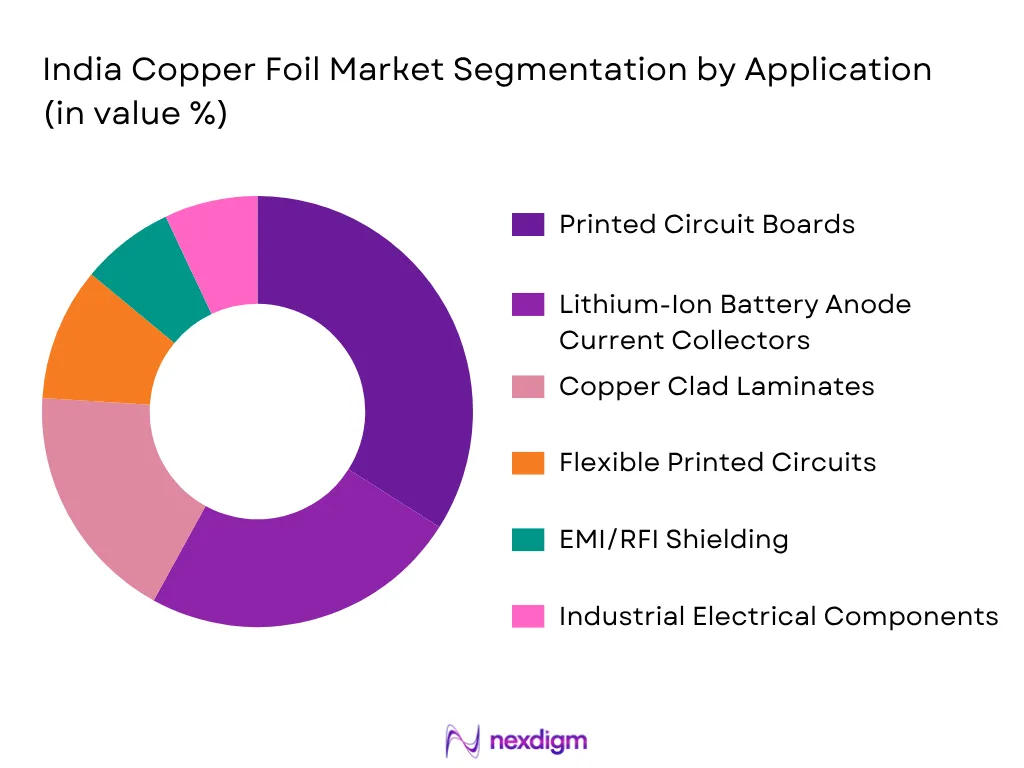
India Copper Foil Market is segmented by application into printed circuit boards, lithium-ion batteries, copper clad laminates, flexible printed circuits, EMI/RFI shielding and industrial electrical components. Printed circuit boards dominate the application mix because India’s electronics assembly ecosystem is significantly more established than domestic battery cell manufacturing. Copper foil is a core conductive layer in PCBs and copper clad laminates used across smartphones, telecom equipment, automotive electronics, consumer appliances and industrial electronics. India’s mobile device production value reached USD ~ billion, and the PCB market is also supported by electronics manufacturing incentives and import substitution. Lithium-ion battery foil is growing faster but remains constrained by limited commercial cell manufacturing scale and long qualification cycles for ultra-thin electrodeposited foil.
Competitive Landscape
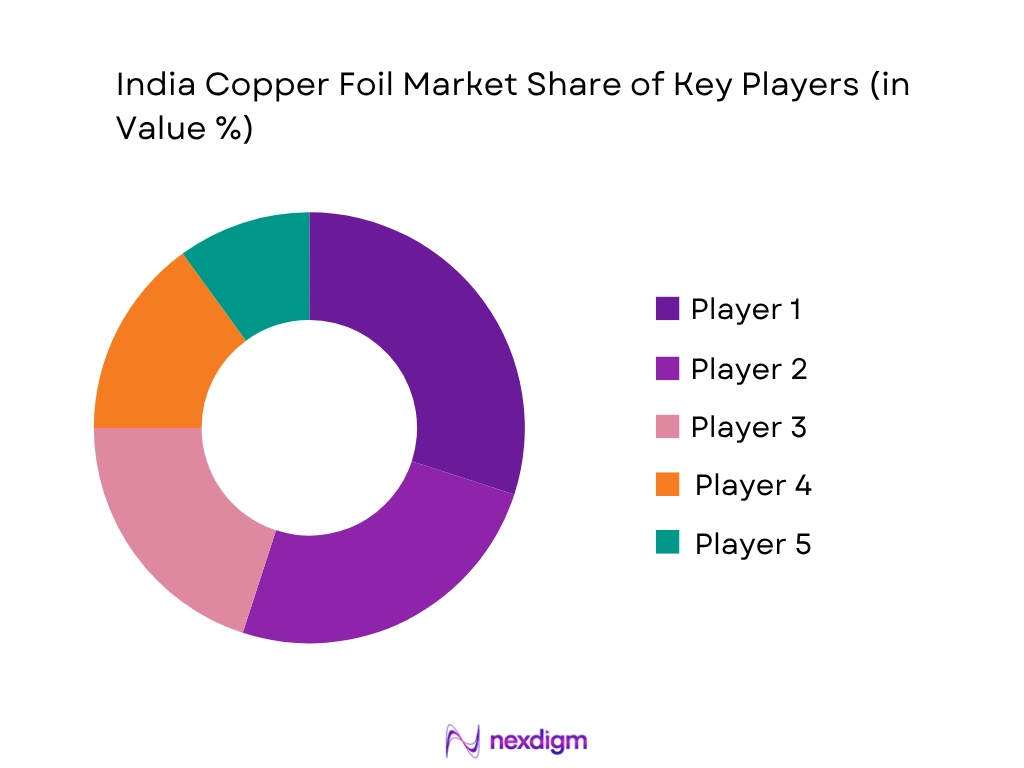
The India Copper Foil Market is import-influenced and moderately concentrated at the high-performance end. Domestic copper-linked groups such as Hindalco, Vedanta and Kutch Copper provide upstream copper relevance, while global specialists such as SK Nexilis and Lotte Energy Materials influence battery-grade and electronics-grade foil availability. Competition is shaped by foil thickness capability, surface treatment technology, OEM approval status, import reliability, copper cathode integration and the ability to serve PCB, CCL and EV battery customers.
| Company | Establishment Year | Headquarters | Product Relevance | India Market Role | Thickness Capability | Key End-Use Exposure | Supply Chain Strength | Strategic Positioning |
| Hindalco Industries Limited | 1958 | Mumbai, India | ~ | ~ | ~ | ~ | ~ | ~ |
| Vedanta Limited / Sterlite Copper | 1976 | Mumbai, India | ~ | ~ | ~ | ~ | ~ | ~ |
| Kutch Copper Limited / Adani Enterprises | 2021 | Ahmedabad, India | ~ | ~ | ~ | ~ | ~ | ~ |
| SK Nexilis | 1988 / 1996 operating lineage | Jeollabuk-do, South Korea | ~ | ~ | ~ | ~ | ~ | ~ |
| Lotte Energy Materials | 1987 | Seoul / Iksan, South Korea | ~ | ~ | ~ | ~ | ~ | ~ |
India Copper Foil Market Analysis
Growth Drivers
ACC PLI
ACC PLI is a direct demand driver for India Copper Foil Market because copper foil is used as the anode current collector in lithium-ion cells, and India’s policy framework is now creating a domestic cell-manufacturing base instead of relying only on imported cells and battery packs. The Ministry of Heavy Industries states that the National Programme on Advanced Chemistry Cell Battery Storage has an outlay of INR 18,100 crore to establish 50 GWh of domestic ACC manufacturing capacity; out of this, 40 GWh has been awarded to 4 beneficiary firms, while 1 GWh installed capacity has been reported. The same government release states that cumulative investment of INR 3,237 crore and employment generation of 1,118 have been achieved under the scheme up to 31 December 2025, and specifically notes that the scheme has raised demand for components including foils, cathode active materials and anode active materials. This supports copper foil demand because every domestic cell line needs qualified, high-purity, thin copper foil rolls with tight thickness tolerance, surface roughness control and roll-to-roll consistency. The macro backdrop also supports industrial capital formation: India’s nominal GDP at current prices stood at INR 318.07 lakh crore and real GDP at INR 299.89 lakh crore in FY 2024–25, creating a larger manufacturing demand base for electronics, EVs and battery materials. World Bank data also reports India’s GDP at USD 3.91 trillion and GDP per capita at USD 2,694.7 for 2024, supporting domestic consumption-linked manufacturing scale-up.
EV Penetration
EV penetration is strengthening India Copper Foil Market because copper foil demand rises with lithium-ion battery cell consumption, especially for two-wheelers, three-wheelers, passenger EVs and stationary battery packs. NITI Aayog states that EV sales in India increased from 50,000 units to 2.08 million units, while global EV sales reached 18.78 million units in 2024, showing that India has entered a higher-volume EV adoption phase. The Ministry of Heavy Industries also states that under the PM E-DRIVE scheme in FY 2024–25, 10,10,101 electric two-wheelers and 1,22,982 L5 electric three-wheelers were registered on the VAHAN portal, with more than 1 million EV sales taking place under the scheme. This matters for copper foil because two-wheelers and three-wheelers create large recurring demand for lithium-ion cells, and localized cell assembly requires copper foil as a functional battery material rather than a generic copper product. Demand visibility improves further because PM E-DRIVE has a notified outlay of INR 10,900 crore up to 31 March 2026, supporting the domestic EV manufacturing ecosystem. The macroeconomic base is also supportive: IMF lists India’s 2026 projected real GDP change at 6.5 and country population at 1,476.626 million, indicating a large mobility-consumption base for battery-powered transport. These conditions support copper foil suppliers targeting battery-grade electrodeposited foil, low-defect foil rolls and OEM-qualified material for domestic cell plants.
Market Challenges
High Import Dependence
High import dependence remains a structural challenge for India Copper Foil Market because India’s copper value chain is still dependent on external supply for several raw and semi-processed copper categories, while high-end copper foil technology remains concentrated in East Asian supplier ecosystems. The Ministry of Commerce’s TradeStat platform states that India’s Export Import Data Bank contains official data from 2017–2018 to 2025–2026, with the latest update on 19 May 2026, and copper foil falls under HS heading 7410 in the traded copper products framework. The Ministry of Mines’ copper vision document notes that India’s copper imports have historically been led by raw and semi-processed materials, and the commencement of Adani’s 0.5 MT Mundra copper unit is expected to reduce refined copper import dependence. Reuters, citing the federal Ministry of Mines, reported that India imported about 363,000 tonnes of refined copper cathodes in the fiscal year ending March 2024, while domestic refined copper production was estimated at 555,000 tonnes and consumption exceeded 750,000 tonnes. This upstream gap affects copper foil because foil manufacturers need reliable cathode quality, stable impurity profiles and consistent supply before scaling electrodeposited foil lines. The macro context adds pressure: India’s gross capital formation at current prices reached INR 109.25 lakh crore in FY 2024–25, indicating expanding industrial investment demand for metals, electronics and energy-transition materials.
Foil Purity Consistency
Foil purity consistency is a major challenge for India Copper Foil Market because battery-grade and PCB-grade copper foil require controlled purity, conductivity, tensile strength, elongation, surface roughness, oxidation resistance and pinhole performance. The issue is not only availability of copper, but the ability to repeatedly convert copper cathode into thin, defect-free foil that can pass battery cycling, PCB lamination and high-frequency signal-integrity tests. Reuters reported in 2026 that India’s leading copper producers opposed the inclusion of scrap-based copper rods in national quality standards because primary producers argued that electrical applications require purity levels of 99.99, and the dispute involved about 400,000 tons of copper wire rods circulating outside the debated regulatory framework. Although the report concerns rods, the same purity logic is relevant for copper foil because trace contaminants, uneven grain structure and surface defects can translate into cell failures, delamination, impedance issues or yield loss in foil-consuming industries. The quality challenge becomes sharper as India scales electronics output: PIB states that electronics production reached INR 11.3 lakh crore in FY 2024–25, mobile phone production reached INR 5.45 lakh crore, and around 330 million mobile phones are produced annually. This pushes copper foil buyers toward suppliers that can demonstrate batch-level traceability, cathode quality control, surface treatment consistency and OEM qualification readiness. India’s real GVA at constant prices also increased to INR 171.87 lakh crore in FY 2024–25, supporting broader industrial demand but increasing pressure on material-quality systems.
Opportunities
Domestic Battery Foil Plants
Domestic battery foil plants represent a future growth opportunity for India Copper Foil Market because India’s current policy-supported cell pipeline creates a local customer base for electrodeposited copper foil, but installed domestic cell capacity is still at an early stage. The Ministry of Heavy Industries states that the ACC PLI programme targets 50 GWh of domestic cell capacity and has awarded 40 GWh to 4 firms, while reported installed capacity stood at 1 GWh up to 31 December 2025. This gap between awarded and installed capacity creates a localized supply opportunity for copper foil producers that can qualify with cell manufacturers before large-scale ramp-up. The same government release states that the scheme has already generated INR 3,237 crore cumulative investment and 1,118 employment, and explicitly notes that demand has increased for components such as foils. Domestic foil plants can also benefit from India’s emerging upstream copper capacity: the Ministry of Mines document identifies Adani’s Mundra copper unit as 0.5 MT, designed to reduce refined copper import dependence. The opportunity is market-specific because battery copper foil is not interchangeable with standard copper sheet; it requires ultra-thin gauges, low pinhole density, controlled tensile strength and roll consistency suited to high-speed cell coating lines. With India’s nominal GDP at INR 318.07 lakh crore and gross saving at INR 111.13 lakh crore in FY 2024–25, the domestic capital base is supportive for materials manufacturing investments tied to batteries, EVs and energy storage.
High-End PCB Foil
High-end PCB foil is an opportunity for India Copper Foil Market because India’s electronics manufacturing scale is increasing, while advanced PCB substrates need treated, reverse-treated, low-profile and high-frequency copper foil grades. PIB states that electronics production reached INR11.3 lakh crore in FY 2024–25, electronics exports reached INR 3.27 lakh crore, and mobile phone production reached INR5.45 lakh crore. It also states that India has over 300 mobile manufacturing units and produces around 330 million mobile phones annually, creating a large downstream base for PCB and copper-clad laminate demand. In the first five months of FY 2025–26, smartphone exports reached INR 1 lakh crore, showing continued electronics export activity that requires reliable PCB material supply. High-end PCB foil is especially relevant for telecom equipment, automotive electronics, smartphones, servers, industrial control boards and defence electronics, where signal integrity, lamination performance and surface profile matter more than basic conductivity alone. India’s macro base supports this opportunity because World Bank data reports GDP of USD 3.91 trillion in 2024, while MoSPI reports private final consumption expenditure at INR 179.71 lakh crore in FY 2024–25, supporting electronics consumption and device replacement cycles. The opportunity is therefore not generic copper demand; it is a move toward specialized foil grades for multilayer boards, HDI boards, flexible circuits and high-frequency PCB laminates that can reduce dependence on imported PCB material inputs.
Future Outlook
The India Copper Foil Market is expected to expand steadily as battery cell localization, PCB import substitution and electronics manufacturing deepen. The forecast CAGR applied for the 2026–2035 period is 4.52%, aligned with the latest India-specific forward growth rate published by Nexdigm for the closest disclosed forecast cycle. Growth will be higher in electrodeposited battery foil and high-frequency PCB foil than in standard industrial foil. Domestic copper refining capacity and potential battery-material incentives may reduce import dependence over time. Demand will increasingly shift from commodity foil to specification-led products: 6–9 micron battery foil, treated PCB foil, low-profile copper foil, reverse-treated copper foil and high-purity electrodeposited foil. Battery foil demand will be linked to ACC PLI execution, domestic cell commissioning and EV adoption, while PCB foil demand will track smartphone, telecom, automotive electronics, defence electronics and EMS localization. The key risk is that domestic copper production does not automatically translate into domestic copper foil capability, because foil requires specialized electroforming, surface treatment, pinhole control, tensile strength control and OEM approval.
Major Players
- Hindalco Industries Limited
- Vedanta Limited / Sterlite Copper
- Kutch Copper Limited / Adani Enterprises
- Hindustan Copper Limited
- Rashtriya Metal Industries Limited
- Bharat Insulation Company
- Jans Copper Private Limited
- Ganpati Wires
- SK Nexilis
- Lotte Energy Materials
- Doosan Corporation Electro-Materials
- Furukawa Electric Co., Ltd.
- Mitsui Mining & Smelting Co., Ltd.
- Nippon Denkai, Ltd.
- Circuit Foil Luxembourg
Key Target Audience
- Copper foil manufacturers and converters
- Lithium-ion battery cell manufacturers
- Printed circuit board and copper clad laminate manufacturers
- Electric vehicle OEMs and battery pack integrators
- Electronics manufacturing services companies
- Copper smelters, refiners and downstream metal processors
- Investments and venture capitalist firms
- Government and regulatory bodies (Ministry of Mines, Ministry of Electronics and Information Technology, Ministry of Heavy Industries, Bureau of Indian Standards, Central Board of Indirect Taxes and Customs, NITI Aayog)
Research Methodology
Step 1: Identification of Key Variables
The initial phase involves mapping the India Copper Foil Market ecosystem across copper smelters, foil importers, PCB fabricators, copper clad laminate producers, EV battery cell manufacturers, electronics EMS players and regulatory bodies. Key variables include copper foil grade, thickness band, end-use demand, import origin, copper cathode pricing, surface treatment type and domestic capacity readiness.
Step 2: Market Analysis and Construction
Historical and current market information is compiled from published market databases, trade references, company disclosures, government schemes, EV sales data, electronics production indicators and PCB demand signals. The market is constructed using top-down validation from published India copper foil values and bottom-up checks from PCB, CCL and battery-linked copper foil consumption.
Step 3: Hypothesis Validation and Expert Consultation
Market hypotheses are validated through structured discussions with copper traders, foil distributors, PCB material suppliers, battery supply-chain specialists, EV procurement teams and electronics component manufacturers. These interviews help test assumptions around grade-wise demand, import dependence, domestic substitution potential, landed cost, lead time and OEM qualification barriers.
Step 4: Research Synthesis and Final Output
The final stage integrates secondary research, primary insights, trade-flow interpretation and application-level demand modeling. Segment shares are normalized across product type and application to reflect India’s current consumption base, while future growth assumptions are aligned with battery localization, electronics manufacturing expansion, copper feedstock availability and high-performance foil adoption.

- Executive Summary
- Research Methodology (Market Definitions and Assumptions, HSN Mapping for Copper Foil, Electrodeposited vs Rolled Foil Classification, Top-Down Market Sizing, Bottom-Up Consumption Build-Up, Import-Export Triangulation, Battery GWh-to-Foil Demand Conversion, PCB/CCL Production-to-Foil Consumption Mapping, Average Selling Price Benchmarking, LME Copper Price Linkage, Primary Interviews with Foil Importers/Converters/PCB Fabricators/Battery Cell Manufacturers, Distributor Channel Checks, Plant Capacity Validation, Limitations and Future Conclusions)

- Definition and Scope
- Overview Genesis
- Evolution of Copper Foil Demand in India
- Business Cycle
- Supply Chain and Value Chain Analysis
- Copper Foil Manufacturing Process Flow
- Import Dependency and Domestic Substitution Landscape
- Role of Copper Foil in EV Battery Cells, PCBs, CCLs and Flexible Electronics
- India Copper Foil Ecosystem Map

- Growth Drivers (ACC PLI, EV Penetration, PCB Localization, 5G Rollout, Consumer Electronics Assembly, Energy Storage Demand)
- Market Challenges (High Import Dependence, Foil Purity Consistency, Ultra-Thin Foil Yield Loss, Copper Price Volatility, Qualification Barriers, Supply Concentration)
- Opportunities (Domestic Battery Foil Plants, High-End PCB Foil, Import Substitution, Treated Foil, Low-Profile Foil, Recycling-Linked Copper Feedstock)
- Market Trends (Thinner Foil Migration, Low-Roughness Surface Demand, Domestic Vendor Qualification, CCL Localization, Battery Component Indigenization)
- Government Regulations and Policy Landscape (HSN 7410, GST, ACC PLI, Electronics Component Manufacturing Scheme, BIS Quality Standards, Import Duty Structure)
- SWOT Analysis (Battery Foil Capability, Domestic Copper Feedstock, Import Reliance, Qualification Risk, PCB Localization Upside)
- Stakeholder Ecosystem (Copper Smelters, Foil Producers, Importers, CCL Manufacturers, PCB Fabricators, Battery Cell OEMs, EV OEMs, Electronics EMS Players, Testing Labs, Government Agencies)
- Porter’s Five Forces (Supplier Power of Cathode Producers, Buyer Power of Battery and PCB OEMs, Threat of Imports, Entry Barriers in ED Foil, Substitution Risk from Alternative Current Collectors)
- Pricing Analysis (LME Copper Benchmark, Conversion Premium, Thickness Premium, Surface Treatment Premium, Import Freight, Duties, INR/USD Movement, MOQ-Based Discounts)
- Trade Flow Analysis (HSN 7410 Imports, Country-Wise Supply, Port-Wise Entry, Battery-Grade vs PCB-Grade Shipment Mix, Import Price Realization)
- Manufacturing Cost Structure (Copper Cathode Cost, Electricity Cost, Additives, Drum Depreciation, Surface Treatment Chemicals, Slitting and Packaging, Yield Loss, Quality Testing)
- Technology Benchmarking (ED Drum Technology, Surface Treatment, Anti-Oxidation Coating, Low-Profile Roughening, Pin-Hole Control, Tensile Strength Control)

- By Value (2020-2025)
- By Volume (2020-2025)
- By Average Selling Price (2020-2025)
- By Domestic Sales vs Imports (2020-2025)
- By Battery-Grade and Electronics-Grade Consumption (2020-2025)

- By Copper Foil Grade (In Value%)
Battery-Grade Electrodeposited Copper Foil
PCB-Grade Electrodeposited Copper Foil
Rolled Annealed Copper Foil
High-Frequency/RF Copper Foil
Standard Industrial Copper Foil - By Manufacturing Route (In Value%)
Electrodeposited Copper Foil
Rolled Copper Foil
Treated Copper Foil
Reverse-Treated Copper Foil
Double-Treated Copper Foil - By Thickness Band (In Value%)
Below 6 Micron
6–9 Micron
10–18 Micron
19–35 Micron
Above 35 Micron - By Application (In Value%)
Lithium-Ion Battery Anode Current Collectors
Printed Circuit Boards
Copper Clad Laminates
Flexible Printed Circuits
EMI/RFI Shielding
Switchgear, Transformers and Industrial Electrical Components - By End-User Industry (In Value%)
EV Battery Cell Manufacturers
Consumer Electronics and Mobile Device Manufacturers
Telecom, 5G and Networking Equipment Manufacturers
Automotive Electronics and Powertrain Component Manufacturers
Energy Storage System Manufacturers
Aerospace and Defence Electronics Manufacturers
Industrial Electrical Equipment Manufacturers - By Backing Type (In Value%)
Not-Backed Refined Copper Foil
Not-Backed Copper Alloy Foil
Backed Refined Copper Foil
Backed Copper Alloy Foil - By Sales Channel (In Value%)
Direct Supply to Battery Cell and PCB OEMs
Importers and Trading Houses
Regional Stockists and Distributors
CCL and PCB Material Suppliers
Contract Manufacturing Procurement Channels - By Import Origin (In Value%)
China-Origin Copper Foil
South Korea-Origin Copper Foil
Japan-Origin Copper Foil
Taiwan-Origin Copper Foil
Malaysia-Origin Copper Foil
Europe-Origin Copper Foil
India-Origin Copper Foil - By Region (In Value%)
West India
South India
North India
East India
Central India

- Market Share of Major Players (Value Share, Volume Share, Battery-Grade Foil Share, PCB-Grade Foil Share, Import-Origin Share, Domestic Supply Share)
- Competitive Positioning Matrix (Battery Foil Capability, PCB Foil Portfolio, India Presence, Foil Thickness Range, Surface Treatment Technology, OEM Approvals, Import Reliability, Pricing Flexibility)
- Cross Comparison Parameters (Foil Thickness Range, Battery-Grade Qualification Status, PCB/CCL Grade Portfolio, Surface Roughness and Treatment Capability, Copper Cathode Integration, India Distribution/Import Network, Production Capacity and Expansion Pipeline, OEM Approval and Long-Term Supply Contracts)
- SWOT Analysis of Major Players (Domestic Feedstock Strength, Technology Gap, Import Dependence, Battery Foil Opportunity, PCB Foil Differentiation)
- Pricing Benchmark of Major Players (6–9 Micron Battery Foil Premium, 12–18 Micron PCB Foil Pricing, Treated Foil Premium, Import Landed Cost, Domestic Conversion Premium)
- Recent Developments and Strategic Moves (Capacity Additions, India Partnerships, Copper Smelter Integration, Battery Cell Supply Contracts, CCL Localization, M&A Activity)
- Detailed Profiles of Major Companies
Hindalco Industries Limited
Vedanta Limited / Sterlite Copper
Kutch Copper Limited / Adani Enterprises
Hindustan Copper Limited
Rashtriya Metal Industries Limited
Bharat Insulation Company
Jans Copper Private Limited
Ganpati Wires
SK Nexilis
Lotte Energy Materials
Doosan Corporation Electro-Materials
Furukawa Electric Co., Ltd.
Mitsui Mining & Smelting Co., Ltd.
Nippon Denkai, Ltd.
Circuit Foil Luxembourg

- Demand and Utilization by End User (Foil Loading per GWh, Copper Foil per PCB Square Meter, CCL Foil Consumption, Scrap Rate, Capacity Utilization)
- Procurement Criteria (Thickness Tolerance, Surface Roughness, Tensile Strength, Elongation, Purity, Oxidation Resistance, Width, Roll Length, MOQ, Lead Time)
- Purchasing Power and Budget Allocation (Battery Material BOM Share, PCB Raw Material Share, Copper Price Pass-Through, Contract Pricing, Spot Procurement)
- Vendor Approval and Qualification Process (Sample Testing, Pilot Lot Approval, Cell Cycling Tests, PCB Lamination Trials, Reliability Testing, Audit and Traceability)
- End-User Pain Point Analysis (Import Lead Time, Price Volatility, Quality Variation, Pin-Hole Defects, Delamination Risk, Foil Wrinkling, Minimum Order Quantity Constraints)
- Decision-Making Process (R&D Validation, Procurement Shortlisting, Quality Sign-Off, Commercial Negotiation, Long-Term Supply Agreement, Dual Sourcing)
- Customer Cohort Analysis (Gigafactory Buyers, CCL Producers, HDI PCB Fabricators, Flexible Circuit Makers, Industrial Foil Buyers, Traders/Stockists)

- By Value (2026-2035)
- By Volume (2026-2035)
- By Average Selling Price (2026-2035)
- By Battery-Grade Copper Foil Demand (2026-2035)
- By PCB and CCL-Grade Copper Foil Demand (2026-2035)
- By Domestic Production vs Import Requirement (2026-2035)


 Request a Sample
 Ask for Customization
 Get a Quote
 Enquire Now