

 Download PDF
Market Overview
The India Corporate Insurance Broking Market is valued at approximately ~ in brokerage revenues, derived from a total non-life insurance gross written premium exceeding INR 2.5 lakh crore and life insurance corporate group premiums surpassing INR 90,000 crore. The market is driven by increasing corporate risk exposure, regulatory mandates under the Insurance Regulatory and Development Authority of India, and rising demand for specialized policies such as cyber, liability, and employee benefits insurance across organized enterprises.
The market is primarily concentrated in metropolitan hubs such as Mumbai, Delhi, Bengaluru, Gurgaon, and Chennai due to high corporate density, presence of multinational companies, and proximity to insurer headquarters. These cities host major broker offices, underwriting teams, and risk advisory centers, enabling better client servicing, faster claims management, and stronger insurer-broker relationships, which collectively strengthen their dominance.
Market Segmentation
By Type of Insurance Placement
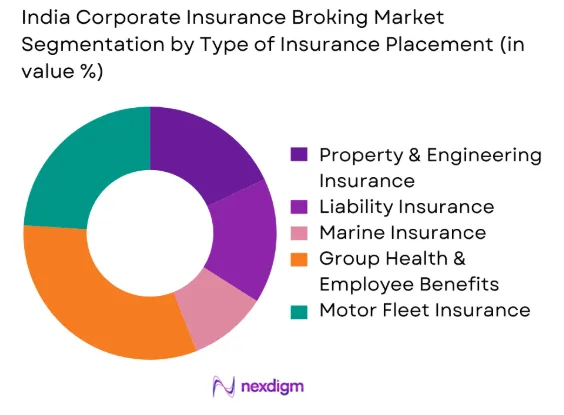
The India Corporate Insurance Broking Market is segmented by type of insurance placement into property & engineering, liability insurance, marine insurance, group health & employee benefits, motor fleet insurance, and specialty lines. Among these, group health & employee benefits insurance dominates the market due to its recurring premium nature and mandatory adoption by large corporates. With increasing workforce size and rising healthcare costs, companies prioritize employee insurance programs as part of retention strategies. Brokers play a crucial role in designing customized health policies, negotiating premiums, and managing claims, which significantly increases their revenue share from this segment. Additionally, post-pandemic awareness regarding employee well-being has accelerated demand for comprehensive health coverage solutions, further strengthening this segment’s leadership.
By Client Industry Vertical
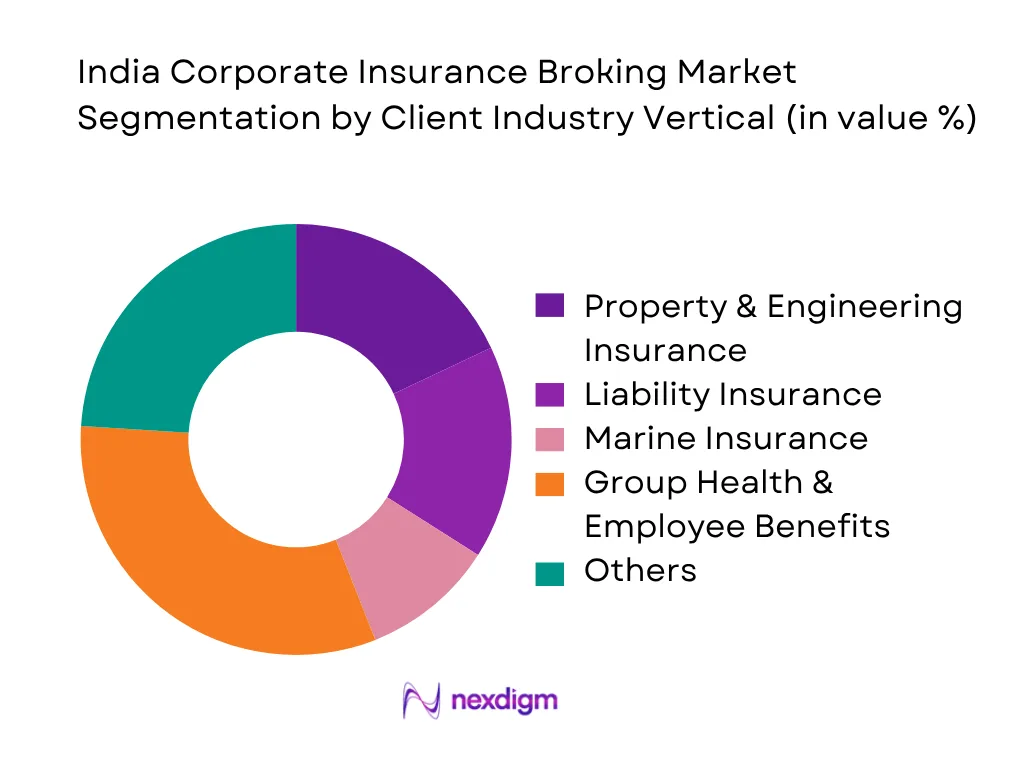
The market is segmented by client industry vertical into BFSI, manufacturing & heavy industries, IT & ITES, infrastructure & construction, healthcare & pharmaceuticals, energy & utilities, and retail & e-commerce. Manufacturing & heavy industries dominate the market due to their high asset value, operational risks, and mandatory insurance requirements. These industries require comprehensive coverage across property damage, machinery breakdown, business interruption, and liability risks, resulting in high premium volumes. Brokers are heavily involved in risk assessment, policy structuring, and claims management for such complex operations. Additionally, large-scale infrastructure investments and industrial expansion in India further drive insurance demand from this segment, reinforcing its leading position in corporate insurance broking.
Competitive Landscape
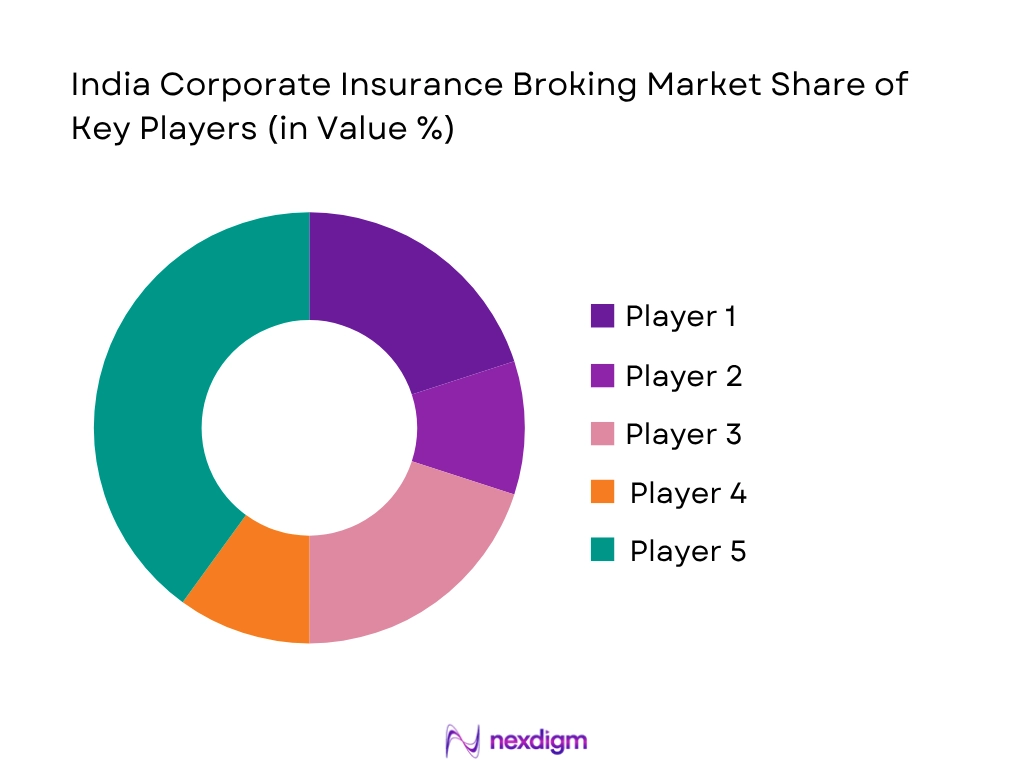
The India Corporate Insurance Broking Market is moderately consolidated, with global brokers and large domestic firms dominating high-value corporate accounts, while mid-sized and digital brokers cater to SMEs. International players bring global expertise, advanced risk analytics, and multinational servicing capabilities, whereas domestic brokers leverage strong local relationships and cost competitiveness. The market is witnessing increasing competition through digital platforms, advisory-led models, and specialization in niche risk segments.
| Company | Establishment Year | Headquarters | Brokerage Revenue Scale | Key Insurance Segments | Client Base Type | Digital Capability | Claims Management Strength | Global Network Presence |
| Marsh India Insurance Brokers | 2002 | Mumbai | ~ | ~ | ~ | ~ | ~ | ~ |
| Aon India Insurance Brokers | 2003 | Mumbai | ~ | ~ | ~ | ~ | ~ | ~ |
| Willis Towers Watson India | 2004 | Mumbai | ~ | ~ | ~ | ~ | ~ | ~ |
| Howden Insurance Brokers India | 2003 | Mumbai | ~ | ~ | ~ | ~ | ~ | ~ |
| Mahindra Insurance Brokers | 2004 | Mumbai | ~ | ~ | ~ | ~ | ~ | ~ |
India Corporate Insurance Broking Market Analysis
Growth Drivers
Rising Regulatory Compliance Requirements
India’s corporate insurance broking market is significantly driven by strengthening regulatory oversight and compliance mandates. The Insurance Regulatory and Development Authority of India has enforced stricter solvency, disclosure, and risk coverage norms, increasing corporate reliance on brokers for compliance-driven policy structuring. India’s formal sector employment crossed 93 million under the EPFO payroll data system, reflecting expansion in organized enterprises requiring statutory insurance coverage. Additionally, the World Bank reports India’s GDP at USD 3.4 trillion, with industrial output growth supported by regulatory frameworks mandating insurance for infrastructure and manufacturing projects. The Insolvency and Bankruptcy Code cases exceeding 7,000 highlight rising financial risks, further necessitating structured insurance advisory. These compliance-heavy environments compel corporates to depend on brokers for policy alignment, claims documentation, and audit readiness, reinforcing the demand for professional broking services across sectors.
Increasing Corporate Risk Complexity
The growing complexity of corporate risks in India is a major driver for insurance broking services. India’s merchandise exports reached USD 451 billion, exposing companies to global supply chain risks, marine liabilities, and geopolitical uncertainties. The Reserve Bank of India highlights that corporate external commercial borrowings exceeded USD 200 billion, increasing financial exposure and credit risk. Additionally, cybercrime incidents registered under NCRB crossed 65,000 cases, indicating rising digital vulnerabilities across enterprises. Infrastructure investments exceeding INR 111 lakh crore under the National Infrastructure Pipeline further increase exposure to engineering, liability, and project risks. These evolving and interconnected risks require specialized insurance solutions and continuous risk assessment. Corporate brokers play a crucial role in mapping these risks, designing multi-layered insurance programs, and ensuring coverage adequacy, making them indispensable in navigating India’s increasingly complex risk environment.
Market Challenges
Pricing Competition Among Brokers
The India Corporate Insurance Broking Market faces intense pricing competition due to increasing number of licensed brokers and limited differentiation in standard insurance products. The Insurance Regulatory and Development Authority of India reports over 600 registered insurance brokers, intensifying competition for large corporate accounts. India’s corporate sector includes more than 1.5 million active companies as per Ministry of Corporate Affairs filings, but a significant portion of premium volume is concentrated among top enterprises, leading brokers to compete aggressively for fewer high-value clients. Additionally, India’s non-life insurance penetration remains around 1 percent of GDP as per the World Bank, limiting overall premium expansion. This imbalance results in brokers lowering commissions, offering value-added services at reduced fees, and investing heavily in client retention, thereby exerting pressure on profitability and sustainability of smaller broking firms.
Regulatory Constraints on Commission Structures
Regulatory restrictions on commission structures present a critical challenge for insurance brokers in India. The Insurance Regulatory and Development Authority of India caps commissions and mandates transparency in broker remuneration, limiting flexibility in pricing strategies. India’s insurance sector assets exceed INR 70 lakh crore, but broker earnings remain tied to regulated commission bands, restricting revenue scalability. Additionally, the implementation of fee-based advisory models requires clear disclosure and client consent, increasing administrative overhead. The International Monetary Fund highlights India’s financial sector reforms aimed at enhancing transparency, which indirectly tightens compliance requirements for intermediaries. These regulatory constraints reduce broker margins, increase compliance costs, and limit innovative pricing models, particularly affecting mid-sized brokers who lack diversified revenue streams and rely heavily on commission-based income.
Opportunities
Digital Transformation of Broking Services
Digital transformation presents a significant opportunity for the India Corporate Insurance Broking Market, driven by rapid technological adoption across enterprises. India has over 850 million internet users and more than 1.2 billion mobile connections as reported by the Telecom Regulatory Authority of India, enabling widespread digital engagement. The World Bank notes that India’s digital economy is expanding with increasing enterprise digitization and cloud adoption. Additionally, Unified Payments Interface transactions exceeded 100 billion annually, indicating strong digital infrastructure supporting financial services integration. These developments allow brokers to deploy digital platforms for policy management, claims tracking, and customer engagement. Automation and analytics tools further enhance underwriting insights and risk assessment capabilities, enabling brokers to scale operations efficiently while improving client experience and expanding reach to underserved SME segments.
Growth in Specialty Risk Segments
The expansion of specialty risk segments such as cyber, environmental liability, and ESG-related insurance provides strong growth opportunities for brokers. India recorded over 65,000 cybercrime cases and increasing digital fraud incidents, highlighting demand for cyber insurance solutions. The Reserve Bank of India reported digital payment fraud cases exceeding 13,000, indicating rising financial risks. Additionally, India’s renewable energy capacity crossed 180 GW as per Ministry of New and Renewable Energy, increasing demand for specialized insurance in energy projects. The International Monetary Fund emphasizes climate-related financial risks, further driving ESG-linked insurance adoption. These emerging risk categories require advanced underwriting expertise and customized solutions, positioning brokers as critical advisors in structuring complex insurance programs and capturing new revenue streams beyond traditional insurance lines.
Future Outlook
The India Corporate Insurance Broking Market is expected to experience strong expansion over the forecast period, supported by increasing insurance penetration, evolving corporate risk landscapes, and regulatory push toward formal risk management practices. The market is projected to grow at a CAGR of approximately 12–14%, driven by digital transformation, rising demand for specialized insurance products, and expansion into underserved SME segments. Growth will also be fueled by the increasing adoption of cyber insurance, ESG-related risk coverage, and advanced analytics in underwriting and claims management. Brokers are expected to shift toward advisory-led models, focusing on value-added services such as risk consulting and employee benefits optimization. Additionally, InsurTech integration will enhance operational efficiency and customer experience, further accelerating market growth.
Major Players
- Marsh India Insurance Brokers Pvt Ltd
- Aon India Insurance Brokers Pvt Ltd
- Willis Towers Watson India Insurance Brokers Pvt Ltd
- Howden Insurance Brokers India Pvt Ltd
- Gallagher Insurance Brokers India Pvt Ltd
- Anand Rathi Insurance Brokers Ltd
- Prudent Insurance Brokers Pvt Ltd
- Mahindra Insurance Brokers Ltd
- Global Insurance Brokers Pvt Ltd
- India Insure Risk Management & Insurance Broking Services Pvt Ltd
- Alpine Insurance Brokers Pvt Ltd
- Securenow Insurance Broker Pvt Ltd
- Ethika Insurance Broking Pvt Ltd
- Probus Insurance Broker Pvt Ltd
- Riskbirbal Insurance Brokers Pvt Ltd
Key Target Audience
- Corporate Risk Managers & CFOs
- Insurance Companies
- Reinsurance Companies
- InsurTech Firms & Digital Platforms
- Investments and Venture Capitalist Firms
- Government and Regulatory Bodies
- Large Enterprises & SME Business Owners
- Third Party Administrators
Research Methodology
Step 1: Identification of Key Variables
The study begins with mapping the ecosystem of the India Corporate Insurance Broking Market, identifying stakeholders such as brokers, insurers, reinsurers, corporates, and TPAs. Secondary research sources including regulatory filings, industry reports, and company disclosures are used to define key variables such as GWP placement, brokerage revenue, and client segmentation.
Step 2: Market Analysis and Construction
Historical data on insurance premiums, brokerage commissions, and corporate insurance adoption is analyzed. A bottom-up approach is used to estimate broker revenues, while a top-down approach validates the total market size using industry-level insurance premium data and broker participation ratios.
Step 3: Hypothesis Validation and Expert Consultation
Insights are validated through interviews with industry experts including broker executives, underwriters, and corporate risk managers. These interactions provide real-time insights into pricing trends, commission structures, and emerging risk categories.
Step 4: Research Synthesis and Final Output
Data is triangulated and synthesized to produce a comprehensive market view. Cross-verification with insurer data, broker disclosures, and regulatory statistics ensures accuracy, while qualitative insights enrich the analysis of trends, opportunities, and competitive dynamics.

- Executive Summary
- Research Methodology (Market Definitions and Assumptions, IRDAI Regulatory Framework Consideration, Corporate Insurance Broking Scope Delineation, Market Sizing Approach (GWP & Brokerage Income Based), Top-Down & Bottom-Up Modelling, Primary Interviews with Brokers/Insurers/Corporate Clients, Data Triangulation, Limitations and Validation Framework)

- Definition and Scope
- Evolution of Corporate Insurance Broking in India
- Regulatory Timeline and Licensing Evolution
- Business Model Framework
- Value Chain Analysis
- Ecosystem Mapping
- Insurance Penetration & Density Context in India
- Corporate Risk Landscape

- Growth Drivers
Rising Regulatory Compliance Requirements
Increasing Corporate Risk Complexity
Growth in Employee Benefits Insurance
Expansion of Cyber & Liability Insurance - Market Challenges
Pricing Competition Among Brokers
Regulatory Constraints on Commission Structures
Dependence on Insurer Underwriting Appetite - Opportunities
Digital Transformation of Broking Services
Growth in Specialty Risk Segments
Increasing Demand for Risk Consulting - Market Trends
Shift Toward Fee-Based Advisory Models
Integration of InsurTech Platforms
Data-Driven Risk Assessment Tools - Regulatory Landscape
- SWOT Analysis
- Porter’s Five Forces Analysis
- Stakeholder Ecosystem
- Competitive Landscape Dynamics

- By Gross Written Premium (GWP) Placement, 2020–2025
- By Brokerage Revenue, 2020–2025
- By Number of Corporate Clients Serviced, 2020–2025
- By Average Commission Rate, 2020–2025

- By Type of Insurance Placement (in Value %)
Property & Engineering Insurance
Liability Insurance
Marine Insurance
Group Health & Employee Benefits
Motor Fleet Insurance
Specialty Lines - By Client Industry Vertical (in Value %)
BFSI
Manufacturing & Heavy Industries
IT & ITES
Infrastructure & Construction
Healthcare & Pharmaceuticals
Energy & Utilities
Retail & E-commerce - By Enterprise Size (in Value %)
Large Enterprises
Mid-Sized Enterprises
SMEs & Emerging Corporates - By Service Offering (in Value %)
Risk Advisory & Consulting
Policy Placement & Negotiation
Claims Management Services
Employee Benefits Consulting
Reinsurance Broking Support - By Distribution Model (in Value %)
Traditional Relationship-Driven Model
Digital Broking Platforms
Hybrid Advisory Model - By Geography (in Value %)
North India
West India
South India
East India

- Market Share Analysis (By Brokerage Revenue & GWP Placement)
- By Insurance Segment
- By Client Industry
- Cross Comparison Parameters (Brokerage Revenue, GWP Placement Volume, Commission Yield %, Client Retention Rate, Claims Settlement Efficiency (TAT), Digital Platform Capability Index, Industry Specialization Depth, Employee Benefits Portfolio Share)
- SWOT Analysis of Major Players
- Pricing & Commission Benchmarking
- Detailed Profiles of Major Companies
Marsh India Insurance Brokers Pvt Ltd
Aon India Insurance Brokers Pvt Ltd
Willis Towers Watson India Insurance Brokers Pvt Ltd
Howden Insurance Brokers India Pvt Ltd
Gallagher Insurance Brokers India Pvt Ltd
Anand Rathi Insurance Brokers Ltd
Prudent Insurance Brokers Pvt Ltd
Mahindra Insurance Brokers Ltd
Global Insurance Brokers Pvt Ltd
India Insure Risk Management & Insurance Broking Services Pvt Ltd
Alpine Insurance Brokers Pvt Ltd
Securenow Insurance Broker Pvt Ltd
Ethika Insurance Broking Pvt Ltd
Probus Insurance Broker Pvt Ltd
Riskbirbal Insurance Brokers Pvt Ltd

- Insurance Buying Behavior (Policy Renewal Rate, Multi-Broker Engagement %)
- Risk Management Budget Allocation (Insurance Spend as % of Revenue)
- Decision-Making Hierarchy (CFO/Risk Manager Influence Index)
- Pain Point Analysis (Claims Settlement TAT, Coverage Gaps %)
- Broker Selection Criteria (Service Quality Index, Pricing Sensitivity)

- By Gross Written Premium (GWP) Placement, 2026–2032
- By Brokerage Revenue, 2026–2032
- By Number of Corporate Clients Serviced, 2026–2032
- By Average Commission Rate, 2026–2032


 Request a Sample
 Ask for Customization
 Get a Quote
 Enquire Now