
 Download PDF
Market Overview
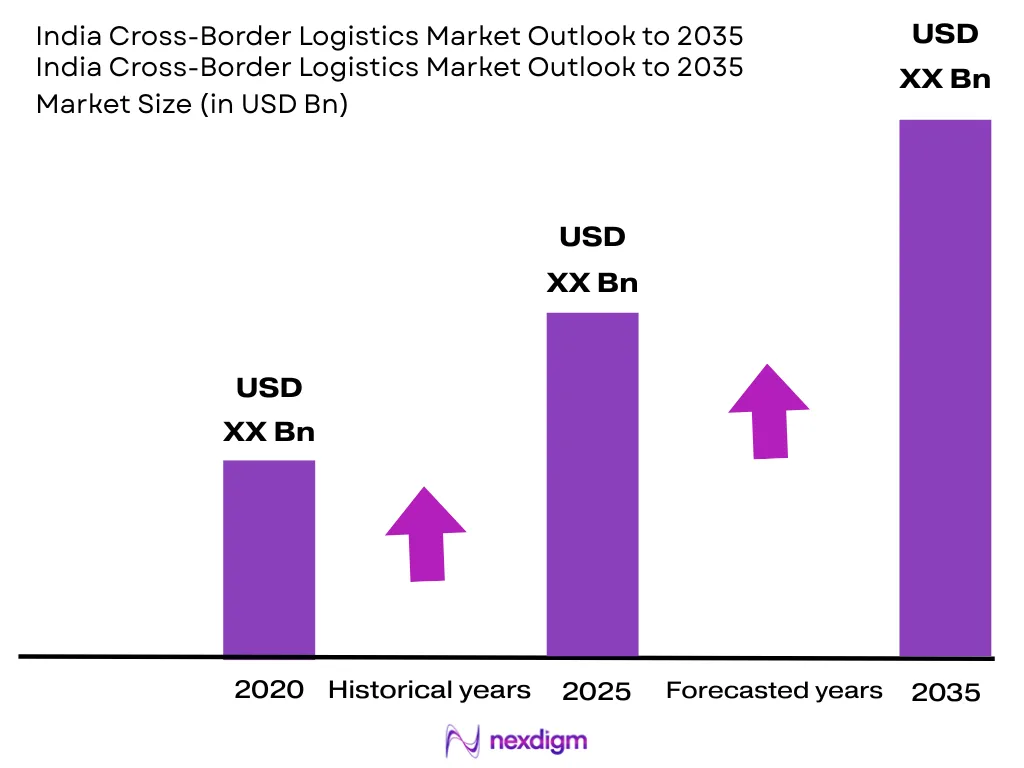
The India Cross-Border Logistics Market was valued at USD ~ Billion in 2024 and is anticipated to expand at a CAGR of ~% during 2026–2035, building on a current market size of approximately USD ~ billion as of 2026. The market is primarily driven by surging cross-border e-commerce, expanding trade agreements, sustained infrastructure investment, and growing adoption of automation, digital platforms, and advanced tracking technologies across India’s logistics ecosystem. India’s broader freight and logistics market is projected to grow from USD 288.89 billion in 2025 to USD 476.51 billion by 2031 at an 8.57% CAGR, while international courier, express, and parcel (CEP) shipments are separately growing at a 10.73% CAGR between 2026 and 2031, reflecting the rapid internationalization of India’s small-parcel export trade. The government’s National Logistics Policy, launched in September 2022, aims to reduce India’s logistics costs from approximately 16% of GDP toward the global average of 8% by 2030, underpinning sustained public and private investment across the cross-border logistics value chain.
Market Segmentation
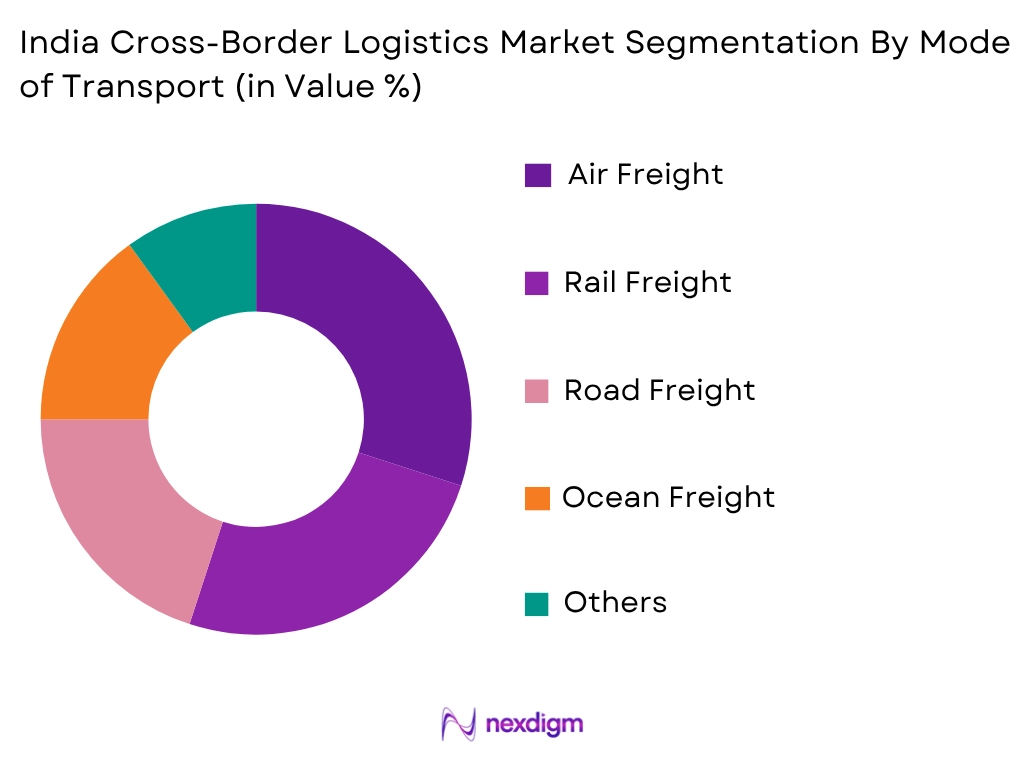
By Mode of Transport
Air Freight has become an increasingly critical mode of transport within the India Cross-Border Logistics Market, particularly for e-commerce and high-value electronics shipments; FedEx’s new 50,000 square foot sorting facility in Bengaluru processes 75,000 outbound parcels daily, illustrating the scale of investment underpinning India’s growing cross-border small-parcel export capability. Dedicated export-oriented air cargo hubs at four Indian airports have shortened customs dwell times to between 12 and 18 hours, a meaningful improvement that is accelerating international CEP growth. Road Freight (Land Border Trade) represents a distinctive segment shaped by India’s extensive land borders with Pakistan, Bangladesh, Nepal, Myanmar, and Bhutan, with the India-Bangladesh and India-Nepal corridors representing particularly large trade volumes supported by bilateral trade agreements, even as road transport operators continue to navigate border crossing hour restrictions and periodic customs IT system interruptions. Ocean Freight remains foundational for bulk manufacturing and industrial exports, while Rail Freight is gaining share as dedicated freight corridor infrastructure continues to expand under the PM Gati Shakti National Master Plan.
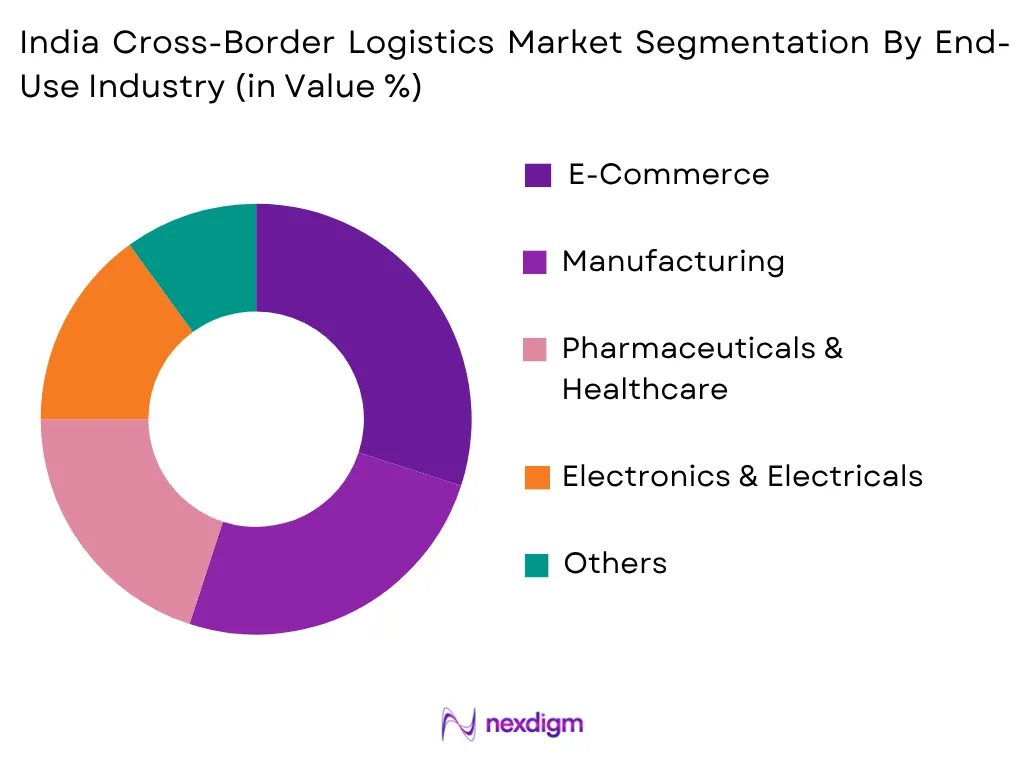
By End-User Industry
E-Commerce represents the fastest-growing end-user industry within the India Cross-Border Logistics Market, with domestic parcels forming 59.40% of courier, express, and parcel value in 2025, driven substantially by social commerce and rural consumption, while international CEP shipments grow at a 10.73% CAGR as Indian export hubs continue to shorten customs dwell times. Ecom Express derived 62% of its 2024 traffic from non-metro locations, illustrating how cross-border and export-oriented e-commerce logistics demand is increasingly originating well beyond India’s traditional metro shipping hubs. Manufacturing represents a substantial and growing end-user category as India’s manufacturing output continues to scale toward a projected USD 1 trillion, driving rising demand for efficient, real-time-tracked supply chain solutions, while Pharmaceuticals & Healthcare, Automotive, and Electronics & Electricals round out the market’s key end-user industries, each requiring differentiated customs brokerage and cold chain or specialized handling capability.
Competitive Landscape
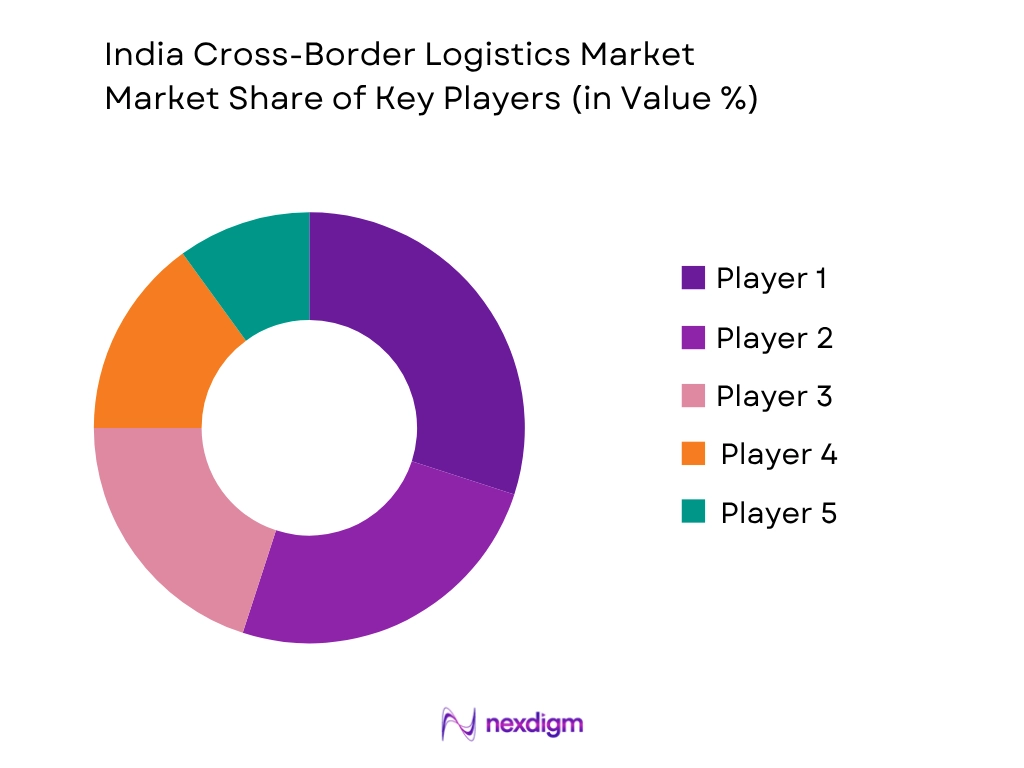
The India Cross-Border Logistics Market is shaped by a combination of large, integrated Indian logistics providers and global express and freight majors with substantial Indian operations. Delhivery, headquartered in Gurugram, reported FY25 revenue of approximately ₹89,319 million (around USD 1.03 billion) and operates a large nationwide network spanning express parcel delivery, freight, warehousing, and cross-border logistics solutions, with the company’s stated strategic focus explicitly including expansion of B2B freight and cross-border logistics to improve profitability. Allcargo Logistics, through its express arm Allcargo Gati, has enhanced capacity and service reliability to support rising B2B and e-commerce logistics demand, with the group’s broader strategic focus centered on global LCL leadership and multimodal infrastructure expansion. Blue Dart Express, part of the DHL Group, maintains a longstanding position as one of India’s leading integrated air and ground express logistics providers, while global players FedEx and DHL continue to invest directly in Indian infrastructure, exemplified by FedEx’s new Bengaluru sorting facility capable of processing 75,000 outbound parcels daily. Competitive dynamics are increasingly shaped by digital tracking technology, customs brokerage expertise, and the ability to serve India’s rapidly expanding non-metro and rural cross-border e-commerce demand.
| Company | Established | Headquarters | Primary Service | Cross-Border Network | Customs Brokerage | Digital Visibility Platform | Sustainability capability | Certifications & Complainces |
| Delhivery Limited | 2011 | ~ | ~ | ~ | ~ | ~ | ~ | ~ |
| Allcargo Logistics Limited | 1993 | ~ | ~ | ~ | ~ | ~ | ~ | ~ |
| FedEx Corporation | 1971 | ~ | ~ | ~ | ~ | ~ | ~ | ~ |
| Blue Dart Express Limited | 1983 | ~ | ~ | ~ | ~ | ~ | ~ | ~ |
| DHL Group | 1969 | ~ | ~ | ~ | ~ | ~ | ~ | ~ |
India Cross-Border Logistics Market Analysis
Growth Drivers
Surging Cross-Border E-Commerce and Digital Trade Growth
India’s cross-border logistics market is being propelled by rapid growth in cross-border e-commerce, with international courier, express, and parcel shipments growing at a 10.73% CAGR between 2026 and 2031 as export-oriented small-parcel trade accelerates. FedEx’s new 50,000 square foot sorting facility in Bengaluru, capable of processing 75,000 outbound parcels daily, exemplifies the scale of infrastructure investment being deployed to support this growth, while dedicated export hubs at four Indian airports have shortened customs dwell times to between 12 and 18 hours. The Directorate General of Foreign Trade’s Standard Operating Procedures for Cross-Border E-commerce, issued in 2024, further reflects the government’s efforts to formalize and streamline regulatory processes supporting this fast-growing trade segment, as MSME digitization and rising direct-to-consumer export activity continue to expand the addressable market for cross-border logistics providers.
National Logistics Policy and Infrastructure Digitalization
India’s National Logistics Policy, launched by Prime Minister Narendra Modi in September 2022, aims to reduce the country’s logistics costs from approximately 16% of GDP to the global average of 8% by 2030, while the sector is estimated to grow at a 10.5% CAGR through 2025 following 7.8% CAGR growth over the preceding five years, according to ICRA. The policy has been accompanied by significant digital infrastructure investment, including the e-Sanchit portal enabling paperless export-import trade operations, faceless assessment in customs clearance, and widespread adoption of e-way bills and FASTag on Indian roads, all of which are streamlining cross-border shipment processing. India’s broader logistics market, valued at approximately USD 160 billion, is projected to reach around USD 215 billion within the next two years, with the sector employing more than 22 million people and expected to see continued workforce growth supported by skill development initiatives.
Market Challenges
Complex Regulatory Framework and High Compliance Costs
The India Cross-Border Logistics Market faces significant challenges from a complex regulatory environment, with compliance across multiple overlapping customs laws and trade agreements leading to delays and increased operational costs for logistics providers and their customers. Industry estimates suggest that businesses operating in India’s cross-border trade ecosystem spend approximately USD 1.5 billion annually on compliance-related costs, a substantial burden that particularly affects smaller exporters and logistics providers without dedicated regulatory affairs capability. This regulatory complexity, spanning customs valuation, trade agreement compliance, and documentation requirements across India’s diverse trading relationships, continues to represent one of the most persistent structural challenges facing the market despite ongoing digitalization efforts.
Infrastructure Gaps and Customs Bottlenecks at Land Borders
India’s extensive land border trade with Pakistan, Bangladesh, Nepal, Myanmar, and Bhutan continues to face meaningful operational challenges, including restricted border crossing hours, periodic customs IT system interruptions, and other unforeseen disruptions that complicate road transport, the preferred mode for time- and cost-effective land border shipments. Urban freight integration gaps further compound these challenges as last-mile cross-border e-commerce fulfillment increasingly extends into India’s non-metro and rural areas, exemplified by Ecom Express deriving 62% of its 2024 traffic from non-metro locations. These infrastructure gaps require continued investment in border infrastructure, digital customs systems, and multimodal connectivity to fully realize the trade potential of India’s land border corridors with its South Asian neighbors.
Market Opportunities
Growth in International Express and Small-Parcel Cross-Border Trade
India’s international express logistics market, currently comprising around 30% of the total express industry, is projected to grow to between USD 18 billion and USD 22 billion by FY30, creating an estimated 6.5 to 7.5 million jobs according to KPMG analysis. This growth trajectory, driven by rising cross-border e-commerce and MSME digitization, creates substantial opportunity for logistics providers capable of scaling customs brokerage, sorting, and last-mile delivery capacity to serve India’s expanding base of export-oriented small businesses and direct-to-consumer brands. FedEx’s Bengaluru sorting facility investment provides a clear template for the kind of dedicated infrastructure expansion likely to continue across India’s major air cargo gateways as international small-parcel volumes scale.
Expansion of Land Border Trade Corridors with South Asian Neighbors
India’s extensive land borders with Bangladesh, Nepal, Myanmar, Bhutan, and Pakistan, combined with existing bilateral trade agreements, particularly across the substantial India-Bangladesh and India-Nepal trade corridors, present significant opportunity for specialized cross-border logistics providers with established regional networks. Companies such as SARVAM Logistics, which has built more than 20 years of experience navigating cross-border trade logistics and customs clearance across these corridors, illustrate the kind of specialized regional expertise increasingly valuable as India’s land border trade volumes continue to grow, creating opportunity for both established players and new entrants capable of addressing persistent border crossing and customs clearance challenges.
Future Outlook
The India Cross-Border Logistics Market is expected to witness sustained expansion over the forecast period, supported by continued growth in cross-border e-commerce, ongoing implementation of the National Logistics Policy and PM Gati Shakti infrastructure investment, and expanding international trade agreements. Growing adoption of digital freight platforms, AI-based tracking technology, and automated customs clearance systems will further accelerate market growth, while continued consolidation among express and freight forwarding providers is expected to reshape the competitive landscape. The market is also likely to benefit from India’s growing manufacturing output, projected to reach USD 1 trillion, as well as continued expansion of dedicated export-oriented infrastructure and land border trade corridors with South Asian neighbors, positioning India’s cross-border logistics sector for sustained growth through 2035.
Major Players
- Delhivery Limited
- Allcargo Logistics Limited (Allcargo Gati)
- Blue Dart Express Limited
- FedEx Corporation
- DHL Group
- Ecom Express Limited
- DTDC Express Limited
- Shiprocket
- SARVAM Logistics
- TCI Express Limited
- Maersk
- Kuehne+Nagel
- DB Schenker
- UPS
- CJ Darcl Logistics
Key Target Audience
- Cross-Border Logistics Providers and Freight Forwarders
- E-Commerce Marketplaces and Direct-to-Consumer Brands
- Manufacturing and Industrial Exporters
- Pharmaceutical, Automotive and Electronics Manufacturers
- Third-Party Logistics and Customs Brokerage Firms
- Investment and Venture Capitalist Firms
- Government and Regulatory Bodies (Directorate General of Foreign Trade – DGFT, Central Board of Indirect Taxes and Customs – CBIC, Ministry of Commerce and Industry)
- Port, Airport and Land Border Infrastructure Operators
Research Methodology
Step 1: Identification of Key Variables
The research process begins with identifying the complete ecosystem of the India Cross-Border Logistics Market, including freight forwarders, customs brokers, warehousing and distribution providers, e-commerce and manufacturing exporters, and regulatory authorities. Extensive secondary research is conducted using company reports, government publications, trade associations, customs statistics, industry journals, and proprietary databases to determine the variables influencing market demand, pricing, shipment volumes, and technological developments.
Step 2: Market Analysis and Construction
Historical market information is collected and analyzed to estimate market size, shipment volumes, service-wise demand, and pricing trends. A combination of top-down and bottom-up approaches is used to estimate market revenues and validate segment-level performance. Consumption patterns across e-commerce, manufacturing, automotive, pharmaceutical, and electronics applications are evaluated to establish an accurate representation of the industry.
Step 3: Hypothesis Validation and Expert Consultation
The preliminary findings are validated through Computer-Assisted Telephone Interviews (CATIs) and structured discussions with logistics providers, procurement managers, customs brokerage specialists, regulatory experts, and senior executives operating within the Indian cross-border logistics industry. These interviews help verify market assumptions, competitive developments, technology adoption trends, pricing dynamics, and future investment opportunities while refining the overall market estimates.
Step 4: Research Synthesis and Final Output
The final stage integrates insights obtained from primary interviews with quantitative information collected through secondary sources. Data triangulation techniques are applied to reconcile differences between supply-side and demand-side estimates, ensuring robust market forecasting. The report is then reviewed through multiple quality assurance checkpoints to deliver a comprehensive analysis covering market size, segmentation, competitive landscape, future outlook, and strategic recommendations for industry stakeholders.

- Executive Summary
- Research Methodology (Market Definitions and Assumptions, Abbreviations, Market Sizing Approach, Top-Down Analysis, Bottom-Up Analysis, Demand-Side Assessment, Supply-Side Assessment, Primary Industry Interviews, Trade Flow Assessment, Freight Intelligence Analysis, Data Triangulation, Forecasting Framework, Limitations and Future Conclusions)

- Definition and Scope
- Market Evolution and Industry Genesis
- Timeline of Major Industry Developments
- Cross-Border Trade Value Chain Analysis
- Cross-Border Logistics Supply Chain Analysis (Shippers, Freight Forwarders, Customs Brokers, Carriers, Warehousing, Border Inspection Agencies, Last-Mile Operators, Technology Providers)
- Trade Corridor Ecosystem Analysis

- Growth Drivers (Surging Cross-Border E-Commerce and Digital Trade Growth, National Logistics Policy and Infrastructure Digitalization, Rising Manufacturing Output and Export Diversification, Expansion of International Express and Small-Parcel Trade, Growth of Trade Agreements and Corridor Expansion, Adoption of Automation and Digital Freight Platforms)
- Market Challenges (Complex Regulatory Framework and High Compliance Costs, Infrastructure Gaps and Customs Bottlenecks at Land Borders, Urban Freight Integration Challenges, Currency and Trade Policy Volatility, Fragmented Multimodal Connectivity, Skilled Workforce Shortages in Logistics Technology)
- Market Opportunities (Growth in International Express and Small-Parcel Cross-Border Trade, Expansion of Land Border Trade Corridors with South Asian Neighbors, Digital Freight Matching and Real-Time Tracking Platforms, Air Cargo Hub Development Under NILP, Cold Chain and Pharmaceutical Export Logistics Growth, Public-Private Infrastructure Investment Partnerships)
- Market Trends (Consolidation Among Express and Freight Forwarding Providers, Growth of Agile and Asset-Light Business Models, Digital Innovation in Customs Clearance, Rising Sustainability Focus in Fleet and Fulfillment Operations, Expansion of Dedicated Export-Oriented Air Cargo Hubs, Growing Use of AI-Based Real-Time Tracking Technologies)
- Government Regulations (National Logistics Policy (NLP) 2022, PM Gati Shakti National Master Plan, DGFT Standard Operating Procedures for Cross-Border E-Commerce 2024, Foreign Trade Policy 2023, ICEGATE and e-Sanchit Customs Digitalization, Goods and Services Tax (GST) Framework)
- Import and Export Analysis (Trade Volume, Major Trading Partners, Land Border Trade Flows, HS Code Analysis, Trade Balance)
- Raw Material Availability Analysis (Fleet and Vehicle Availability, Air Cargo Capacity Constraints, Port and Terminal Infrastructure Capacity, Warehousing and Cold Chain Infrastructure, Digital Customs Infrastructure Access)
- Technology Landscape (AI-Based Real-Time Tracking Technology, Digital Freight Matching Platforms, Faceless Customs Assessment Systems, Automated Sorting and Fulfillment Technology, Blockchain-Based Trade Documentation)
- Sustainability Assessment (Fleet Electrification and Emissions Reduction, Sustainable Packaging in Cross-Border Fulfillment, Carbon Footprint Reduction in Air and Ocean Freight, Green Logistics Infrastructure Investment, Circular Economy Alignment in Reverse Logistics)
- PESTLE Analysis
- SWOT Analysis
- Porter’s Five Forces Analysis
- Stakeholder Ecosystem
- Competition Ecosystem

- By Market Value (2020-2025)
- By Freight Volume (2020-2025)
- By Average Logistics Cost per Shipment (2020-2025)

- By Service Type (In Value %)
Freight Forwarding
Customs Brokerage
Warehousing & Distribution
Transportation (Road, Rail, Air, Sea)
Last-Mile Delivery - By Mode of Transport (In Value %)
Air Freight
Ocean Freight
Road Freight (Land Border Trade)
Rail Freight - By End-User Industry (In Value %)
E-Commerce
Manufacturing
Automotive
Pharmaceuticals & Healthcare
Electronics & Electricals - By End User (In Value %)
E-Commerce Marketplaces & DTC Brands
Manufacturing & Industrial Exporters
Pharmaceutical & Healthcare Companies
Automotive & Electronics Manufacturers
Third-Party Logistics Providers - By Region (In Value %)
North India
South India
West India
East India

- Market Share of Major Players (By Value, Shipment Volume, Service Type, End-User Industry, Trade Corridor)
- Cross Comparison Parameters (Network Coverage and Reach, Customs Brokerage Capability, Digital Tracking Technology Portfolio, Application Technical Support, Fleet and Infrastructure Capacity, Regulatory Compliance & Certifications, Customer Base, Innovation & New Service Launch Frequency)
- SWOT Analysis of Major Players
- Pricing Analysis by Service Type and Trade Corridor
- Capacity and Throughput Analysis
- Network and Hub Footprint Analysis
- Distribution Network Analysis
- Innovation Benchmarking
- Detailed Profiles of Major Companies
Delhivery Limited
Allcargo Logistics Limited (Allcargo Gati)
Blue Dart Express Limited
FedEx Corporation
DHL Group
Ecom Express Limited
DTDC Express Limited
Shiprocket
SARVAM Logistics
TCI Express Limited
Maersk
Kuehne+Nagel
DB Schenker
UPSCJ Darcl Logistics

- Consumption Pattern Analysis (Shipment Volume Intensity, Parcel Size Distribution, End-User Industry Penetration, Seasonal and Peak-Period Demand, Non-Metro vs Metro Traffic Split)
- Purchasing Criteria (Cost Per Shipment, Regulatory and Customs Compliance Support, Delivery Speed and Reliability, Real-Time Tracking Capability, Multimodal Network Reach, Returns and Reverse Logistics Support)
- Procurement and Supplier Selection Analysis
- Digital Freight Platform Adoption Assessment
- Metro vs Non-Metro Cross-Border Fulfillment Demand
- Product Attribute Preference Analysis (Customs Clearance Speed, Tracking Accuracy, Network Coverage, Cost Efficiency, Reliability, Multimodal Flexibility)
- Sustainability & ESG Influence on Procurement Decisions
- Pain Point Analysis
- Decision-Making Process

- By Market Value (2026-2035)
- By Freight Volume (2026-2035)
- By Average Logistics Cost per Shipment (2026-2035)


 Request a Sample
 Ask for Customization
 Get a Quote
 Enquire Now