

 Download PDF
Market Overview
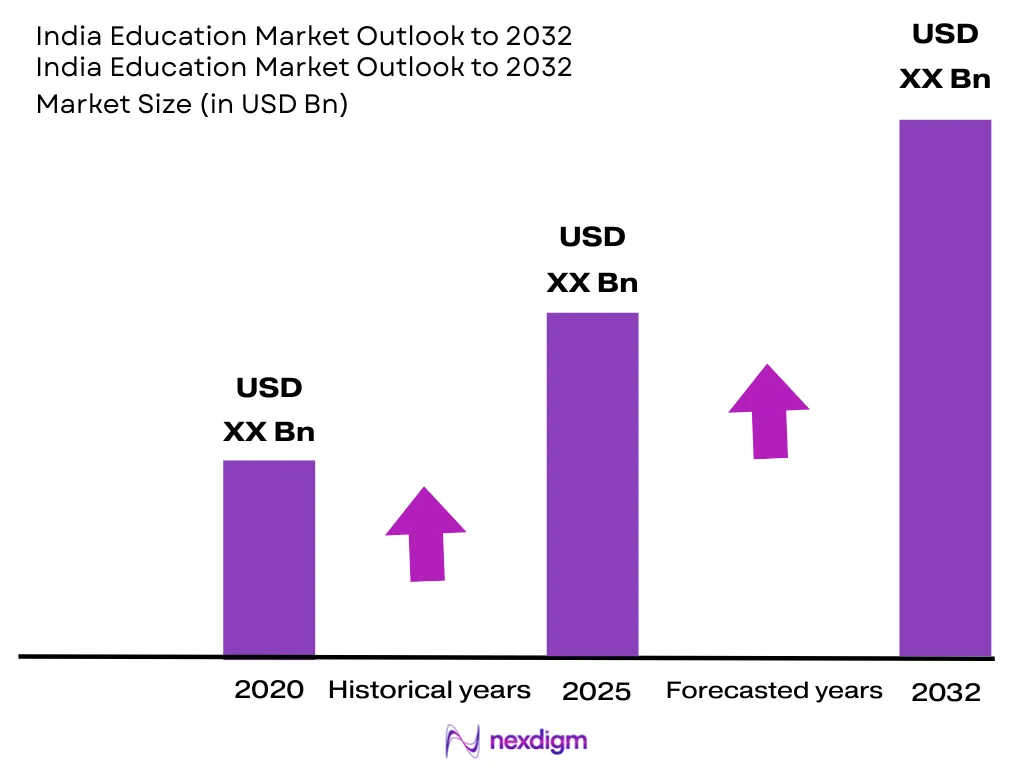
The India education market was valued at USD ~ billion in 2024 and is projected to expand at a CAGR of ~% during the 2026–2032 forecast period. According to data published by the Ministry of Education and the All India Survey on Higher Education (AISHE), India operates the largest education system in the world by number of institutions, enrolling more than 260 million students across school and higher education levels, supported by over 1.5 million schools and more than 43,000 higher education institutions. Data from the National Statistical Office and industry associations indicates that both public and private education expenditure continue to rise steadily, while the sector continues to benefit from demographic tailwinds, rising household aspiration for quality education, rapid digital infrastructure expansion, and strong policy support under the National Education Policy (NEP) 2020. Growth is further supported by increasing private investment in EdTech platforms, expanding vocational training ecosystems, rising gross enrollment ratios at the higher education level, and growing corporate demand for workforce upskilling and reskilling programs across India’s rapidly evolving economy.
Market Segmentation
By Sector
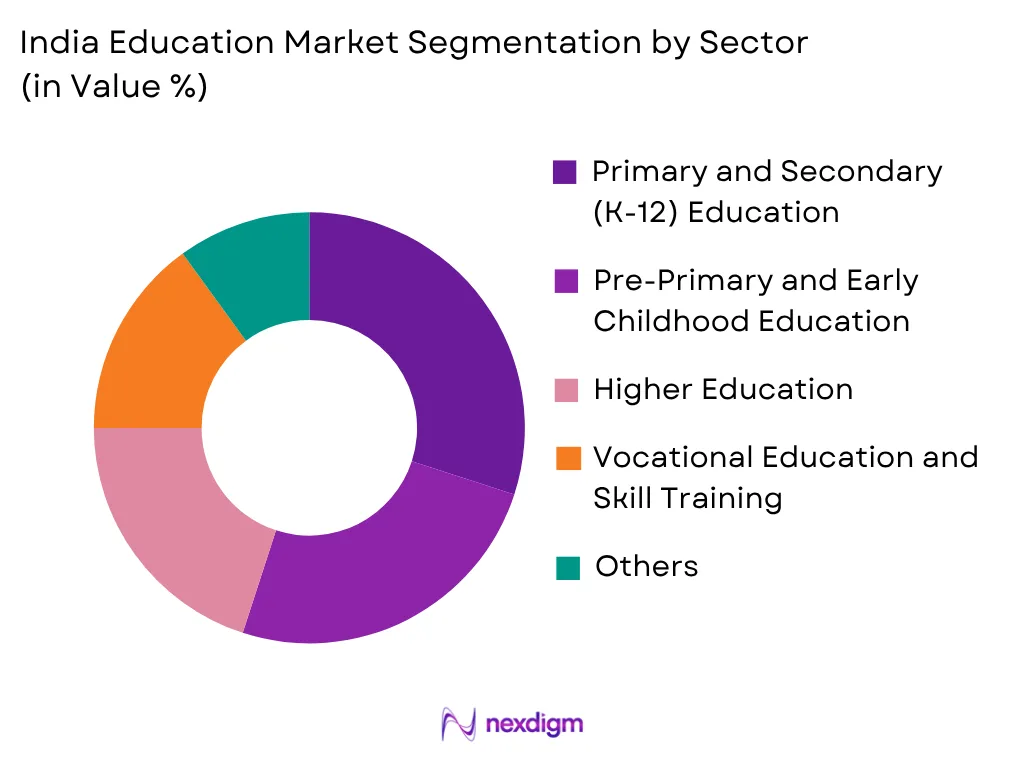
K-12 education dominates the India education market by enrollment and overall market value, owing to the country’s large school-age population, mandatory Right to Education provisions for children between 6 and 14 years of age, and deep parental investment in children’s academic outcomes from an early age. India’s school education system serves more than 250 million students across government, government-aided, and private unaided schools, making it the world’s largest school system. Private unaided schools, particularly those affiliated with CBSE and ICSE boards, continue to attract a growing share of urban and semi-urban enrollment as families aspiring to quality education actively migrate from government to private institutions. At the same time, the competitive exam preparation segment has emerged as one of the fastest-growing and highest-revenue-generating sub-sectors within K-12 and post-secondary education, driven by intense competition for seats in premier engineering and medical institutions including the IITs, NITs, and AIIMS. EdTech platforms targeting K-12 learners with supplementary tutoring, adaptive assessments, and live coaching have experienced rapid growth, particularly following accelerated digital adoption during and after the COVID-19 pandemic. Continuous investment in curriculum innovation, digital content development, personalized learning technologies, and outcome-oriented program design continues to strengthen K-12 education’s dominant position within the broader India education market landscape.
By Delivery Mode
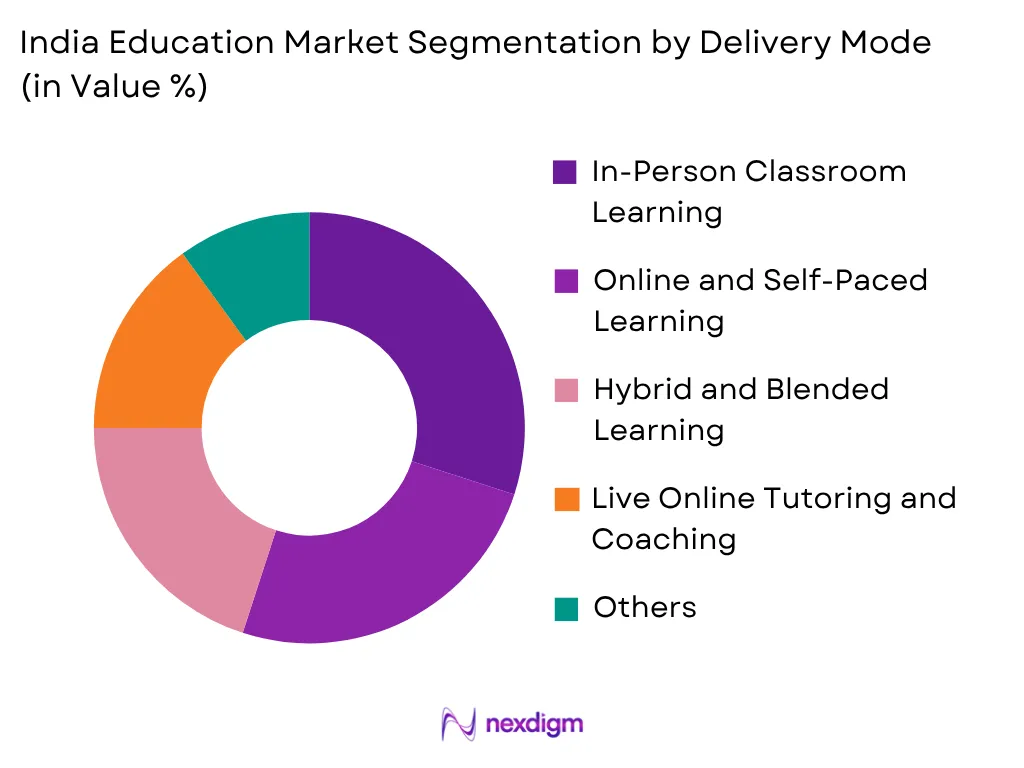
In-person classroom learning continues to account for the largest share of education delivery in India by value and enrollment, reflecting the deeply embedded cultural preference among Indian parents and students for face-to-face teaching, direct faculty interaction, and structured institutional environments. The vast majority of India’s school and higher education enrollment remains concentrated in physical campuses, supported by government infrastructure, CBSE and state board affiliation requirements, and the socialization and extracurricular dimensions of traditional schooling that parents and students continue to value highly. However, online and hybrid learning modes have experienced structural acceleration since the COVID-19 pandemic, with EdTech platforms including BYJU’S, Unacademy, PhysicsWallah, and Vedantu attracting tens of millions of registered learners across supplementary tutoring, live coaching, competitive exam preparation, and professional upskilling. Government platforms such as DIKSHA and SWAYAM have further expanded the availability of free digital learning content to students in government schools and colleges across the country. Mobile-first learning applications have become particularly important in reaching students in Tier 2, Tier 3, and rural markets, where smartphone penetration continues to rise significantly. Hybrid and blended models combining in-person and digital delivery are increasingly adopted by private schools, coaching institutes, and higher education institutions seeking to extend geographic reach while maintaining academic quality.
Competitive Landscape
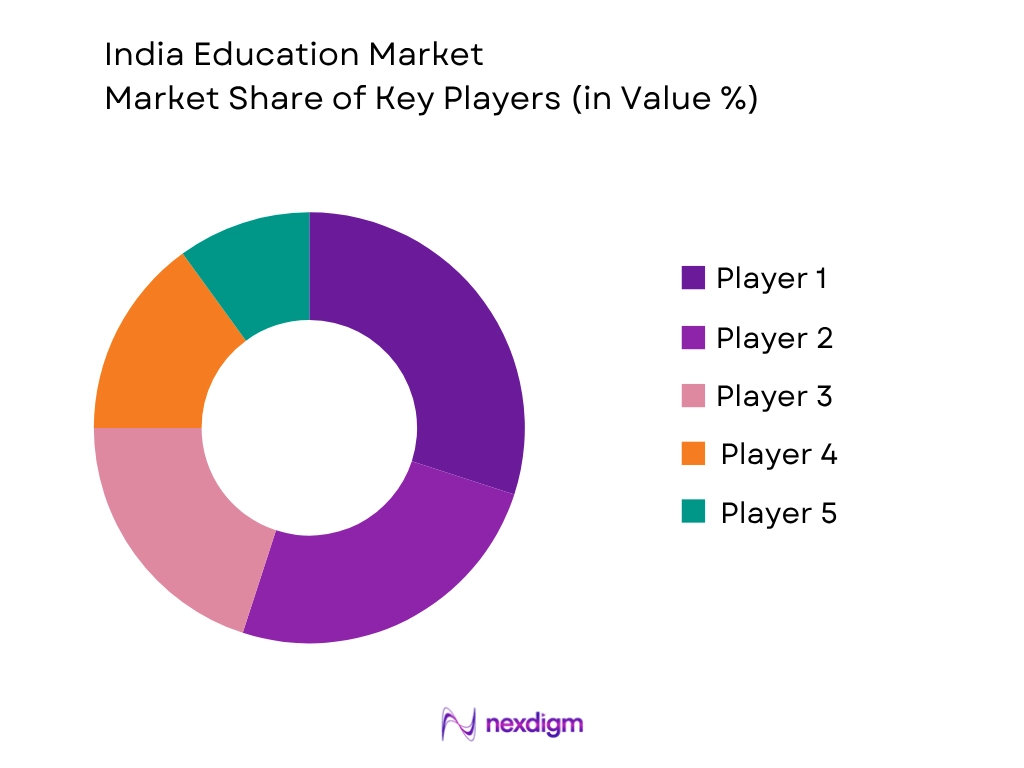
The India education market is highly fragmented across school, higher education, coaching, vocational, and EdTech segments, with a mix of large established players, regional coaching institutes, government-aided institutions, and rapidly scaling digital-first platforms competing for student enrollment. Leading EdTech companies including BYJU’S, PhysicsWallah, Unacademy, and upGrad have attracted significant venture capital funding and built large national learner bases. Traditional coaching powerhouses including Allen Career Institute and Aakash Educational Services maintain dominant positions in the high-stakes competitive exam preparation segment. Professional upskilling providers including NIIT, Simplilearn, and Great Learning compete in the corporate and higher education reskilling space. Continuous investments in technology infrastructure, vernacular content development, faculty quality, and student outcome improvement remain key competitive differentiators across all segments.
| Company | Establishment Year | Headquarters | Primary Education Focus | Delivery Platforms
|
Geographic Reach | Accreditation Status | Technology Investment | Key Program Portfolio |
| BYJU’S | 2011 | ~ | ~ | ~ | ~ | ~ | ~ | ~ |
| PhysicsWallah (PW) | 2020 | ~ | ~ | ~ | ~ | ~ | ~ | ~ |
| Allen Career Institute | 1988 | ~ | ~ | ~ | ~ | ~ | ~ | ~ |
| upGrad | 2015 | ~ | ~ | ~ | ~ | ~ | ~ | ~ |
| NIIT Limited | 1981 | ~ | ~ | ~ | ~ | ~ | ~ | ~ |
India Education Market Analysis
Growth Drivers
Large, Young, and Aspiration-Driven Population
India’s large and youthful population continues to be the single most significant structural growth driver for the education market. The Census of India and National Statistical Office data estimate India’s total population at more than 1.44 billion, making it the world’s most populous nation, with a median age of approximately 28 years. This demographic profile ensures an exceptionally large school-age and college-going population, with the Ministry of Education reporting more than 250 million students enrolled in school education and over 43 million enrolled in higher education institutions across the country. The sheer scale of this demand base provides an unparalleled addressable market for education providers across all segments, from pre-primary schooling to professional upskilling. Rising household aspiration is an equally powerful driver, as India’s expanding middle class—estimated by the National Council of Applied Economic Research to exceed 300 million individuals—places quality education among its highest priorities, willingly spending a disproportionate share of household income on children’s schooling, tutoring, and higher education. The International Monetary Fund estimates India’s nominal GDP at more than USD 3.7 trillion and projects the country to remain one of the world’s fastest-growing major economies, sustaining household income growth and education spending capacity. India’s young demographic dividend, with more than 600 million citizens below the age of 25, also creates robust long-term demand for vocational training, higher education, and professional upskilling programs, as this cohort seeks to convert its population advantage into productive economic participation over the forecast period.
National Education Policy 2020 and Government Investment
The National Education Policy (NEP) 2020, the most comprehensive reform of India’s education system since 1986, has created a powerful long-term structural catalyst for market expansion. The policy fundamentally restructures the school education framework from a 10+2 to a 5+3+3+4 model emphasizing foundational literacy and numeracy, critical thinking, and multidisciplinary learning, while introducing significant reforms at the higher education level including the Academic Bank of Credits, multiple entry and exit pathways in undergraduate programs, and a target of raising the Gross Enrollment Ratio (GER) in higher education from approximately 27 percent to 50 percent by 2035. The Ministry of Education has committed to increasing public education expenditure toward 6 percent of GDP, a significant step up from current levels, which the World Bank estimates at approximately 4.6 percent. The Samagra Shiksha Abhiyan integrates school education from pre-primary to senior secondary into a unified program, providing infrastructure, teacher training, and digital resource support across all government schools. The PM-POSHAN mid-day meal scheme covering more than 118 million children across government schools provides nutritional support that directly improves school attendance and retention rates, expanding the addressable enrollment base for private supplementary education providers. The government’s Skill India Mission and PM Kaushal Vikas Yojana have further expanded the vocational training ecosystem, targeting the certification of millions of youth annually. These policy initiatives create substantial demand for private education services, curriculum development, assessment technologies, teacher training programs, and digital learning infrastructure investment across all segments of the India education market.
Market Challenges
Quality Disparity Between Urban and Rural Education
One of the most structurally persistent challenges facing the India education market is the profound quality disparity between urban and rural education institutions, which constrains both learning outcomes and market expansion potential across large parts of the country. The Annual Status of Education Report (ASER), published by Pratham, has consistently documented that a significant proportion of children enrolled in government schools in rural areas cannot read simple texts or perform basic arithmetic at the expected grade level, indicating deep foundational learning gaps despite high enrollment rates driven by the Right to Education Act. These learning deficits reflect the combined impact of infrastructure shortfalls, high pupil-to-teacher ratios in government schools exceeding 30 students per teacher on average, high rates of teacher absenteeism recorded by the Ministry of Education, inadequate physical infrastructure including classrooms, toilets, and electricity, and limited availability of qualified and trained teaching professionals willing to serve in remote rural postings. The stark contrast between outcomes at well-resourced private urban schools and underfunded rural government schools creates a two-tiered education system that limits social mobility, reinforces inter-generational inequality, and challenges the ability of EdTech platforms and private education providers to deliver consistent quality at scale across India’s geographically vast and logistically complex rural hinterland. Bridging this urban-rural education quality gap requires sustained and coordinated investment in teacher training, digital infrastructure, government school strengthening, and community engagement, representing both a structural challenge and a long-term opportunity for private sector participation under public-private partnership frameworks.
Regulatory Complexity and Multi-Jurisdictional Compliance
The India education sector operates under one of the most complex and multi-layered regulatory environments of any industry in the country, creating significant compliance costs and operational challenges for education providers seeking to scale nationally. Regulatory oversight is divided among multiple central government bodies including the University Grants Commission (UGC) for higher education, the All India Council for Technical Education (AICTE) for technical and management programs, the National Medical Commission (NMC) for medical education, the Bar Council of India for legal education, and the National Council for Teacher Education (NCTE) for teacher training institutions, each with distinct and frequently updated accreditation, fee regulation, faculty qualification, and infrastructure requirements. State governments maintain separate regulatory jurisdictions over school education through State Education Departments and State Boards of Secondary Education, creating significant variation in curriculum standards, fee regulation policies, and operational requirements across India’s 28 states and 8 union territories. EdTech platforms and private coaching institutes operate in a comparatively less regulated but rapidly evolving compliance environment, with the Ministry of Education issuing new guidelines for online education delivery, digital content standards, and student data protection. Fee regulation norms for private unaided schools and colleges under various state-specific acts, including Supreme Court judgments on capitation fees and commercialization of education, add further legal complexity for private institutions seeking sustainable fee structures. These regulatory layers increase the administrative burden on education providers, slow down the pace of new institution approvals, limit fee flexibility, and create inconsistent operating conditions across states, affecting the ability of national private education groups to scale efficiently.
Market Opportunities
EdTech Expansion Into Vernacular Languages and Tier 2 and Tier 3 Markets
The expansion of EdTech platforms into vernacular regional languages and underserved Tier 2, Tier 3, and rural markets represents one of the most substantial and structurally significant growth opportunities in the India education sector. The vast majority of India’s population does not communicate primarily in English, with the Census of India recording Hindi as the mother tongue of approximately 44 percent of the population and hundreds of regional languages including Bengali, Marathi, Telugu, Tamil, Gujarati, Kannada, Odia, and Punjabi spoken by hundreds of millions of students outside English-medium educational contexts. Until recently, most EdTech content has been developed predominantly in English or Hindi, leaving a large proportion of students in regional language-medium schools and rural communities underserved by digital education platforms. Platform providers including PhysicsWallah, Unacademy, and Vedantu have begun expanding vernacular content libraries and regional language live tutoring capabilities, and early evidence indicates strong student engagement and retention improvements when content is delivered in the learner’s mother tongue. The Telecom Regulatory Authority of India reports that mobile internet subscriber base has exceeded 800 million, with the majority of new subscribers being first-time internet users in Tier 2, Tier 3, and rural markets accessing content primarily on affordable Android smartphones. This expanding digital access base creates a rapidly growing addressable market for vernacular EdTech content that combines academic rigor with regional language accessibility. Platforms and institutions that invest in high-quality vernacular curriculum development, regional language live instruction, localized assessments, and culturally relevant pedagogy are well positioned to capture the next wave of digital education growth beyond India’s saturated urban English-medium market.
Vocational Training, Skill Development, and Corporate Upskilling
India’s rapidly evolving economy, ongoing digital transformation across industries, and the government’s Skill India Mission create a compelling and large-scale opportunity for vocational training, professional certification, and corporate workforce upskilling providers. The National Skill Development Corporation (NSDC) estimates that India requires the training and certification of more than 400 million workers across new and existing skill sets by 2030 to meet the demands of an economy transitioning toward digital services, advanced manufacturing, renewable energy, healthcare, and logistics. Currently, India’s formal vocational training ecosystem remains significantly undersized relative to this demand, with the network of Industrial Training Institutes (ITIs), Pradhan Mantri Kaushal Kendras, and sector skill councils certifying a fraction of the workforce required. This gap represents a multi-billion dollar addressable market for private vocational training providers, EdTech platforms offering job-linked programs, corporate training companies, and higher education institutions developing industry-aligned short-term certification courses. The International Monetary Fund projects India’s nominal GDP to surpass USD 5 trillion by the end of the forecast period, driving corporate expansion and continuous demand for workforce upskilling in technology, data analytics, artificial intelligence, cybersecurity, financial services, and green energy. Professional upskilling platforms including upGrad, Simplilearn, Great Learning, and NIIT have already established significant market positions by offering industry-recognized certifications in partnership with global universities and technology companies. The UGC’s recognition of online degrees and the NEP 2020’s framework for short-term micro-credentials further legitimize non-traditional learning pathways, expanding the addressable market for skill-based education providers targeting India’s working professional population.
Future Outlook
The India education market is expected to witness sustained and broad-based growth throughout the forecast period, supported by a large and growing student population, rising household investment in education, policy-driven structural reforms under NEP 2020, and rapid digital infrastructure expansion. Education providers are increasingly investing in technology-enabled personalized learning, vernacular content development, outcome-linked program design, and hybrid delivery models. Growing demand for competitive exam preparation, higher education access, vocational skill certification, and corporate upskilling is expected to create significant additional revenue opportunities across both established and emerging segments. Continued private investment in EdTech innovation, international academic partnerships, and public-private collaboration in school infrastructure will further strengthen the long-term competitiveness of the India education market.
Major Players
- BYJU’S (Think and Learn Private Limited)
- Unacademy
- Vedantu
- upGrad
- PhysicsWallah (PW)
- Allen Career Institute
- Aakash Educational Services (AESL)
- Simplilearn
- Great Learning
- NIIT Limited
- Pearson India
- Manipal Global Education Services
- Amity Education Group
- EduBridge Learning
- WhiteHat Jr (BYJU’S)
Key Target Audience
- Private School and Higher Education Institution Operators
- EdTech Platform Developers and Investors
- Vocational Training and Skill Development Providers
- Educational Content and Curriculum Developers
- Assessment and Examination Technology Companies
- Education Infrastructure and Technology Suppliers
- Investments and Venture Capitalist Firms
- Government and Regulatory Bodies (Ministry of Education (MoE), University Grants Commission (UGC), All India Council for Technical Education (AICTE), National Skill Development Corporation (NSDC))
Research Methodology
Step 1: Identification of Key Variables
The research begins by identifying the major stakeholders across the India education value chain, including government policy bodies, school and university operators, EdTech platform providers, content developers, assessment agencies, vocational training providers, and learners. Extensive secondary research is conducted using government publications, AISHE reports, industry associations, NSDC databases, company reports, and proprietary databases to establish the key variables influencing market performance.
Step 2: Market Analysis and Construction
Historical market information is compiled and evaluated to estimate the overall market size, enrollment trends, institutional penetration, fee and revenue dynamics, and growth across major education segments. Both demand-side and supply-side indicators are analyzed using bottom-up and top-down market sizing approaches to ensure comprehensive market coverage across school education, higher education, coaching, vocational training, and EdTech segments.
Step 3: Hypothesis Validation and Expert Consultation
Preliminary market estimates and analytical assumptions are validated through Computer Assisted Telephone Interviews (CATIs) and structured discussions with school administrators, university officials, EdTech founders and executives, corporate training heads, vocational educators, and policy experts. These interviews provide valuable on-ground insights that strengthen the reliability of market estimates across diverse geographic and institutional contexts.
Step 4: Research Synthesis and Final Output
The final stage integrates primary research findings with secondary information to develop a comprehensive assessment of market size, segmentation, competitive landscape, learner behavior, and future opportunities. Multiple validation techniques, including data triangulation and cross-verification across central government data, state-level enrollment records, and industry sources, are employed to ensure the consistency, accuracy, and credibility of the final market report.

- Executive Summary
- Research Methodology (Market Definitions and Assumptions, Abbreviations, Market Taxonomy, Market Sizing Approach, Top-Down Analysis, Bottom-Up Analysis, Demand-Side Assessment, Supply-Side Assessment, Primary Industry Interviews, Secondary Research Validation, Data Triangulation, Forecasting Framework, Limitations and Future Conclusions)

- Definition and Scope
- Market Evolution and Industry Genesis
- Timeline of Major Industry Developments
- Industry Value Chain Analysis
- Supply Chain Analysis

- Growth Drivers (Large and Young Population Base, Rising Middle-Class Aspiration for Quality Education, Government Initiatives Under the National Education Policy 2020, Rapid Digital Infrastructure Expansion, Growing Demand for Skill-Based and Vocational Training, Increasing Private Investment in EdTech, Rising Higher Education Gross Enrollment Ratio, Expanding Corporate Learning and Development Budgets)
- Market Challenges (Quality Disparity Between Urban and Rural Education, High Student-to-Teacher Ratios in Government Schools, Infrastructure Deficit Across Tier 2 and Tier 3 Cities, Low Completion Rates in Higher Education, Regulatory Complexity Across Central and State Jurisdictions, Affordability Constraints for Lower-Income Households, Brain Drain and Faculty Shortages, Digital Divide Limiting Online Education Penetration in Rural Areas)
- Market Opportunities (National Education Policy 2020 Implementation, EdTech Platform Expansion into Vernacular and Regional Languages, Vocational Training and Skill India Mission, Study Abroad and International Partnership Programs, AI-Powered Personalized Learning, Corporate Upskilling and Reskilling Demand, Government-Private Partnership in School Infrastructure, Early Childhood Education Expansion)
- Market Trends (Hybrid and Blended Learning Models, Gamification in K-12 Education, AI and Adaptive Learning Platforms, Increasing Vernacular Content Demand, Rise of Micro-Credentials and Short-Term Certifications, STEM and Coding Education at School Level, Mental Health and Holistic Development Integration, International School Curriculum Adoption)
- Government Regulations (National Education Policy (NEP) 2020, Right to Education (RTE) Act 2009, University Grants Commission (UGC) Regulations, All India Council for Technical Education (AICTE) Guidelines, Central Board of Secondary Education (CBSE) Standards, National Curriculum Framework, Ministry of Education (MoE) Directives, National Skill Development Corporation (NSDC) Frameworks, Foreign Education Institutions Regulation)
- Public Education Spending Analysis (Central Government Education Budget, State Government Education Expenditure, Samagra Shiksha Abhiyan Allocation, PM-POSHAN Mid-Day Meal Scheme, Higher Education Financing Agency (HEFA), Private Household Education Expenditure, Corporate Social Responsibility (CSR) Education Investments)
- Teacher Availability and Quality Analysis (Pupil-Teacher Ratio, Trained Teacher Availability, Government Teacher Recruitment, Private School Faculty Hiring, EdTech Instructor Ecosystem, Faculty Development Programs)
- Seasonal Demand Analysis (Academic Year Enrollment (April-June), Board Exam Preparation Season (October-March), Competitive Exam Coaching Cycles (JEE, NEET, CAT, UPSC), Admission Season, Professional Development Off-Season Programs, Corporate Training Budget Cycles)
- Digital Infrastructure and Penetration Analysis (Smartphone and Internet Penetration, PM-WANI Wi-Fi Scheme, DIKSHA Platform Usage, BharatNet Rural Broadband, EdTech App Adoption Rates, Online Examination Infrastructure)
- Innovation Landscape (AI-Driven Personalized Tutoring, Augmented and Virtual Reality Classrooms, Learning Management System Adoption, Gamified Assessments, Blockchain-Based Credential Verification, Vernacular Language Learning Platforms)
- Sustainability and Inclusion Analysis (Inclusive Education for Students with Disabilities, Girl Child Education Initiatives, PM Poshan, Kasturba Gandhi Balika Vidyalaya, Scholarship and Financial Aid Ecosystem, Environmental Sustainability in Campus Operations)
- SWOT Analysis
- Porter’s Five Forces Analysis
- PESTLE Analysis
- Stakeholder Ecosystem
- Competition Ecosystem

- By Market Value (2020-2025)
- By Student Enrollment (2020-2025)
- By Average Spend Per Learner (2020-2025)

- By Sector (In Value %)
Pre-Primary and Early Childhood Education
Primary and Secondary (K-12) Education
Higher Education (Undergraduate and Postgraduate)
Vocational Education and Skill Training
Test Preparation and Competitive Exam Coaching
EdTech and Online Learning
Corporate Learning and Development
International and Study Abroad Programs - By Delivery Mode (In Value %)
In-Person Classroom Learning
Online and Self-Paced Learning
Hybrid and Blended Learning
Live Online Tutoring and Coaching
Mobile Learning Applications
Distance and Correspondence Education - By Institution Type (In Value %)
Government and Public Schools and Colleges
Private Unaided Schools and Colleges
Deemed and Autonomous Universities
International Schools and IB Programs
Coaching Institutes and Tutorial Centers
EdTech Platforms and Online Academies
Vocational Training Centers and ITIs
Corporate Training Providers - By Course Type (In Value %)
Science, Technology, Engineering and Mathematics (STEM)
Commerce and Business Management
Humanities and Social Sciences
Medical and Allied Health Sciences
Law and Legal Studies
Arts, Design and Creative Fields
Language and Communication Skills
Competitive Exam Preparation (JEE, NEET, UPSC, CAT, GATE) - By Region (In Value %)
North India (Delhi NCR, Uttar Pradesh, Rajasthan, Haryana, Punjab)
South India (Maharashtra, Karnataka, Tamil Nadu, Telangana, Andhra Pradesh, Kerala)
East India (West Bengal, Bihar, Odisha, Jharkhand)
West India (Gujarat, Maharashtra)
Central India (Madhya Pradesh, Chhattisgarh)
Northeast India

- Market Share Analysis (By Value, Enrollment, Sector, Delivery Mode, Price Segment)
- Cross Comparison Parameters (Course Portfolio Breadth, Geographic Reach Across States, Annual New Program Launches, Technology Infrastructure Investment, Faculty Strength, Placement and Outcome Track Record, Accreditation Status, Vernacular Content Capability)
- SWOT Analysis of Major Players
- Fee and Pricing Analysis (By Program Type, Institution Tier, Delivery Mode, Geographic Location, Duration)
- Detailed Profiles of Major Companies
BYJU’S (Think and Learn Private Limited)
Unacademy
Vedantu
upGrad
PhysicsWallah (PW)
Allen Career Institute
Aakash Educational Services (AESL)
Simplilearn
Great Learning
NIIT Limited
Pearson India
Manipal Global Education Services
Amity Education Group
EduBridge Learning
WhiteHat Jr (BYJU’S)

- Learner Enrollment Pattern Analysis (Enrollment Frequency, Subject Preference, Mode of Learning Preference, Seasonal Enrollment Behavior, Household Education Spending)
- Demographic Enrollment Analysis (Age Group, Gender, Income Level, Household Size, State and Urban-Rural Distribution)
- Household Education Expenditure Analysis
- Premium Private vs Government Institution Analysis
- Brand and Institution Loyalty Analysis
- Outcome-Oriented Purchase Behaviour (Employment, Higher Studies, Skill Certification)
- Course and Program Attribute Preference Analysis (Faculty Quality, Campus Infrastructure, Placement Record, Accreditation, Fee Structure, Location, Online Flexibility, Brand Reputation)
- Parental Decision-Making in K-12 Education
- Online vs Offline Learning Preference
- Consumer Pain Point Analysis
- Purchase Decision-Making Process

- By Market Value (2026-2032)
- By Volume Consumption (2026-2032)
- By Average Selling Price (2026-2032)


 Request a Sample
 Ask for Customization
 Get a Quote
 Enquire Now