
 Download PDF
Market Overview
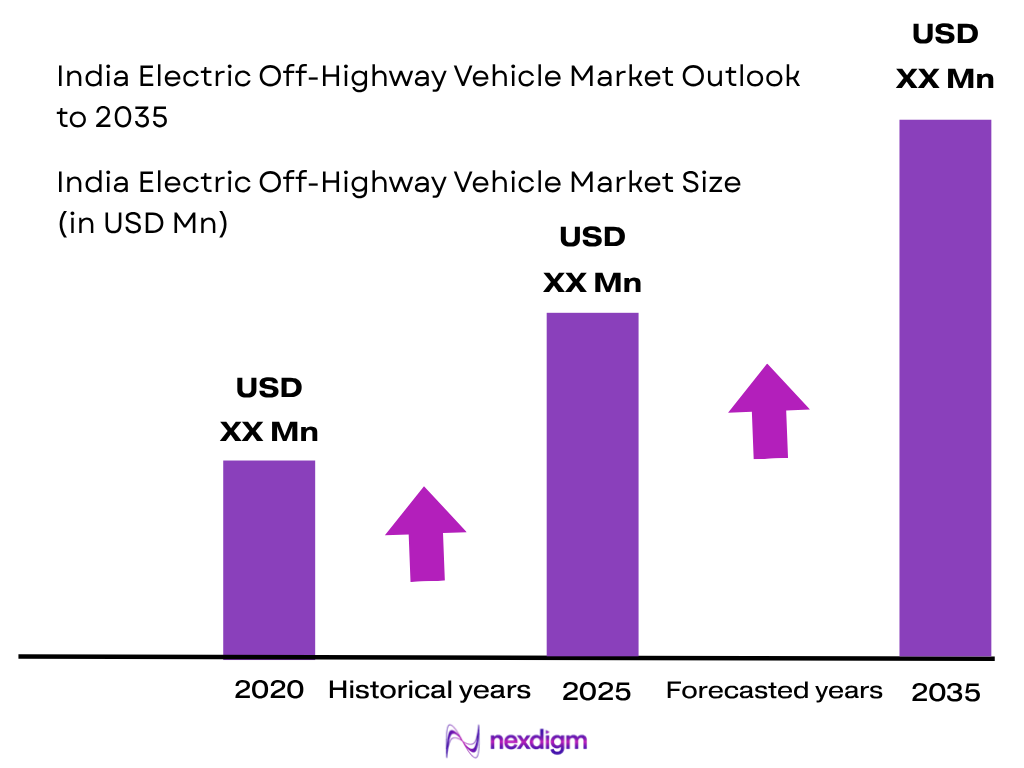
The India Electric Off-Highway Vehicle Market is valued at ~USD XX billion, supported by rapid expansion of the underlying construction-equipment ecosystem, infrastructure investment and increasing equipment electrification. ICEMA reported 135,650 construction-equipment units sold in FY24, compared with 107,779 units in FY23, while earthmoving equipment reached 93,531 units. The wider industrial base is also substantial, with industry including construction contributing 24.6% of GDP in 2024 and India recording 6.5% GDP growth, strengthening the operating environment for electric machinery.
Demand is concentrated around major construction, infrastructure, manufacturing, agricultural and mining clusters, particularly Maharashtra, Gujarat, Tamil Nadu, Karnataka, Telangana, Uttar Pradesh, Rajasthan and Odisha. These locations combine large construction-equipment fleets, industrial activity, ports, manufacturing clusters and agricultural operations. ICEMA reported 123,660 domestic construction-equipment sales in FY24 and 126,961 units in FY25, while domestically produced equipment represented 98% of domestic sales in FY25. This established equipment ecosystem provides an important installed base for electric-machine adoption and localized servicing.
Market Segmentation
By Vehicle Type
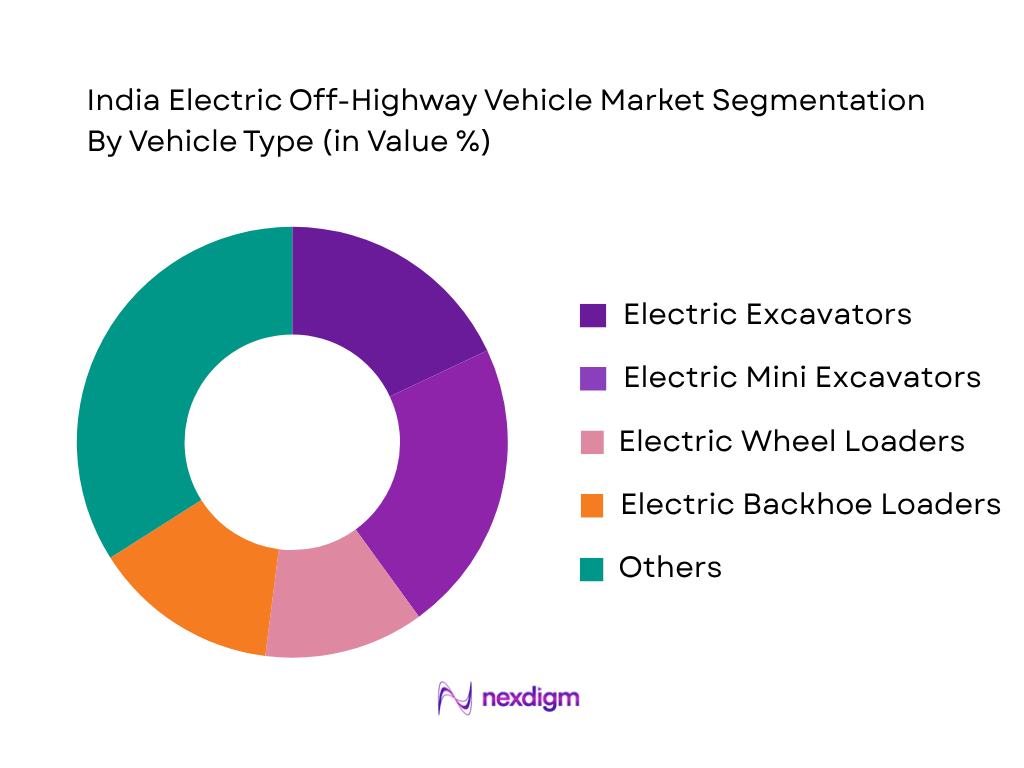
The India Electric Off-Highway Vehicle Market is segmented by vehicle type into electric excavators, mini excavators, wheel loaders, backhoe loaders, skid-steer loaders, compact track loaders, dumpers, cranes, forklifts, agricultural tractors, mining vehicles and electric road-construction equipment. Electric mini excavators and compact construction equipment are positioned as the leading sub-segment because their operating profiles are comparatively compatible with battery-electric powertrains. They are particularly suitable for urban construction, indoor projects, utility works and restricted-access sites where lower noise and zero tailpipe emissions provide operational advantages. The broader construction-equipment base provides a substantial conversion opportunity: ICEMA recorded 51,394 backhoe loaders and 33,030 crawler excavators sold in FY24, demonstrating the scale of equipment categories that can progressively adopt electrification. Electric equipment also benefits from simpler drivetrain architecture, reduced local emissions and suitability for depot or jobsite charging. As OEMs expand electric portfolios, compact equipment is likely to provide an important entry point before electrification reaches heavier, longer-duration machines requiring substantially larger battery packs.
By Application
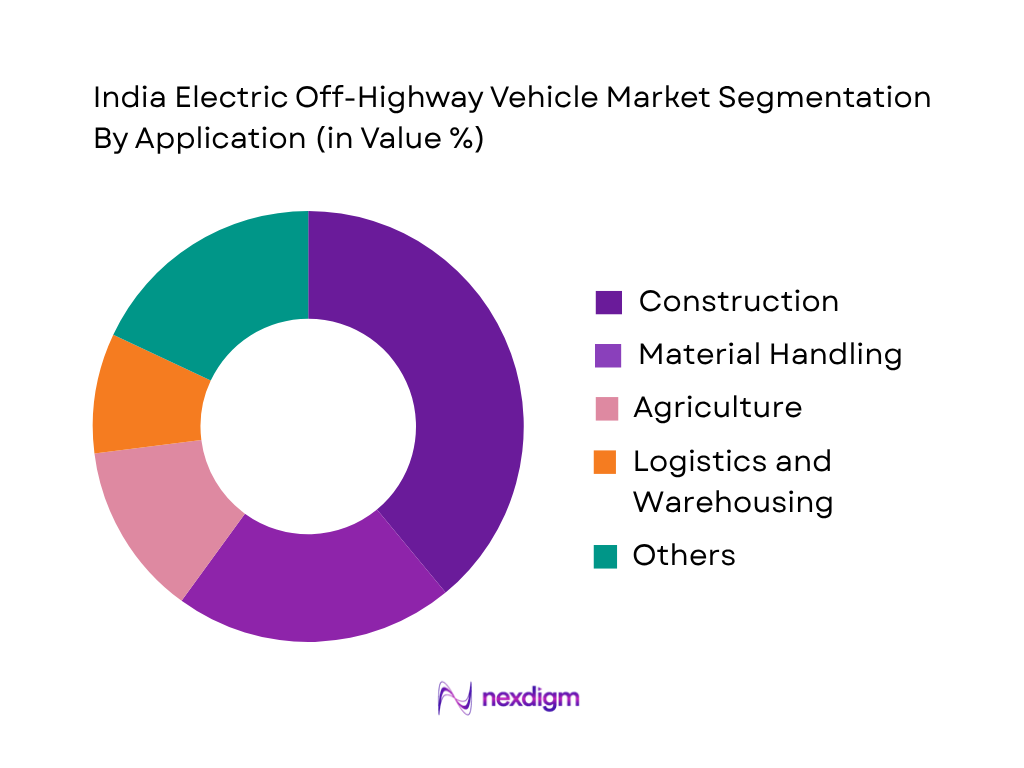
The India Electric Off-Highway Vehicle Market is segmented by application into construction, mining and quarrying, agriculture, material handling, road construction, infrastructure development, logistics and warehousing, forestry, landscaping and municipal operations. Construction represents the dominant application because India has a large installed base of earthmoving, material-handling and concrete equipment serving highways, metro systems, housing, industrial parks and urban infrastructure. ICEMA reported 93,531 earthmoving equipment units sold in FY24, including 51,394 backhoe loaders and 33,030 crawler excavators, illustrating the scale of equipment utilization across construction activities. Electric machinery can be particularly attractive for urban projects because lower noise and zero tailpipe emissions can improve suitability around densely populated areas. Material handling provides another strong electrification pathway because forklifts and warehouse equipment operate in structured environments with predictable routes and charging windows. Mining and agriculture offer substantial longer-term opportunities, although high loads, long operating hours and remote operating environments can make battery sizing and charging infrastructure more challenging.
Competitive Landscape
The India Electric Off-Highway Vehicle Market is developing around established construction-equipment, agricultural-machinery and material-handling manufacturers, alongside global OEMs introducing battery-electric platforms. Competitive differentiation increasingly depends on electric-model breadth, battery and drivetrain capability, machine productivity, charging solutions, dealer reach, aftermarket support and localization. India’s construction-equipment industry includes more than 50 OEMs, while FY25 domestic sales reached 126,961 units, providing an extensive installed base for OEM-led electrification.
| Company | Established | Headquarters | Electric Equipment Portfolio | Battery/Powertrain Capability | India Manufacturing | Dealer & Service Network | Telematics Capability |
| JCB India | 1945* | New Delhi, India | ~ | ~ | ~ | ~ | ~ |
| Tata Hitachi Construction Machinery | 1961* | Kolkata, India | ~ | ~ | ~ | ~ | ~ |
| Volvo Construction Equipment | 1832* | Gothenburg, Sweden | ~ | ~ | ~ | ~ | ~ |
| SANY India | 1989* | Pune, India | ~ | ~ | ~ | ~ | ~ |
| BEML | 1964 | Bengaluru, India | ~ | ~ | ~ | ~ | ~ |
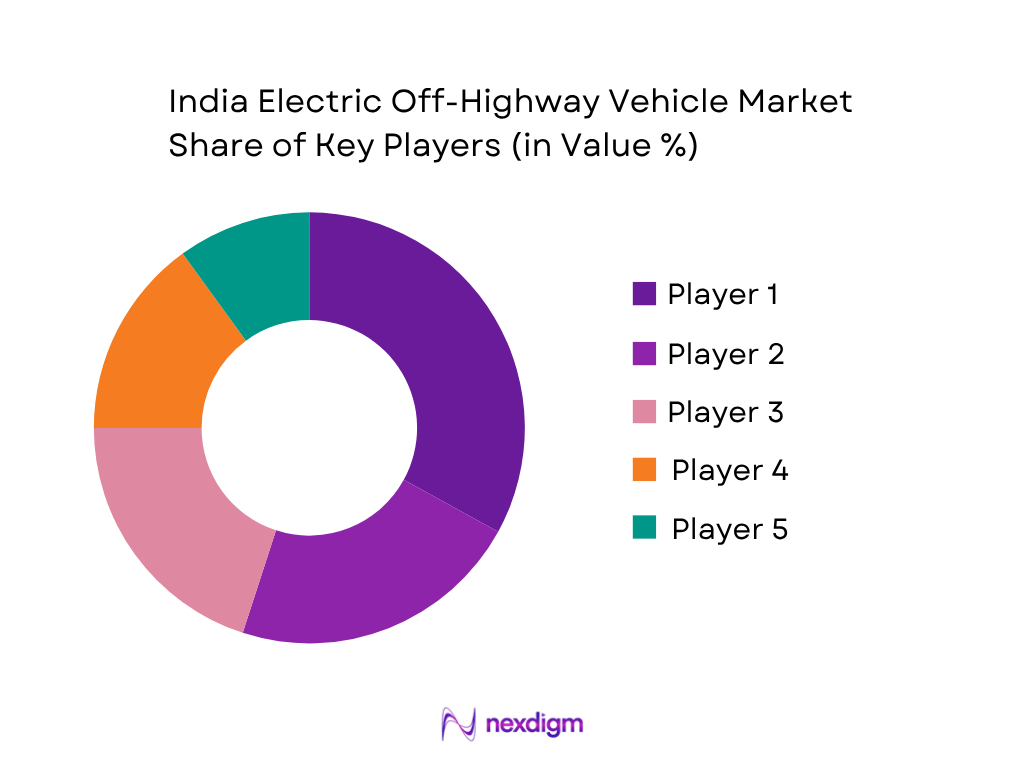
India Electric Off-Highway Vehicle Market Analysis
Growth Drivers
Infrastructure and Construction Activity
India’s infrastructure-led investment cycle is creating a broad operating base for electric off-highway equipment across excavation, loading, road building and material handling. World Bank data places India’s 2024 GDP at US$3,909.9 billion, with real GDP growth of 6.5, indicating continued economic expansion that supports construction and capital formation. Gross capital formation was 31.0 of GDP in the latest World Bank data, reinforcing the importance of investment activity to equipment demand. The construction-equipment industry provides a direct market-specific indicator: ICEMA recorded 135,650 units of construction equipment sales during FY24, compared with 107,779 units in FY23, while domestic sales reached 123,660 units. Earthmoving equipment alone accounted for 93,531 units, highlighting the scale of excavators, loaders and backhoe applications that can progressively transition toward electric powertrains. The World Bank also records industry, including construction, at 26.6 of GDP, demonstrating the economic weight of the activities that consume off-highway machinery. Electrification is particularly relevant for urban construction, infrastructure projects and enclosed worksites where zero tailpipe emissions and lower operating noise provide practical benefits. Continued capital-intensive development therefore expands the addressable base for electric excavators, loaders, dumpers, compact machinery and other equipment.
Mining Electrification and Agricultural Mechanisation
India’s mining and agricultural production systems provide additional operating environments for electric off-highway vehicles, although adoption suitability varies substantially by duty cycle. The Ministry of Mines reported 274 million metric tonnes of iron-ore production during FY2023-24, while provisional production reached 208 million tonnes during April–December of FY2024-25, up from 203 million tonnes in the corresponding period. Such production volumes sustain demand for excavators, loaders, haulage equipment and material-handling machinery in mining and quarrying environments. Agriculture also remains economically significant: World Bank data records agriculture, forestry and fishing value added at US$636.7 billion in 2024. India’s overall GDP reached US$3,909.9 billion, while real GDP growth was 6.5, supporting investment across productive sectors. Electric tractors and compact agricultural machines can particularly benefit from predictable operating cycles, depot-based charging and lower local emissions, while mining presents opportunities for specialized battery-electric loaders, underground equipment and short-haul vehicles where charging can be centralized. The existing construction-equipment ecosystem further demonstrates equipment demand: domestic construction-equipment sales reached 123,660 units in FY24. As electrification technology expands beyond compact machinery, mining and agricultural operators can become important users of purpose-built electric equipment, particularly where operating environments allow charging infrastructure and where emissions, ventilation or noise considerations materially affect equipment selection.
Market Challenges
Battery Energy Density and Charging Infrastructure Gaps
Battery performance and charging availability remain significant constraints for electric off-highway vehicles because construction, mining and agricultural machines can operate for long shifts under high loads. India’s economic scale creates substantial equipment demand, with 2024 GDP of US$3,909.9 billion and GDP growth of 6.5, but equipment electrification requires infrastructure that matches the operating profile of heavy machinery. The World Bank records electricity consumption at 879.9 kWh per capita in its latest India development series, illustrating the expanding electricity-use base but also the need to accommodate additional high-power industrial charging loads. ICEMA recorded 135,650 construction-equipment units sold in FY24, including 93,531 earthmoving units, showing that electrification must eventually address a large population of power-intensive machines. Charging is comparatively straightforward for equipment returning to a fixed depot, whereas excavators, loaders and mining vehicles operating remotely can require high-capacity mobile or temporary charging systems. Battery mass can also affect payload and machine productivity when substantial energy storage is required. These constraints are especially relevant for multi-shift construction, mining and agricultural operations where downtime has direct operational consequences. Consequently, electric-equipment adoption will initially favor applications with predictable routes, accessible electrical connections and defined charging windows, while high-utilization heavy equipment will require improvements in battery energy density, fast charging, thermal management and charging infrastructure before broad deployment becomes practical.
Heavy-Duty Duty Cycles and Limited Residual-Value History
Electric off-highway vehicles face adoption barriers where machines operate under demanding loads, extended shifts and variable terrain, because battery degradation, runtime and residual value are less established than for conventional diesel equipment. India’s construction-equipment market illustrates the scale of the issue: ICEMA reported 135,650 units of equipment sales in FY24 and 140,191 units in FY25, with earthmoving equipment reaching 99,159 units in FY25. These machines are frequently deployed in applications requiring substantial hydraulic power and long operating periods, making equipment uptime a critical purchasing criterion. IMF analysis reports that manufacturing capacity utilization reached 75.8 in 2024Q2, indicating a substantial industrial operating base, while investment reached 33.3 of GDP in 2023/24, highlighting continued capital formation. For fleet operators, the uncertainty surrounding used-equipment values for newer electric platforms can complicate replacement decisions because battery health and remaining useful life are different from conventional engine and transmission wear patterns. Heavy-duty users must also evaluate thermal management, battery replacement, charging downtime and service technician availability alongside machine productivity. This can lengthen qualification cycles and encourage buyers to adopt electric equipment first in controlled applications rather than immediately replacing high-intensity diesel machinery. OEM warranties, battery-health diagnostics, financing structures and documented operating histories will therefore be important in reducing perceived technology and residual-value risk.
Market Opportunities
Electric Mini Excavators and Mid-Size Excavators
Compact and mid-size electric excavators represent a practical entry point for India’s off-highway electrification because they can address construction applications where operating routes are localized and charging can be organized at depots or jobsites. The opportunity is supported by the size of India’s construction-equipment ecosystem: ICEMA recorded 135,650 units of total equipment sales in FY24, including 33,030 crawler excavators and 51,394 backhoe loaders within the earthmoving segment. The wider economy provides additional support, with World Bank data recording 6.5 real GDP growth and US$3,909.9 billion of GDP in 2024. Industry, including construction, accounted for 26.6 of GDP, demonstrating the scale of economic activity requiring excavation and material movement. Electric mini excavators can be particularly relevant to urban construction, utility projects, landscaping and indoor or semi-enclosed worksites because lower noise and zero tailpipe emissions can improve operating suitability. Mid-size excavators can extend the addressable market toward infrastructure and commercial construction while remaining more manageable from a battery and charging perspective than very large mining machines. As OEMs expand electric model availability, contractors and rental fleets can evaluate these machines through defined duty cycles and measurable utilization. This creates an opportunity for manufacturers to pair electric machinery with jobsite charging, battery-health monitoring, telematics and service packages rather than selling the machine as a standalone product.
Electric Agricultural Tractors, Mining Equipment and Autonomous Machinery
Longer-term opportunities extend into agricultural tractors, mining equipment and autonomous electric machinery as battery systems, charging infrastructure and machine-control technologies mature. India’s agricultural economy generated US$636.7 billion of value added in 2024 according to the World Bank, providing a substantial economic base for tractor and agricultural-equipment applications. Mining provides another sizeable addressable environment: the Ministry of Mines reported 274 million tonnes of iron-ore production during FY2023-24, while April–December FY2024-25 production reached 208 million tonnes. These production volumes support continuous demand for loading, hauling and material-handling equipment, including applications where electric drivetrains can be deployed in controlled routes or underground environments. The broader industrial environment also remains substantial, with industry including construction representing 26.6 of GDP and overall GDP reaching US$3,909.9 billion in 2024. Autonomous functions can strengthen the economics of electrification by combining battery-electric powertrains with optimized routing, precision operation, remote monitoring and predictive maintenance. For agriculture, autonomous electric tractors can target repetitive operations with predictable routes; in mining, autonomous electric haulage and loading can operate within controlled sites where charging infrastructure can be planned around production cycles. These applications create opportunities for integrated solutions combining machinery, batteries, charging, software and fleet-management systems rather than equipment-only offerings.
Future Outlook
The India Electric Off-Highway Vehicle Market is expected to expand as construction, agriculture, mining, warehousing and infrastructure operators increasingly evaluate electrification at the equipment level. Adoption will initially favor compact machines, forklifts and controlled-duty-cycle equipment where charging can be integrated into existing operations. Larger excavators, loaders, mining vehicles and agricultural machinery should progressively gain attention as battery technology, charging infrastructure and electric drivetrains improve. Government electrification initiatives, OEM localization and growing demand for lower-emission jobsites are expected to reinforce the transition.
Major Players
- JCB India
- Tata Hitachi Construction Machinery
- BEML Limited
- SANY India
- Volvo Construction Equipment
- Komatsu India
- Caterpillar India
- Mahindra & Mahindra
- TAFE
- Escorts Kubota
- John Deere India
- CNH Industrial India
- AGCO Corporation
- Hyundai Construction Equipment India
- Doosan Bobcat
Key Target Audience
- Construction Equipment OEMs and Electric Machinery Manufacturers
- Agricultural Machinery OEMs and Tractor Manufacturers
- Mining Companies and Mining Equipment Operators
- Equipment Rental and Leasing Companies
- Logistics, Warehousing and Material-Handling Fleet Operators
- Investments and Venture Capitalist Firms
- Government and Regulatory Bodies (Ministry of Heavy Industries, Ministry of Road Transport and Highways, Ministry of Agriculture & Farmers Welfare, Ministry of Mines, Bureau of Energy Efficiency)
- Battery, Charging Infrastructure and Electric Powertrain Suppliers
Research Methodology
Step 1: Identification of Key Variables
The initial phase establishes the India Electric Off-Highway Vehicle ecosystem covering construction machinery, agricultural equipment, mining vehicles, material-handling equipment and road-construction machinery. Variables include equipment population, unit sales, operating hours, electrification suitability, battery capacity, power output, charging requirements and replacement cycles. ICEMA equipment-sales data and official economic indicators are used to establish the underlying market framework. (I-Cema)
Step 2: Market Analysis and Construction
Historical equipment sales are compiled by vehicle category, application, equipment weight and operating environment. The analysis distinguishes between conventional diesel equipment and electric machinery and evaluates the addressable fleet for electrification. Bottom-up calculations incorporate OEM shipments, dealer activity, fleet replacement, rental equipment and application-specific utilization.
Step 3: Hypothesis Validation and Expert Consultation
Market hypotheses are validated through discussions with equipment OEMs, dealers, rental companies, fleet operators, battery suppliers and charging-infrastructure providers. Interviews assess purchasing criteria, battery-runtime expectations, charging requirements, maintenance considerations, financing preferences and barriers to diesel-to-electric replacement. Technical validation is used to refine the segmentation and adoption assumptions.
Step 4: Research Synthesis and Final Output
The final stage triangulates OEM, industry-association, government and macroeconomic information with bottom-up fleet analysis. Market estimates are reconciled across vehicle type, application, powertrain, battery capacity and geography. Scenario testing is then used to assess different electrification pathways and identify commercially attractive equipment categories, regions and customer groups.

- Executive Summary
- Research Methodology (Market Definition and Scope, Electric Off-Highway Vehicle Classification, Historical Market Reconstruction, Market Sizing Framework, Unit-Sales and Revenue Assessment, Top-Down Analysis, Bottom-Up Analysis, OEM-Level Validation, Dealer and Rental-Fleet Assessment, Primary Industry Interviews, Secondary Data Validation, Data Triangulation, Forecasting Framework, Scenario Analysis, Assumptions and Limitations)

- Definition and Scope
- Evolution of Electric Off-Highway Vehicles in India
- India Off-Highway Electrification Ecosystem
- Electric Off-Highway Vehicle Value Chain
- Indian Manufacturing and Localization Landscape

- Growth Drivers (Infrastructure and Construction Activity, Mining Electrification, Agricultural Mechanisation, Government Electrification Policies, Zero-Emission Jobsites, Warehouse Automation, Fleet Operating Efficiency, OEM Product Expansion)
- Market Challenges (High Initial Acquisition Requirements, Battery Energy Density, Charging Infrastructure Gaps, Rural Grid Limitations, Long Charging Duration, Heavy-Duty Duty Cycles, Battery Thermal Management, Limited Residual-Value History, Skilled Service Requirements)
- Market Opportunities (Electric Mini Excavators, Mid-Size Excavators, Electric Agricultural Tractors, Electric Mining Equipment, Electric Forklifts, Battery-Electric Road Equipment, Mobile Charging, Autonomous Electric Machinery)
- Emerging Technology Trends (LFP Battery Adoption, High-Voltage Architecture, Fast Charging, Electric Hydraulics, Integrated E-Axles, Thermal Management, Regenerative Systems, Software-Defined Machinery)
- Government and Regulatory Analysis (AIS-174, CEV Emission Standards, PM E-DRIVE, State EV Policies, Battery Safety Requirements, Charging Standards, Agricultural Electrification Policies)
- Porter’s Five Forces Analysis
- PESTLE Analysis
- SWOT Analysis

- By Market Value (2020-2025)
- By Unit Sales (2020-2025)
- By Average Selling Value (2020-2025)
- By Vehicle Type (2020-2025)
- By Application (2020-2025)
- By End User (2020-2025)
- By Charging Configuration (2020-2025)
- By Geography (2020-2025)

- By Vehicle Type (in value %)
Electric Excavators
Electric Mini Excavators
Electric Wheel Loaders
Electric Backhoe Loaders
Electric Skid-Steer Loaders
Electric Compact Track Loaders
Electric Bulldozers
Electric Dumpers
Electric Cranes
Electric Forklifts
Electric Agricultural Tractors
Electric Mining Vehicles
Electric Road Construction Equipment
Electric Utility and Specialty Vehicles - By Propulsion Technology (in value %)
Battery Electric
Hybrid Electric
Plug-in Hybrid Electric
Fuel-Cell Electric
Hydrogen Combustion
Other Alternative Powertrains - By Application (in value %)
Construction
Mining and Quarrying
Agriculture
Material Handling
Road Construction
Infrastructure Development
Logistics and Warehousing
Forestry
Landscaping
Municipal and Utility Operations
Industrial Manufacturing - By Equipment Weight (in value %)
Below 5 Tons
5–10 Tons
10–20 Tons
20–40 Tons
Above 40 Tons - By Battery Capacity (in value %)
Below 50 kWh
50–150 kWh
151–300 kWh
301–500 kWh
Above 500 kWh - By Power Output (in value %)
Below 50 kW
50–100 kW
101–200 kW
201–400 kW
Above 400 kW

- Market Share of Major Players (By Revenue, Unit Sales, Vehicle Type, Application, Propulsion Technology, Battery Capacity, Equipment Weight and Geography)
- Cross Comparison Parameters (Electric Equipment Portfolio Breadth, Battery Capacity Range, Electric Machine Model Count, Maximum Power Output, Operating Runtime, Charging Technology Capability, Indian Dealer and Service Network Coverage, Telematics and Autonomous Technology Capability)
- Detailed Profiles of Major Companies
JCB India
Tata Hitachi Construction Machinery
BEML Limited
SANY India
Volvo Construction Equipment India
Komatsu India
Caterpillar India
Mahindra & Mahindra
TAFE
Escorts Kubota
John Deere India
CNH Industrial India
AGCO Corporation
Hyundai Construction Equipment India
Doosan Bobcat India


 Request a Sample
 Ask for Customization
 Get a Quote
 Enquire Now