
 Download PDF
Market Overview
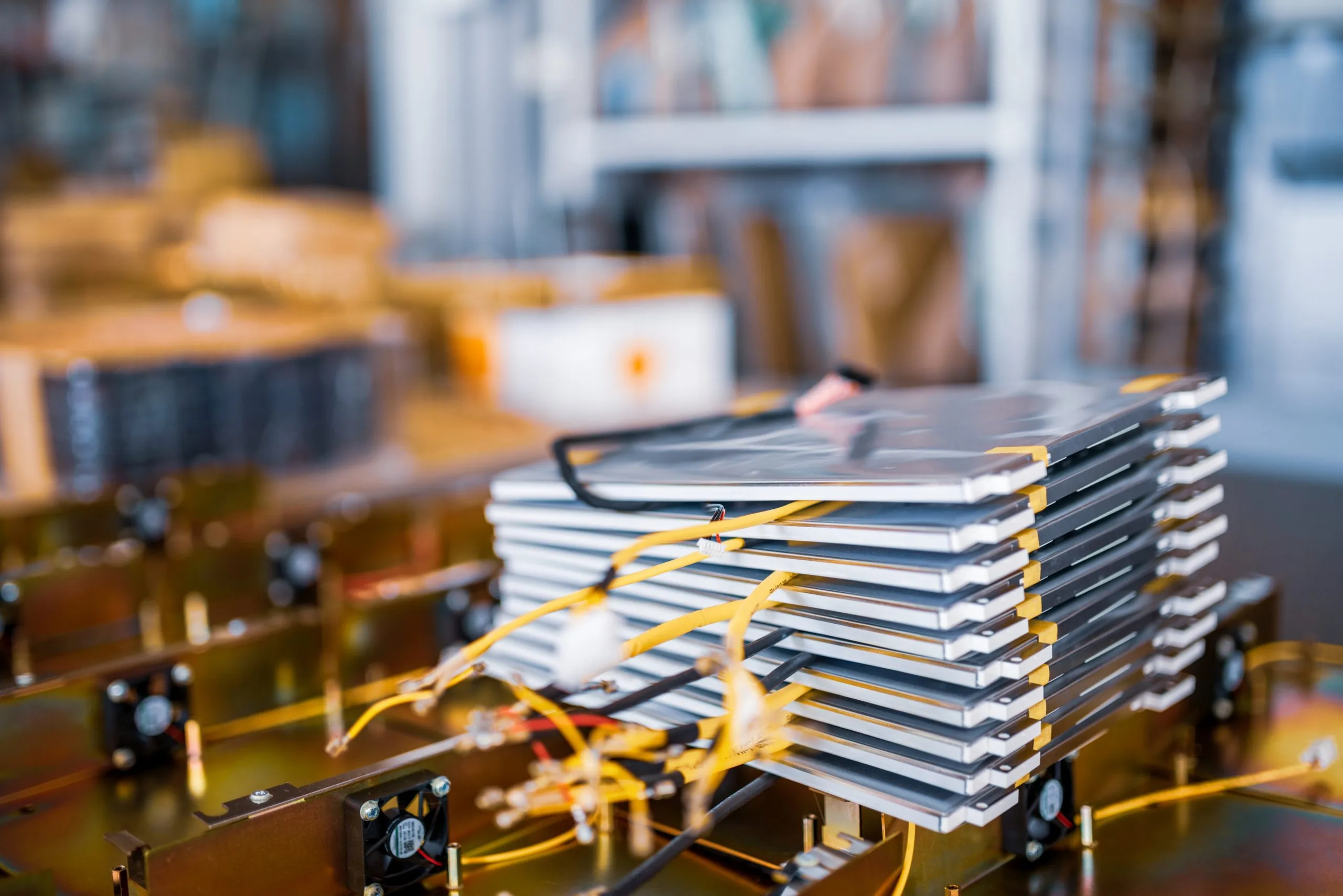
The India Electrical Insulation Laminate Market is valued at approximately USD ~ million, supported by transformers, motors, generators, switchgear, EV traction equipment and renewable-energy electrical systems. Solar capacity additions increased from 12,783.8 MW in the preceding annual period to 15,033.24 MW in the subsequent annual period, while wind additions moved from 2,275.55 MW to 3,253.38 MW, expanding demand for transformers, generators, converters and insulation materials.Mumbai–Nashik–Pune, Ahmedabad–Vadodara, Bengaluru, Hyderabad and the wider Chennai–Coimbatore industrial belt constitute key demand and supply locations for the India Electrical Insulation Laminate Market because they combine transformer, motor, switchgear, engineering, automotive and electrical-component manufacturing. Nashik hosts established electrical-insulation manufacturers, Mumbai/Bhiwandi supports flexible laminate production, Hyderabad houses integrated rigid-laminate manufacturers, and Bengaluru has long-established polyester-film and flexible-laminate manufacturing serving motors and other electrical equipment.
Market Segmentation
By Product Architecture
The India Electrical Insulation Laminate Market is segmented into Polyester Film-based laminates (Class B/F), Advanced laminates (Class H/C), rigid epoxy-glass laminates, phenolic laminates and other specialty structural insulation laminates. Polyester Film-based Class B/F laminates hold the dominant report-model share because DMD, DM and related flexible composites are extensively suited to slot liners, phase insulation and interlayer applications in industrial motors, generators and electrical equipment. Ganapathy Industries manufactures Class F DMD using polyester film and polyester fabric, while Harnawa supplies DMD and other flexible electrical laminates in India. Their relative affordability, flexibility, dielectric properties, ease of slitting and compatibility with automated motor winding support broad consumption across established rotating-equipment applications. Advanced Class H/C laminates such as NMN, NKN and aramid-polyimide constructions are strategically smaller but increasingly relevant for traction motors, high-temperature generators, rail propulsion and compact high-power-density electrical machines. Harnawa, for example, supplies NMN and polyimide-aramid AHA constructions, demonstrating India’s evolving domestic capability in higher-temperature insulation systems.
By End-Use Equipment
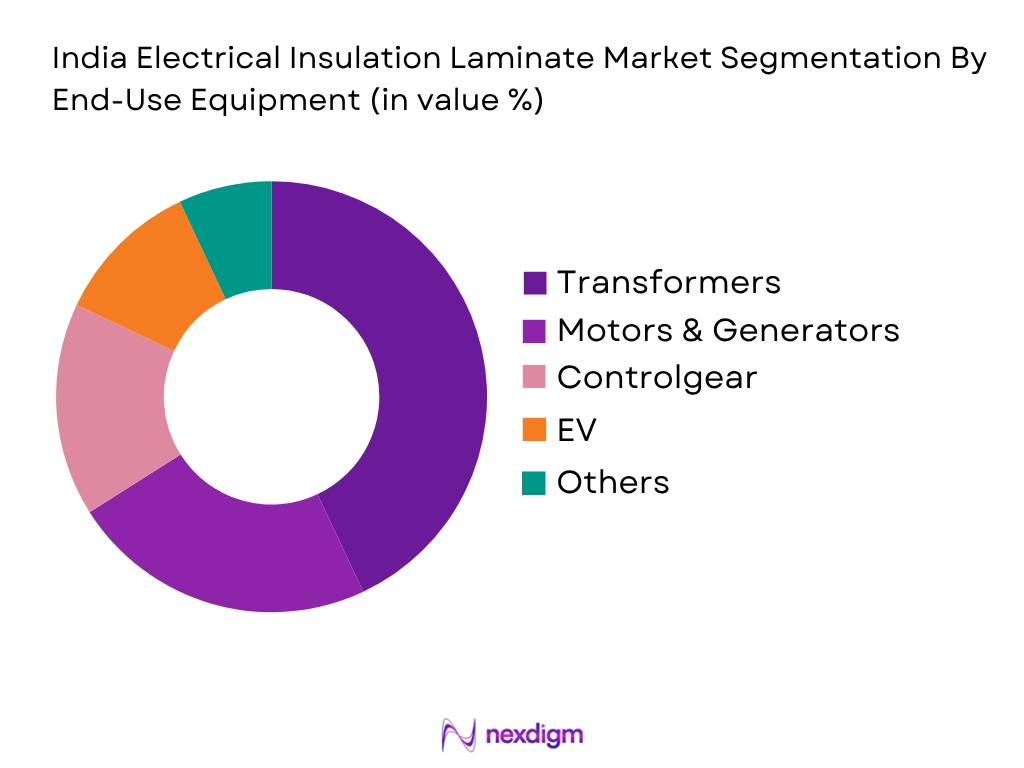
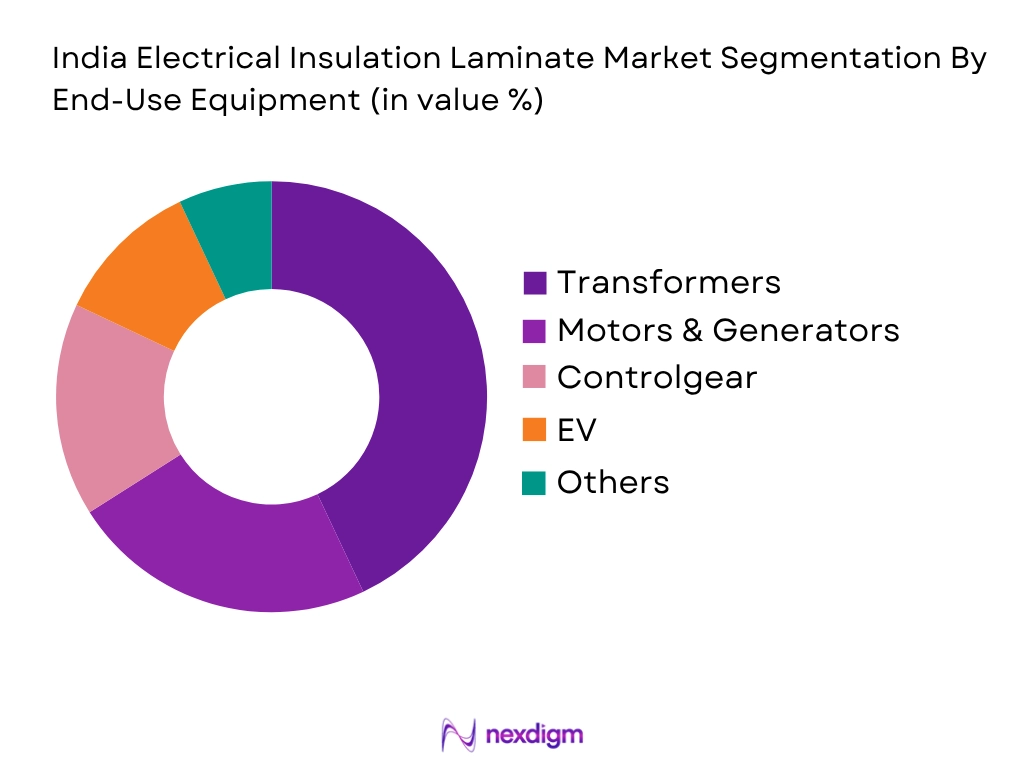
The India Electrical Insulation Laminate Market is segmented into transformers, motors and generators, switchgear and controlgear, EV and railway traction equipment, and renewable-energy/power-electronics equipment. Transformers hold the dominant report-model share because electrical laminates are required across winding supports, barriers, terminal components, spacers, densified-wood structures and rigid epoxy-glass insulation. India’s Ministry of Heavy Industries identifies transformers, generators and switchgear as core products of the domestic heavy electrical engineering sector and explicitly links their performance to national power-capacity expansion. Inter-regional transmission capacity had already reached 116,540 MW in the national transmission system, while continued additions to substations and transformation capacity sustain demand for electrically and mechanically robust insulation materials. Motors and generators form the next major application because flexible DMD, NMN and advanced Class H laminates are consumed as slot liners, phase separators and winding insulation. EV and railway traction equipment represent the technologically fastest-developing application because higher power density and thermal cycling favour Class H/C insulation structures.
Competitive Landscape
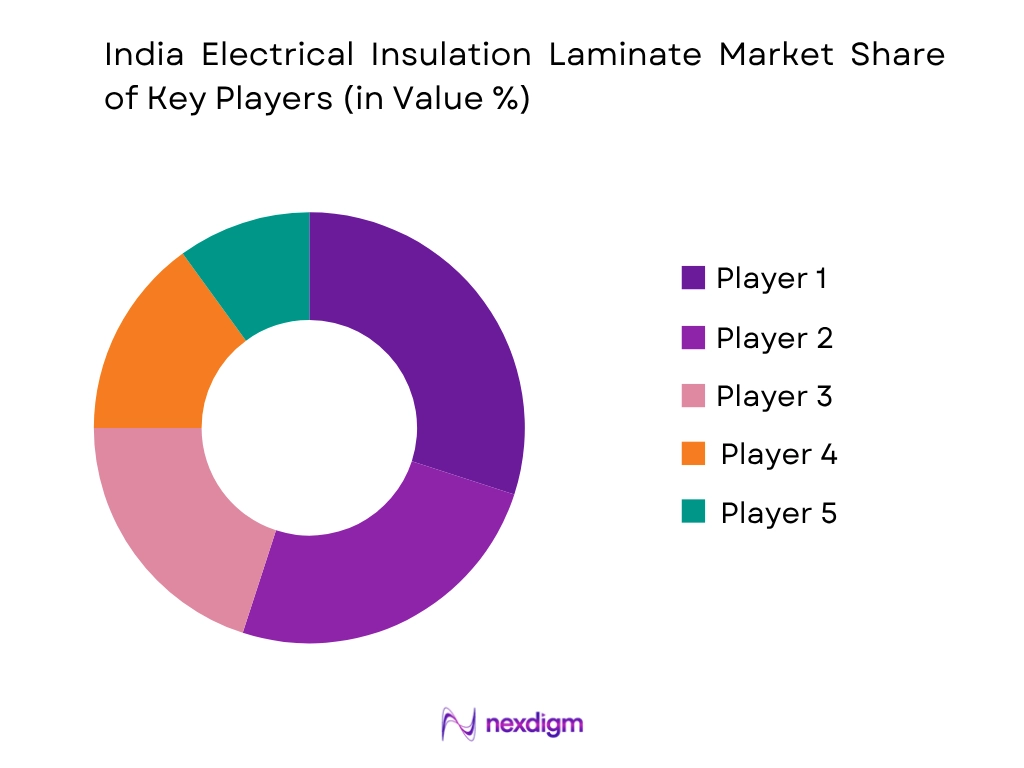
The India Electrical Insulation Laminate Market combines long-established domestic flexible-insulation manufacturers, integrated rigid-laminate producers, electrical-insulation component converters and global advanced-material suppliers. Competition differs materially between the high-volume Class B/F market and technically demanding Class H/C segment. Harnawa and Ganapathy have strong flexible laminate exposure; Lamtuf has integrated phenolic, epoxy-glass, polyester-composite and densified-wood capability; ACC and ARiC supply transformer, switchgear and machined electrical insulation components.
| Major Player | Establishment | Headquarters | Core Product Focus | Polyester Film Class B/F Capability | Advanced Class H/C Capability | Rigid Laminate Capability | Major End-Use Exposure | Conversion / Fabrication Capability |
| Lamtuf Limited | 1976 | Hyderabad, Telangana | ~ | ~ | ~ | ~ | ~ | ~ |
| Harnawa Insulations | 1973 | Mumbai, Maharashtra | ~ | ~ | ~ | ~ | ~ | ~ |
| ACC Insulations | 1994 | Nashik, Maharashtra | ~ | ~ | ~ | ~ | ~ | ~ |
| ARiC Insulation | 1969 | Maharashtra | ~ | ~ | ~ | ~ | ~ | ~ |
| Ganapathy Industries | 1967 | Bengaluru, Karnataka | ~ | ~ | ~ | ~ | ~ | ~ |
India Electrical Insulation Laminate Market Analysis
Growth Drivers
Expansion of Power Transmission, Transformation and Renewable-Energy Electrical Equipment
India’s continuing expansion of its electricity network is directly strengthening demand for electrical insulation laminates used in transformers, generators, switchgear, busbar supports, terminal boards, winding spacers and rotating electrical machines. The Ministry of Power recorded cumulative inter-regional transmission capacity of 116,540 MW as of January 2024, while its subsequent annual reporting noted that the national synchronous grid had accumulated 194,208 circuit-km of transmission lines and 720,534 MVA of transformation capacity since the beginning of the major grid-expansion cycle. During 2024–25 alone, India added a record 34 GW of generation capacity, of which 29.5 GW came from renewable sources, materially increasing requirements for transformer and power-electronics insulation. The Ministry of New and Renewable Energy recorded 15,033.24 MW of solar additions and 3,253.38 MW of wind additions during one recent annual cycle, followed by 23,832.87 MW of solar additions in the next reported period. As of June 2026, cumulative solar capacity stood at 162,152 MW and wind capacity at 57,443.39 MW. This physical infrastructure expansion is particularly relevant for polyester-film Class B/F laminates such as DMD used in conventional motors and auxiliary equipment, as well as Class H/C laminates, G11, FR5 and high-temperature composite insulation deployed in compact generators, high-load motors and power-conversion systems. The Ministry of Heavy Industries explicitly identifies transformers, generators, turbines and switchgear among the major products of India’s heavy electrical manufacturing sector and states that sector performance is closely linked to the national power-capacity addition programme. The macroeconomic backdrop reinforces this demand environment. The IMF’s April 2026 database places India’s nominal GDP at approximately USD 4.15 trillion in 2026, while its country profile records a population of 1,476.626 million people and projected real output growth of 6.4 units per 100 units of GDP in 2026. A larger economy, accelerating electricity consumption and a geographically expanding transmission network increase the installed base of transformers, motors and switchgear that require dielectric isolation and mechanically robust insulation. For laminate manufacturers, the demand implication is therefore broader than simply more transformer sheets: it includes polyester-film composites for winding and slot insulation, epoxy-glass sheets for structural components, densified wood for transformer supports, and increasingly Class H/C aramid- and polyimide-based composites for higher-temperature electrical equipment.
Industrial Electrification, Railway Electrification and Electric-Mobility Manufacturing
India’s industrial and transport electrification cycle is creating a second major demand engine for electrical insulation laminates, particularly those used in motors, traction machines, converters and high-temperature winding systems. The Ministry of Heavy Industries describes India as having a strong domestic manufacturing base for heavy electrical products including transformers, turbo-generators, switchgear and related rotating equipment, which directly consumes rigid epoxy-glass and flexible film-based insulation. Railway electrification adds another large application base: Indian Railways reported that more than 96 units out of every 100 units of the broad-gauge network were electrified by the end of 2024, and by June 2025 approximately 68,592 route-km had been electrified, representing roughly 99 units out of every 100 route-km of the network. Electrified railways require traction motors, auxiliary motors, traction transformers, converters and switchgear, all of which use slot liners, phase insulation, rigid laminate supports and high-temperature electrical barriers. This is especially relevant for Advanced Class H/C laminates such as NMN, NKN, polyimide-aramid and mica-polyimide constructions because traction systems experience repeated thermal cycling, high vibration and elevated electrical stress. Electric mobility is adding a related manufacturing channel. The Government approved the Scheme to Promote Manufacturing of Electric Passenger Cars in India in March 2024, while PM E-DRIVE was notified in September 2024 with an outlay of ₹10,900 crore and originally implemented from October 2024 through March 2026; subsequent notifications extended the scheme through March 2028. The Ministry of Heavy Industries also mandates localisation through phased manufacturing requirements under PM E-DRIVE and requires at least 50 units of domestic value addition per 100 units of eligible product value under the automotive PLI framework, creating incentives for localisation of motors, power electronics and associated insulation materials. The broader macroeconomic setting supports industrial capacity creation: IMF data put India’s 2026 GDP near USD 4.15 trillion and population at 1,476.626 million, giving manufacturers both a large domestic customer base and growing installed electrical infrastructure. For the electrical insulation laminate industry, this combination creates a widening specification ladder. Conventional industrial motors continue to absorb Class B/F polyester-film laminates such as DMD, whereas traction motors, high-efficiency motors and compact generators increasingly require Class F/H/C systems with improved thermal endurance, dielectric strength and dimensional stability. The opportunity for manufacturers is therefore not only greater physical consumption but migration toward technically higher-value laminate architectures as India electrifies transport and industrial machinery.
Market Challenges
Dependence on Specialty Raw Materials and Higher Technical Requirements for Class H/C Laminates
One of the most important challenges for India’s Electrical Insulation Laminate Market is the technical and supply-chain transition from conventional polyester-film Class B/F materials toward advanced Class H/C systems based on aramid paper, polyimide films, mica composites and high-temperature adhesive chemistries. The domestic electrical-equipment industry is large and expanding, but the performance requirements placed on insulation materials are also becoming more demanding as motors and transformers become more compact and power dense. Indian Railways had electrified approximately 68,592 route-km by June 2025, while renewable-energy deployment pushed cumulative solar capacity to 162,152 MW and wind capacity to 57,443.39 MW by June 2026. These systems create applications in traction motors, wind generators, converters and high-load transformers where conventional Class B materials can be inadequate. Class H/C laminates must maintain dielectric separation after repeated heating, cooling, vibration and partial-discharge exposure, making raw-material consistency critical. The challenge is intensified by the structure of India’s manufacturing sector. World Bank analysis notes that global-value-chain-linked manufacturing firms remain a relatively small portion of Indian manufacturing companies even though they contribute close to 20 units of every 100 units of manufacturing value added, indicating that access to advanced imported technologies and materials remains disproportionately important in higher-value industrial production. For electrical insulation manufacturers, aramid paper and high-specification polyimide materials can therefore expose production programmes to international supply availability, foreign-exchange movements and long qualification cycles. This becomes particularly problematic when an OEM has approved a specific thermal-class laminate construction: substituting film, adhesive or paper grades generally requires renewed electrical, mechanical and thermal testing rather than a simple procurement change. Meanwhile, the IMF places India’s 2026 economy at approximately USD 4.15 trillion with a population of 1,476.626 million, meaning local demand is large enough to justify advanced material capacity, but the scale also raises the consequences of inconsistent supply. Manufacturers must therefore invest in controlled lamination, adhesive uniformity, moisture management, film tension control and traceable batch testing while simultaneously building supplier redundancy. Failure in any of these areas can result in delamination, loss of dielectric strength, premature thermal ageing or rejected OEM lots. The challenge is particularly acute for Class H/C materials because their commercial proposition depends on demonstrably superior performance rather than simply meeting basic insulation requirements.
Stringent Quality Qualification and Electrical-Equipment Safety Compliance
India’s electrical insulation laminate suppliers face an increasingly rigorous qualification environment because laminates perform a safety-critical role inside transformers, motors, generators, switchgear and traction equipment. Unlike commodity polymer sheets, these products must maintain electrical isolation while simultaneously tolerating mechanical stress, temperature cycling, moisture exposure and fabrication processes such as punching or CNC machining. The Ministry of Heavy Industries identifies transformers, generators, switchgear and related accessories as core products of the domestic heavy-electrical sector, while the Ministry of Power recorded 116,540 MW of inter-regional transmission capability and later reported cumulative transformation capacity of 720,534 MVA added during the modern grid-expansion phase. Any laminate failure inside this equipment can therefore affect assets operating at significant voltage and power levels. Regulatory expectations are also broadening. Government discussions during 2025 specifically addressed the Machinery and Electrical Equipment Safety (Omnibus Technical Regulation) Order 2024 and its interaction with railway equipment, illustrating the increasing importance of formal electrical-equipment safety requirements across industrial and traction applications. For laminate suppliers, this means obtaining an OEM nomination is not only a commercial exercise; material properties such as dielectric breakdown, volume and surface resistivity, thermal endurance, flexural strength, flame behaviour and dimensional stability must be reproducible across batches. The issue becomes more difficult as customers migrate from polyester-film Class B/F systems to Class H/C architectures because higher thermal ratings introduce more sophisticated material interfaces—such as aramid-to-polyimide or mica-to-polyimide bonding—that can fail through adhesive degradation or differential thermal expansion. India’s economic scale magnifies the need for dependable manufacturing. IMF data place national GDP near USD 4.15 trillion in 2026, while projected population reaches 1,476.626 million, and the country continues expanding rail, electricity and renewable-energy infrastructure simultaneously. The resulting OEM customer base increasingly expects large-volume consistency, short lead times and technical documentation. Smaller laminate converters without in-house electrical and thermal testing can therefore struggle to qualify for traction, high-voltage transformer or premium motor programmes even if they can physically produce similar-looking materials. Requalification following changes in resin, film, paper or adhesive also adds development time and limits rapid supplier switching. The principal market challenge is consequently not a lack of end-use demand, but the rising technical threshold required to participate in high-value applications. Companies that fail to build material traceability, laboratory capability and disciplined process control risk being confined to lower-specification Class B/F applications even as market growth increasingly shifts toward high-temperature insulation.
Market Opportunities
Localisation of Advanced Class H/C Laminates for EV, Railway and High-Efficiency Motors
The transition toward higher-temperature electrical machines creates a substantial localisation opportunity for India’s laminate manufacturers because the underlying applications are already expanding at scale. Indian Railways reported more than 68,592 electrified route-km by June 2025, while PM E-DRIVE was launched with an outlay of ₹10,900 crore to accelerate electric mobility and related infrastructure. The Government also approved the electric passenger-car manufacturing scheme in March 2024, and automotive PLI rules require at least 50 units of domestic value addition per 100 units of eligible product value for incentive qualification. These current manufacturing and policy conditions create a strong foundation for future local demand for NMN, NKN, aramid-polyimide and other Class H/C flexible laminates used in traction motors, inverter assemblies and auxiliary rotating machinery. The opportunity is technological rather than simply volume-driven. Traction motors operate under high current density, rapid acceleration and regenerative-braking cycles that generate repeated heating and cooling. Higher-temperature laminate systems allow manufacturers to use thinner insulation packages while protecting windings from electrical breakdown, enabling higher slot fill and greater power density. This requirement also extends to rail traction transformers and converters, where insulation must withstand vibration and electrical stress over long service intervals. The addressable ecosystem is supported by India’s broader industrial scale. IMF data value the economy at approximately USD 4.15 trillion in 2026, with a population of 1,476.626 million, while the Ministry of Heavy Industries identifies generators, motors, transformers and switchgear as established domestic manufacturing capabilities rather than purely imported equipment categories. This means insulation localisation can occur alongside an existing OEM manufacturing base instead of waiting for downstream demand to emerge. The commercially attractive route for laminate suppliers is to move beyond standard DMD into Class F/H/C systems and offer the accompanying conversion services—slitting, die cutting, creasing, slot-liner forming and customised insulation kits—that traction-motor manufacturers require. Domestic qualification can also reduce the procurement lead time associated with imported specialty materials and provide closer technical collaboration between the laminate producer and OEM. Because the supporting statistics already show an extensive electrified railway network, active EV localisation policy and substantial domestic heavy-electrical manufacturing capability, expansion into Class H/C insulation is backed by current industrial activity rather than speculative future installation figures.
Domestic Supply of Transformer, Renewable-Energy and Precision Fabricated Insulation Components
Another major opportunity lies in moving downstream from raw laminate production into precision-fabricated insulation components for transformers, switchgear, renewable-energy generators and power-electronics systems. India added 34 GW of generation capacity during 2024–25, including 29.5 GW of renewable capacity, while solar additions reached 23,832.87 MW in a subsequent reporting period and cumulative solar capacity stood at 162,152 MW by June 2026. These current additions create immediate equipment requirements for step-up transformers, inverter transformers, generators, switchgear, busbars and grid-interface systems. The Ministry of Power had already recorded 116,540 MW of inter-regional transmission capacity in January 2024 and later documented an accumulated 720,534 MVA of transformation capacity, confirming the scale of India’s transformer and substation equipment base. The Ministry of Heavy Industries specifically states that transformer-industry health is closely linked to power generation and transmission programmes and identifies state electricity boards, Power Grid Corporation of India and industrial users as major transformer customers. This gives laminate manufacturers a clear route to future growth through epoxy-glass barriers, G10/G11 components, densified-wood supports, terminal boards, busbar supports, machined spacers and flexible winding insulation rather than relying only on commodity sheet sales. Precision conversion increases technical differentiation because transformer and switchgear OEMs require tight dimensional tolerances, clean machined edges, consistent hole positioning and electrical-clearance compliance. The same capability can be extended to renewable-energy converters, battery-energy-storage power electronics and large industrial drives. India’s macroeconomic environment supports capacity investment: the IMF estimates nominal GDP at around USD 4.15 trillion in 2026 and population at 1,476.626 million, while the World Bank continues to characterize India as one of the fastest-growing major economies based on recent national-output performance. For laminate companies, the strategic opportunity is therefore vertical integration. A supplier capable of producing Class B/F polyester composites, Class H/C flexible laminates and rigid epoxy-glass sheets and then converting them into finished OEM components can capture a larger portion of electrical-equipment value creation while reducing customers’ need for separate machining and conversion vendors. The current transmission, renewable-energy and transformation-capacity statistics demonstrate that the underlying equipment installed base is already large enough to support this transition. Future growth can consequently come from both higher laminate consumption and deeper penetration per customer through engineered components, pre-cut insulation kits and application-specific assemblies.
Future Outlook
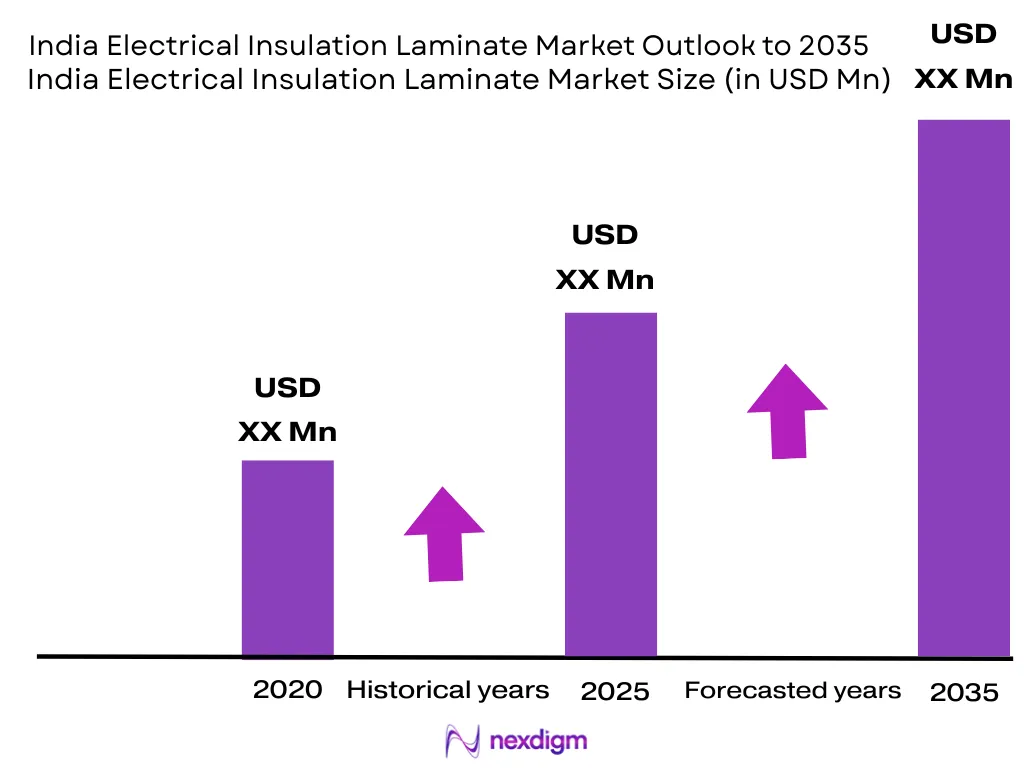
The India Electrical Insulation Laminate Market is expected to expand at approximately ~ CAGR during 2026–2035, supported by continued investment in India’s electricity system, transformer manufacturing, industrial motors, renewable energy, electric mobility and railway electrification. The strongest change is expected in the material mix, with Class F products retaining substantial volume while Class H/C materials gain strategic importance in high-power-density applications. Polyester Film-based laminates should continue to provide the volume foundation of the industry. DMD and related polyester composites offer a practical balance between dielectric performance, mechanical flexibility, processing ease and motor-production economics. Established domestic manufacturing also provides insulation converters with access to slit rolls, customised widths and die-cut components required by motor and generator manufacturers. Advanced Class H/C laminates should become progressively more important as India manufactures more traction motors, high-efficiency motors, railway propulsion systems and compact high-temperature electrical machines. NMN combines aramid paper with polyester film, while AHA-type constructions combine aramid paper and polyimide film for demanding thermal environments. Domestic capability in these products is already visible, although certain specialty films and aramid inputs remain dependent on globally specialised material technologies.
Major Players
- Lamtuf Limited
- Harnawa Insulations Pvt. Ltd.
- ACC Insulations
- ARiC Insulation / Rishabh Corporation
- SAM Composites India Pvt. Ltd.
- Impex Insulation Pvt. Ltd.
- Green India Laminates
- Synergy Global Sourcing
- Hi-Tech Insulation
- Hatim Dielectrics
- KREMPEL Group
- ELANTAS Electrical Insulation
- DuPont – Nomex and Kapton Electrical Insulation
- ISOVOLTA Group
- Röchling Industrial
Key Target Audience
- Electrical Insulation Laminate Manufacturers
- Transformer and Switchgear OEMs
- Industrial Motor and Generator Manufacturers
- EV Traction Motor and Power Electronics Manufacturers
- Railway Traction and Renewable-Energy Equipment Manufacturers
- Electrical Insulation Raw Material, Film and Aramid Suppliers
- Investments and Venture Capitalist Firms
- Government and Regulatory Bodies (Ministry of Heavy Industries, Ministry of Power, Central Electricity Authority, Bureau of Indian Standards, Ministry of New and Renewable Energy, Ministry of Railways)
Research Methodology
Step 1: Identification of Key Variables
The initial phase involves constructing an ecosystem map encompassing electrical insulation laminate manufacturers, polyester-film suppliers, aramid and polyimide suppliers, transformer manufacturers, motor and generator OEMs, EV traction suppliers, switchgear companies and converters. The principal variables include laminate architecture, thermal class, thickness, dielectric performance, equipment output and insulation consumption per unit. Secondary research draws from the Central Electricity Authority, Ministry of Power, Ministry of Heavy Industries, Ministry of New and Renewable Energy, EV programme documentation and manufacturer technical specifications. These inputs are used to define the relationships between electrical-equipment manufacturing and laminate consumption.
Step 2: Market Analysis and Construction
The top-down analysis starts from transformer, motor, switchgear, renewable-energy and traction-equipment demand and applies material-intensity assumptions by equipment category. Separate models are created for flexible Class B/F laminates, advanced Class H/C laminates and rigid structural insulation to avoid combining products with substantially different performance and pricing structures. The bottom-up analysis maps domestic manufacturers, product families, manufacturing capabilities, estimated utilisation, imports, distribution flows and converted-component output. Demand is triangulated against transformer production, grid additions, renewable-energy deployment and identified EV/railway traction applications. India’s heavy-electrical industry provides the core equipment-manufacturing anchor for this methodology.
Step 3: Hypothesis Validation and Expert Consultation
Market hypotheses are validated through CATIs with laminate manufacturers, transformer OEMs, motor manufacturers, insulation converters, distributors, winding shops and power-electronics suppliers. Interviews examine DMD versus NMN selection, Class F-to-H migration, domestic versus imported aramid/polyimide materials, specification qualification and average material consumption by equipment type. The validation process also examines laminate failure mechanisms such as delamination, thermal ageing, moisture absorption, dielectric breakdown and dimensional instability. Supplier qualification and OEM-specific specifications are reconciled with IEC/IS-compliant product descriptions from established domestic manufacturers.
Step 4: Research Synthesis and Final Output
The final phase triangulates top-down demand from electrical-equipment production with bottom-up laminate supply, conversion and import data. Separate value and volume models are maintained for Polyester Film-based Class B/F products, Advanced Class H/C products, epoxy-glass laminates and phenolic/structural laminates. Forecasts incorporate grid expansion, transformer requirements, high-efficiency motors, EV traction localisation, railway electrification, renewable-energy additions and material-class migration. The resulting model evaluates both volume growth and premiumisation as customers move from conventional Class B/F insulation toward higher-performance Class H/C systems.

- Executive Summary
- Research Methodology (Market Definitions and Assumptions, Abbreviations, Electrical Insulation Laminate Market Boundary, Rigid and Flexible Laminate Scope, Top-Down Market Sizing, Bottom-Up Consumption Modelling, Electrical Equipment Production Mapping, Transformer Demand Assessment, Motor and Generator Demand Assessment, Switchgear Demand Assessment, EV Traction Motor Assessment, Railway Traction Assessment, Renewable-Energy Equipment Assessment, Resin and Film Consumption Assessment, Primary OEM Interviews, Laminate Manufacturer Interviews, Distributor Interviews, Demand-Side Assessment, Supply-Side Assessment, Import-Export Assessment, Data Triangulation, Forecasting Framework, Limitations and Future Conclusions)

- Definition and Scope
- Industry Genesis and Evolution
- Evolution of Electrical Insulation Systems in India
- Transition from Paper and Cotton Phenolic Laminates to Epoxy-Glass and Flexible Composite Laminates
- Evolution from Class B Insulation toward Class F, Class H and Class C Systems

- Growth Drivers (Power Transmission Expansion, Transformer Manufacturing, High-Efficiency Motors, EV Traction Motors, Railway Electrification, Renewable Energy, Switchgear Demand, Domestic Electrical Equipment Manufacturing)
- Market Challenges (Polyester Film Supply, Polyimide Cost, Aramid Dependence, Epoxy Resin Volatility, Specialty Imports, Qualification Cycle, Quality Consistency, Price Competition)
- Market Opportunities (Class H/C Localisation, EV Traction Motor, Railway Traction, G11/FR5, Import Substitution, CNC Components, Dry Transformer, High-Voltage Applications)
- Market Trends (Class F Migration, Class H/C Adoption, Thin-Gauge Films, High Dielectric Strength, Halogen-Free Systems, CNC Conversion, EV-Compatible Materials, Integrated Insulation Kits)
- SWOT Analysis
- Porter’s Five Forces Analysis
- PESTLE Analysis

- By Market Value (2020-2025)
- By Consumption Volume (2020-2025)
- By Domestic Production Volume (2020-2025)

- By Product Architecture (In Value %)
Polyester Film-Based Laminates – Class B/F
DMD – Polyester Nonwoven / Polyester Film / Polyester Nonwoven
DM – Polyester Nonwoven / Polyester Film
DMD-F – Enhanced Class F Polyester Composite
Polyester Film–Paper Laminates
Polyester Film–Fleece Laminates - By Advanced Laminates – Class H/C (In Value %)
NMN – Nomex / Polyester Film / Nomex
NPN – Nomex / Polyester Film / Nomex-Type Advanced Composite
NKN – Nomex / Polyimide Film / Nomex
Aramid–Polyimide–Aramid Laminates
Polyimide Film–Aramid Paper Laminates - By Thermal Class (In Value %)
Class B Laminates
Class F Laminates
Class H Laminates
Class C Laminates
Multi-Class Qualified Laminates - By Product Form (In Value %)
Flexible Laminate Rolls
Rigid Laminated Sheets
Laminated Tubes
Laminated Rods
Slot Liners - By End-Use Equipment (In Value %)
Power Transformers
Distribution Transformers
Dry-Type Transformers
Industrial Motors
High-Efficiency Motors - By Region (In Value %)
North India
West India
South India
East India
Central India

- Market Share of Major Players by Market Value
- Cross Comparison Parameters (Polyester Film Class B/F Laminate Portfolio, Advanced Class H/C Laminate Portfolio, Thermal Class and Dielectric Performance Range, In-House Lamination and Conversion Capability, Transformer–Motor–EV–Railway OEM Qualification Coverage, Polyester–Polyimide–Aramid Raw Material Integration, Pan-India Distribution and Technical Support Reach, Custom Slitting–Die Cutting–CNC Fabrication Capability)
- SWOT Analysis of Major Players
- Detailed Profiles of Major Companies
Lamtuf Limited
Harnawa Inc.
ACC Insulations
ARiC Insulation / Rishabh Corporation
SAM Composites India Pvt. Ltd.
Impex Insulation Pvt. Ltd.
Green India Laminates
Synergy Global Sourcing
Hi-Tech Insulation
Hatim Dielectrics
KREMPEL Group
ELANTAS Electrical Insulation
DuPont – Nomex and Kapton Electrical Insulation
ISOVOLTA Group
Röchling Industrial

- Material Selection Criteria
- Thermal-Class Selection
- Rigid versus Flexible Laminate Selection
- Polyester Film versus Advanced Laminate Selection
- Thickness Selection

- By Market Value (2026-2035)
- By Consumption Volume (2026-2035)
- By Domestic Production Volume (2026-2035)


 Request a Sample
 Ask for Customization
 Get a Quote
 Enquire Now