

 Download PDF
Market Overview
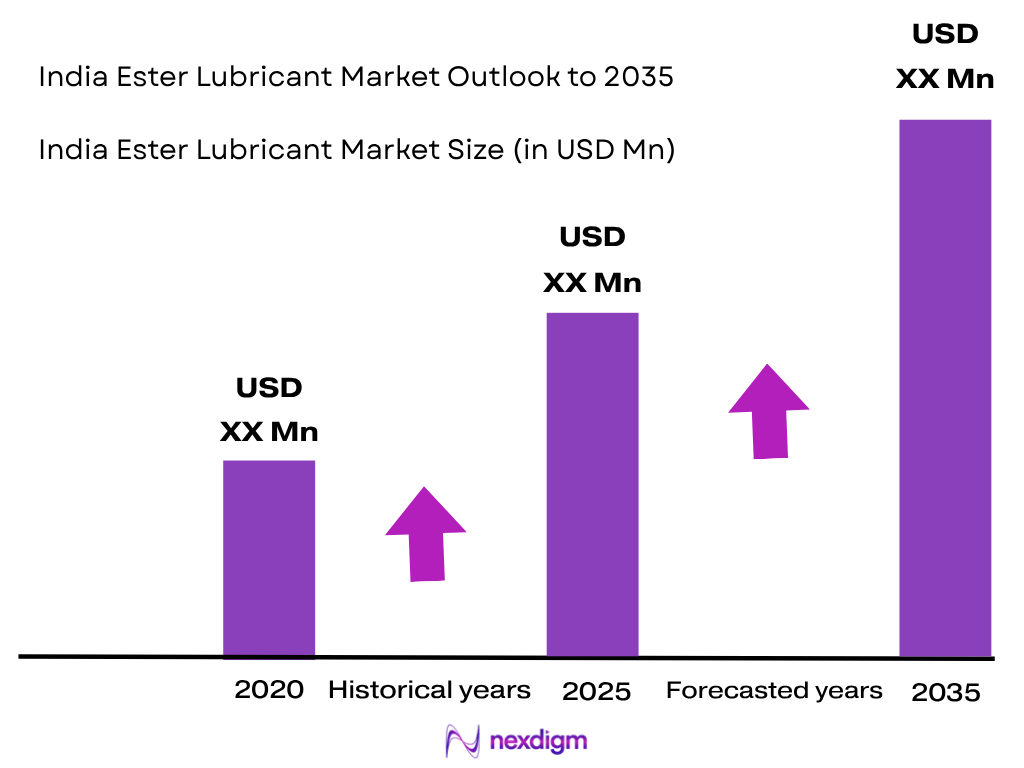
The India Ester Lubricant Market is valued at approximately USD ~ billion, supported by increasing adoption of high-performance lubricants across automotive, industrial, aviation, and specialty machinery applications. The market growth is driven by the requirement for lubricants offering higher thermal stability, oxidation resistance, longer service intervals, and improved equipment efficiency compared with conventional mineral-based lubricants. Increasing industrial manufacturing activity, expansion of automotive production, and growing focus on environmentally acceptable lubricant solutions are strengthening demand for synthetic and bio-based ester lubricant formulations.
India’s ester lubricant demand is concentrated across major industrial and automotive clusters including Maharashtra, Gujarat, Tamil Nadu, Karnataka, Delhi-NCR, and Andhra Pradesh due to the presence of automobile manufacturing plants, engineering industries, chemical processing facilities, aerospace operations, and heavy machinery users. Western India dominates due to its strong industrial ecosystem, refinery presence, and manufacturing base, while southern states contribute significantly through automotive, electronics, and precision engineering industries. Increasing investments in electric vehicle manufacturing, industrial automation, and advanced machinery are creating additional requirements for specialty ester-based lubrication solutions.
Market Segmentation
By Product Type
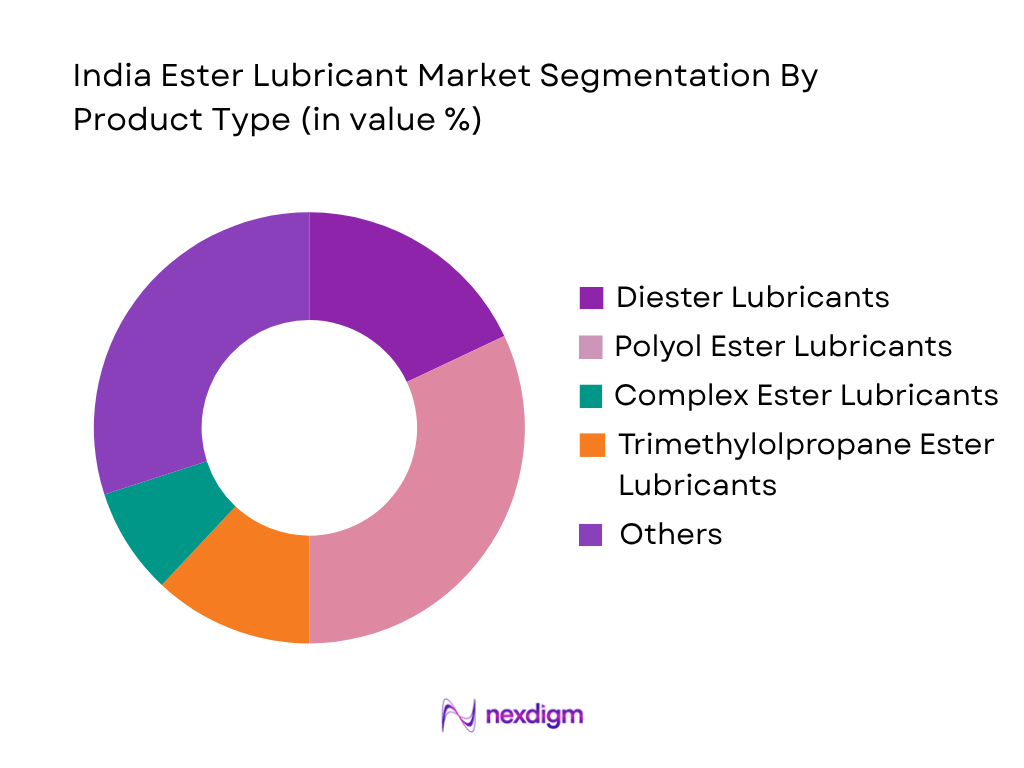
The India Ester Lubricant Market is segmented by product type into diester lubricants, polyol ester lubricants, complex ester lubricants, trimethylolpropane ester lubricants, pentaerythritol ester lubricants, neopentyl glycol ester lubricants, bio-based ester lubricants, and specialty ester lubricant formulations. Polyol ester lubricants represent a dominant product category due to their superior thermal stability, oxidation resistance, and performance under extreme operating conditions. These characteristics make them suitable for aviation turbines, compressors, refrigeration systems, automotive applications, and high-temperature industrial machinery. The increasing requirement for extended lubricant life, reduced maintenance downtime, and improved equipment efficiency supports the adoption of polyol ester formulations. Bio-based ester lubricants are also gaining importance due to sustainability requirements and environmental regulations encouraging biodegradable lubrication solutions. Specialty ester formulations are increasingly used in applications requiring precise performance characteristics such as low volatility, high lubricity, and resistance to temperature fluctuations.
By Application Type
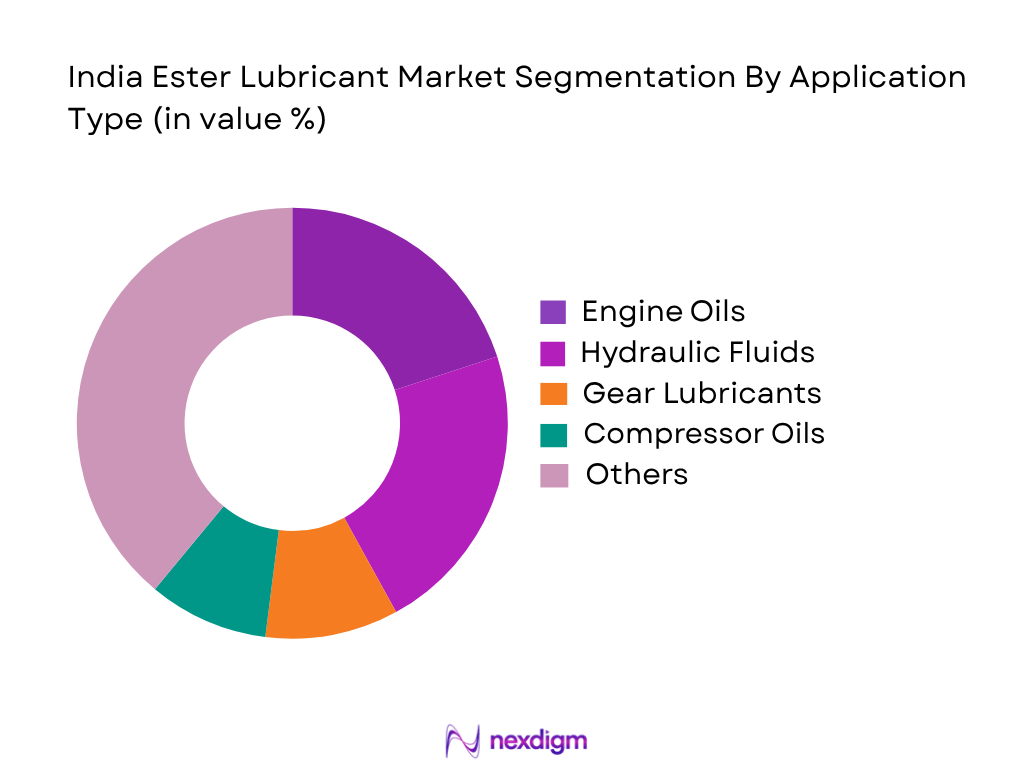
The India Ester Lubricant Market is segmented by application into engine oils, hydraulic fluids, gear lubricants, compressor oils, turbine oils, metalworking fluids, greases, transmission fluids, refrigeration lubricants, and aviation lubricants. Industrial hydraulic fluids represent a significant application segment due to increasing demand from manufacturing, construction equipment, power generation, and heavy engineering industries. Ester-based hydraulic fluids provide improved biodegradability, thermal performance, and oxidation stability, making them suitable for applications operating under high temperature and pressure conditions. Automotive applications are also expanding due to increasing demand for advanced engine lubricants and electric vehicle thermal management fluids. Aviation lubricants represent a specialized demand area because ester-based formulations are widely preferred for their high-temperature performance and reliability. Growing industrial automation, expansion of precision manufacturing, and increasing adoption of environmentally acceptable lubricants are supporting demand across multiple end-use applications.
Competitive Landscape
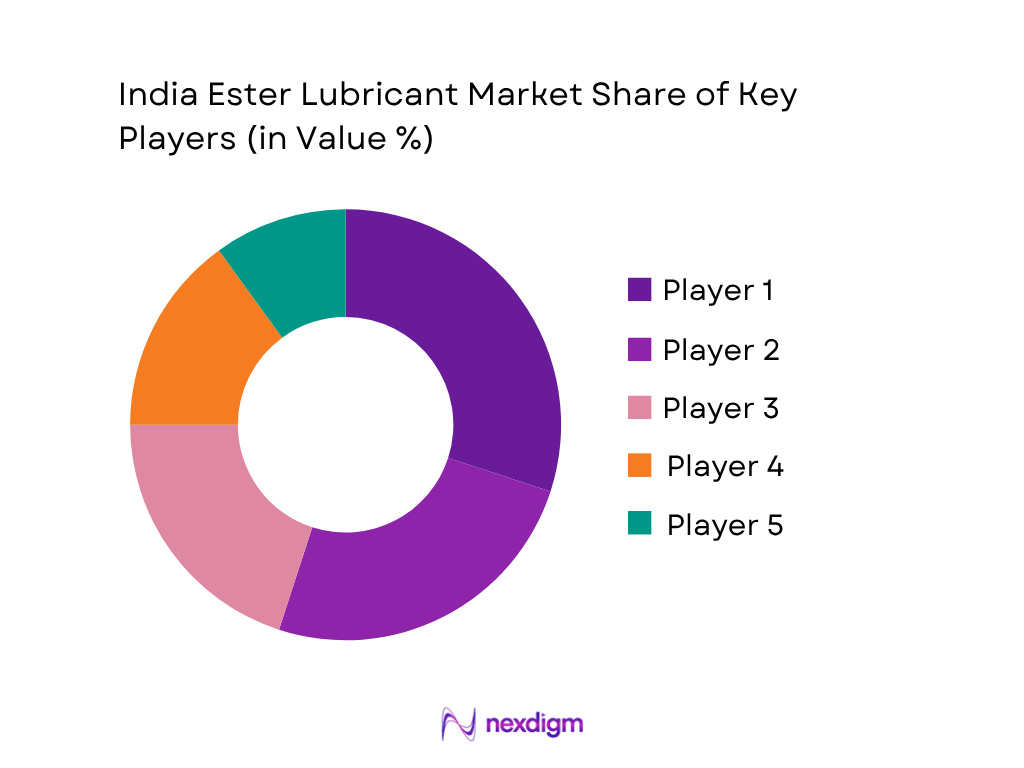
The India Ester Lubricant Market is characterized by the presence of global lubricant manufacturers, specialty chemical companies, and domestic lubricant producers offering synthetic ester and bio-based lubricant solutions. Companies compete through formulation capabilities, additive technology, application expertise, distribution reach, and relationships with automotive and industrial customers. Major players focus on developing high-performance ester lubricant products for automotive, aviation, industrial machinery, and environmentally sensitive applications.
| Company | Establishment Year | Headquarters | Product Portfolio | Ester Technology Capability | Major Application Areas | Distribution Presence | R&D Capability |
| ExxonMobil | 1999 | USA | ~ | ~ | ~ | ~ | ~ |
| Shell | 1907 | UK | ~ | ~ | ~ | ~ | ~ |
| Castrol | 1899 | UK | ~ | ~ | ~ | ~ | ~ |
| BASF | 1865 | Germany | ~ | ~ | ~ | ~ | ~ |
| Fuchs | 1931 | Germany | ~ | ~ | ~ | ~ | ~ |
India Ester Lubricant Market Analysis
Growth Drivers
Expansion of Automotive and Industrial Manufacturing Activities
The India Ester Lubricant Market is supported by expanding automotive manufacturing, industrial production, and machinery utilization, which increase demand for advanced lubrication solutions with improved thermal stability and operational efficiency. The automotive sector remains a key consumer of specialty lubricants due to increasing vehicle production, precision engineering requirements, and demand for longer lubricant service intervals. India’s automobile production ecosystem recorded approximately 28.4 million vehicles across categories during the fiscal period 2023-24, creating continuous requirements for engine oils, transmission fluids, hydraulic fluids, and specialty lubricants. Industrial demand is further supported by manufacturing growth, as India’s industrial sector continues to expand through investments in engineering, chemicals, machinery, and infrastructure. The World Bank reported India’s GDP at approximately USD 3.57 trillion in 2023, reflecting a large industrial and consumption base supporting equipment-intensive sectors. Ester lubricants are increasingly adopted in high-performance applications because they provide oxidation resistance, low volatility, and improved lubrication efficiency compared with conventional lubricant systems. Growth in manufacturing clusters across Maharashtra, Gujarat, Tamil Nadu, and Karnataka is strengthening demand from automotive plants, industrial machinery producers, and engineering companies requiring reliable lubrication technologies. Expansion of infrastructure projects, industrial corridors, and automated manufacturing facilities is further increasing the requirement for high-performance lubricants used in heavy machinery and precision equipment. Government-led manufacturing initiatives and rising investments in engineering, automotive components, and industrial equipment are supporting wider adoption of specialty lubrication technologies. Ester lubricants are gaining importance in applications requiring reduced maintenance frequency, improved equipment life, and better operating efficiency under high-load conditions. The increasing focus on productivity enhancement among manufacturers is encouraging industries to evaluate advanced lubricant solutions that can improve machinery performance and reduce operational disruptions.
Increasing Adoption of Sustainable and High-Performance Lubrication Solutions
The India Ester Lubricant Market is gaining momentum due to increasing demand for environmentally acceptable lubricants, biodegradable formulations, and high-performance synthetic solutions across industrial and specialty applications. Ester-based lubricants are preferred in applications requiring improved biodegradability, reduced volatility, and enhanced performance under extreme temperature conditions. Demand is increasing from sectors such as aerospace, hydraulic equipment, marine machinery, and precision manufacturing where lubricant reliability directly impacts equipment efficiency. India’s industrial transition toward energy-efficient operations is supporting adoption of advanced lubrication technologies. The International Energy Agency reported that India’s electricity consumption exceeded 1,700 TWh in 2024, reflecting expanding industrial and commercial activity requiring efficient machinery operation. According to government energy statistics, India had more than 200 GW of installed renewable energy capacity in 2024, highlighting the transition toward cleaner industrial systems. Ester lubricants align with these requirements by supporting longer equipment life, lower maintenance frequency, and improved operational performance in demanding applications. Increasing sustainability commitments among industries are encouraging evaluation of lubricants based on environmental impact, lifecycle efficiency, and resource conservation. Renewable energy projects, marine applications, and environmentally sensitive industrial operations are creating additional opportunities for ester-based formulations due to their performance advantages. Companies are increasingly developing specialty ester lubricants designed for specific operating conditions, including high-temperature machinery, hydraulic systems, and energy-sector equipment. The growing emphasis on reducing carbon intensity and improving industrial efficiency is expected to support demand for advanced lubricant technologies across multiple sectors.
Market Challenges
Higher Production Complexity and Raw Material Dependency
The India Ester Lubricant Market faces challenges due to the complex manufacturing process of synthetic ester formulations and dependence on specialized raw materials including fatty acids, alcohols, base chemicals, and performance additives. Ester lubricants require precise chemical formulation to achieve required viscosity, oxidation stability, thermal resistance, and compatibility with specific equipment systems. Compared with conventional mineral lubricants, these formulations generally require advanced production capabilities and specialized supply chains. India’s chemical industry is expanding, but dependence on imported specialty chemicals remains a challenge for several high-performance lubricant applications. The Ministry of Commerce and Industry reported India’s crude oil imports remained above 200 million tonnes annually, highlighting continued dependence on external energy-related supply chains that influence lubricant feedstock availability. Fluctuations in international chemical markets, transportation disruptions, and currency movements can affect input availability for lubricant manufacturers. Smaller industrial users may also face adoption barriers due to limited awareness regarding lifecycle benefits of ester lubricants compared with traditional lubrication products. Manufacturing ester lubricants requires specialized blending technologies, quality-control systems, and technical expertise, increasing operational complexity for producers. Maintaining consistent product quality is essential because lubricant performance directly affects equipment reliability and operating efficiency. Supply chain uncertainty, dependency on specialty chemical imports, and limited domestic availability of certain advanced additives can affect production flexibility. Manufacturers need stronger domestic sourcing networks, technology investments, and formulation capabilities to improve supply security and support long-term market development.
Limited Awareness and Application-Specific Technical Requirements
The India Ester Lubricant Market faces adoption challenges because ester-based lubricants require application-specific selection, technical evaluation, and compatibility testing before replacement of conventional lubricant systems. Industrial users often require detailed performance analysis to determine suitability for hydraulic systems, compressors, turbines, automotive components, and specialized machinery. Lack of technical awareness among smaller manufacturing units can slow adoption, particularly where conventional lubricants continue to dominate due to familiarity and established procurement practices. India’s MSME sector includes more than 63 million enterprises, according to government estimates, representing a large but fragmented industrial user base with varying levels of technical capability. Many smaller manufacturers prioritize immediate operating costs rather than evaluating long-term benefits such as reduced maintenance, improved equipment efficiency, and longer service intervals. Additionally, ester lubricants require careful handling regarding seal compatibility, additive selection, and operating conditions, making technical support and application expertise important factors influencing market penetration. The requirement for specialized knowledge can increase transition barriers for industries shifting from mineral-based lubricants to advanced synthetic solutions. Maintenance teams may require additional training to understand lubricant selection, storage conditions, and replacement procedures. Smaller industrial facilities with limited technical resources may hesitate to adopt premium lubricant technologies without clear operational benefits. Stronger distributor networks, technical support services, and awareness initiatives can improve adoption by helping users understand performance advantages and lifecycle benefits.
Market Opportunities
Growth of Electric Vehicles and Advanced Mobility Lubrication Requirements
The expansion of electric vehicles creates new opportunities for the India Ester Lubricant Market through demand for specialized fluids used in electric drivetrains, thermal management systems, and high-efficiency components. EV systems require lubricants capable of managing heat transfer, electrical compatibility, and component protection under different operating conditions. India’s electric mobility sector is expanding, supported by government initiatives and increasing manufacturer investments. The Ministry of Road Transport and Highways reported more than 1.7 million electric vehicles registered in India by 2024, demonstrating growing adoption of electric mobility solutions. Ester-based formulations can support emerging requirements for EV-specific fluids, including transmission lubrication, cooling systems, and specialized industrial manufacturing equipment used for battery and component production. Expansion of EV manufacturing facilities in states including Tamil Nadu, Gujarat, Maharashtra, and Karnataka creates additional demand opportunities for specialty lubricant suppliers. Increasing focus on energy efficiency and advanced vehicle technologies is encouraging lubricant manufacturers to develop customized ester-based solutions for next-generation mobility applications. The development of battery manufacturing ecosystems and electric vehicle component supply chains is creating additional applications for specialty lubricants. Manufacturing equipment used in battery production, electric motors, and precision automotive components requires advanced lubrication solutions capable of maintaining performance under controlled conditions. Ester lubricants can provide advantages in thermal management and efficiency-focused applications where conventional lubricants may not meet emerging performance requirements. Increasing investments in EV production infrastructure are expected to create new demand areas beyond traditional engine lubrication.
Expansion of Industrial Automation and Precision Manufacturing
The India Ester Lubricant Market has opportunities from increasing industrial automation, precision manufacturing, and adoption of advanced machinery requiring high-performance lubrication solutions. Automated production systems, robotics, CNC equipment, and precision engineering machinery require lubricants capable of maintaining performance under continuous operation, high temperature, and strict contamination-control conditions. India’s manufacturing sector is being strengthened through investments in electronics, automotive components, aerospace, and industrial equipment production. The Ministry of Electronics and Information Technology reported significant growth in electronics manufacturing capacity, supporting India’s emergence as a major production base for electronic components and devices. Advanced manufacturing operations require specialized lubricants that improve equipment reliability and reduce downtime. Ester lubricants provide advantages such as high lubricity, thermal stability, and improved oxidation resistance, making them suitable for demanding industrial applications. Increasing investments in industrial corridors, smart manufacturing facilities, and automation technologies are expected to create additional demand for specialty lubricant formulations across manufacturing and engineering sectors. The adoption of Industry 4.0 technologies is increasing the need for lubricants capable of supporting precision equipment performance and predictive maintenance systems. Modern machinery operates at higher speeds and tighter tolerances, requiring advanced lubrication solutions with improved stability and reliability. Industries such as electronics manufacturing, aerospace components, robotics, and automotive parts are creating additional opportunities for specialty ester lubricant suppliers. As manufacturers focus on improving productivity, reducing downtime, and achieving sustainable operations, ester lubricants can support enhanced equipment protection and operational efficiency.
Future Outlook
The India Ester Lubricant Market is expected to witness increasing adoption driven by industrial modernization, electric vehicle expansion, sustainability requirements, and demand for high-performance lubrication technologies. Growth in manufacturing, renewable energy, automotive components, and precision engineering will create additional applications for ester-based lubricant solutions. Companies are expected to focus on developing customized formulations offering improved efficiency, longer service life, and environmental benefits. Increasing awareness regarding lifecycle cost reduction and equipment reliability will further support adoption across industrial sectors.
Major Players
- ExxonMobil Corporation
- Shell India Markets Private Limited
- Castrol India Limited
- Fuchs Lubricants India Private Limited
- BASF India Limited
- TotalEnergies Marketing India Private Limited
- Chevron Lubricants India Private Limited
- Indian Oil Corporation Limited
- Bharat Petroleum Corporation Limited
- Hindustan Petroleum Corporation Limited
- Klüber Lubrication India Private Limited
- Dow India Private Limited
- Croda India Private Limited
- LANXESS India Private Limited
- Afton Chemical India Private Limited
Key Target Audience
- Automotive lubricant manufacturers
- Industrial machinery manufacturers
- Aerospace and aviation equipment companies
- Chemical and specialty lubricant producers
- Oil and gas equipment operators
- Investments and venture capitalist firms (Energy Transition Funds, Industrial Technology Investment Funds)
- Government and regulatory bodies (Ministry of Heavy Industries, Ministry of Petroleum and Natural Gas, Bureau of Indian Standards)
- Renewable energy equipment manufacturers
Research Methodology
Step 1: Identification of Key Variables
The initial phase involves developing a comprehensive ecosystem map covering lubricant manufacturers, raw material suppliers, automotive companies, industrial equipment users, and regulatory stakeholders within the India Ester Lubricant Market. Secondary research is conducted using industry databases, government publications, trade statistics, and company information to identify critical variables influencing market demand, supply dynamics, technology adoption, and application requirements.
Step 2: Market Analysis and Construction
Historical market information is analyzed by evaluating lubricant consumption patterns, industrial production trends, automotive manufacturing activity, and specialty lubricant adoption across major end-use sectors. Supply-side assessment includes analysis of domestic manufacturing capabilities, import dependency, raw material availability, and distribution structures to establish a comprehensive understanding of market development.
Step 3: Hypothesis Validation and Expert Consultation
Market assumptions are validated through discussions with industry participants including lubricant manufacturers, distributors, automotive companies, industrial users, and technical experts. These interactions provide insights into product preferences, application requirements, procurement behavior, competitive dynamics, and emerging opportunities influencing the India Ester Lubricant Market.
Step 4: Research Synthesis and Final Output
The final stage integrates primary and secondary research findings to create a validated market assessment. Data points related to segmentation, competitive landscape, growth factors, challenges, and future opportunities are analyzed to develop a detailed understanding of market evolution and industry prospects.

- Executive Summary
- Research Methodology (Market Definition and Scope, India Ester Lubricant Market Classification, Ester Lubricant Product Mapping, Base Oil Chemistry Assessment, Synthetic Ester Technology Assessment, Fatty Acid Ester and Polyol Ester Analysis, Lubricant Performance Parameter Assessment, Viscosity Grade Assessment, Biodegradability Assessment, Application-Level Demand Analysis, End-Use Industry Assessment, Industrial Lubrication Demand Assessment, Automotive Lubrication Demand Assessment, Aviation Lubrication Assessment, Domestic Manufacturing Assessment, Import and Export Trade Analysis, Raw Material Supply Assessment, Vegetable Oil and Chemical Feedstock Analysis, Distribution Channel Assessment, Demand-Side Assessment, Supply-Side Assessment, Top-Down Market Sizing, Bottom-Up Market Sizing, Primary Industry Interviews, Data Triangulation, Forecasting Framework, Market Share Validation, Limitations and Future Conclusions)

- Definition and Scope
- India Ester Lubricant Industry Evolution and Development of Synthetic Lubricants, Bio-Based Lubricant Technologies, High-Performance Industrial Lubrication Systems, Automotive Lubrication Applications and Specialty Lubricant Manufacturing
- Ester Lubricant Value Chain Analysis
- Ester Lubricant Supply Chain Analysis
- Chemical Feedstock Suppliers, Fatty Acid Manufacturers, Polyol Suppliers, Ester Base Stock Producers, Lubricant Blenders, Additive Manufacturers, Specialty Lubricant Suppliers, Automotive OEMs, Industrial Equipment Manufacturers, Aviation Operators, Distributors and End Users
- Ester Lubricant Integration Across Automotive Engines, Electric Vehicle Components, Hydraulic Systems, Metalworking Fluids, Gear Systems, Compressors, Turbines, Aviation Equipment, Marine Applications, Food-Grade Lubricants and Environmentally Sensitive Applications

- Growth Drivers (Expansion of Automotive and Electric Vehicle Manufacturing, Increasing Demand for High-Performance Lubrication Solutions, Growth of Industrial Automation and Advanced Machinery, Rising Adoption of Environmentally Sustainable Lubricants, Increasing Requirement for Energy-Efficient Lubrication Systems, Expansion of Aerospace and Aviation Activities, Growth of Manufacturing and Engineering Industries, Increasing Use of Biodegradable Lubricants in Environmentally Sensitive Applications, Rising Demand for Extended Drain Interval Lubricants, Development of Specialty Lubricant Applications Across Industrial Sectors)
- Market Challenges (Higher Cost Compared With Conventional Mineral Lubricants, Limited Awareness Among Small and Medium Industrial Users, Dependence on Imported Specialty Raw Materials, Complex Formulation Requirements, Limited Domestic Ester Production Capacity, Compatibility Challenges With Existing Equipment, Supply Chain Constraints for Specialty Chemicals, Performance Qualification Requirements Across Industries, Competition From Mineral and Other Synthetic Lubricants)
Market Opportunities (Expansion of Bio-Based Ester Lubricants, Increasing Electric Vehicle Lubrication Requirements, Growth of - Environmentally Acceptable Lubricants, Development of High-Performance Industrial Fluids, Aviation and Aerospace Lubricant Applications, Marine Lubrication Solutions, Food-Grade Lubricant Expansion, Renewable Feedstock-Based Lubricant Development, Customized Ester Formulations for Industrial Applications, Growth of Energy-Efficient Machinery Lubrication)
- Market Trends (Sustainable Lubricant Development, Bio-Based Synthetic Ester Adoption, High-Performance Lubrication Technologies, Electric Vehicle Thermal Management Fluids, Advanced Industrial Machinery Lubrication, Low-Emission Automotive Lubricants, Extended-Life Lubricant Formulations, Specialty Ester Blending Technologies, Environmentally Friendly Hydraulic Fluids)
- Government Regulations and Standards (Bureau of Indian Standards Lubricant Specifications, Automotive Lubricant Quality Requirements, Environmental Protection Regulations, Hazardous Chemical Management Standards, Industrial Safety Regulations, Waste Oil Management Requirements, Bio-Based Product Standards, Automotive Emission Regulations, Food Safety Lubricant Requirements)
- SWOT Analysis
- Porter’s Five Forces Analysis
- PESTLE Analysis
- Stakeholder Ecosystem
- Competition Ecosystem

- By Market Value (2020-2025)
- By Volume Consumption (2020-2025)
- By Synthetic Ester Lubricant Consumption Volume (2020-2025)
- By Bio-Based Ester Lubricant Consumption Volume (2020-2025)
- By Automotive Ester Lubricant Consumption Volume (2020-2025)
- By Industrial Ester Lubricant Consumption Volume (2020-2025)
- By Domestic Production Volume (2020-2025)
- By Import Volume (2020-2025)
- By Export Volume (2020-2025)
- By Average Selling Price (2020-2025)

- By Product Type (In Value %)
Diester Lubricants
Polyol Ester Lubricants
Complex Ester Lubricants
Trimethylolpropane Ester Lubricants
Pentaerythritol Ester Lubricants
Neopentyl Glycol Ester Lubricants
Bio-Based Ester Lubricants
Specialty Ester Lubricant Formulations - By Base Oil Type (In Value %)
Synthetic Esters
Natural Esters
Vegetable Oil-Based Esters
Modified Natural Esters
Biodegradable Ester Lubricants
High-Performance Synthetic Ester Lubricants - By Application Type (In Value %)
Engine Oils
Hydraulic Fluids
Gear Lubricants
Compressor Oils
Turbine Oils
Metalworking Fluids
Greases
Transmission Fluids
Refrigeration Lubricants
Aviation Lubricants - By End-Use Industry (In Value %)
Automotive Industry
Electric Vehicle Industry
Manufacturing Industry
Power Generation
Aerospace and Aviation
Marine Industry
Mining Industry
Construction Equipment
Food Processing Industry
Chemical Processing Industry - By Performance Parameter (In Value %)
High-Temperature Stability
Low-Temperature Performance
Oxidation Resistance
Wear Protection
Biodegradability
Thermal Stability
Energy Efficiency Enhancement
Extended Drain Interval Performance - By Distribution Channel (In Value %)
Direct Industrial Sales
Automotive OEM Supply
Authorized Lubricant Distributors
Industrial Lubricant Dealers
Specialty Chemical Distributors
Online Industrial Platforms
Aftermarket Automotive Channels
Service and Maintenance Networks - By Region (In Value %)
Western India
Northern India
Southern India
Eastern India
Central India
Industrial Manufacturing Hubs

- Market Share of Major Players (By India Revenue, Ester Lubricant Sales Volume, Synthetic Ester Product Portfolio, Bio-Based Lubricant Portfolio, Automotive Customer Coverage, Industrial Customer Coverage, Manufacturing Capacity, Distribution Network Coverage, Regional Presence, Application Coverage, Technical Service Capability, R&D Capability)
- Cross Comparison Parameters (Ester Lubricant Revenue, Synthetic Ester Technology Portfolio, Bio-Based Lubricant Capability, Automotive Lubricant Application Coverage, Industrial Lubrication Capability, High-Temperature Performance Solutions, Distribution Network Reach, Technical Formulation Support Capability)
- SWOT Analysis of Major Players
- Competitive Positioning Matrix
- Detailed Profiles of Major Companies
ExxonMobil India
Shell India
BP Castrol India
TotalEnergies Marketing India
Chevron Lubricants India
FUCHS Lubricants India
Klüber Lubrication India
Petronas Lubricants India
BASF India
Evonik India
LANXESS India
Afton Chemical India
Lubrizol India
Indian Oil Corporation Limited
Bharat Petroleum Corporation Limited

- Automotive OEM Lubricant Requirement Assessment
- Electric Vehicle Component Lubrication Assessment
- Industrial Machinery Lubricant Procurement Analysis
- Manufacturing Plant Lubrication Requirement Assessment
- Power Generation Equipment Lubrication Assessment
- Aerospace and Aviation Lubricant Requirement Analysis
- Marine Equipment Lubrication Assessment
- Mining Equipment Lubricant Requirement Analysis
- Construction Equipment Lubricant Procurement Assessment
- Food Processing Equipment Lubricant Assessment
- Chemical Industry Lubrication Requirement Analysis
- Metalworking Fluid Procurement Assessment
- Hydraulic System Lubricant Requirement Assessment
- Industrial Maintenance Service Provider Assessment

- By Market Value (2026-2035)
- By Volume Consumption (2026-2035)
- By Synthetic Ester Lubricant Consumption Volume (2026-2035)
- By Bio-Based Ester Lubricant Consumption Volume (2026-2035)
- By Automotive Ester Lubricant Consumption Volume (2026-2035)
- By Industrial Ester Lubricant Consumption Volume (2026-2035)
- By Domestic Production Volume (2026-2035)
- By Import Volume (2026-2035)
- By Export Volume (2026-2035)
- By Average Selling Price (2026-2035)


 Request a Sample
 Ask for Customization
 Get a Quote
 Enquire Now