

 Download PDF
Market Overview
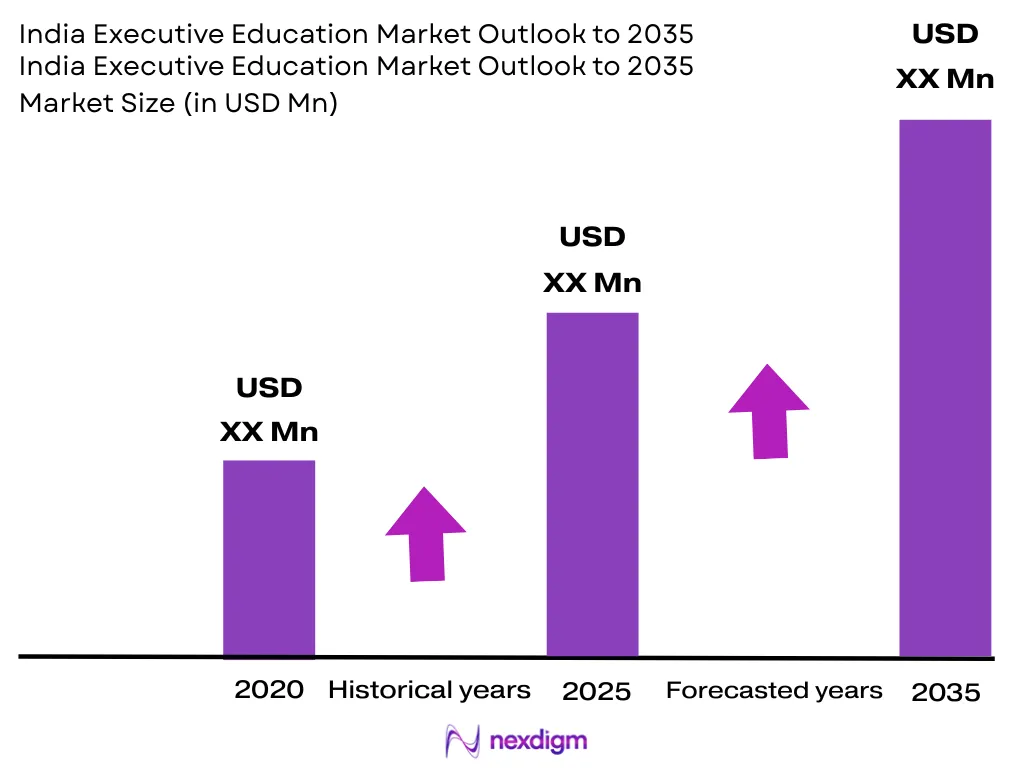
The India Executive Education Market was valued at approximately USD ~ Million in 2024 and is anticipated to expand at a CAGR of approximately 14.8% during 2026-2035, driven by rising corporate learning and development investment and accelerating demand for leadership and digital transformation skills among India’s expanding professional workforce. According to the National Skill Development Corporation, demand for skilled professionals in India is projected to reach approximately 700 million, while the World Economic Forum estimates that approximately 54% of employees globally will require reskilling in the coming years, reinforcing sustained structural demand for executive education programs. The market continues to be shaped by a dynamic mix of government-affiliated B-schools, private business schools, and technology-enabled learning platforms, with institutions such as the Indian School of Business partnering with global platforms including Coursera to blend traditional executive education with online delivery and expand reach beyond their historical on-campus cohorts.
Market Segmentation
By Program Type
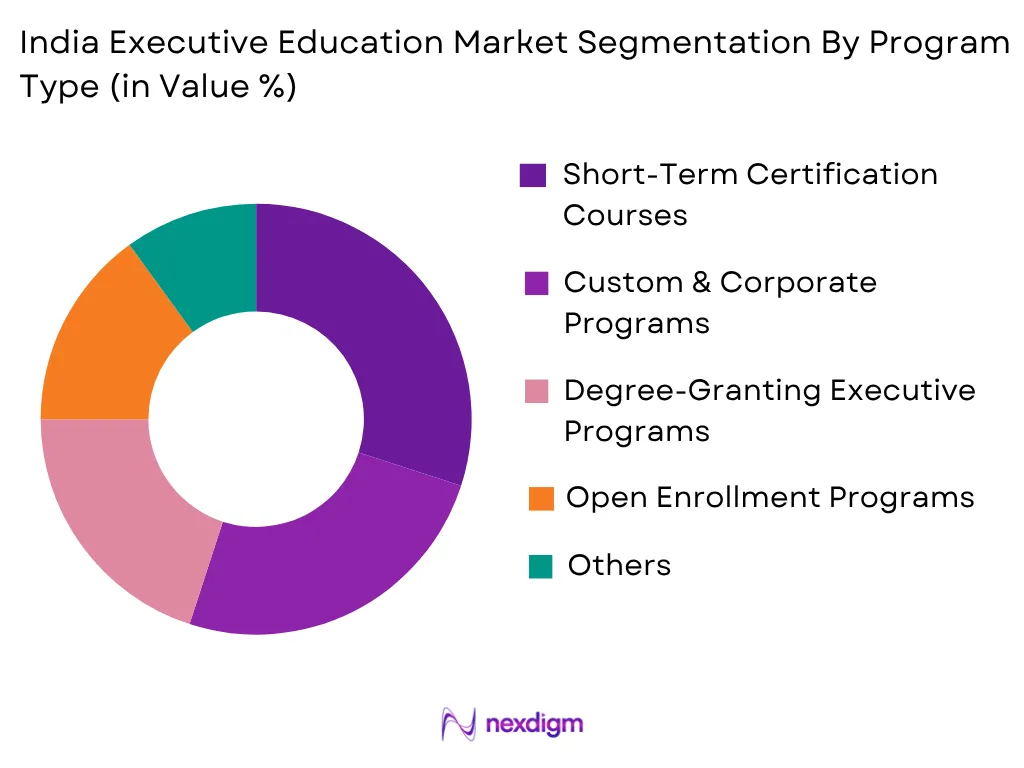
Short-Term Certification Courses hold a substantial and growing share of the India Executive Education Market, reflecting rising demand among working professionals for intensive, schedule-compatible learning experiences that deliver immediate, applicable skills without requiring extended leave from full-time employment. The Indian School of Business reported approximately 25% growth in its executive education segment in 2023, driven particularly by short-term certificate programs, reflecting the institution’s emphasis on practical, industry-relevant content as a key differentiator. Custom & Corporate Programs continue to expand as Indian enterprises increasingly commission tailored leadership and functional training curricula designed around organization-specific strategic priorities, rather than relying solely on open-enrollment offerings. Degree-Granting Executive Programs, including one-year MBA-equivalent formats such as ISB’s Post Graduate Programme in Management for Working Professionals, continue to serve senior and mid-career professionals seeking comprehensive credential-backed career transitions, while Open Enrollment Programs remain a foundational offering across nearly all major providers.
By Delivery Mode
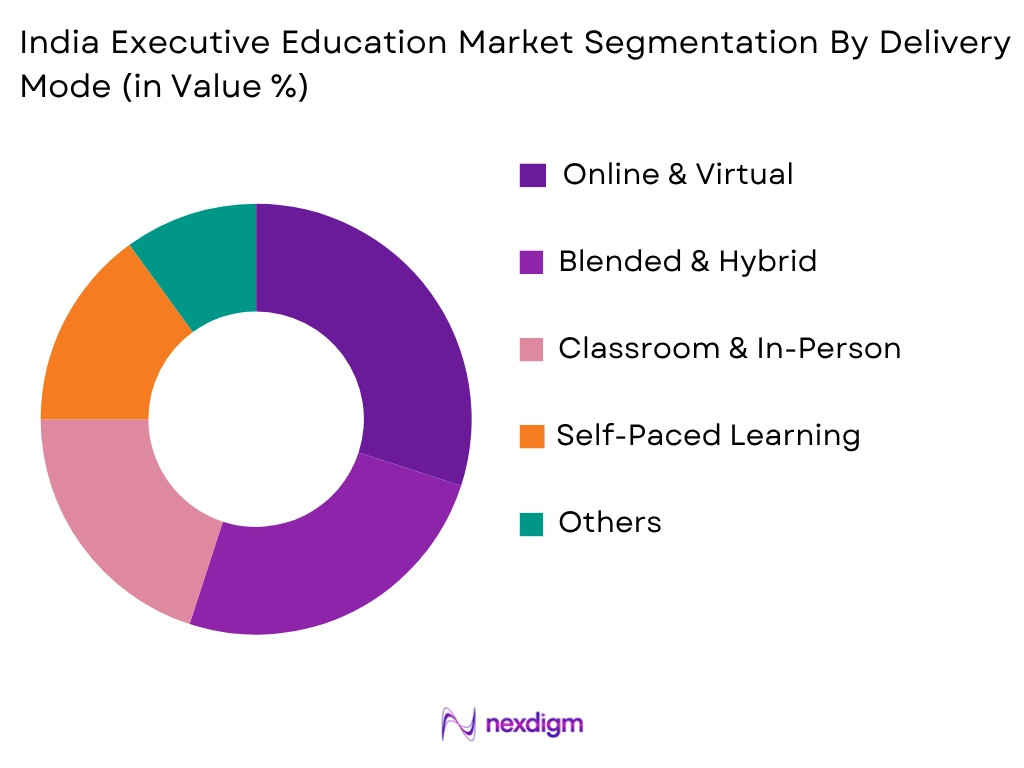
Online & Virtual delivery continues to expand rapidly across the India Executive Education Market, accelerated by institutions increasingly blending traditional classroom-based executive education with digital platforms to reach a broader, geographically dispersed audience of working professionals. IIM Ahmedabad reported an approximately 20% increase in enrollments for its executive education programs in 2023, driven substantially by new online offerings in digital transformation and leadership, illustrating the scale of demand shift toward virtual and blended formats among India’s most prestigious management institutions. Blended & Hybrid delivery models, combining live virtual sessions with periodic in-person immersions, continue to gain particular traction among corporate-sponsored cohorts seeking to balance program depth with minimal disruption to participants’ full-time work commitments. Classroom & In-Person delivery retains strong appeal for premium, networking-intensive flagship programs where peer interaction and campus immersion remain central to the value proposition, particularly for senior leadership and general management programs offered by institutions such as ISB and the IIMs.
Competitive Landscape
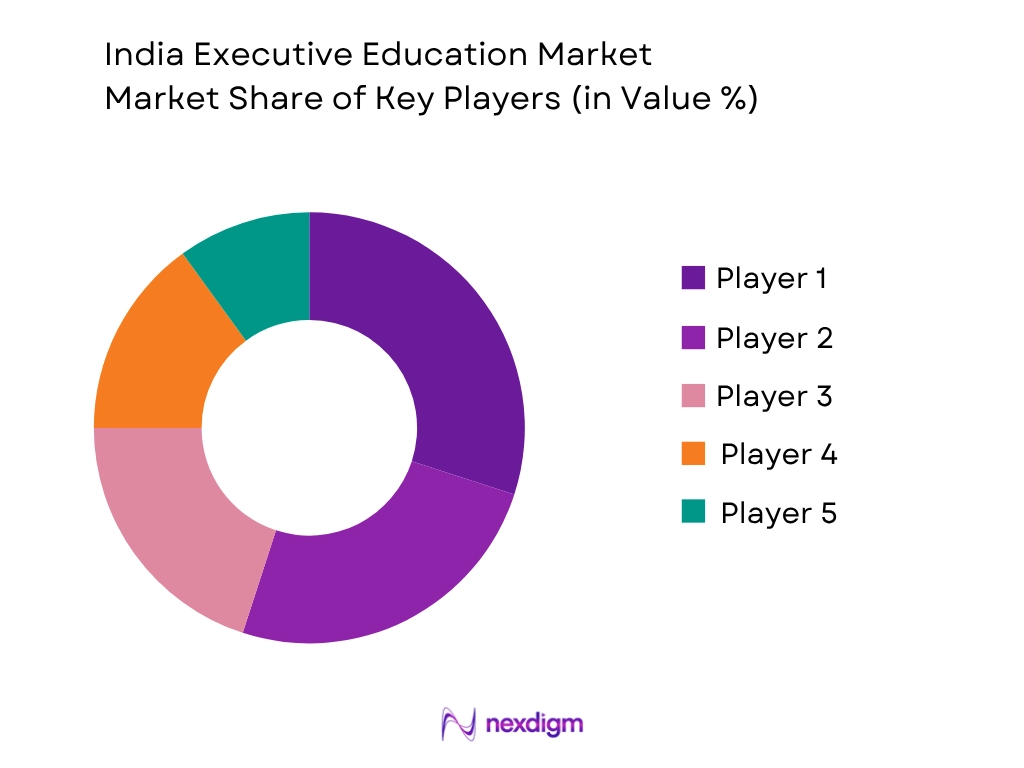
The India Executive Education Market features a dynamic mix of government-affiliated business schools, private business schools, dedicated training institutes, and technology-enabled e-learning platforms competing across different price points, delivery modes, and target audiences. Executive education players including IIM Bangalore, IIM Ahmedabad, ISB Hyderabad, and ICFAI Business School have historically commanded the largest share of market revenue among traditional providers, leveraging strong brand recognition, faculty credentials, and alumni networks built over decades of operation. E-learning providers including upGrad, Emeritus, Coursera India, Simplilearn, and TalentSprint have captured substantial share within the virtual and blended learning segment, competing on accessibility, pricing flexibility, and partnerships with global universities and corporations to offer internationally recognized credentials. Competition throughout the market is primarily shaped by brand image and global recognition of institutions, program structure and career advancement outcomes, faculty quality, and the strength of industry tie-ups, with ISB’s 2023 partnership with Coursera exemplifying the broader trend of established B-schools embracing technology platforms to extend their reach beyond traditional in-person cohorts.
| Company | Establishment Year | Headquarters | Primary Program Portfolio | Executive Education Portfolio
|
Delivery Presence | Major End-Use Industries | Key Strategic Focus | Certifications & Compliance |
| Indian School of Business (ISB) | 2001 | ~ | ~ | ~ | ~ | ~ | ~ | ~ |
| IIM Ahmedabad | 1961 | ~ | ~ | ~ | ~ | ~ | ~ | ~ |
| XLRI Jamshedpur | 1949 | ~ | ~ | ~ | ~ | ~ | ~ | ~ |
| upGrad | 2015 | ~ | ~ | ~ | ~ | ~ | ~ | ~ |
| Emeritus | 2010 | ~ | ~ | ~ | ~ | ~ | ~ | ~ |
India Executive Education Market Analysis
Growth Drivers
Rising Corporate L&D Investment and Digital Transformation Upskilling Demand
The India executive education market is experiencing sustained growth due to increasing corporate investment in learning and development as organizations seek to remain competitive amid rapid technological change. According to industry research, more than 60% of Indian employees are actively seeking additional training to enhance their skills, while the National Skill Development Corporation projects that demand for skilled professionals in India will reach approximately 700 million in the coming years. Bangalore’s position as India’s information technology capital continues to drive particularly strong demand for executive programs focused on technology and digital transformation, reinforcing the city’s status as one of the country’s dominant executive education markets alongside Mumbai and Delhi NCR. As Indian organizations across sectors accelerate digital transformation initiatives, demand for structured leadership and technical upskilling programs capable of preparing mid- and senior-level professionals for evolving business models continues to expand correspondingly, sustaining robust growth across both traditional and technology-enabled executive education providers.
Blended Learning Adoption and EdTech-B-School Partnership Growth
Growing collaboration between established business schools and global technology platforms continues to reshape the India executive education market’s delivery landscape. In 2023, the Indian School of Business launched a new executive education program in collaboration with Coursera, specifically targeting mid-career professionals seeking to upskill in digital transformation, leadership, and strategy, reflecting the broader industry trend of blending traditional executive education with online platforms to reach audiences beyond geographically constrained in-person cohorts. IIM Ahmedabad’s launch of a new online executive education program focused on digital transformation in 2023, which contributed to an approximately 20% increase in program enrollments that year, further illustrates how India’s premier management institutes are actively embracing blended and fully virtual delivery formats to expand market reach. As corporate learning and development budgets increasingly favor flexible, scalable delivery formats capable of serving distributed workforces, providers that have successfully integrated digital platforms alongside their traditional faculty and content strengths are well positioned to capture disproportionate enrollment growth across the market.
Market Challenges
Market Fragmentation and Intense Competition
The India Executive Education Market remains highly fragmented, encompassing government business schools such as the IIMs, IITs, and IIFT, private business schools including ISB, XLRI, and Great Lakes, dedicated training institutes such as AIMA and ICFAI, and a substantial and growing roster of e-learning providers including Jaro Education, upGrad, Emeritus, Coursera, and EdX. This fragmentation creates intense competition across nearly every price point and delivery format, requiring providers to continuously differentiate on program structure, career advancement outcomes, brand image, institutional tie-ups, rankings, and faculty quality to retain and grow their share of a crowded market. Niche, vertical-focused e-learning players face particular pressure to establish credible differentiation against both well-established traditional B-schools and larger, better-capitalized virtual learning platforms, with adoption among these smaller players driven substantially by ease of learning and accessibility rather than brand prestige alone. This competitive intensity continues to compress margins and elevate customer acquisition costs across the industry, particularly for providers lacking the institutional brand equity of India’s top-tier management schools.
EdTech Funding Winter and Sustainability Pressure
India’s broader edtech sector, which includes many of the virtual executive education platforms competing in this market, has faced a well-documented funding contraction following the exceptional investment levels seen during the pandemic-era boom, when Indian edtech firms collectively garnered private equity investments totaling more than USD 4 billion over a five-year period. This funding winter has intensified pressure on virtual learning providers to demonstrate sustainable unit economics, program completion rates, and measurable career outcomes rather than relying primarily on enrollment growth funded by continued external capital. Providers operating on thinner margins face increased scrutiny of program quality, learner engagement, and completion rates, as corporate sponsors and individual learners alike increasingly demand demonstrable return on investment before committing to program fees. This shift toward profitability and sustainable growth continues to reshape competitive dynamics within the virtual and blended learning segment, favoring providers with strong institutional partnerships, differentiated content, and proven learner outcomes over those competing primarily on price or aggressive marketing spend.
Market Opportunities
Growth in Industry-Specific and Vertical-Focused Programs
Rising demand for specialized, industry-specific executive education creates substantial opportunity for providers capable of developing deeply tailored curricula addressing sector-specific challenges rather than generic management content. The continued rise of niche, vertical-focused e-learning players reflects growing market appetite for specialized programs addressing specific functional or industry needs, from financial technology and healthcare management to renewable energy and digital marketing. As corporate learning and development budgets increasingly prioritize measurable business impact over generic credentialing, providers that can demonstrate deep industry expertise, practitioner faculty, and direct applicability to participants’ specific professional contexts are well positioned to command premium pricing and stronger corporate sponsorship relationships. This trend toward specialization also creates opportunity for established B-schools to extend their brand equity into new vertical-specific offerings developed in partnership with industry bodies, corporate sponsors, or technology platforms seeking to combine academic credibility with specialized subject matter expertise.
Tier-2 and Tier-3 City Expansion and Global Partnership Growth
Continued geographic expansion beyond India’s dominant executive education hubs of Bangalore, Mumbai, and Delhi NCR creates meaningful opportunity for providers seeking to capture demand from India’s rapidly growing base of professionals in emerging Tier-2 and Tier-3 cities. As digital and blended delivery formats continue reducing the geographic barriers historically associated with premium executive education, providers with strong online capabilities are increasingly well positioned to serve professionals outside India’s traditional metropolitan executive education markets. Simultaneously, continued growth in partnerships between Indian institutions and global universities and platforms, exemplified by ISB’s collaboration with Coursera and the presence of international providers such as Harvard Business School Online within the competitive landscape, creates opportunity for Indian executive education providers to offer globally benchmarked credentials without requiring participants to study abroad. As India’s economy continues expanding and its professional workforce increasingly seeks internationally recognized qualifications, providers capable of combining global academic partnerships with locally relevant, cost-accessible program design are well positioned to capture growth across both established and emerging Indian markets.
Future Outlook
The India Executive Education Market is expected to witness robust expansion over the forecast period, supported by sustained corporate learning and development investment, continued growth in blended and online delivery formats, and rising demand for industry-specific leadership and digital transformation skills across India’s expanding professional workforce. Continued consolidation around providers capable of demonstrating measurable career outcomes and strong institutional partnerships will likely reshape competitive dynamics as the sector’s funding environment continues normalizing following the pandemic-era edtech investment boom. The market is also likely to benefit from continued geographic expansion beyond India’s traditional metropolitan hubs and growing global university partnerships that extend internationally recognized credentials to a broader base of Indian professionals.
Major Players
- Indian School of Business (ISB)
- IIM Ahmedabad
- IIM Bangalore
- IIM Calcutta
- XLRI Jamshedpur
- SP Jain Institute of Management and Research (SPJIMR)
- MDI Gurgaon
- Great Lakes Institute of Management
- upGrad
- Emeritus
- Coursera India
- Simplilearn
- TalentSprint
- Jaro Education
- NIIT Limited
Key Target Audience
- Executive Education Providers and Business Schools
- Corporates and Enterprises (Learning & Development Functions)
- Individual Working Professionals
- Government and Public Sector Organizations
- E-Learning and EdTech Platforms
- Investment and Venture Capitalist Firms
- Government and Regulatory Bodies (University Grants Commission (UGC), All India Council for Technical Education (AICTE), Ministry of Education)
- Global University Partners and Content Providers
Research Methodology
Step 1: Identification of Key Variables
The research process begins with identifying the complete ecosystem of the India Executive Education Market, including government and private business schools, training institutes, e-learning platforms, corporate learning and development functions, and regulatory authorities. Extensive secondary research is conducted using institutional annual reports, government publications, industry associations, enrollment statistics, industry journals, and proprietary databases to determine the variables influencing market demand, pricing, enrollment, and technological developments.
Step 2: Market Analysis and Construction
Historical market information is collected and analyzed to estimate market size, enrollment volumes, program-wise demand, and pricing trends. A combination of top-down and bottom-up approaches is used to estimate market revenues and validate segment-level performance. Consumption patterns across open enrollment, custom corporate, certificate, and degree-granting programs are evaluated to establish an accurate representation of the industry.
Step 3: Hypothesis Validation and Expert Consultation
The preliminary findings are validated through Computer-Assisted Telephone Interviews (CATIs) and structured discussions with business school administrators, corporate learning and development managers, e-learning platform executives, faculty members, and senior executives operating within the Indian executive education industry. These interviews help verify market assumptions, competitive developments, technology adoption trends, pricing dynamics, and future investment opportunities while refining the overall market estimates.
Step 4: Research Synthesis and Final Output
The final stage integrates insights obtained from primary interviews with quantitative information collected through secondary sources. Data triangulation techniques are applied to reconcile differences between supply-side and demand-side estimates, ensuring robust market forecasting. The report is then reviewed through multiple quality assurance checkpoints to deliver a comprehensive analysis covering market size, segmentation, competitive landscape, future outlook, and strategic recommendations for industry stakeholders.

- Executive Summary
- Research Methodology (Market Definitions and Assumptions, Abbreviations, Market Sizing Approach, Top-Down Analysis, Bottom-Up Analysis, Demand-Side Assessment, Supply-Side Assessment, Primary Industry Interviews, Secondary Research Validation, Data Triangulation, Forecasting Framework, Limitations and Future Conclusions)

- Definition and Scope
- Market Evolution and Industry Genesis
- Timeline of Major Industry Developments
- Executive Education Industry Value Chain Analysis
- Supply Chain Analysis

- Growth Drivers (Rising Corporate L&D Investment, Digital Transformation Upskilling Demand, Blended Learning Adoption, EdTech-B-School Partnership Growth, Expanding Middle Management Talent Pool, Global University Tie-Up Expansion)
- Market Challenges (Market Fragmentation & Intense Competition, EdTech Funding Winter & Sustainability Pressure, Program Completion & Engagement Rates, Price Sensitivity Among Individual Learners, Brand Differentiation Difficulty Among Niche Players, Faculty & Content Quality Consistency)
- Market Opportunities (Growth in Industry-Specific & Vertical Programs, Tier-2 & Tier-3 City Expansion, International Partnership & Global Campus Growth, AI & Data Science Program Demand, Government-Backed Skilling Initiatives, Micro-Credential & Modular Learning Growth)
- Market Trends (Growth in Short-Term Certificate Programs, Blended & Hybrid Delivery Model Adoption, AI-Personalized Learning Paths, Vertical-Focused Niche Program Growth, Global University Collaboration Expansion, Corporate Custom Program Growth)
- Government Regulations (University Grants Commission (UGC) Guidelines, All India Council for Technical Education (AICTE) Approval Requirements, UGC Online Education Regulations, National Education Policy (NEP) 2020 Alignment, Skill India & National Skill Development Corporation Programs, Foreign University Collaboration Norms)
- Enrollment and Placement Analysis (Enrollment Volume, Corporate Sponsorship Trends, Program Completion Rates, Alumni Career Progression, Employer Partnership Analysis)
- Faculty & Content Availability Analysis (In-House Faculty Capacity, Industry Practitioner Involvement, Global Faculty Exchange Programs, Case Study & Content Development, Guest Lecture & Masterclass Integration)
- Technology Landscape (Learning Management System (LMS) Platforms, AI-Personalized Learning Technologies, Virtual Classroom & Live Cohort Technologies, Assessment & Certification Platforms, Mobile Learning Applications)
- Sustainability Assessment (Digital-First Delivery Impact, Reduced Travel & Carbon Footprint, Accessible & Inclusive Learning Design, Employer-Sponsored Learning Impact, Long-Term Career Outcome Tracking)
- PESTLE Analysis
- SWOT Analysis
- Porter’s Five Forces Analysis
- Stakeholder Ecosystem
- Competition Ecosystem

- By Market Value (2020-2025)
- By Enrollment Volume (2020-2025)
- By Average Program Fee (2020-2025)

- By Program Type (In Value %)
Open Enrollment Programs
Custom & Corporate Programs
Certificate Programs
Degree-Granting Executive Programs (PGPX/EMBA)
Short-Term Certification Courses - By Delivery Mode (In Value %)
Classroom & In-Person
Online & Virtual
Blended & Hybrid
Self-Paced Learning - By Provider Type (In Value %)
Government B-Schools (IIMs & IITs)
Private B-Schools (ISB, XLRI & Others)
Training Institutes
E-Learning Platforms - By End User (In Value %)
Corporates & Enterprises
Individual Professionals
Government & Public Sector
SMEs & Startups - By Region (In Value %)
Bangalore
Mumbai
Delhi NCR
Hyderabad
Other Cities

- Market Share of Major Players (By Value, Enrollment Volume, Program Type, End-User Category, Delivery Mode)
- Cross Comparison Parameters (Program Portfolio Breadth, Faculty & Industry Practitioner Network, Global University Partnerships, Corporate Client Base, Delivery Mode Flexibility, Accreditation & Certifications, Brand Ranking & Reputation, Innovation & New Program Launch Frequency)
- SWOT Analysis of Major Players
- Pricing Analysis by Program Type and Duration
- Enrollment Capacity Analysis
- Delivery Footprint Analysis
- Distribution & Partnership Network Analysis
- Innovation Benchmarking
- Detailed Profiles of Major Companies
Indian School of Business (ISB)
IIM Ahmedabad
IIM Bangalore
IIM Calcutta
XLRI Jamshedpur
SP Jain Institute of Management and Research (SPJIMR)
MDI Gurgaon
Great Lakes Institute of Management
upGrad
Emeritus
Coursera India
Simplilearn
TalentSprint
Jaro Education
NIIT Limited

- Consumption Pattern Analysis (Cohort Size, Enrollment Volume, Program Category Penetration, Seasonal Enrollment Cycles, Corporate Sponsorship Activity)
- Purchasing Criteria (Brand Reputation & Ranking, Faculty Quality, Program Fee, Delivery Flexibility, Industry Relevance, Career Advancement Value)
- Procurement and Provider Selection Analysis
- Corporate Sponsorship Adoption Assessment
- Individual vs Corporate-Sponsored Enrollment Demand
- Program Attribute Preference Analysis (Faculty Credentials, Peer Network Quality, Practical Applicability, Certification Value, Delivery Flexibility, Alumni Network Strength)
- Career Advancement & ROI Influence on Enrollment Decisions
- Pain Point Analysis
- Decision-Making Process

- By Market Value (2026-2035)
- By Enrollment Volume (2026-2035)
- By Average Program Fee (2026-2035)


 Request a Sample
 Ask for Customization
 Get a Quote
 Enquire Now