
 Download PDF
Market Overview
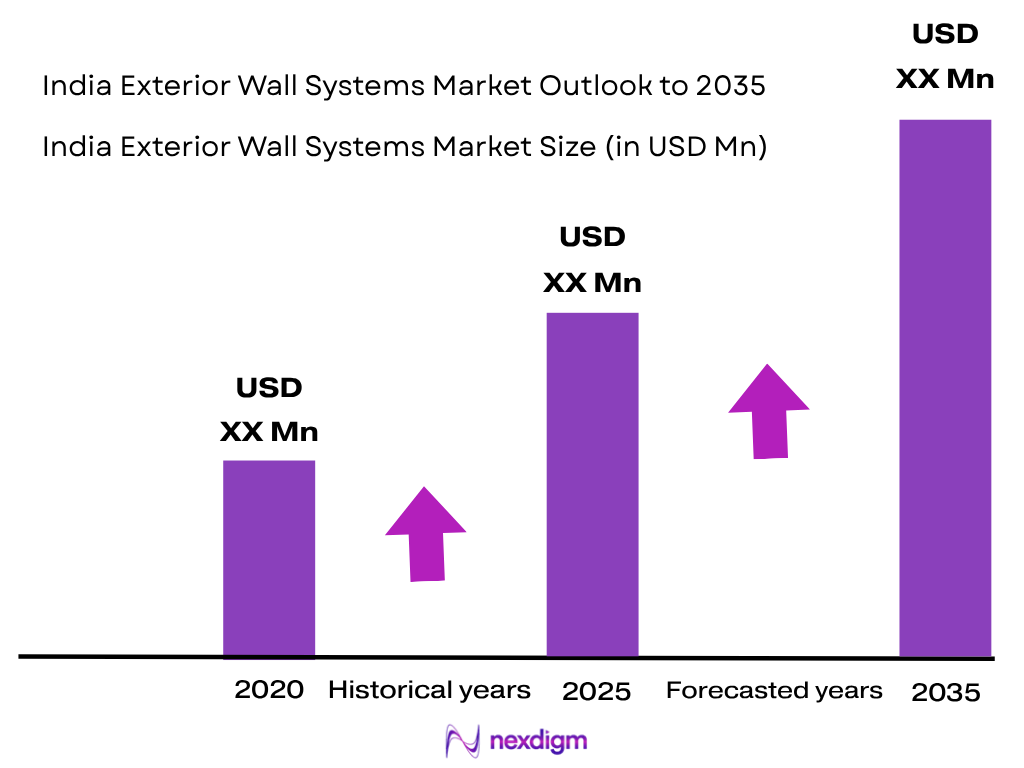
The India Exterior Wall Systems Market is supported by expanding commercial, residential and infrastructure construction, together with increasing requirements for thermal performance, weather protection, architectural appearance and energy efficiency. The broader Indian façade market was reported at USD 2.8554 billion in 2023 and at approximately USD 3.0605 billion in FY2024-25. The market encompasses glass, aluminium, steel, stone, concrete, metal and other facade materials, with demand strengthened by commercial-space development, remodeling, public infrastructure upgrades and energy-efficient building requirements.
India’s exterior wall systems demand is concentrated around major commercial and construction centers, particularly Bengaluru, Hyderabad, Mumbai, Delhi-NCR, Pune and Chennai. These markets combine large office developments, technology campuses, residential towers, hospitality projects and infrastructure construction. India’s office market recorded 79.0 million sq. ft. of gross absorption in 2024, while new office supply reached 52.3 million sq. ft. Bengaluru, Hyderabad and Pune together accounted for 67% of new supply additions. This concentration supports demand for advanced curtain walls, glazing, cladding and building-envelope systems.
Market Segmentation
By System Type
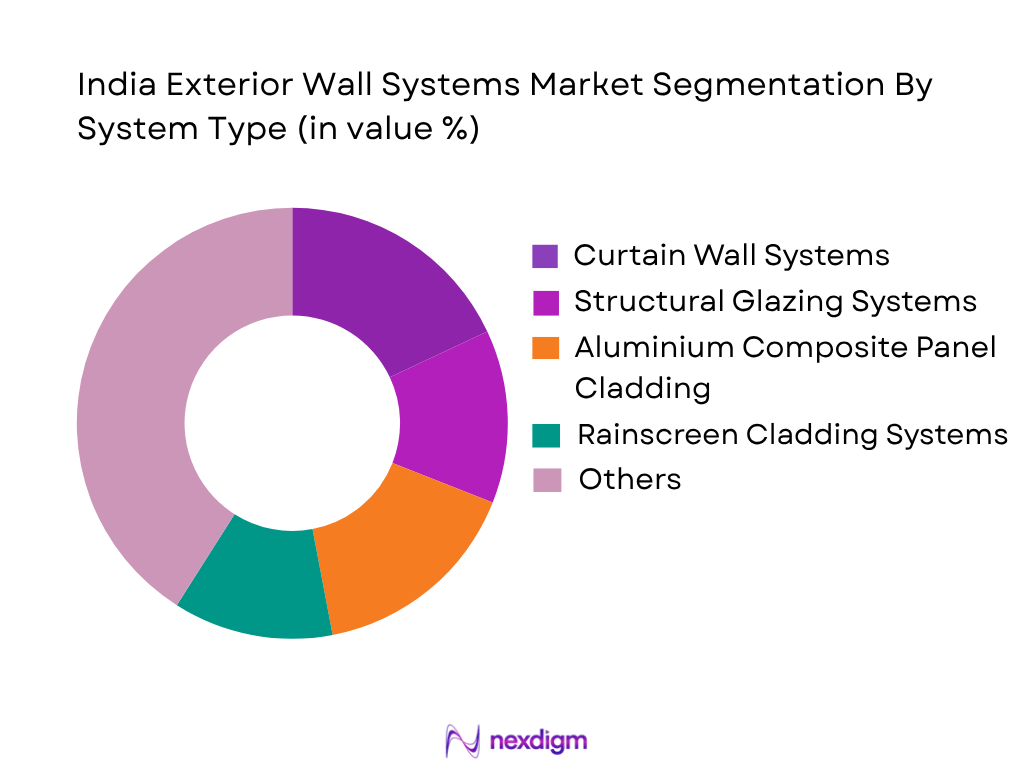
The India Exterior Wall Systems Market is segmented into curtain wall systems, structural glazing systems, aluminium composite panel cladding, rainscreen cladding systems, insulated sandwich wall panels, precast exterior wall systems, EIFS and render systems, fibre cement cladding, HPL and compact laminate cladding, stone and terracotta cladding, metal wall cladding, and GRC and architectural composite facades. Ventilated facade systems represent the leading category in the broader Indian façade market because they provide an air cavity that assists moisture management and can improve thermal behavior. Available market data identifies ventilated facades as the largest product category, with a 48.37% revenue share in 2025 in one published dataset. Their relevance is strengthened by India’s varied climatic conditions, including high heat, monsoon exposure and humidity. Curtain walls and structural glazing remain particularly important for Grade-A offices, hotels and high-rise commercial buildings, while ACP, metal, fibre-cement and stone systems serve a wider range of residential, commercial and institutional projects.
By Application
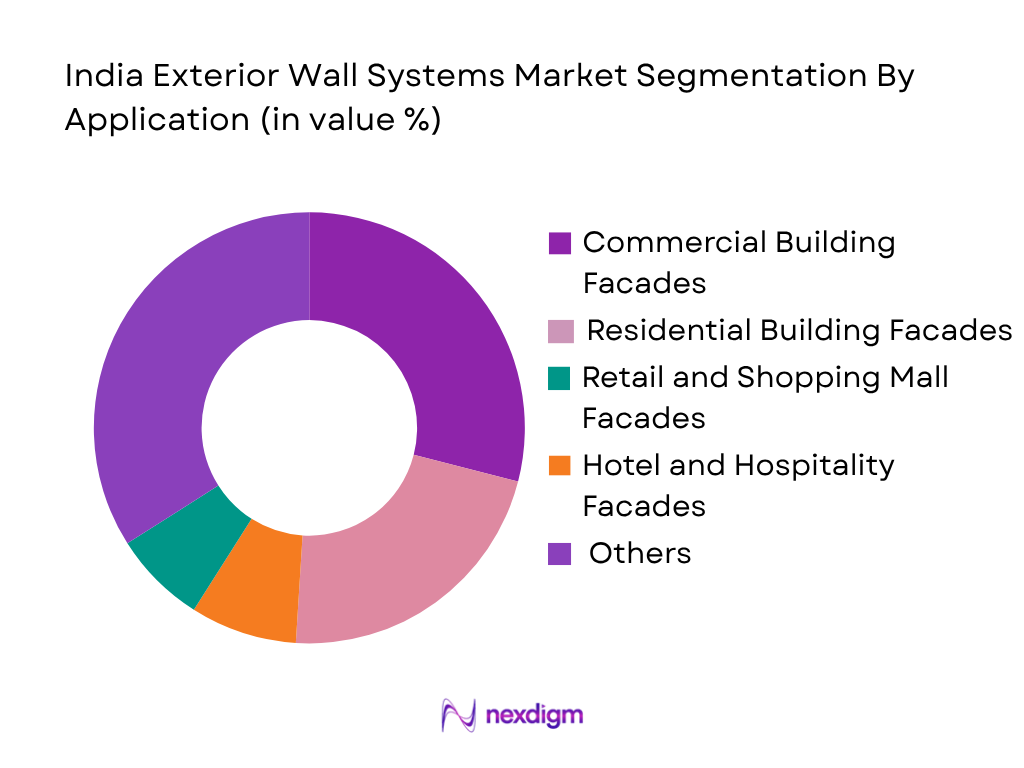
The India Exterior Wall Systems Market is segmented into commercial building facades, residential building facades, retail and shopping mall facades, hotel and hospitality facades, healthcare building facades, educational building facades, industrial and manufacturing building facades, warehouse and logistics building facades, data center facades, airport and transportation infrastructure facades, government and institutional building facades, and renovation and building retrofit facades. Commercial building facades represent the leading application because office towers, technology campuses, shopping centers, hotels and Grade-A developments commonly require extensive curtain walls, glazing, ACP, aluminium and other engineered envelope systems. India’s office market recorded 79.0 million sq. ft. of gross absorption in 2024, while 52.3 million sq. ft. of new office supply was added. Commercial projects therefore create substantial recurring demand for high-performance facade systems. Residential towers form another major application as developers increasingly differentiate projects through external aesthetics, balconies, glazing and premium cladding. Industrial, logistics and data-center facilities create demand for insulated and metal wall systems, while airports, metro facilities, hospitals and government buildings support specialized exterior-envelope requirements.
Competitive Landscape
The competitive landscape consists of international building-material manufacturers, facade-system suppliers, aluminium and glass companies, specialist facade contractors and domestic system integrators. Competition is differentiated by system engineering capability, material portfolio, fabrication capacity, project execution, fire and structural performance, energy-efficiency characteristics and relationships with architects, developers and contractors. The market includes companies involved in glass, aluminium, cladding, insulation, curtain-wall engineering and complete facade execution.
| Company | Establishment | Headquarters | Core Exterior Material | Principal Exterior Offering | Key End Markets | Manufacturing / India Presence | Performance Focus | Competitive Positioning |
| Saint-Gobain India | 1996 | Chennai, India | ~ | ~ | ~ | ~ | ~ | ~ |
| Tata BlueScope Steel | 2005 | Pune, India | ~ | ~ | ~ | ~ | ~ | ~ |
| Hindalco Industries | 1958 | Mumbai, India | ~ | ~ | ~ | ~ | ~ | ~ |
| Jindal Aluminium | 1968 | Bengaluru, India | ~ | ~ | ~ | ~ | ~ | ~ |
| Hunter Douglas India | 1970s | Mumbai, India | ~ | ~ | ~ | ~ | ~ | ~ |
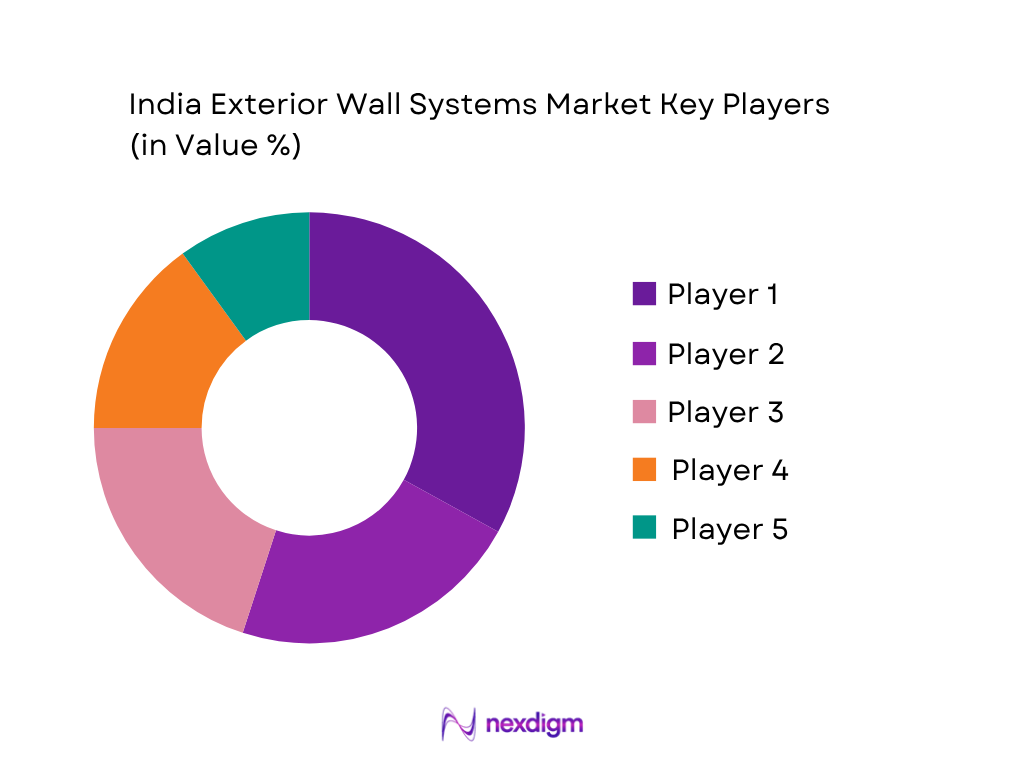
India Exterior Wall Systems Market Analysis
Growth Drivers
Expansion of Residential and Urban Construction
The expansion of residential construction is creating a broad project pipeline for exterior wall systems, particularly cladding, plaster-based systems, insulation assemblies, glazing and architectural facade solutions. The Government of India reported that 118.64 lakh houses had been sanctioned under PMAY-U, with 114.33 lakh houses grounded and 85.04 lakh houses completed as of July 2024. The government also announced PMAY-U 2.0 with an investment framework of ₹10 lakh crore to address the housing requirements of 1 crore urban families. This creates recurring requirements for exterior-envelope materials across new housing and associated urban infrastructure. The broader construction ecosystem is also significant: World Bank data places India’s industry, including construction, at 24.6 of GDP in 2024, while the IMF reported real GDP growth of 6.5 for 2024/25. These conditions support construction activity across residential, commercial and institutional projects. For exterior wall-system suppliers, the resulting demand extends beyond structural construction to weather protection, thermal performance, aesthetics and durability. Large housing programmes therefore provide a substantial base for standardized, prefabricated and cost-efficient facade systems.
Infrastructure Investment and Commercial Building Development
Infrastructure investment and commercial construction provide another important demand channel for India’s exterior wall systems because airports, offices, hospitals, transport facilities, industrial buildings and public infrastructure increasingly require engineered building envelopes. India’s Economic Survey reported that Union Government capital expenditure reached ₹9.5 lakh crore in FY2024, while total Union Government capital expenditure plus grants for creation of capital assets and public-enterprise resources reached ₹15.8 lakh crore. The Survey also recorded ₹79,000 crore of net bank-credit flows to infrastructure sectors between March 2023 and March 2024, while external commercial borrowing inflows to infrastructure sectors reached USD 9.05 billion in FY2024. The Union Budget subsequently allocated ₹11,11,111 crore for capital expenditure in FY2024-25. These investment flows support projects requiring facade assemblies, curtain walls, metal cladding, insulated panels, glazing and architectural exterior systems. Building-energy requirements further strengthen the technical role of exterior envelopes: BEE’s ECBC framework applies to commercial buildings with connected loads of 100 kW or contract demand of 120 kVA or more and addresses opaque walls, fenestration, roofs and envelope sealing.
Market Challenges
Construction Cost and Material-Cycle Volatility
Material-cost volatility remains a challenge for India’s Exterior Wall Systems Market because facade assemblies commonly combine aluminium, steel, glass, insulation, cementitious materials, coatings, fasteners and specialized hardware. Changes in construction-sector input conditions can therefore affect project budgets, procurement schedules and contractor margins. The IMF reported India’s consumer-price inflation at 4.8 for 2024/25, compared with 5.4 in 2023/24, indicating that price pressures remained relevant even as inflation moderated. At the broader macroeconomic level, the World Bank recorded industry including construction at 24.6 of GDP in 2024, illustrating the scale of economic activity exposed to construction input cycles. Infrastructure financing conditions also matter: the Economic Survey recorded only ₹79,000 crore of net bank-credit flow to infrastructure sectors between March 2023 and March 2024, while external commercial borrowing inflows reached USD 9.05 billion. For facade contractors, developers and system suppliers, these conditions can complicate long-duration procurement decisions, especially where projects require imported or specialized components. The challenge is particularly relevant for projects with fixed contractual budgets, long construction schedules and multiple subcontractors because changes in material availability can influence system selection, installation sequencing and project completion timelines.
Skilled Installation and Building-Envelope Execution Constraints
Exterior wall systems require specialized design, fabrication and installation capabilities, making workforce availability and execution quality important constraints. India’s construction sector employed approximately 7.47 crore workers in 2022/23 according to RBI KLEMS data cited by the Ministry of Labour and Employment, demonstrating the scale of the construction workforce but also the industry’s dependence on large numbers of site workers. Government data further shows that construction represented 12 of employment in the 2023-24 PLFS framework. At the same time, exterior wall systems involve specialized activities such as facade anchoring, sealant application, glazing, insulation installation, waterproofing, panel alignment and structural-interface coordination. Errors in these activities can affect water resistance, thermal performance, air leakage, appearance and long-term durability. India’s building-envelope requirements are also becoming more technically structured. BEE’s ECBC framework addresses opaque walls, vertical fenestration, skylights, roof assemblies and envelope sealing, while the newer sustainable-building framework incorporates building-envelope considerations across different building-performance requirements. Consequently, contractors increasingly need workers capable of interpreting detailed facade drawings, coordinating interfaces and executing systems consistently. This raises the importance of installer training, quality-control procedures, digital coordination and standardized installation practices across India’s geographically dispersed construction projects.
Market Opportunities
Energy-Efficient and High-Performance Building Envelopes
The transition toward higher-performing buildings creates an opportunity for exterior wall-system manufacturers to develop products combining thermal insulation, solar control, weather resistance and architectural functionality. India’s Bureau of Energy Efficiency applies envelope-related requirements to commercial buildings with connected loads of 100 kW or contract demand of 120 kVA or more. The ECBC framework specifically addresses opaque construction materials, thermal conductivity, specific heat, density, thickness, fenestration U-factors, solar heat-gain coefficients, visible-light transmittance and envelope sealing. BEE also identifies 5 climate zones in India’s building-energy framework, making climate-responsive facade design particularly relevant. Its ECBC programme currently identifies 117 buildings across 24 states at discussion, design, construction or completed stages under ECBC guidelines. These requirements create opportunities for insulated facade systems, high-performance glazing, ventilated facades, reflective surfaces, thermal-break systems and other envelope technologies that can improve building performance. The opportunity extends beyond new construction because existing commercial buildings can require facade renovation, glazing upgrades, insulation improvements and envelope remediation. As developers and building owners increasingly evaluate operational performance alongside appearance, exterior wall systems can evolve from primarily architectural components into integrated building-performance solutions.
Large-Scale Housing and Urban Development Projects
Large housing and urban-development programmes create an opportunity for standardized exterior wall systems that can be produced, transported and installed efficiently across multiple projects. PMAY-U had 118.64 lakh houses sanctioned, 114.33 lakh houses grounded and 85.04 lakh houses completed as of July 2024, while PMAY-U 2.0 was announced with an investment framework of ₹10 lakh crore targeting 1 crore urban families. The Union Budget also allocated ₹11,11,111 crore for capital expenditure in FY2024-25, reinforcing the wider infrastructure and urban-development pipeline. These programmes can support demand for durable, standardized and rapidly installable wall-envelope solutions across residential complexes, affordable housing, institutional facilities and supporting infrastructure. The opportunity is particularly relevant to systems that reduce site labour requirements while maintaining weather resistance, fire performance, thermal performance and installation consistency. India’s geographically diverse construction environment also creates scope for products adapted to different climatic conditions, including hot-dry, warm-humid, composite, temperate and cold zones recognized within India’s building-energy framework. Manufacturers that combine modular design, local fabrication, lightweight materials and standardized installation methods can therefore address the requirements of large multi-building developments while reducing execution complexity and improving project-level consistency.
Future Outlook
The India Exterior Wall Systems Market is positioned for continued development as commercial real estate, residential construction, industrial facilities, transportation infrastructure and specialized assets require increasingly engineered building envelopes. Demand is expected to move toward systems that combine architectural appearance with thermal insulation, solar control, fire performance, weather resistance and lower maintenance requirements. Commercial office development is particularly relevant because India recorded 79.0 million sq. ft. of office absorption and 52.3 million sq. ft. of new supply in 2024. Green-certified and investment-grade buildings are also supporting greater attention to facade performance and material selection.
Major Players
- Saint-Gobain India
- Tata BlueScope Steel
- Hindalco Industries
- Jindal Aluminium
- Alstrong Enterprises
- Aludecor
- VIVA Composite Panel
- Everest Industries
- ArcelorMittal Building Solutions India
- Hunter Douglas India
- Schüco India
- Kawneer India
- Glass Wall Systems India
- FunderMax India
- Umiya Facade Systems
Key Target Audience
- Real Estate Developers and Property Development Companies
- Commercial Building Owners and Operators
- Facade Contractors and Building Envelope Specialists
- Aluminium, Glass and Cladding Manufacturers
- Architectural and Facade Engineering Procurement Teams
- Investments and Venture Capitalist Firms
- Government and Regulatory Bodies (Bureau of Indian Standards, Ministry of Housing and Urban Affairs, Bureau of Energy Efficiency)
- Infrastructure and Public-Works Project Developers
Research Methodology
Step 1: Identification of Key Variables
The initial phase involves constructing an ecosystem map covering facade manufacturers, material suppliers, system designers, fabricators, contractors, developers, architects and building owners. Secondary research is used to identify system categories, material flows, application areas, construction activity and regional demand variables. The objective is to establish the operating boundaries of the India Exterior Wall Systems Market.
Step 2: Market Analysis and Construction
Historical market information is compiled across facade system types, materials, applications, building categories and geographic markets. Construction activity, commercial development, residential projects, infrastructure projects and building-envelope specifications are assessed to identify demand-generating variables. Revenue and installation activity are then organized through a consistent market-sizing framework.
Step 3: Hypothesis Validation and Expert Consultation
Market hypotheses are validated through discussions with facade contractors, manufacturers, architects, developers, material suppliers and building-envelope specialists. Interviews focus on system selection, project specifications, fabrication capacity, installation practices, material preferences and procurement behavior. These inputs are used to test assumptions and identify differences between nominal demand and executed facade installations.
Step 4: Research Synthesis and Final Output
The final stage integrates demand-side and supply-side findings into a consolidated market model. Segment-level results are cross-checked against construction activity, company disclosures, project pipelines and available industry statistics. The resulting analysis provides a structured assessment of system adoption, application demand, competitive positioning and future market development.

- Executive Summary
- Research Methodology (Market Definition and Scope, India Exterior Wall Systems Market Classification, Exterior Wall System Technology Mapping, Curtain Wall Assessment, Structural Glazing Assessment, Aluminium Composite Panel Assessment, Rainscreen Cladding Assessment, Insulated Wall System Assessment, Fibre Cement Cladding Assessment, HPL Cladding Assessment, Stone Cladding Assessment, Metal Cladding Assessment, GRC Facade Assessment, Glass Facade Assessment, Thermal Performance Assessment, Fire Performance Assessment, Acoustic Performance Assessment, Wind-Load Performance Assessment, Weather Resistance Assessment, Installation Methodology Assessment, Facade Fabrication Assessment, Building Envelope Engineering Assessment, Supply-Side Assessment, Demand-Side Assessment, Top-Down Market Sizing, Bottom-Up Market Sizing, Primary Industry Interviews, Data Triangulation, Forecasting Framework)

- Definition and Scope
- India Exterior Wall Systems Industry Evolution and Development of Curtain Wall Systems, Structural Glazing, Aluminium Composite Panel Facades, Rainscreen Cladding, Fibre Cement Cladding, HPL Cladding, Stone Cladding, Metal Cladding, Glass Facades, Insulated Sandwich Wall Panels, EIFS and Render Systems, Precast Exterior Wall Systems, GRC Facades, Louvers and Solar-Shading Systems, Unitized Facades, Stick-Built Facades, Double-Skin Facades, Prefabricated Facade Systems, Energy-Efficient Building Envelope Technologies
- Exterior Wall Systems Value Chain Analysis
- Exterior Wall Systems Supply Chain Analysis
- Aluminium Suppliers, Glass Manufacturers, Insulation Material Suppliers, Fibre Cement Manufacturers, HPL Manufacturers, ACP Manufacturers, Metal Cladding Manufacturers, Sealant and Adhesive Suppliers, Structural Framing Suppliers, Fastener Manufacturers, Facade Engineering Companies, System Designers, Facade Fabricators, Facade Contractors, Installation Contractors, Architects, Developers, General Contractors, Real Estate Companies, Infrastructure Developers, Government Construction Agencies

- Growth Drivers (Commercial Building Development, Urban Residential Construction, Grade-A Office Space Expansion, Data Center Construction, Airport and Transportation Infrastructure Development, Building Energy-Efficiency Requirements, Lightweight Facade Adoption, High-Performance Building Envelope Demand, Premium Commercial Facade Development)
- Market Challenges (High Installation Requirements, Skilled Facade Installation Constraints, Imported Material Dependency, Fire-Safety Compliance Requirements, Structural and Wind-Load Engineering Complexity, Supply Chain Volatility, Maintenance Requirements, Project Execution Delays, Design Coordination Challenges)
- Market Opportunities (Energy-Efficient Building Envelopes, High-Performance Curtain Walls, Insulated Exterior Wall Systems, Fire-Rated ACP and Metal Cladding, Sustainable Facade Materials, Green Building Development, Data Center Facades, Healthcare and Institutional Construction, Rainscreen System Adoption, Prefabricated Facade Systems, Smart Facade Technologies, Solar-Shading Integration)
- Market Trends (Unitized Curtain Wall Adoption, Fire-Rated ACP Adoption, Energy-Efficient Glazing, Rainscreen Facade Adoption, Lightweight Cladding Systems, Prefabricated Facade Components, Building Envelope Optimization, Integrated Solar Shading, Low-Maintenance Exterior Materials, Sustainable Facade Materials, BIM-Based Facade Design, High-Performance Insulation Systems)
- Government Regulations and Standards (National Building Code of India, Energy Conservation Building Code, Eco-Niwas Samhita, Bureau of Indian Standards Facade Standards, Fire Safety Requirements, Structural Safety Requirements, Wind-Load Standards, Thermal Performance Requirements, Energy-Efficiency Compliance, Green Building Requirements, State Building Regulations, Municipal Development Regulations)
- SWOT Analysis
- Porter’s Five Forces Analysis
- PESTLE Analysis
- Stakeholder Ecosystem
- Competition Ecosystem

- By Market Value (2020-2025)
- By Exterior Wall System Installation Area (2020-2025)
- By Exterior Wall Cladding Volume (2020-2025)
- By Curtain Wall Installation Area (2020-2025)
- By Aluminium Composite Panel Consumption Volume (2020-2025)
- By Glass Facade Installation Area (2020-2025)
- By Insulated Wall Panel Installation Area (2020-2025)
- By Metal Cladding Consumption Volume (2020-2025)
- By Exterior Wall System Project Count (2020-2025)
- By Average Selling Price per Square Meter (2020-2025)

- By System Type (In Value %)
Curtain Wall Systems
Structural Glazing Systems
Aluminium Composite Panel Cladding
Rainscreen Cladding Systems
Insulated Sandwich Wall Panels
Precast Exterior Wall Systems
EIFS and Render Systems
Fibre Cement Cladding
HPL and Compact Laminate Cladding
Stone and Terracotta Cladding
Metal Wall Cladding
GRC and Architectural Composite Facades - By Material Type (In Value %)
Aluminium
Glass
Steel
Fibre Cement
HPL
Natural Stone
Terracotta
GRC
Concrete
Insulation Materials - By Building Type (In Value %)
Commercial Office Buildings
Residential Buildings
Retail and Shopping Malls
Hotels and Hospitality Buildings
Healthcare Facilities
Educational Buildings
Industrial and Manufacturing Facilities
Warehouses and Logistics Facilities
Data Centers
Airports and Transportation Buildings
Government and Institutional Buildings - By Application (In Value %)
Commercial Building Facades
Residential Building Facades
Retail and Shopping Mall Facades
Hotel and Hospitality Facades
Healthcare Building Facades
Educational Building Facades
Industrial and Manufacturing Building Facades
Warehouse and Logistics Building Facades
Data Center Facades
Airport and Transportation Infrastructure Facades
Government and Institutional Building Facades
Renovation and Building Retrofit Facades - By Geography (In Value %)
North India
South India
West India
East India
Delhi NCR
Mumbai Metropolitan Region
Bengaluru
Chennai
Hyderabad
Pune
Ahmedabad
Kolkata
Rest of India

- Market Share of Major Players (By Revenue, Installed Facade Area, Curtain Wall Installation Volume, ACP Panel Sales, Glass Facade Volume, Cladding System Portfolio, Manufacturing Capacity, Project Execution Capacity, Dealer and Distributor Network, Facade Engineering Capability, Fire-Rated Product Portfolio, Energy-Efficient Facade Portfolio, Aftermarket and Maintenance Services)
- Cross Comparison Parameters (Exterior Wall System Portfolio Breadth, Curtain Wall Engineering Capability, ACP and Metal Cladding Portfolio, Fire-Rated Facade Capability, Thermal Performance Capability, Facade Manufacturing Capacity, Installation and Project Execution Network, Building
- Envelope Engineering and Design Capability)
- SWOT Analysis of Major Players
- Competitive Positioning Matrix
- Exterior Wall System Technology and Application Benchmarking
- Facade Material and System Performance Assessment
- Thermal and Energy-Efficiency Performance Assessment
- Fire Safety and Building Envelope Compliance Assessment
- Wind-Load and Structural Performance Assessment
- Facade Fabrication and Installation Capability Assessment
- India Manufacturing Capability and Distribution Assessment
- Major Companies
Saint-Gobain India
Tata BlueScope Steel
Hindalco Industries
Jindal Aluminium
Alstrong Enterprises
Aludecor
VIVA Composite Panel
Eternit Everest
ArcelorMittal Building Solutions India
Hunter Douglas India
Schueco India
Kawneer India
Glass Wall Systems India
FunderMax India
Umiya Facade Systems

- Real Estate Developer Facade Requirement Assessment
- Commercial Building Developer Demand Analysis
- Residential Developer Exterior Wall Requirement Assessment
- Architect and Facade Consultant Specification Assessment
- General Contractor Procurement Assessment
- Infrastructure Developer Facade Requirement Assessment
- Industrial and Warehouse Building Requirement Assessment
- Data Center Exterior Wall Requirement Assessment
- Healthcare and Institutional Building Requirement Assessment
- Government and Public Infrastructure Facade Requirement Assessment
- Building Performance Requirement Assessment (Thermal Insulation, Fire Resistance, Acoustic Performance, Wind Resistance, Weather Resistance, Solar Heat Gain Control, Daylight Transmission, Air Tightness, Water Tightness, Durability, Maintenance Requirements

- By Market Value (2026-2035)
- By Exterior Wall System Installation Area (2026-2035)
- By Exterior Wall Cladding Volume (2026-2035)
- By Curtain Wall Installation Area (2026-2035)
- By Aluminium Composite Panel Consumption Volume (2026-2035)
- By Glass Facade Installation Area (2026-2035)
- By Insulated Wall Panel Installation Area (2026-2035)
- By Metal Cladding Consumption Volume (2026-2035)
- By Energy-Efficient Exterior Wall System Installation Area (2026-2035)
- By Fire-Rated Exterior Wall System Volume (2026-2035)
- By Data Center Exterior Wall System Installation Area (2026-2035)
- By Prefabricated Facade System Installation Area (2026-2035)


 Request a Sample
 Ask for Customization
 Get a Quote
 Enquire Now