
 Download PDF
Market Overview
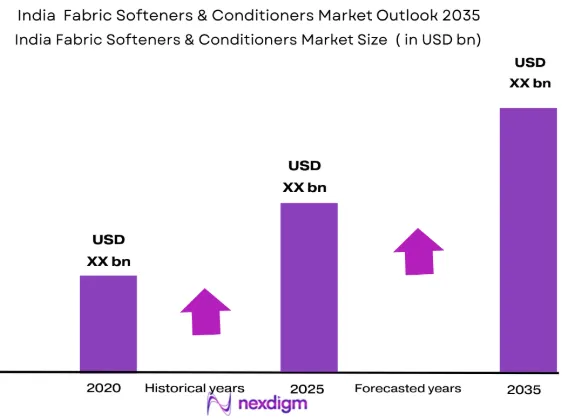
The India fabric softeners and conditioners market has reached a value of approximately USD ~ billion based on a recent historical assessment, driven by increasing consumer awareness of fabric care, rising disposable incomes, and expanding urbanization across major metropolitan regions. Growth is further supported by the proliferation of modern retail formats, aggressive brand marketing by multinational companies, and the rising preference for premium household care products that offer fragrance, softness, and long-lasting freshness benefits.
Major urban centers such as Mumbai, Delhi NCR, Bengaluru, and Chennai dominate the market due to higher purchasing power, greater product awareness, and well-developed retail infrastructure. These cities exhibit strong adoption of branded and premium fabric conditioners owing to lifestyle shifts and exposure to global consumer trends. Additionally, tier I cities benefit from deeper penetration of organized retail and e-commerce platforms, which enhances product accessibility and drives consistent consumer demand.
Market Segmentation
By Product Type
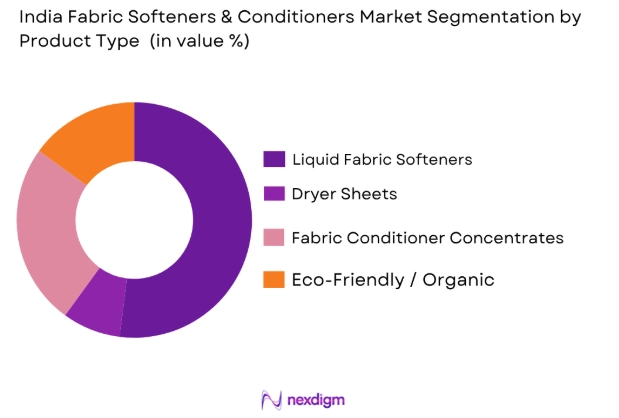
India fabric softeners and conditioners market is segmented by product type into liquid fabric softeners, dryer sheets, fabric conditioner concentrates, and eco-friendly or organic softeners. Recently, liquid fabric softeners has a dominant market share due to factors such as widespread consumer familiarity, ease of use, compatibility with both hand and machine washing, and strong brand presence across urban and semi-urban regions. These products are heavily marketed through television and digital platforms, making them more recognizable and trusted among consumers. Additionally, liquid formats offer superior fragrance retention and softness compared to other variants, making them highly preferred. Increasing penetration of washing machines in Indian households further supports their dominance, as liquid softeners are specifically designed for such usage. The availability of multiple price points and pack sizes also allows brands to target diverse income groups, thereby reinforcing their leading position.
By Distribution Channel
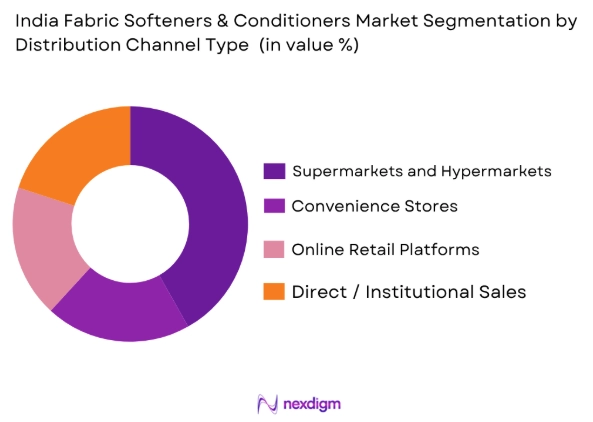
India fabric softeners and conditioners market is segmented by distribution channel into supermarkets and hypermarkets, convenience stores, online retail platforms, and direct or institutional sales. Recently, supermarkets and hypermarkets has a dominant market share due to factors such as wide product assortment, strong visibility, and consumer trust in organized retail environments. These retail formats allow customers to physically compare brands, fragrances, and pricing, which significantly influences purchasing decisions. Promotional discounts, bundling strategies, and in-store marketing campaigns further enhance sales volumes. Moreover, supermarkets serve as primary shopping destinations for urban consumers purchasing household essentials in bulk. The presence of leading brands and premium product lines in these stores strengthens their appeal. While e-commerce is growing rapidly, traditional retail still dominates due to habit-driven purchasing behavior and immediate product availability.
Competitive Landscape
The India fabric softeners and conditioners market is moderately consolidated, with a mix of multinational corporations and domestic players competing for market share. Leading companies leverage strong distribution networks, brand recognition, and continuous product innovation to maintain their positions. Global brands dominate premium segments, while local players focus on affordability and regional reach, creating a competitive balance between price and quality across segments.
| Company Name | Establishment Year | Headquarters | Technology Focus | Market Reach | Key Products | Revenue | Distribution Strength |
| Hindustan Unilever | 1933 | Mumbai | ~ | ~ | ~ | ~ | ~ |
| Procter & Gamble | 1837 | USA | ~ | ~ | ~ | ~ | ~ |
| Godrej Consumer | 2001 | Mumbai | ~ | ~ | ~ | ~ | ~ |
| Jyothy Labs | 1983 | Mumbai | ~ | ~ | ~ | ~ | ~ |
| Henkel India | 1876 | Germany | ~ | ~ | ~ | ~ | ~ |
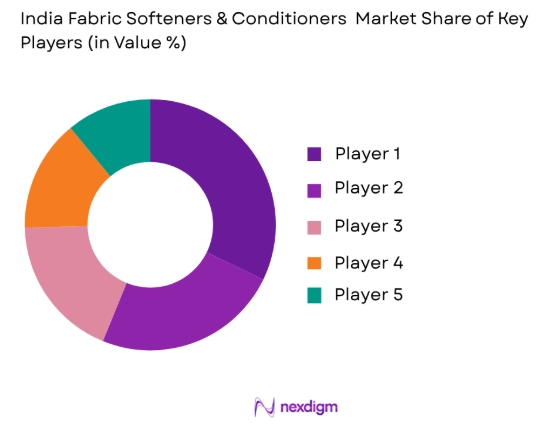
India Fabric Softeners & Conditioners Market Analysis
Growth Drivers
Increasing Awareness of Fabric Care and Hygiene
India’s rising awareness of hygiene and fabric care is strongly supported by macro-level improvements in sanitation and health indicators. According to the World Bank, access to basic sanitation services in India reached 78% of the population in recent assessments, up from 60% a decade earlier, reflecting a structural shift toward cleanliness and hygiene practices. Additionally, the Ministry of Jal Shakti reported that over 110 million households were covered under sanitation programs, improving exposure to hygiene-related behaviors. The National Family Health Survey (NFHS-5) indicates that over 89% of households now use improved water sources, reinforcing better washing practices. Increased awareness of hygiene directly correlates with higher adoption of value-added laundry products such as fabric conditioners. Urban literacy rates exceeding 77% (World Bank) also contribute to consumer understanding of product benefits. These developments collectively support the demand for fabric care solutions as hygiene awareness becomes embedded in daily routines across households.
Rising Disposable Income and Urbanization
India’s economic expansion and rapid urbanization are key drivers of fabric softener adoption. The World Bank reports India’s GDP at over USD 3.4 trillion, with per capita income crossing USD 2,400, indicating rising consumer purchasing power. The urban population has exceeded 520 million people, creating a large base of consumers with access to modern retail and appliances. According to the Ministry of Housing and Urban Affairs, over 35% of India’s population resides in urban areas, with increasing migration from rural regions. The Reserve Bank of India highlights steady growth in household financial savings exceeding USD 300 billion, reflecting higher spending capacity. Increased penetration of washing machines, supported by rising electricity access reaching 99% of households (World Bank), further boosts demand for fabric conditioners. Urban consumers are more inclined toward premium and convenience-oriented products, reinforcing market expansion. These macroeconomic indicators strongly validate the role of income growth and urbanization in driving the market.
Challenges
Price Sensitivity in Mass Market Segments
A major challenge for the India fabric softeners and conditioners market is the high level of price sensitivity among consumers, particularly in rural and lower-income segments. The World Bank reports that around 10% of India’s population still lives below the national poverty line, limiting discretionary spending on non-essential products. Additionally, rural consumption expenditure remains significantly lower, with the National Sample Survey Office (NSSO) indicating average monthly rural household spending below USD 150. Food expenditure accounts for over 50% of rural consumption, leaving limited room for premium household products. The Ministry of Statistics also highlights that inflation in essential goods continues to impact purchasing decisions. These economic constraints make fabric conditioners a secondary purchase compared to detergents. Furthermore, over 65% of India’s population resides in rural areas, where affordability remains a key concern. This widespread price sensitivity restricts market penetration and forces companies to focus on low-cost alternatives and smaller packaging formats.
Environmental Concerns Regarding Chemical Ingredients
Environmental awareness and regulatory pressure on chemical usage pose a significant challenge for the market. India generates over 3.5 million tonnes of plastic waste annually, as reported by the Central Pollution Control Board, increasing scrutiny on packaging and chemical-based products. The Ministry of Environment, Forest and Climate Change has implemented stricter regulations on hazardous substances under the Plastic Waste Management Rules. Additionally, India’s water pollution levels remain a concern, with over 70% of surface water reported as contaminated (NITI Aayog), raising questions about chemical discharge from household products. The World Bank also highlights increasing environmental compliance costs for manufacturers due to stricter sustainability norms. Consumers are becoming more conscious, with urban waste generation exceeding 150,000 tonnes per day, emphasizing the need for eco-friendly alternatives. These factors compel companies to invest in sustainable formulations, increasing operational complexity and cost pressures while maintaining product effectiveness.
Opportunities
Expansion in Tier II and Tier III Cities
Tier II and Tier III cities present a strong growth opportunity for the India fabric softeners and conditioners market, supported by improving economic and infrastructure indicators. The Ministry of Statistics reports that India’s urban population is expanding rapidly, with over 40% of new urban growth coming from smaller cities. Government initiatives such as the Smart Cities Mission have allocated over USD 25 billion for urban development, improving retail infrastructure and consumer access. Additionally, internet penetration in India has crossed 850 million users (Telecom Regulatory Authority of India), enabling product awareness and online purchasing in smaller towns. The World Bank notes that electricity access has reached nearly 99% of households, facilitating the adoption of appliances like washing machines. Rising household incomes in non-metro areas, supported by economic growth, further enhance purchasing capacity. These factors collectively create a favorable environment for expanding fabric conditioner usage beyond metropolitan regions.
Growth in Eco-Friendly and Sustainable Products
The shift toward sustainability offers a significant opportunity for the market, driven by environmental awareness and regulatory support. India has committed to reducing carbon emissions intensity by 45% under its climate goals, as reported by the Government of India, encouraging industries to adopt eco-friendly practices. The Ministry of Environment highlights increasing adoption of biodegradable materials and green chemistry in manufacturing processes. Additionally, renewable energy capacity in India has exceeded 180 GW, indicating a broader shift toward sustainability across industries. Urban consumers are increasingly aligned with these trends, supported by rising education levels and environmental awareness. The World Bank also reports growing investments in sustainable development initiatives, exceeding USD 10 billion annually in recent years. These macroeconomic and policy-driven factors create a strong foundation for the development of eco-friendly fabric conditioners, enabling companies to innovate and cater to evolving consumer preferences while aligning with national sustainability goals.
Future Outlook
The India fabric softeners and conditioners market is expected to witness steady growth over the next five years, driven by increasing consumer awareness, rising urbanization, and expanding retail infrastructure. Technological advancements in product formulations, including eco-friendly and concentrated variants, will play a key role in shaping market dynamics. Regulatory support for sustainable products is likely to encourage innovation and compliance. Additionally, growing demand from tier II and tier III cities will significantly contribute to market expansion.
Major Players
- Hindustan Unilever
- Procter & Gamble
- Godrej Consumer Products
- Jyothy Labs
- Henkel India
- Reckitt Benckiser
- Nirma Limited
- Patanjali Ayurved
- RSPL Group
- Unilever Global
- Church & Dwight
- Lion Corporation
- Kao Corporation
- Colgate-Palmolive
- ITC Limited
Key Target Audience
- FMCG product manufacturers
- Household care brands
- Retail chain operators
- E-commerce platforms
- Distributors and wholesalers
- Investments and venture capitalist firms
- Government and regulatory bodies
- Packaging solution providers
Research Methodology
Step 1: Identification of Key Variables
Key variables influencing the market such as pricing trends, consumer behavior, distribution networks, and product innovation were identified through secondary research. Industry reports, company filings, and government publications were analyzed to determine relevant metrics.
Step 2: Market Analysis and Construction
The market was constructed using a bottom-up and top-down approach, integrating data from multiple sources. Historical consumption patterns and revenue data were used to estimate market size and segmentation.
Step 3: Hypothesis Validation and Expert Consultation
Findings were validated through consultations with industry experts, distributors, and market participants. Assumptions were refined based on expert insights and real-world market dynamics.
Step 4: Research Synthesis and Final Output
All collected data was synthesized into a structured report, ensuring consistency, accuracy, and clarity. Final outputs were reviewed for reliability and alignment with market realities.

- Executive Summary
- Research Methodology (Market Definitions and Assumptions, Abbreviations and Terminology, Data Sources and Validation Approach, India Fabric Softeners & Conditioners Market Sizing Methodology, Primary and Secondary Research Benchmarks, Market Reliability and Confidence Intervals)

- Industry Definition and Scope
- Market Genesis and Evolution in India
- Consumer Adoption Patterns
- Market Value Chain and Distribution Architecture
- Import and Export Dynamics

- Growth Drivers
Increasing Awareness of Fabric Care and Hygiene
Rising Disposable Income and Urbanization
Growing Demand for Fragrance and Long-Lasting Freshness
Expansion of Modern Retail and E-commerce Channels
Innovation in Eco-Friendly and Skin-Safe Products - Challenges
Price Sensitivity in Mass Market Segments
Volatility in Raw Material Costs
Competition from Low-Cost and Local Brands
Environmental Concerns Regarding Chemical Ingredients
Limited Awareness in Rural Areas - Opportunities
Expansion in Tier II and Tier III Cities
Growth in Eco-Friendly and Sustainable Products
Increasing Demand from Institutional Buyers
Product Innovation (Anti-Bacterial, Baby-Safe, Skin-Friendly)
Rising E-commerce and D2C Channels - Trends
Shift Toward Premium and Fragrance-Based Products
Growth of Liquid Fabric Softeners over Traditional Formats
Rising Popularity of Sustainable and Plant-Based Ingredients
Increased Influence of Digital Marketing and Brand Awareness
Compact and Concentrated Product Formats - Government Regulations
Standards for Household Cleaning and Fabric Care Products
Environmental Regulations on Chemical Ingredients
Packaging and Labeling Requirements
Import Regulations for Chemical-Based Products
Sustainability and Waste Management Policies - SWOT Analysis
- Porter’s Five Forces Analysis

- By Market Value, 2020–2025
- By Volume Consumption, 2020–2025
- By Per Capita Consumption, 2020–2025
- By Product Category Revenue Contribution, 2020–2025

- By Product Type (In Value %)
Liquid Fabric Softeners
Dryer Sheets
Fabric Conditioners (Concentrates)
Eco-Friendly / Organic Softeners - By Distribution Channel (In Value %)
Supermarkets and Hypermarkets
Convenience Stores
Online Retail / E-commerce Platforms
Direct Selling and Institutional Sales - By Consumer Demographic (In Value %)
Urban Households
Rural Households
Middle-Income Consumers
Premium Consumers
Institutional Buyers (Hotels, Hospitals, Laundries) - By Price Tier (In Value %)
Economy / Mass Segment
Mid-Range Segment
Premium Segment
Luxury / Imported Brands - By Region (In Value %)
North India
South India
East India
West India
Central India

- Market Share by Leading Brands
- Product Portfolio Comparison
- Distribution Network Strength
- Pricing Strategy Analysis
- Brand Positioning and Consumer Perception
- Company Profiles
Hindustan Unilever (Comfort)
Procter & Gamble (Downy)
Godrej Consumer Products
RSPL Group (Ghari)
Jyothy Labs
Patanjali Ayurved
Nirma Limited
Henkel India
Reckitt Benckiser
Local and Regional Brands

- Buying Decision Drivers
- Brand Loyalty and Switching Behavior
- Pricing Sensitivity and Value Perception
- Usage Patterns and Frequency
- Pain Points in Product Usage

- By Market Value, 2026–2035
- By Volume Consumption, 2026–2035
- By Per Capita Consumption, 2026–2035
- By Product Category Revenue Contribution, 2026–2035


 Request a Sample
 Ask for Customization
 Get a Quote
 Enquire Now