
 Download PDF
Market Overview
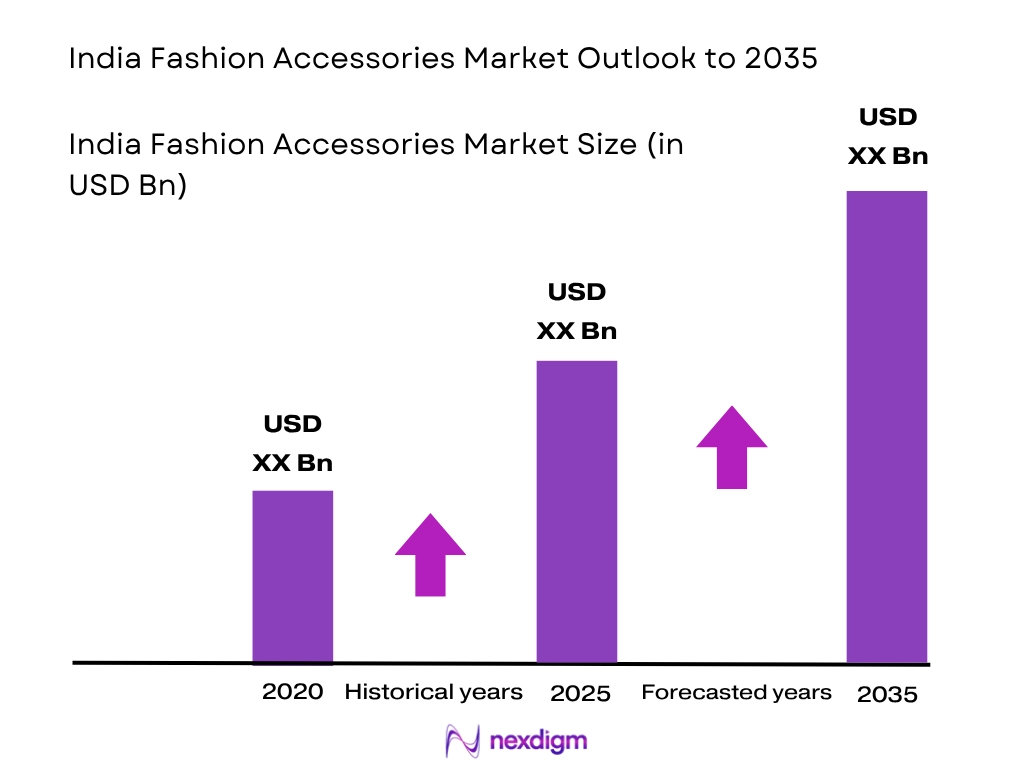
The India Fashion Accessories Market is valued at USD ~ billion, based on Nexdigm Research’s 2024 India fashion accessories databook, with jewelry the largest product segment at 51.56% of revenue. A wider India personal accessories benchmark, covering watches, fashion jewelry, handbags, wallets and lifestyle accessories, records a USD ~ billion value and a 9.40% CAGR for 2026–2035. Demand is driven by urban fashion adoption, D2C brands, organized retail, premiumization, and digital shopping behaviour. India’s e-retail GMV expanded from USD ~ billion in 2023 to around USD ~ billion in 2024, supporting online discovery and sales of accessories.
Mumbai, Delhi NCR, Bengaluru, Chennai, Hyderabad, Pune and Ahmedabad dominate the India Fashion Accessories Market due to stronger mall density, premium retail clusters, working-women participation, creator-led fashion consumption and higher exposure to global brands. India’s urban population reached about 513.3 million people in 2024, while the country had more than 270 million online shoppers in 2024, creating a large addressable base for handbags, eyewear, watches and fashion jewelry. Bengaluru and Chennai benefit from South India’s jewelry and premium-accessory culture, while Mumbai and Delhi NCR remain major fashion retail and luxury demand centres.
Market Segmentation
By Product Category
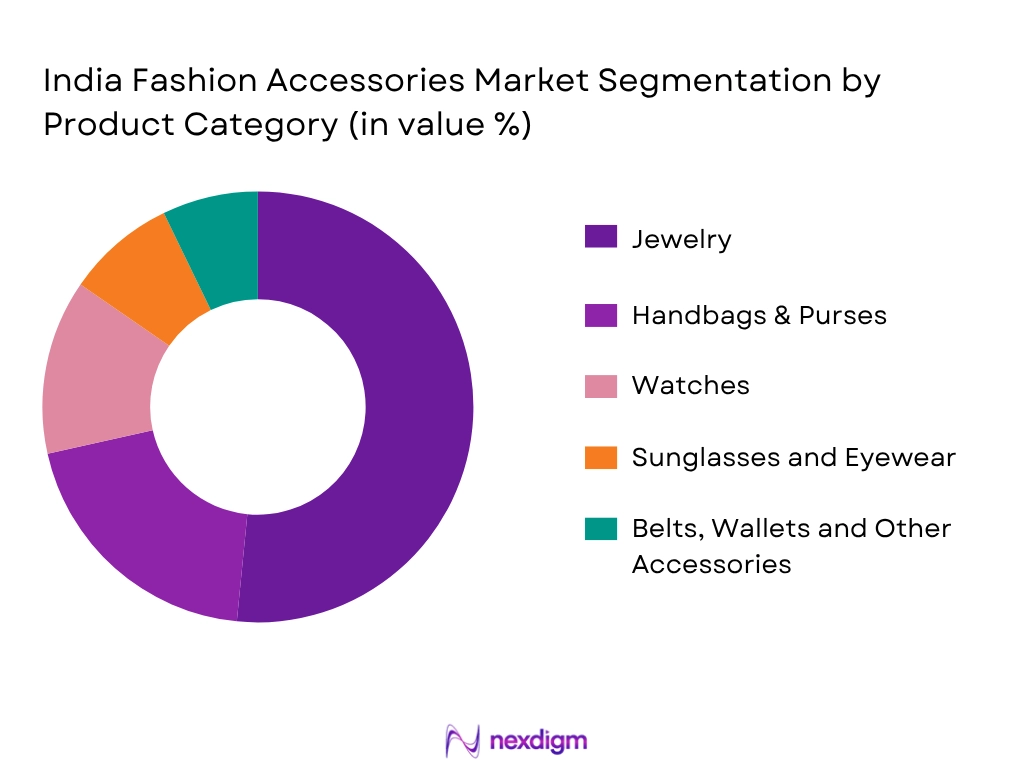
India Fashion Accessories Market is segmented by product type into jewelry, handbags and purses, watches, sunglasses and eyewear, and belts, wallets and other accessories. Recently, jewelry has held the dominant market share in India under the product type segmentation, due to its cultural relevance, high gifting intensity, wedding-led demand, daily-wear adoption and broad price architecture from imitation to demi-fine and branded jewelry. Nexdigm Research identifies jewelry as the largest segment in India fashion accessories with 51.56% revenue share, while other Insights separately notes strong handbag momentum within the market. The jewelry segment benefits from frequent purchase occasions, strong offline trust, growing online discovery, and the ability of brands to refresh SKUs quickly across festive, ethnic, minimalist and office-wear collections.
By Distribution Channel
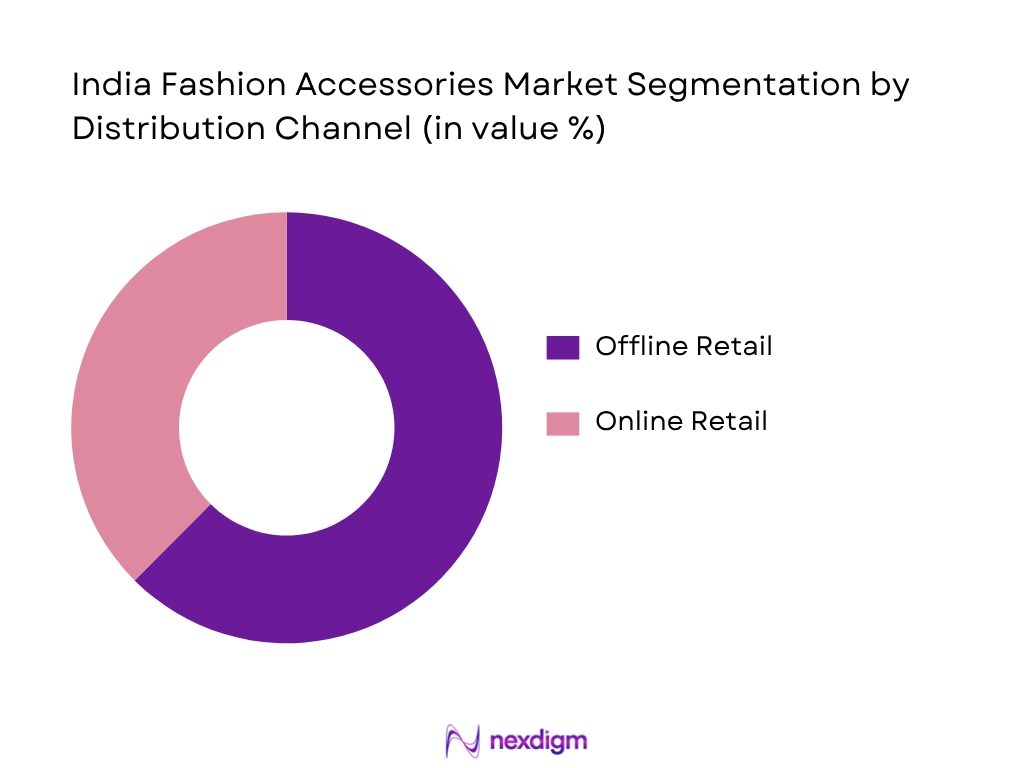
India Fashion Accessories Market is segmented by distribution channel into offline retail and online retail. Recently, offline retail has maintained the dominant market share in India under the distribution channel segmentation because accessories are tactile, style-sensitive and trust-led purchases. Consumers prefer trying sunglasses, assessing handbag material, checking jewelry finish and validating watch fit before purchase. Nexdigm reports offline revenue of USD ~ billion within the India fashion accessories market framework, while the total market value is USD ~ billion, implying offline leadership. Offline dominance is reinforced by exclusive brand outlets, mall stores, department stores, multi-brand retailers and jewelry-led purchase behaviour. However, online channels are scaling rapidly through Myntra, Amazon, Nykaa Fashion, Ajio, brand-owned websites, influencer commerce and D2C launches.
Competitive Landscape
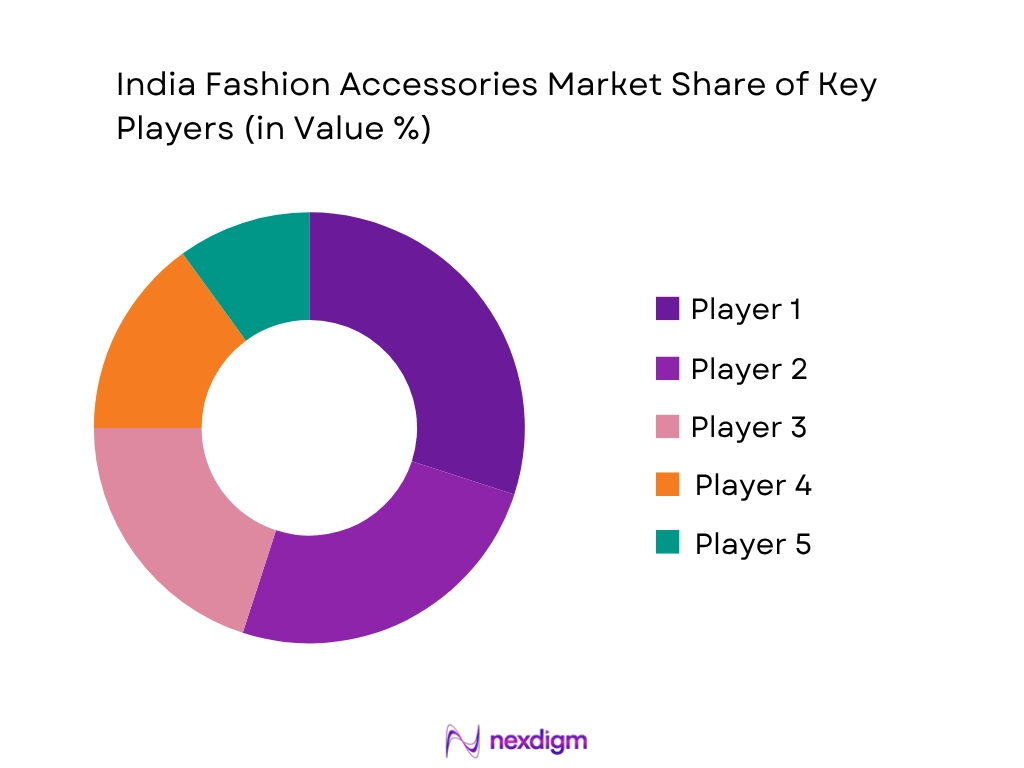
The India Fashion Accessories Market is fragmented across jewelry, eyewear, handbags, watches, small leather goods and lifestyle accessories, but organized leadership is concentrated among large omnichannel players and category specialists. Titan dominates through watches, jewelry and eyewear, Lenskart leads tech-enabled eyewear retail, while Baggit, Hidesign and Lavie compete strongly in handbags and wallets. Digital-first brands are increasing competitive intensity through fast design cycles, influencer marketing, vegan materials and marketplace-led scale.
| Player | Establishment Year | Headquarters | Core Accessory Category | Channel Strength | Price Positioning | Material / Product Focus | Omnichannel Presence | Market-Specific Differentiator |
| Titan Company Limited | 1984 | Bengaluru, Karnataka | ~ | ~ | ~ | ~ | ~ | ~ |
| Lenskart | 2010 / incorporated earlier as Valyoo Technologies | Gurugram, Haryana | ~ | ~ | ~ | ~ | ~ | ~ |
| Hidesign | 1978 | Puducherry | ~ | ~ | ~ | ~ | ~ | ~ |
| Baggit | 1990 | Mumbai, Maharashtra | ~ | ~ | ~ | ~ | ~ | ~ |
| Lavie | 2010 | Mumbai, Maharashtra | ~ | ~ | ~ | ~ | ~ | ~ |
India Fashion Accessories Market Analysis
Growth Drivers
Rising Disposable Income
Rising disposable income is strengthening India Fashion Accessories Market demand because accessories are discretionary products bought after essential consumption needs are met. India’s GDP reached USD 3.91 trillion and GDP per capita stood at USD 2,694.7, showing a broader income base for branded watches, handbags, eyewear, fashion jewelry, wallets and lifestyle accessories. At the domestic level, India’s per capita net national income at current prices reached INR 1,92,774, while per capita private final consumption expenditure reached INR1,27,627, indicating stronger consumer spending capacity for non-essential purchases such as premium handbags, sunglasses, belts, watches and occasion-led jewelry. Private final consumption expenditure also reported 7.2% real growth during FY 2024–25, compared with 5.6% in the previous fiscal year, supporting continued discretionary retail momentum. For fashion accessories brands, this creates stronger demand for mid-premium SKUs, gifting packs, office-wear accessories and occasion-specific products, particularly in urban and salaried consumer cohorts where fashion spending rises faster than staple consumption. The category benefits from lower entry barriers than luxury apparel, allowing consumers to upgrade identity and styling through smaller-ticket accessories.
Gen Z Fashion Consumption
Gen Z and young consumers are a core demand engine for the India Fashion Accessories Market because they use accessories for identity, social media styling, college wear, workwear transition and frequent wardrobe refresh. India has 371 million young people in the 15–29 age group, the largest such population base globally, creating a large addressable pool for fashion jewelry, sunglasses, phone accessories, smart wearables, caps, backpacks, wallets and affordable handbags. Digital access further supports discovery-led buying: TRAI recorded 954.40 million internet subscribers at the end of March 2024, rising to 970.16 million total internet subscribers at the end of December 2024. Urban internet subscribers reached 556.05 million, while rural internet subscribers reached 398.35 million at the end of March 2024, expanding fashion-accessory discovery beyond metro cities. This matters for accessory brands because Gen Z-led buying is strongly influenced by short-form content, celebrity styling, creator-led product drops, marketplace search and impulse gifting. In the fashion accessories category, small SKUs such as earrings, bracelets, sunglasses, hair accessories and phone accessories fit this behaviour because they are visually expressive, frequently refreshed and easy to sell through digital-first channels.
Market Challenges
Counterfeiting
Counterfeiting is a major challenge for the India Fashion Accessories Market because many leading categories of watches, footwear accessories, handbags, eyewear, beauty-linked accessories and branded fashion products depend on visible logos, brand trust and authenticity. The 2024 USTR Notorious Markets review identifies Heera Panna in Mumbai as a market offering counterfeit watches, footwear, accessories and cosmetics, and identifies Tank Road in Delhi, along with nearby Karol Bagh and Gaffar Market, as a wholesale source for counterfeit apparel, footwear, watches and beauty products. The report also flags Sadar Patrappa Road Market in Bengaluru as a counterfeit-product market where enforcement has been insufficient to reduce sales. These three named Indian locations matter for fashion accessories because they overlap directly with high-risk accessory categories such as watches, footwear accessories, sunglasses, handbags, wallets and branded small goods. Enforcement pressure is also reflected through recent DRI action where 160 metric tonnes of illegally imported goods, including counterfeit cosmetics and unbranded footwear, were seized across ports and inland locations. For organized accessory brands, this weakens consumer trust, diverts demand to low-quality substitutes and forces higher investment in authentication, packaging, authorized retail and marketplace monitoring.
High Return Rate
High return activity is a structural challenge for the India Fashion Accessories Market because online purchases of handbags, sunglasses, fashion jewelry, watches and wallets are affected by product mismatch, material expectation gaps, size/fit issues, colour variation and perceived quality differences after delivery. Official consumer-grievance data shows why this pressure is relevant for digital fashion retail: the National Consumer Helpline facilitated resolution of 79,521 refund-related consumer grievances across 31 sectors during the nine-month period from 25 April to 31 January 2026. The same official system operates across 17 languages and multiple channels, making refund and return disputes easier to escalate. E-commerce also emerged as a leading refund-grievance category, with 3,594 refund-related cases recorded in July 2025 according to government-linked reporting based on Ministry of Consumer Affairs information. For fashion accessories, high returns create operational strain because the product’s value depends heavily on appearance, packaging condition and freshness of style. Returned jewelry, sunglasses or handbags may require repackaging, quality checks and inventory markdown decisions, while repeated return cycles reduce seller confidence in fast-moving online SKUs.
Market Opportunities
Premium Accessories
Premium accessories represent a future growth opportunity in the India Fashion Accessories Market because India’s current income and consumption indicators support gradual upgrading from unbranded accessories to branded, design-led and material-led products. India’s current-dollar GDP reached USD 3.91 trillion, while GDP per capita stood at USD 2,694.7, creating a larger consumer base capable of buying branded handbags, watches, sunglasses, wallets and jewelry as lifestyle goods rather than only functional items. At the household level, per capita private final consumption expenditure reached INR 1,27,627, and per capita net national income reached INR 1,92,774, both supporting a move toward better-quality accessories, gifting products and workwear styling. Urbanization further supports premiumization: India’s urban population reached about 513.3 million, concentrating disposable income, mall retail, department stores, office-going consumers and premium brand visibility in large cities. Premium accessories are positioned to grow because consumers can trade up within manageable ticket sizes: a branded sunglass, wallet, watch strap, demi-fine jewelry piece or office handbag offers visible status without the full commitment of luxury apparel. This makes premium accessories attractive for omnichannel brands targeting metros, Tier-I cities and affluent Tier-II consumers.
Men’s Accessories
Men’s accessories are a future growth opportunity in the India Fashion Accessories Market because male workforce participation, urban employment and grooming-led fashion behaviour create demand for watches, wallets, belts, sunglasses, office bags, backpacks, smart wearables and minimal jewelry. Government PLFS data shows male labour-force participation in urban areas reached 75.0 for persons aged 15 years and above during July–September 2024, while the male worker-population ratio stood at 70.7 in the same period. These numbers indicate a large employed and economically active male consumer base, particularly relevant for workwear and commuting-led accessories. India’s total population reached 1.450 billion, while the working-age population accounted for 68.23 of the population, creating a broad base for formal and semi-formal accessory consumption. Men’s accessories also benefit from digital reach, as India had 970.16 million internet subscribers at the end of December 2024, enabling discovery of D2C wallets, sunglasses, watches, laptop bags and grooming-linked accessories. For brands, the opportunity lies in building collections around office use, travel, gifting, smart casual styling and premium utility, rather than treating men’s accessories as a secondary category.
Future Outlook
Over the forecast period, the India Fashion Accessories Market is expected to expand steadily as consumers shift from utility-based accessories to fashion-led, occasion-led and identity-led purchases. Growth will be supported by D2C brands, mall retail, marketplace visibility, regional fashion adoption and rising demand for premium yet affordable products. The strongest future opportunities are expected in handbags and wallets, fashion jewelry, eyewear, smart wearables and sustainable accessories. Online channels are expected to grow faster than offline, but offline will remain important for trust-led and tactile categories. The market’s long-term CAGR benchmark is 9.40% for 2026–2035 for the aligned personal accessories category, supported by urbanization, fashion-conscious youth consumers and global lifestyle trend adoption. Online distribution is expected to grow faster, with Nexdigm’s Market Research indicating 12.3% CAGR for online channels in the same forecast framework. Handbags and wallets are expected to outperform at 11.0% CAGR, reflecting rising demand from working women, gifting, travel, and affordable-premium fashion.
Major Players
- Titan Company Limited
- Fastrack
- Titan Eye+
- Lenskart
- Hidesign
- Baggit
- Caprese
- Lavie
- Da Milano
- Zouk
- Miraggio
- Accessorize London India
- Voylla
- BlueStone
- Michael Kors India
Key Target Audience
- Fashion accessories manufacturers and brand owners
- Handbag, wallet and small leather goods companies
- Fashion jewelry and demi-fine jewelry brands
- Eyewear and sunglasses retailers
- Watch and wearable accessory companies
- E-commerce marketplaces and omnichannel fashion platforms
- Investments and venture capitalist firms
- Government and regulatory bodies (Department for Promotion of Industry and Internal Trade, Bureau of Indian Standards, Central Board of Indirect Taxes and Customs, Ministry of Textiles, Ministry of Commerce and Industry, Consumer Affairs Department)
Research Methodology
Step 1: Identification of Key Variables
The initial phase involves constructing an ecosystem map of the India Fashion Accessories Market, covering brands, D2C players, marketplaces, offline retailers, importers, contract manufacturers and raw material suppliers. Key variables include product category revenue, ASP, channel contribution, pricing architecture, SKU width, consumer cohorts, import reliance and regional retail density.
Step 2: Market Analysis and Construction
Historical market data is compiled from credible secondary sources, company disclosures, industry reports, marketplace listings, import statistics and retail channel benchmarks. The analysis evaluates revenue generation across jewelry, handbags, watches, eyewear, wallets and related accessories, while validating category penetration, online-offline contribution, product pricing and organized versus unorganized participation.
Step 3: Hypothesis Validation and Expert Consultation
Market hypotheses are validated through interviews with brand managers, category heads, distributors, fashion retailers, marketplace sellers and sourcing specialists. These consultations help verify segment-level movement, margin structures, consumer preferences, return rates, fast-moving SKUs, discounting intensity and the role of influencer-led demand in shaping accessory purchases.
Step 4: Research Synthesis and Final Output
The final phase integrates desk research, primary insights and bottom-up revenue modelling to build a validated view of the India Fashion Accessories Market. Company-level profiles, segmentation tables, channel assessment, competitive benchmarking and future outlook are synthesized to deliver a business-ready report for strategic planning, investments, partnerships and market-entry decisions.

- Executive Summary
- Research Methodology (Market Definition, Product Inclusion and Exclusion, TAM/SAM/SOM Framework, Top-Down Market Sizing, Bottom-Up Revenue Build-Up, Brand-Level Revenue Estimation, Channel Split Estimation, ASP and SKU Basket Analysis, Primary Interviews with Retailers/Distributors/D2C Brands, Consumer Purchase Journey Mapping, Marketplace SKU Scraping, Import and Domestic Supply Assessment, Limitations and Forecast Assumptions)

- Definition and Scope
- Market Genesis and Evolution
- Timeline of Organized, Luxury, D2C and Marketplace-Led Accessory Brands
- Business Cycle and Seasonality
- Supply Chain and Value Chain Analysis
- Fashion Accessories Retail Ecosystem
- Role of Marketplaces, Quick Commerce, Brand Websites and Offline Retail
- India Consumer Accessory Purchase Behaviour Overview

- Growth Drivers (Rising Disposable Income, Gen Z Fashion Consumption, Premiumization, Occasion Wear Demand, Online Fashion GMV Growth)
- Market Challenges (Counterfeiting, High Return Rate, Inventory Obsolescence, Import Dependence, Fashion Trend Volatility)
- Market Opportunities (Premium Accessories, Men’s Accessories, Functional Fashion, Sustainable Materials, Regional D2C Brands)
- Market Trends (D2C Scaling, Creator Commerce, Quiet Luxury, Ethnic Fusion, Capsule Wardrobes, Quick Fulfilment)
- Government Regulations and Compliance (BIS Norms, GST, Import Duties, Labelling, Consumer Protection, E-Commerce Rules)
- SWOT Analysis (Brand Equity, Channel Reach, Product Breadth, Pricing Power, Design Differentiation)
- Stakeholder Ecosystem (Brands, Contract Manufacturers, Importers, Marketplaces, Retail Chains, Influencers, Logistics Partners)
- Porter’s Five Forces (Supplier Power, Buyer Power, Threat of Substitutes, New Entrants, Competitive Rivalry)
- PESTLE Analysis (Consumer Demographics, Import Policy, E-Commerce Regulation, Sustainability Pressure, Digital Payments)
- Unit Economics Analysis (COGS, Gross Margin, CAC, AOV, Return Rate, Repeat Purchase Rate, Inventory Turnover)
- Supply Chain Risk Analysis (China Import Dependence, Domestic Craft Clusters, Leather Sourcing, Lead Time, Stock-Out Risk)
- Pricing and Discounting Architecture (MRP Strategy, Marketplace Discounting, Festive Promotions, Bundling, Flash Sales)

- By Value (2020-2025)
- By Volume (2020-2025)
- By Average Selling Price (2020-2025)
- By Organized vs Unorganized Contribution (2020-2025)
- By Online vs Offline Contribution (2020-2025)
- By Domestic Brands vs International Brands (2020-2025)
- By Premium, Bridge-to-Luxury and Mass-Market Contribution (2020-2025)

- By Product Category (In Value%)
Fashion Jewelry
Handbags and Purses
Watches and Smart Fashion Wearables
Eyewear and Sunglasses
Wallets, Belts and Small Leather Goods
Scarves, Stoles, Caps and Hair Accessories
Travel and Occasion Accessories
Phone, Tech and Lifestyle Accessories - By Consumer Gender and User Group (In Value%)
Women
Men
Unisex
Kids and Teens
Gen Z and Young Professionals
Bridal and Occasion Buyers - By Price Positioning (In Value%)
Mass
Value Fashion
Mid-Premium
Premium
Bridge-to-Luxury
Luxury - By Distribution Channel (In Value%)
Multi-Brand Marketplaces
Brand-Owned D2C Websites and Apps
Exclusive Brand Outlets
Department Stores and Lifestyle Retail Chains
Multi-Brand Offline Retailers
Social Commerce and Influencer-Led Stores
Quick Commerce and Hyperlocal Delivery Platforms
Airport, Travel Retail and Premium Mall Stores - By Material and Design Language(In Value%)
Gold-Plated and Imitation Metal
Sterling Silver and Demi-Fine Materials
Genuine Leather
Vegan Leather and PU
Fabric, Jute, Canvas and Handcrafted Textiles
Acetate, Metal and Polycarbonate Eyewear Frames
Sustainable, Recycled and Cruelty-Free Materials
Ethnic, Fusion, Minimalist and Western Fashion Designs - By Purchase Occasion (In Value%)
Daily Wear
Office and Workwear
Weddings and Festive Wear
Party and Evening Wear
Gifting
Travel and Vacation
Athleisure and Casual Lifestyle
College and Youth Fashion - By Sales Model (In Value%)
D2C Brand-Led Model
Marketplace-Led Model
Franchise-Led Retail Model
Company-Owned Company-Operated Stores
Shop-in-Shop Model
Distributor and Dealer-Led Model
Export-Oriented Accessory Manufacturing Model - By Geography (In Value%)
North India
South India
West India
East India
Metro Cities
Tier-I Cities
Tier-II Cities
Tier-III and Emerging Urban Clusters

- Market Share of Major Players (Revenue, Product Category, Channel Presence, Store Network, Online Visibility)
- Cross Comparison Parameters (Company Overview, Product Category Coverage, Price Architecture, ASP Band, SKU Width, Online Marketplace Presence, D2C Website Strength, Offline Store Footprint, Social Media Engagement, Influencer Collaboration Intensity, Material Positioning, Warranty and After-Sales Policy, Discounting Strategy, New Collection Launch Frequency, Gross Margin Profile, Revenue Split by Channel, Regional Penetration, Brand Positioning, Strengths, Weaknesses, Recent Developments)
- Market-Specific Cross Comparison Parameters (Accessory Category Breadth, Fashion Trend Responsiveness, Vegan/Sustainable Material Adoption, Occasion-Wear Collection Depth, Marketplace Ranking and Review Strength, Omnichannel Fulfilment Capability, Premiumization Readiness, Tier-II/Tier-III Expansion Potential)
- SWOT Analysis of Major Players (Design Strength, Channel Leverage, Pricing Power, Brand Recall, Supply Chain Control)
- Pricing Analysis by SKU Basket (Handbags, Wallets, Sunglasses, Watches, Fashion Jewelry Sets, Belts, Scarves, Hair Accessories)
Brand Positioning Matrix (Mass, Value Fashion, Premium, Bridge-to-Luxury, - Luxury)
- Channel Benchmarking (Marketplace, D2C, EBO, MBO, Department Store, Social Commerce)
- Product Launch and Collection Strategy Benchmarking (Seasonal Drops, Festive Capsules, Bridal Edits, Workwear Lines, Sustainable Lines)
- Detailed Profiles of Major Companies
Titan Company Limited
Fastrack
Titan Eye plus
Lenskart
Hidesign
Baggit
Caprese
Lavie
Da Milano
Zouk
Miraggio
Accessorize London India
Voylla
BlueStone
Michael Kors India

- Consumer Demand and Utilization (Daily Wear, Occasion Wear, Gifting, Office Wear, Travel Use)
- Purchasing Power and Budget Allocation (ASP Band, Monthly Fashion Spend, Accessory Wallet Share)
- Needs, Desires and Pain Points (Design Freshness, Durability, Tarnish Resistance, Warranty, Authenticity, Return Ease)
- Decision-Making Process (Influencer Trigger, Marketplace Search, Store Trial, Review Check, Price Comparison)
- Consumer Cohort Analysis (Gen Z, Millennials, Working Women, Affluent Men, Bridal Buyers, Tier-II Aspirers)
- Brand Loyalty and Switching Behaviour (Repeat Purchase, Discount Sensitivity, New Drop Frequency, Social Proof)
- Gifting Behaviour Analysis (Festive Gifting, Corporate Gifting, Personalized Gifting, Premium Packaging)
- Online Purchase Funnel (Traffic Source, Add-to-Cart Rate, Conversion Rate, COD Share, Return Rate)
- Offline Store Behaviour (Footfall, Trial Rate, Conversion, Attach Rate, Store Productivity)

- By Value (2026-2035)
- By Volume (2026-2035)
- By Average Selling Price (2026-2035)
- By Organized vs Unorganized Contribution (2026-2035)
- By Online vs Offline Contribution (2026-2035)
- By Domestic vs International Brand Contribution (2026-2035)
- By Premiumization Contribution (2026-2035)


 Request a Sample
 Ask for Customization
 Get a Quote
 Enquire Now