

 Download PDF
Market Overview
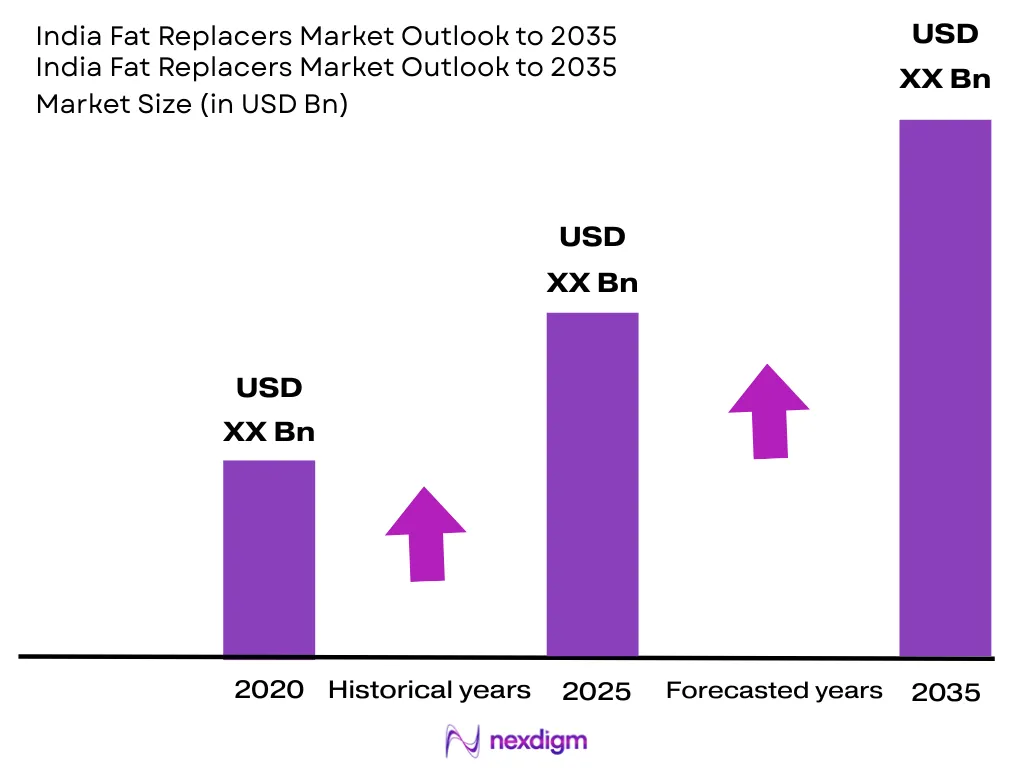
The India Fat Replacers Market was valued at approximately USD ~ billion in 2024 and is projected to grow at a CAGR of ~% during the 2026–2035 forecast period. The market is driven by increasing demand for reduced-fat and low-calorie food products, rising health consciousness among Indian consumers, and growing reformulation activities by food manufacturers across bakery, dairy, processed foods, snacks, and functional food categories. India possesses one of the world’s largest and fastest-growing food processing industries, with the sector contributing approximately USD 250 billion to the national economy while serving a domestic population exceeding 1.44 billion consumers. According to the Indian Council of Medical Research (ICMR) and the National Family Health Survey (NFHS), India is experiencing a rapidly escalating burden of obesity, type 2 diabetes, and cardiovascular disease, with urban overweight and obesity rates rising significantly, driving demand for reduced-fat, lower-calorie, and nutritionally improved packaged food products. The expansion of organised retail, branded packaged food, dairy products, functional snacks, and convenience food categories has significantly increased the utilisation of carbohydrate-, protein-, and fibre-based fat replacers across India’s diversified food manufacturing base. Continuous innovation in clean-label ingredients, dietary fibres, domestically sourced plant proteins, hydrocolloids including guar gum, and modified starches derived from India’s abundant corn and tapioca agricultural output is further accelerating adoption across multiple food applications.
Market Segmentation
By Source
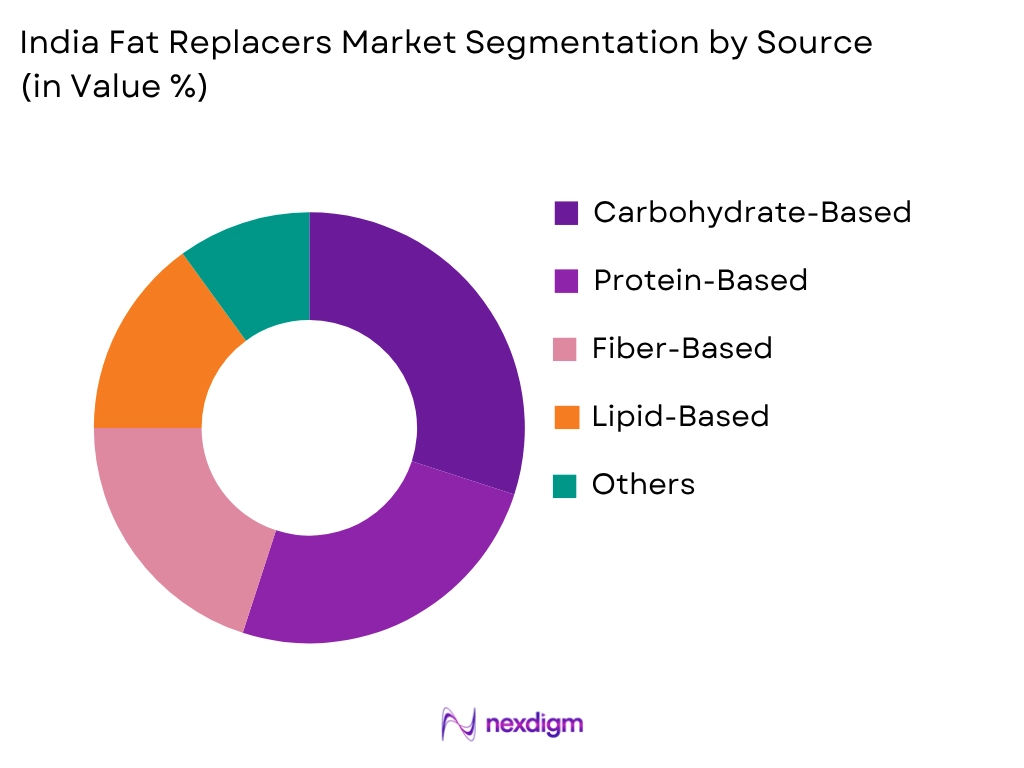
Carbohydrate-based fat replacers dominate the Indian market because they provide excellent functionality while maintaining product texture, viscosity, moisture retention, and mouthfeel at comparatively lower formulation costs — a critical consideration in India’s highly price-sensitive food manufacturing environment. Ingredients such as modified starches, maltodextrins, cellulose derivatives, polydextrose, and hydrocolloids are extensively incorporated into bakery products, dairy products, sauces, confectionery, processed snacks, and ready-to-eat foods across India’s large and diverse food processing sector. India’s abundant domestic production of corn, tapioca, and rice provides manufacturers with competitive and readily available domestic sources for starch-based ingredients, reducing dependence on imported alternatives and improving cost-competitiveness for price-sensitive food manufacturers. India is also the world’s largest producer of guar gum, a naturally occurring hydrocolloid with significant fat replacement and texture-enhancement properties, providing a uniquely competitive domestically available ingredient for Indian food manufacturers. Food manufacturers increasingly prefer carbohydrate-based solutions because they allow significant fat reduction without adversely affecting sensory characteristics or consumer acceptance, while also satisfying FSSAI labelling requirements and clean-label consumer preferences. Continuous innovation in resistant starches and soluble fibres further strengthens the segment by enabling clean-label product reformulation while improving nutritional profiles and supporting calorie reduction initiatives.
By Application
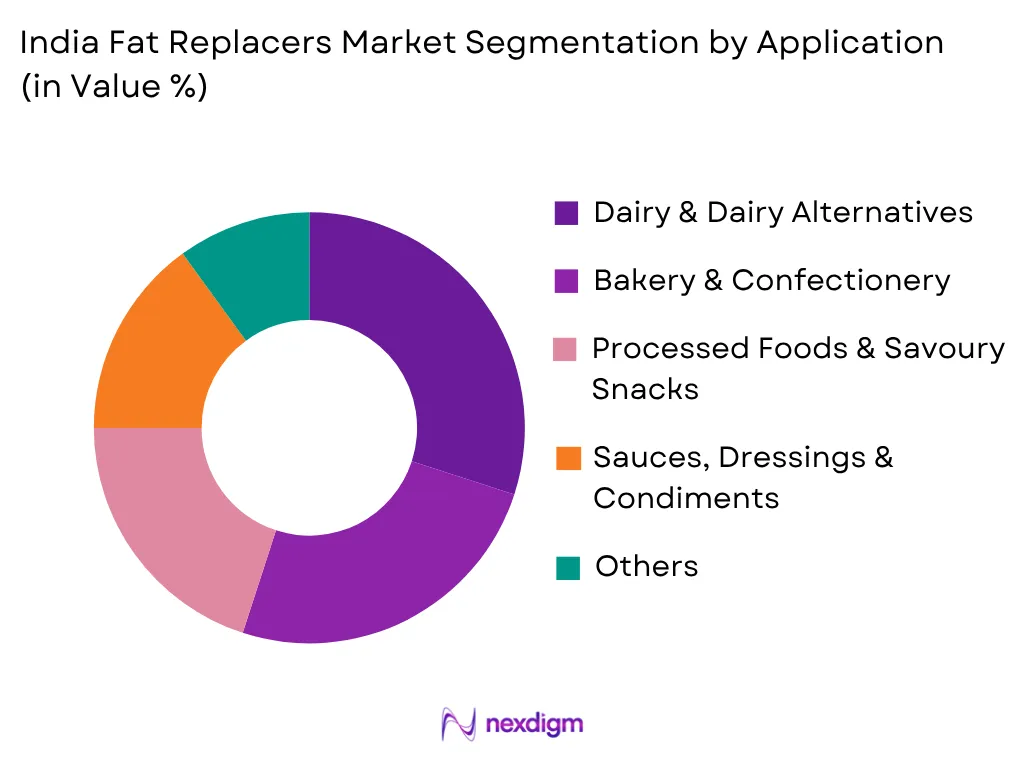
Dairy and dairy alternatives represent a critically important application segment in India’s fat replacers market, reflecting the country’s position as the world’s largest producer and consumer of dairy products and the culturally central role of dairy in the Indian diet. Low-fat dairy reformulation — spanning reduced-fat dahi (yoghurt), low-fat paneer, reduced-calorie flavoured milk, and low-fat dairy-based sweets — represents a growing application area as urban consumers increasingly seek healthier dairy product options without compromising on taste and texture. Bakery also represents a large application segment as fat replacers play a crucial role in reducing calories while maintaining softness, moisture retention, texture, and shelf stability in bread, cakes, biscuits, and Indian-specific baked formats. The rapidly growing namkeen and savoury snack sector — encompassing extruded products, fried snacks, and traditional Indian savoury formats — represents an additional and distinctively Indian application area driven by growing manufacturer interest in reduced-oil and reduced-fat variants targeting health-conscious urban consumers. Growing demand for functional food products including protein-enriched biscuits, fibre-fortified breads, and low-fat packaged dairy sweets has further accelerated ingredient adoption across multiple categories. The widespread presence of large-scale food manufacturers including ITC, Parle, Amul, and Britannia — each operating extensive production networks across India — reinforces the scale and breadth of commercial fat replacer ingredient demand across the domestic market.
Competitive Landscape
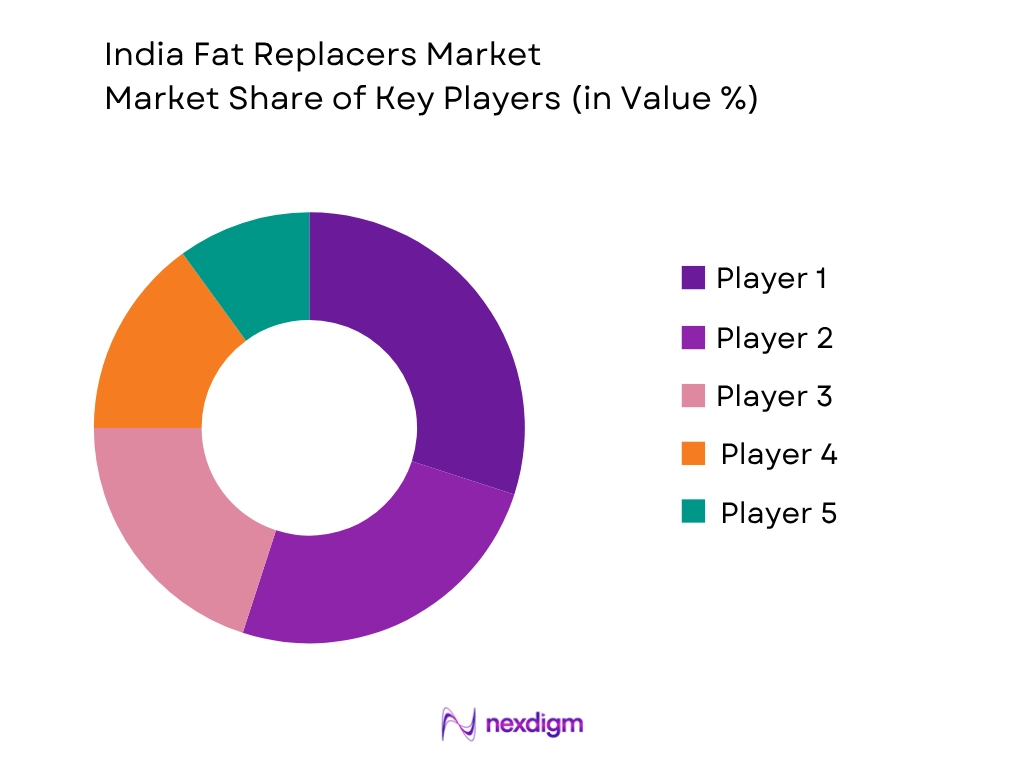
The India Fat Replacers Market is moderately fragmented, with a small number of multinational ingredient companies competing alongside domestic starch and hydrocolloid manufacturers, with cost competitiveness, technical service availability, and FSSAI regulatory compliance expertise representing the primary competitive differentiators. Global companies including Ingredion India, Cargill India, Tate & Lyle, Roquette, and Kerry India leverage advanced ingredient technology portfolios and application development capabilities, while domestic hydrocolloid manufacturers — particularly guar gum processors in Rajasthan and modified starch producers utilising domestic corn and tapioca feedstocks — compete strongly on price accessibility and local supply chain advantages. The market is characterised by intense cost pressure given India’s price-sensitive food manufacturing environment, requiring ingredient suppliers to continuously balance technical performance, regulatory compliance, and formulation cost-effectiveness.
| Company | Establishment Year | Headquarters | Primary Fat Replacer Portfolio | Key Application Industries
|
Manufacturing Presence | R&D Capability | Distribution Network | Clean Label Solutions |
| Ingredion India | 1906 | ~ | ~ | ~ | ~ | ~ | ~ | ~ |
| Cargill India | 1865 | ~ | ~ | ~ | ~ | ~ | ~ | ~ |
| Tate & Lyle | 1921 | ~ | ~ | ~ | ~ | ~ | ~ | ~ |
| Roquette India | 1933 | ~ | ~ | ~ | ~ | ~ | ~ | ~ |
| Kerry India | 1972 | ~ | ~ | ~ | ~ | ~ | ~ | ~ |
India Confectionary Market Analysis
Growth Drivers
Rising Non-Communicable Disease Burden and Growing Health Awareness
India’s rapidly escalating burden of obesity, type 2 diabetes, and cardiovascular disease is creating strong and sustained structural demand for reduced-fat and nutritionally improved food products across the country’s large food processing industry. According to the Indian Council of Medical Research (ICMR) and the National Family Health Survey (NFHS-5), the prevalence of overweight and obesity among urban Indian adults has increased significantly over the past decade, with some metropolitan surveys indicating that more than 40% of urban adults in major cities including Mumbai, Delhi, and Bengaluru are overweight or obese. The International Diabetes Federation (IDF) estimates that India has approximately 101 million people living with type 2 diabetes, representing the world’s largest diabetes population, creating particularly strong demand for reduced-sugar and reduced-fat food formulations among the country’s health-aware consumer segment. The World Bank estimated India’s GDP at approximately USD 3.9 trillion in 2024, with the IMF projecting continued robust economic growth, supporting increased household expenditure on premium and health-oriented packaged food categories, particularly among India’s rapidly expanding urban middle class. Growing consumer awareness, driven by social media, health professional guidance, and increasing health literacy among India’s young and digitally connected population, is progressively translating disease awareness into active dietary modification and health-oriented food purchasing behaviour. Major Indian food companies including ITC, Britannia, Amul, and Marico have publicly committed to product reformulation and nutritional improvement agendas, creating commercial demand for technically capable fat replacement ingredient systems that can deliver meaningful fat reduction while maintaining the taste, texture, and price positioning required to sustain consumer acceptance in India’s highly competitive packaged food market.
Abundant Domestic Agricultural Raw Materials Supporting Cost-Competitive Fat Replacer Development
India’s exceptional agricultural diversity and scale provide the domestic fat replacers industry with a structural competitive advantage through abundant and cost-competitive domestically available raw materials for carbohydrate-, fibre-, and protein-based fat replacement ingredient development. According to the Ministry of Agriculture and Farmers Welfare, India is among the world’s largest producers of corn, rice, wheat, tapioca, soybean, and sugarcane, providing the food ingredient industry with a diverse and competitively priced feedstock base for starch derivatives, maltodextrins, cellulose products, and sugar cane fibres. India is also the world’s largest producer and exporter of guar gum, with Rajasthan alone accounting for approximately 80% of global guar production — providing Indian food manufacturers with a uniquely proximate and cost-competitive source of a naturally functional fat replacement hydrocolloid. Psyllium husk, produced extensively in Gujarat and Rajasthan, provides another domestically abundant natural dietary fibre with significant fat replacement and mouthfeel enhancement properties. The availability of domestic whey protein from India’s large dairy processing sector, and soy protein from the country’s substantial soybean processing industry, further strengthens the domestic supply base for protein-based fat replacement systems. These structural raw material advantages enable Indian food ingredient manufacturers to develop and commercialise fat replacement solutions at price points significantly more accessible than imported specialty ingredients, allowing broader adoption across India’s price-sensitive food processing industry while simultaneously supporting clean-label positioning through regionally familiar and locally sourced ingredient declarations.
Market Challenges
Price Sensitivity and Functional Performance Limitations in Indian Food Formats
India’s fat replacers market faces structural challenges arising from the extreme price sensitivity of the domestic food manufacturing sector and the technical complexity of reformulating distinctively Indian food formats that rely on fat for unique cultural and sensory characteristics. According to the Confederation of Indian Industry (CII) and various food industry associations, the majority of India’s food processing companies — particularly small and medium-scale manufacturers serving price-sensitive mass-market consumer segments — make formulation decisions primarily on the basis of ingredient cost rather than technical performance, creating a significant barrier to the adoption of higher-performance but more expensive specialty fat replacer ingredients. Fat replacers must therefore be priced at levels competitive with the conventional oils and fats they replace, rather than at premium ingredient price points that may be commercially justified in more developed markets. Simultaneously, India’s diverse traditional food formats — including ghee-rich dairy sweets such as burfi, ladoo, and gulab jamun; deep-fried savoury snacks including samosas, pakoras, and namkeens; and fat-enriched bakery products — present formidable technical reformulation challenges because fat contributes simultaneously to their distinctive texture, flavour, mouthfeel, appearance, and cultural authenticity. Replacing ghee or refined oil in these products without compromising on the sensory characteristics that define them in consumer perception requires sophisticated ingredient combinations and extensive product development investment that many manufacturers in India’s fragmented food processing industry are not yet equipped or commercially incentivised to undertake.
FSSAI Regulatory Complexity and Import Dependency for Specialty Ingredients
Indian food manufacturers and ingredient suppliers continue facing challenges associated with navigating the FSSAI’s evolving regulatory framework governing food additives, novel food ingredients, and nutritional claims, alongside persistent import dependency for certain high-performance specialty fat replacement ingredients. According to the Food Safety and Standards Authority of India (FSSAI), the regulatory approval pathway for novel food ingredients and new food additives in India requires comprehensive safety dossiers, stability data, and evidence of technological necessity, representing a significant investment in time and resources before commercial launch. Novel fat replacement ingredients including certain precision fermentation-derived proteins, advanced modified starches, and botanical fat mimetics not previously approved under FSSAI food additive lists must undergo formal approval processes that can extend development timelines considerably. Simultaneously, while India’s domestic raw material base is strong for conventional starch and gum-based fat replacers, certain high-performance specialty ingredients — including advanced modified hydrocolloids, purified protein concentrates with specific fat mimetic functionality, and novel botanical extracts — continue to rely on international supply chains from Europe and North America, exposing Indian manufacturers to currency risk on the Indian Rupee, import duty costs, and supply disruption risks. The combination of regulatory pathway complexity and import dependency for advanced ingredients creates particular challenges for smaller domestic food manufacturers seeking to access the most technically sophisticated fat replacement solutions without the regulatory affairs resources and procurement leverage of larger multinational food companies operating in India.
Market Opportunities
Expansion of Domestic Plant-Based, Dairy, and Functional Food Categories
India’s rapidly evolving food sector presents significant opportunities for fat replacer manufacturers serving what will become the world’s largest consumer market over the coming decade. Rising consumer awareness regarding diet-related diseases has accelerated demand for foods formulated with recognisable ingredients, dietary fibres, plant proteins, and naturally derived fat replacement systems, particularly among India’s large and growing urban middle-class consumer base. India’s population exceeding 1.44 billion, combined with an expanding middle class and rising per capita income, provides the world’s single largest addressable population base for health-oriented food reformulation over the long term. The country’s extraordinary agricultural diversity — providing domestic sources of corn starch, tapioca starch, soy protein, whey protein, guar gum, psyllium husk, and sugar cane fibre — enables cost-competitive development of clean-label fat replacement solutions from locally available and consumer-familiar raw materials. Manufacturers are increasingly reformulating dairy products, bakery products, savoury snacks, and convenience foods using modified starches, soluble fibres, inulin, and plant proteins, with reformulated low-fat dahi, reduced-fat paneer, and low-calorie biscuits representing the most commercially active reformulation categories. The Indian government’s Eat Right India movement, FSSAI’s food fortification programs, and the Ministry of Health’s dietary guidelines advocating reduced fat and calorie intake are creating policy-level incentives for food reformulation that are expected to progressively stimulate industry demand for fat replacer ingredients across multiple food categories.
Guar Gum, Psyllium Husk and Domestically Sourced Clean-Label Ingredient Innovation
India’s unique position as the world’s dominant producer of guar gum and a major producer of psyllium husk presents a distinctive and globally significant opportunity for the development and commercialisation of domestically sourced, naturally functional, and clean-label fat replacement systems. According to the Indian Guar Gum Manufacturers and Exporters Association, India produces approximately 80% of the world’s guar gum supply, primarily from Rajasthan’s arid agricultural regions, providing the domestic food ingredient industry with an abundant, cost-competitive, and consumer-familiar natural hydrocolloid with established fat replacement, texture enhancement, and mouthfeel improvement functionality across multiple food categories. Similarly, India’s substantial psyllium husk production — concentrated in Gujarat and Madhya Pradesh and exported globally as a dietary fibre ingredient — provides a domestically available natural soluble fibre with significant fat replacement and satiety-enhancement properties. The development of food-grade guar gum derivatives, modified psyllium preparations, and tapioca-based resistant starch systems tailored specifically for Indian food manufacturers represents a significant commercial innovation opportunity that would combine technical fat replacement performance with domestic supply chain security, lower import costs, and clean-label consumer appeal. Investment in domestic processing infrastructure to upgrade raw guar gum and psyllium into higher-value, food-grade fat replacement functional forms — rather than exporting these raw materials for processing abroad — could create substantial value addition opportunities for India’s agricultural processing sector while simultaneously reducing the import dependency of India’s food manufacturing industry on specialty fat replacement ingredients sourced from Europe and North America.
Future Outlook
The India Fat Replacers Market is expected to experience robust expansion throughout the forecast period, supported by the country’s escalating non-communicable disease burden, increasing consumer health awareness, government-led food reformulation initiatives, and the rapid growth of organised and branded food manufacturing across multiple categories. Food manufacturers are expected to accelerate product reformulation as demand for reduced-fat, clean-label, and functional foods continues to rise across bakery, dairy, snacks, and convenience food segments. Rapid innovation in domestically sourced ingredients — particularly guar gum derivatives, psyllium-based fibres, tapioca-derived resistant starches, and soy and whey protein systems — is likely to improve cost-competitive fat replacement functionality while maintaining desirable sensory characteristics in distinctively Indian food formats. Growing investments in food technology, FSSAI regulatory approvals for novel ingredients, and domestic manufacturing capacity will further strengthen the Indian ingredient ecosystem. The government’s Eat Right India initiative and FSSAI’s food reformulation agenda are expected to progressively formalise industry-level fat and calorie reduction commitments, creating sustained structural demand for fat replacer ingredients through 2035.
Major Players
- Ingredion India
- Cargill India
- Tate & Lyle India
- Roquette India
- Kerry India
- IFF (Danisco India)
- DSM-Firmenich India
- CP Kelco India
- BENEO India
- Corbion India
- Glanbia Nutritionals India
- Ashland India
- Jungbunzlauer India
- Fiberstar, Inc.
- Brenntag India (Specialty Ingredients Distribution)
Key Target Audience
- Food & Beverage Manufacturers
- Bakery & Confectionery Manufacturers
- Dairy Product Manufacturers
- Snack & Processed Food Manufacturers
- Functional Food & Nutraceutical Companies
- Ingredient Distributors & Specialty Food Ingredient Suppliers
- Investments and Venture Capitalist Firms
- Government and Regulatory Bodies (Food Safety and Standards Authority of India (FSSAI), Ministry of Food Processing Industries (MoFPI), Indian Council of Medical Research (ICMR))
Research Methodology
Step 1: Identification of Key Variables
The research process begins with identifying all major stakeholders across the India Fat Replacers Market ecosystem, including raw material suppliers, specialty ingredient manufacturers, food processors, distributors, retailers, regulatory authorities, and end-use industries. Extensive desk research is conducted using government publications, FSSAI databases, trade statistics, company annual reports, food ingredient databases, industry journals, and proprietary databases to determine the key variables influencing market demand, supply dynamics, technological developments, and regulatory compliance.
Step 2: Market Analysis and Construction
Historical market information is compiled and analysed to evaluate consumption patterns, ingredient utilisation rates, production capacities, import-export movements, application trends, and industrial demand across different food categories. A combination of top-down and bottom-up market sizing approaches is adopted to estimate market revenues, supported by demand-side consumption analysis and supply-side production assessment. Data triangulation techniques are employed to ensure consistency across all market segments and sub-segments.
Step 3: Hypothesis Validation and Expert Consultation
The preliminary market estimates and analytical assumptions are validated through Computer Assisted Telephone Interviews (CATIs) and structured discussions with food ingredient manufacturers, formulation experts, procurement managers, product development specialists, regulatory professionals, and executives from food processing companies. Their operational and commercial insights are utilised to verify ingredient adoption trends, technological developments, purchasing behaviour, and future market opportunities while improving the accuracy of market forecasts.
Step 4: Research Synthesis and Final Output
The final phase integrates findings from secondary research and primary interviews to prepare a comprehensive assessment of the India Fat Replacers Market. Detailed analyses covering market size, segmentation, competitive landscape, innovation trends, application analysis, consumer preferences, and future growth prospects are developed through multiple rounds of validation. Cross-verification using both supply-side and demand-side information ensures that the final report delivers reliable, actionable, and business-oriented market intelligence.

- Executive Summary
- Research Methodology (Market Definitions and Assumptions, Abbreviations, Market Taxonomy, Market Sizing Approach, Top-Down Analysis, Bottom-Up Analysis, Demand-Side Assessment, Supply-Side Assessment, Primary Industry Interviews, Secondary Research Validation, Data Triangulation, Forecasting Framework, Limitations and Future Conclusions)

- Definition and Scope
- Market Evolution and Industry Genesis
- Timeline of Major Industry Developments
- Fat Replacer Industry Value Chain Analysis
- Supply Chain Analysis

- Growth Drivers (Rising Obesity and Non-Communicable Disease Burden, Expanding Processed Food and Food Manufacturing Sector, Growing Health and Wellness Consumer Awareness, Abundant Domestic Agricultural Raw Materials, Expansion of Functional and Fortified Foods, Rising Dairy and Bakery Reformulation Activities)
- Market Challenges (Price Sensitivity and Cost-Driven Formulation Decisions, Functional Performance Limitations in Tropical Climate Conditions, Consumer Acceptance of Reformulated Traditional Indian Foods, Dependence on Imported Specialty Ingredients, FSSAI Regulatory Approval Complexity, Raw Material Price Volatility and Currency Risk)
- Market Opportunities (Expansion of Plant-Based and Alternative Protein Foods, Rising Functional and Fortified Nutrition Products, Government-Led Sugar and Fat Reduction Initiatives, Premium Healthy Snack Innovation, Dairy Reformulation for Low-Fat Products, Domestic Raw Material-Derived Clean-Label Ingredients)
- Market Trends (Hydrocolloid Innovation, Plant Protein Fat Mimetics, Fibre-Enriched Fat Replacers, Domestically Sourced Natural Ingredient Reformulation, Multi-Functional Ingredient Systems, Ayurvedic and Botanical Fat Replacement Systems)
- Government Regulations (Food Safety and Standards Authority of India (FSSAI) Food Additive Regulations, FSSAI Nutrition and Health Claims Regulations, Front-of-Pack Labelling Requirements, Novel Food Ingredient Approval under FSSAI, Organic Certification Standards, Ministry of Health and Family Welfare Dietary Guidelines)
- Ingredient Innovation Landscape (Novel Hydrocolloids, Resistant Starches, Soluble Fibres, Functional Proteins, Botanical Fat Mimetics, Enzyme-Based Fat Modification, Fermentation-Based Ingredients)
- Raw Material Supply Analysis (Corn Starch, Tapioca Starch, Soy Protein, Whey Protein, Chicory Root Fibre, Guar Gum, Psyllium Husk, Sugar Cane Fibre)
- Import Dependency Assessment (Specialty Modified Starches, High-Performance Hydrocolloids, Advanced Protein Isolates, Precision Fermentation Ingredients, Novel Food Ingredients)
- Product Reformulation Landscape (Fat Reduction Targets, Texture Optimisation for Indian Food Formats, Flavour Retention, Shelf-Life Stability in Tropical Conditions, Calorie Reduction)
- Consumer Health & Nutrition Analysis (Low-Fat Consumption Trends, Clean Label Preference, Functional Food Adoption, Diabetes and Cardiovascular Health Demand, High-Protein Consumption)
- Sustainability Assessment (Renewable Domestic Raw Materials, Sustainable Ingredient Sourcing, Food Waste Reduction, Carbon Footprint Optimisation)
- SWOT Analysis
- Porter’s Five Forces Analysis
- PESTLE Analysis
- Stakeholder Ecosystem
- Competition Ecosystem

- By Market Value (2020-2025)
- By Volume Consumption (2020-2025)
- By Average Selling Price (2020-2025)

- By Source (In Value %)
Carbohydrate-Based Fat Replacers
Protein-Based Fat Replacers
Lipid-Based Fat Replacers
Fibre-Based Fat Replacers
Botanical & Plant-Derived Fat Replacers
Microbial Fermentation-Based Fat Replacers - By Ingredient Type (In Value %)
Starch-Based Fat Replacers
Cellulose-Based Fat Replacers
Protein-Based Fat Replacers
Functional & Fortified Fat Replacers
Organic & Natural Fat Replacers
Plant-Based & Vegan Fat Replacers - By Product Type (In Value %)
Starch Derivative
Cellulose Derivatives
Inulin
Maltodextrin
Whey Protein Concentrates
Microparticulated Proteins
Polydextrose
Hydrocolloids - By Functionality (In Value %)
Fat Mimetic
Fat Substitute
Fat Extender
Texture Enhancer
Mouthfeel Enhancer - By Application (In Value %)
Bakery & Confectionery
Dairy & Dairy Alternatives
Processed Foods & Savoury Snacks
Sauces, Dressings & Condiments
Namkeens & Extruded Snacks
Functional & Nutritional Foods
Ready Meals & Convenience Foods - By Region (In Value %)
North India
South India
West India
East India

- Market Share Analysis (By Value, Volume, Source Type, Application, End User)
- Cross Comparison Parameters (Fat Replacement Technology Portfolio, Clean Label Ingredient Portfolio, Functional Ingredient Innovation, Food Application Coverage, Manufacturing Capacity, India Distribution Network, Regulatory Compliance Expertise, R&D Investment & Product Development Capability)
- SWOT Analysis of Major Players
- Pricing Analysis (By Ingredient Type, Functional Performance, Application Category, Inclusion Rate, Purity Level)
- Detailed Profiles of Major Companies
Ingredion India
Cargill India
Tate & Lyle India
Roquette India
Kerry India
IFF (Danisco India)
DSM-Firmenich India
CP Kelco India
BENEO India
Corbion India
Glanbia Nutritionals India
Ashland India
Jungbunzlauer India
Fiberstar, Inc.
Brenntag India (Specialty Ingredients Distribution)

- Ingredient Utilisation Analysis (Application Intensity, Inclusion Rate, Formulation Complexity, Processing Compatibility)
- Purchasing Criteria Assessment (Functionality, Cost Efficiency, Regulatory Compliance, Label Friendliness, Ingredient Availability)
- Product Reformulation Analysis (Fat Reduction Targets, Sensory Performance in Traditional Indian Food Formats, Texture Retention, Shelf-Life Extension in Tropical Climate)
- Consumer Preference Analysis (Taste Acceptance, Mouthfeel, Nutrition Claims, Clean Label Preference, Protein Enrichment)
- Decision-Making Framework (R&D Teams, Procurement, Regulatory Affairs, Product Development, Commercialisation)

- By Market Value (2026-2035)
- By Volume Consumption (2026-2035)
- By Average Selling Price (2026-2035)


 Request a Sample
 Ask for Customization
 Get a Quote
 Enquire Now