

 Download PDF
Market Overview
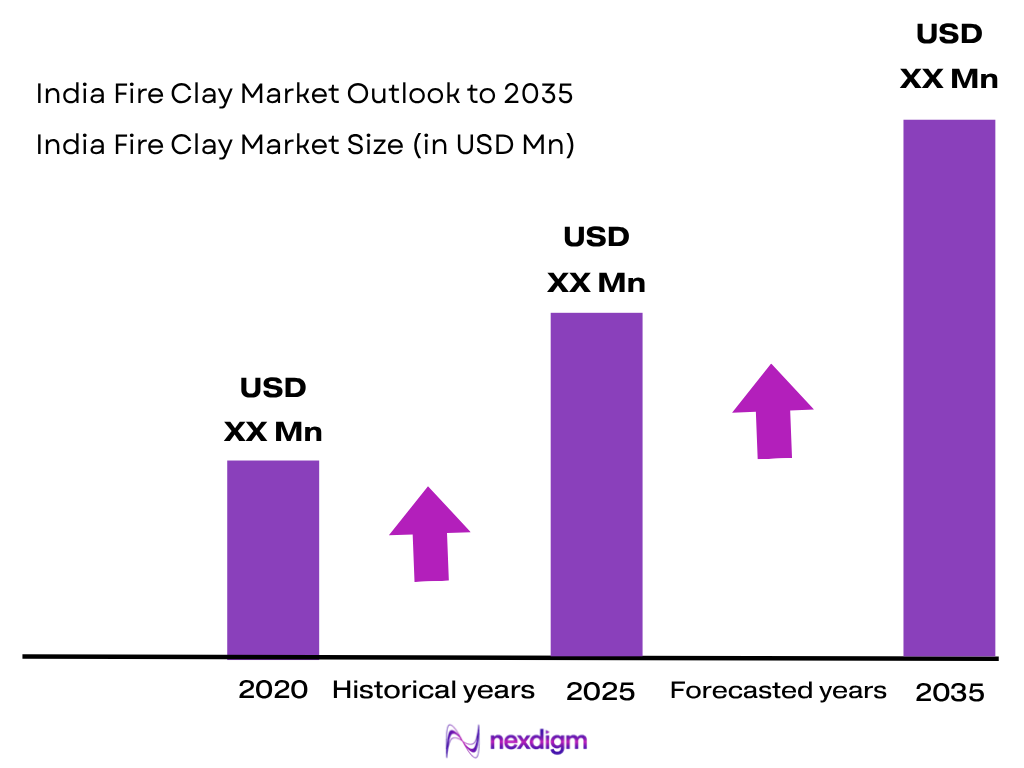
The India Fire Clay Market is estimated at ~USD XX million in 2024, with demand anchored in refractory manufacturing, steelmaking, cement kilns, furnaces, foundries, ceramics and other high-temperature applications. Fireclay is valued for refractoriness, plasticity and resistance to high temperatures, with the Indian Bureau of Mines identifying applications including bricks, blocks, retorts, crucibles, mortars, pottery and tiles. India’s crude-steel production reached 144.30 million tonnes in the latest completed fiscal period and 152.18 million tonnes in the following period, strengthening the industrial base supporting refractory consumption.
India’s fireclay resource base is associated with coal-measure formations and non-coal deposits, with important occurrences identified across Odisha, Jharkhand, West Bengal, Madhya Pradesh, Andhra Pradesh, Tamil Nadu and Gujarat. The Indian Bureau of Mines identifies Lower Gondwana coalfields and the Neyveli lignite fields among important geological settings, while Gujarat, Jabalpur and Belpahar-Sundargarh also contain notable non-coal fireclay occurrences. Industrial demand is concentrated around steel and refractory clusters in eastern and central India, supported by 152.18 million tonnes of crude-steel production and substantial cement manufacturing activity.
Market Segmentation
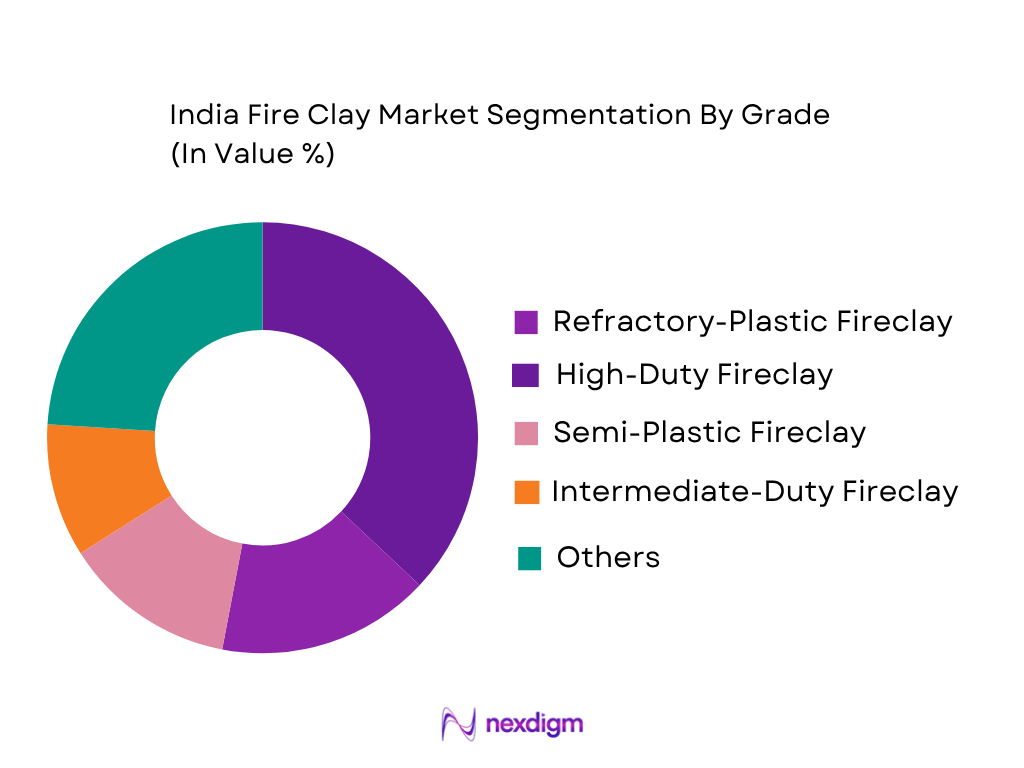
By Grade
The India Fire Clay Market is segmented by grade into low-duty fireclay, intermediate-duty fireclay, high-duty fireclay, super-duty fireclay, refractory-plastic fireclay, refractory non-plastic and semi-plastic fireclay, high-alumina fireclay and other grades. Refractory-plastic fireclay represents a major product category because plasticity and refractoriness are fundamental properties required for forming refractory bricks and shaped products. The Indian Bureau of Mines classifies fireclays according to their ability to withstand high temperatures and identifies low-duty, intermediate-duty, high-duty and super-duty grades. High-quality material is characterized by higher alumina and lower iron oxide, lime, magnesia and alkali content. This makes higher-grade fireclay particularly relevant for steel furnaces, kilns, coke ovens and other demanding thermal applications. TRL Krosaki, for example, manufactures fireclay and high-alumina products covering 30% to 99% Al₂O₃, while its Belpahar facility has 24,000 tonnes per annum of fireclay and high-alumina capacity. The continued expansion of Indian steel production therefore supports demand for consistent, higher-performance refractory raw materials.
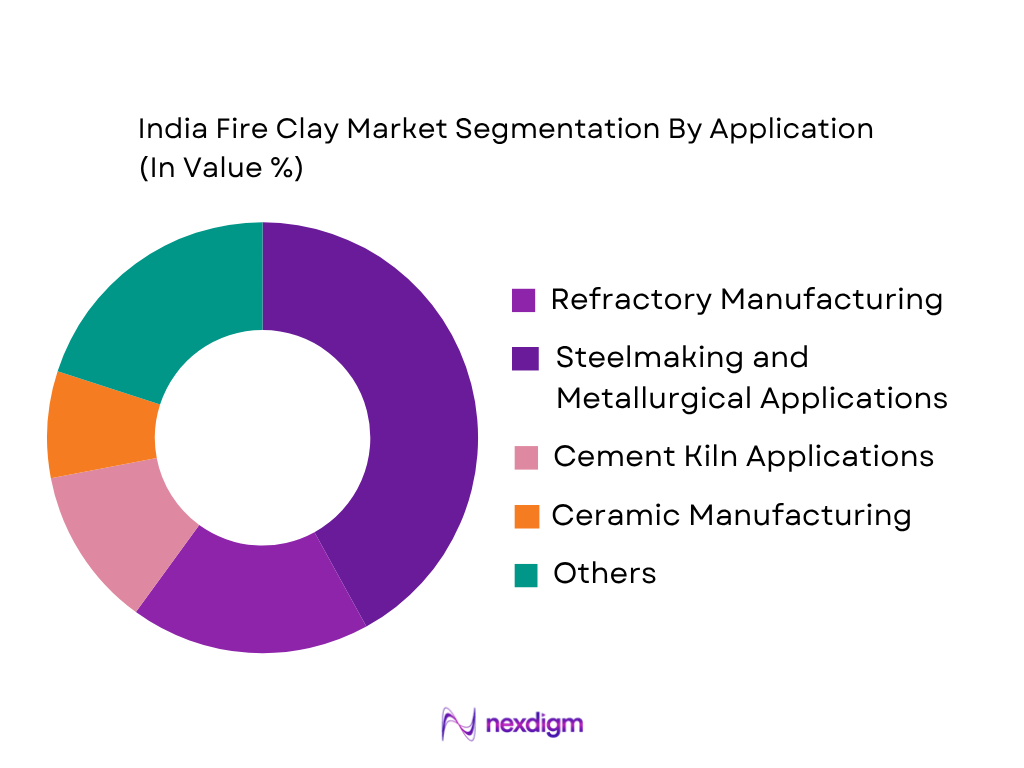
By Application
The India Fire Clay Market is segmented by application into fireclay bricks and shapes, refractory linings, furnace and kiln linings, steelmaking refractories, cement kiln applications, ceramic manufacturing, foundry applications, glass manufacturing, industrial furnaces and pottery and sanitaryware. Refractory bricks and furnace linings represent a major application because fireclay provides the thermal resistance and forming characteristics required in high-temperature equipment. Fireclay bricks are used extensively in metallurgical industries, while the material is also used in furnaces, kilns and ovens. India’s steel industry provides a substantial downstream demand base: crude-steel production increased from 144.30 million tonnes to 152.18 million tonnes across the latest two completed fiscal periods reported by the Ministry of Steel. Cement production also reached 321.32 million tonnes during April–December of the latest reported period, compared with 309.84 million tonnes in the corresponding preceding period. These industries require refractory linings capable of operating under intense heat, abrasion and chemical exposure, supporting continued consumption of fireclay-containing refractory products.
Competitive Landscape
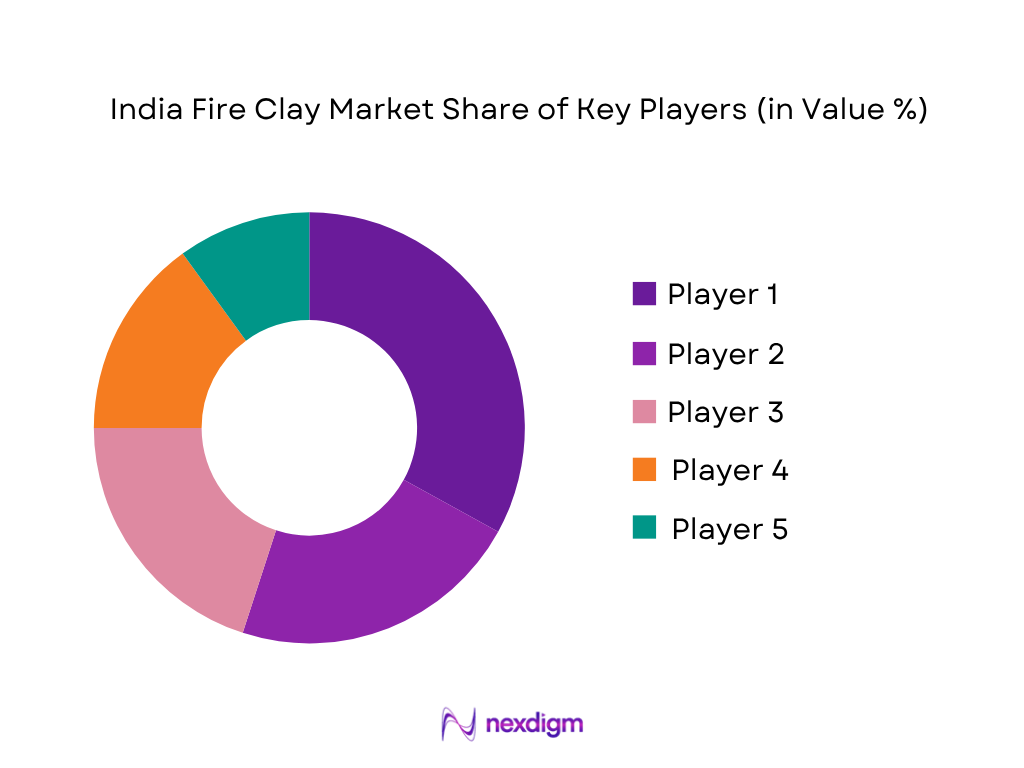
The India Fire Clay Market operates within a broader refractory ecosystem comprising integrated refractory manufacturers, specialist fireclay producers, high-alumina refractory manufacturers and mineral suppliers. Major participants compete through raw-material access, fireclay grade range, alumina content, refractory-brick manufacturing, production capacity, technical support and proximity to steel and cement customers. TRL Krosaki has dedicated fireclay and high-alumina manufacturing capabilities, while RHI Magnesita expanded its Indian refractory footprint through the acquisition of Dalmia Bharat Refractories’ Indian refractory business, adding almost 300,000 tonnes of annual capacity across shaped and unshaped refractories.
| Company | Establishment Year | Headquarters | Fireclay Product Range | Major End-Use Exposure | Manufacturing Footprint | High-Alumina Capability | Technical Services |
| TRL Krosaki Refractories Limited | 1958 | Belpahar, Odisha | ~ | ~ | ~ | ~ | ~ |
| RHI Magnesita India | 2011* | Gurugram, Haryana | ~ | ~ | ~ | ~ | ~ |
| IFGL Refractories Limited | 1989 | Kolkata, West Bengal | ~ | ~ | ~ | ~ | ~ |
| Vesuvius India Limited | 1991 | Kolkata, West Bengal | ~ | ~ | ~ | ~ | ~ |
| Orient Refractories Limited | 1977 | Ahmedabad, Gujarat | ~ | ~ | ~ | ~ | ~ |
India Fire Clay Market Analysis
Growth Drivers
Expansion of Steel Production
India’s expanding steel production base is a direct structural driver for fireclay demand because fireclay is used in refractory bricks and other heat-resistant materials serving furnaces and metallurgical operations. The Ministry of Steel reports that crude steel production reached 152.18 million tonnes in FY2024-25, compared with 144.30 million tonnes in FY2023-24, while finished-steel production increased from 139.15 million tonnes to 146.69 million tonnes over the same period. Finished-steel consumption also reached 152.13 million tonnes in FY2024-25, demonstrating substantial domestic furnace and steel-processing activity. The Ministry of Steel identifies refractories as an input industry associated with the steel sector, while the Indian Bureau of Mines states that firebricks are extensively used in metallurgical industries and that fireclay is an important refractory raw material. The continued scale of steelmaking therefore supports recurring requirements for refractory linings exposed to high temperatures, abrasion and chemical attack. The Ministry of Steel also reported 54.19 million tonnes of crude steel production during April–July 2025, indicating that industrial demand for refractory materials continued across the subsequent production cycle. This steel-intensive industrial base creates sustained downstream requirements for suitable fireclay grades.
Refractory Consumption in Metallurgical Furnaces
India’s large metallurgical manufacturing base creates recurring demand for refractory materials capable of operating under extreme thermal conditions, supporting the consumption of suitable fireclay grades. The Indian Bureau of Mines defines fireclay as refractory clay capable of withstanding temperatures above PCE 19, while good-quality fireclay requires a fusion point above 1,580°C and adequate plasticity. The Bureau also reports that high-alumina, low-impurity fireclay is preferred for refractory manufacturing and that firebricks are used extensively in furnaces, kilns and ovens. This application is supported by India’s steel production, with crude steel output reaching 152.18 million tonnes in FY2024-25, while finished steel production reached 146.69 million tonnes. The Ministry of Steel further reports 55.76 million tonnes of sponge-iron production in FY2024-25, reflecting substantial high-temperature reduction activity requiring refractory-lined equipment. India’s industry and construction sector represented 24.6% of GDP in 2024 according to the World Bank, reinforcing the scale of industrial activity that supports refractory consumption. Fireclay therefore benefits from its role as a mineral input rather than simply as a construction material, particularly where furnace durability, thermal resistance and controlled refractory performance are essential.
Market Challenges
Limited Availability of High-Grade Fireclay
The availability of suitable high-grade fireclay is a structural challenge because refractory manufacturers require specific chemical and physical characteristics rather than simply large quantities of clay. The Indian Bureau of Mines reports that India possesses substantial fireclay resources, but deposits containing more than 37% alumina are limited. The Bureau further identifies high alumina and low concentrations of iron oxide, lime, magnesia and alkalis as desirable characteristics for refractory manufacturers. Fireclay deposits are concentrated in specific geological settings, particularly coal-associated formations in Andhra Pradesh, Jharkhand, West Bengal and Madhya Pradesh, as well as the Neyveli lignite fields of Tamil Nadu. The National Mineral Inventory maintained by IBM covers 64 minerals and more than 13,000 freehold and leasehold deposits or blocks, providing a national framework for evaluating mineral availability, but fireclay remains subject to localized geological conditions. Because fireclay was classified as a minor mineral under the relevant government notification, production information is reported directly by states rather than centrally to IBM. This creates additional difficulty in establishing consistent national availability information. For refractory producers, the combination of limited high-grade deposits, geological concentration and variable reporting can complicate procurement planning and encourage greater attention to beneficiation and deposit exploration.
Mining and Environmental Compliance
Mining and environmental compliance can constrain fireclay supply because extraction must operate within India’s state-level mineral administration and environmental-management framework, while fireclay deposits are frequently associated with coal-bearing geological formations. The Indian Bureau of Mines confirms that fireclay has been classified as a minor mineral, meaning producers report production directly to respective state authorities rather than to IBM. The Bureau’s mineral information system provides national information on reserves, resources, mining leases and other mineral characteristics, while the National Mineral Inventory contains information covering 64 minerals and more than 5,500 freehold and 7,500 leasehold deposits or blocks. These institutional arrangements make state-level approvals, lease conditions and environmental requirements important considerations for producers. The challenge becomes particularly relevant when fireclay extraction occurs alongside established coal-mining or industrial areas, where land use, mine planning and environmental management must be coordinated. At the same time, India’s industrial base remains substantial: industry including construction contributed 24.6% of GDP in 2024, according to World Bank data, maintaining demand for mineral inputs while increasing the importance of compliant and reliable supply. For fireclay producers, regulatory compliance can therefore affect mine development, operating continuity, resource evaluation and the ability to bring additional deposits into production.
Market Opportunities
High-Alumina Fireclay Exploration
High-alumina fireclay exploration presents an opportunity to address a specific supply requirement within India’s refractory industry, where chemical composition directly determines suitability for demanding high-temperature applications. The Indian Bureau of Mines identifies fireclay containing more than 37% alumina as limited and states that high-alumina, low-impurity material is preferred by refractory manufacturers. The Bureau identifies important fireclay occurrences across Andhra Pradesh, Jharkhand, West Bengal, Madhya Pradesh and Tamil Nadu, with additional occurrences in Gujarat and Odisha. The National Mineral Inventory provides entrepreneurs with information covering reserves and resources, geological characteristics, infrastructure, exploration and beneficiation, creating an institutional base for identifying prospective deposits. Demand-side conditions are also substantial: India produced 152.18 million tonnes of crude steel and 146.69 million tonnes of finished steel in FY2024-25, while finished-steel consumption reached 152.13 million tonnes. These industrial volumes indicate an established downstream market for refractory materials. Exploration focused specifically on alumina content, iron-oxide levels, refractory behavior and deposit continuity could therefore help identify material suitable for higher-performance refractory applications. The opportunity is particularly relevant to integrated mineral-to-refractory businesses seeking more reliable domestic sources of specialized refractory raw materials.
Beneficiation of Lower-Grade Deposits
Beneficiation of lower-grade fireclay provides an opportunity to improve the usable resource base by upgrading mineral characteristics before refractory manufacturing, particularly where naturally occurring high-grade material is constrained. The Indian Bureau of Mines notes that high-grade fireclay containing more than 37% alumina is limited and identifies alumina content, iron oxide and other fluxing impurities as important quality considerations. IBM’s National Mineral Inventory incorporates information on beneficiation, geology, exploration, infrastructure and physical and chemical properties, providing a framework for evaluating deposits beyond their raw mineral tonnage. The downstream industrial base provides a clear application context: crude steel production reached 152.18 million tonnes in FY2024-25, while sponge-iron production reached 55.76 million tonnes and finished-steel consumption reached 152.13 million tonnes. These activities require refractory systems capable of operating in demanding thermal environments. Beneficiation technologies that improve alumina concentration, reduce undesirable impurities and achieve more consistent refractory characteristics could allow selected lower-grade deposits to serve applications that otherwise require higher-quality feedstock. Such processing can also support more integrated supply chains by connecting mineral extraction with controlled preparation of refractory-grade material for steel, cement, furnace and kiln applications.
Future Outlook
The India Fire Clay Market is expected to benefit from continued development of steel, cement, ceramics, foundries and other high-temperature industries. Demand will increasingly depend on refractory performance, furnace operating efficiency, lining life and the availability of consistent-grade raw materials. Higher-alumina fireclay and processed refractory feedstocks can gain importance as manufacturers seek predictable thermal and mechanical performance. The expanding domestic steel base provides a particularly important downstream foundation, with crude-steel capacity reaching 200.33 million tonnes and production reaching 152.18 million tonnes in the latest completed fiscal period.
Major Players
- TRL Krosaki Refractories Limited
- RHI Magnesita India Refractories Limited
- IFGL Refractories Limited
- Vesuvius India Limited
- Orient Refractories Limited
- Dalmia Bharat Refractories Limited
- Calderys India Refractories
- Maithan Ceramic Limited
- Rajhans Refractories
- Tata Steel Refractories
- Gujarat Mineral Development Corporation Limited
- Odisha Mining Corporation Limited
- Andhra Pradesh Mineral Development Corporation Limited
- Associated Ceramic & Allied Products Limited
- Bharat Refractories Limited
Key Target Audience
- Iron and steel manufacturers and refractory procurement departments
- Cement manufacturers and kiln operations
- Refractory manufacturers and raw-material procurement teams
- Fireclay mining and mineral-processing companies
- Ceramic, glass and foundry manufacturers
- Investments and venture capitalist firms
- Government and regulatory bodies (Ministry of Mines, Indian Bureau of Mines, State Directorates of Mining and Geology)
- Industrial furnace, kiln and thermal-equipment manufacturers
Research Methodology
Step 1: Identification of Key Variables
The initial phase involves mapping the India Fire Clay Market ecosystem across mining, mineral processing, refractory manufacturing and end-use industries. Key variables include fireclay grade, alumina content, refractoriness, plasticity, production, consumption, application and geographic concentration. Geological occurrences and state-level reporting structures are incorporated because fireclay reporting differs from major-mineral reporting. Indian Bureau of Mines
Step 2: Market Analysis and Construction
Historical production and consumption information will be compiled from Indian government mineral statistics, State Directorate records and industry-level operating information. The assessment will distinguish crude fireclay, processed material and fireclay incorporated into refractory products. Steel, cement, ceramics and other downstream indicators will be used to construct the demand-side framework without treating downstream production as direct fireclay consumption.
Step 3: Hypothesis Validation and Expert Consultation
Market hypotheses will be validated through discussions with participants across fireclay mining, refractory manufacturing, procurement and industrial furnace operations. Particular attention will be given to grade specifications, alumina requirements, refractory-life expectations, sourcing patterns and substitution between fireclay and alternative refractory raw materials. Company-level information will be cross-checked against available government and corporate disclosures.
Step 4: Research Synthesis and Final Output
The final stage will triangulate supply-side production information with downstream refractory requirements and end-use industry activity. Geographic production centers, major refractory manufacturing clusters, application demand and competitive capabilities will be integrated into the final market assessment. Any segment for which official market-share data are unavailable will be clearly distinguished from independently derived market estimates.

- Executive Summary
- Research Methodology (Market Definition and Scope, Fire Clay Classification, Fireclay Grade Mapping, Alumina Content Assessment, Refractoriness and PCE Evaluation, Deposit Mapping, Resource and Reserve Assessment, Top-Down Market Sizing, Bottom-Up Market Sizing, Production-Side Assessment, Consumption-Side Assessment, End-Use Demand Validation, Primary Industry Interviews, State-Level Production Validation, Data Triangulation, Forecasting Framework, Assumptions and Limitations)

- Definition and Scope
- India Fire Clay Industry Evolution
- Fire Clay Geological Occurrence and Deposit Mapping
- Fire Clay Value Chain Analysis
- Fire Clay Supply Chain Analysis
- Fire Clay Resource and Reserve Assessment

- Growth Drivers (Expansion of Steel Production, Refractory Consumption in Metallurgical Furnaces, Cement Kiln Expansion, Industrial Furnace Development, Demand for High-Temperature Refractory Materials, Infrastructure-Linked Construction Material Demand, Expansion of Ceramic Manufacturing, Increasing Requirement for High-Alumina Refractories)
- Market Challenges (Limited Availability of High-Grade Fireclay, Uneven Deposit Distribution, State-Level Production Reporting, Quality Variability Across Deposits, High-Grade Alumina Requirement, Mining and Environmental Compliance, Transportation of Low-Value Bulk Mineral, Processing and Beneficiation Constraints, Competition from Alternative Refractory Raw Materials)
- Market Opportunities (High-Alumina Fireclay Exploration, Beneficiation of Lower-Grade Deposits, Advanced Fireclay Refractory Products, Domestic Refractory Raw-Material Substitution, Fireclay Brick Export Development, Integrated Mining-to-Refractory Supply Chains, Value-Added Fireclay Processing, High-Temperature Industrial Applications)
- Market Trends (Increasing High-Alumina Refractory Adoption, Shift Toward Lower Refractory Consumption per Tonne of Steel, Growth of Monolithic Refractories, Development of Precast Refractory Products, Fireclay Beneficiation, Advanced Furnace Lining Materials, Improved Refractory Life, Industrial Energy Efficiency, Specialized Fireclay Grades)
- Government Regulations and Standards (Mines and Minerals Development Framework, Minor Mineral Classification, State Mining Rules, Environmental Clearance Requirements, Forest and Land Regulations, Bureau of Indian Standards Refractory Standards, Mineral Conservation Requirements, Mining Lease Compliance, Transportation and Royalty Regulations)
- SWOT Analysis
- Porter’s Five Forces Analysis
- PESTLE Analysis
- Stakeholder Ecosystem

- By Market Value (2020-2025)
- By Production Volume (2020-2025)
- By Consumption Volume (2020-2025)
- By Average Realization (2020-2025)
- By Fireclay Production from Major Producing States (2020-2025)
- By Fireclay Consumption by End-Use Industry (2020-2025)

- By Grade (In Value %)
Low-Duty Fireclay
Intermediate-Duty Fireclay
High-Duty Fireclay
Super-Duty Fireclay
Refractory-Plastic Grade Fireclay
Refractory Non-Plastic and Semi-Plastic Fireclay
High-Alumina Fireclay
Unclassified and Other Fireclay Grades - By Alumina and Chemical Composition (In Value %)
Below 30% Al₂O₃ Fireclay
30%-35% Al₂O₃ Fireclay
35%-37% Al₂O₃ Fireclay
37%-40% Al₂O₃ Fireclay
Above 40% Al₂O₃ Fireclay
Low-Fe₂O₃ Fireclay
Low-Fluxing-Impurity Fireclay
Kaolinitic and Aluminous Fireclay - By Application (In Value %)
Fireclay Bricks and Shapes
Refractory Bricks and Linings
Furnace and Kiln Linings
Cement Manufacturing
Iron and Steel Manufacturing
Ceramic Manufacturing
Foundry Applications
Glass Manufacturing
Industrial Furnaces
Pottery and Sanitaryware - By End-Use Industry (In Value %)
Iron and Steel Industry
Cement Industry
Ceramic Industry
Glass Industry
Foundry Industry
Non-Ferrous Metallurgy
Chemical Processing Industry
Power Generation
Engineering and Industrial Manufacturing
Construction Materials Industry - By Product Form (In Value %)
Crude Fireclay
Processed Fireclay
Beneficiated Fireclay
Fireclay Powder
Fireclay Granules
Fireclay Bricks
Fireclay Shapes
Fireclay Mortars and Monolithic Products - By Region (In Value %)
Odisha
West Bengal
Jharkhand
Madhya Pradesh
Andhra Pradesh
Telangana
Tamil Nadu
Gujarat
Other Fireclay-Producing Regions

- Market Share of Major Players (By Fireclay Supply, Refractory Production Capacity, Fireclay Brick Output, High-Alumina Product Portfolio, End-Use Industry Exposure)
- Cross Comparison Parameters (Fireclay Raw-Material Access, High-Alumina Fireclay Capability, Fireclay Brick Manufacturing Capacity, Refractory Product Portfolio Breadth, Steel Industry Customer Coverage, Cement Industry Customer Coverage, Mineral Processing and Beneficiation Capability, Geographic Manufacturing Footprint)
- SWOT Analysis of Major Players
- Detailed Profiles of Major Companies
TRL Krosaki Refractories Limited
Dalmia Bharat Refractories Limited
IFGL Refractories Limited
Orient Refractories Limited
Vesuvius India Limited
Calderys India Refractories Limited
RHI Magnesita India Limited
Maithan Ceramic Limited
Bharat Refractories Limited
Associated Ceramic & Allied Products Limited
National Refractories
Tata Steel Refractories
Gujarat Mineral Development Corporation Limited
Andhra Pradesh Mineral Development Corporation Limited
Odisha Mining Corporation Limited

- Iron and Steel Refractory Demand Assessment
- Cement Industry Fire Clay Requirement Assessment
- Ceramic Industry Fire Clay Demand Assessment
- Foundry and Furnace Application Assessment
- Glass Industry Application Assessment

- By Market Value (2026-2035)
- By Production Volume (2026-2035)
- By Consumption Volume (2026-2035)
- By Average Realization (2026-2035)
- By Fireclay Production from Major Producing States (2026-2035)
- By Fireclay Consumption by End-Use Industry (2026-2035)


 Request a Sample
 Ask for Customization
 Get a Quote
 Enquire Now