
 Download PDF
Market Overview
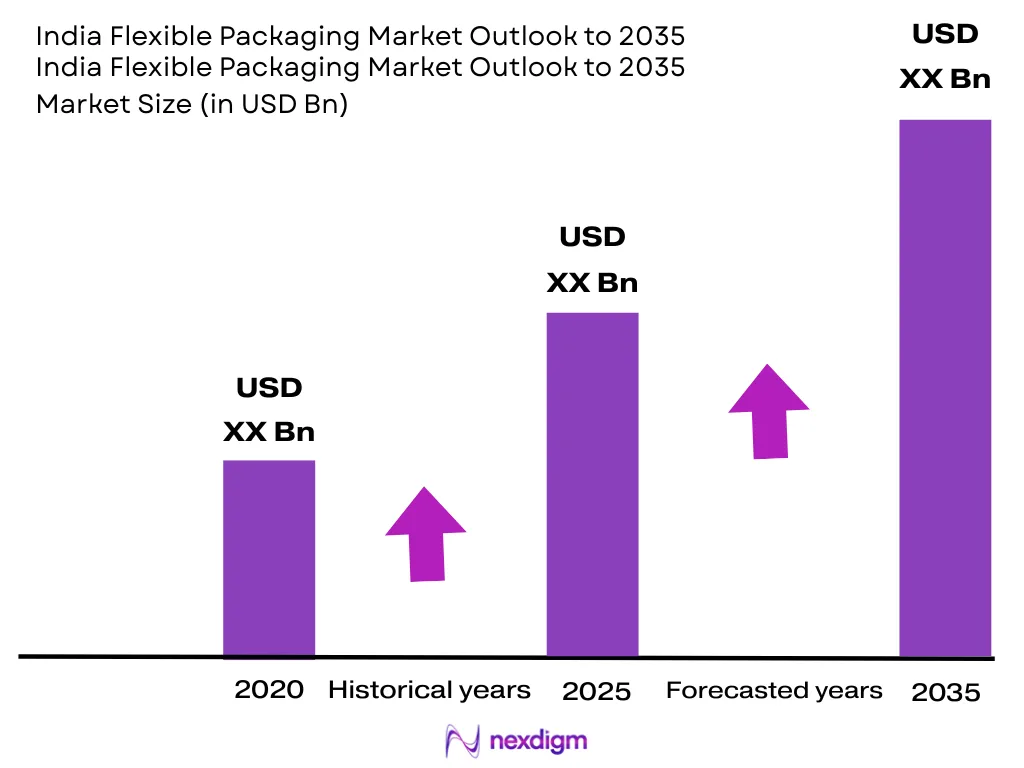
The India Flexible Packaging Market was valued at USD ~ Billion in 2025 and is anticipated to expand at a CAGR of 11.46% during 2025–2030, reaching approximately USD ~ Billion by 2030, according to Mordor Intelligence. The market is primarily driven by the rapid expansion of e-commerce and quick-commerce logistics, rising consumption of packaged and convenience foods, and growing investment in the pharmaceutical and electronics sectors under the government’s Production-Linked Incentive (PLI) scheme. India’s e-commerce sector is projected to reach USD 200 billion in revenue by 2026, according to the India Brand Equity Foundation (IBEF), while package volumes from 15-minute quick-commerce delivery platforms grew 300% in major metros during 2024, driving demand for tamper-proof pouches and moisture-barrier liners. The Food & Beverages segment remained the largest end-user category, valued at USD 10.28 billion in 2024, while the Pharmaceuticals segment accounted for 18.0% of the market in FY2024 and is projected to grow to 19.35% by FY2030. The Indian government’s 2022 Extended Producer Responsibility (EPR) guidelines, which mandate 70% collection of plastic waste, alongside the Plastic Waste Management Amendment Rules of 2023 requiring compostable and biodegradable materials, continue to shape the market’s transition toward recyclable mono-material structures across bakery, dairy, beverages, pharmaceutical, and personal care applications.
Market Segmentation
By Material
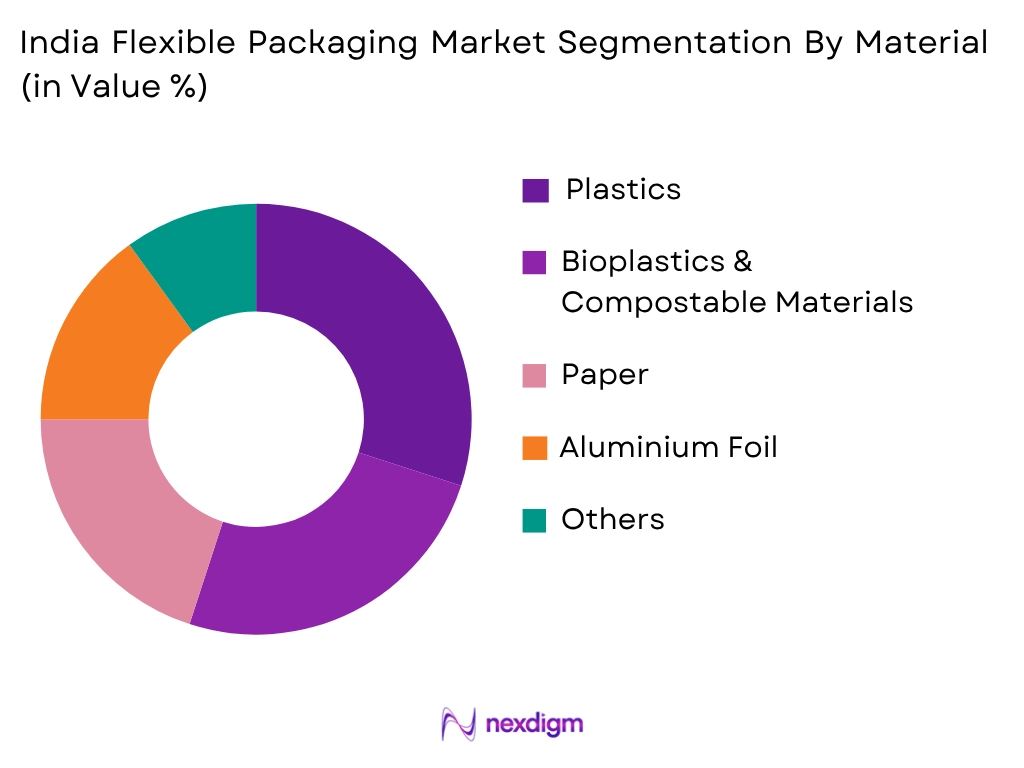
Among these, Plastic, encompassing BOPP, BOPET, CPP, PE, and PP films, dominates the India Flexible Packaging Market, reflecting the country’s well-established polymer film manufacturing base and integrated production capabilities among leading domestic players. UFlex Limited has continued expanding its integrated plastic film production, commercializing a BOPET plant in Dharwad and a CPP plant in Dubai in Q4 FY23, alongside a PET chips unit in Panipat with a capacity of 14,400 tons per month that became operational in Q4 FY24. Cosmo First Limited, which rebranded from Cosmo Films Ltd. in 2023 to reflect its expanded business activities, has shifted its portfolio toward specialty films, which now constitute approximately 65% of its offerings, up from 25% a few years earlier. Polyethylene (PE) remains particularly favored for food wraps, pouches, and shrink films due to its sealability and toughness, while Polypropylene (PP), particularly biaxially oriented polypropylene (BOPP) films, continues to gain share in snack wrappers, confectionery, and bakery packaging applications given its high-clarity and heat-resistant properties.
By Product Type
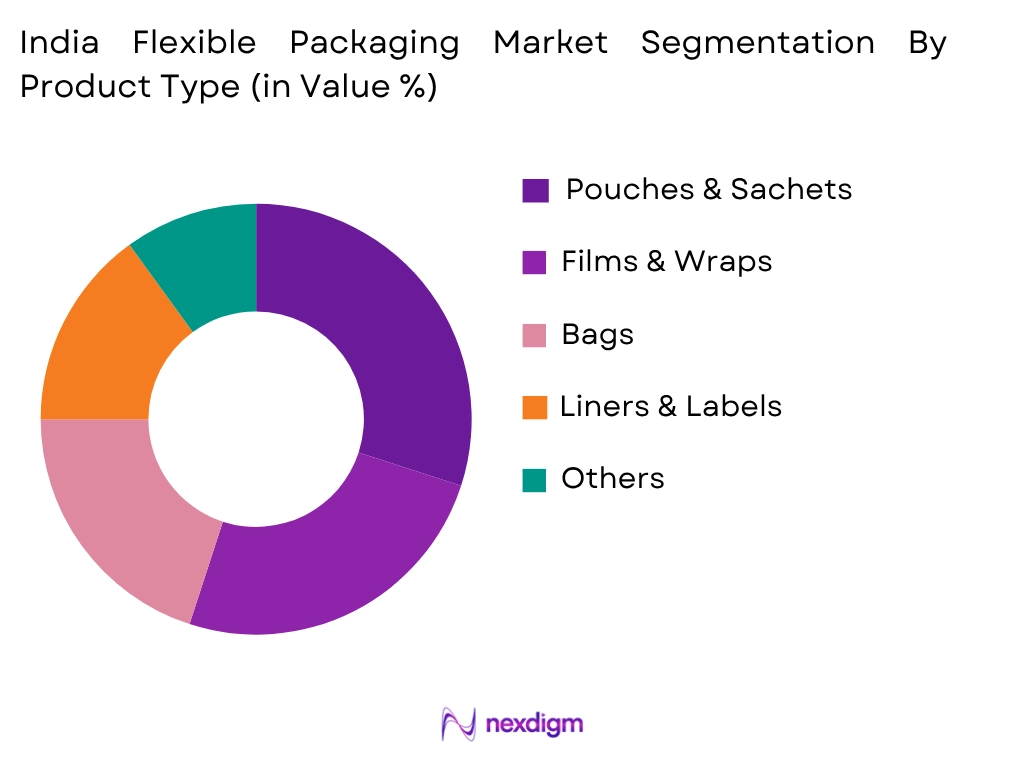
The Pouches & Sachets segment holds the largest share of the India Flexible Packaging Market, accounting for approximately 31.85% of revenue in 2025, owing to their versatility, cost-effectiveness, and widespread application across food, beverages, and personal care products, particularly suited to India’s large sachet-based distribution model for rural and price-sensitive urban consumers. UFlex’s May 2024 launch of ‘B-UUB-M,’ a high-performance barrier metalized BOPP film designed for dry fruits, beverages, snacks, confectionery, and bakery products, offering an oxygen transmission rate below 0.1cc/m2/day, illustrates continued innovation within this segment. The Films & Wraps segment represents a significant secondary category, benefiting from rising demand for lightweight, durable packaging in logistics and quick-commerce applications, with some automated high-speed sachet lines now filling 1,500 packs per minute in condiment manufacturing plants.
Competitive Landscape
The India Flexible Packaging Market exhibits moderate concentration, with approximately 200 organized firms operating across films, laminates, and rigid containers, though the top 10 players control around 35% of total sales. Competition is primarily based on manufacturing capacity, barrier film technology, integrated raw material sourcing, regulatory compliance with EPR and plastic waste management rules, and the ability to serve large food, beverage, and pharmaceutical customers. UFlex Limited stands out as the market leader with revenues exceeding USD 1 billion, maintaining a significant presence in both domestic and export markets for BOPP films, laminates, and aseptic packaging, while its 168,000 MTPA rPET chip plant in Panipat secures feedstock for its CPP and BOPET film lines, insulating margins against virgin-resin price volatility. Polyplex Corporation and Cosmo First combined control a sizable portion of the polyester and specialty films market, with Polyplex reporting global revenues exceeding USD 2 billion and a substantial Indian manufacturing base. International players including Amcor, which completed the acquisition of a manufacturing facility in India in September 2023, and Berry Global continue to expand their domestic footprint, while private equity interest in the sector was underscored by PAG’s near USD 1 billion acquisition of Manjushree Technopack in November 2024.
| Company | Establishment Year | Headquarters | Primary Product Portfolio | Flexible Packaging Portfolio
|
Manufacturing Presence | Major End-Use Industries | Key Strategic Focus | Certifications & Compliance |
| UFlex Limited | 1985 | ~ | ~ | ~ | ~ | ~ | ~ | ~ |
| Cosmo First Limited | 1976 | ~ | ~ | ~ | ~ | ~ | ~ | ~ |
| Jindal Poly Films Limited | 1974 | ~ | ~ | ~ | ~ | ~ | ~ | ~ |
| Polyplex Corporation Limited | 1984 | ~ | ~ | ~ | ~ | ~ | ~ | ~ |
| Huhtamaki PPL | 1958 | ~ | ~ | ~ | ~ | ~ | ~ | ~ |
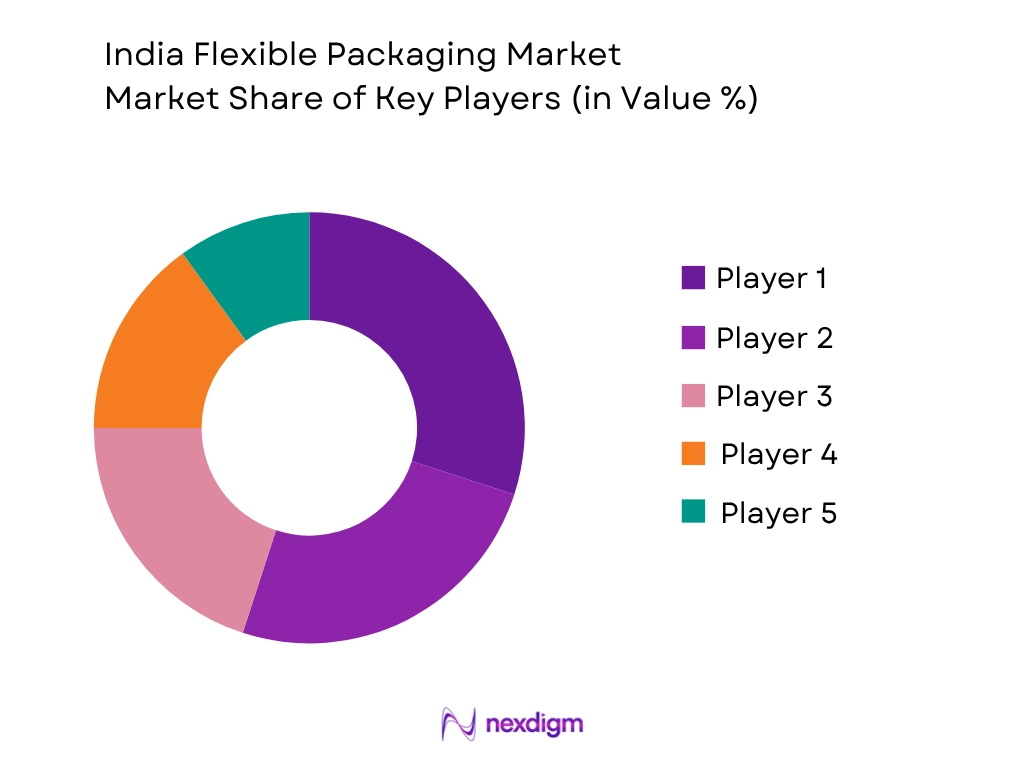
India Flexible Packaging Market Analysis
Growth Drivers
Explosive Growth in E-Commerce and Quick-Commerce Logistics
The India Flexible Packaging Market is experiencing sustained growth due to the rapid expansion of e-commerce and quick-commerce logistics across the country. India’s e-commerce sector is projected to reach USD 200 billion in revenue by 2026, according to the India Brand Equity Foundation (IBEF), driven by increasing internet and smartphone penetration. E-commerce parcel volumes surged 40% in 2024 alone, triggering a parallel spike in demand for secondary packaging formats such as tamper-evident pouches, low-gauge stretch films, and moisture-barrier liners. Package volumes from 15-minute quick-commerce delivery platforms grew 300% in major metropolitan areas during 2024, requiring tamper-proof pouches capable of preserving product integrity across multiple handling points. This rapid logistics-driven demand growth continues to create substantial opportunities for flexible packaging manufacturers capable of supplying lightweight, durable, and cost-effective packaging formats at scale.
PLI Scheme-Driven Electronics and Pharmaceutical Packaging Demand
The Indian government’s Production-Linked Incentive (PLI) scheme has significantly impacted the electronics and pharmaceutical sectors, both of which are key consumers of high-performance flexible packaging. In 2023, the electronics sector attracted investments totaling INR 4,784 crore, while the pharmaceutical sector saw new API manufacturing facilities established with investments of INR 2,019 crore. The pharmaceutical sector alone accounted for 18.0% of the India Flexible Packaging Market in FY2024 and is projected to grow to 19.35% by FY2030, requiring robust packaging solutions that meet stringent regulations and assure the safety, integrity, and effectiveness of drugs and healthcare products. These PLI-driven investments are creating sustained demand for high-barrier blister films, child-resistant flexible packaging, and anti-counterfeiting packaging features tailored to India’s expanding electronics and pharmaceutical manufacturing base.
Market Challenges
Evolving EPR and Plastic Waste Regulations
The India Flexible Packaging Market faces increasing regulatory complexity following the implementation of Extended Producer Responsibility (EPR) guidelines in 2022, which mandate 70% collection of plastic waste and place the onus of post-consumer waste management on brand owners. The Plastic Waste Management Amendment Rules of 2023 further mandate the use of compostable and biodegradable materials, while India’s 2022 ban on the production, import, storage, distribution, sale, and use of specific single-use plastic items has required manufacturers to reformulate product lines. With India generating approximately 26,000 metric tons of plastic waste daily as of 2023, these sustainability-driven regulations continue to push smaller, less-capitalized manufacturers toward consolidation, while requiring all market participants to invest in recyclable mono-material structures and compliant recycled-content resins.
Overcapacity in Biaxial Films Segment
The India Flexible Packaging Market has experienced periods of oversupply within its biaxially oriented film segment, with the industry facing a brief slowdown brought on by an excess of biaxial film (BOPP and BOPET) capacity additions in recent years. This overcapacity has created pricing pressure for manufacturers of standard commodity films, pushing companies such as Cosmo First to pivot toward higher-margin specialty films, which now constitute approximately 65% of its offerings. Additionally, only about 15% of national recycling throughput currently meets compliance thresholds for direct food-contact applications, creating a structural gap between growing recycled-content demand and available compliant processing capacity, further complicating capacity planning decisions for manufacturers across the value chain.
Market Opportunities
Vertical Integration into Recycled Content and Chemical Recycling
Growing regulatory and consumer demand for recycled-content packaging presents substantial opportunities for vertically integrated manufacturers in the India Flexible Packaging Market. UFlex’s 168,000 MTPA recycled PET (rPET) chip plant in Panipat exemplifies this trend, securing feedstock for its CPP and BOPET film lines while insulating margins against virgin-resin volatility. Financial closure for a USD 165 million depolymerization plant announced in 2024 demonstrates growing investor confidence that chemical recycling technology will meet upcoming quality thresholds for direct food contact applications. International entrants such as ALPLA have pledged to double domestic recycling capacity to 700,000 tonnes by 2030, while certified rPET currently commands a 20-25% price premium over virgin resin due to limited compliant capacity, with rPET certificates trading at an average of USD 55 per tonne on emerging EPR credit exchanges in Q1 2025, creating additional revenue opportunities for compliant recyclers.
Mono-Material and High-Barrier Film Development for Pharmaceutical and Food Export
The shift toward mono-material recyclable structures and high-barrier film technology presents significant innovation opportunities across the India Flexible Packaging Market. Pharmaceutical companies increasingly demand high-barrier blister films with integrated anti-counterfeiting features to protect sensitive medications and ensure supply chain integrity, while food and beverage manufacturers seek mono-material laminates that enhance recyclability while complying with stringent plastic waste management regulations. Technology adoption continues to differentiate market leaders, with AI-enabled vision inspection systems reducing defect rates below 0.3%, boosting production efficiency for high-speed sachet lines. Continued investment in digital printing, barrier coating technologies, and holographic anti-counterfeiting features positions Indian manufacturers to capture growing export demand from international food, beverage, and pharmaceutical companies seeking cost-competitive, high-quality flexible packaging solutions.
Future Outlook
The India Flexible Packaging Market is expected to witness sustained expansion over the forecast period, supported by continued growth in e-commerce and quick-commerce logistics, PLI scheme-driven investment in electronics and pharmaceutical manufacturing, and increasing consumer preference for sustainable packaging formats. Continued vertical integration into recycled content and chemical recycling capacity, led by companies such as UFlex, is expected to strengthen the market’s ability to meet evolving EPR compliance requirements. The market is also likely to benefit from continued innovation in mono-material and high-barrier film technologies, supporting long-term growth across food and beverage, pharmaceutical, personal care, and electronics packaging applications.
Major Players
- UFlex Limited
- Cosmo First Limited
- Jindal Poly Films Limited
- Polyplex Corporation Limited
- Huhtamaki PPL
- Amcor Flexibles India
- Essel Propack Limited
- Constantia Flexibles
- Berry Global Inc.
- Garware Hi-Tech Films Limited
- Bilcare Limited
- TCPL Packaging Limited
- Mondi Group
- Tetra Pak International
- Sonoco Products Company
Key Target Audience
- Flexible Packaging Film and Laminate Manufacturers
- Food & Beverage Companies
- Pharmaceutical Companies
- Personal Care and Cosmetics Companies
- E-Commerce and Quick-Commerce Platforms
- Recycling and Waste Management Companies
- Investment and Venture Capitalist Firms
- Government and Regulatory Bodies (Ministry of Environment, Forest and Climate Change, Central Pollution Control Board (CPCB), Bureau of Indian Standards (BIS), Food Safety and Standards Authority of India (FSSAI))
- Raw Material Suppliers and Resin Manufacturers
Research Methodology
Step 1: Identification of Key Variables
The research process begins with identifying the complete ecosystem of the India Flexible Packaging Market, including raw material suppliers, film and laminate manufacturers, converters, brand owners, retailers, and regulatory authorities. Extensive secondary research is conducted using company annual reports, government publications, trade associations, customs statistics, industry journals, and proprietary databases to determine the variables influencing market demand, pricing, production, consumption, and technological developments.
Step 2: Market Analysis and Construction
Historical market information is collected and analyzed to estimate market size, production volumes, import-export activity, application-wise demand, and pricing trends. A combination of top-down and bottom-up approaches is used to estimate market revenues and validate segment-level performance. Consumption patterns across food and beverages, pharmaceuticals, personal care, and electronics are evaluated to establish an accurate representation of the industry.
Step 3: Hypothesis Validation and Expert Consultation
The preliminary findings are validated through Computer-Assisted Telephone Interviews (CATIs) and structured discussions with flexible packaging manufacturers, procurement managers, converters, brand owners, regulatory experts, and senior executives operating within the Indian packaging industry. These interviews help verify market assumptions, competitive developments, technology adoption trends, pricing dynamics, and future investment opportunities while refining the overall market estimates.
Step 4: Research Synthesis and Final Output
The final stage integrates insights obtained from primary interviews with quantitative information collected through secondary sources. Data triangulation techniques are applied to reconcile differences between supply-side and demand-side estimates, ensuring robust market forecasting. The report is then reviewed through multiple quality assurance checkpoints to deliver a comprehensive analysis covering market size, segmentation, competitive landscape, future outlook, and strategic recommendations for industry stakeholders.

- Executive Summary
- Research Methodology (Market Definitions and Assumptions, Abbreviations, Market Sizing Approach, Top-Down Analysis, Bottom-Up Analysis, Demand-Side Assessment, Supply-Side Assessment, Primary Industry Interviews, Secondary Research Validation, Data Triangulation, Forecasting Framework, Limitations and Future Conclusions)

- Definition and Scope
- Market Evolution and Industry Genesis
- Timeline of Major Industry Developments
- Flexible Packaging Industry Value Chain Analysis
- Supply Chain Analysis

- Growth Drivers (Explosive Growth in E-Commerce and Quick-Commerce Logistics, PLI Scheme-Driven Electronics and Pharmaceutical Packaging Demand, Rising Consumption of Packaged and Convenience Foods, Expansion of Organized Retail, Growth in Sustainable Packaging Adoption, Premiumization of Consumer Products)
- Market Challenges (Evolving EPR and Plastic Waste Regulations, Overcapacity in Biaxial Films Segment, Limited Compliant Recycling Infrastructure, Raw Material Price Volatility, Regulatory Compliance Complexity)
- Market Opportunities (Vertical Integration into Recycled Content and Chemical Recycling, Mono-Material and High-Barrier Film Development, Export-Oriented Manufacturing, Smart and Intelligent Packaging Features, Pharmaceutical Anti-Counterfeiting Packaging)
- Market Trends (Shift Toward Mono-Material Recyclable Structures, Growth of Aseptic and Retort Packaging, Digital and Holographic Printing Adoption, AI-Enabled Quality Inspection, Consolidation Through Mergers and Acquisitions)
- Government Regulations (Extended Producer Responsibility Guidelines 2022, Plastic Waste Management Amendment Rules 2023, Single-Use Plastic Ban 2022, BIS Packaging Standards, Food Safety and Standards Authority of India (FSSAI) Packaging Norms)
- Import and Export Analysis (Trade Volume, Major Import Sources, Export Destinations, HS Code Analysis, Trade Balance)
- Raw Material Availability Analysis (Polyethylene, Polypropylene, Polyester Resin, Aluminum Foil Stock, Recycled PET (rPET))
- Technology Landscape (Biaxial Orientation Technology, Multi-Layer Coextrusion, Barrier Coating Technologies, Digital Printing, AI-Enabled Vision Inspection Systems)
- Sustainability Assessment (Recycled Content Adoption, Mono-Material Design, Chemical Recycling Investment, Carbon Footprint Reduction, Compostable Packaging Development)
- PESTLE Analysis
- SWOT Analysis
- Porter’s Five Forces Analysis
- Stakeholder Ecosystem
- Competition Ecosystem

- By Market Value (2020-2025)
- By Volume Consumption (2020-2025)
- By Average Selling Price (2020-2025)

- By Material (In Value %)
Plastic (BOPP, BOPET, CPP, PE & PP)
Paper
Aluminum Foil
Bioplastics & Compostable Materials - By Product Type (In Value %)
Pouches & Sachets
Films & Wraps
Bags
Liners & Labels - By Printing Technology (In Value %)
Rotogravure Printing
Flexographic Printing
Digital Printing - By End User (In Value %)
Food & Beverages
Pharmaceuticals
Personal Care & Cosmetics
Household Care
Electronics
Other Consumer Goods - By Region (In Value %)
Western India
Northern India
Southern India
Eastern India

- Market Share of Major Players (By Value, Volume, Material, Application Industry, Product Category)
- Cross Comparison Parameters (Product Portfolio Breadth, Barrier Film Capability, Application Technical Support Capability, Manufacturing Capacity, Regulatory Compliance & Certifications, Food & Pharma Customer Base, Innovation & New Product Launch Frequency)
- SWOT Analysis of Major Players
- Pricing Analysis by Product Category and SKU
- Production Capacity Analysis
- Manufacturing Footprint Analysis
- Distribution Network Analysis
- Innovation Benchmarking
- Detailed Profiles of Major Companies
UFlex Limited
Cosmo First Limited
Jindal Poly Films Limited
Polyplex Corporation Limited
Huhtamaki PPL
Amcor Flexibles India
Essel Propack Limited
Constantia Flexibles
Berry Global Inc.
Garware Hi-Tech Films Limited
Bilcare Limited
TCPL Packaging Limited
Mondi Group
Tetra Pak International
Sonoco Products Company

- Consumption Pattern Analysis (Industrial Usage, Order Size, Product Category Penetration, Seasonal Demand, Reformulation Activity)
- Purchasing Criteria (Barrier Performance, Regulatory Compliance, Cost Efficiency, Recyclability, Shelf Life, Supply Reliability)
- Procurement and Supplier Selection Analysis
- Sustainable Packaging Adoption Assessment
- Premium vs Conventional Packaging Demand
- Product Attribute Preference Analysis (Barrier Consistency, Print Quality, Seal Integrity, Recyclability, Shelf Appeal, Tamper Evidence)
- Consumer Sustainability Preference Influence on Product Development
- Pain Point Analysis
- Decision-Making Process

- By Market Value (2026-2035)
- By Volume Consumption (2026-2035)
- By Average Selling Price (2026-2035)


 Request a Sample
 Ask for Customization
 Get a Quote
 Enquire Now