
 Download PDF
Market Overview
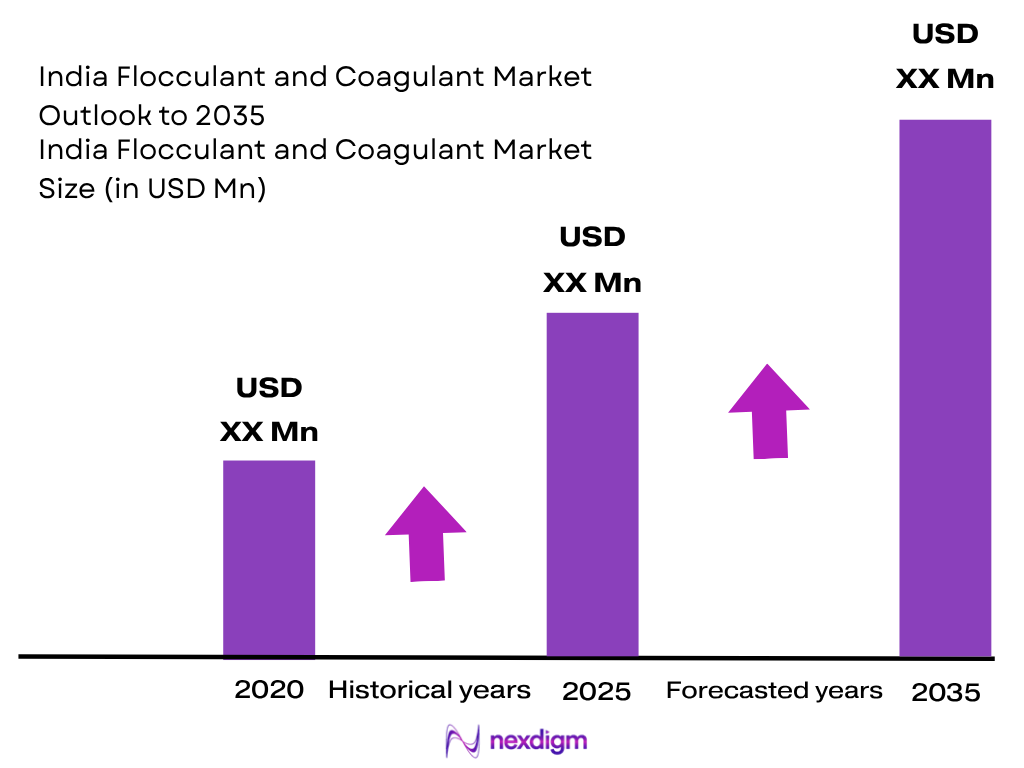
The India Flocculant and Coagulant Market is valued at USD ~ billion in 2024, with the market supported primarily by municipal drinking-water treatment, sewage treatment, industrial wastewater management, sludge dewatering, and water-reuse applications. The treatment-chemical requirement is closely linked with the expansion of water-treatment infrastructure and the increasing need to remove suspended solids, colloids and dissolved contaminants. The Central Pollution Control Board reports 61,754 MLD of sewage generation and 22,963 MLD of sewage-treatment capacity, demonstrating the scale of treatment infrastructure requiring coagulation and flocculation processes.
The India Flocculant and Coagulant Market is concentrated around major industrial and urban wastewater-treatment clusters, particularly Maharashtra, Gujarat, Tamil Nadu, Karnataka, Uttar Pradesh and Delhi. These locations combine large municipal populations with chemical, textile, pharmaceutical, engineering, food-processing, paper, mining and power-generation activities. CPCB identifies Maharashtra, Tamil Nadu, Uttar Pradesh, Delhi and Gujarat among the states accounting for approximately half of national sewage generation, while the same assessment highlights their importance in installed sewage-treatment capacity. This creates substantial recurring requirements for coagulation, flocculation and sludge-management chemicals.
Market Segmentation
By Product Type
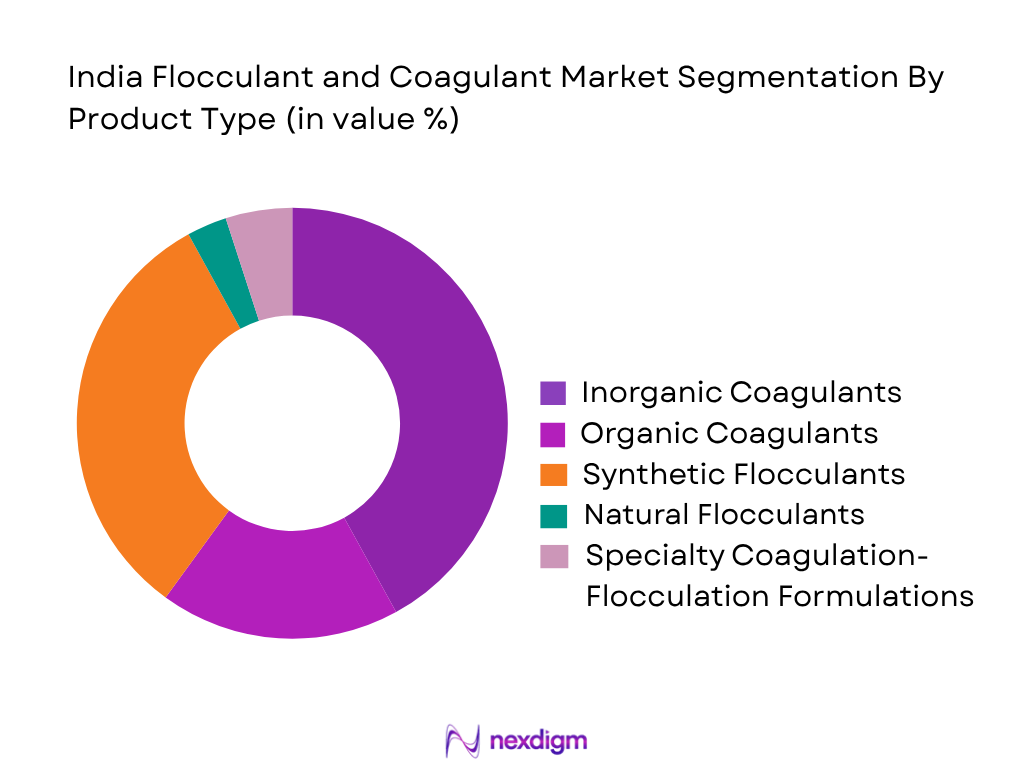
The India Flocculant and Coagulant Market is segmented by product type into inorganic coagulants, organic coagulants, synthetic flocculants, natural flocculants and specialty coagulation-flocculation formulations. Inorganic coagulants constitute a major demand category because aluminium- and iron-based chemicals are established treatment inputs for municipal drinking-water clarification, sewage treatment and industrial wastewater applications. Aluminium sulfate, polyaluminium chloride, ferric chloride and ferric sulfate are used to destabilize suspended particles and facilitate subsequent separation. Organic coagulants and polymeric flocculants complement these products where higher clarification efficiency, sludge conditioning or lower dosing requirements are required. Synthetic polymers are particularly relevant to industrial applications because formulation can be tailored to wastewater characteristics and solid-liquid separation requirements. SNF’s Indian operations, for example, manufacture polyacrylamide-based products for wastewater treatment and several industrial applications, while its Indian facility also manufactures acrylamide monomers.
By Application Type
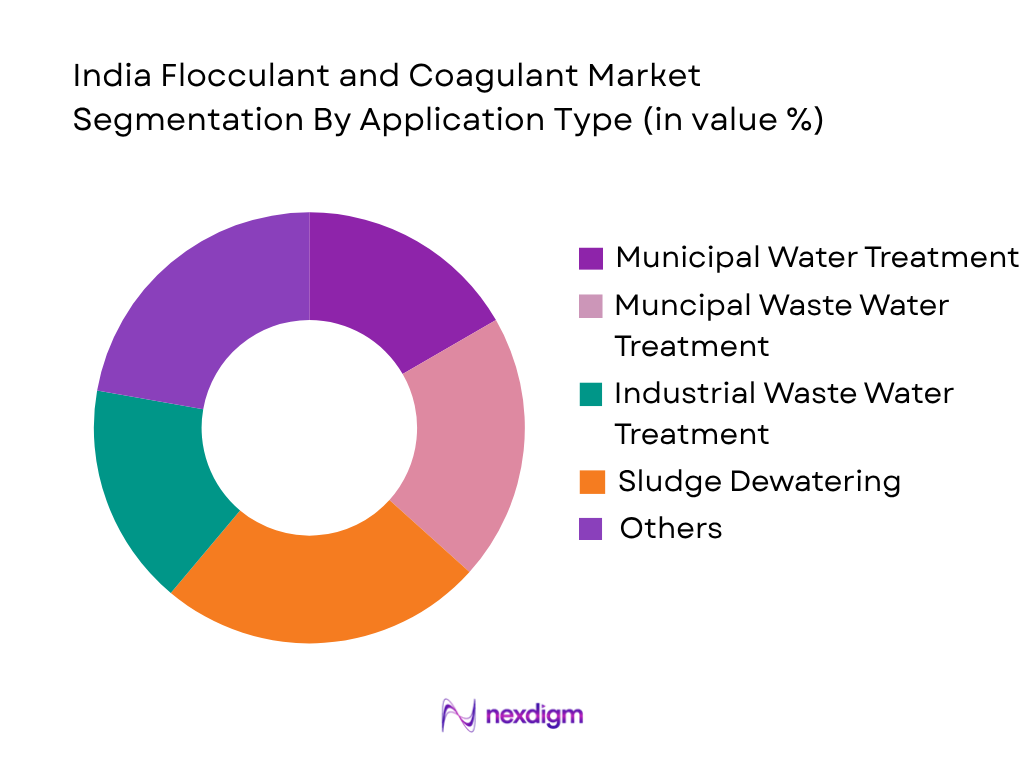
The India Flocculant and Coagulant Market is segmented by application into municipal water treatment, municipal wastewater treatment, industrial wastewater treatment, sludge dewatering, mining and mineral processing, pulp and paper, textiles, food and beverage, chemicals and pharmaceuticals, and power generation. Municipal wastewater treatment represents a structurally important application because coagulation and flocculation are integral to suspended-solids removal and sludge-management processes. The scale of India’s sewage-treatment requirement supports recurring chemical consumption: CPCB reports 61,754 MLD of sewage generation against 22,963 MLD of treatment capacity. Industrial demand further broadens the market because wastewater from textiles, paper, chemicals, mining, food processing and pharmaceuticals differs substantially in solids loading and chemistry, requiring application-specific treatment programs. Government water infrastructure programs also support treatment demand; Jal Jeevan Mission incorporates water treatment plants, distribution systems and technological interventions for contaminant removal as components of its water-supply infrastructure.
Competitive Landscape
The India Flocculant and Coagulant Market comprises global water-treatment chemical suppliers, specialty polymer manufacturers, integrated water-treatment companies and domestic chemical producers. Competition is shaped by inorganic and organic product portfolios, polymer chemistry, formulation capability, local production, technical service, water-treatment expertise and distribution coverage. SNF has maintained an Indian presence since 1989 and operates a production site at Visakhapatnam, while its portfolio includes polyacrylamide-based wastewater-treatment products.
| Major Player | Establishment | Headquarters | Product Portfolio | Key Flocculant/Coagulant Capability | Major Applications | India Manufacturing/Operations | Technical Service |
| SNF India Pvt. Ltd. | 1989 India presence | Visakhapatnam, India | ~ | ~ | ~ | ~ | ~ |
| Ecolab / Nalco Water | 1920 | St. Paul, USA | ~ | ~ | ~ | ~ | ~ |
| Kemira | 1920 | Helsinki, Finland | ~ | ~ | ~ | ~ | ~ |
| Solenis | 1907 | Wilmington, USA | ~ | ~ | ~ | ~ | ~ |
| Ion Exchange India | 1964 | Mumbai, India | ~ | ~ | ~ | ~ | ~ |
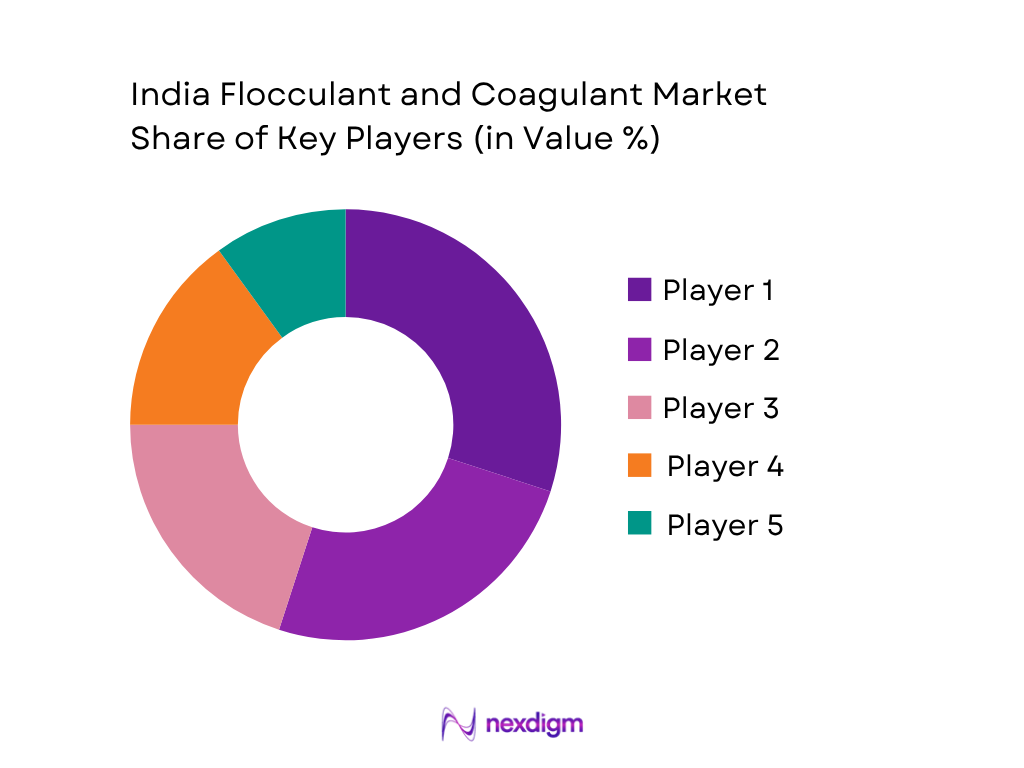
India Flocculant and Coagulant Market Analysis
Growth Drivers
Expansion of Municipal Water and Wastewater Treatment Infrastructure
The India Flocculant and Coagulant Market is supported by the scale of municipal water and wastewater treatment requirements across urban centers. The Central Pollution Control Board records 61,754 MLD of sewage generation, 22,963 MLD of sewage-treatment capacity, and 38,791 MLD of untreated sewage, indicating substantial treatment requirements for clarification, suspended-solids removal and sludge management. The infrastructure requirement is particularly relevant for flocculant and coagulant consumption because these chemicals are used in primary clarification, tertiary treatment and sludge-conditioning processes. The concentration of sewage generation in major states further strengthens regional demand: Maharashtra, Tamil Nadu, Uttar Pradesh, Delhi and Gujarat together account for approximately 50% of national sewage generation, while the same group accounts for approximately 67% of installed sewage-treatment capacity. AMRUT 2.0 is also supporting additional treatment infrastructure, with individual approved projects including a 100 MLD sewage-treatment plant in Agra and multiple STP augmentation projects. These infrastructure developments create continuing requirements for inorganic coagulants, organic coagulants and polymeric flocculants. The market therefore benefits from the physical expansion and upgrading of India’s water and wastewater-treatment network.
Industrial Manufacturing and Water-Intensive Production Expansion
Industrial manufacturing provides another important demand base for the India Flocculant and Coagulant Market because chemical treatment is required to manage wastewater generated by manufacturing processes. The World Bank reports that industry, including construction, contributed 24.6% of India’s GDP in 2024, while India’s GDP reached USD 3.91 trillion and GDP growth was 6.5%. Manufacturing activity is particularly relevant to treatment-chemical consumption because sectors such as chemicals, pharmaceuticals, rubber and plastics generate wastewater with different suspended-solid, organic and chemical characteristics. India’s Index of Industrial Production data show a manufacturing weight of 7.873 for chemicals and chemical products, 4.981 for pharmaceuticals, and 2.422 for rubber and plastics products, demonstrating the scale of these industrial categories within manufacturing output. Chemical and pharmaceutical production also recorded individual monthly IIP index levels of 135.3 and 224.5, respectively, in July 2024. Such industrial activity requires application-specific coagulation and flocculation programs for wastewater clarification and sludge separation. Consequently, continued industrial production, expansion of manufacturing clusters and increasing wastewater-management requirements create a broader customer base for treatment-chemical suppliers.
Market Challenges
Variability in Wastewater Characteristics and Treatment Requirements
The India Flocculant and Coagulant Market faces a technical challenge arising from the highly variable characteristics of municipal and industrial wastewater. Different treatment streams require different combinations of coagulant chemistry, polymer molecular weight, charge density, dosage and pH adjustment. India’s scale makes this particularly significant: CPCB records 61,754 MLD of sewage generation, while 38,791 MLD remains untreated, creating treatment requirements across municipalities with substantially different wastewater compositions and infrastructure conditions. Industrial treatment adds further complexity because chemical, pharmaceutical, textile, paper, food-processing and mineral-processing effluents contain different suspended solids and dissolved contaminants. CPCB also identifies industrial wastewater from 17 categories of medium and large-scale industries as an important pollution-management concern and notes the use of captive ETPs and common effluent-treatment plants. For suppliers, this creates requirements for jar testing, dosing optimization, technical support and customized formulations rather than a single standardized product. Treatment facilities must also balance clarification performance with sludge generation and downstream dewatering requirements. These factors increase application complexity and can lengthen product qualification and customer-conversion cycles for flocculant and coagulant manufacturers.
Chemical Feedstock and Macroeconomic Cost Pressures
The India Flocculant and Coagulant Market is exposed to broader chemical-sector and macroeconomic conditions because many products rely on aluminium, iron, acrylamide, polyacrylamide and other chemical inputs. India’s economic scale provides a large industrial demand base, but changes in monetary conditions and input availability can affect procurement decisions and supplier margins. The IMF reported 4.8% consumer-price inflation for India’s 2024/25 fiscal year, while bank credit to the private sector was projected at 13.0% year-on-year growth, indicating an environment in which financing and input conditions remain relevant to industrial purchasing. The World Bank records India’s industry, including construction, at 24.6% of GDP in 2024, reinforcing the connection between treatment-chemical demand and the wider industrial economy. Manufacturing activity also spans chemicals, pharmaceuticals, plastics and metals, creating competition for chemical feedstocks and logistics capacity. For treatment-chemical suppliers, disruptions in upstream chemical availability can affect formulation schedules and inventory requirements, while industrial customers may seek lower chemical consumption through optimized dosing or alternative treatment processes. The challenge is therefore not limited to raw-material availability but also encompasses supply planning, formulation consistency and maintaining reliable delivery to dispersed municipal and industrial treatment facilities.
Market Opportunities
Expansion of Water Reuse, Sewage Treatment and Sludge Management
The expansion of water reuse and improved sewage-treatment infrastructure creates opportunities for higher-value flocculant and coagulant applications in India. CPCB’s recorded 61,754 MLD of sewage generation and 22,963 MLD of treatment capacity demonstrate a large infrastructure requirement for treatment and process optimization. AMRUT 2.0 is incorporating wastewater reuse and treatment into urban infrastructure, with the Ministry of Housing and Urban Affairs setting a 50 MLD recycled-water development target for the relevant program output framework. Individual projects demonstrate the direction of infrastructure development: Navi Mumbai has an approved 10 MLD tertiary-treatment facility for treated-wastewater reuse, while Agra has a 100 MLD sewage-treatment plant under the program. These developments can increase demand for treatment chemicals beyond conventional primary clarification, including polymers for tertiary-treatment processes, sludge thickening and dewatering. The opportunity is therefore linked to increasing treatment intensity rather than simply greater wastewater volumes. Suppliers capable of providing application-specific chemistry, automated dosing support and formulations suited to sludge-management processes can address increasingly sophisticated treatment requirements. Water reuse also encourages treatment operators to focus on consistent clarification and contaminant removal, supporting demand for specialized coagulation and flocculation programs.
Industrial Effluent Treatment and Specialty Flocculation Applications
Industrial wastewater treatment offers an opportunity for product specialization because India’s manufacturing base spans industries with substantially different effluent characteristics. The World Bank records USD 3.91 trillion of Indian GDP in 2024, with industry including construction contributing 24.6% of GDP, while the government’s industrial-production data separately track chemical products, pharmaceuticals, rubber and plastics, non-metallic minerals and basic metals. The IIP weighting assigned to chemicals and chemical products is 7.873, pharmaceuticals 4.981, rubber and plastics 2.422, and basic metals 12.804, highlighting substantial industrial activity across multiple wastewater-generating sectors. Treatment requirements in these industries can extend beyond conventional clarification to include color removal, fine-particle separation, sludge conditioning and difficult solid-liquid separation. This creates opportunities for higher-performance polyacrylamide formulations, organic coagulants, charge-specific polymers and customized treatment programs. Common effluent-treatment plants also provide a route to serve clusters of smaller industrial units: CPCB records 194 CETPs with combined treatment capacity of approximately 1,475–1,500 MLD across 18 states and Delhi in its national assessment. As industrial clusters expand and treatment plants seek improved operating efficiency, suppliers with specialized formulations and application engineering can address more complex effluent streams.
Future Outlook
The India Flocculant and Coagulant Market is expected to benefit from continued development of municipal water infrastructure, sewage treatment, industrial wastewater treatment and water-reuse systems. Increasing treatment complexity should support demand for application-specific polymeric flocculants, organic coagulants and optimized chemical-treatment programs. Expansion of industrial manufacturing, particularly in water-intensive sectors, should sustain industrial wastewater-treatment requirements. The market is also positioned to benefit from greater emphasis on sludge dewatering, treatment efficiency, contaminant removal and water-resource conservation.
Major Players
- SNF India Pvt. Ltd.
- Ecolab / Nalco Water India
- Kemira Chemicals India
- Solenis India
- Ion Exchange India Limited
- Thermax Limited
- Gujarat Alkalies and Chemicals Limited
- Chemtex Speciality Limited
- Aries Chemical
- Feralco India
- Aquapharm Chemicals
- Accepta India
- Vizag Chemicals
- VIMARSHANA Chemical Industries
- Sree Rayalaseema Hi-Strength Hypo Limited
Key Target Audience
- Water-treatment chemical manufacturers and formulators
- Municipal water and wastewater treatment operators
- Industrial wastewater treatment companies
- Specialty chemical distributors
- Mining and mineral-processing companies
- Pulp, paper, textile and chemical manufacturers
- Investments and venture capitalist firms
- Government and regulatory bodies (Central Pollution Control Board, Ministry of Jal Shakti, Department of Water Resources, River Development and Ganga Rejuvenation)
Research Methodology
Step 1: Identification of Key Variables
The initial phase involves constructing an India Flocculant and Coagulant Market ecosystem covering chemical manufacturers, water-treatment operators, municipal authorities, industrial consumers, distributors and wastewater-treatment technology providers. Key variables include product chemistry, treatment application, consumption volume, production capacity, import dependence, industrial wastewater generation and treatment infrastructure. Public-sector water and pollution-control datasets are incorporated to establish the market’s demand framework.
Step 2: Market Analysis and Construction
Historical market information is compiled through a combination of secondary research, industry databases, company disclosures, trade information and government publications. The analysis separates inorganic coagulants, organic coagulants, polymeric flocculants and specialty formulations while mapping consumption across municipal and industrial applications. Bottom-up calculations are constructed by evaluating treatment capacity, chemical application requirements, industrial demand and supplier-level operating information.
Step 3: Hypothesis Validation and Expert Consultation
Market hypotheses are validated through discussions with water-treatment chemical manufacturers, formulation specialists, treatment-plant operators, distributors and industrial procurement professionals. Interviews focus on chemical selection, dosing practices, product substitution, customer requirements, treatment efficiency and procurement behavior. The resulting insights are cross-checked against available company information and public-sector infrastructure data.
Step 4: Research Synthesis and Final Output
The final research phase integrates demand-side and supply-side findings into a unified India Flocculant and Coagulant Market model. Market estimates are tested against production, trade, treatment infrastructure and end-use indicators to identify inconsistencies. Segmentation outputs are then validated across product type, application, end-use industry, distribution structure and geographic demand before preparation of the final market outlook.

- Executive Summary
- Research Methodology (Market Definition and Scope, India Flocculant and Coagulant Market Classification, Coagulant and Flocculant Product Mapping, Inorganic and Organic Chemistry Assessment, Polymer Grade Assessment, Dosage and Treatment-Stage Assessment, Application-Level Demand Analysis, End-Use Industry Assessment, Water and Wastewater Treatment Capacity Mapping, Domestic Manufacturing Assessment, Import and Export Trade Analysis, Aluminium and Iron Salt Feedstock Assessment, Polyacrylamide and PolyDADMAC Feedstock Assessment, Demand-Side Assessment, Supply-Side Assessment, Top-Down Market Sizing, Bottom-Up Market Sizing, Primary Industry Interviews, Data Triangulation, Forecasting Framework, Market Share Validation, Limitations and Future Conclusions)

- Definition and Scope
- India Flocculant and Coagulant Industry Evolution and Development of Municipal Water Treatment, Industrial Effluent Treatment, Sewage Treatment Infrastructure, Polymer Chemistry and Advanced Solid-Liquid Separation Technologies
- Flocculant and Coagulant Value Chain Analysis
- Flocculant and Coagulant Supply Chain Analysis
- Aluminium and Iron Salt Manufacturers, Chemical Feedstock Suppliers, Polyacrylamide Producers, Organic Coagulant Manufacturers, Water Treatment Chemical Formulators, Specialty Chemical Distributors, Water Treatment OEMs, Engineering Procurement and Construction Companies, Municipal Utilities, Industrial Treatment Plants, End-Use Industries
- Coagulant Integration Across Drinking Water Treatment, Municipal Sewage Treatment, Industrial Effluent Treatment, Pulp and Paper, Textile, Mining, Power Generation, Food Processing, Chemical Manufacturing and Oil and Gas Applications
- Flocculant Integration Across Clarification, Sludge Dewatering, Thickening, Dissolved Air Flotation, Mineral Processing, Industrial Wastewater Treatment, Municipal Wastewater Treatment and Water Reuse Applications

- Growth Drivers (Expansion of Municipal Sewage Treatment Infrastructure, Rising Industrial Effluent Treatment Requirements, Growth of Water Reuse and Recycling, Expansion of Urban Water Infrastructure, Stricter Effluent Discharge Compliance, Growth of Mining and Mineral Processing, Expansion of Pulp and Paper Production, Textile Industry Wastewater Treatment Demand, Increasing Sludge Dewatering Requirements)
- Market Challenges (Volatility in Aluminium and Iron-Based Feedstocks, Acrylamide and Specialty Monomer Supply Exposure, Dependence on Imported Specialty Treatment Polymers, Variability in Raw Water and Wastewater Characteristics, Chemical Sludge Generation, Technical Dosage Optimization Requirements, Fragmented Industrial Treatment Infrastructure, Skilled Water Treatment Personnel Requirements, Competition from Advanced Physical and Membrane Treatment Technologies)
- Market Opportunities (Municipal Sewage Treatment Expansion, Industrial Water Reuse and Zero-Liquid-Discharge Applications, Bio-Based and Natural Flocculants, High-Performance Cationic Polymers, Specialty Coagulants for Difficult Effluents, Sludge Dewatering Optimization, Mining Wastewater Treatment, Textile Effluent Treatment, Pulp and Paper Process Optimization, Digital Chemical Dosing and Treatment Monitoring)
- Market Trends (Shift Toward High-Performance Polymeric Flocculants, PolyDADMAC and Polyamine Adoption, Low-Dose Treatment Formulations, Water Reuse and Recycling, Advanced Sludge Dewatering, Bio-Based Flocculant Development, Automated Chemical Dosing, Online Water Quality Monitoring, Integrated Coagulation-Flocculation Systems, Increasing Treatment Chemical Optimization)
- Government Regulations and Standards (Central Pollution Control Board Effluent Discharge Standards, State Pollution Control Board Consent Requirements, Water Prevention and Control of Pollution Act, Environment Protection Act, Environmental Protection Rules, CPCB Sewage Treatment Plant Standards, Industrial Effluent Discharge Requirements, BIS Drinking Water Standards, Hazardous and Other Wastes Management Requirements, Chemical Handling and Workplace Safety Requirements)
- SWOT Analysis
- Porter’s Five Forces Analysis
- PESTLE Analysis
- Stakeholder Ecosystem
- Competition Ecosystem

- By Market Value (2020-2025)
- By Market Volume (2020-2025)
- By Coagulant Consumption Volume (2020-2025)
- By Flocculant Consumption Volume (2020-2025)
- By Inorganic Coagulant Consumption Volume (2020-2025)
- By Organic Coagulant Consumption Volume (2020-2025)
- By Synthetic Flocculant Consumption Volume (2020-2025)
- By Domestic Production Volume (2020-2025)
- By Import Volume (2020-2025)
- By Export Volume (2020-2025)
- By Average Selling Price (2020-2025)

- By Product Type (In Value %)
Inorganic Coagulants
Organic Coagulants
Synthetic Flocculants
Natural Flocculants
Coagulant-Flocculant Blends
Specialty Water Treatment Polymers
Other Treatment Chemicals - By Coagulant Chemistry (In Value %)
Aluminium Sulfate
Ferric Chloride
Ferric Sulfate
Polyaluminium Chloride
Polyaluminium Ferric Chloride
PolyDADMAC
Polyamine
Dicyandiamide-Based Coagulants
Other Organic Coagulants - By Flocculant Chemistry (In Value %)
Anionic Polyacrylamide
Cationic Polyacrylamide
Non-Ionic Polyacrylamide
Amphoteric Polyacrylamide
PolyDADMAC-Based Flocculants
Natural Polymer Flocculants
Biopolymer Flocculants
Other Specialty Flocculants - By Application Type (In Value %)
Drinking Water Treatment
Municipal Sewage Treatment
Industrial Effluent Treatment
Sludge Dewatering and Thickening
Mineral Processing and Mining
Paper and Pulp Processing
Textile Wastewater Treatment
Oil and Gas Water Treatment
Food and Beverage Wastewater Treatment
Power Generation Water Treatment - By End-Use Industry (In Value %)
Municipal Water Utilities
Industrial Manufacturing
Pulp and Paper Industry
Textile Industry
Mining and Mineral Processing
Oil and Gas Industry
Power Generation Industry
Chemical and Petrochemical Industry
Food and Beverage Industry
Pharmaceutical Industry
Iron and Steel Industry
Cement and Construction Materials Industry - By Treatment Process (In Value %)
Coagulation and Flocculation
Primary Clarification
Secondary Clarification
Dissolved Air Flotation
Sludge Thickening
Sludge Dewatering
Water Reuse and Recycling
Advanced Industrial Effluent Treatment - By Distribution Channel (In Value %)
Direct Industrial Sales
Direct Municipal Utility Sales
Authorized Chemical Distributors
Specialty Water Treatment Distributors
Engineering Procurement and Construction Channels
Water Treatment Equipment OEM Channels
Industrial Chemical Dealers
Online Industrial Procurement Platforms - By Region (In Value %)
West India
North India
South India
East India
Central India

- Market Share of Major Players (By India Revenue, Coagulant Sales Volume, Flocculant Sales Volume, Product Chemistry Portfolio, Municipal Treatment Exposure, Industrial Treatment Exposure, Production Capacity, Distribution Network Coverage, Regional Presence, Customer Industry Coverage, Product Certification Coverage, R&D Capability, Technical Service Capability)
- Cross Comparison Parameters (Flocculant and Coagulant Revenue, Coagulant Chemistry Portfolio Breadth, Flocculant Chemistry Portfolio Breadth, Production and Formulation Capacity, Municipal Water Treatment Coverage, Industrial Effluent Treatment Capability, Sludge Dewatering Technology Capability, Distribution Network Reach)
- SWOT Analysis of Major Players
- Competitive Positioning Matrix
- Coagulant Product Portfolio and Application Benchmarking
- Sustainable and Bio-Based Flocculant Technology Assessment
- Digital Dosing and Treatment Optimization Assessment
- Detailed Profiles of Major Companies
SNF India Pvt. Ltd.
Kemira Chemicals India Pvt. Ltd.
Ecolab / Nalco Water India Ltd.
Solenis India Pvt. Ltd.
Chemtex Speciality Limited
Aries Chemical
Accepta India Pvt. Ltd.
Thermax Limited
Ion Exchange (India) Limited
VIMARSHANA Chemical Industries Pvt. Ltd.
Feralco India
Gujarat Alkalies and Chemicals Limited
Vizag Chemicals
BWA Water Additives India Pvt. Ltd.
Aquapharm Chemicals Pvt. Ltd.

- Municipal Water Utility Chemical Procurement Assessment
- Sewage Treatment Plant Chemical Requirement Analysis
- Industrial Effluent Treatment Plant Procurement Assessment
- Pulp and Paper Chemical Treatment Requirement Analysis
- Textile Effluent Treatment Chemical Assessment
- Mining and Mineral Processing Flocculant Requirement Analysis
- Power Plant Water Treatment Chemical Assessment
- Oil and Gas Produced-Water Treatment Requirement Analysis
- Food and Beverage Wastewater Treatment Assessment
- Pharmaceutical Effluent Treatment Chemical Requirement Analysis
- Sludge Dewatering Chemical Procurement Assessment

- By Market Value (2026-2035)
- By Market Volume (2026-2035)
- By Coagulant Consumption Volume (2026-2035)
- By Flocculant Consumption Volume (2026-2035)
- By Inorganic Coagulant Consumption Volume (2026-2035)
- By Organic Coagulant Consumption Volume (2026-2035)
- By Synthetic Flocculant Consumption Volume (2026-2035)
- By Domestic Production Volume (2026-2035)
- By Import Volume (2026-2035)
- By Export Volume (2026-2035)
- By Average Selling Price (2026-2035)


 Request a Sample
 Ask for Customization
 Get a Quote
 Enquire Now