
 Download PDF
Market Overview
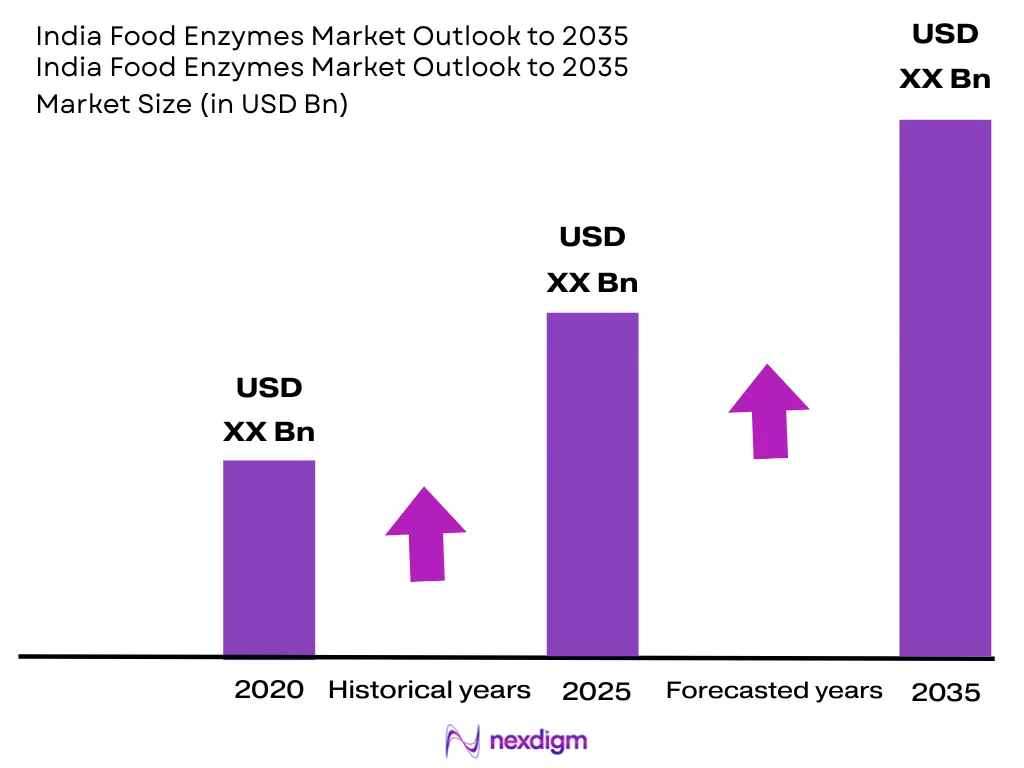
The India Food Enzymes Market was valued at USD ~ Billion in 2024 and is anticipated to expand at a CAGR of ~% during 2026–2035. The market is primarily driven by the country’s large and rapidly organising food processing industry, growing demand for clean-label processing aids, and increasing preference for vegetarian and microbial enzyme alternatives over animal-derived ingredients. According to Mordor Intelligence, the India Food Enzymes Market was worth USD ~ Billion in 2026 and is projected to grow at a CAGR of 7.11% to reach USD ~ Billion by 2031. DSM-Firmenich has committed USD 100 million toward manufacturing and laboratory investment in India, aiming to position the country among the world’s top three enzyme markets within five years, reflecting strong industry confidence in India’s long-term growth potential.
Market Segmentation
By Source
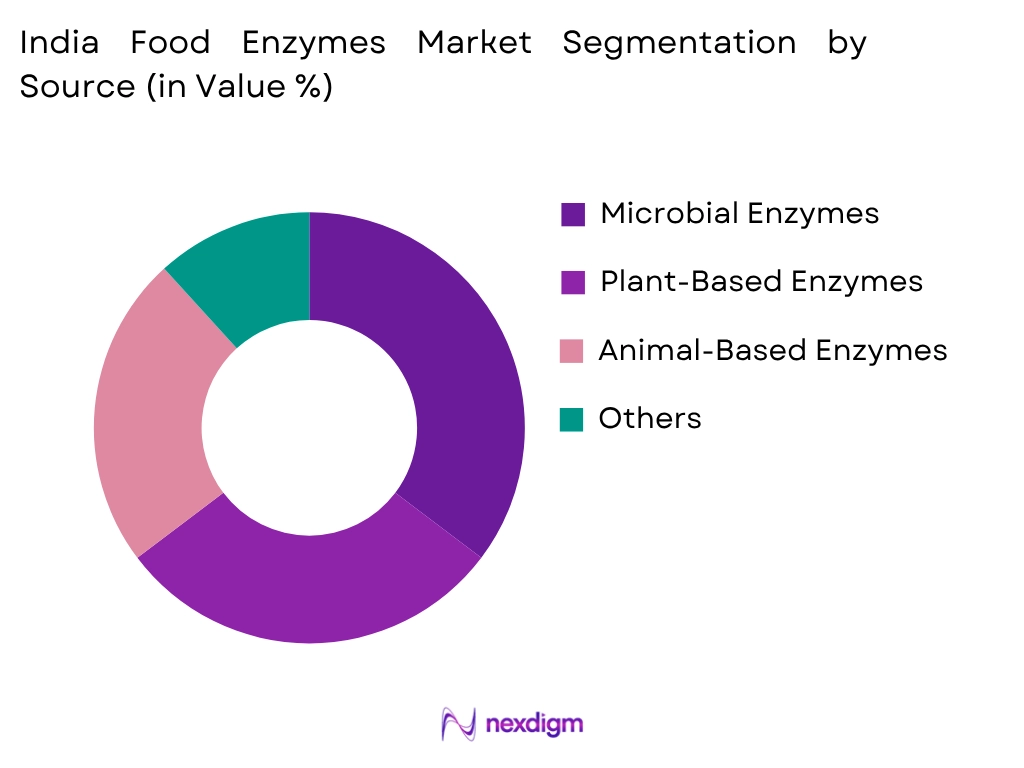
Among these, Microbial Enzymes dominate the India Food Enzymes Market owing to India’s large vegetarian population and widespread religious dietary restrictions that favour non-animal enzyme alternatives. Animal-sourced enzymes, primarily rennet used in cheese making, are steadily losing market share as microbial and plant-based substitutes gain acceptance among vegetarian consumers and processors seeking halal and kosher certifications. Global bioscience leaders such as Novonesis and Kerry have capitalised on this shift by expanding their microbial rennet and plant-based coagulant portfolios for the Indian market. Domestically, Advanced Enzyme Technologies Ltd. was the first company in the world to produce microbial rennet using genetic engineering, reflecting India’s early and continued leadership in this segment. Amano Enzyme’s focus on non-GMO microbial enzymes and classical fermentation further supports demand among processors wary of genetically modified inputs, reinforcing the segment’s dominance across dairy, bakery, and beverage applications.
By Application
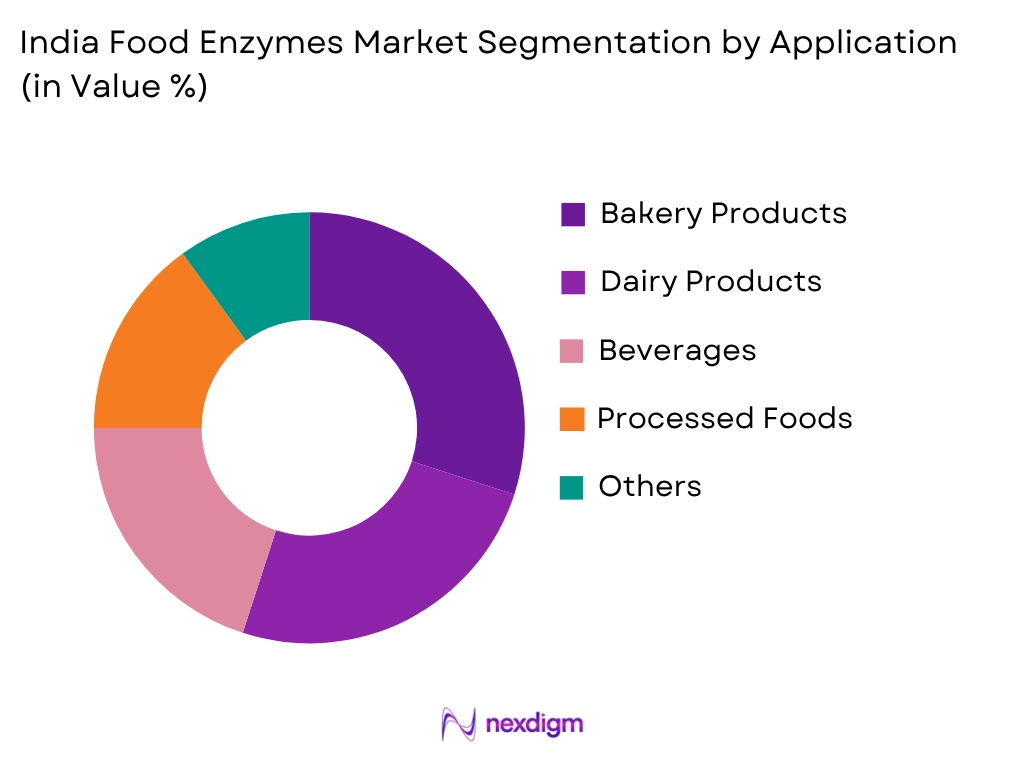
The Bakery segment holds a substantial and growing share, driven by the rapid organisation of India’s bakery industry, as organised bakery chains and industrial bread manufacturers increasingly capture market share from unbranded, kirana-store-supplied bakeries. This structural shift has heightened demand for standardised enzyme improvers that ensure consistent crumb texture, extend shelf life, and reduce dependence on chemical emulsifiers. As large-scale production lines demand precise dough rheology and predictable fermentation windows amid varying flour quality and ambient humidity, enzyme blends have become indispensable processing aids. Puratos India, for instance, uses amylase and hemicellulase-based technologies in enzyme bread improvers such as Soft’r Toast to enhance softness and resilience while adhering to non-bromated regulatory standards, illustrating the broader industry shift toward packaged breads, buns, and sweet goods supported by enzymatic solutions.
Competitive Landscape
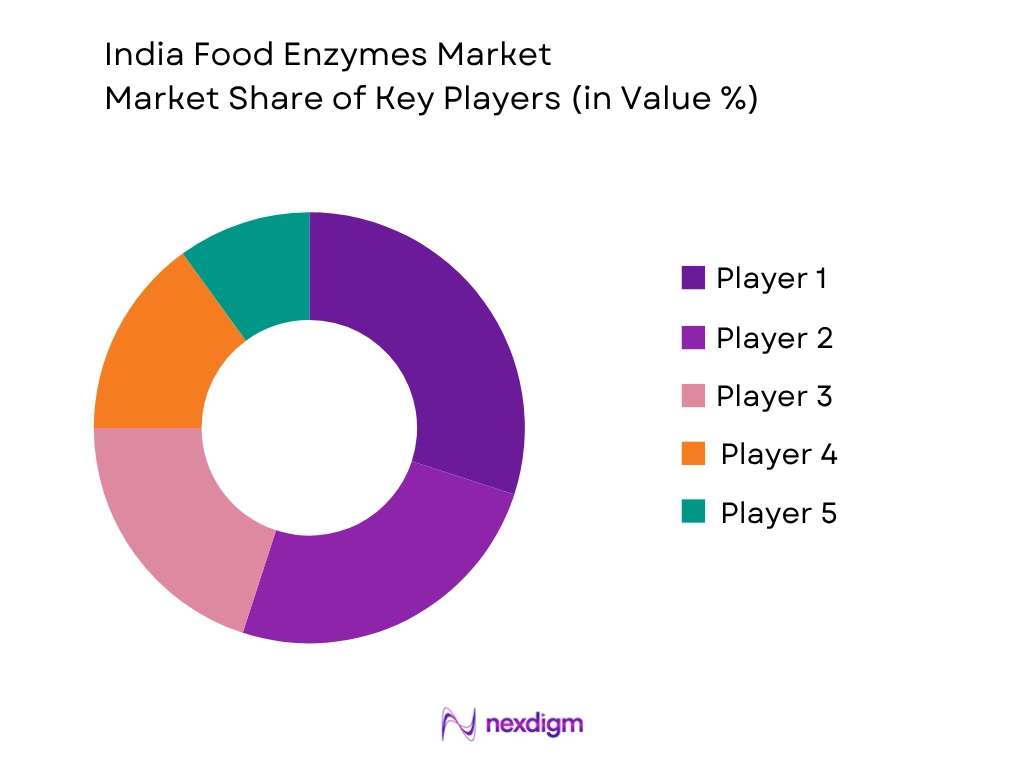
The India Food Enzymes Market is fairly fragmented, with multiple companies participating across various segments of the industry. Global leaders such as Novonesis, a EUR 3.7 billion biosolutions entity formed in February 2024 from the merger of Novozymes and Chr. Hansen, and DSM-Firmenich dominate through their expertise in technical services, regulatory affairs, and fermentation intellectual property. Domestic players such as Advanced Enzyme Technologies Ltd., Maps Enzymes Limited, and Lumis Biotech Pvt. Ltd. leverage cost efficiencies and regional distribution networks to cater to Tier-2 and Tier-3 food processors across the country. Competition is primarily based on enzyme portfolio breadth, custom development capability, cost efficiency, regulatory compliance, and distribution reach into India’s dispersed processing base. The National Centre for Cold-chain Development’s October 2024 quality certification programme aims to improve logistics for temperature-sensitive enzyme products, though benefits are expected to take until 2026 to materialise fully.
| Company | Establishment Year | Headquarters | Primary Product Portfolio | Enzyme Portfolio
|
Manufacturing Presence | Major End-Use Industries | Key Strategic Focus | Certifications & Compliance |
| Advanced Enzyme Technologies Ltd. | 1957 | ~ | ~ | ~ | ~ | ~ | ~ | ~ |
| Maps Enzymes Limited | 1975 | ~ | ~ | ~ | ~ | ~ | ~ | ~ |
| Lumis Biotech Pvt. Ltd. | 1994 | ~ | ~ | ~ | ~ | ~ | ~ | ~ |
| Novonesis (Novozymes A/S) | 2000 | ~ | ~ | ~ | ~ | ~ | ~ | ~ |
| DSM-Firmenich (Koninklijke DSM N.V.) | 1902 | ~ | ~ | ~ | ~ | ~ | ~ | ~ |
India Food Enzymes Market Analysis
Growth Drivers
Rapid Organisation of India’s Food Processing Industry
The India food enzymes market is experiencing sustained growth due to the rapid organisation of the country’s food processing industry, particularly within the bakery sector. Organised bakery chains and industrial bread manufacturers are increasingly capturing market share, sidelining unbranded kirana-store suppliers, according to Mordor Intelligence. This shift toward packaged breads, buns, and sweet goods has surged the adoption of standardised enzyme improvers that ensure consistent crumb texture, extend shelf life, and reduce dependence on chemical emulsifiers. Large-scale production lines demand precise dough rheology and predictable fermentation windows, capabilities that only enzyme blends can reliably offer amid varying flour quality and ambient humidity across India’s diverse climatic regions. This structural shift in the food processing landscape is expected to sustain strong demand for baking and processing enzymes over the forecast period.
Growing Preference for Vegetarian and Microbial Enzyme Alternatives
India’s large vegetarian population and religious dietary restrictions continue to drive demand for microbial and plant-based enzymes over animal-sourced alternatives, a structural feature that distinguishes the Indian market from many other geographies. Animal-sourced enzymes, primarily rennet for cheese making, are losing market share as microbial and plant-based alternatives gain acceptance among vegetarian consumers and processors seeking halal and kosher certifications. This trend is being actively leveraged by companies such as Novonesis and Kerry through microbial rennet and plant-based coagulants, while Amano Enzyme’s focus on non-GMO microbial enzymes and classical fermentation caters to processors wary of GMO-derived products. The Indian government’s BioE3 policy, targeting a USD 300 billion bioeconomy by 2030, is expected to further accelerate research and development in microbial enzyme engineering, benefiting domestic players such as Advanced Enzyme Technologies Ltd. and Infinita Biotech, according to the Department of Biotechnology.
Market Challenges
High Dependence on Imported Specialty Enzymes
India’s food enzymes market remains significantly dependent on imported specialty enzymes and enzyme technologies, particularly for niche applications requiring advanced fermentation and protein engineering capabilities concentrated among a small number of global producers such as Novonesis and DSM-Firmenich. While domestic players continue to expand production capacity, commercial-scale production of advanced engineered enzyme variants remains nascent and concentrated among a limited set of players, including Advanced Enzyme Technologies Ltd. and Infinita Biotech, as noted by the Department of Biotechnology. This dependency exposes Indian food and beverage manufacturers to currency fluctuations, import logistics costs, and global supply disruptions, particularly for enzymes requiring temperature-controlled storage and transport across India’s developing cold-chain infrastructure.
Cold-Chain and Logistics Infrastructure Gaps
Enzyme stability and quality are highly sensitive to temperature and storage conditions, presenting a persistent challenge in a market where cold-chain infrastructure remains under development outside major metropolitan hubs. The National Centre for Cold-chain Development’s October 2024 quality certification programme aims to improve logistics standards for temperature-sensitive products, though industry observers note that benefits may take until 2026 to fully materialise. This infrastructure gap particularly affects the ability of domestic manufacturers to serve Tier-2 and Tier-3 food processors reliably, complicating distribution for both imported specialty enzymes and domestically produced alternatives. In addition, manufacturers must navigate compliance with the Food Safety and Standards Authority of India (FSSAI), which regulates the approval, labelling, and permitted usage levels of food enzymes, adding further complexity to product development and market entry for new enzyme formulations.
Market Opportunities
Government Bioeconomy Initiatives and Domestic Manufacturing Expansion
India’s BioE3 policy, targeting a USD 300 billion bioeconomy by 2030, presents a substantial opportunity for domestic enzyme manufacturers to expand research and development capabilities in microbial enzyme engineering, as highlighted by the Department of Biotechnology. The “Atmanirbhar Bharat” (Self-Reliant India) campaign further promotes domestic manufacturing and innovation across biotechnology and enzyme sectors, encouraging increased local production capacity and reduced dependency on imports. DSM-Firmenich’s USD 100 million investment in Indian manufacturing and laboratory infrastructure, aimed at positioning India among the top three global enzyme markets within five years, illustrates the scale of opportunity multinational and domestic players alike see in India’s expanding food processing base. Domestic players such as Advanced Enzyme Technologies Ltd., which holds the largest domestic enzyme manufacturing footprint in the country, are well positioned to capture this growth through continued capacity expansion and R&D investment.
Growth in Organised Retail and Functional Food Categories
The continued expansion of organised bakery chains, packaged food manufacturing, and functional food categories across India creates substantial long-term opportunities for enzyme manufacturers. As Indian consumers increasingly shift toward packaged breads, dairy alternatives, and health-oriented food products, demand for enzyme-based processing solutions that improve texture, shelf life, and nutritional profile continues to rise. Growth in India’s dairy processing sector, combined with rising demand for lactose-free and reduced-sugar products, further supports expansion of the lactase and specialty dairy enzyme segments. Domestic biotechnology firms report measurable gains in enzyme efficiency through advancements in protein modification and recombinant DNA technology, according to Ken Research, positioning Indian enzyme manufacturers to compete more effectively both domestically and in export markets across South and Southeast Asia.
Future Outlook
The India Food Enzymes Market is expected to witness steady expansion over the forecast period, supported by the continued organisation of the country’s food processing industry, sustained government support through the BioE3 policy and Atmanirbhar Bharat campaign, and rising consumer preference for vegetarian, microbial, and clean-label enzyme solutions. Growing investment from both domestic manufacturers and global players such as DSM-Firmenich and Novonesis will further accelerate capacity expansion and technology transfer into the Indian market. The market is also likely to benefit from improving cold-chain infrastructure and continued growth in organised bakery, dairy, and functional food categories, even as manufacturers navigate import dependency for specialty enzymes and a still-developing domestic regulatory and logistics landscape.
Major Players
- Novonesis (Novozymes A/S)
- DSM-Firmenich (Koninklijke DSM N.V.)
- Chr. Hansen India
- Kerry Group plc
- IFF (International Flavors & Fragrances)
- DuPont Nutrition & Biosciences
- BASF SE
- Amano Enzyme Inc.
- Puratos India
- Advanced Enzyme Technologies Ltd.
- Maps Enzymes Limited
- Lumis Biotech Pvt. Ltd.
- Aumgene Biosciences
- JC Biotech Private Limited
- Antozyme Biotech Pvt. Ltd.
Key Target Audience
- Food Enzyme Manufacturers
- Food & Beverage Processing Companies
- Bakery Manufacturers
- Dairy Product Manufacturers
- Brewers and Beverage Manufacturers
- Investment and Venture Capitalist Firms
- Government and Regulatory Bodies (Food Safety and Standards Authority of India (FSSAI), Department of Biotechnology, Ministry of Food Processing Industries)
- Food Ingredient Distributors and Industrial Raw Material Suppliers
Research Methodology
Step 1: Identification of Key Variables
The research process begins with identifying the complete ecosystem of the India Food Enzymes Market, including raw material and fermentation feedstock suppliers, enzyme manufacturers, ingredient distributors, food processors, retailers, and regulatory authorities. Extensive secondary research is conducted using company annual reports, government publications, trade associations, customs statistics, industry journals, and proprietary databases to determine the variables influencing market demand, pricing, production, consumption, and technological developments.
Step 2: Market Analysis and Construction
Historical market information is collected and analysed to estimate market size, production volumes, import-export activity, application-wise demand, and pricing trends. A combination of top-down and bottom-up approaches is used to estimate market revenues and validate segment-level performance. Consumption patterns across bakery, dairy, beverages, confectionery, processed foods, and nutraceuticals are evaluated to establish an accurate representation of the industry.
Step 3: Hypothesis Validation and Expert Consultation
The preliminary findings are validated through Computer-Assisted Telephone Interviews (CATIs) and structured discussions with enzyme manufacturers, procurement managers, distributors, food technologists, regulatory experts, and senior executives operating within the Indian food industry. These interviews help verify market assumptions, competitive developments, technology adoption trends, pricing dynamics, and future investment opportunities while refining the overall market estimates.
Step 4: Research Synthesis and Final Output
The final stage integrates insights obtained from primary interviews with quantitative information collected through secondary sources. Data triangulation techniques are applied to reconcile differences between supply-side and demand-side estimates, ensuring robust market forecasting. The report is then reviewed through multiple quality assurance checkpoints to deliver a comprehensive analysis covering market size, segmentation, competitive landscape, future outlook, and strategic recommendations for industry stakeholders.

- Executive Summary
- Research Methodology (Market Definitions and Assumptions, Abbreviations, Market Sizing Approach, Top-Down Analysis, Bottom-Up Analysis, Demand-Side Assessment, Supply-Side Assessment, Primary Industry Interviews, Secondary Research Validation, Data Triangulation, Forecasting Framework, Limitations and Future Conclusions)

- Definition and Scope
- Market Evolution and Industry Genesis
- Timeline of Major Industry Developments
- Food Enzymes Industry Value Chain Analysis
- Supply Chain Analysis

- Growth Drivers (Growing Clean Label Food Demand, Rising Consumption of Processed Foods, Expansion of Organized Bakery Chains, Increasing Demand for Lactose-Free and Vegetarian-Friendly Enzymes, Growth of Dairy Processing, Government Bioeconomy Initiatives)
- Market Challenges (High Cost of Specialty Enzymes, Enzyme Stability and Cold-Chain Requirements, Raw Material Price Volatility, Regulatory Compliance Complexity, Fragmented Distribution Network, Import Dependency for Specialty Enzymes)
- Market Opportunities (Precision Fermentation Technologies, Domestic Enzyme Manufacturing Expansion, Vegetarian and Halal-Certified Enzyme Demand, Functional Food Innovation, Export-Oriented Enzyme Manufacturing, Clean Label Reformulation Projects)
- Market Trends (Replacement of Chemical Processing Aids, Shift from Animal-Derived to Microbial Enzymes, Custom Enzyme Development, Organized Bakery Chain Expansion, Enzymes for Sugar and Additive Reduction, Multi-Functional Enzyme Blends)
- Government Regulations (FSSAI Food Enzyme Regulations, Food Labelling Requirements, Maximum Permitted Usage Levels, Novel Enzyme Approval Standards, Import Compliance, Food Safety Standards)
- Import and Export Analysis (Trade Volume, Major Import Sources, Export Destinations, HS Code Analysis, Trade Balance)
- Raw Material Availability Analysis (Fermentation Feedstocks, Cereal and Grain Substrates, Milk-Derived Substrates, Fruit and Vegetable Substrates, Microbial Strains)
- Technology Landscape (Submerged Fermentation, Solid-State Fermentation, Enzyme Immobilisation, Protein Engineering, Recombinant Enzyme Production)
- Sustainability Assessment (Renewable Fermentation Feedstocks, Carbon Footprint Reduction, Waste Valorisation, Energy-Efficient Manufacturing, Biodegradable Processing Aids)
- PESTLE Analysis
- SWOT Analysis
- Porter’s Five Forces Analysis
- Stakeholder Ecosystem
- Competition Ecosystem

- By Market Value (2020-2025)
- By Volume Consumption (2020-2025)
- By Average Selling Price (2020-2025)

- By Type (In Value %)
Carbohydrases
Proteases
Lipases
Phytases
Lactases
Pectinases - By Source (In Value %)
Microbial Enzymes
Plant-Based Enzymes
Animal-Based Enzymes - By Application (In Value %)
Bakery
Dairy
Beverages (Brewing, Wine and Juice Processing)
Confectionery
Meat, Poultry and Seafood Products
Processed Foods
Nutraceuticals and Functional Foods - By Distribution Channel (In Value %)
Direct Sales to Food Manufacturers
Ingredient Distributors
Industrial Ingredient Suppliers
Online B2B Ingredient Platforms
Specialty Ingredient Suppliers - By Region (In Value %)
North India
South India
West India
East India

- Market Share of Major Players (By Value, Volume, Enzyme Type, Application Industry, Product Category)
- Cross Comparison Parameters (Enzyme Portfolio Breadth, Custom Enzyme Development Capability, Thermal and pH Stability Performance, Application Technical Support Capability, Manufacturing Capacity, Regulatory Compliance & Certifications, Food & Beverage Customer Base, Innovation & New Product Launch Frequency)
- SWOT Analysis of Major Players
- Pricing Analysis by Product Category and SKU
- Production Capacity Analysis
- Manufacturing Footprint Analysis
- Distribution Network Analysis
- Innovation Benchmarking
- Detailed Profiles of Major Companies
Novonesis (Novozymes A/S)
DSM-Firmenich (Koninklijke DSM N.V.)
Chr. Hansen India
Kerry Group plc
IFF (International Flavors & Fragrances)
DuPont Nutrition & Biosciences
BASF SE
Amano Enzyme Inc.
Puratos India
Advanced Enzyme Technologies Ltd.
Maps Enzymes Limited
Lumis Biotech Pvt. Ltd.
Aumgene Biosciences
JC Biotech Private Limited
Antozyme Biotech Pvt. Ltd.

- Consumption Pattern Analysis (Industrial Usage, Batch Size, Product Category Penetration, Seasonal Demand, Reformulation Activity)
- Purchasing Criteria (Enzyme Activity Consistency, Regulatory Compliance, Cost Efficiency, Thermal Stability, pH Stability, Shelf Life)
- Procurement and Supplier Selection Analysis
- Clean Label Adoption Assessment
- Premium vs Conventional Product Demand
- Product Attribute Preference Analysis (Activity Consistency, Dosage Efficiency, Thermal Tolerance, Substrate Specificity, Vegetarian Certification, Label Friendliness)
- Consumer Health & Wellness Influence on Product Development
- Pain Point Analysis
- Decision-Making Process

- By Market Value (2026-2035)
- By Volume Consumption (2026-2035)
- By Average Selling Price (2026-2035)


 Request a Sample
 Ask for Customization
 Get a Quote
 Enquire Now