

 Download PDF
Market Overview
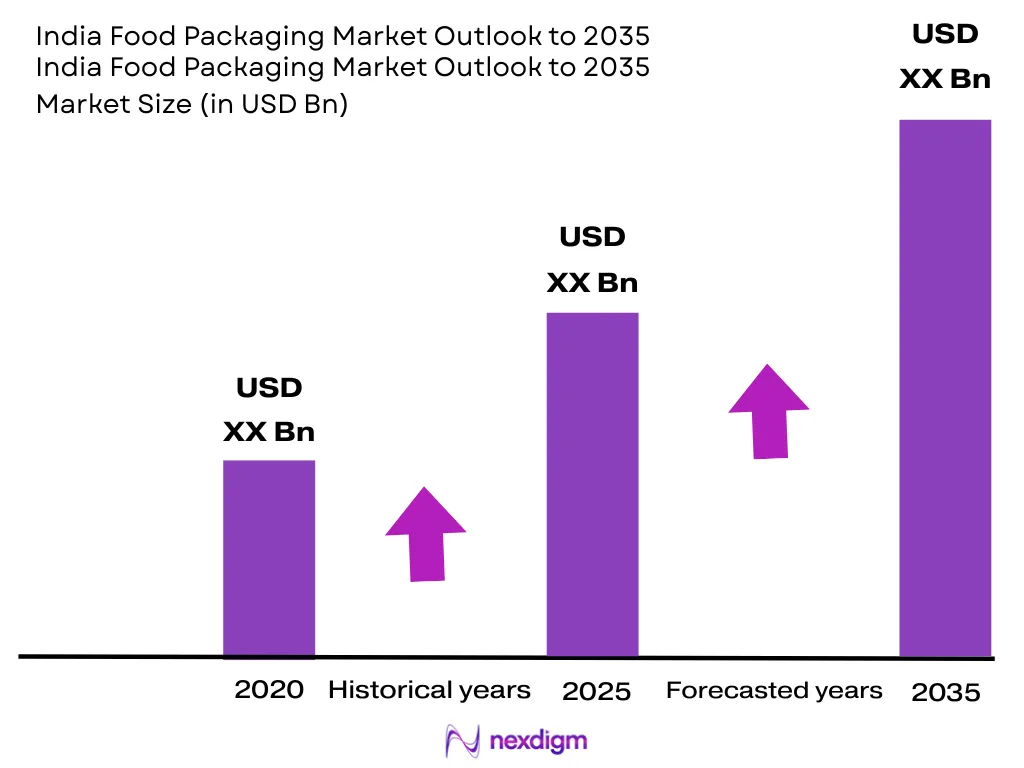
The India Food Packaging Market was valued at USD ~ Billion in 2024 and is anticipated to expand at a CAGR of ~% during 2026-2035. The market is primarily driven by rapid growth in processed and packaged food consumption across India’s 1.4 billion population base, alongside deepening organized retail penetration, quick-commerce expansion, and rising exports of processed food products. India’s food processing industry maintained an average annual growth rate of approximately 7.3% between 2015 and 2022, according to the India Brand Equity Foundation (IBEF), with exports of processed fruits and vegetables projected to rise from USD 1.53 billion in FY2021 to an estimated USD 2.48 billion by FY2024. Industry estimates place the India food packaging market at approximately USD ~ billion in 2025, growing toward approximately USD ~ billion by 2034. A significant structural shift is underway as the Environment Protection (Extended Producer Responsibility for Packaging) Rules, 2024, together with existing Plastic Waste Management Rules obligations, push converters and brand owners toward recycled-content adoption, with paper packaging required to contain 40% recycled content by 2026-27, rising to 70% by 2029-30, and analogous targets applying to metal and glass packaging.
Market Segmentation
By Material
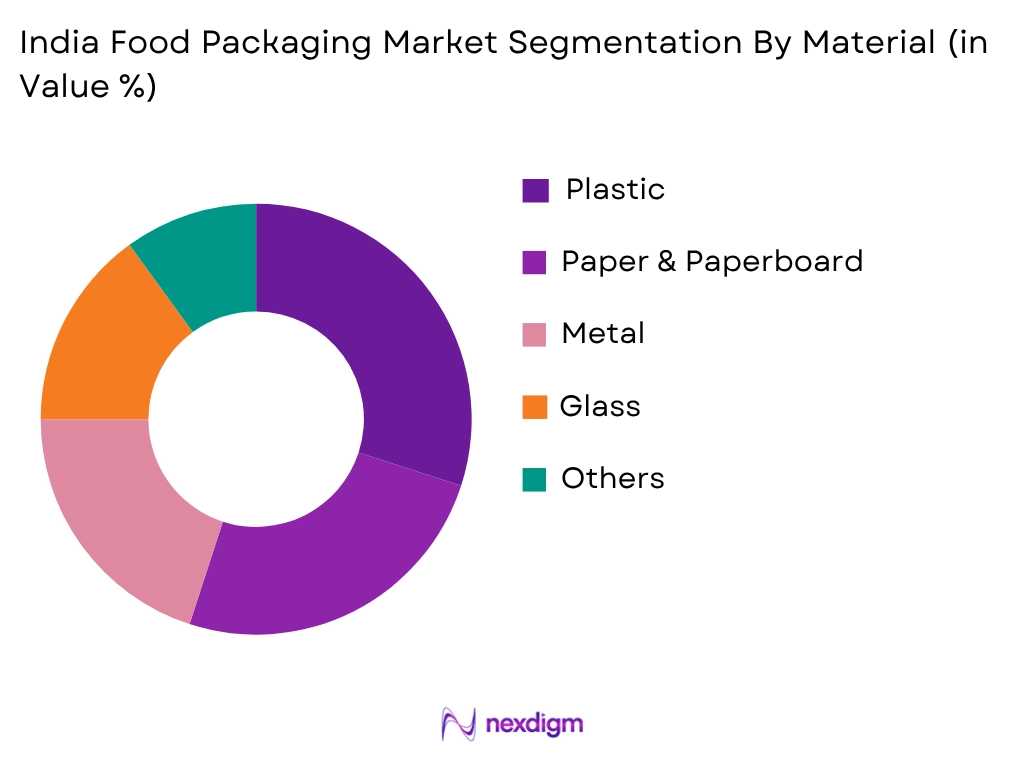
Plastic, primarily polyethylene, polypropylene, and PET, dominates the India Food Packaging Market, supported by an extensive base of converters, cost efficiency, and established filling-line compatibility across dairy, snacks, beverages, and ready-to-eat categories. Flexible plastic formats alone captured 52.88% of the India food and beverage packaging market by packaging format in 2025, according to Mordor Intelligence, reflecting the centrality of pouches, sachets, and films to Indian food packaging. Paper and paperboard, including aseptic cartons, is gaining share as multinational dairy and beverage brands invest in carton-based packaging; SIG’s phased investment in its Ahmedabad facility, announced in March 2024, is targeting production of up to 10 billion aseptic packs annually in support of net-zero emissions goals by 2050. Glass and metal retain meaningful share in condiments, beverages, and traditional preserved foods, while bioplastics and compostable formats remain nascent relative to conventional plastics, constrained by higher costs and limited domestic compostable resin production capacity.
By Product Type
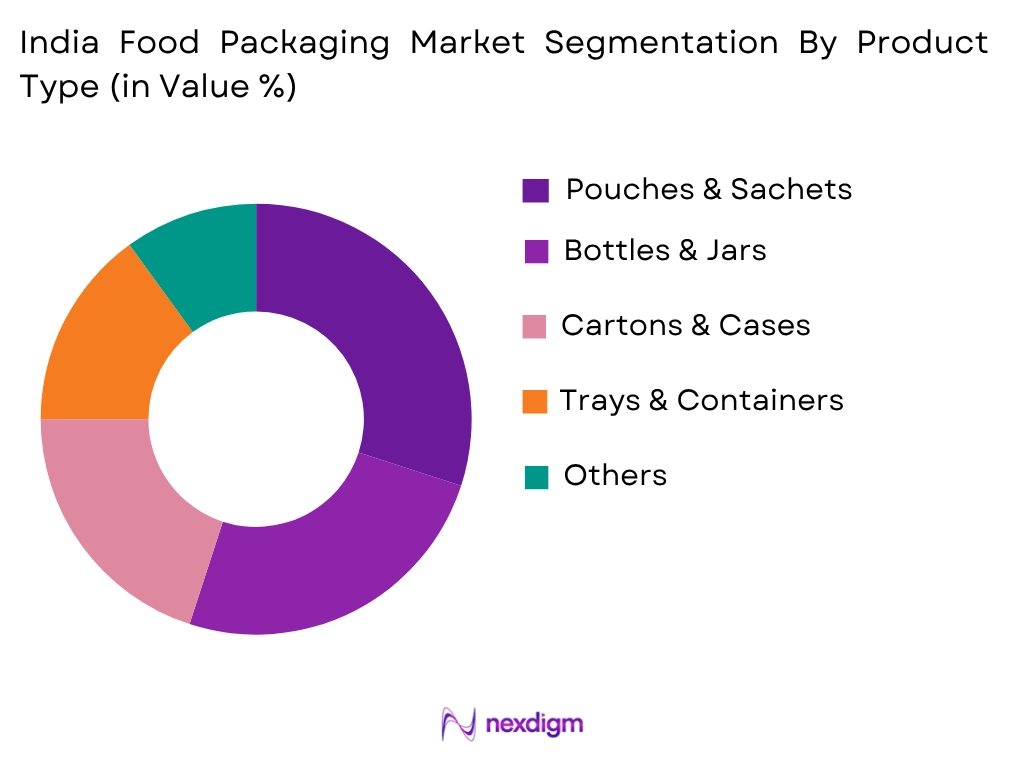
Pouches and sachets represent the largest product-type segment, reflecting India’s deeply established sachet economy across snacks, spices, dairy, and beverages, where flexible single-serve formats remain affordable and accessible to price-sensitive consumers across both urban and rural markets. Bottles, jars, and rigid containers maintain a substantial share supported by India’s dairy, edible oil, and beverage industries, with less than 10% of India’s milk output currently packaged, leaving considerable headroom for aseptic cartons and multilayer pouches, per Mordor Intelligence estimates. Cartons and cases continue to expand alongside organized retail and e-commerce logistics growth, while films and wraps benefit from rising demand for bakery, frozen, and ready-to-eat products among India’s rapidly urbanizing population. Growing quick-commerce penetration is also increasing demand for tamper-evident, resealable, and portion-controlled formats across nearly all product-type segments.
Competitive Landscape
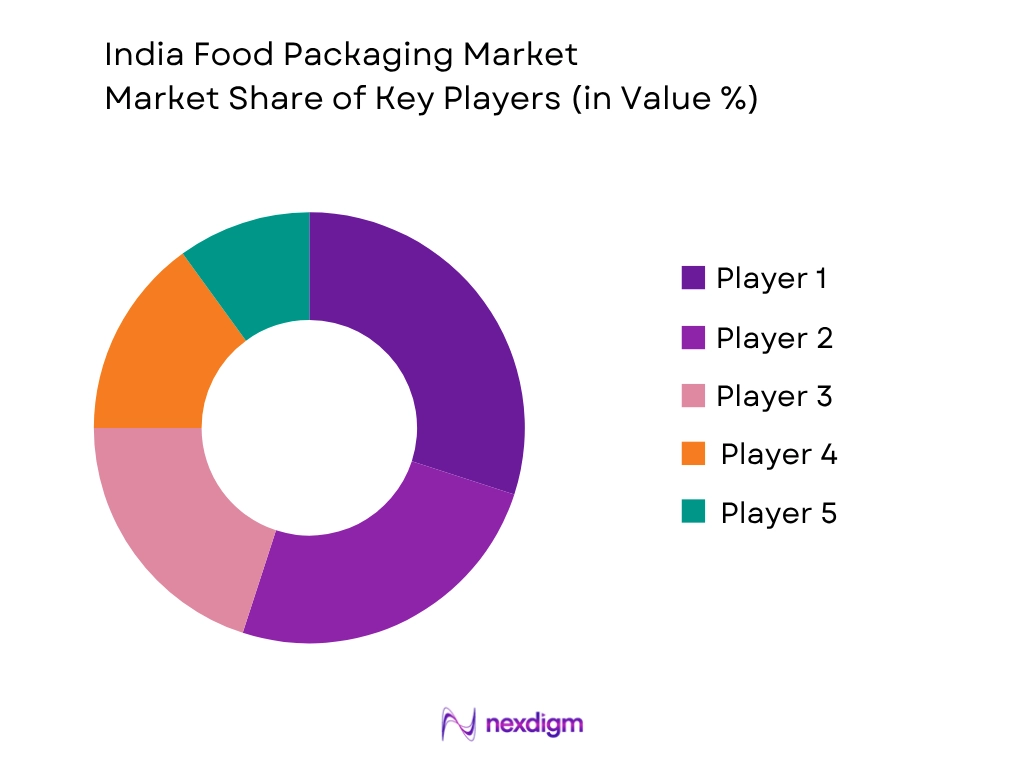
The India Food Packaging Market remains fragmented, with a mix of large diversified converters, specialized rigid and flexible packaging manufacturers, and multinational subsidiaries competing across price points and technical specifications. Competition is primarily based on manufacturing scale, feedstock integration, compliance with FSSAI and BIS standards, and the ability to serve both large multinational FMCG customers and India’s extensive base of small and medium-sized food processors. UFlex Limited has built a leading position since its establishment in 1985 as India’s largest flexible packaging materials company, serving food, beverage, and FMCG clients with packaging films, laminates, and aseptic liquid packaging solutions. Established rigid-packaging players such as Manjushree Technopack Limited and Mold-Tek Packaging Limited maintain large-scale injection-molding capacity backed by strong distribution networks, while multinational-linked converters such as Huhtamaki PPL Limited and EPL Limited bring global technical expertise in specialized pouches and laminated tube formats. The phased rollout of India’s Extended Producer Responsibility for Packaging Rules 2024 is reshaping competitive dynamics industry-wide, as converters with early investment in recycling infrastructure and recycled-content sourcing gain a structural compliance advantage over competitors still reliant on virgin feedstock.
| Company | Establishment Year | Headquarters | Primary Product Portfolio | Food Packaging Portfolio
|
Manufacturing Presence | Major End-Use Industries | Key Strategic Focus | Certifications & Compliance |
| UFlex Limited | 1985 | ~ | ~ | ~ | ~ | ~ | ~ | ~ |
| Huhtamaki PPL Limited | 1935 | ~ | ~ | ~ | ~ | ~ | ~ | ~ |
| Manjushree Technopack Limited | 1983 | ~ | ~ | ~ | ~ | ~ | ~ | ~ |
| EPL Limited | 1
982 |
~ | ~ | ~ | ~ | ~ | ~ | ~ |
| Mold-Tek Packaging Limited | 1986 | ~ | ~ | ~ | ~ | ~ | ~ | ~ |
India Food Packaging Market Analysis
Growth Drivers
Rapid Growth of India’s Processed Food and Organized Retail Sector
India’s food packaging market is experiencing sustained growth due to rapid expansion of the country’s processed and packaged food industry, which the India Brand Equity Foundation reported grew at an average annual rate of approximately 7.3% between 2015 and 2022. Supermarkets and hypermarkets accounted for 52.8% of packaged food sales channels in 2025, according to IMARC Group, reflecting continued organized retail expansion, while quick-commerce platforms are driving faster category creation and higher packaging turnover. Consistent with this trend, exports of processed fruits and vegetables were projected to rise from USD 1.53 billion in FY2021 to an estimated USD 2.48 billion by FY2024, underscoring packaging’s centrality to India’s growing agro-processing and export ambitions.
Extended Producer Responsibility Driving Recycled-Content Adoption
The notification of the Environment Protection (Extended Producer Responsibility for Packaging) Rules, 2024, effective April 1, 2026, represents a structural turning point for India’s food packaging industry. Under these rules, paper packaging must contain 40% recycled content by 2026-27, rising to 70% by 2029-30, while metal and glass packaging face escalating recycled-content and recycling targets over the same period. This builds on existing Plastic Waste Management Rules obligations, under which producers, importers, and brand owners must recycle or reuse at least 20% of plastic packaging placed on the market in FY2024-25, rising toward 100% collection and processing targets by 2028-29. Converters investing early in recycling infrastructure, such as UFlex Limited’s March 2025 commitment of Rs 317 crore toward two new recycling plants in Noida with a combined capacity of 39,600 metric tons of plastic waste annually, are positioned to gain a durable compliance and cost advantage as these mandates phase in.
Market Challenges
Frequent Regulatory Change and Fragmented Compliance Costs
India’s food packaging converters continue to navigate a rapidly evolving and frequently changing regulatory environment that raises compliance costs across the industry. Industry estimates compiled by FICCI indicate that companies faced nine separate changes to labelling regulations under FSSAI and Plastic Waste Management Rules in 2022 alone, with four further changes recommended in 2024, each requiring the destruction of pre-printed packaging inventory and imposing recurring financial and environmental costs. The Food Safety and Standards Authority of India’s April 2025 reclassification of food-grade packaging materials from ‘non-critical’ to ‘critical’ within inspection checklists further raises compliance stakes, while the absence of clear FSSAI guidelines for food-grade recycled plastics beyond rPET complicates sourcing decisions for converters seeking to meet the FY2025-26 recycled-content compliance deadline.
Competition from the Unorganized Sector and Cold Chain Infrastructure Gaps
India’s food packaging converters face substantial competition from a large unorganized manufacturing base; in the organized consumer rigid plastic packaging segment alone, the unorganized sector held roughly 60% share as of FY24, constrained by outdated infrastructure and limited access to capital but nonetheless competing aggressively on price. Inadequate temperature-controlled logistics in Tier-3 and rural markets continue to limit the reach of frozen, dairy, and ready-meal categories, creating spoilage risk and constraining the addressable market for higher-value barrier packaging formats. Converters serving India’s price-sensitive Tier-2 and Tier-3 markets must balance investment in compliance and sustainability upgrades against continued cost pressure from both unorganized competitors and increasingly frequent regulatory change.
Market Opportunities
Recycled-Content Infrastructure Investment Under EPR for Packaging Rules
The phased implementation of India’s Environment Protection (EPR for Packaging) Rules, 2024, creates substantial opportunity for converters that invest early in recycling infrastructure and recycled-content sourcing capability. With paper, metal, and glass packaging facing escalating recycled-content mandates through 2029-30, and plastic packaging waste processors required to scale collection and processing capacity toward 100% targets by 2028-29, converters positioned to supply compliant, certified recycled-content packaging are likely to capture disproportionate share of new contracts from FMCG and food processing brand owners seeking to de-risk their own EPR compliance obligations.
Quick-Commerce and Aseptic Packaging Expansion
India’s rapidly expanding quick-commerce and online grocery channels are creating substantial opportunity for converters specializing in tamper-evident, resealable, and portion-controlled packaging formats suited to last-mile delivery. Separately, with less than 10% of India’s milk output currently packaged, converters and machinery suppliers investing in aseptic carton capacity, exemplified by SIG’s phased Ahmedabad plant expansion targeting up to 10 billion packs annually, are positioned to capture significant untapped demand across dairy, plant-based beverages, and functional drinks. Growing multinational brand owner sustainability commitments and rising demand for smart, QR-code-enabled packaging further signal expanding opportunity for converters capable of combining technical performance with credible sustainability credentials.
Future Outlook
The India Food Packaging Market is expected to witness steady expansion over the forecast period, supported by continued growth in processed food consumption, organized retail and quick-commerce penetration, and rising processed food exports. Continued investment in aseptic carton capacity, recycled-content sourcing to meet phased EPR for Packaging Rules obligations, and evolving compliance capability ahead of Front-of-Pack Nutrition Labelling norms will further shape competitive positioning across the industry. The market is also likely to benefit from India’s position as one of the world’s fastest-growing large consumer markets and continued government emphasis on food processing sector growth and domestic manufacturing capacity.
Major Players
- UFlex Limited
- Huhtamaki PPL Limited
- Manjushree Technopack Limited
- EPL Limited
- Mold-Tek Packaging Limited
- TCPL Packaging Limited
- Parksons Packaging Limited
- AGI Greenpac Limited
- Amcor Flexibles India
- Cosmo First Limited
- Time Technoplast Limited
- Parekhplast India Limited
- ITC Packaging & Printing Division
- Hindustan Tin Works Limited
- Piramal Glass Private Limited
Key Target Audience
- Food Packaging Manufacturers
- Food & Beverage Processing Companies
- Agro-Processing & Export Companies
- Healthcare & Pharmaceutical Companies
- Household & Personal Care Manufacturers
- Investment and Venture Capitalist Firms
- Government and Regulatory Bodies (Food Safety and Standards Authority of India (FSSAI), Bureau of Indian Standards (BIS), Central Pollution Control Board (CPCB), Ministry of Environment, Forest and Climate Change)
- Raw Material Suppliers and Resin Producers
Research Methodology
Step 1: Identification of Key Variables
The research process begins with identifying the complete ecosystem of the India Food Packaging Market, including raw material suppliers, packaging converters, printing technology providers, brand owners, retailers, and regulatory authorities. Extensive secondary research is conducted using company annual reports, government publications, trade associations, customs statistics, industry journals, and proprietary databases to determine the variables influencing market demand, pricing, production, consumption, and technological developments.
Step 2: Market Analysis and Construction
Historical market information is collected and analyzed to estimate market size, production volumes, import-export activity, application-wise demand, and pricing trends. A combination of top-down and bottom-up approaches is used to estimate market revenues and validate segment-level performance. Consumption patterns across dairy, bakery, beverages, and ready-to-eat food packaging are evaluated to establish an accurate representation of the industry.
Step 3: Hypothesis Validation and Expert Consultation
The preliminary findings are validated through Computer-Assisted Telephone Interviews (CATIs) and structured discussions with food packaging converters, procurement managers, distributors, packaging engineers, regulatory experts, and senior executives operating within the Indian packaging industry. These interviews help verify market assumptions, competitive developments, technology adoption trends, pricing dynamics, and future investment opportunities while refining the overall market estimates.
Step 4: Research Synthesis and Final Output
The final stage integrates insights obtained from primary interviews with quantitative information collected through secondary sources. Data triangulation techniques are applied to reconcile differences between supply-side and demand-side estimates, ensuring robust market forecasting. The report is then reviewed through multiple quality assurance checkpoints to deliver a comprehensive analysis covering market size, segmentation, competitive landscape, future outlook, and strategic recommendations for industry stakeholders.

- Executive Summary
- Research Methodology (Market Definitions and Assumptions, Abbreviations, Market Sizing Approach, Top-Down Analysis, Bottom-Up Analysis, Demand-Side Assessment, Supply-Side Assessment, Primary Industry Interviews, Secondary Research Validation, Data Triangulation, Forecasting Framework, Limitations and Future Conclusions)

- Definition and Scope
- Market Evolution and Industry Genesis
- Timeline of Major Industry Developments
- Food Packaging Industry Value Chain Analysis
- Supply Chain Analysis

- Growth Drivers (Rapid Growth of Processed and Packaged Food Consumption, Rising Organized Retail & Quick-Commerce Penetration, Expansion of Cold Chain & Frozen Food Infrastructure, Growing E-Commerce & Direct-to-Consumer Food Delivery, Urbanization & Rising Disposable Incomes, Growth of Processed Food Exports)
- Market Challenges (Frequent Regulatory & Labelling Changes, Fragmented Compliance Costs Under EPR and FSSAI Norms, Competition from the Unorganized Packaging Sector, Cold Chain and Logistics Infrastructure Gaps, Volatility in Polymer & Resin Prices, Limited Domestic Recycled-Content Availability)
- Market Opportunities (Recycled-Content Demand Created by EPR for Packaging Rules 2024, Growth in Aseptic Carton & Retort Pouch Adoption, Quick-Commerce Driven Packaging Innovation, Rising Processed Food Export Packaging Demand, Smart & QR-Enabled Packaging Adoption, Sustainable and Mono-Material Packaging Investment)
- Market Trends (Shift Toward Recyclable Mono-Material Structures, Growth in Aseptic Carton Capacity, Rising Adoption of Post-Consumer Recycled (PCR) Content, Premiumization of Packaging Design, Front-of-Pack Nutrition Labelling Compliance, Regional-Language and Tier 2/3 Focused Packaging Design)
- Government Regulations (FSSAI Food Safety and Standards (Packaging) Regulations 2018, Plastic Waste Management Rules 2016 and EPR for Plastic Packaging, Environment Protection (EPR for Packaging) Rules 2024, BIS Compulsory Registration Scheme, Front-of-Pack Nutrition Labelling Norms, Import Compliance)
- Import and Export Analysis (Trade Volume, Major Import Sources, Export Destinations, HS Code Analysis, Trade Balance)
- Raw Material Availability Analysis (Domestic Polymer & Resin Supply, Recycled PET & PCR Feedstock, Kraft Paper & Paperboard, Aluminum Foil Stock, Virgin and Recycled Glass Cullet)
- Technology Landscape (Multilayer Coextrusion Technologies, Aseptic Carton Filling Systems, Flexographic & Digital Printing Systems, Barrier Coating Technologies, Mechanical & Chemical Recycling Technologies)
- Sustainability Assessment (Post-Consumer Recycled Content Adoption, Mono-Material Recyclability, PET Collection & Recycling Infrastructure Expansion, Carbon Footprint Reduction, Circular Economy Partnerships)
- PESTLE Analysis
- SWOT Analysis
- Porter’s Five Forces Analysis
- Stakeholder Ecosystem
- Competition Ecosystem

- By Market Value (2020-2025)
- By Volume Consumption (2020-2025)
- By Average Selling Price (2020-2025)

- By Material Type (In Value %)
Plastic (Polyethylene & Polypropylene)
Paper & Paperboard
Metal (Tinplate & Aluminum Cans)
Glass
Bioplastics & Compostables - By Product Type (In Value %)
Pouches & Sachets
Bottles & Jars
Cartons & Cases
Trays & Containers
Films & Wraps
Cans - By Printing Technology (In Value %)
Flexography
Rotogravure
Digital Printing
Offset Printing
Others - By End User (In Value %)
Dairy Products
Bakery, Confectionery & Snacks
Beverages
Meat, Poultry & Seafood
Fruits & Vegetables Processing
Ready-to-Eat & Convenience Foods
Edible Oils & Staples - By Region (In Value %)
West & Central India (Maharashtra, Gujarat)
North India (Delhi NCR, Punjab, Haryana, Uttar Pradesh)
South India (Karnataka, Tamil Nadu, Telangana, Andhra Pradesh)
East & Northeast India

- Market Share of Major Players (By Value, Volume, Material Type, Application Industry, Product Category)
- Cross Comparison Parameters (Product Portfolio Breadth, Feedstock Integration, Barrier Technology Performance, Application Technical Support, Manufacturing Capacity, Regulatory Compliance & Certifications, Food & Beverage Customer Base, Innovation & New Product Launch Frequency)
- SWOT Analysis of Major Players
- Pricing Analysis by Product Category and SKU
- Production Capacity Analysis
- Manufacturing Footprint Analysis
- Distribution Network Analysis
- Innovation Benchmarking
- Detailed Profiles of Major Companies
UFlex Limited
Huhtamaki PPL Limited
Manjushree Technopack Limited
EPL Limited
Mold-Tek Packaging Limited
TCPL Packaging Limited
Parksons Packaging Limited
AGI Greenpac Limited
Amcor Flexibles India
Cosmo First Limited
Time Technoplast Limited
Parekhplast India Limited
ITC Packaging & Printing Division
Hindustan Tin Works Limited
Piramal Glass Private Limited

- Consumption Pattern Analysis (Industrial Usage, Batch Size, Product Category Penetration, Seasonal Demand, Reformulation Activity)
- Purchasing Criteria (Barrier Performance, FSSAI/BIS Compliance, Cost Efficiency, Recyclability, Print Quality, Shelf Appeal)
- Procurement and Supplier Selection Analysis
- Recycled-Content Adoption Assessment
- Organized vs Unorganized Packaging Demand
- Product Attribute Preference Analysis (Moisture Barrier Performance, Seal Integrity, Print Definition, Recyclability, Tensile Strength, Shelf Life Extension)
- Regulatory & Compliance Cost Influence on Procurement Decisions
- Pain Point Analysis
- Decision-Making Process

- By Market Value (2026-2035)
- By Volume Consumption (2026-2035)
- By Average Selling Price (2026-2035)


 Request a Sample
 Ask for Customization
 Get a Quote
 Enquire Now