
 Download PDF
Market Overview
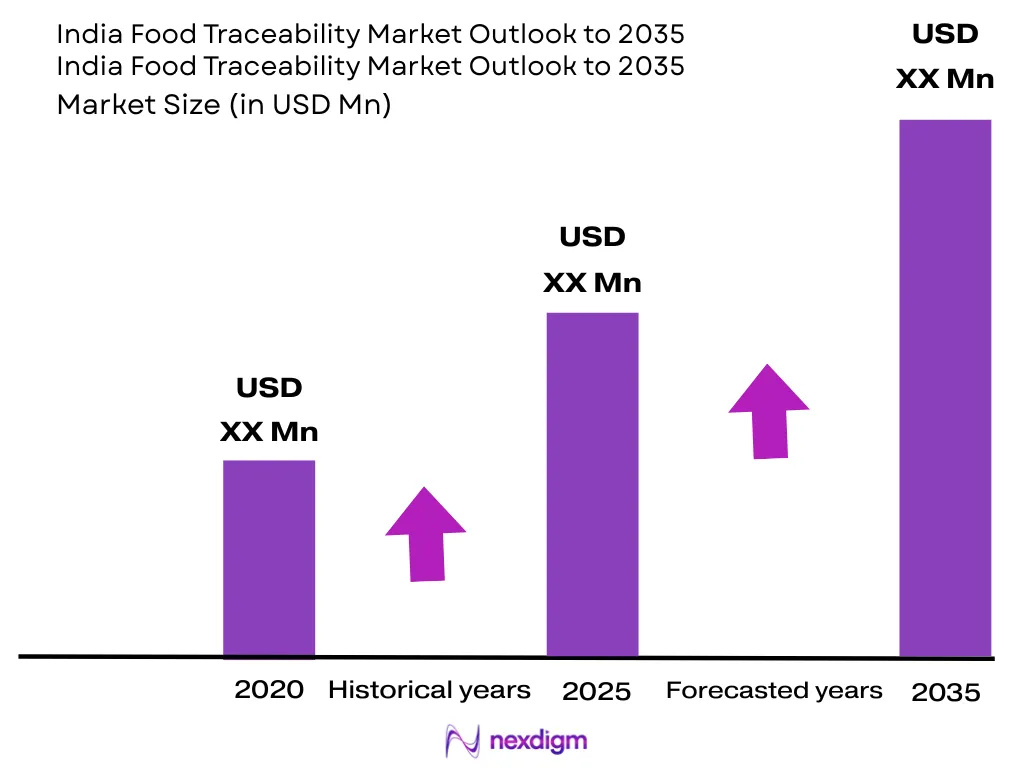
The India Food Traceability Market was valued at USD ~ Million in 2024 and is anticipated to expand at a CAGR of ~% during 2026–2035. The market is primarily driven by rising agri-food export compliance requirements, sustained government investment in export traceability infrastructure, and India’s large and rapidly digitalising food processing and retail base. According to GlobalGrowthInsights, India holds approximately 27% share of the Asia-Pacific food traceability solutions market, driven by traceable supply chains in dairy, grains, and produce exports, within a global Food Traceability Solutions Market valued at USD 26.89 billion in 2026 and projected to reach USD 67.13 billion by 2035 at a 10.7% CAGR. Bengaluru-based TraceX Technologies estimates that India’s food traceability market specifically is expected to reach USD 1.7 billion by the end of the decade, reflecting the scale of opportunity as the country works to close persistent gaps in an industry that remains, according to Inc42, still far from fully organised.
Market Segmentation
By Technology Type
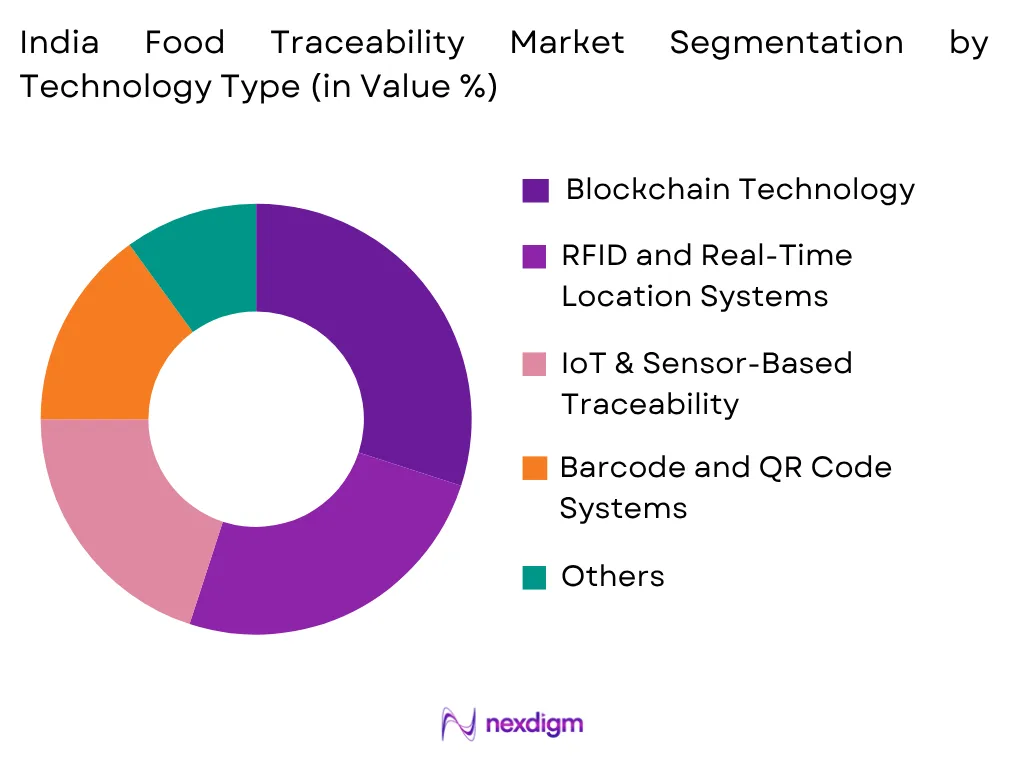
Among these, Blockchain-Based Platforms represent one of the fastest-growing technology segments in the India Food Traceability Market, led by domestic innovators such as TraceX Technologies, a Bengaluru-based digital agriculture platform founded in 2019 by Srivatsa Sreenivasarao and Anil Nadig, which uses blockchain to connect participants across food and agricultural supply chains and now works with more than 30 food companies including Olam, MTR Foods, Slay Coffee, BlueTokai, and Milk Mantra. SourceTrace, founded in 2013 and operating implementations across 28 countries, provides a complete value chain platform spanning farm management, procurement, and blockchain-based traceability for commodities including coffee, cocoa, and organic cotton, serving Indian organisations such as the Chetna Organic Agriculture Producer Company. RFID Systems and Barcode and QR Code Systems also maintain a substantial share, underpinned by the government’s APEDA Tracenet Module, an electronic traceability system that has simplified export documentation and is estimated to save at least one million sheets of paper annually.
By Application
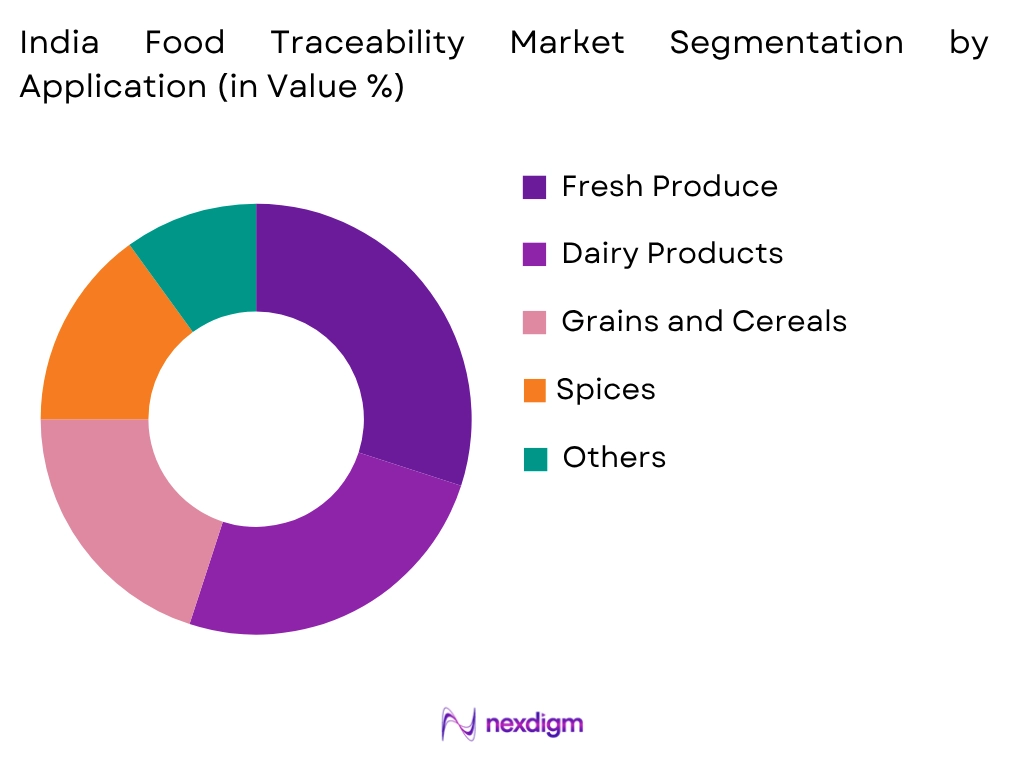
The Fresh Produce and Dairy Products segments command a substantial share of the India Food Traceability Market, reflecting both the scale of India’s agricultural output and the country’s persistent post-harvest loss challenge, with India witnessing nearly 5-15% annual wastage in fruits and vegetables, valued at approximately USD 13 billion, due to a lack of modern harvesting technologies and cold chain infrastructure, according to Invest India. The Spices and Seafood segments are particularly significant for export-oriented traceability adoption, with the Food Safety and Standards Authority of India (FSSAI) collaborating with the Marine Products Export Development Authority (MPEDA), the Spices Board, and the Agricultural and Processed Food Products Export Development Authority (APEDA) to strengthen quality standards and streamline compliance for exporters. TraceX Technologies’ partnership with TechnoServe to provide blockchain traceability for Araku Valley coffee producers illustrates the growing application of digital traceability to India’s premium agricultural export categories beyond staple commodities.
Competitive Landscape
The India Food Traceability Market combines a vibrant ecosystem of domestic agritech startups with established global enterprise technology and certification providers. TraceX Technologies has emerged as one of the most visible domestic players, working across livestock, poultry, seafood, and agricultural supply chains through a B2B SaaS subscription model, having raised a total of USD 1.36 million in funding from investors including NABARD-backed NABVENTURES, Social Alpha, and Plug and Play Tech Center. SourceTrace, one of India’s longest-operating agri-traceability platforms, has impacted more than one million farmers’ livelihoods across 28 countries through its DATAGREEN platform. Global players including IBM Corporation, which has partnered with Walmart to expand blockchain-based food tracking to more than 4,000 suppliers worldwide, alongside Zebra Technologies Corporation and SGS SA, compete on enterprise blockchain infrastructure, RFID and barcode hardware, and international export certification credibility respectively, while a broader field of Indian providers including Aeologic Technologies, Tracesci, and Barcode India compete on custom deployment, serialisation, and anti-counterfeiting capabilities across food, pharmaceutical, and FMCG sectors.
| Company | Establishment Year | Headquarters | Primary Product Portfolio | Traceability Solution Portfolio
|
Deployment Presence | Major End-Use Industries | Key Strategic Focus | Certifications & Compliance |
| TraceX Technologies | 2019 | ~ | ~ | ~ | ~ | ~ | ~ | ~ |
| SourceTrace | 2013 | ~ | ~ | ~ | ~ | ~ | ~ | ~ |
| IBM Corporation | 1911 | ~ | ~ | ~ | ~ | ~ | ~ | ~ |
| Zebra Technologies Corporation | 1969 | ~ | ~ | ~ | ~ | ~ | ~ | ~ |
| SGS SA | 1878 | ~ | ~ | ~ | ~ | ~ | ~ | ~ |
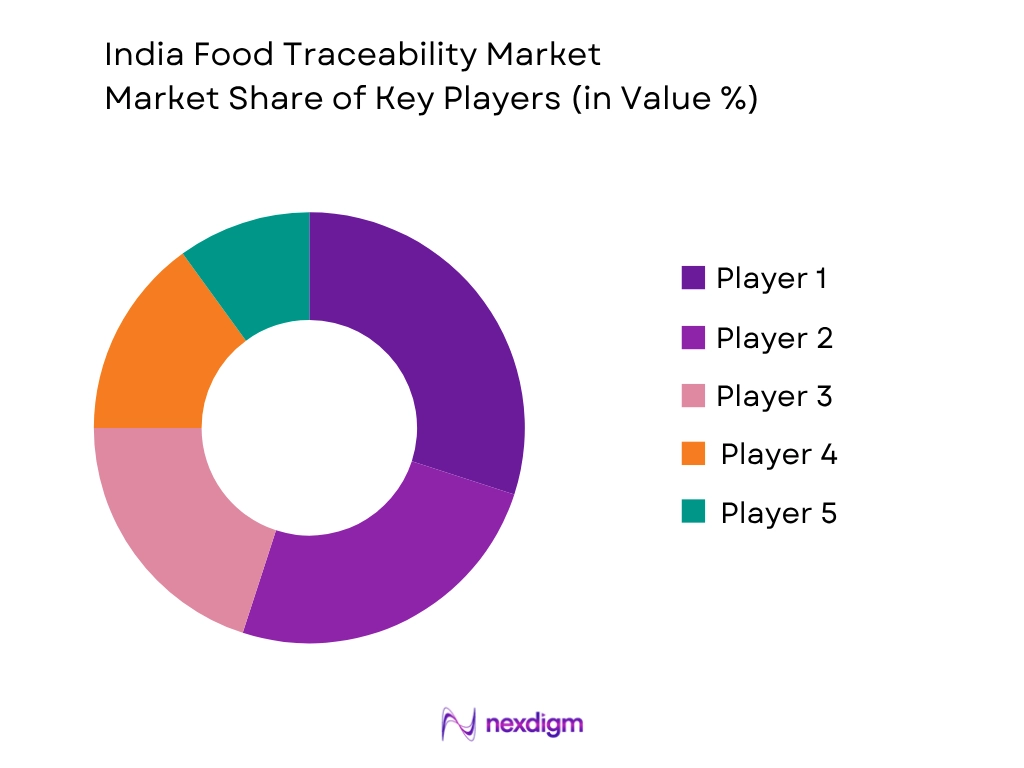
India Food Traceability Market Analysis
Growth Drivers
Rising Agri-Food Export Compliance Requirements
The India food traceability market is experiencing sustained growth due to increasingly stringent traceability and food safety compliance requirements from international buyers, particularly across the European Union, United States, and Middle East export markets. The Food Safety and Standards Authority of India (FSSAI) is leading initiatives to safeguard quality in both domestic consumption and exports, with collaboration between FSSAI, MPEDA, the Spices Board, and APEDA making compliance more streamlined for exporters, according to MarketsandMarkets. The Agricultural and Processed Food Products Export Development Authority has shown growing interest in electronic traceability systems for farming products, developing the APEDA Tracenet Module to facilitate hassle-free cross-border trade by reducing transaction time and cost, offering paperless processing, and reducing physical interface with exporters. TraceX Technologies’ growing portfolio of EU Deforestation-Free Regulation (EUDR) compliance and digital product passport offerings further illustrates how export-driven regulatory pressure is directly translating into commercial demand for Indian traceability technology providers.
Reduction of Post-Harvest Food Wastage and Growth of Organised Retail
India’s persistent post-harvest food wastage challenge is a significant driver of traceability technology adoption, with the country witnessing nearly 5-15% annual wastage in fruits and vegetables, valued at approximately USD 13 billion, due to a lack of modern harvesting technologies and cold chain infrastructure, according to Invest India. With India’s population expected to reach almost 1.6 billion by 2030, the pressure on the country’s food supply chain to minimize losses and improve efficiency continues to intensify. Traceability offers a significant opportunity to identify and address loss points across the supply chain, providing visibility that can strengthen inclusivity and empower small-scale producers with improved market access. The tremendous growth of e-commerce and food delivery in India, with companies such as Swiggy and Zomato increasingly sharing real-time information about food preparation and delivery with customers, is further extending consumer demand for transparency beyond retail packaged goods into the broader digital food ecosystem.
Market Challenges
Fragmented and Unorganised Food Supply Chains
A significant challenge facing the India Food Traceability Market is the highly fragmented and largely unorganised nature of the country’s food supply chain, with a major portion of the market still far from organised, according to Inc42. India ranked 102nd out of 123 countries on the Global Hunger Index, reflecting deeper structural food security challenges that compound the difficulty of building comprehensive traceability infrastructure. A questionnaire-based survey of food business operators in India found that awareness regarding traceability remained limited, and researchers concluded there is an urgent need for technology upgradation, financial support for capacity building, and infrastructure development by the government, along with greater emphasis on documentation and record keeping, to foster a food safety culture capable of implementing a robust traceability system nationwide, according to research published in the journal covering food traceability systems in India.
High Implementation Costs and Data Reliability Gaps for MSMEs
Implementing end-to-end traceability systems can be expensive for small and medium-sized food businesses, according to Aeologic Technologies, with standardised services starting around ₹50,000 per year while large-scale implementations involving customisation, integration, and infrastructure costs make pricing highly variable across industries and business sizes. Data reliability presents a further compounding challenge: traceability systems depend on a “garbage in, garbage out” principle, where if upstream data from farms and raw material suppliers is weak or inconsistently captured, the entire traceability chain breaks down. Since large-scale industries typically have better finances and technical exposure than smaller producers, it would be easier to establish traceability systems starting with them, according to research on India’s food traceability landscape, suggesting that MSME and smallholder adoption will likely continue to lag behind large exporters and processors without targeted government or industry support.
Market Opportunities
Spice, Coffee, and Seafood Export Traceability Expansion
India’s position as a major global exporter of spices, coffee, and seafood presents a substantial opportunity for specialised traceability technology providers. TraceX Technologies’ partnership with TechnoServe to provide blockchain traceability for Araku Valley coffee producers, alongside the company’s broader work across chilli pepper and other spice value chains, illustrates the type of commercial deployment that could be extended across India’s diverse spice-growing regions to meet international food safety and quality assurance requirements. With FSSAI actively collaborating with the Spices Board and MPEDA to strengthen quality standards, technology providers capable of integrating laboratory test results, certifications, and audit data directly into traceability platforms are well positioned to capture growing demand from exporters seeking to differentiate premium Indian agricultural products in demanding international markets.
Farmer Producer Organisation Digital Inclusion and Carbon-Linked Traceability
India’s traceability sector presents a significant opportunity to strengthen inclusivity and empower small-scale producers with improved market visibility and access to new services and resources, according to Invest India. SourceTrace’s DATAGREEN platform, which has already impacted more than one million farmers’ livelihoods across 28 countries by connecting farmer profiling, geolocation, and certification information into a single asset-light, mobile-first system, demonstrates the commercial viability of extending traceability infrastructure to India’s vast base of smallholder farmers and Farmer Producer Organisations. The growing convergence of traceability with carbon measurement, reporting, and verification, exemplified by TraceX’s Trace Carbon platform supporting companies’ net-zero journeys, further positions Indian traceability providers to capture emerging demand at the intersection of food safety, export compliance, and climate-linked sustainability reporting.
Future Outlook
The India Food Traceability Market is expected to witness steady expansion over the forecast period, supported by continued growth in agri-food exports, sustained government investment in traceability infrastructure through APEDA’s Tracenet Module, and rising international regulatory pressure from major buyers in the European Union, United States, and Middle East. India’s food traceability market alone is projected to reach USD 1.7 billion by the end of the decade, according to TraceX Technologies, while the country’s broader authentication and traceability market is projected to reach ₹16,575 crore by FY 2029, growing at approximately 11.3% CAGR from FY24 levels. Growing investment from both domestic startups such as TraceX Technologies and SourceTrace and global enterprise technology providers will further accelerate market development, even as the industry continues to navigate the practical challenges of a fragmented, largely unorganised food supply chain, high implementation costs for MSMEs, and persistent data reliability gaps stemming from India’s vast base of smallholder producers.
Major Players
- IBM Corporation (IBM Food Trust)
- Zebra Technologies Corporation
- SGS SA
- Bureau Veritas SA
- Honeywell International Inc.
- SAP SE
- C.H. Robinson Worldwide, Inc.
- Cognex Corporation
- Trimble Inc.
- Intelex Technologies ULC
- Barcode India
- TraceX Technologies
- SourceTrace
- Aeologic Technologies
- Tracesci
Key Target Audience
- Food Traceability Technology Providers
- Food & Beverage Processing Companies
- Agricultural Exporters and Trading Companies
- Retailers and Modern Trade Chains
- Farmer Producer Organisations and Cooperatives
- Investment and Venture Capitalist Firms
- Government and Regulatory Bodies (Food Safety and Standards Authority of India (FSSAI), Agricultural and Processed Food Products Export Development Authority (APEDA), Marine Products Export Development Authority (MPEDA), Spices Board)
- Foodservice and Food Delivery Platforms
Research Methodology
Step 1: Identification of Key Variables
The research process begins with identifying the complete ecosystem of the India Food Traceability Market, including hardware and software technology providers, blockchain platform developers, certification and audit bodies, food processors and exporters, retailers, and regulatory authorities. Extensive secondary research is conducted using company annual reports, government publications, trade associations, customs statistics, industry journals, and proprietary databases to determine the variables influencing market demand, pricing, deployment, adoption, and technological developments.
Step 2: Market Analysis and Construction
Historical market information is collected and analysed to estimate market size, deployment volumes, technology adoption rates, application-wise demand, and pricing trends. A combination of top-down and bottom-up approaches is used to estimate market revenues and validate segment-level performance. Adoption patterns across dairy, grains, fresh produce, spices, seafood, and meat and poultry are evaluated to establish an accurate representation of the industry.
Step 3: Hypothesis Validation and Expert Consultation
The preliminary findings are validated through Computer-Assisted Telephone Interviews (CATIs) and structured discussions with traceability technology providers, procurement managers, food processors, exporters, regulatory experts, and senior executives operating within the Indian food and agribusiness industries. These interviews help verify market assumptions, competitive developments, technology adoption trends, pricing dynamics, and future investment opportunities while refining the overall market estimates.
Step 4: Research Synthesis and Final Output
The final stage integrates insights obtained from primary interviews with quantitative information collected through secondary sources. Data triangulation techniques are applied to reconcile differences between supply-side and demand-side estimates, ensuring robust market forecasting. The report is then reviewed through multiple quality assurance checkpoints to deliver a comprehensive analysis covering market size, segmentation, competitive landscape, future outlook, and strategic recommendations for industry stakeholders.

- Executive Summary
- Research Methodology (Market Definitions and Assumptions, Abbreviations, Market Sizing Approach, Top-Down Analysis, Bottom-Up Analysis, Demand-Side Assessment, Supply-Side Assessment, Primary Industry Interviews, Secondary Research Validation, Data Triangulation, Forecasting Framework, Limitations and Future Conclusions)

- Definition and Scope
- Market Evolution and Industry Genesis
- Timeline of Major Industry Developments
- Food Traceability Industry Value Chain Analysis
- Supply Chain Analysis

- Growth Drivers (Rising Agri-Food Export Compliance Requirements, Growth of Organised Retail and Modern Trade, EU Deforestation Regulation Compliance, Reduction of Post-Harvest Food Wastage, Government Export Traceability Infrastructure (APEDA Tracenet), Rising Consumer Demand for Origin Transparency)
- Market Challenges (Fragmented and Unorganised Food Supply Chains, Limited Cold Chain Infrastructure, High Implementation Costs for MSMEs, Low Digital Maturity Among Smallholder Farmers, Interoperability Across Solution Providers, Data Reliability from Upstream Sources)
- Market Opportunities (Spice and Coffee Export Traceability Platforms, Farmer Producer Organisation Digital Inclusion, Cold Chain and Seafood Export Verification, Carbon and Sustainability-Linked Traceability (MRV), Food Delivery Platform Transparency Tools, Export Market Access Compliance Services)
- Market Trends (Blockchain-IoT Convergence, Lab and Certification Data Integration, Rise of Domestic Agritech Platforms, Consumer-Facing QR Code Transparency, Cooperative-Level Digital Traceability Adoption, Multi-Commodity Platform Expansion)
- Government Regulations (FSSAI Food Safety and Traceability Requirements, APEDA Tracenet Export Traceability Module, MPEDA Seafood Export Standards, Spices Board Quality Standards, Food Labelling Requirements, Import and Export Certification Requirements)
- Import and Export Analysis (Agri-Food Export Value, Major Export Destinations (EU, US, Middle East), Spice and Seafood Export Compliance, HS Code Analysis, Trade Balance)
- Technology Landscape (Blockchain Platforms, AI-Based Supply Chain Analytics, Mobile Application-Based Farm Data Capture, IoT Cold Chain Sensors, Cloud-Based Traceability Software)
- Sustainability Assessment (EU Deforestation Regulation (EUDR) Compliance, Carbon Measurement, Reporting and Verification (MRV), Sustainable Sourcing Certification, Traceability-Linked Export Premiums, Smallholder Inclusion Initiatives)
- PESTLE Analysis
- SWOT Analysis
- Porter’s Five Forces Analysis
- Stakeholder Ecosystem
- Competition Ecosystem

- By Market Value (2020-2025)
- By Volume of Deployments (2020-2025)
- By Average Selling Price (2020-2025)

- By Technology (In Value %)
Blockchain-Based Platforms
RFID Systems
Barcode and QR Code Systems
GPS and IoT Sensor-Based Tracking
ERP and Cloud Software Platforms - By Component (In Value %)
Hardware
Software
Services - By Application (In Value %)
Dairy Products
Grains and Cereals
Fresh Produce (Fruits and Vegetables)
Spices
Seafood
Coffee and Cocoa
Meat and Poultry - By End User (In Value %)
Food Processors and Manufacturers
Exporters and Trading Companies
Retailers and Modern Trade Chains
Farmer Producer Organisations and Cooperatives
Foodservice and Food Delivery Platforms
Government and Regulatory Bodies - By Region (In Value %)
North India
South India
West India
East India

- Market Share of Major Players (By Value, Deployment Volume, Technology Type, Application Industry, Customer Segment)
- Cross Comparison Parameters (Technology Portfolio Breadth, Blockchain and AI Capability, Field Deployment Support, Application Technical Support Capability, Client Base Across Export-Oriented Industries, Regulatory Compliance & Certifications, Customer Base Across Industries, Innovation & New Product Launch Frequency)
- SWOT Analysis of Major Players
- Pricing Analysis by Solution Category
- Deployment Capacity Analysis
- Technology Footprint Analysis
- Distribution and Partner Network Analysis
- Innovation Benchmarking
- Detailed Profiles of Major Companies
IBM Corporation (IBM Food Trust)
Zebra Technologies Corporation
SGS SA
Bureau Veritas SA
Honeywell International Inc.
SAP SE
C.H. Robinson Worldwide, Inc.
Cognex Corporation
Trimble Inc.
Intelex Technologies ULC
Barcode India
TraceX Technologies
SourceTrace
Aeologic Technologies
Tracesci

- Consumption Pattern Analysis (Enterprise Adoption Rate, Farmer Producer Organisation Adoption Rate, Product Category Penetration, Regional Adoption Variation, Reformulation Activity)
- Purchasing Criteria (Export Regulatory Compliance, Interoperability, Cost Efficiency, Ease of Field Implementation, Data Security, Scalability)
- Procurement and Supplier Selection Analysis
- Export Market Compliance Adoption Assessment
- Large Enterprise vs MSME Adoption Demand
- Product Attribute Preference Analysis (Real-Time Data Capture, Offline and Low-Connectivity Functionality, Blockchain Immutability, Consumer-Facing Interface, Multi-Commodity Support, Ease of Integration)
- Consumer Trust and Transparency Influence on Adoption
- Pain Point Analysis
- Decision-Making Process

- By Market Value (2026-2035)
- By Volume of Deployments (2026-2035)
- By Average Selling Price (2026-2035)


 Request a Sample
 Ask for Customization
 Get a Quote
 Enquire Now