
 Download PDF
Market Overview
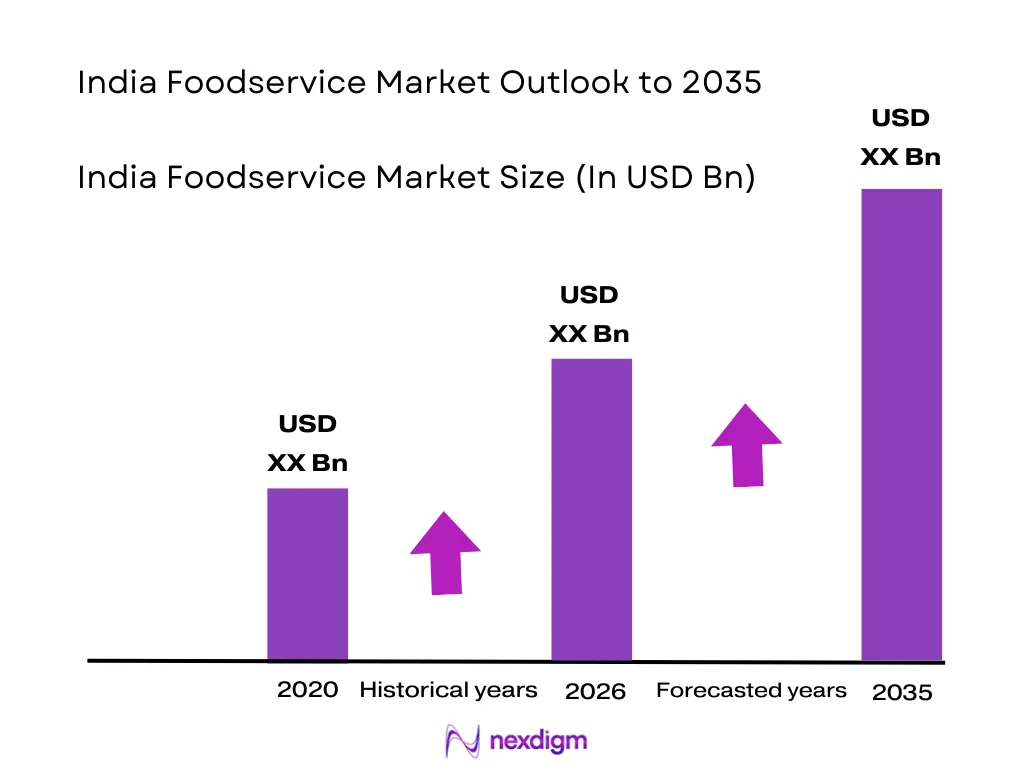
The India Foodservice Market is supported by rising urbanization, increasing disposable income, and expanding digital food ordering ecosystems across metropolitan and emerging cities. The market generated nearly USD ~ billion in revenue through organized and unorganized foodservice channels, while online food delivery platforms processed more than 4 billion annual orders across India. Quick service restaurants, cafés, and cloud kitchens continue to expand because of increasing smartphone penetration, digital payments adoption, and convenience-focused consumption patterns. Growing workforce participation and changing lifestyle preferences are accelerating demand for dine-in, takeaway, and app-based food consumption across urban households.
Cities such as Mumbai, Delhi NCR, Bengaluru, Hyderabad, Chennai, and Pune dominate the India Foodservice Market due to strong concentration of working professionals, high disposable income, and advanced digital infrastructure supporting food delivery ecosystems. Bengaluru and Hyderabad remain key technology-driven consumption hubs because of large IT workforce populations and strong cloud kitchen penetration. Mumbai and Delhi NCR continue to lead in premium dining and casual restaurant formats due to higher spending on lifestyle and social dining experiences. Emerging cities including Ahmedabad, Chandigarh, Coimbatore, and Indore are also witnessing rapid organized restaurant expansion due to infrastructure growth and increasing consumer demand for branded dining experiences.
Market Segmentation
By Restaurant Format
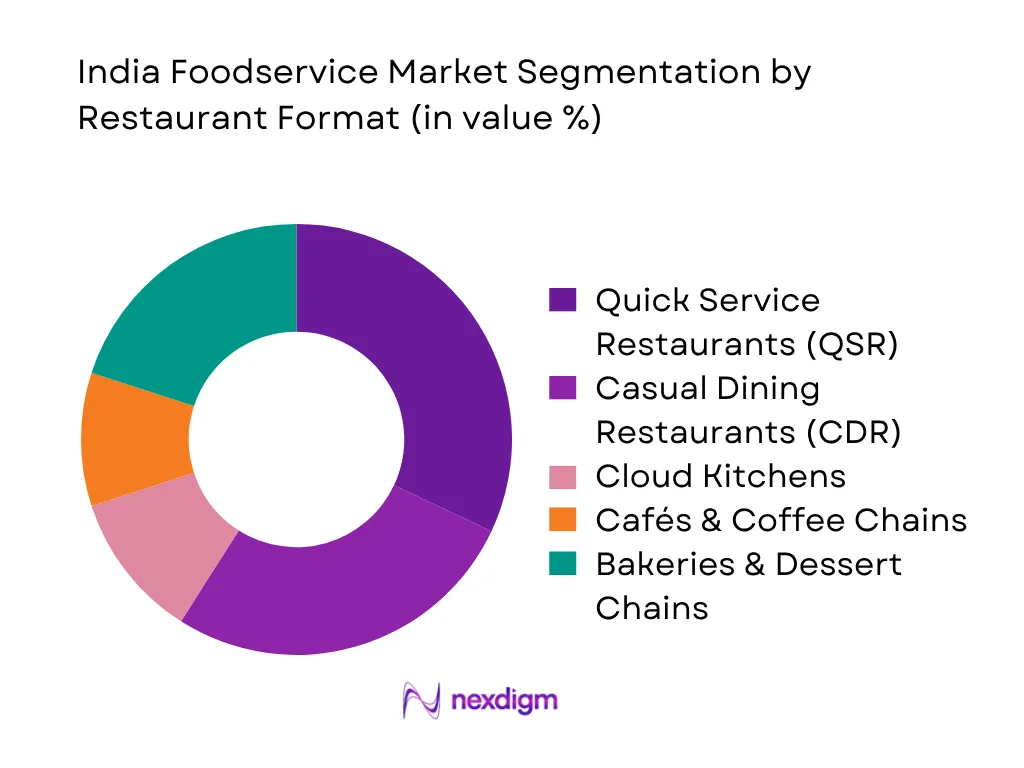
The India Foodservice Market is segmented by restaurant format into quick service restaurants (QSR), casual dining restaurants (CDR), fine dining restaurants, cafés and coffee chains, cloud kitchens, bakeries and dessert chains, pubs and bars, and institutional catering. Quick service restaurants dominate the India Foodservice Market because of their affordability, scalability, and integration with digital food delivery platforms. Organized QSR chains continue expanding aggressively into tier-II and tier-III cities through franchise-led models and compact outlet formats. Consumers prefer QSRs due to lower ticket size, faster service, and standardized menu offerings. Delivery-focused operations, drive-thru expansion, and value meal offerings further strengthen category leadership. Additionally, increasing app-based ordering and loyalty ecosystems continue improving customer retention and repeat order frequency within the QSR segment.
By Service Mode
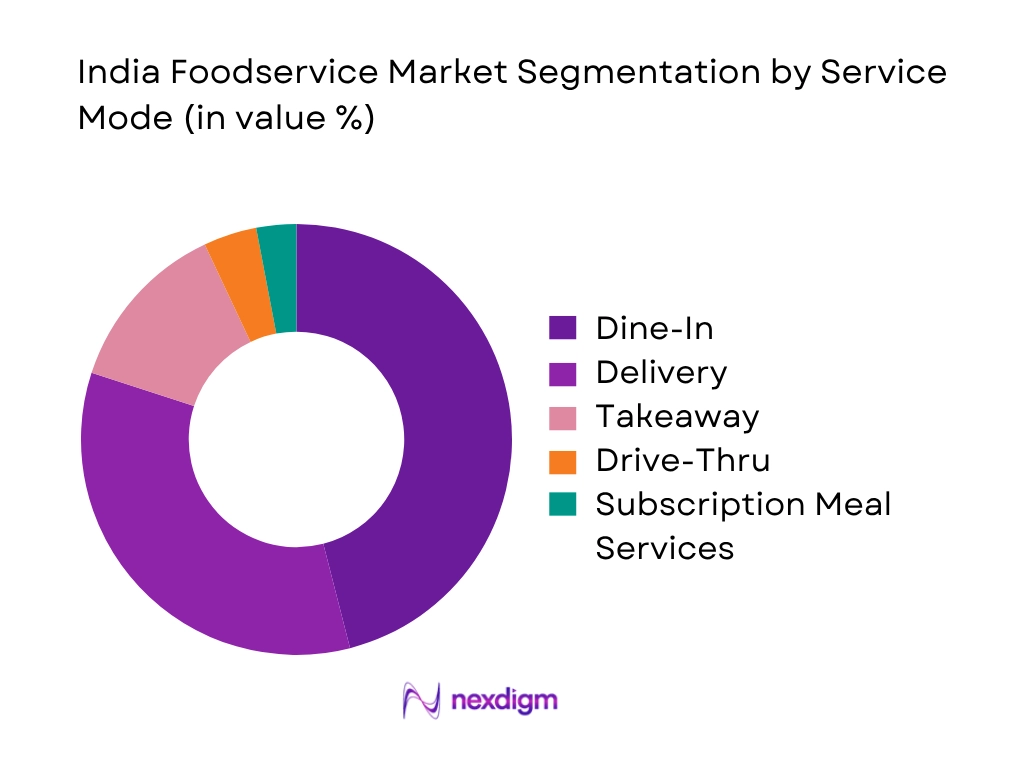
The India Foodservice Market is segmented by service mode into dine-in, delivery, takeaway, drive-thru, and subscription meal services. Dine-in dominates the India Foodservice Market because Indian consumers continue to prefer social and family-oriented dining experiences across restaurants, cafés, and premium foodservice outlets. Metropolitan cities witness strong dine-in demand due to mall culture, lifestyle spending, and occasion-based consumption behavior. Restaurant operators are increasingly investing in ambiance enhancement, live kitchens, personalized service, and experiential dining formats to improve customer engagement. Higher average order values and group dining behavior also contribute significantly to dine-in revenue leadership. Although online delivery has expanded rapidly due to aggregator platforms, dine-in remainsdom inant because of premium menu consumption and increasing spending on social dining experiences.
Competitive Landscape
The India Foodservice Market is moderately consolidated with organized restaurant chains, cloud kitchen operators, and food delivery aggregators competing aggressively through digital ordering ecosystems, franchise expansion, menu innovation, and hyperlocal delivery optimization. Major operators are strengthening market presence through loyalty programs, AI-enabled customer engagement, and expansion into emerging urban clusters. The market is also witnessing increasing investments in cloud kitchen infrastructure, automation technologies, and sustainable restaurant operations.
| Company | Establishment Year | Headquarters | Restaurant Portfolio | Outlet Network | Delivery Integration | Franchise Strength | Digital Loyalty Ecosystem | Expansion Focus |
| Jubilant FoodWorks | 1995 | Noida, India | ~ | ~ | ~ | ~ | ~ | ~ |
| Westlife Foodworld | 1982 | Mumbai, India | ~ | ~ | ~ | ~ | ~ | ~ |
| Devyani International | 1991 | Gurugram, India | ~ | ~ | ~ | ~ | ~ | ~ |
| Rebel Foods | 2011 | Mumbai, India | ~ | ~ | ~ | ~ | ~ | ~ |
| Zomato | 2008 | Gurugram, India | ~ | ~ | ~ | ~ | ~ | ~ |
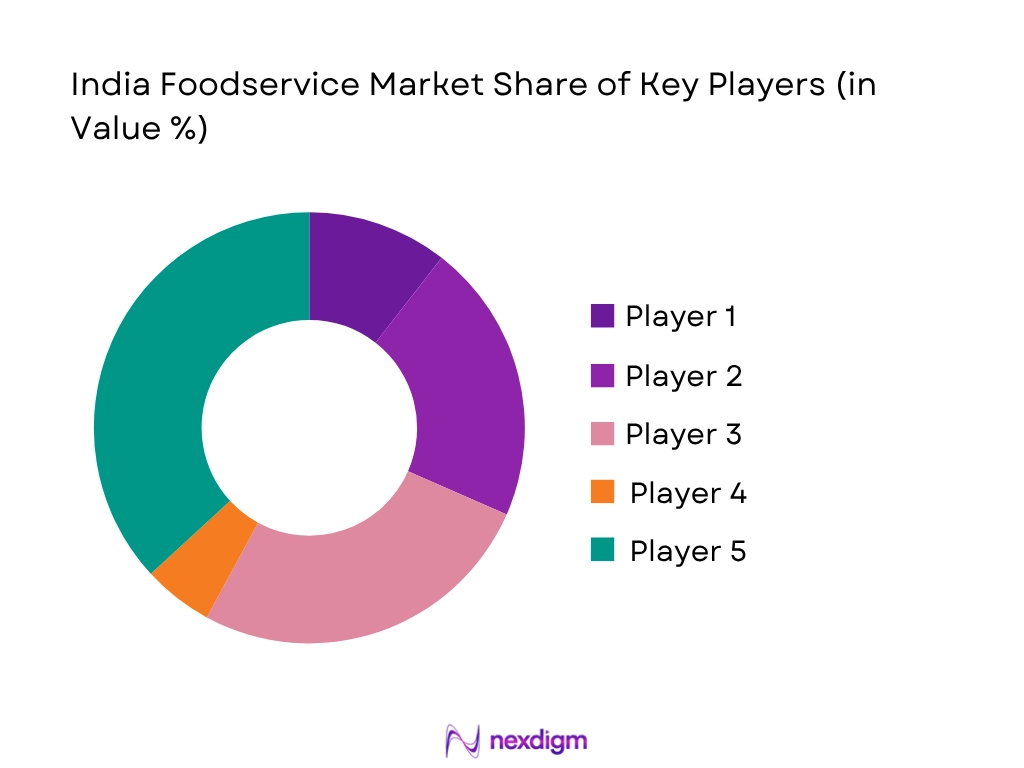
India Foodservice Market Analysis
Growth Drivers
Rising Urban Disposable Income and Expanding Middle-Class Consumption
India’s foodservice market is strongly supported by rising urban disposable income, increasing workforce participation, and rapid expansion of middle-class consumption patterns. India’s GDP exceeded USD 3.9 trillion according to IMF estimates during 2024, while urban population crossed 522 million people according to the United Nations Population Division. MOSPI data highlighted urban monthly per capita consumption expenditure reaching INR 6,996 during 2023-24, reflecting stronger discretionary spending on dining and convenience-led food consumption. India’s private final consumption expenditure crossed INR 188 trillion according to RBI data, supporting higher spending across cafés, restaurants, and food delivery platforms. Increasing commercial office spaces, shopping mall expansion, and airport passenger movement are further accelerating foodservice demand across metropolitan and tier-II cities.
Expansion of Digital Food Delivery Ecosystem
India’s digital infrastructure expansion continues to accelerate foodservice demand through online ordering and app-based restaurant discovery. TRAI reported more than 954 million internet subscribers and over 939 million broadband subscribers during 2024, significantly expanding the addressable customer base for food delivery platforms. UPI transactions crossed 131 billion annually according to NPCI, improving accessibility of digital payments for restaurant transactions. RBI’s Digital Payments Index increased substantially during 2024, reflecting stronger adoption of digital commerce ecosystems. Expansion of smartphone users beyond 750 million and increasing hyperlocal logistics capabilities are enabling restaurant operators and cloud kitchens to expand rapidly into emerging cities and high-frequency delivery zones.
Market Challenges
Food Inflation and Commodity Price Volatility
Food inflation remains a major challenge for India’s foodservice market due to rising prices of vegetables, dairy products, cereals, and edible oils. MOSPI data showed India’s Consumer Food Price Index remaining above 8 during several months of 2024, increasing procurement pressure on restaurant operators. India imported more than 16 million metric tonnes of edible oils during 2023-24 according to industry trade data, exposing foodservice businesses to global commodity volatility and currency fluctuations. Rising transportation expenses and fluctuating fuel prices are also increasing logistics costs for restaurant chains and cloud kitchens. These inflationary pressures are forcing operators to optimize menu engineering, procurement efficiency, and outlet productivity to sustain profitability.
Employee Attrition and Skilled Labor Shortage
India’s foodservice market continues facing workforce-related challenges due to high employee attrition and shortage of trained hospitality workers. Ministry of Skill Development and Entrepreneurship estimates indicate India requires millions of additional skilled hospitality workers over the coming years to support organized foodservice expansion. PLFS data reported persistent urban youth unemployment alongside skill mismatch across hospitality operations. Rising competition from quick commerce and e-commerce delivery platforms has increased labor migration away from restaurant operations and kitchen staffing. Increasing living costs in metropolitan cities such as Mumbai, Bengaluru, and Delhi NCR are also affecting workforce retention and operational stability across organized restaurant chains.
Market Opportunities
Expansion of Healthy and Functional Food Consumption
Increasing health consciousness and rising prevalence of lifestyle-related diseases are creating strong opportunities for healthy and functional foodservice formats in India. ICMR data indicated non-communicable diseases account for more than 60% of deaths in India, encouraging consumers to seek healthier dining alternatives. FSSAI’s “Eat Right India” initiative is promoting healthier menu development and nutritional transparency across restaurants. Rising demand for protein-rich meals, millet-based foods, low-calorie menus, and plant-based offerings is encouraging restaurant operators to diversify product portfolios. Increasing gym memberships, wellness awareness, and preventive healthcare focus among millennials and Gen Z consumers continue strengthening demand for wellness-oriented dining concepts.
Expansion of Tier-II and Tier-III Cities
Tier-II and tier-III cities are emerging as major growth opportunities for India’s foodservice market due to rising disposable income, urban infrastructure development, and increasing digital adoption. Government-led infrastructure initiatives under Smart Cities Mission and highway connectivity programs are accelerating commercial real estate and mall development across regional cities. Broadband penetration and smartphone adoption are increasing rapidly outside metropolitan regions, enabling expansion of food delivery ecosystems and franchise restaurant formats. Lower rental costs, rising youth population, and increasing preference for branded dining experiences are encouraging organized foodservice operators to expand aggressively into emerging urban centers such as Indore, Surat, Lucknow, Coimbatore, and Bhubaneswar.
Future Outlook
The India Foodservice Market is expected to witness strong expansion over the coming years due to increasing urban consumption, rising digital food ordering, and expansion of organized restaurant chains across emerging cities. Quick service restaurants, cafés, and cloud kitchens are expected to remain major growth contributors because of scalability, convenience-led consumption, and integration with hyperlocal delivery ecosystems. Increasing demand for premium dining experiences, health-focused menus, and sustainable foodservice operations is expected to reshape competitive dynamics across the industry. Technological advancements including AI-driven customer engagement, kitchen automation, QR-based ordering systems, and loyalty analytics are expected to improve operational efficiency and customer retention across organized restaurant chains. Expansion of tier-II and tier-III cities, rising workforce participation, and increasing disposable income are expected to strengthen long-term foodservice demand across India. Sustainable packaging adoption, millet-based product innovation, and regional cuisine expansion are also expected to emerge as key strategic priorities for foodservice operators over the forecast period.
Major Players
- Jubilant FoodWorks
- Westlife Foodworld
- Devyani International
- Sapphire Foods India
- Restaurant Brands Asia
- Barbeque-Nation Hospitality
- Speciality Restaurants
- Coffee Day Enterprises
- Wow! Momo Foods
- Rebel Foods
- Zomato
- Swiggy
- Haldiram Foods International
- Bikanervala Foods
- Impresario Entertainment & Hospitality
Key Target Audience
- Quick Service Restaurant Chains
- Cloud Kitchen Operators
- Food Delivery Aggregators
- Franchise Investors and Multi-Unit Operators
- Food Packaging and Kitchen Equipment Manufacturers
- Commercial Real Estate Developers and Mall Operators
- Investments and Venture Capitalist Firms
- Government and Regulatory Bodies
Research Methodology
Step 1: Identification of Key Variables
The initial stage involved identifying major variables influencing the India Foodservice Market, including restaurant format expansion, digital ordering penetration, urban dining frequency, food delivery adoption, and changing consumer consumption patterns. Extensive secondary research was conducted using government publications, trade databases, industry reports, and financial disclosures to understand the market ecosystem and operational landscape.
Step 2: Market Analysis and Construction
Historical market analysis was conducted using restaurant transaction data, outlet expansion statistics, digital ordering volumes, and consumer spending trends across organized and unorganized foodservice channels. Revenue estimations were derived using bottom-up calculations based on restaurant categories, service formats, regional demand patterns, and online food delivery contribution.
Step 3: Hypothesis Validation and Expert Consultation
The preliminary market findings were validated through interviews with restaurant operators, franchise owners, food aggregators, cloud kitchen managers, and hospitality industry participants. These consultations provided operational insights regarding menu innovation, profitability benchmarks, customer retention, expansion strategies, and digital transformation across the foodservice ecosystem.
Step 4: Research Synthesis and Final Output
The final stage involved consolidating qualitative and quantitative findings to prepare a comprehensive assessment of the India Foodservice Market. Data triangulation and cross-validation techniques were applied using government statistics, operational insights, and financial disclosures to ensure consistency and reliability of market estimates, segmentation analysis, and future growth outlook.

- Executive Summary
- Research Methodology (Market Definitions and Assumptions, Abbreviations, Research Framework, Bottom-Up Market Estimation, Top-Down Validation, Consumption Mapping, Demand-Supply Assessment, Primary Interviews with Restaurant Chains and Aggregators, Forecasting Framework, Data Triangulation Model, Limitations and Assumptions)

- Definition and Scope
- Evolution of Organized and Unorganized Foodservice in India
- Industry Ecosystem and Stakeholder Mapping
- Supply Chain and Value Chain Analysis
- Foodservice Procurement and Distribution Network
- Restaurant Operating Model Analysis

- Growth Drivers
Rising Urban Disposable Income and Expanding Middle-Class Consumption
Expansion of Digital Food Delivery Ecosystem
Growth in Working Population and Nuclear Households
Increasing Penetration of Organized Restaurant Chains
Expansion of Tier-II and Tier-III Cities
Growth of Convenience-Led Dining Behavior - Market Challenges
Food Inflation and Commodity Price Volatility
Employee Attrition and Skilled Labor Shortage
High Commercial Rental Costs
Aggregator Commission Dependency
Supply Chain and Cold Storage Constraints
Food Safety and Regulatory Compliance Burden - Market Opportunities
Expansion of Healthy and Functional Food Consumption
Growth of Regional Cuisine Chains
Expansion of Drive-Thru and Transit Foodservice
AI-Driven Customer Personalization and Loyalty Platforms
Sustainable Packaging and Green Restaurant Operations
Growth of Smart Kitchens and Automation Technologies - Market Trends
Rise of Cloud Kitchens and Delivery-Only Brands
Premiumization of Café and Casual Dining Formats
Hyperlocal Delivery Optimization
QR-Based Ordering and Contactless Dining
Growth of Millet-Based and Protein-Rich Menus
Celebrity and Influencer-Led Restaurant Brands - Government Regulations
FSSAI Licensing and Food Safety Compliance
GST Structure for Restaurants and Delivery Platforms
Labor and Employment Regulations
Food Labeling and Nutritional Disclosure Standards
Environmental and Waste Management Guidelines - SWOT Analysis
Porter’s Five Forces Analysis
Stakeholder Ecosystem Analysis
Automation Penetration Analysis Across Industries
Import–Export Trade Analysis
Localization and Domestic Manufacturing Assessment

- By Revenue, 2020-2025
- By Number of Outlets, 2020-2025
- By Number of Transactions, 2020-2025
- By Average Order Value, 2020-2025
- By Organized vs Unorganized Contribution, 2020-2025

- By Restaurant Format (in Value %)
Outlet Density
Average Ticket Size
Order Frequency
Seating Capacity Utilization - By Service Mode (in Value %)
Delivery Penetration
Customer Footfall
Table Turnover Rate
Order Fulfillment Efficiency - By Cuisine Type (in Value %)
Menu Penetration
Consumer Preference Index
Repeat Consumption Rate
Regional Cuisine Adoption - By Ownership Model (in Value %)
Franchise Density
Capital Intensity
Expansion Rate
Operational Scalability - By Consumer Demographics (in Value %)
Per Capita Foodservice Spend
Frequency of Eating Out
Digital Ordering Adoption
Brand Loyalty Rate - By Ordering Platform (in Value %)
Monthly Active Users
Digital Transaction Frequency
App Conversion Rate
Subscription Usage - By Location Type (in Value %)
Footfall Density
Rental Occupancy Cost
Delivery Radius Efficiency
Commercial Catchment Potential - By Region (in Value %)
North India
South India
East India
West India
Central India

- Market Share Analysis of Major Players on the Basis of Revenue Share, Shipment Share, Installed Base Share, OEM Partnerships, Service Revenue Share, Regional Presence, Product Portfolio Strength, Localization Capability
- Competitive Benchmarking by Product Portfolio and Technology
- Cross Comparison Parameters (Company Overview, Restaurant Portfolio Breadth, Outlet Network Size, Same Store Sales Growth, Delivery-to-Dine-In Revenue Mix, Kitchen Automation Level, Loyalty Membership Base, Franchise Network Strength, Average Daily Footfall, Expansion Strategy, Digital Ordering Ecosystem, Operational Efficiency, Sustainability Initiatives, Menu Innovation, EBITDA Margins, Strategic Partnerships)
- Competitive Benchmarking Matrix
- SWOT Analysis of Major Players
- Pricing Analysis by Restaurant Format and SKU
- Detailed Profiles of Major Companies
Jubilant FoodWorks
Westlife Foodworld
Devyani International
Sapphire Foods India
Restaurant Brands Asia
Barbeque-Nation Hospitality
Speciality Restaurants
Coffee Day Enterprises
Wow! Momo Foods
Rebel Foods
Zomato
Swiggy
Haldiram Foods International
Bikanervala Foods
Impresario Entertainment & Hospitality

- Dining Frequency Analysis
- Consumer Spending and Basket Analysis
- Brand Loyalty and Switching Behavior
- Purchase Decision Parameters
- Health and Wellness Preference Mapping
- Delivery vs Dine-In Consumption Trends
- Occasion-Based Dining Analysis

- By Revenue, 2026-2035
- By Number of Outlets, 2026-2035
- By Number of Transactions, 2026-2035
- By Average Order Value, 2026-2035
- By Organized vs Unorganized Contribution, 2026-2035


 Request a Sample
 Ask for Customization
 Get a Quote
 Enquire Now