
 Download PDF
 Download PDF
Market Overview
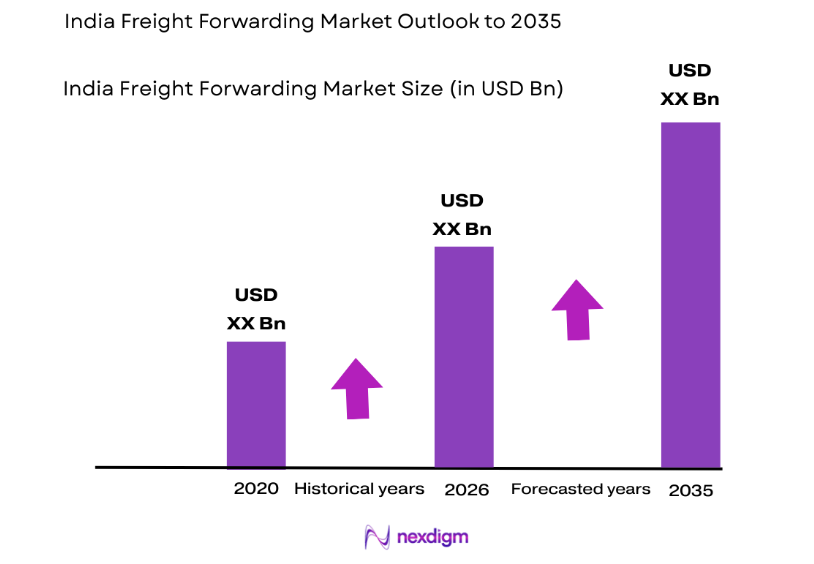
India’s freight forwarding market is valued at approximately USD ~ billion based on a recent historical assessment supported by logistics industry publications from the India Brand Equity Foundation and data released through the Ministry of Commerce and Industry regarding trade logistics activity. Market expansion is strongly driven by increasing international trade flows, manufacturing exports, and rising containerized cargo volumes moving through maritime ports and air cargo terminals. Growth in cross-border e-commerce shipments and improved logistics infrastructure investments are also strengthening freight forwarding demand.
Major logistics hubs such as Mumbai, Delhi NCR, Chennai, Kolkata, and Bengaluru dominate the India freight forwarding ecosystem due to proximity to international ports, airports, and industrial manufacturing clusters. These cities host integrated logistics parks, container freight stations, and multimodal transportation corridors that support efficient cargo movement across global supply chains. Strong export activity from automotive, pharmaceuticals, electronics, and textile industries also contributes to the concentration of freight forwarding operations within these regions.
Market Segmentation
By Transport Mode
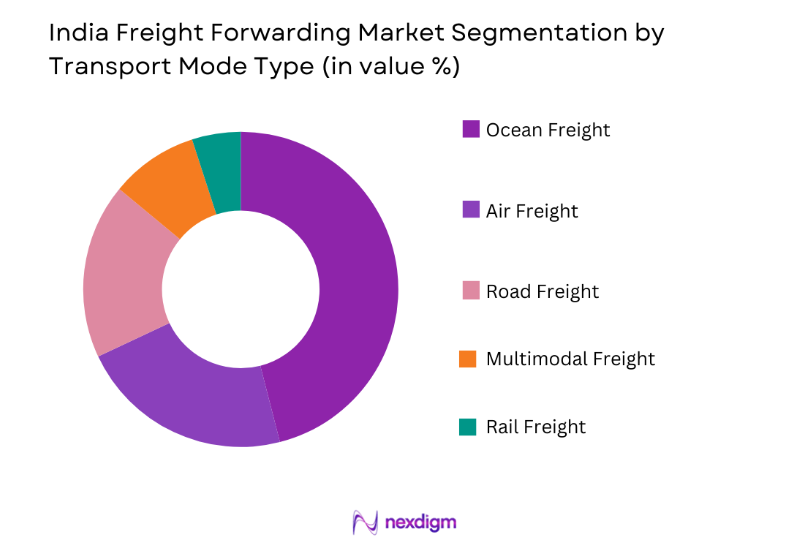
India Freight Forwarding market is segmented by Transport Mode type into Ocean Freight, Air Freight, Rail Freight, Road Freight, and Multimodal Freight. Recently, Ocean Freight has a dominant market share due to factors such as demand patterns, brand presence, infrastructure availability, or consumer preference. International trade shipments largely rely on maritime transport because ocean freight enables cost-effective movement of large cargo volumes across global trade routes. India’s extensive coastline and major seaports facilitate containerized exports and imports across industrial sectors including automotive components, chemicals, machinery, and consumer goods. Shipping lines and freight forwarders maintain large container handling capacities within major port clusters. The growth of export manufacturing and international trade corridors has further strengthened ocean freight operations across India’s freight forwarding network.
By End User Industry
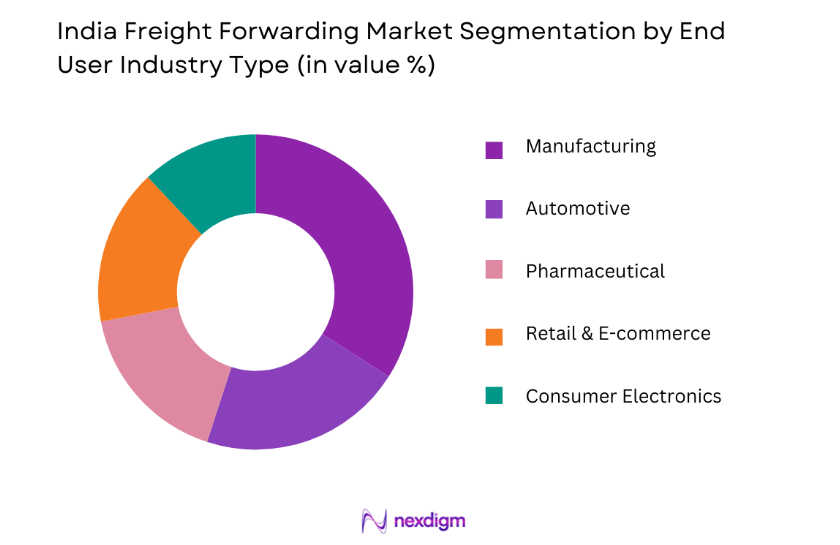
India Freight Forwarding market is segmented by End User Industry type into Manufacturing, Automotive, Pharmaceutical, Retail & E-commerce, and Consumer Electronics. Recently, Manufacturing has a dominant market share due to factors such as demand patterns, brand presence, infrastructure availability, or consumer preference. India’s strong manufacturing base generates substantial international cargo flows that require specialized freight forwarding services to manage export documentation, cargo consolidation, and multimodal transport coordination. Industrial sectors such as chemicals, machinery, engineering goods, and textiles regularly ship large cargo consignments across global markets. Freight forwarding companies maintain specialized logistics expertise to manage customs clearance, cargo packaging, and international shipping documentation. Government initiatives supporting industrial exports and supply chain modernization have also strengthened the demand for freight forwarding services within manufacturing supply chains.
Competitive Landscape
The India freight forwarding market features a mixture of global logistics corporations and domestic freight forwarding specialists competing across air, sea, and multimodal cargo services. Large international freight companies maintain extensive global networks that enable efficient cargo movement between India and major global trade hubs. Domestic logistics companies compete through regional expertise, customized cargo handling services, and integrated supply chain management capabilities. Technology integration including digital freight booking platforms and cargo tracking systems is becoming increasingly important for competitive positioning within the industry.
| Company Name | Establishment Year | Headquarters | Technology Focus | Market Reach | Key Products | Revenue | Cargo Handling Capacity |
| DHL Global Forwarding | 1969 | Bonn, Germany | ~ | ~ | ~ | ~ | ~ |
| Kuehne + Nagel | 1890 | Schindellegi, Switzerland | ~ | ~ | ~ | ~ | ~ |
| DB Schenker | 1872 | Essen, Germany | ~ | ~ | ~ | ~ | ~ |
| Blue Dart Express | 1983 | Mumbai, India | ~ | ~ | ~ | ~ | ~ |
| Allcargo Logistics | 1993 | Mumbai, India | ~ | ~ | ~ | ~ | ~ |
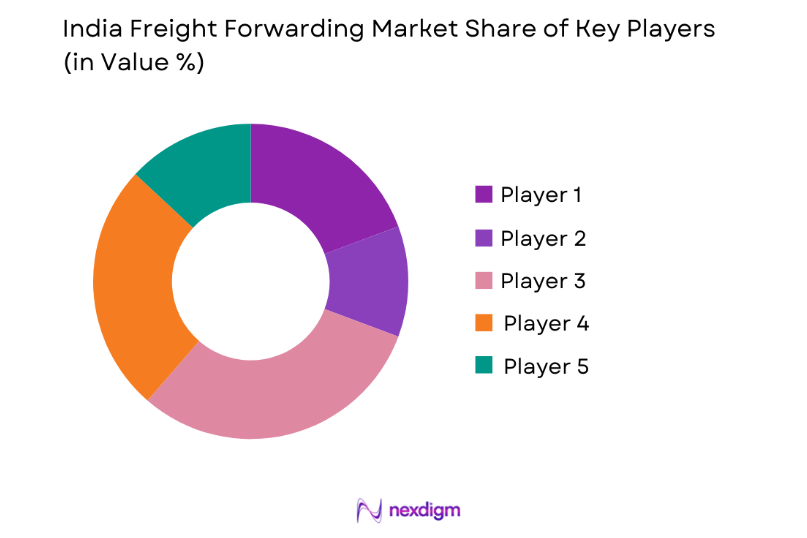
India Freight Forwarding Market Analysis
Growth Drivers
Expansion of International Trade and Export Manufacturing Activity
India’s freight forwarding market growth is strongly supported by the rapid expansion of international trade flows driven by industrial manufacturing, global supply chain integration, and increasing export demand from multiple economic sectors. Export-oriented industries such as pharmaceuticals, automotive components, textiles, engineering goods, and electronics continue expanding production capacities to serve global markets. Rising cargo volumes require specialized logistics coordination services that freight forwarders provide including cargo consolidation, customs documentation management, and multimodal transportation planning. Government initiatives supporting manufacturing exports and trade facilitation have also strengthened logistics activity across the country. Improvements in port infrastructure, cargo terminals, and inland container depots allow freight forwarders to manage larger shipment volumes with greater operational efficiency. Global supply chains increasingly rely on integrated freight forwarding networks to coordinate shipments across multiple transport modes. Logistics companies therefore expand service offerings such as warehousing, cargo insurance, and supply chain consulting to meet evolving trade requirements. Increasing cross-border e-commerce shipments further contribute to international cargo flows that require specialized freight handling capabilities. As global trade activity continues expanding, freight forwarding services remain essential for coordinating complex international cargo transportation operations.
Development of Multimodal Logistics Infrastructure and Dedicated Freight Corridors
Infrastructure modernization across India’s transportation networks represents another major growth driver for the freight forwarding market. Government investments in multimodal logistics parks, dedicated freight corridors, and industrial transportation infrastructure significantly improve cargo movement efficiency across the country. Dedicated freight rail corridors reduce congestion within existing rail networks and enable faster cargo transportation between major industrial zones and ports. Modern container terminals and cargo handling facilities improve throughput capacity and reduce shipment processing times. Freight forwarding companies benefit from improved connectivity between seaports, airports, rail terminals, and inland logistics hubs. Multimodal logistics infrastructure also enables the integration of different transportation modes to optimize cost efficiency and transit times for cargo shipments. Digital logistics platforms integrated with these infrastructure networks improve shipment tracking and coordination capabilities. International logistics companies increasingly invest in distribution centers and freight consolidation facilities near these infrastructure corridors. These developments significantly enhance India’s global trade competitiveness while creating strong demand for freight forwarding services. As infrastructure modernization continues expanding, freight forwarders will play an increasingly critical role in coordinating complex cargo flows across national and international supply chains.
Market Challenges
Complex Customs Procedures and Regulatory Compliance Requirements
Freight forwarding companies operating within India frequently encounter operational challenges associated with customs clearance procedures and international trade compliance requirements. Cross-border cargo shipments must comply with detailed documentation standards, import regulations, and customs inspection procedures that vary across different countries. Freight forwarders must coordinate with customs authorities, port officials, and regulatory agencies to ensure cargo shipments comply with international trade rules. Administrative delays within customs clearance processes can increase cargo dwell times at ports and airports, creating supply chain inefficiencies. Freight forwarding companies must therefore maintain specialized regulatory expertise to manage documentation requirements and compliance procedures. Rapid changes in international trade policies and tariff regulations also create additional operational complexity for logistics providers. Companies must invest in compliance management systems and trained logistics personnel to ensure cargo shipments meet regulatory standards. Failure to comply with customs documentation requirements can result in shipment delays, financial penalties, or cargo rejection. These regulatory complexities increase operational costs and administrative burdens for freight forwarding companies managing international cargo transportation.
Volatility in Global Freight Rates and Shipping Capacity Constraints
The freight forwarding market is significantly affected by fluctuations in global shipping rates and transportation capacity availability. Freight rates for air cargo and ocean container shipping often fluctuate due to fuel price volatility, geopolitical disruptions, and supply chain imbalances across global trade routes. Sudden increases in freight costs can disrupt logistics planning for exporters and importers relying on stable shipping prices. Freight forwarders must continuously negotiate shipping contracts with carriers to secure transportation capacity during periods of high demand. Limited container availability or reduced air cargo capacity can create shipment backlogs across major ports and airports. Logistics providers must therefore develop flexible transportation strategies that include multiple shipping routes and alternative carriers. Global trade disruptions, port congestion, and shipping delays further complicate cargo scheduling and delivery timelines. These challenges increase operational uncertainty within the freight forwarding industry and require companies to maintain resilient logistics networks capable of adapting to changing transportation conditions.
Opportunities
Growth of Cross Border E Commerce Logistics Services
The rapid expansion of cross-border e-commerce presents a major opportunity for companies operating within the India freight forwarding market. Online marketplaces and direct-to-consumer brands increasingly sell products internationally through digital retail platforms, generating rising volumes of international parcel shipments. Freight forwarding companies are expanding specialized e-commerce logistics services including small parcel consolidation, international shipping coordination, and customs clearance management. Technology platforms that integrate digital freight booking, shipment tracking, and automated documentation processing are improving logistics efficiency for e-commerce shipments. Retailers require reliable freight forwarding services to deliver international orders within competitive shipping timelines. Logistics providers therefore develop specialized cross-border fulfillment solutions that streamline global order delivery processes. The growth of international online marketplaces also increases the need for efficient reverse logistics and returns management services. As global e-commerce trade continues expanding, freight forwarding companies will benefit from increased demand for specialized international logistics solutions.
Adoption of Digital Freight Platforms and Logistics Technology Integration
Technological innovation within logistics operations represents a major opportunity for freight forwarding companies seeking to improve operational efficiency and customer service capabilities. Digital freight platforms allow exporters and importers to book cargo shipments, track deliveries, and manage documentation through integrated online systems. Freight forwarders increasingly deploy artificial intelligence and predictive analytics tools to optimize cargo routing and transportation planning. These technologies improve shipment visibility and enable companies to anticipate logistics disruptions across global trade routes. Automated documentation systems reduce administrative processing times and simplify customs compliance procedures. Cloud-based logistics management platforms also improve coordination between freight forwarders, shipping carriers, and cargo terminal operators. Companies adopting advanced digital logistics systems gain competitive advantages through improved service transparency and operational efficiency. As technology adoption continues expanding across the logistics sector, digital freight forwarding platforms will play a critical role in modernizing cargo transportation services.
Future Outlook
The India freight forwarding market is expected to expand steadily as international trade flows and export manufacturing activities continue increasing across the country. Investments in logistics infrastructure, digital freight platforms, and multimodal transportation corridors will significantly enhance cargo transportation efficiency. Government initiatives supporting trade facilitation and supply chain modernization will further strengthen logistics competitiveness. Growing demand from cross-border e-commerce, manufacturing exports, and global supply chain integration will continue driving freight forwarding activity across India.
Major Players
- DHL Global Forwarding
- Kuehne + Nagel
- DB Schenker
- Allcargo Logistics
- Blue Dart Express
- CEVA Logistics
- Expeditors International
- DSV Global Transport
- FedEx Logistics
- UPS Supply Chain Solutions
- Nippon Express
- Yusen Logistics
- Bolloré Logistics
- Agility Logistics
- TVS Supply Chain Solutions
Key Target Audience
- Investments and venture capitalist firms
- Government and regulatory bodies
- Export oriented manufacturing companies
- Import export trading companies
- International logistics operators
- Shipping and maritime companies
- E commerce exporters
Research Methodology
Step 1: Identification of Key Variables
Key variables influencing the India freight forwarding market were identified through detailed analysis of trade logistics flows, cargo transportation infrastructure, and international shipping networks. These variables include trade volumes, logistics infrastructure capacity, cargo handling facilities, and regulatory frameworks affecting international freight movement.
Step 2: Market Analysis and Construction
Market structure and size were analyzed using secondary research sources including trade statistics, logistics industry reports, and government trade databases. Data from port authorities, aviation cargo reports, and international shipping organizations was consolidated to construct the market framework.
Step 3: Hypothesis Validation and Expert Consultation
Industry hypotheses were validated through consultations with freight forwarding executives, logistics managers, and supply chain experts involved in international trade operations. These insights helped confirm cargo movement patterns, operational challenges, and emerging logistics technologies influencing the market.
Step 4: Research Synthesis and Final Output
All research findings were synthesized using comparative data analysis and logistics market modeling techniques. The final output integrates trade statistics, infrastructure insights, and competitive dynamics to present a comprehensive assessment of the India freight forwarding market.

- Executive Summary
- Research Methodology (Definitions, Scope, Industry Assumptions, Market Sizing Approach, Primary & Secondary Research Framework, Data Collection & Verification Protocol, Analytic Models & Forecast Methodology, Limitations & Research Validity Checks)

- Market Definition and Scope
- Value Chain & Stakeholder Ecosystem
- Regulatory / Certification Landscape
- Sector Dynamics Affecting Demand

- Growth Drivers
Growth in International Trade and Export Activities
Expansion of E-commerce and Cross-Border Logistics
Government Investments in Logistics Infrastructure and Trade Corridors - Market Challenges
Port Congestion and Infrastructure Bottlenecks
Complex Customs and Regulatory Procedures
Volatility in Fuel Prices and Freight Costs - Market Opportunities
Development of Digital Freight Forwarding Platforms
Expansion of Multimodal Logistics Corridors
Growth of Specialized Freight Services for Pharmaceuticals and Electronics - Trends
Increasing Adoption of Digital Freight Booking Platforms
Growth of Integrated End-to-End Supply Chain Solutions - Government Regulations
- SWOT Analysis
- Porter’s Five Forces

- By Market Value, 2020-2025
- By Installed Units, 2020-2025
- By Average System Price, 2020-2025
- By System Complexity Tier, 2020-2025

- By System Type (In Value%)
Air Freight Forwarding Services
Sea Freight Forwarding Services
Road Freight Forwarding Services
Rail Freight Forwarding Services
Multimodal Freight Forwarding Solutions - By Platform Type (In Value%)
Air Cargo Logistics Platforms
Ocean Freight Logistics Platforms
Road Freight Logistics Platforms
Integrated Multimodal Freight Platforms - By Fitment Type (In Value%)
Asset-Light Freight Forwarding Services
Integrated Freight Management Solutions
Contract-Based Freight Forwarding Services
Digital Freight Forwarding Platforms - By End User Segment (In Value%)
Manufacturing and Industrial Companies
Retail and E-commerce Companies
Pharmaceutical and Healthcare Companies

- Market Share Analysis
- Cross Comparison Parameters (Service Portfolio Breadth, Global Logistics Network Strength, Technology Integration Level, Pricing Competitiveness, Customs Clearance Capabilities, Multimodal Transport Capacity, Strategic Partnerships with Carriers)
- SWOT Analysis of Key Competitors
- Pricing & Procurement Analysis
- Key Players
DHL Global Forwarding India
DB Schenker India
Kuehne + Nagel India
Expeditors International India
Allcargo Logistics
TVS Supply Chain Solutions
CJ Darcl Logistics
Mahindra Logistics
Safexpress
FedEx Logistics India
Blue Dart Express
Gati Limited
Container Corporation of India
DSV Air & Sea India
Bolloré Logistics India

- Manufacturing Companies Expanding Export-Oriented Logistics Networks
- Retail and E-commerce Firms Increasing Cross-Border Shipping Volumes
- Pharmaceutical Companies Requiring Temperature-Controlled Freight Services
- Automotive Industry Leveraging Multimodal Freight Solutions for Supply Chains

- Forecast Market Value, 2026-2035
- Forecast Installed Units, 2026-2035
- Price Forecast by System Tier, 2026-2035
- Future Demand by Platform, 2026-2035


 Request a Sample
 Ask for Customization
 Get a Quote
 Enquire Now