
 Download PDF
Market Overview
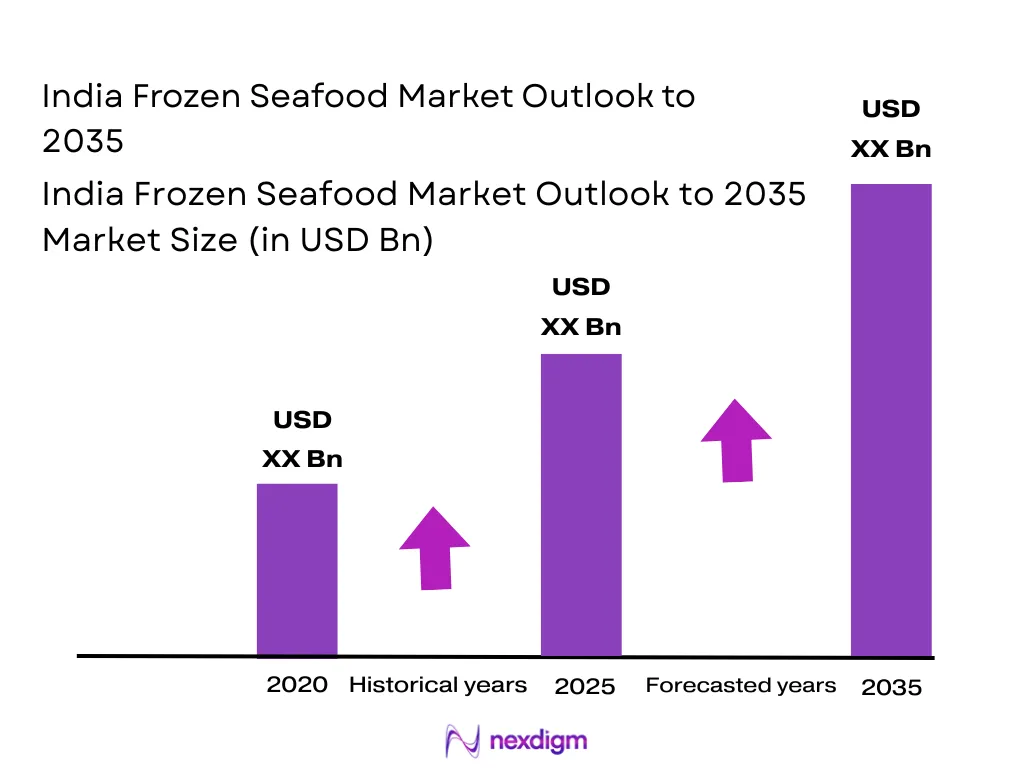
The India Frozen Seafood Market is valued at USD ~ billion, based on official frozen seafood export categories covering frozen shrimp, frozen fish, frozen squid, surimi, frozen cuttlefish, frozen octopus and frozen lobster. The preceding official base recorded USD ~ billion across the same exportable frozen categories, while the broader seafood export basket reached USD ~ billion and ~ million MT. Demand is driven by export-oriented shrimp processing, IQF adoption, value-added seafood, and cold-chain expansion. Andhra Pradesh, Gujarat, Kerala, Tamil Nadu, Maharashtra, Karnataka, Odisha and West Bengal dominate due to coastal landing centers, aquaculture ponds, processing plants, ice plants and port connectivity. India’s seafood exports reached USD ~ billion and 1,698,170 MT in the latest reported base, with the United States importing 346,868 MT and China importing 396,424 MT. These destinations dominate because Indian exporters supply frozen shrimp, fish and cephalopods at scale with established buyer relationships. The market is expected to record a forecast CAGR of around 5.5% during the 2026-2035 outlook period, supported by India’s faster country-level expansion in frozen seafood demand, export diversification, domestic frozen protein adoption, and value-added product penetration.
Market Segmentation
By Product Type
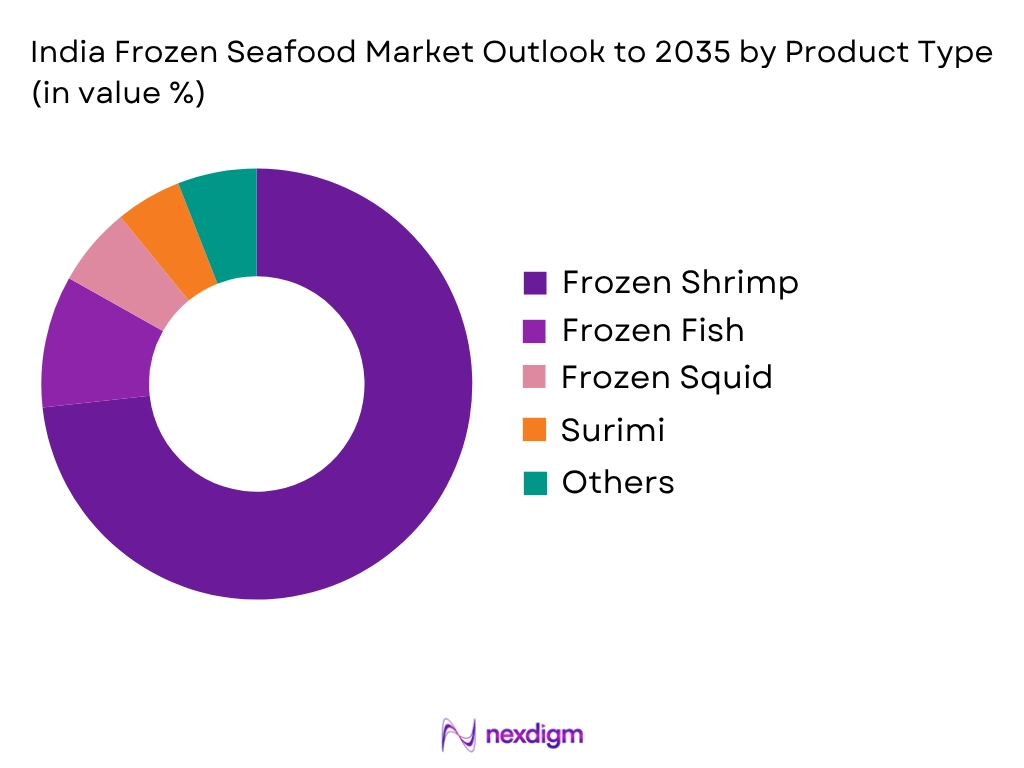
India Frozen Seafood Market is segmented by product type into frozen shrimp, frozen fish, frozen squid, surimi and surimi analogs, frozen cuttlefish, frozen octopus and frozen lobster. Frozen shrimp dominates the market because India has built a large Vannamei-centered aquaculture and processing ecosystem across Andhra Pradesh, Odisha, Tamil Nadu and Gujarat. The segment benefits from pond-level production scale, hatchery and feed integration, established peeling/deveining capacity, IQF and block freezing lines, and strong demand from the United States, China, Japan and the European Union. Frozen shrimp also commands stronger realization than many marine fish categories because exporters supply multiple formats such as HOSO, HLSO, PD, PDTO, cooked shrimp, Nobashi and breaded products. Official seafood export data identifies frozen shrimp as the largest item by both quantity and value, reinforcing its role as the commercial anchor of the frozen seafood industry.
By Frozen Shrimp Export Destination
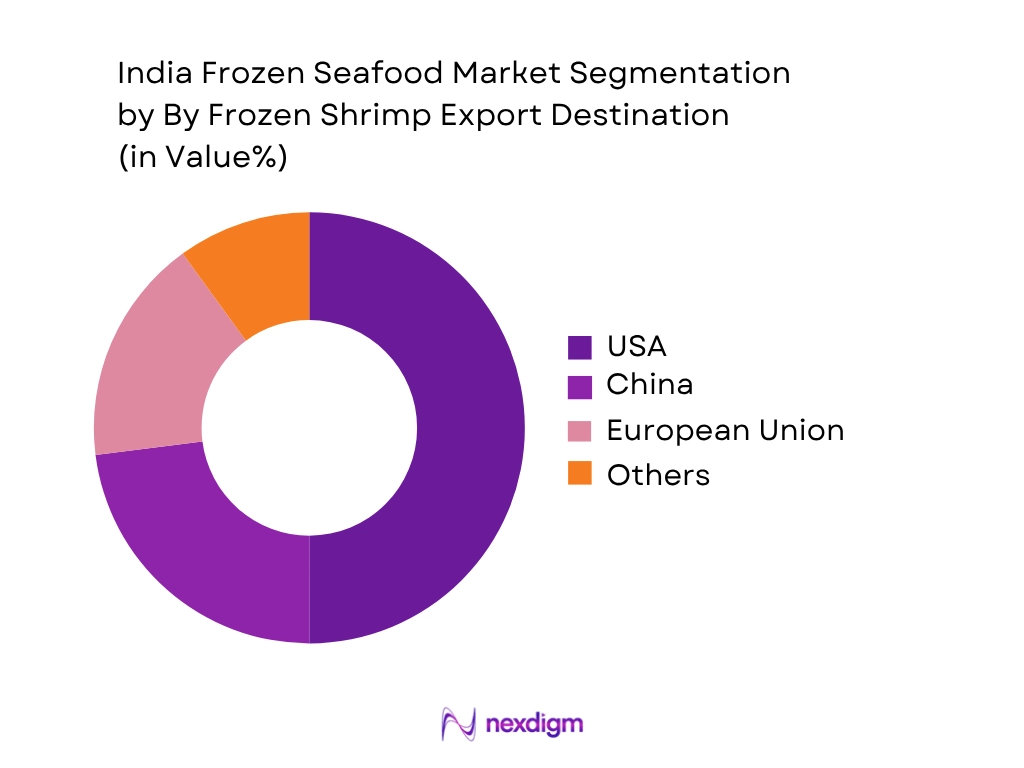
India Frozen Seafood Market is segmented by frozen shrimp export destination into the United States, China, European Union, Southeast Asia, Japan, Middle East and other markets. The United States dominates because Indian processors have long-standing relationships with US importers, retail chains, foodservice distributors and reprocessors. The market absorbs large volumes of peeled, deveined, cooked and value-added shrimp, making it commercially attractive for integrated exporters. US demand is also supported by established compliance routes, buyer audits, seafood import infrastructure and the ability of Indian exporters to supply consistent count sizes. China follows as a major volume market, while the European Union and Japan remain quality-sensitive destinations requiring tighter traceability, residue control and certification discipline. This destination mix makes export diversification a central strategic priority for processors.
Competitive Landscape
The India Frozen Seafood Market is led by integrated shrimp processors, export houses and value-added seafood manufacturers with strong plant approvals, export certifications, raw material access and buyer networks. Competition is concentrated around shrimp processing scale, cold-chain reliability, global market access, certification portfolios and the ability to move from commodity frozen shrimp into cooked, breaded, marinated and retail-ready seafood formats. Companies with hatchery, farm, feed, processing and export integration have stronger control over quality, traceability and margins.
| Company | Establishment Year | Headquarters | Core Product Focus | Processing / Capacity Indicator | Export Market Reach | Integration Model | Certifications / Quality Positioning | Strategic Strength |
| Devi Sea Foods | 1992 | Andhra Pradesh | ~ | ~ | ~ | ~ | ~ | ~ |
| Nekkanti Sea Foods | 1983 | Visakhapatnam, Andhra Pradesh | ~ | ~ | ~ | ~ | ~ | ~ |
| Avanti Frozen Foods | 2015 | Andhra Pradesh / Hyderabad-linked group structure | ~ | ~ | ~ | ~ | ~ | ~ |
| Apex Frozen Foods | 1995 | Andhra Pradesh | ~ | ~ | ~ | ~ | ~ | ~ |
| Gadre Marine Export | 1994 | Ratnagiri, Maharashtra | ~ | ~ | ~ | ~ | ~ | ~ |
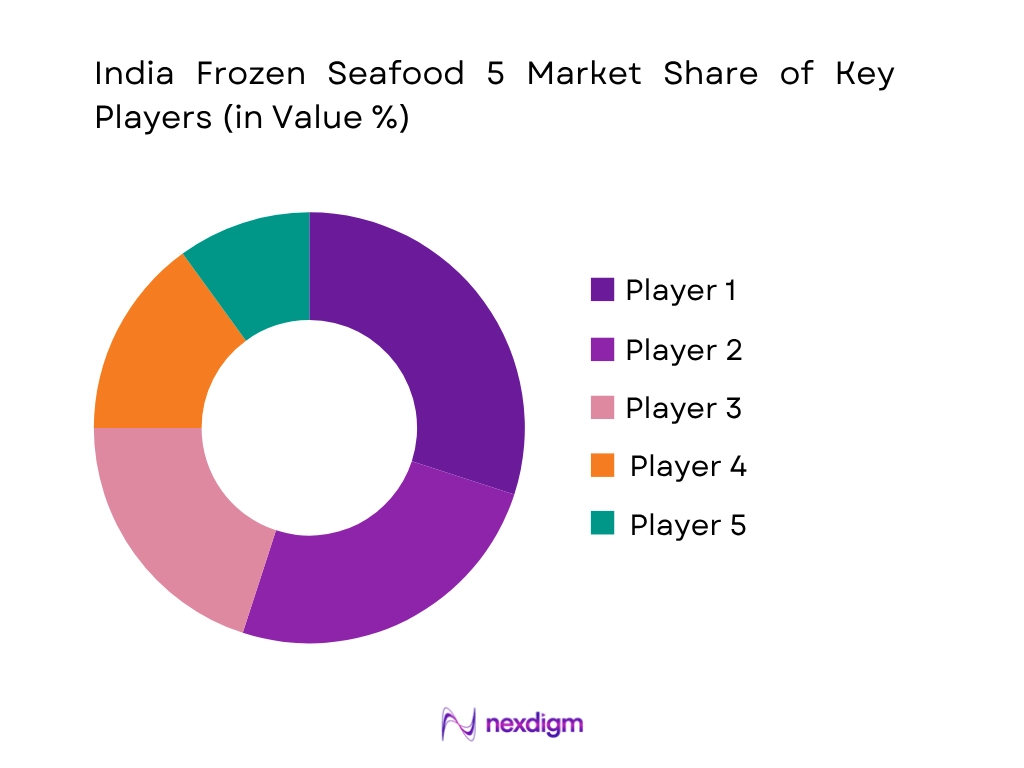
India Frozen Seafood Market Outlook to 2035
Growth Drivers
Export-Oriented Frozen Shrimp Processing Base
India Frozen Seafood Market is strongly driven by the export-oriented frozen shrimp processing base, where frozen shrimp remains the anchor product for processors, cold stores, reefer operators and export houses. MPEDA reported that India exported 1,698,170 MT of seafood in FY 2024-25, while frozen shrimp alone accounted for 741,529 MT. The United States imported 311,948 MT of Indian frozen shrimp, followed by China with 136,164 MT, the European Union with 99,310 MT, Southeast Asia with 58,003 MT, Japan with 38,917 MT, and the Middle East with 32,784 MT. This destination spread supports continuous demand for IQF shrimp, block frozen shrimp, peeled and deveined shrimp, cooked shrimp and value-added formats. The macroeconomic base also supports export capacity: World Bank data shows India’s GDP at USD ~ trillion and GDP per capita at USD 2,694.7 in 2024, giving processors a large domestic operating base for labor, ports, logistics and food processing expansion.
Large Fish Production Base Supporting Raw Material Availability
India Frozen Seafood Market is supported by a large fisheries and aquaculture production base that supplies shrimp, fish, cephalopods and other marine species for freezing, processing and export. The Ministry of Food Processing Industries’ fisheries sector profile states that India produced 18.40 MMT of fish in FY 2023-24, including 13.91 MMT from inland fisheries and 4.49 MMT from marine fisheries. A PIB fisheries update later reported fish production at 197.75 lakh tonnes in FY 2024-25, while average aquaculture productivity reached 4.77 tonnes per hectare. This production base strengthens availability for frozen fish, frozen shrimp, frozen squid, frozen cuttlefish and value-added seafood manufacturers. World Bank data further shows India’s total urban population at 513,325.08 thousand people in 2024, creating a widening consumption base for frozen seafood through supermarkets, online meat platforms, cold-chain distributors and HoReCa buyers. The combination of raw material depth and rising urban demand supports processing-led market expansion.
Market Opportunities
Value-Added Seafood and Cold-Chain Expansion
India Frozen Seafood Market has a strong opportunity in value-added seafood because the government-backed cold-chain ecosystem is expanding into multi-temperature storage, IQF, blast freezing, reefer vans and distribution infrastructure. MoFPI reported that, as of 30 June 2024, it had approved 399 cold-chain projects, 41 mega food parks, 76 agro-processing clusters, 588 food processing units, 61 backward and forward linkage projects, and 52 Operation Greens projects under PMKSY. The cold-chain scheme explicitly covers fish and marine products through infrastructure such as pre-cooling, sorting, grading, multi-product cold storage, IQF, blast freezing, reefer vans and mobile cooling units. This creates a practical opportunity for processors to move beyond bulk block frozen exports into IQF fish fillets, breaded shrimp, skewered shrimp, marinated shrimp, frozen curry cuts and HoReCa-ready seafood. India’s 513.3 million urban residents in 2024, according to World Bank data, also provide a large city-based base for frozen retail packs and online seafood delivery.
Shrimp Broodstock, Seed Quality and Integrated Aquaculture Upgrading
India Frozen Seafood Market has a major opportunity in shrimp broodstock improvement and integrated aquaculture upgrading. The Department of Fisheries stated that the Union Budget 2024-25 announced financial support for setting up a network of Nucleus Breeding Centres for shrimp broodstock, focused on improving broodstock quality for key species including Litopenaeus vannamei. The same government guidelines specify development of Specific Pathogen Free broodstock and require applicants to demonstrate capability in maintaining at least 5 generations and developing at least 50 families of candidate species through R&D. PIB also reported that the Department of Fisheries received a budgetary allocation of Rs. 2,616.44 crore for FY 2024-25, with Rs. 2,352 crore allocated to PMMSY. For frozen seafood processors, this supports future raw material reliability, disease management, traceability and shrimp export consistency. IMF also lists India’s population at 1,476.626 million for 2026, indicating a large labor, farming and consumption base for aquaculture-linked seafood processing.
Market Challenges
High Export Destination Concentration and Buyer Compliance Exposure
India Frozen Seafood Market faces a structural challenge from export destination concentration, especially in frozen shrimp. MPEDA reported frozen shrimp exports of 741,529 MT in FY 2024-25, of which the United States imported 311,948 MT, China imported 136,164 MT, the European Union imported 99,310 MT, Southeast Asia imported 58,003 MT, Japan imported 38,917 MT, and the Middle East imported 32,784 MT. This means processors remain highly exposed to buyer audits, residue norms, labeling requirements, container availability, port documentation and destination-specific regulatory checks. EIC’s export control guidance requires approved seafood establishments to operate HACCP-based own-check systems and maintain records under official surveillance, making compliance a constant operational burden rather than a one-time requirement. The macroeconomic context adds pressure because India’s 2024 GDP per capita was only USD 2,694.7, according to the World Bank, limiting the ability of many domestic buyers to absorb premium frozen seafood if export channels face temporary disruption.
Aquatic Disease, Residue Monitoring and Farm-Level Quality Risk
India Frozen Seafood Market faces farm-level quality risk from shrimp diseases and residue compliance, both of which directly affect frozen shrimp processing yields, rejection risk and buyer confidence. A Lok Sabha response stated that the National Surveillance Programme for Aquatic Animal Diseases is implemented through 31 laboratories across ICAR fisheries institutes, fisheries universities and colleges, covering active and passive surveillance of major shrimp diseases. ICAR-CIBA training material identifies Enterocytozoon hepatopenaei, White Spot Syndrome Virus and White Feces Syndrome as major shrimp diseases affecting production and profitability across India. MPEDA separately states that its residue monitoring covers inland fish, crustaceans and molluscs and includes pesticide residue monitoring, radionuclide monitoring and antibiotic residue controls. For export shrimp, MPEDA has also operated 12 ELISA laboratories across Bhimavaram, Amalapuram, Kakinada, Ongole, Nellore, Machilipatnam, Bhubaneswar, Balasore, Kolkata, Valsad, Kochi and Nagapattinam for pre-harvest testing. These controls are necessary, but they raise operational complexity for processors and farmers.
Future Outlook
Over the long-term outlook period, India Frozen Seafood Market is expected to grow as exporters deepen value-added processing, strengthen traceability and diversify away from single-destination dependence. Frozen shrimp will remain the largest revenue pool, but frozen fish fillets, surimi, breaded shrimp, ready-to-cook packs and premium retail seafood are expected to gain commercial relevance. Domestic growth will be supported by modern retail, quick commerce, HoReCa demand and improved frozen-chain infrastructure. Export growth will depend on disease control, residue compliance, tariff management and higher processing sophistication.
Major Players
- Devi Sea Foods
- Nekkanti Sea Foods
- Avanti Frozen Foods
- Apex Frozen Foods
- Gadre Marine Export
- Sandhya Marines
- Coastal Corporation
- The Waterbase Limited
- IFB Agro Industries
- Falcon Marine Exports
- Kader Exports
- BMR Group
- Sagar Grandhi Exports
- Abad Fisheries
- Liberty Frozen Foods
Key Target Audience
- Frozen seafood processors and exporters
- Shrimp aquaculture companies and integrated seafood groups
- Cold-chain logistics and reefer transport companies
- Seafood distributors, importers and export trading houses
- HoReCa chains, QSR operators and cloud kitchen groups
- Modern retail, online meat platforms and quick commerce companies
- Investments and venture capitalist firms
- Government and regulatory bodies
Research Methodology
Step 1: Identification of Key Variables
The initial phase involves constructing an ecosystem map covering frozen shrimp exporters, fish processors, surimi manufacturers, cold-chain operators, aquaculture farms, landing centers, domestic retailers and export buyers. Key variables include product type, export destination, species source, processing capacity, cold-chain availability, certification status, average realization and end-user channel.
Step 2: Market Analysis and Construction
Historical frozen seafood values are compiled from official export datasets, category-level trade records and publicly available industry filings. The analysis reconciles frozen shrimp, frozen fish, squid, cuttlefish, surimi and other frozen categories to construct the market base. Processor capacity, shipment volume, price realization and destination mix are evaluated to build the market structure.
Step 3: Hypothesis Validation and Expert Consultation
Market hypotheses are validated through structured interactions with seafood exporters, processing plant operators, cold-chain distributors, aquaculture stakeholders and HoReCa procurement heads. These consultations test assumptions on yield loss, capacity utilization, export pricing, certification costs, product mix shifts and domestic channel margins.
Step 4: Research Synthesis and Final Output
The final phase integrates official trade data, company intelligence, expert inputs and channel checks into a consolidated market model. Segment shares, growth outlook, competitive positioning and investment opportunities are reviewed through both top-down and bottom-up approaches to ensure the final output reflects market-specific operating realities.

- Executive Summary
- Research Methodology(Market Definitions and Assumptions, Frozen Seafood Classification, HS Code Mapping, MPEDA Export Mapping, EIC-Approved Unit Mapping, FSSAI Compliance Review, Primary Interviews with Exporters/Processors/Distributors/HoReCa Buyers, Bottom-Up Plant Capacity Estimation, Top-Down Export and Domestic Demand Reconciliation, Price Benchmarking by Species and SKU, Cold-Chain Channel Validation, Forecasting Assumptions, Limitations and Risk Adjustments)

- Definition and Scope
- Market Genesis and Evolution
- Industry Business Cycle
- Seafood Export and Domestic Consumption Ecosystem
- Supply Chain and Value Chain Analysis

- Growth Drivers (Export-Led Shrimp Processing, Aquaculture Expansion, Urban Protein Diversification, Cold-Chain Development, Ready-to-Cook Demand)
- Expansion of Aquaculture and Processing Clusters (Andhra Pradesh, Odisha, West Bengal, Tamil Nadu, Gujarat, Hatcheries, Feed Mills, Processing Plants, Cold Stores)
- Market Challenges (Export Dependence, Disease Risk, Residue Compliance, Cold-Chain Gaps, Raw Material Volatility, Fresh Seafood Preference)
- High Dependence on Export Markets (US Demand, China Demand, EU Compliance, Japan Quality Standards, Anti-Dumping Exposure, Currency Risk)
- Market Opportunities(Value-Added Shrimp, Domestic Branded Seafood, HoReCa Standardization, Export Diversification, Traceable Seafood)
- White Space in Value-Added Shrimp Products (Breaded Shrimp, Nobashi Shrimp, Cooked Shrimp, Tempura Shrimp, Skewered Shrimp, Marinated Shrimp)
- Market Trends (IQF Adoption, Branded Retail Packs, Sustainability, Traceability, Value-Added Processing, Digital Grocery)
- Shift from Commodity Blocks to IQF and Retail-Ready Packs (IQF Shrimp, Fish Fillets, Small Pack Sizes, Resealable Pouches, Glazed Seafood, Retail Labelling)
- Supply Chain Risk Analysis
- SWOT Analysis
- Porter’s Five Forces
- Stakeholder Ecosystem

- By Value (2020-2025)
- By Volume (2020-2025)
- By Average Realization per Kg (2020-2025)

- By Product Category (In Value %)
Frozen Shrimp
Frozen Fish
Frozen Cephalopods
Frozen Crustaceans and Molluscs
Surimi and Value-Added Seafood - By Freezing Technology (In Value %)
IQF Frozen Seafood
Block Frozen Seafood
Blast/Plate Frozen Seafood
Glazed Frozen Seafood - By End User (In Value %)
Export Buyers
HoReCa and Foodservice
Modern Retail and General Trade
Online Meat and Seafood Platforms
Institutional and Industrial Buyers - By Distribution Channel (In Value %)
Export Channel
Domestic Distributor Channel
Modern Trade Channel
Online and Quick Commerce Channel

- Cross Comparison Parameters (Product Portfolio, Processing Capacity, Freezing Technology, Certification Portfolio, Export Market Footprint, Raw Material Sourcing Model, Cold-Chain/Distribution Reach, Value-Added Product Share)
- SWOT Analysis of Major Players
- Pricing Analysis of Major Players
- Detailed Profiles of Major Companies
Devi Sea Foods
Nekkanti Sea Foods
Avanti Frozen Foods
Apex Frozen Foods
Sandhya Marines
Gadre Marine Export
IFB Agro Industries
The Waterbase Limited
Coastal Corporation
Kings Infra Ventures
Zeal Aqua
BMR Group
Kader Exports
Abad Fisheries
Liberty Frozen Foods

- Export Buyer Analysis
- Domestic Retail Consumer Analysis
- HoReCa Buyer Analysis
- QSR and Cloud Kitchen Buyer Analysis
- Institutional Buyer Analysis

- By Value (2026-2035)
- By Volume (2026-2035)
- By Average Realization per Kg (2026-2035)


 Request a Sample
 Ask for Customization
 Get a Quote
 Enquire Now