
 Download PDF
Market Overview
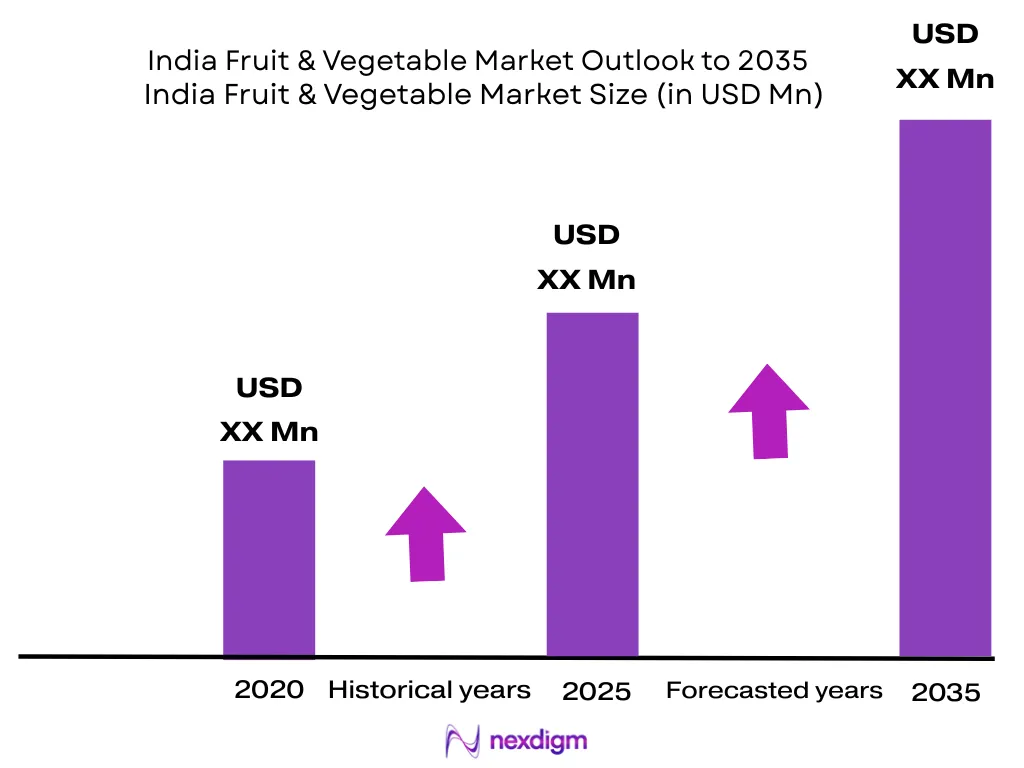
The India Fresh Fruits & Vegetables Market is valued at USD ~ million, based on a five-year historical analysis, and is forecast to expand at 5.7% CAGR across the available long-range outlook. India’s broader horticulture production base increased from 3,547.44 lakh tonnes to 3,707.38 lakh tonnes, while fruit production rose from 1,129.78 lakh tonnes to 1,176.49 lakh tonnes and vegetable production rose from 2,072.08 lakh tonnes to 2,177.97 lakh tonnes, supporting fresh retail, mandi trade, processing, exports and quick commerce demand. Maharashtra, Uttar Pradesh, West Bengal, Gujarat, Andhra Pradesh, Karnataka, Madhya Pradesh, Tamil Nadu and Himachal Pradesh dominate the India Fruit & Vegetable Market due to crop specialization, mandi linkages, irrigation, packhouses, export clusters and large consumption centres. Maharashtra is strong in grapes, pomegranates, bananas and onions; Uttar Pradesh leads large-scale vegetable and mango belts; Gujarat supports onion, potato and okra; Karnataka and Andhra Pradesh are important for tomato, chilli and banana; Himachal Pradesh anchors apple supply. India exported USD 1,818.56 million of fresh fruits and vegetables, including USD 999.55 million fruits and USD 819 million vegetables.
Market Segmentation
By Product Type
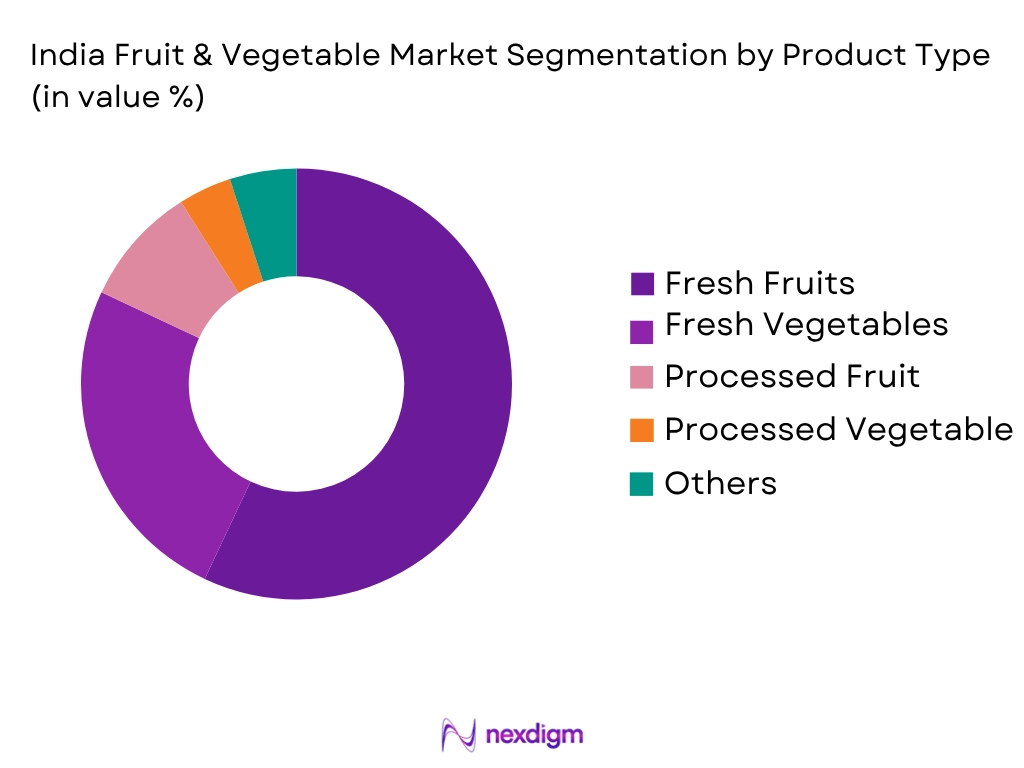
India Fruit & Vegetable Market is segmented by product type into fresh vegetables, fresh fruits, processed fruits, processed vegetables, and frozen, dehydrated and fresh-cut produce. Recently, fresh vegetables have a dominant market share in India under the segmentation product type, it is due to their daily use in household cooking, kirana purchases, mandi procurement, HoReCa kitchens, institutional meals and street food preparation. Potato, onion, tomato, brinjal, cabbage, cauliflower, chilli, okra, peas and leafy vegetables create high-frequency demand across urban and rural consumers. Vegetable production increased from 2,072.08 lakh tonnes to 2,177.97 lakh tonnes, with higher output in onion, potato, green chilli, cauliflower, cabbage, brinjal, okra, peas, pumpkin, bottle gourd, bitter gourd, cucumber, tapioca, sweet potato, radish and capsicum.
By Distribution Channel
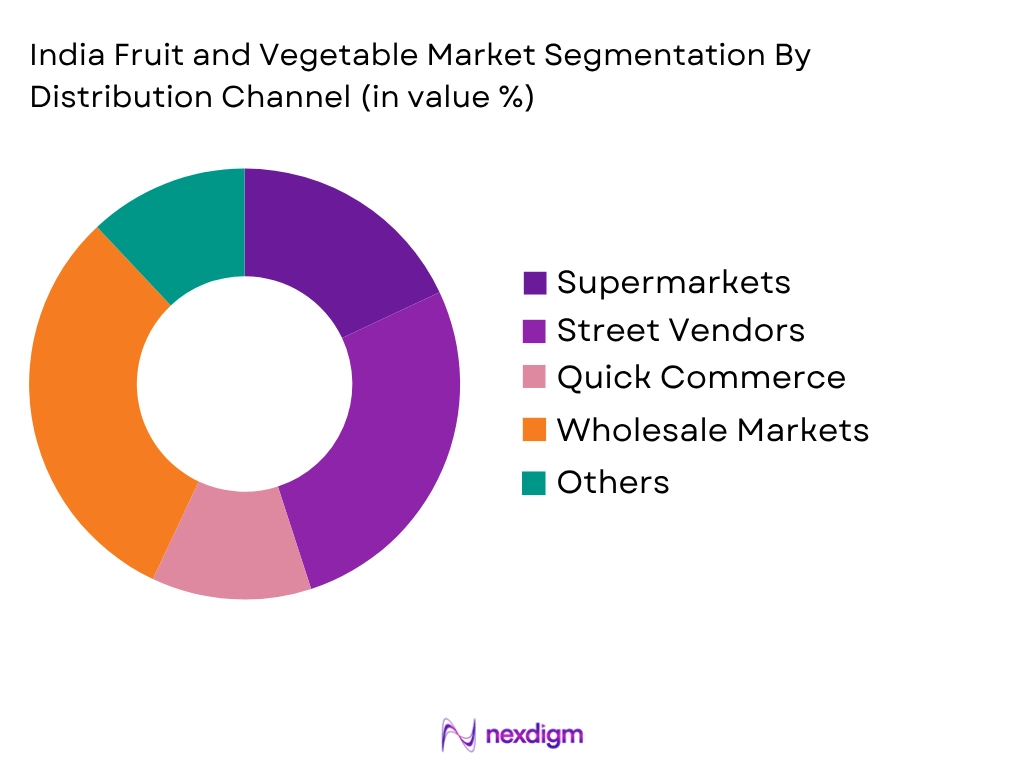
India Fruit & Vegetable Market is segmented by distribution channel into APMC mandis and wholesale markets, traditional retailers and street vendors, organized retail and supermarkets, e-grocery and quick commerce, and processors/exporters/HoReCa distributors. Recently, APMC mandis and wholesale markets have a dominant market share in India under the segmentation distribution channel, it is due to the fragmented farmer base, daily auction-based price discovery, commission agent networks, inter-state crop movement and loose produce trade. Mandis remain central for tomato, onion, potato, banana, mango, grapes, cauliflower, cabbage, okra and leafy greens. Organized retail and quick commerce are growing because consumers want sorted, graded and fast-delivered produce, but traditional wholesale channels continue to control bulk aggregation, daily arrivals and redistribution into kiranas, carts, foodservice and local markets.
Competitive Landscape
The India Fruit & Vegetable Market is fragmented at farm and mandi level, but organized players are gaining influence across direct procurement, e-grocery, quick commerce, fresh produce distribution, exports and processing. Reliance Retail Fresh, BigBasket, Ninjacart, WayCool Foods and Sahyadri Farms are important because they combine farmer sourcing, technology-led aggregation, packhouse operations, urban distribution and retail access. Competition is shaped by sourcing depth, SKU standardization, cold-chain reach, mandi bypass capability, export compliance and ability to serve high-frequency fresh baskets.
| Company | Establishment Year | Headquarters | Key Categories | Business Model | Key Channel | Sourcing Footprint | Market-Specific Capability | Competitive Advantage |
| Reliance Retail Fresh | 2006 | Mumbai, Maharashtra | ~ | ~ | ~ | ~ | ~ | ~ |
| BigBasket | 2011 | Bengaluru, Karnataka | ~ | ~ | ~ | ~ | ~ | ~ |
| Ninjacart | 2015 | Bengaluru, Karnataka | ~ | ~ | ~ | ~ | ~ | ~ |
| WayCool Foods | 2015 | Chennai, Tamil Nadu | ~ | ~ | ~ | ~ | ~ | ~ |
| Sahyadri Farms | 2010 | Nashik, Maharashtra | ~ | ~ | ~ | ~ | ~ | ~ |
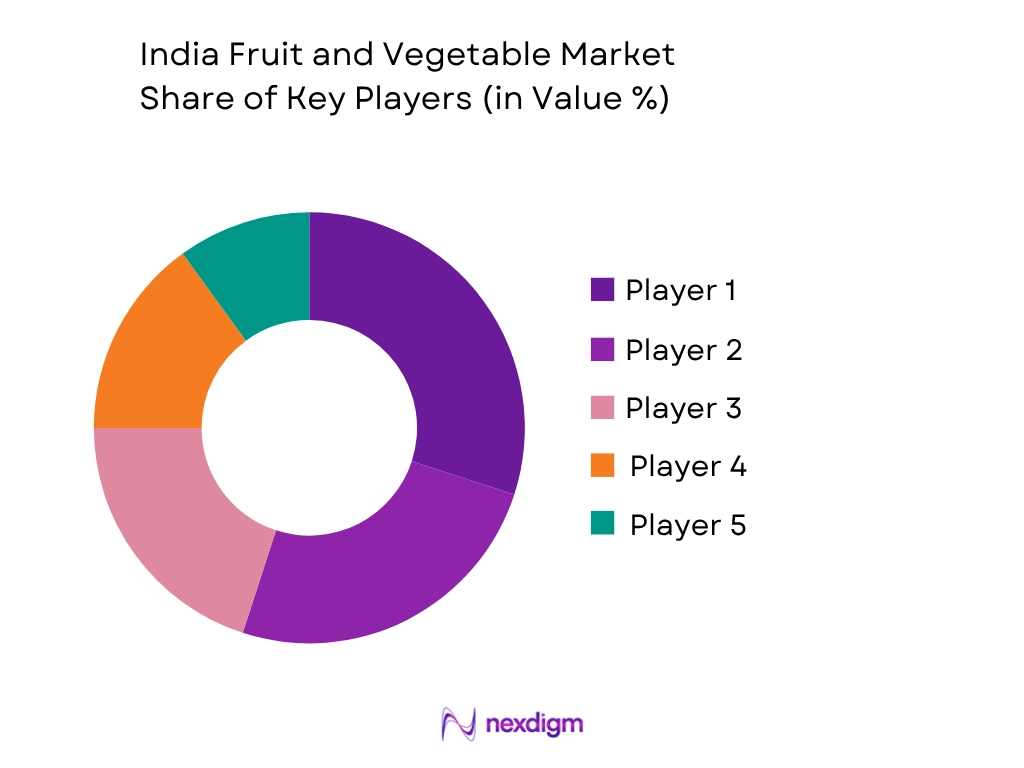
India Fruit & Vegetable Market Analysis
Growth Drivers
Expanding Horticulture Output Strengthens Fresh Produce Availability
India Fruit & Vegetable Market is supported by a large production base and a broad consumer economy. World Bank data records India’s GDP at USD 3.91 trillion and GDP per capita at USD 2,694.7 in 2024, giving the country a large macroeconomic base for food retail, mandi trade, quick commerce and HoReCa demand. The Ministry of Agriculture & Farmers Welfare reported horticulture area at 301.36 lakh hectares and horticulture production at 3,707.38 lakh tonnes in 2024-25, compared with 290.86 lakh hectares and 3,547.44 lakh tonnes in 2023-24. Fruit production reached 1,176.49 lakh tonnes, while vegetable production reached 2,177.97 lakh tonnes, supporting large-scale movement of banana, mango, papaya, guava, onion, potato, green chilli, cauliflower, cabbage, brinjal, okra, peas, gourds and cucumber. This directly supports mandis, traditional retailers, organized supermarkets, food processors, e-grocery platforms and export packhouses.
Exportable Crop Base Supports Packhouse and Compliance-Led Growth
India Fruit & Vegetable Market is driven by exportable produce categories and a rising need for sorting, grading, packhouses, residue control and reefer logistics. World Bank data places India’s GDP at USD 3.91 trillion and GDP per capita at USD 2,694.7 in 2024, supporting investment capacity in food supply chains and agriculture-linked infrastructure. APEDA reports that India exported fresh fruits and vegetables worth USD 1,818.56 million in 2024-25, including fresh fruits worth USD 999.55 million and fresh vegetables worth USD 819 million. Grapes, pomegranates, mangoes, bananas and oranges formed the larger fruit export basket, while onions, mixed vegetables, potatoes, tomatoes and green chilli contributed strongly to vegetable exports. Processed fruits and juices added USD 721.86 million, and processed vegetables and pulses added USD 1,752.03 million, indicating strong demand for fresh and value-added horticulture products. This supports export-oriented investments in Nashik grapes, Maharashtra pomegranates, mango pulp, dehydrated onion, frozen vegetables and APEDA-certified packhouses.
Market Challenges
Cold-Chain and Post-Harvest Infrastructure Remain Below Production Scale
India Fruit & Vegetable Market faces a structural handling challenge because production volumes are substantially larger than formal cold-chain and preservation infrastructure. World Bank data records India’s GDP at USD 3.91 trillion and GDP per capita at USD 2,694.7 in 2024, but fresh produce still relies heavily on fragmented mandi, transport and retail handling systems. The Ministry of Agriculture & Farmers Welfare reported horticulture production of 3,707.38 lakh tonnes in 2024-25, including fruit production of 1,176.49 lakh tonnes and vegetable production of 2,177.97 lakh tonnes. Against this scale, MoFPI reported that, as of June 2025, 395 integrated cold-chain projects had been approved and 291 completed projects had become operational, creating preservation capacity of 25.52 lakh metric tonnes per year and processing capacity of 114.66 lakh metric tonnes per year. This mismatch creates pressure on tomatoes, onions, potatoes, leafy vegetables, mangoes, bananas, grapes and pomegranates, where timing, temperature, grading and storage determine realizable value.
TOP Crop Volatility Creates Procurement and Supply Planning Risk
India Fruit & Vegetable Market faces recurring instability in tomato, onion and potato supply because these crops are heavily exposed to acreage shifts, weather, storage limits and regional concentration. World Bank data shows India’s GDP at USD 3.91 trillion and GDP per capita at USD 2,694.7 in 2024, indicating a large consumption economy where staple vegetable disruption quickly affects retailers, mandis, processors and foodservice buyers. The Ministry of Agriculture & Farmers Welfare reported onion area rising from 15.41 lakh hectares in 2023-24 to 19.68 lakh hectares in 2024-25, with onion production reaching 307.67 lakh tonnes. Potato production reached 585.71 lakh tonnes in 2024-25, compared with 570.53 lakh tonnes in 2023-24, while tomato production stood at 205.99 lakh tonnes in 2024-25 against 213.23 lakh tonnes in 2023-24. These large crop swings create procurement uncertainty for quick commerce platforms, kirana wholesalers, HoReCa suppliers, frozen potato processors, tomato processors and mandi traders.
Market Opportunities
Cold-Chain, Packhouse and Processing Infrastructure Offers Expansion Scope
India Fruit & Vegetable Market has a strong opportunity in cold-chain, packhouse, ripening, sorting, grading and processing infrastructure because current production volumes are large and formal capacity is still developing. World Bank data records India’s GDP at USD 3.91 trillion and GDP per capita at USD 2,694.7 in 2024, creating a macroeconomic base for investment in agriculture infrastructure and value-added food systems. MoFPI states that the Integrated Cold Chain and Value Addition Infrastructure Scheme supports pre-cooling, weighing, sorting, grading, waxing, cold storage, CA storage, packing, IQF, blast freezing, reefer vans and mobile cooling units. As of June 2025, completed cold-chain projects created preservation capacity of 25.52 lakh metric tonnes per year and processing capacity of 114.66 lakh metric tonnes per year, while the scheme generated 1,74,600 jobs. The policy base is also active, with PMKSY allocation raised to ₹6,520 crore for the 15th Finance Commission cycle and 50 multi-product food irradiation units supported under the cold-chain component. This supports future growth in fresh-cut produce, mango pulp, frozen peas, onion dehydration, banana ripening and export packing.
Export and Processing Channels Can Capture Higher Value from Horticulture Output
India Fruit & Vegetable Market has a clear opportunity to scale export-grade and processed produce channels because official production and trade data show large current supply depth. World Bank data places India’s GDP at USD 3.91 trillion and GDP per capita at USD 2,694.7 in 2024, supporting formalization of fresh produce procurement, digital platforms and value-chain investment. India produced 1,176.49 lakh tonnes of fruits and 2,177.97 lakh tonnes of vegetables in 2024-25, with 2025-26 first estimates placing fruit production at 1,186.80 lakh tonnes and vegetable production at 2,161.60 lakh tonnes. APEDA reported fresh fruits and vegetables exports of USD 1,818.56 million in 2024-25, while processed fruits and juices exported USD 721.86 million and processed vegetables and pulses exported USD 1,752.03 million. These figures indicate current exportable and processable supply across grapes, mangoes, bananas, pomegranates, oranges, onions, potatoes, tomatoes, green chilli, dehydrated onion, frozen vegetables and fruit pulp. Exporters, FPOs and processors can use certified packhouses, residue testing, traceability and reefer logistics to capture higher-quality domestic and international demand.
Future Outlook
Over the next five years, the India Fruit & Vegetable Market is expected to grow through higher horticulture output, organized retail penetration, export-grade packhouses, quick commerce expansion, cold-chain investment and food processing demand. The market’s forecasted CAGR is 5.7%, aligned with the available India fresh fruits and vegetables outlook. Fresh vegetables will remain the largest segment because Indian households buy vegetables frequently and rely on potato, onion, tomato, chilli, cabbage, cauliflower, okra, brinjal and leafy greens for daily meals. Fresh fruits will gain momentum through banana, mango, citrus, guava, papaya, grapes, pomegranate and premium imported fruits sold through supermarkets and online channels.
Exports will remain a strategic growth lever. APEDA reports fresh fruits and vegetables exports of USD 1,818.56 million, with grapes, pomegranates, mangoes, bananas and oranges forming the larger portion of fruit exports, while onions, mixed vegetables, potatoes, tomatoes and green chilli are major vegetable export items. Quick commerce, e-grocery and organized retail will increase the need for sorted, graded, packed, traceable and city-level replenished produce. Packhouses, ripening chambers, cold rooms, reefer logistics, farmer aggregation, FPO sourcing and digital mandi systems will become more relevant as retailers and exporters seek stable quality and lower wastage.
Major Players
- Reliance Retail Fresh
- BigBasket
- Blinkit
- Zepto
- Swiggy Instamart
- WayCool Foods
- Ninjacart
- DeHaat
- INI Farms
- Sahyadri Farms
- Desai Fruits Venture
- Freshtrop Fruits
- Allana Group
- Jain Farm Fresh Foods
- Mother Dairy Safal
Key Target Audience
- Fruit growers and vegetable producer groups
- Farmer Producer Organisations and cooperatives
- Organized retailers, supermarkets and hypermarkets
- E-grocery and quick commerce platforms
- Fresh produce exporters and APEDA-registered packhouses
- Food processing, frozen produce, pulp and dehydration companies
- Investments and venture capitalist firms
- Government and regulatory bodies (Ministry of Agriculture & Farmers Welfare, APEDA, FSSAI, National Horticulture Board, Ministry of Food Processing Industries, Directorate of Plant Protection, Quarantine & Storage, State APMC Boards, e-NAM)
Research Methodology
Step 1: Identification of Key Variables
The initial phase involves constructing an ecosystem map encompassing all major stakeholders within the India Fruit & Vegetable Market. This includes farmers, FPOs, APMC traders, commission agents, wholesalers, retailers, e-grocery platforms, exporters, processors and cold-chain operators. The primary objective is to identify production, channel, trade, processing, wastage, pricing and consumer variables influencing market dynamics.
Step 2: Market Analysis and Construction
In this phase, historical data is compiled and analyzed for India Fruit & Vegetable Market production, crop mix, mandi movement, exports, processing demand and organized retail penetration. The market is assessed through top-down market sizing and bottom-up crop-level modelling. Production trends for fruits, vegetables, onion, potato, tomato, banana, mango, grapes and pomegranate are analyzed for reliability.
Step 3: Hypothesis Validation and Expert Consultation
Market hypotheses are validated through computer-assisted telephonic interviews with FPO leaders, mandi traders, packhouse operators, retail category managers, exporters, cold-chain companies and processors. These consultations provide operational insights on procurement cycles, grade standards, wastage, direct sourcing, residue compliance, cold-chain adoption and channel-level margins. The findings are used to refine segmentation and competitive positioning.
Step 4: Research Synthesis and Final Output
The final phase involves engagement with fresh produce companies, exporters, processors, retailers and e-grocery platforms to verify product segments, sourcing models, sales channels and customer preferences. This interaction complements official data and secondary research. The final output provides market size, segmentation, competitive landscape, target audience mapping, future outlook and strategic recommendations for the India Fruit & Vegetable Market.

- Executive Summary
- Research Methodology (Market Definitions and Assumptions, Fresh and Processed Produce Classification, Farm-Gate and Retail Valuation, Wholesale Mandi Price Mapping, APEDA Export Data Review, NHB and MoA Production Data Triangulation, Bottom-Up Crop Production Model, Top-Down Consumption Expenditure Model, Primary Interviews with Farmers, FPOs, APMC Traders, Retailers, Exporters, Processors and Cold-Chain Operators, Limitations and Forecast Assumptions)

- Definition and Scope
- Market Genesis and Evolution
- India Horticulture Production Landscape
- Role of Fruits and Vegetables in Domestic Food Basket
- Role of APMC Mandis and Wholesale Markets

- Growth Drivers (Rising Horticulture Output, Large Domestic Food Basket, Urbanization, E-Grocery Adoption, Quick Commerce Expansion, Food Processing Demand, Export Demand, Government Infrastructure Schemes, FPO Aggregation)
- Market Challenges (Post-Harvest Losses, Cold-Chain Deficit, Mandi Intermediation, Price Volatility, Climate Risk, Fragmented Farming, Quality Standardization Gaps, Export Rejection Risk)
- Market Opportunities (Cold-Chain Investment, Packhouse Modernization, Farmer Aggregation, Export-Grade Sorting, Processed Produce, Organic Produce, Residue-Free Produce, Digital Procurement)
- Trends (Branded Fresh Produce, Residue-Free Claims, Farm-to-Fork Models, Direct Procurement, FPO-Led Aggregation, Digital Mandis, Premium Fruit Retail, Exotic Produce Adoption)
- SWOT Analysis
- Porter’s Five Forces

- By Value (2020-2025)
- By Volume (2020-2025)
- By Average Realization (2020-2025)

- By Product Category (In Value %)
Fresh Fruits
Fresh Vegetables
Processed Fruits
Processed Vegetables
Value-Added Produce - By Fruit Type (In Value %)
Tropical Fruits
Citrus Fruits
Temperate Fruits
Export-Oriented Fruits
Melons and High-Water Fruits - By Distribution Channel (In Value %)
APMC Mandis
Traditional Retailers
Street Vendors
Organized Supermarkets
E-Grocery Platforms
- By Geography (In Value %)
North India
West India
South India
East India
Central India

- Market Share of Major Players (Value Share, Volume Share, Product Category Share, Channel Share, Export Share, Processing Share)
- Cross Comparison Parameters (Farmer and FPO Sourcing Network, Crop Portfolio Depth, Mandi and Direct Procurement Reach, Packhouse and Sorting Capacity, Cold-Chain and Reefer Logistics Capability, Retail/E-Grocery/HoReCa Channel Penetration, Export Certification and Compliance Infrastructure, Processing and Value-Added Produce Capability)
- SWOT Analysis of Major Players
- Pricing and SKU Benchmarking of Major Players
- Detailed Profiles of Major Companies
Reliance Retail Fresh
BigBasket
Blinkit
Zepto
Swiggy Instamart
WayCool Foods
Ninjacart
DeHaat
INI Farms
Sahyadri Farms
Desai Fruits Venture
Freshtrop Fruits
Allana Group
Jain Farm Fresh Foods
Mother Dairy Safal

- Household Consumers
- Kirana Stores and Street Vendors
- Organized Retailers and Supermarkets
- E-Grocery and Quick Commerce Platforms
- HoReCa and Cloud Kitchens

- By Value (2026-2035)
- By Volume (2026-2035)
- By Average Realization (2026-2035)


 Request a Sample
 Ask for Customization
 Get a Quote
 Enquire Now