

 Download PDF
Market Overview
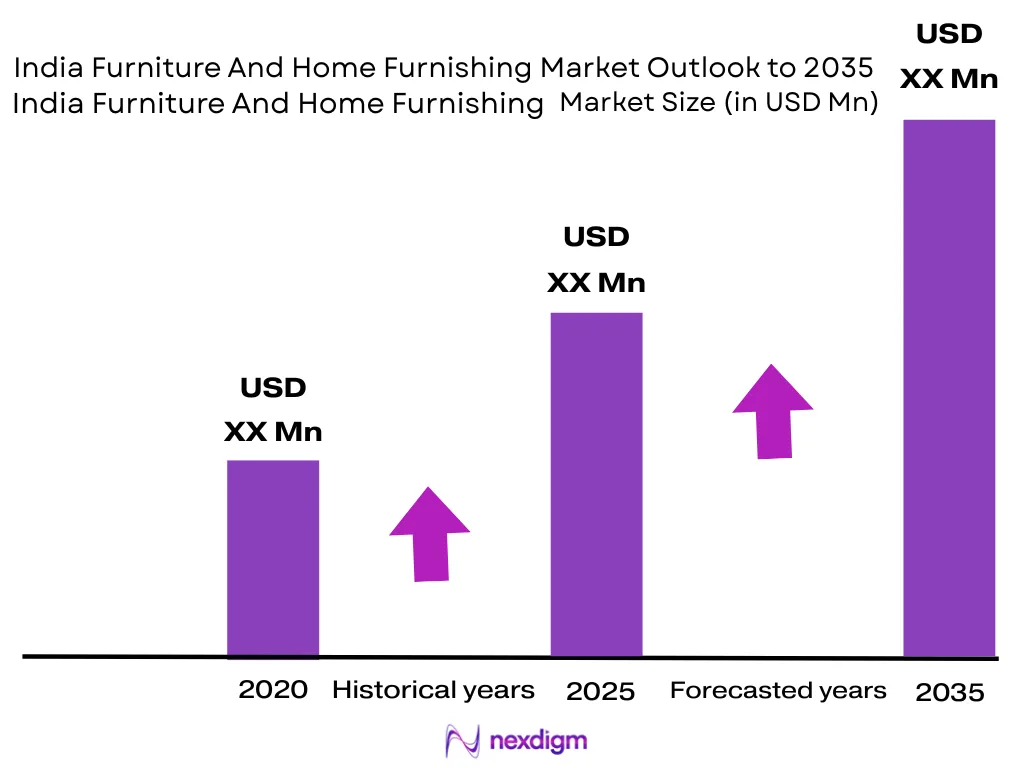
The India Furniture And Home Furnishing Market is valued at USD ~ billion, while the India home décor market generated USD ~ million, supporting demand across furniture, textiles, décor, lighting, storage and modular interiors. The market is driven by urbanization, real estate growth, branded furniture adoption, online retail, modular kitchens, wardrobes, mattresses and home improvement. India’s population reached ~ billion, strengthening the long-term residential furniture and furnishing demand base. India dominates South Asia’s furniture and home furnishing demand because of its population scale, manufacturing clusters, urban housing expansion and fast-growing digital retail ecosystem. Delhi NCR, Mumbai, Bengaluru, Hyderabad, Chennai, Pune, Ahmedabad and Kolkata dominate the market because they concentrate high-income households, apartment projects, office demand, interior designers, organized retail stores, online delivery networks and modular interior buyers. India’s GDP reached USD 3,912.69 billion, supporting broad consumption-led home furnishing demand.
Market Segmentation
By Product Type
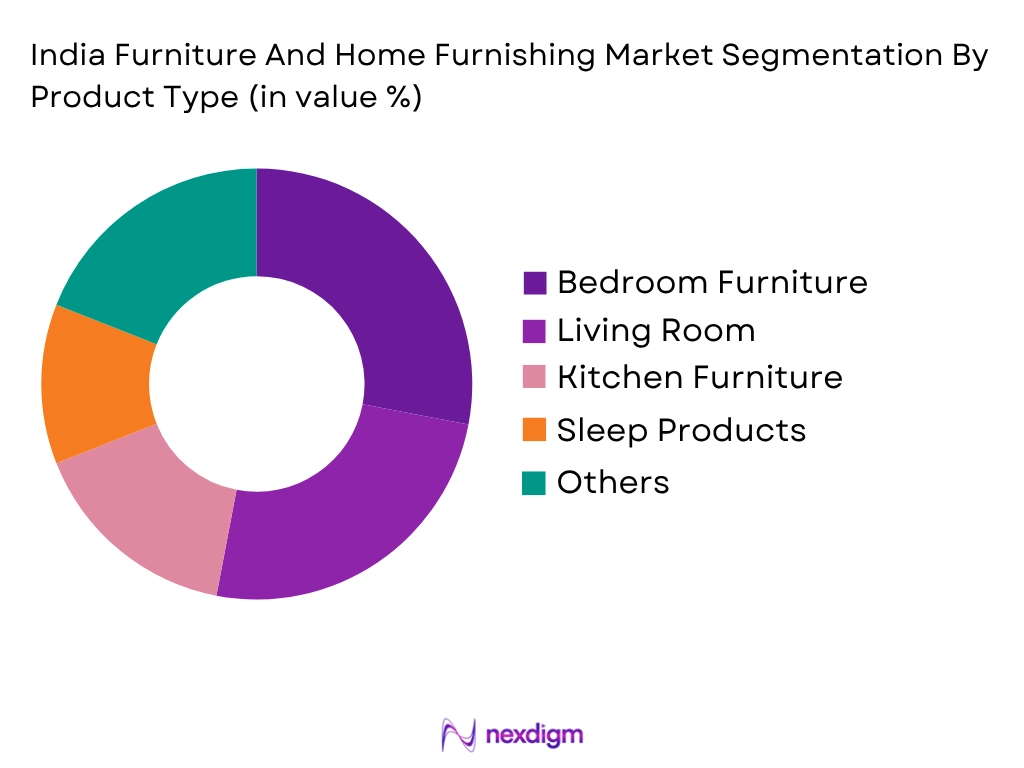
India Furniture And Home Furnishing Market is segmented by product type into bedroom furniture, living room furniture, dining and kitchen furniture, mattresses and sleep products, storage and utility furniture, home textiles, décor and lighting, and home office and study furniture. Bedroom furniture holds the dominant market share because beds, wardrobes, mattresses, dressers, bedside tables and storage units are essential household categories across owned homes, rented apartments and newly formed nuclear households. The dominance of this segment is also supported by compact urban homes, where storage-led bedroom products such as sliding wardrobes, hydraulic beds, box beds and modular bedroom sets solve space constraints. Branded retailers and online platforms also prioritize beds and wardrobes because they generate strong ticket values, repeat replacement demand and attachment sales in mattresses, pillows, bedding, curtains and lighting.
By Material
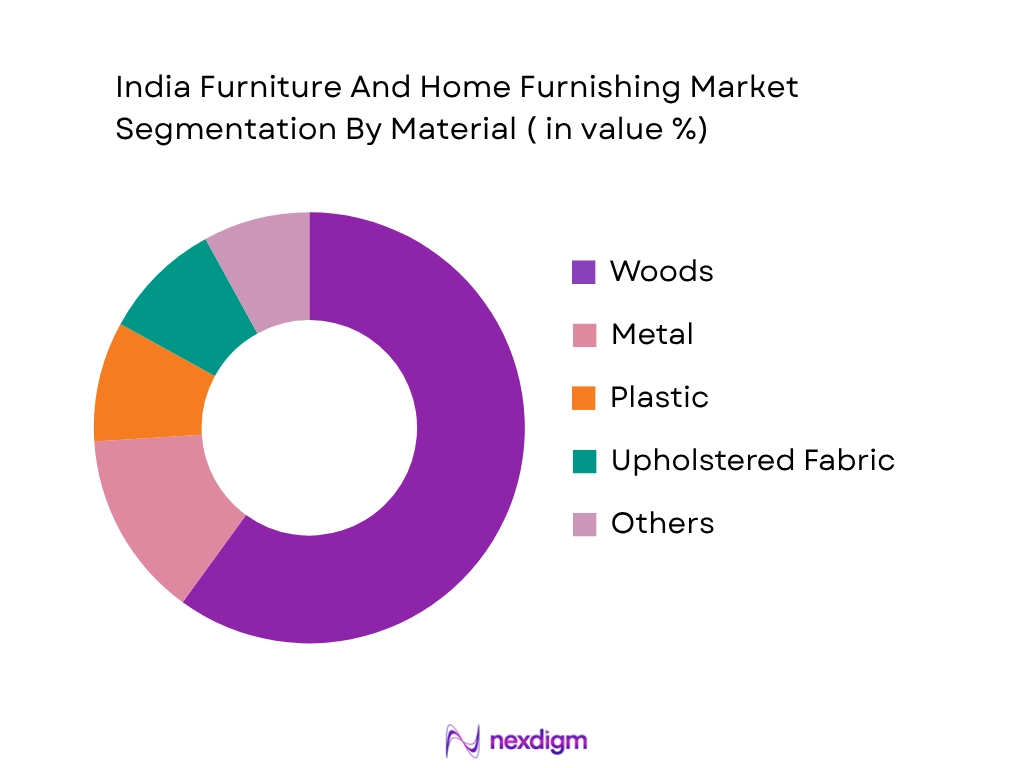
India Furniture And Home Furnishing Market is segmented by material into wood and engineered wood, metal, plastic and polymer, upholstered fabric, leather and leatherette, and cane, bamboo, glass and other materials. Wood and engineered wood hold the dominant market share because Indian consumers associate wood-based furniture with durability, aesthetics, resale value and suitability for home interiors. Solid wood remains important in premium and handcrafted categories, while engineered wood such as plywood, MDF, particle board and laminated boards supports affordable wardrobes, beds, modular kitchens, TV units and ready-to-assemble furniture. The segment is strengthened by manufacturing hubs such as Jodhpur, Saharanpur, Kirti Nagar, Bengaluru, Mumbai-Pune and Kerala. Wood-based products also fit both organized retail and local carpenter-led demand, enabling broad adoption across economy, value, mid-market and premium price tiers.
Competitive Landscape
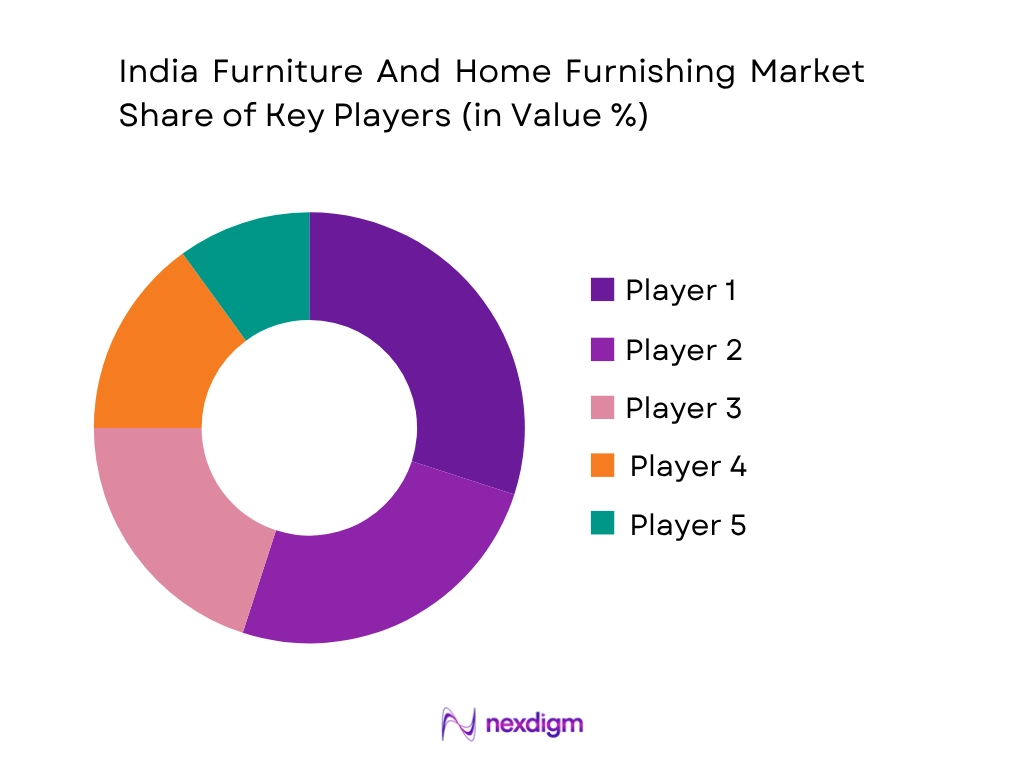
India Furniture And Home Furnishing Market remains fragmented, with unorganized carpenters and local dealers operating alongside national brands, omnichannel retailers, online furniture platforms, modular interior companies and mattress specialists. Godrej Interio, IKEA India, Pepperfry, Urban Ladder and Nilkamal influence organized demand through store networks, e-commerce platforms, manufacturing capability, product standardization, warranties, EMI support and expanding presence in Tier-I and Tier-II cities.
| Company | Establishment Year | Headquarters | Core Positioning | Product Strength | Sales Channel | Fulfillment Model | Price Tier | Market-Specific Capability |
| Godrej Interio | 1923 | Mumbai | ~ | ~ | ~ | ~ | ~ | ~ |
| IKEA India | 1943 | Delft, Netherlands / India operations in Bengaluru | ~ | ~ | ~ | ~ | ~ | ~ |
| Pepperfry | 2012 | Mumbai | ~ | ~ | ~ | ~ | ~ | ~ |
| Urban Ladder | 2012 | Bengaluru | ~ | ~ | ~ | ~ | ~ | ~ |
| Nilkamal Limited | 1981 | Mumbai | ~ | ~ | ~ | ~ | ~ | ~ |
India Furniture And Home Furnishing Market Analysis
Growth Drivers
Urban Consumer Base and Digital Reach Supporting Organized Furniture Retail
India Furniture And Home Furnishing Market is supported by a large urban and digitally connected consumption base, which directly benefits beds, wardrobes, sofas, mattresses, modular kitchens, curtains, rugs, lighting and décor sold through organized stores and online platforms. The World Bank reported India’s population at 1.45 billion and GDP at USD 3.91 trillion in 2024, while GDP per capita stood at USD 2,694.7. TRAI reported 970.16 million internet subscribers in the October–December 2024 quarter, including 561.42 million urban internet subscribers and 407.69 million rural internet subscribers, supporting product discovery, online furniture comparison and omnichannel purchases.
Housing Programs Creating Post-Occupancy Furniture Demand
India Furniture And Home Furnishing Market is driven by housing delivery because every occupied home requires essential furniture such as beds, wardrobes, mattresses, kitchen cabinets, dining tables, storage units, curtains and lighting. The official PMAY-U portal reported 125.4 lakh houses sanctioned, 119.8 lakh houses grounded and 98.43 lakh houses completed, creating a large installed base for entry-level and mid-market home furnishing demand. The Ministry of Housing and Urban Affairs also stated that PMAY-U was extended until 31 December 2025 for completion of houses sanctioned up to 31 March 2022. This supports demand for affordable modular furniture, local carpentry, ready-to-assemble products and mattress purchases.
Market Challenges
Credit Conditions Affecting Big-Ticket Furniture Purchases
India Furniture And Home Furnishing Market faces pressure from interest-rate conditions because sofas, beds, wardrobes, modular kitchens and mattresses are commonly purchased through EMIs, consumer durable loans and credit-card financing. RBI’s monetary policy statement kept the policy repo rate at 6.50 in December 2024, while the April 2025 policy reduced it to 6.00. These credit conditions influence household decisions on large-ticket furnishing purchases, especially for middle-income consumers upgrading homes after relocation or renovation. World Bank data showing India’s GDP per capita at USD 2,694.7 in 2024 also indicates that affordability and financing remain important for organized furniture conversion.
Raw-Material Dependence and Quality Compliance Burden
India Furniture And Home Furnishing Market faces supply-side challenges from dependence on wood inputs and the transition toward mandatory product standards. CAPEXIL reported that India imported USD 1.04 billion worth of wood logs and USD 522.67 million worth of sawn timber during 2024-25, which affects wood furniture, modular interiors, plywood-based products and premium solid-wood categories. The Furniture Quality Control Order, published in February 2025, comes into force after 12 months and requires covered furniture products to conform to Indian Standards and bear the BIS Standard Mark. This raises compliance requirements for manufacturers, importers, retailers and MSMEs.
Market Opportunities
Digital Commerce Infrastructure Supporting Online Furniture Expansion
India Furniture And Home Furnishing Market has a strong opportunity in online furniture, DTC mattresses, modular interiors and omnichannel experience centers because digital access and payments are already deeply embedded in consumer behaviour. TRAI reported 970.16 million internet subscribers in the October–December 2024 quarter, while its 2025 year-in-review reported 969.10 million total internet subscribers, 944.12 million broadband subscribers, 41.41 million wired internet subscribers and 927.70 million wireless internet subscribers. MeitY’s digital economy report stated that more than 1,644 billion digital transactions took place in FY 2023-24, supporting online checkout, EMI conversion and furniture marketplace transactions.
Tier-II Housing and Affordable Furnishing Opportunity
India Furniture And Home Furnishing Market has future growth potential in affordable beds, wardrobes, mattresses, kitchen storage, shoe racks, study tables and compact sofas because housing delivery is expanding beyond premium metro projects. PMAY-U reported 125.4 lakh sanctioned houses, 119.8 lakh grounded houses and 98.43 lakh completed houses, while a government release in 2025 stated that more than 120 lakh houses had been sanctioned and 93.81 lakh pucca houses had been constructed and delivered. These figures support demand for value furniture bundles, local dealer networks, modular storage, entry-level mattresses and small-space products across urban and semi-urban households.
Future Outlook
India Furniture And Home Furnishing Market is expected to show sustained growth over the next decade, supported by urban housing, household formation, branded furniture penetration, modular interiors, online furniture retail and mattress replacement demand. The market is forecast to grow at a CAGR of 8.21% during the 2035 outlook period. Growth will be increasingly shaped by the formalization of furniture retail. Consumers are shifting from purely local carpenter-led purchases toward organized brands that offer warranties, standard sizes, after-sales service, delivery tracking, installation and financing support. However, unorganized retailers will continue to remain relevant in custom, price-sensitive and locality-based purchases. Tier-II and Tier-III cities will become more important as organized furniture brands expand experience centers, dealer networks, delivery coverage and online catalogues. Cities such as Lucknow, Jaipur, Surat, Indore, Coimbatore, Kochi, Chandigarh, Nagpur and Vadodara will support demand for value furniture, modular kitchens, wardrobes, mattresses and home décor. Modular kitchens, wardrobes, compact furniture, storage beds, sofa beds, study tables and multifunctional furniture will remain important opportunity areas. These categories align with urban apartments, rental housing, nuclear families, hybrid work, student housing and rising consumer interest in space optimization.
Major Players
- Godrej Interio
- IKEA India
- Pepperfry
- Urban Ladder
- Nilkamal Limited
- Durian Industries
- Wakefit
- WoodenStreet
- Home Centre India
- Royaloak Furniture
- Spacewood Furnishers
- Featherlite
- Wipro Furniture
- Duroflex
- Kurlon
Key Target Audience
- Furniture manufacturers and modular furniture producers
- Home furnishing retailers and organized furniture store chains
- Online furniture platforms and e-commerce marketplaces
- Modular kitchen, wardrobe and interior solution providers
- Real estate developers, builders and interior contractors
- Investments and venture capitalist firms
- Government and regulatory bodies
- Logistics, warehousing, last-mile delivery and furniture assembly service providers
Research Methodology
Step 1: Identification of Key Variables
The initial phase involves constructing an ecosystem map for India Furniture And Home Furnishing Market, covering manufacturers, local carpenters, organized retailers, online platforms, modular interior providers, material suppliers, distributors, logistics operators and end users. Key variables include product demand, material mix, channel penetration, regional clusters, organized share, delivery capability and housing-linked purchases.
Step 2: Market Analysis and Construction
In this phase, historical and current information is compiled across bedroom furniture, living room furniture, dining furniture, modular kitchens, mattresses, storage, home textiles and décor. Market construction is carried out through top-down demand assessment and bottom-up mapping of organized brands, unorganized channels, dealer networks, e-commerce platforms and institutional buyers.
Step 3: Hypothesis Validation and Expert Consultation
Market hypotheses are validated through computer-assisted telephone interviews with furniture manufacturers, retailers, distributors, modular interior companies, mattress brands, real estate developers, logistics providers and interior designers. These consultations provide operational insight into product demand, pricing tiers, delivery issues, assembly requirements, customer preferences and regional channel dynamics.
Step 4: Research Synthesis and Final Output
The final phase combines desk research, primary validation, company benchmarking and segmentation analysis into a validated market model. The final output assesses market size, growth outlook, segmentation, competitive positioning, key opportunities, end-user demand and supply-side structure in India Furniture And Home Furnishing Market.

- Executive Summary
- Research Methodology (Market Definitions and Assumptions, Abbreviations, Market Sizing Approach, Top-Down Household Demand Mapping, Bottom-Up Brand Revenue Assessment, Organized and Unorganized Channel Triangulation, Furniture Cluster Mapping, E-Commerce GMV Estimation, Import-Export Mapping, Dealer and Distributor Interviews, Retailer and Carpenter Network Validation, Consumer Purchase Journey Assessment, Limitations and Future Conclusions)

- Definition and Scope
- Overview Genesis
- Evolution of India’s Furniture and Home Furnishing Industry
- Timeline of Major Players and Retail Formats
- Business Cycle
- Supply Chain and Value Chain Analysis

- Growth Drivers (Urbanization, Nuclear Families, Housing Schemes, Real Estate Development, Modular Furniture Adoption, E-Commerce Growth, Rising Branded Furniture Acceptance)
- Market Challenges (Fragmented Unorganized Sector, Raw Material Volatility, Quality Variability, Logistics Complexity, Assembly Dependence, Import Competition, Compliance Burden)
- Market Opportunities (Modular Interiors, Organized Retail Expansion, Tier-II Demand, Sustainable Furniture, Contract Furniture, Export-Oriented Craft Furniture)
- Market Trends (Flat-Pack Furniture, DTC Brands, Furniture Rentals, Design Personalization, Fast Delivery, EMI-Led Sales, Social Commerce)
- SWOT Analysis
- Porter’s Five Forces
- PESTLE Analysis

- By Value (2020-2025)
- By Volume (2020-2025)
- By Average Selling Price (2020-2025)

- By Product Category (In Value %)
Bedroom Furniture
Living Room Furniture
Dining and Kitchen Furniture
Storage and Utility Furniture - By Sales Channel (In Value %)
Unorganized Local Furniture Stores
Organized Furniture Specialty Stores
Online Furniture Platforms
E-Commerce Marketplaces
Home Improvement and Modular Interior Platforms - By End User (In Value %)
Residential Households
Real Estate Developers and Interior Contractors
Commercial Offices and Co-Working Spaces
Hospitality and Foodservice Buyers
Educational Institutions - By Region (In Value %)
North India
West India
South India
East India
Central India

- Market Share of Major Players (Value Share, Volume Share, Organized Share, Channel Share, Regional Presence)
- Cross Comparison Parameters (Store Footprint, Online Sales Capability, Modular Furniture Portfolio, Manufacturing and Assembly Network, Mattress and Sleep Product Portfolio, Dealer and Franchise Network, Tier-II/Tier-III Reach, BIS and Quality Compliance Capability)
- SWOT Analysis of Major Players
- Pricing Analysis by Key SKUs
- Detailed Profiles of Major Companies
Godrej Interio
IKEA India
Pepperfry
Urban Ladder
Nilkamal Limited
Durian Industries
Wakefit
WoodenStreet
Home Centre India
Royaloak Furniture
Spacewood Furnishers
Featherlite
Wipro Furniture
Duroflex
Kurlon

- Residential Consumer Demand Analysis
- Commercial Buyer Demand Analysis
- Real Estate Developer and Interior Contractor Demand Analysis
- Institutional Buyer Demand Analysis
- Interior Designer and Architect Demand Analysis

- By Value (2026-2035)
- By Volume (2026-2035)
- By Average Selling Price (2026-2035)


 Request a Sample
 Ask for Customization
 Get a Quote
 Enquire Now