

 Download PDF
Market Overview
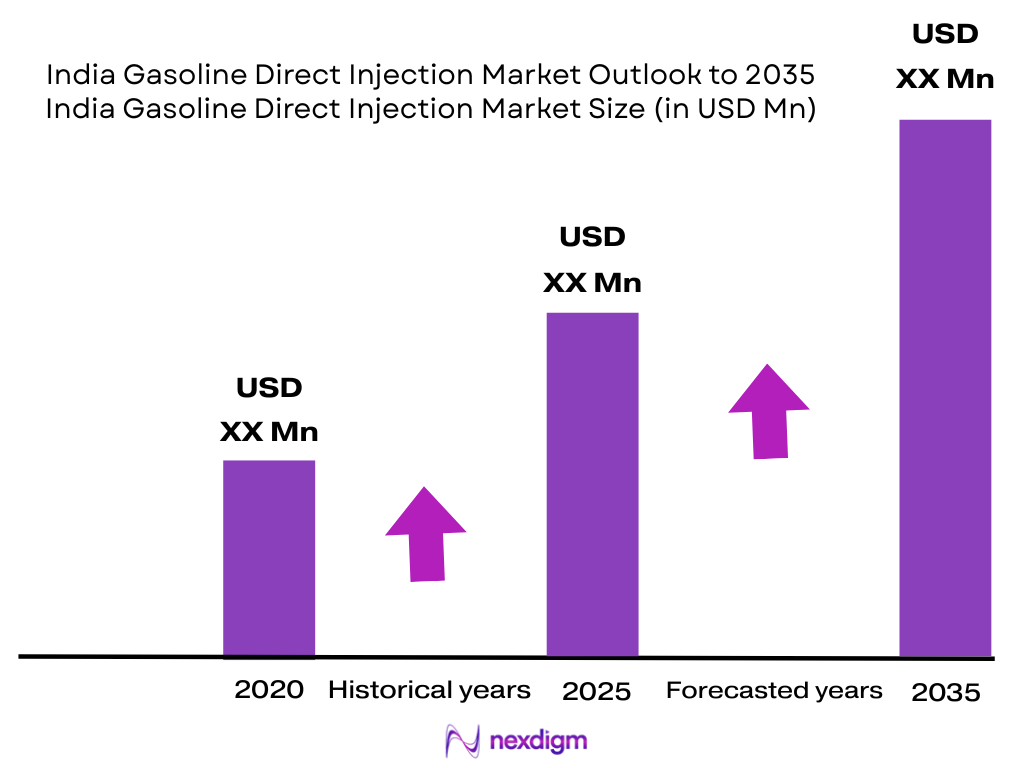
The India Gasoline Direct Injection Market is valued at approximately USD ~ million, with the figure retained as a placeholder because no authoritative public dataset separately reports national GDI-system revenue. The underlying automotive base expanded from approximately 25.9 million vehicles to more than 28 million vehicles, while automobile exports reached about 4.5 million units. This scale supports demand for high-pressure injectors, pumps, rails, sensors and electronic engine-control systems. Pune, Chennai, Gurugram-Manesar, Bengaluru and Nashik dominate India’s addressable GDI ecosystem because these clusters combine passenger-vehicle assembly, gasoline-engine production, Tier-1 powertrain suppliers, machining capabilities and automotive R&D. Bosch has long-established operations across Bengaluru and Nashik, while DENSO maintains extensive Indian automotive manufacturing activities. India’s broader production ecosystem exceeds 28 million vehicles, creating substantial component localisation opportunities around established automotive corridors.
Market Segmentation
By Component Type
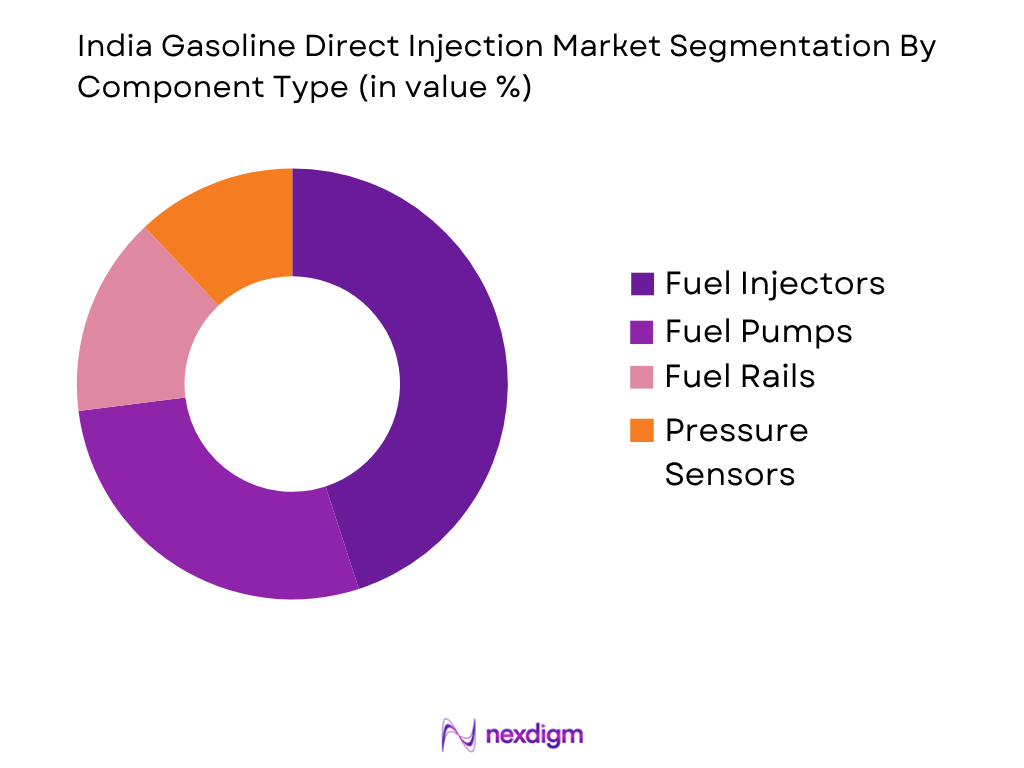
The India Gasoline Direct Injection Market is segmented into high-pressure fuel injectors, high-pressure fuel pumps, fuel rails, pressure sensors and control valves, and ECUs/high-pressure supporting components. High-pressure fuel injectors represent the dominant segment in the report model because every GDI cylinder requires precisely controlled direct fuel delivery. Injectors determine spray targeting, atomisation, injection quantity and transient combustion behaviour. Bosch describes the injector as directly metering and atomising fuel inside the combustion chamber, while current GDI architectures can operate at pressures of up to 350 bar. More advanced systems require multiple injection events and tighter flow tolerances, raising injector technology content. High-pressure pumps form the second-largest component category because they convert low-pressure fuel supply of around 6 bar into high-pressure rail supply reaching hundreds of bar. Fuel rails, sensors and electronic controls subsequently regulate pressure and injection timing across varying engine loads.
By Powertrain Type
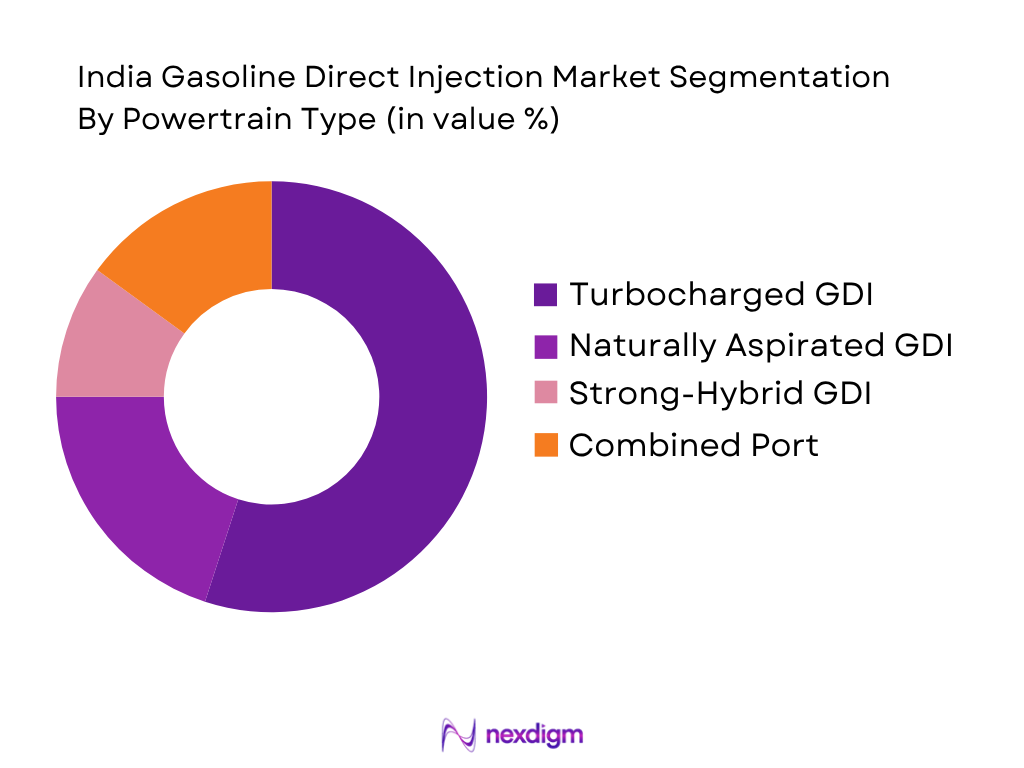
The India Gasoline Direct Injection Market is segmented into turbocharged GDI, naturally aspirated GDI, mild-hybrid GDI, strong-hybrid GDI and combined port-plus-direct-injection systems. Turbocharged GDI dominates the report model because direct injection complements downsized turbo-petrol engines through charge cooling, improved knock resistance and precise mixture formation. This architecture is increasingly relevant to compact and mid-size SUVs, where OEMs seek higher torque from comparatively small-displacement gasoline engines. Bosch notes that direct injection can improve combustion efficiency and torque by injecting fuel directly into the chamber at high pressure. Hybrid-GDI represents a strategically important emerging segment because gasoline engines remain necessary within strong-hybrid systems and face demanding restart, transient-load and cold-start conditions. Combined port and direct injection occupies a smaller premium segment but provides OEMs with greater flexibility to optimise low-load efficiency, deposit formation and high-load combustion performance.
Competitive Landscape
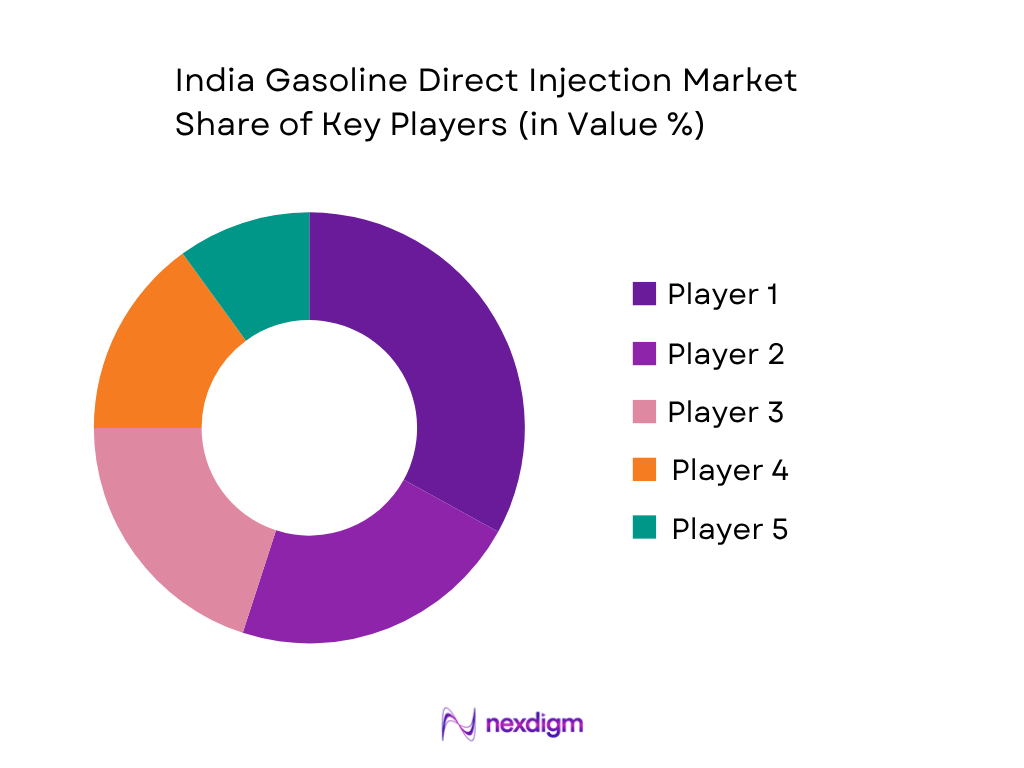
The India Gasoline Direct Injection Market is technology-intensive and relatively concentrated among global fuel-system specialists because injectors and pumps require micron-level machining, high-pressure durability, accurate calibration and lengthy OEM validation. Bosch provides integrated injectors, pumps and rails for systems reaching 350 bar; DENSO markets direct-injection high-pressure injectors and pumps; PHINIA’s Delphi portfolio extends to 500+ bar; Astemo supplies direct-injection injectors and pumps reaching 50 MPa; and Stanadyne has developed specialised GDI pump architectures and maintains manufacturing operations in India.
| Company | Establishment | Headquarters | GDI Injector Capability | High-Pressure Pump Capability | Pressure Positioning | Fuel Rail/System Capability | Alternative-Fuel Readiness | India/Regional Manufacturing Position |
| Robert Bosch GmbH | 1886 | Gerlingen, Germany | ~ | ~ | ~ | ~ | ~ | ~ |
| DENSO Corporation | 1949 | Kariya, Japan | ~ | ~ | ~ | ~ | ~ | ~ |
| PHINIA / Delphi | 2023 as independent PHINIA | Auburn Hills, USA | ~ | ~ | ~ | ~ | ~ | ~ |
| Astemo Ltd. | 2021 | Tokyo, Japan | ~ | ~ | ~ | ~ | ~ | ~ |
| Stanadyne | Roots to 1876 | Jacksonville, North Carolina, USA | ~ | ~ | ~ | ~ | ~ | ~ |
India Gasoline Direct Injection Market Analysis
Growth Drivers
Rising Utility-Vehicle and Turbo-Petrol Powertrain Demand
India’s expanding passenger-vehicle base is increasing the addressable application pool for gasoline direct injection, particularly in compact SUVs, mid-size SUVs and higher-output petrol vehicles where manufacturers increasingly combine smaller engines with turbocharging. SIAM reported 4.30 million passenger-vehicle domestic sales in FY2024-25, compared with approximately 4.22 million units in FY2023-24, while sales subsequently reached 4.643 million units in FY2025-26. Utility vehicles have become especially relevant to GDI suppliers: they accounted for roughly 65 vehicles out of every 100 passenger vehicles in FY2024-25 and 66 vehicles out of every 100 during the first quarter of FY2025-26. These volumes support greater deployment of downsized turbo-petrol engines, where direct injection can provide higher specific output, stronger low-speed torque and improved knock control without relying on substantially larger displacement. SIAM also recorded passenger-vehicle exports of 204,000 units during Q1 FY2025-26, indicating that Indian manufacturing plants increasingly serve both domestic and overseas programmes; this expands potential production runs for locally sourced injectors, high-pressure pumps and fuel rails. The wider macroeconomic environment provides additional support: World Bank data place India’s economy at approximately USD 4.17 trillion in 2024, while IMF country data place India’s population at 1,476.626 million people in 2026, giving vehicle manufacturers a very large domestic demand base. Technically, the transition from port injection to GDI is material because a GDI architecture adds a high-pressure pump, pressure sensor, volume-control hardware and combustion-chamber injectors that are absent from a conventional port-fuel-injection system. Bosch currently specifies GDI system pressures of up to 350 bar, demonstrating the additional component and precision-engineering content embedded in each GDI-equipped vehicle. Thus, the important demand driver is not merely higher automobile production; it is the changing composition of India’s passenger-vehicle fleet toward SUVs, turbocharged petrol engines and increasingly sophisticated gasoline powertrains. This creates higher component value per gasoline engine and broadens opportunities for manufacturers of injector bodies, high-pressure pumps, fuel rails, pressure-control valves and ECU-linked injection electronics.
Higher Combustion Precision and E20-Compatible Fuel-System Requirements
India’s transition toward higher ethanol blending and more sophisticated gasoline combustion is another direct growth driver for the India Gasoline Direct Injection Market because ethanol-compatible engines require increasingly precise fuel metering, pressure management and material engineering. Government data show ethanol blending increasing from 14.60 litres per 100 litres of petrol during ESY2023-24 to 17.98 litres per 100 litres by February 2025, before India achieved the national 20-litre E20 level in 2025. Ethanol production capacity also expanded substantially, with government reporting 661.1 crore litres of ethanol produced by June 2025. For GDI suppliers, these developments have practical implications beyond fuel composition. High-pressure injectors operate inside the combustion chamber, while pumps, rails, seals and control valves experience repeated pressure cycling and continuous fuel exposure. Ethanol therefore increases the importance of corrosion-resistant metallic surfaces, compatible elastomers, robust coatings, sealing performance and calibration strategies capable of managing different fuel properties. Bosch’s current direct-injection fuel rail is designed for ethanol resistance and operates at system pressure of up to 350 bar, illustrating the type of engineering specification increasingly relevant to India. The company’s current high-pressure injector also supports 350-bar injection pressure, with a compact 6-millimetre injector tip and 9.4-millimetre O-ring diameter, demonstrating the tight packaging and sealing requirements involved in modern GDI systems. PHINIA’s contemporary GDI injector portfolio extends further, with its M16e architecture operating at up to 400 bar and the M16 family above 500 bar; its pumps are similarly available in 350-bar and 500-plus-bar configurations. These technology benchmarks indicate that India’s transition toward E20 occurs simultaneously with global migration toward higher injection pressure. The macroeconomic foundation remains supportive: World Bank data record India’s GDP at approximately USD 4.17 trillion in 2024, and IMF data place the 2026 population above 1.47 billion, giving OEMs sufficient scale to localise technologies that might otherwise remain imported. GDI manufacturers able to combine high-pressure operation with ethanol-resistant materials can therefore address both regulatory fuel changes and growing turbo-petrol demand. The opportunity extends across injectors, pump plungers, fuel rails, pressure sensors, seals and ECU calibration rather than being limited to a single component.
Market Challenges
Battery-Electric Vehicle Expansion and Shrinking Long-Term ICE Addressability
The principal structural challenge for the India Gasoline Direct Injection Market is that every battery-electric passenger vehicle removes the entire gasoline high-pressure fuel circuit from the vehicle bill of materials. A battery-electric vehicle requires no gasoline injector, high-pressure fuel pump, fuel rail or combustion-engine fuel-pressure control system, creating complete rather than partial substitution for GDI hardware. India’s policy framework is actively developing advanced automotive technologies, including electric powertrains, through the Ministry of Heavy Industries’ Production Linked Incentive programme. The scheme covers 19 Advanced Automotive Technology vehicle categories and 103 component categories, with the explicit objective of moving domestic automotive manufacturing toward higher-value technologies and deeper localisation. The competitive pressure is therefore technological: fuel-injection suppliers are investing in increasingly advanced combustion hardware while OEM investment is simultaneously expanding into batteries, motors, inverters and electric-drive systems. This challenge must nevertheless be considered against the continuing scale of India’s conventional passenger-vehicle base. SIAM recorded 4.30 million passenger vehicles in FY2024-25 and 4.643 million units in FY2025-26, meaning gasoline and hybrid powertrains retain a substantial near-term manufacturing base. Utility vehicles represented roughly 65 of every 100 passenger vehicles in FY2024-25, which helps sustain turbo-petrol and GDI applications in the medium term. World Bank data place India’s GDP at around USD 4.17 trillion in 2024, while the IMF reports a population of 1,476.626 million in 2026, supporting a large overall mobility market capable of accommodating multiple powertrain technologies simultaneously. The challenge for GDI suppliers is therefore less an immediate disappearance of combustion engines and more a progressively constrained future platform pool. Investment decisions in new injector lines, pump capacity and rail manufacturing must account for shorter platform lives and the possibility that a larger portion of future incremental vehicle demand will be captured by electric architectures. Suppliers can partially defend their position by prioritising gasoline-hybrid engines because hybrids retain direct-injection hardware while reducing fuel consumption and emissions. They can also focus on higher-pressure GDI, E20 compatibility and export-oriented manufacturing, where higher technical content per remaining combustion vehicle helps offset slower volume expansion. Companies concentrated only on conventional naturally aspirated gasoline engines face the greatest technology-substitution risk.
High-Pressure Manufacturing Complexity, Fuel Sensitivity and Durability Requirements
Gasoline direct injection creates a substantially more difficult manufacturing and validation environment than conventional port injection because the fuel must be pressurised, precisely metered and atomised directly inside the combustion chamber. Bosch notes that port-fuel-injection systems avoid the high-pressure pump, high-pressure sensor, volume-control valve and high-pressure injectors required in GDI, highlighting the additional hardware and control burden created when manufacturers shift to direct injection. Bosch’s current GDI system operates at up to 350 bar, while PHINIA supplies pumps at 350 bar and more than 500 bar and injectors extending beyond 500 bar. Such pressures require exceptionally precise injector needles, nozzle holes, pump plungers, sealing surfaces and fuel-rail welds. A small deviation in machining or contamination can alter injection quantity, spray geometry or pressure stability, creating combustion imbalance, particulate formation, starting problems or durability failures. The engineering challenge is becoming more demanding as India’s ethanol content rises. Government data show national blending moving from 14.60 litres per 100 litres of petrol to the 20-litre E20 benchmark, meaning components must tolerate greater ethanol exposure alongside high mechanical and thermal stresses. Bosch specifically highlights ethanol resistance in its direct-injection rail architecture, demonstrating that material compatibility is an integral component requirement rather than a secondary consideration. India’s manufacturing scale makes this difficult to manage consistently: SIAM recorded 4.30 million passenger vehicles in FY2024-25 and 4.643 million in FY2025-26, meaning local suppliers seeking large OEM contracts need repeatable quality across millions of precision parts rather than specialised low-volume output. This requires clean assembly, microscopic filtration control, high-pressure leak testing, injector flow calibration, spray visualisation, pump endurance testing and pressure-cycle validation. The macroeconomic environment provides scale but also raises expectations: World Bank data indicate an economy of roughly USD 4.17 trillion in 2024, while the IMF reports 1,476.626 million people in 2026, creating strong incentives for local manufacturing but also intense pressure to meet global OEM standards. Domestic suppliers without advanced metrology, specialised coatings, high-pressure test benches and mature IATF-quality processes may find it difficult to qualify for injector or pump programmes. Consequently, localisation can progress more slowly in the most technically demanding GDI components than in simpler automotive parts.
Market Opportunities
Localisation of High-Pressure E20-Compatible Injectors, Pumps and Fuel Rails
India’s ethanol transition provides a substantial localisation opportunity because E20-compatible gasoline engines need validated high-pressure components that can operate reliably with different chemical, thermal and lubrication characteristics than conventional petrol systems. India reached the national 20-litre ethanol-per-100-litre petrol benchmark in 2025, while government reporting indicates ethanol production reached 661.1 crore litres by June 2025. The scale and permanence of this fuel transition mean OEMs increasingly require injectors, pumps, rails, elastomers and pressure-control systems to be engineered around E20 rather than treated as temporary adaptations. Bosch’s GDI fuel rail is explicitly designed for ethanol resistance and can operate at up to 350 bar, while its direct-injection architecture combines a high-pressure pump, rail-mounted pressure sensing and high-pressure injectors. PHINIA provides a further technology benchmark with 350-bar and 500-plus-bar pumps and injectors reaching 400 bar and more than 500 bar. India can use these technical requirements to move domestic suppliers further up the automotive value chain. The Ministry of Heavy Industries’ PLI-Auto framework covers 103 Advanced Automotive Technology component categories, with policy objectives centred on domestic supply-chain development and higher-value automotive manufacturing. This provides a broader industrial setting for localisation of injector bodies, precision needles, nozzles, pump housings, plungers, high-pressure pipes, rails and electronic control elements. Demand scale already exists: SIAM reported 4.30 million passenger-vehicle sales in FY2024-25, followed by 4.643 million units in FY2025-26. Passenger-vehicle exports also reached 204,000 units in Q1 FY2025-26, creating potential for Indian facilities to supply export engine programmes as well as the domestic fleet. India’s macroeconomic scale reinforces the investment case, with World Bank data placing GDP at approximately USD 4.17 trillion in 2024 and IMF data showing 1,476.626 million people in 2026. The future-growth opportunity therefore lies in replacing imported high-pressure assemblies with locally validated E20-ready products while simultaneously establishing India as an export base. Companies capable of combining materials engineering, precision machining, spray calibration, ethanol testing and OEM validation should be positioned to capture more value than suppliers focused only on low-pressure fuel hardware.
Migration to 350-Bar-plus GDI and Hybrid Gasoline Powertrains
Higher injection pressure and hybridised gasoline engines represent a major future-growth opportunity because they increase technology content per combustion vehicle even if the long-term number of pure gasoline vehicles grows more slowly. Bosch currently offers GDI systems and high-pressure pumps operating at up to 350 bar, whereas PHINIA supplies 350-bar and 500-plus-bar pumps and injectors capable of 400 bar and more than 500 bar. The shift toward higher pressure enables finer atomisation and more flexible injection strategies, but it simultaneously requires improved injector nozzles, stronger pump mechanisms, better pressure sensors and more durable rails. Indian suppliers that master these higher specifications can capture a larger share of vehicle-level component value than manufacturers limited to older pressure classes. Hybridisation adds another opportunity because gasoline-electric hybrids continue to require an internal-combustion engine and fuel-injection system, but their duty cycle is technically demanding. Repeated engine starts, transient load changes and high-efficiency operating strategies favour precise injection timing, stable rail pressure and wide injector dynamic range. PHINIA explicitly positions its GDI technology for passenger cars, light vehicles and hybrids, demonstrating that direct injection remains relevant as electrification progresses through intermediate powertrain architectures. India’s passenger-vehicle base provides sufficient scale for these technologies: SIAM recorded 4.30 million units in FY2024-25 and 4.643 million units in FY2025-26, while utility vehicles continued to represent roughly two-thirds of passenger-vehicle demand during parts of FY2025-26. These vehicle categories are suitable for turbocharged and hybrid gasoline architectures because buyers require torque, drivability and fuel efficiency in comparatively heavy bodies. The Ministry of Heavy Industries is simultaneously encouraging Advanced Automotive Technology manufacturing through a framework covering 19 vehicle categories and 103 components, providing a policy environment for localisation of sophisticated powertrain hardware. On the demand side, India’s economy measured approximately USD 4.17 trillion in 2024 according to World Bank data, and the IMF reports 1,476.626 million people in 2026, giving OEMs a very large market across multiple propulsion technologies. The strongest future opportunity for the India Gasoline Direct Injection Market is therefore likely to be qualitative as well as quantitative: more pressure, more electronic control, more hybrid integration and more ethanol-compatible engineering per gasoline engine. Suppliers investing now in 350-bar-plus systems, hybrid calibration and next-generation injector technology can defend GDI relevance even as battery-electric vehicles gain presence.
Future Outlook
The India Gasoline Direct Injection Market is projected to expand at approximately ~ CAGR during 2026–2035, retained as a placeholder for the final market model. Growth will be driven primarily by turbo-petrol engines, hybrid gasoline powertrains, higher injection-pressure requirements, ethanol-compatible fuel systems and localisation of precision automotive components. Technology intensity should rise even if the long-term number of internal-combustion platforms is constrained by electric vehicles. Bosch currently supports systems up to 350 bar, PHINIA offers GDI injectors and pumps at 500+ bar, and Astemo’s high-pressure pump reaches 50 MPa, indicating continuing pressure migration. India’s fuel transition will further reshape product specifications. Injectors, seals, pump materials and fuel rails will increasingly need compatibility with higher ethanol blends. This should move supplier competition away from simple component availability toward validated material compatibility, cold-start performance, pressure stability and adaptive ECU calibration. Hybridisation creates another defensive growth channel. Strong hybrids and plug-in hybrids retain a gasoline combustion engine while requiring accurate restart injection, efficient transient operation and robust fuel-pressure control. GDI suppliers capable of serving turbo-hybrid and combined port/direct-injection systems can therefore remain relevant even as pure gasoline vehicle penetration gradually changes.
Major Players
- Robert Bosch GmbH / Bosch Limited
- DENSO Corporation / DENSO India
- PHINIA / Delphi
- Astemo Ltd.
- Stanadyne
- Marelli
- Aisan Industry Co., Ltd.
- Mikuni Corporation
- Schaeffler Group
- MAHLE Group
- AISIN Corporation
- TI Fluid Systems
- AUMOVIO
- Standard Motor Products
- Niterra Co., Ltd.
Key Target Audience
- Gasoline Direct Injection System Manufacturers
- Passenger Vehicle and Gasoline Engine OEMs
- High-Pressure Fuel Injector and Pump Manufacturers
- Automotive Tier-1 and Precision Component Manufacturers
- Hybrid and Turbocharged Powertrain Manufacturers
- Automotive Aftermarket and Fuel-System Distribution Companies
- Investments and Venture Capitalist Firms
- Government and Regulatory Bodies (Ministry of Heavy Industries, Ministry of Road Transport & Highways, Ministry of Petroleum & Natural Gas, Automotive Research Association of India, International Centre for Automotive Technology, Bureau of Indian Standards)
Research Methodology
Step 1: Identification of Key Variables
The initial phase develops an ecosystem map covering passenger-vehicle OEMs, engine manufacturers, injector suppliers, high-pressure pump companies, rail manufacturers, electronics suppliers and aftermarket participants. Critical variables include gasoline-engine production, GDI fitment, cylinders per engine, injectors per vehicle, turbocharging, injection pressure, engine displacement, hybridisation and ethanol compatibility.
Secondary research incorporates SIAM automotive datasets, Ministry of Heavy Industries documentation, government automotive-production information and technical documentation from established GDI-system manufacturers. SIAM maintains annual and model-wise production, domestic sales and export datasets that form an important base for vehicle-platform mapping.
Step 2: Market Analysis and Construction
The top-down assessment begins with passenger-vehicle and gasoline-powertrain production, after which GDI-equipped engine platforms are separated from conventional port-injected engines. Vehicle-level component content is then calculated across injectors, pumps, rails, sensors, high-pressure lines and electronic controls.
The bottom-up model maps supplier portfolios, OEM platform nominations, estimated system content and replacement demand. Technical specifications such as injection pressure and pump architecture are benchmarked against commercial systems from Bosch, DENSO, PHINIA, Astemo and Stanadyne to prevent unrealistic assumptions.
Step 3: Hypothesis Validation and Expert Consultation
Market hypotheses are validated through CATIs with gasoline-engine engineers, passenger-vehicle manufacturers, fuel-system Tier-1 suppliers, component distributors and automotive service specialists. Interviews assess GDI fitment by engine family, sourcing structure, localisation levels, injection-pressure migration, ethanol compatibility and component replacement behaviour. Technical discussions focus on injector spray patterns, pump durability, rail-pressure control, contamination sensitivity, deposit formation and calibration requirements. These insights are used to reconcile differences between calculated component demand and supplier-level market information.
Step 4: Research Synthesis and Final Output
The final stage triangulates vehicle-platform analysis, supplier information and primary interviews to produce component-level and powertrain-level market estimates. Separate models are constructed for turbo-GDI, naturally aspirated GDI, hybrid GDI and combined port/direct-injection applications.
Forecast scenarios incorporate gasoline passenger-vehicle demand, SUV mix, hybrid adoption, engine downsizing, ethanol compatibility, injection-pressure migration, localisation and battery-electric substitution. This framework captures both changes in the number of GDI-equipped vehicles and changes in technology content per vehicle.

- Executive Summary
- Research Methodology (Market Definitions and Assumptions, GDI System Boundary, Abbreviations, Vehicle Platform Mapping, Engine-Family Mapping, GDI Fitment Assessment, Top-Down Market Sizing, Bottom-Up Component Consumption Model, Injectors per Engine Assessment, High-Pressure Pump Fitment, Fuel Rail Fitment, OEM Demand Assessment, Replacement Demand Assessment, Supply-Side Mapping, Primary Interviews with OEMs and Tier-1 Suppliers, Import-Export Assessment, Data Triangulation, Scenario Forecasting, Limitations and Future Conclusions)

- Definition and Scope
- Evolution from Carburetion and Multi-Point Fuel Injection to Direct Injection
- Evolution of Naturally Aspirated Petrol Engines to Turbo-GDI Engines
- Gasoline Direct Injection System Architecture
- Low-Pressure and High-Pressure Fuel Circuit Architecture

- Growth Drivers (Expansion of Turbocharged Petrol Powertrains, Growing Compact and Mid-Size SUV Engine Demand, Engine Downsizing with Higher Specific Power, Increasing Hybrid Gasoline Powertrain Integration)
- Market Challenges (Battery-Electric Vehicle Substitution, Precision Manufacturing, Injector Deposits, Pump Wear, Gasoline Particulate Emissions, Ethanol Compatibility, OEM Concentration, Complex Diagnostics)
- Market Opportunities (High-Pressure GDI, E20-Compatible Systems, Flex-Fuel GDI, Hybrid-GDI, Injector Localisation, Pump Localisation, Remanufacturing, Export Manufacturing)
- Market Trends (Higher Injection Pressure, Multiple Injection, Integrated Rails, Dual Injection, Turbo-Hybrid Engines, Ethanol-Resistant Materials, Compact Pumps, Advanced Diagnostics)
- SWOT Analysis
- Porter’s Five Forces Analysis
- PESTLE Analysis

- By Market Value (2020-2025)
- By GDI System Volume (2020-2025)
- By GDI-Equipped Vehicle Volume (2020-2025)

- By Component (In Value %)
High-Pressure Fuel Injectors
High-Pressure Fuel Pumps
Fuel Rails
Fuel Rail Pressure Sensors
Electronic Control Units and Injector Drivers - By Vehicle Type (In Value %)
Hatchbacks
Compact Sedans
Mid-Size and Executive Sedans
Compact SUVs
Mid-Size SUVs - By Powertrain Type (In Value %)
Naturally Aspirated GDI
Turbocharged GDI
Mild-Hybrid GDI
Strong-Hybrid GDI
Plug-In Hybrid GDI - By Region (In Value %)
North India
West India
South India
East India
Central India

- Market Share of Major Players by Value
- Cross Comparison Parameters (Maximum GDI Injection Pressure Capability, High-Pressure Injector Portfolio Breadth, High-Pressure Pump Pressure and Flow Range, Integrated Fuel Rail and Pressure-Sensor Capability, E20/Flex-Fuel Material Compatibility, India Manufacturing and Localisation Footprint, OEM Engine-Platform Coverage, Hybrid-GDI and Combined Port-Direct Injection Capability)
- SWOT Analysis of Major Players
- Detailed Profiles of Major Companies
Robert Bosch GmbH / Bosch Limited
DENSO Corporation / DENSO India
Marelli
PHINIA / Delphi
Astemo Ltd.
Stanadyne
Schaeffler Group
Aisan Industry Co., Ltd.
Mikuni Corporation
TI Fluid Systems
AUMOVIO
MAHLE Group
AISIN Corporation
Standard Motor Products
Niterra Co., Ltd.

- Passenger Vehicle OEM Demand
- Turbo-Petrol Engine Manufacturer Demand
- Hybrid Powertrain Manufacturer Demand
- Premium Vehicle OEM Demand
- Tier-1 Fuel-System Integrator Demand

- By Market Value (2026-2035)
- By GDI System Volume (2026-2035)
- By GDI-Equipped Vehicle Volume (2026-2035)


 Request a Sample
 Ask for Customization
 Get a Quote
 Enquire Now