
 Download PDF
Market Overview
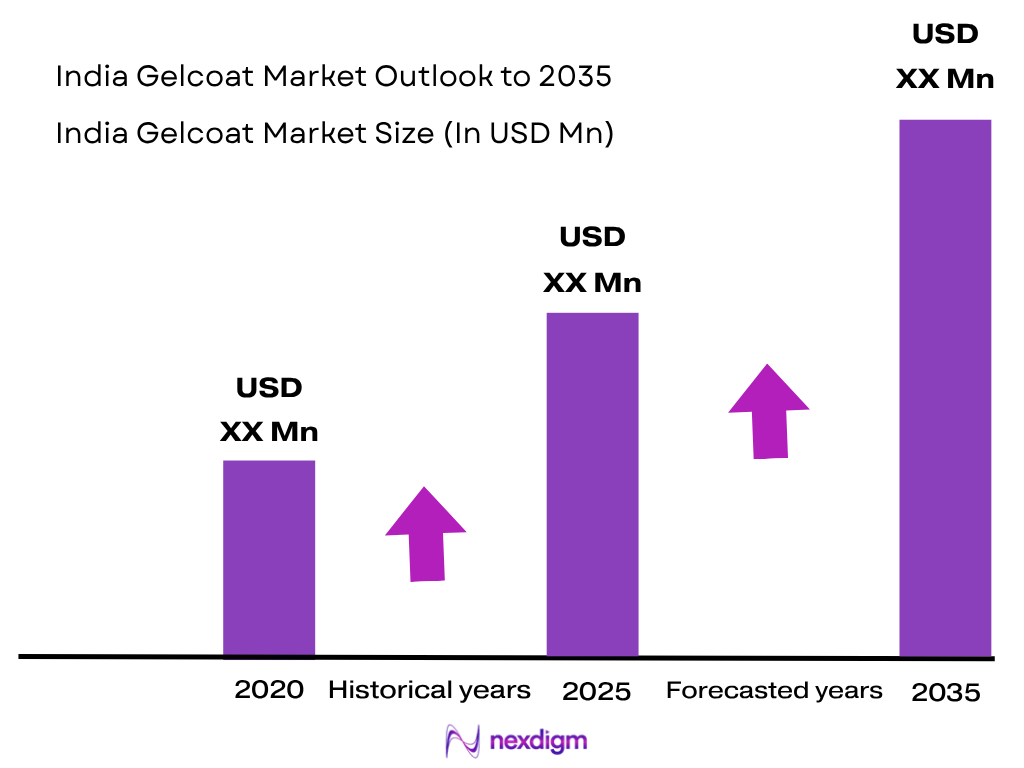
The India Gelcoat Market is valued at approximately ~USD XX million, based on historical demand from marine, wind energy, FRP tanks and pipes, transportation, sanitary ware and industrial composites. The underlying manufacturing environment strengthened as India added 3,253.38 MW of wind capacity in the latest completed annual period versus 2,275.55 MW in the preceding period. Gelcoat demand is therefore supported by growing composite fabrication alongside established marine, infrastructure and industrial FRP applications.
Maharashtra, Gujarat, Tamil Nadu, Karnataka and Goa represent important India Gelcoat Market clusters because they combine resin manufacturing, FRP fabrication, marine activity, wind-component production and industrial composite demand. Tamil Nadu hosts major resin and gelcoat manufacturing operations, while Maharashtra contains composite-material suppliers and significant chemical-industry infrastructure. India’s maritime ecosystem now includes 61 shipyards, comprising 8 central public-sector, 2 state-government and 51 private shipyards, strengthening demand around western and southern coastal manufacturing belts.
Market Segmentation
By Resin Chemistry
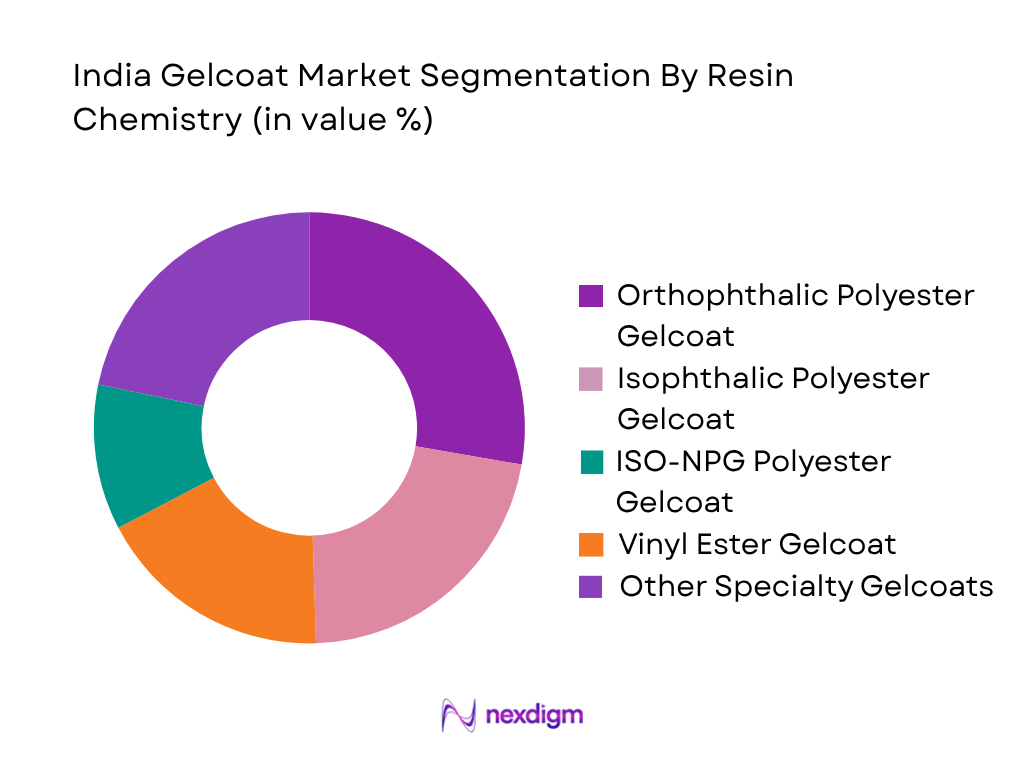
The India Gelcoat Market is segmented by resin chemistry into orthophthalic polyester, isophthalic polyester, ISO-NPG polyester, vinyl ester and other specialty gelcoats. Polyester-based gelcoats hold the dominant market share because they are deeply integrated with India’s conventional FRP fabrication ecosystem and are compatible with hand lay-up, brush, roller and spray-up manufacturing. Orthophthalic systems remain relevant for general-purpose molded parts, while isophthalic and ISO-NPG grades provide improved water resistance, UV stability, gloss retention and blister resistance for marine, bathware and exterior applications. Indian suppliers maintain broad portfolios across these chemistries: Mechemco manufactures orthophthalic and specialty gelcoats, K-Bond supplies GP, ISO and ISO-NPG grades, and Skyline offers orthophthalic, isophthalic and NPG-isophthalic systems. Vinyl ester gelcoats occupy a more specialized position where chemical resistance, higher heat performance and corrosion protection are required, particularly in process equipment, tanks and demanding industrial components.
By End-Use Industry
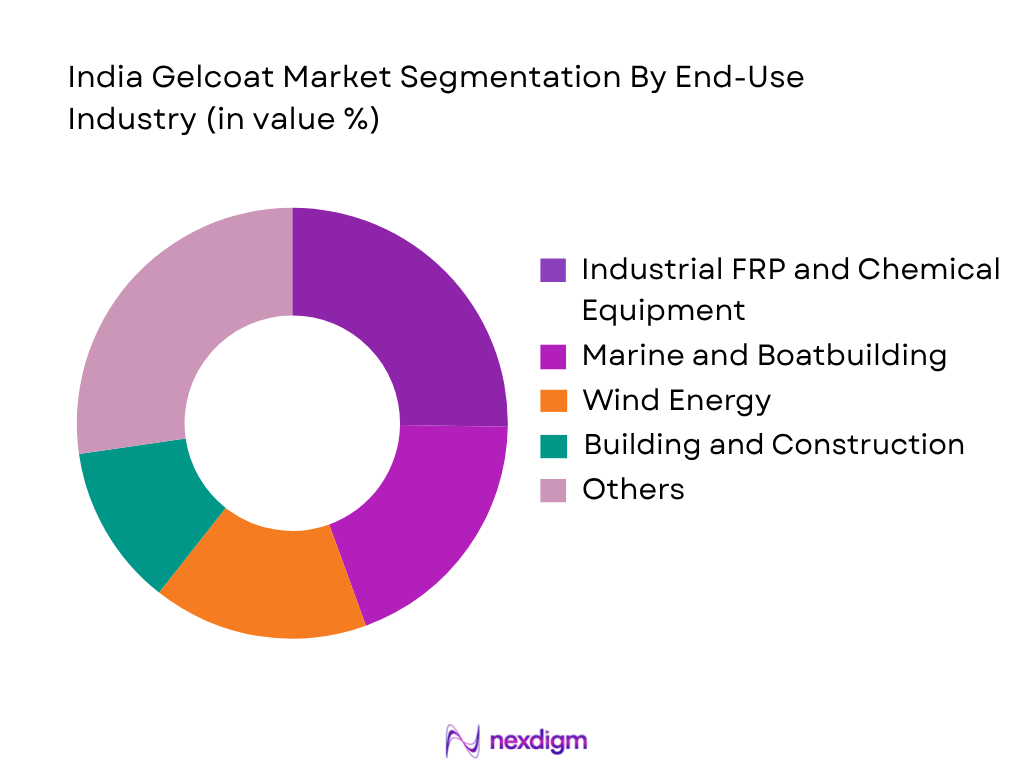
The India Gelcoat Market is segmented into marine and boatbuilding, wind energy, industrial FRP, building and construction, transportation, sanitary ware and other composite applications. Industrial FRP and infrastructure-linked composite applications constitute a leading demand block, supported by the widespread use of gelcoated tanks, pipes, process vessels, cooling systems, architectural products and corrosion-resistant molded components. Marine and wind-energy applications are also strategically important because both require durable exterior composite surfaces. India added 3,253.38 MW of wind capacity during the latest completed annual period, reinforcing demand for composite nacelles and related structures. The Ministry of Ports, Shipping and Waterways also identifies 61 shipyards across India, creating a sizable marine and vessel-manufacturing ecosystem. Gelcoats used in these applications must provide water resistance, UV stability, chemical durability, controlled surface finish and compatibility with polyester or vinyl ester laminates. These requirements favor domestic suppliers capable of serving multiple FRP fabrication technologies and end markets.
Competitive Landscape
The India Gelcoat Market is fragmented between domestic resin formulators, integrated unsaturated-polyester and vinyl-ester manufacturers, multinational composite-material suppliers and specialized distributors. Competition centers on resin chemistry breadth, customization, pigmentation capability, fire-retardant formulations, marine performance, chemical resistance, technical assistance and regional availability. Domestic suppliers benefit from close proximity to FRP fabricators, while multinational participants compete through proprietary formulations, global product platforms and qualification experience across marine, transportation and renewable-energy applications.
| Company | Establishment Year | Headquarters | Gelcoat Chemistry | Key End Uses | Manufacturing Position | Specialty Capability | Application Technology | India Market Position |
| Scott Bader | 1921 | Wollaston, UK; India office in Mumbai | ~ | ~ | ~ | ~ | ~ | ~ |
| Mechemco | 1983 | Maharashtra, India | ~ | ~ | ~ | ~ | ~ | ~ |
| Vasavibala Resins | 1992 | Chennai, Tamil Nadu | ~ | ~ | ~ | ~ | ~ | ~ |
| Link Composites | 2008 | Pune, Maharashtra | ~ | ~ | ~ | ~ | ~ | ~ |
| Skyline Resins and Chemicals | 2001 | Chennai, Tamil Nadu | ~ | ~ | ~ | ~ | ~ | ~ |
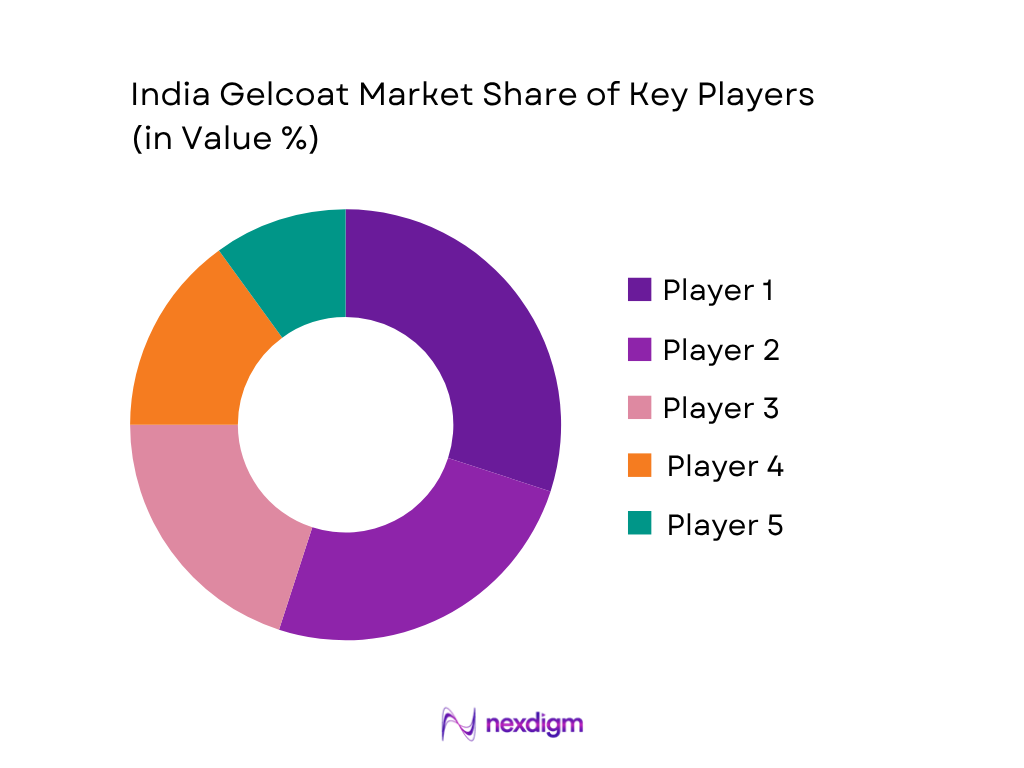
India Gelcoat Market Analysis
Growth Drivers
Expansion of Wind-Energy Composite Manufacturing
India’s wind-energy manufacturing ecosystem is creating a strong structural demand base for gelcoats used on nacelle covers, composite housings and other fiberglass-reinforced components requiring UV stability, moisture resistance and durable surface finishing. The Ministry of New and Renewable Energy recorded 4,151.31 MW of new wind capacity during 2024-25, following 3,253.38 MW during 2023-24. MNRE also reports domestic annual wind-turbine manufacturing capability of approximately 18,000 MW, supported by 14 manufacturers, while commercially available turbine unit sizes have reached 5.2 MW. Larger turbine platforms require correspondingly larger molded composite surfaces, increasing the importance of consistent gelcoat thickness, weather resistance, surface hardness and long-term outdoor durability. The macroeconomic environment also provides an enabling industrial base: the World Bank reported India’s 2024 GDP at USD 3,909.89 billion, GDP per capita at USD 2,694.7, and population at 1,450,935,791. These indicators, combined with expanding domestic wind-component manufacturing, strengthen demand for ISO-NPG, UV-stabilized, flame-retardant and specialty polyester gelcoats suitable for high-exposure renewable-energy applications.
Expansion of Marine, Shipbuilding and Coastal Manufacturing Activity
India’s expanding maritime manufacturing base supports gelcoat consumption in fiberglass boats, patrol craft, passenger vessels, leisure craft, deck structures, molded interiors and ancillary marine composite components. The Ministry of Ports, Shipping and Waterways reported that India had 1,552 Indian-flagged vessels with 13.65 million gross tonnage as of November 30, 2024. The ministry currently identifies 61 shipyards, comprising 8 Central Public Sector shipyards, 2 state-government shipyards and 51 private-sector shipyards, providing a geographically diversified manufacturing and repair ecosystem. Marine-grade gelcoats benefit from this industrial base because fiberglass components require resistance to water ingress, UV exposure, blistering, salt environments and repeated surface weathering. The wider macroeconomic setting further strengthens downstream marine activity. According to the World Bank, India generated USD 3,909.89 billion of GDP in 2024, supported by a population of 1,450,935,791 and GDP per capita of USD 2,694.7. These conditions provide a substantial domestic industrial and consumer base for coastal infrastructure, recreational vessels and marine services, supporting long-term demand for ISO-NPG, vinyl-ester, high-gloss and hydrolysis-resistant gelcoat systems.
Market Challenges
Limited Domestic Scale of Unsaturated Polyester Resin Production
The India gelcoat market faces a raw-material and localization challenge because unsaturated polyester resin is a principal chemistry supporting conventional polyester gelcoat formulation, yet its monitored domestic production base remains relatively small compared with India’s broader petrochemical system. The Department of Chemicals and Petrochemicals reported 34.0 thousand tonnes of installed unsaturated polyester resin capacity and 22.4 thousand tonnes of production during 2024-25. In comparison, production of selected major petrochemicals reached 20,642.6 thousand tonnes, monoethylene glycol production reached 1,935.3 thousand tonnes, and benzene production reached 1,284.2 thousand tonnes during the same period. This disparity highlights the comparatively specialized scale of the resin chain serving FRP and gelcoat manufacturing. Gelcoat formulators therefore need reliable access to polyester resin intermediates, glycols, aromatic feedstocks, pigments, additives and catalyst systems while maintaining batch consistency across marine, wind, tanks and industrial applications. The World Bank recorded India’s 2024 GDP at USD 3,909.89 billion, GDP per capita at USD 2,694.7, and population at 1,450,935,791, demonstrating that gelcoat suppliers operate within a very large manufacturing economy despite a comparatively narrow monitored domestic UPR production base.
Increasing Surface-Quality Requirements from Larger Composite Components
Indian gelcoat manufacturers face increasingly demanding process-control requirements as downstream composite components become larger and more technically sophisticated. The Ministry of New and Renewable Energy reports that domestically manufactured wind turbines now reach individual machine sizes of 5.2 MW, while India possesses approximately 18,000 MW of annual wind-turbine manufacturing capability across 14 manufacturers. Large nacelles, molded covers and other exterior composite structures require gelcoat application over substantial surface areas, making control of wet-film thickness, catalyst dispersion, sagging, air entrapment, cure uniformity, pigmentation and surface defects significantly more critical. A localized defect on a large composite component can require extensive rework and interrupt subsequent assembly or finishing operations. Similar requirements occur across marine and industrial FRP fabrication, where India’s maritime manufacturing base includes 61 shipyards, including 51 privately operated facilities. Macroeconomic scale intensifies expectations for industrial quality: the World Bank recorded USD 3,909.89 billion of Indian GDP in 2024, alongside GDP per capita of USD 2,694.7 and population of 1,450,935,791. Gelcoat suppliers therefore face pressure to provide application engineering, controlled curing systems, consistent pigmentation and technically repeatable formulations rather than competing solely through general-purpose resin availability.
Market Opportunities
High-Performance Gelcoats for the Domestic Wind Manufacturing Ecosystem
India’s established wind-turbine production platform creates an opportunity for gelcoat manufacturers to move toward higher-performance surface systems designed for large outdoor composite components. MNRE reports approximately 18,000 MW of annual domestic wind-turbine manufacturing capacity, with 14 manufacturers operating through Indian companies, subsidiaries and licensed-production structures. Available turbine platforms have reached 5.2 MW per machine, increasing the physical scale and service requirements of nacelles and associated composite housings. India also added 4,151.31 MW of wind capacity during 2024-25, demonstrating current installation activity that supports the domestic turbine and component supply chain. These existing indicators provide a foundation for future demand for gelcoats offering stronger UV stability, color retention, water resistance, abrasion protection, fire performance and compatibility with automated composite manufacturing. India’s broader macroeconomic capacity supports localization: the World Bank recorded USD 3,909.89 billion of GDP in 2024, USD 2,694.7 of GDP per capita, and a population of 1,450,935,791. Suppliers capable of developing specialized ISO-NPG, low-emission and weather-resistant formulations can use this existing renewable-energy manufacturing base to diversify beyond traditional general-purpose FRP applications and establish higher-value technical product portfolios.
Localization of Specialty Gelcoats for Industrial FRP and Downstream Conversion Clusters
India offers an opportunity to expand domestically formulated specialty gelcoats for chemical tanks, piping, process equipment, construction components, sanitary products and other corrosion-resistant FRP applications. The Department of Chemicals and Petrochemicals recorded 22.4 thousand tonnes of unsaturated polyester resin production from 34.0 thousand tonnes of installed capacity during 2024-25, providing an identifiable domestic resin foundation for polyester-based gelcoat formulation. The government is simultaneously supporting downstream material-processing clusters through its Plastic Parks Scheme, under which 10 Plastic Parks had been approved by March 2026. These parks include 239 acres at Thiruvallur, 173 acres at Tinsukia, 122 acres at Tamot, 120 acres at Paradeep and 104 acres at Ganjimutt, demonstrating geographically distributed polymer-processing infrastructure. Although the parks cover plastics broadly, such conversion clusters strengthen supporting capabilities in polymer handling, compounding, additives, fabrication and industrial material distribution that are relevant to composite supply chains. The World Bank recorded India’s 2024 GDP at USD 3,909.89 billion, population at 1,450,935,791, and GDP per capita at USD 2,694.7. This manufacturing scale creates scope for locally produced chemical-resistant, fire-retardant, tooling and UV-stabilized gelcoats tailored to Indian FRP processing requirements.
Future Outlook
The India Gelcoat Market is expected to expand at approximately ~XX% CAGR during 2026-2035, supported by increasing composite adoption in wind energy, shipbuilding, FRP infrastructure, transportation and corrosion-resistant industrial equipment. Growth is expected to move increasingly toward ISO-NPG, vinyl ester, low-styrene, flame-retardant and higher-performance surface systems rather than purely general-purpose polyester gelcoats.
Wind-energy manufacturing represents an important structural demand driver. India added 3,253.38 MW of wind capacity during 2023-24 and 4,151.31 MW during 2024-25, demonstrating continued expansion in a sector that relies extensively on large composite structures. Surface materials used around nacelles, covers and molded components must tolerate UV exposure, moisture, heat cycling and outdoor service, creating opportunities for weather-resistant and specialized gelcoat formulations.
Marine demand should also broaden as India develops shipbuilding and repair capabilities. The Ministry of Ports, Shipping and Waterways currently identifies 61 shipyards, including 51 private-sector facilities, and reports an Indian shipping fleet of 1,544 ships with 13.50 million gross tonnage as of March 2025. Although gelcoat consumption is concentrated more heavily in fiberglass boats, smaller vessels and molded marine parts than in steel commercial ships, expansion of coastal, defence, leisure and small-craft manufacturing creates a broader ecosystem for marine composites.
Major Players
- Polynt Reichhold India
- Scott Bader India
- Mechemco Resins
- Vasavibala Resins
- Link Composites
- K-Bond Polymers
- Skyline Resins and Chemicals
- Crest Speciality Resins
- Sai Krupa Polymers
- M.N. Polyester India
- Samrat Poly Resins
- S.R. Resins & Chemicals
- Strongbonds Polyseal Aryan Composites
- Kanoria Chembond
Key Target Audience
- Gelcoat and Unsaturated Polyester Resin Manufacturers
- FRP Tank, Pipe and Chemical Equipment Manufacturers
- Marine, Boatbuilding and Small-Craft Manufacturers
- Wind Turbine and Renewable-Energy Composite Component Manufacturers
- Railway, Automotive and Transportation Composite Manufacturers
- Composite Material Distributors and Specialty Chemical Suppliers
- Investments and Venture Capitalist Firms
- Government and Regulatory Bodies (Ministry of Chemicals and Fertilizers, Ministry of Ports Shipping and Waterways, Ministry of New and Renewable Energy, Central Pollution Control Board, Bureau of Indian Standards)
Research Methodology
Step 1: Identification of Key Variables
The first stage develops an ecosystem map covering polyester and vinyl-ester resin producers, styrene and chemical suppliers, gelcoat formulators, pigment suppliers, distributors, FRP fabricators and OEM customers. Critical variables include gelcoat chemistry, domestic production, imports, application technology, end-use consumption, resin integration, regional manufacturing concentration and product-performance requirements. Secondary and proprietary databases are used to establish market definitions and avoid overlap between gelcoat, topcoat and conventional coating products.
Step 2: Market Analysis and Construction
Historical India Gelcoat Market demand is analyzed through top-down and bottom-up methodologies. The top-down approach examines composite production across marine, wind energy, industrial FRP, tanks and pipes, transportation, construction and sanitary applications. The bottom-up approach assesses manufacturer portfolios, production facilities, distribution coverage, gelcoat consumption per application and customer procurement patterns. Supply-side and demand-side datasets are reconciled to eliminate double counting between manufacturers, distributors and downstream fabricators.
Step 3: Hypothesis Validation and Expert Consultation
Initial market hypotheses are validated through CATIs and structured discussions with gelcoat producers, resin formulators, composite distributors, FRP fabricators, marine manufacturers, wind-component suppliers and process specialists. Interviews examine resin chemistry preferences, ISO-NPG adoption, vinyl-ester requirements, gelcoat thickness, pigment customization, catalyst systems, spray versus hand application and technical qualification. Primary findings are subsequently compared with company disclosures, government manufacturing information and industry application data.
Step 4: Research Synthesis and Final Output
The final stage triangulates manufacturer-level supply information with application-level demand estimates to establish the market structure, segmentation and competitive positioning. Historical patterns are validated against marine, renewable-energy, industrial and transportation activity. Forecast assumptions incorporate composite penetration, domestic resin localization, wind-energy expansion, shipbuilding development, environmental requirements, low-styrene chemistry, fire-retardant systems and higher-performance surface technologies to generate a consistent long-term India Gelcoat Market outlook.

- Executive Summary
- Research Methodology (Market Definition and Scope, India Gelcoat Market Classification, Gelcoat Demand Assessment, Unsaturated Polyester and Vinyl Ester Resin Feedstock Mapping, Domestic Gelcoat Manufacturing Assessment, FRP Fabrication Industry Assessment, Marine and Boatbuilding Application Analysis, Wind Energy Composite Application Assessment, Industrial FRP Demand Mapping, Import-Export Analysis, End-Use Industry Demand Mapping, Gelcoat Application Technology Assessment)

- Definition and Scope
- India Gelcoat Industry Evolution and Development of FRP, Marine, Wind Energy and Industrial Composite Ecosystem
- Gelcoat Manufacturing, Unsaturated Polyester Resin Production and Composite Processing Industry Structure
- India Gelcoat Value Chain Analysis
- India Gelcoat Supply Chain Analysis
- Resin Producer, Styrene Supplier, Pigment and Additive Supplier, Gelcoat Formulator, Composite Material Distributor, FRP Fabricator, OEM and Aftermarket Ecosystem Analysis
- Gelcoat Manufacturing and Application Integration Assessment Across Marine, Wind Energy, Chemical Equipment, Transportation, Construction and Sanitary Ware Applications

- Growth Drivers (Expansion of Wind Turbine Composite Manufacturing, Growth of Domestic Shipbuilding and Marine Fabrication, Increasing Use of FRP Tanks and Piping, Composite Adoption in Transportation, Infrastructure Demand for Corrosion-Resistant FRP Products, Expansion of Sanitary Ware and Bathware Manufacturing, Demand for UV-Resistant Composite Surfaces, Localization of Unsaturated Polyester Resin and Gelcoat Production)
- Market Challenges (Styrene Emission and Worker Exposure Management, Dependence on Petrochemical Feedstocks, Inconsistent Gelcoat Application Thickness Among Small FRP Fabricators, Surface Defects Including Pinholes and Blistering, Limited Automated Spray Adoption, Color and Gloss Batch Consistency Requirements, Fragmented FRP Fabricator Base, Skilled Applicator Availability)
- Market Opportunities (Wind Turbine Nacelle Surface Systems, Premium Marine ISO-NPG Gelcoats, Vinyl Ester Gelcoats for Chemical Processing Equipment, Low-Styrene and Lower-Emission Formulations, Halogen-Free Fire-Retardant Gelcoats, Automated Gelcoat Spray Systems, Rail and Mass-Transit Composite Surfaces, High-Performance Tooling Gelcoats, Repair and Refurbishment Gelcoats)
- Market Trends (ISO-NPG Formulation Adoption, Vinyl Ester Gelcoat Penetration, UV-Stabilized Surface Systems, Low-Styrene Resin Development, Halogen-Free Fire-Retardant Formulations, Pre-Pigmented Gelcoat Adoption, Automated Spray Processing, High-Gloss Premium Surface Finishes, Custom Color Matching)
- Regulatory and Standards Landscape (Environment Protection Act Requirements, Manufacture Storage and Import of Hazardous Chemical Rules, Styrene Handling and Storage Requirements, Factory Occupational Safety Requirements, Central Pollution Control Board Compliance, Bureau of Indian Standards FRP Product Standards, Indian Register of Shipping Marine Composite Requirements, Hazardous Waste Management Rules)
- SWOT Analysis
- Porter’s Five Forces Analysis
- PESTLE Analysis
- Stakeholder Ecosystem
- Competition Ecosystem

- By Market Value (2020-2025)
- By Gelcoat Consumption Volume (2020-2025)
- By Domestic Gelcoat Production Volume (2020-2025)
- By Polyester Gelcoat Consumption Volume (2020-2025)
- By Vinyl Ester Gelcoat Consumption Volume (2020-2025)
- By Gelcoat Import Volume (2020-2025)
- By Gelcoat Export Volume (2020-2025)

- By Resin Chemistry (In Value %)
Orthophthalic Polyester Gelcoat
Isophthalic Polyester Gelcoat
Isophthalic-NPG Gelcoat
Neopentyl Glycol Polyester Gelcoat
Vinyl Ester Gelcoat
Novolac Vinyl Ester Gelcoat
Hybrid and Modified Polyester Gelcoat
Low-Styrene Specialty Gelcoat - By Product Type (In Value %)
General-Purpose Gelcoat
Marine Gelcoat
Tooling Gelcoat
Clear Gelcoat
Pigmented Gelcoat
UV-Stabilized Gelcoat
Fire-Retardant Gelcoat
Chemical-Resistant Gelcoat
Abrasion-Resistant Gelcoat
Barrier Coat and Specialty Surface Systems - By Application Type (In Value %)
Marine Hull and Deck Applications
Wind Turbine Nacelle and Composite Applications
FRP Tank and Pipe Applications
Chemical Processing Equipment Applications
Automotive and Transportation Composite Applications
Building and Construction Composite Applications
Sanitary Ware and Bathware Applications
Swimming Pool and Water Park Applications
Composite Tooling and Mold Applications - By Application Technology (In Value %)
Hand Lay-Up Gelcoat Application
Manual Spray-Up Gelcoat Application
Automated Spray Gelcoat Application
Brush Application
Roller Application
Open-Mold Gelcoat Application
RTM-Compatible Surface Systems
Resin Infusion-Compatible Surface Systems
Pre-Accelerated Gelcoat Systems
MEKP-Cured Gelcoat Systems - By End-Use Industry (In Value %)
Marine and Boatbuilding
Wind Energy
Chemical Processing Equipment
FRP Tanks and Pipes
Building and Construction
Automotive and Commercial Vehicles
Railways and Mass Transit
Sanitary Ware and Bathware
Industrial Equipment
Composite Tooling and Mold Manufacturing - By Functional Performance (In Value %)
UV and Weather Resistance
Hydrolysis and Water Resistance
Osmosis and Blister Resistance
Chemical and Corrosion Resistance
Abrasion and Wear Resistance
Fire and Flame Resistance
High-Gloss and Color Retention
Thermal Resistance
Crack and Impact Resistance
High-Temperature Tooling Performance

- Market Share of Major Players (By Revenue, Gelcoat Volume, Resin Chemistry and Product Portfolio, End-Use Industry, Application Technology, Manufacturing Footprint, Distribution Network, Customer Segment Distribution)
- Cross Comparison Parameters (India Gelcoat Revenue, Installed Gelcoat and UPR Production Capacity, Orthophthalic-Isophthalic-ISO-NPG-Vinyl Ester Portfolio Breadth, Marine-Wind-Industrial FRP Application Coverage, Low-Styrene and Fire-Retardant Formulation Capability, Custom Pigmentation and Color-Matching Capability, India Manufacturing and Distribution Footprint, Application Laboratory and FRP Technical-Service Capability)
- SWOT Analysis of Major Players
- Competitive Positioning Matrix
- Gelcoat Resin and Product Portfolio Benchmarking
- Pricing and Gelcoat Category Benchmarking
- Manufacturing and Formulation Technology Assessment
- Customer Industry and Regional Distribution Assessment
- Detailed Profiles of Major Companies
Polynt Reichhold India
Scott Bader India
Mechemco Resins
Vasavibala Resins
Link Composites
K-Bond Polymers
Skyline Resins and Chemicals
Crest Speciality Resins
Sai Krupa Polymers
M.N. Polyester India
Samrat Poly Resins
S.R. Resins & Chemicals
Strongbonds Polyseal
Aryan Composites
Kanoria Chembond

- Marine and Boatbuilder Gelcoat Procurement Assessment
- Wind Turbine Component Manufacturer Surface Material Requirement Analysis
- FRP Tank and Pipe Fabricator Gelcoat Requirement Assessment
- Chemical Processing Equipment Manufacturer Surface Protection Analysis
- Automotive and Commercial Vehicle Composite Manufacturer Assessment
- Railway Composite Component Manufacturer Gelcoat Requirement Analysis
- Sanitary Ware and Bathware Manufacturer Surface Finish Assessment
- Building and Construction Composite Manufacturer Gelcoat Analysis
- Composite Tooling Manufacturer Tooling Gelcoat Requirement Assessment

- By Market Value (2026-2035)
- By Gelcoat Consumption Volume (2026-2035)
- By Domestic Gelcoat Production Volume (2026-2035)
- By Polyester Gelcoat Consumption Volume (2026-2035)
- By ISO-NPG Gelcoat Consumption Volume (2026-2035)
- By Vinyl Ester Gelcoat Consumption Volume (2026-2035)
- By Gelcoat Import Volume (2026-2035)
- By Gelcoat Export Volume (2026-2035)


 Request a Sample
 Ask for Customization
 Get a Quote
 Enquire Now