

 Download PDF
 Download PDF
Market Overview
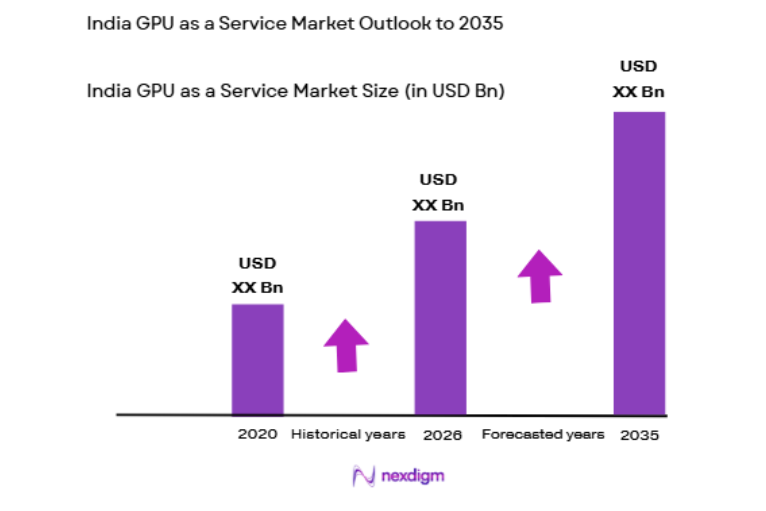
The India GPU as a Service market is poised for significant growth, with projections indicating a market size of approximately USD ~ billion. The primary drivers include the rapid adoption of artificial intelligence, machine learning, and high-performance computing applications across various industries. Enterprises are increasingly migrating to cloud platforms for their computing needs, with GPU-based services offering scalable and cost-effective solutions for complex workloads. Additionally, the rise in demand for AI-powered services, real-time data analytics, and cloud gaming is accelerating the adoption of GPU technologies in the country, further fueling market expansion.
Bengaluru, Hyderabad, and Pune are the leading cities driving the growth of GPU as a Service in India. Bengaluru, being the technology hub, hosts a dense concentration of IT companies and startups, making it a significant contributor to the market. Hyderabad and Pune follow closely, driven by their growing infrastructure for data centers, cloud services, and an expanding presence of global technology firms. These cities have established themselves as major centers for innovation, research, and data-driven businesses, further accelerating the adoption of GPU solutions and shaping the national market landscape.
Market Segmentation
By Product Type
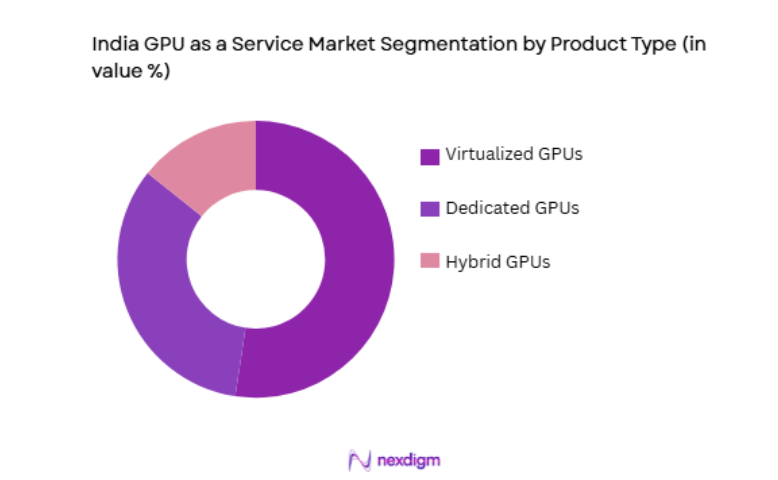
The India GPU as a Service market is segmented by product type into virtualized GPUs, dedicated GPUs, and hybrid GPUs. Recently, virtualized GPUs have captured the largest share of the market due to their ability to provide flexible, on-demand GPU resources at a lower cost compared to dedicated GPUs. Virtualized GPUs enable multiple clients to share a single GPU, making them ideal for businesses that require scalability without the need for dedicated physical hardware. This flexibility, combined with cost-effectiveness, has led to an increase in the adoption of virtualized GPUs, especially in industries like gaming, AI research, and cloud-based computing platforms.
By End-User Industry
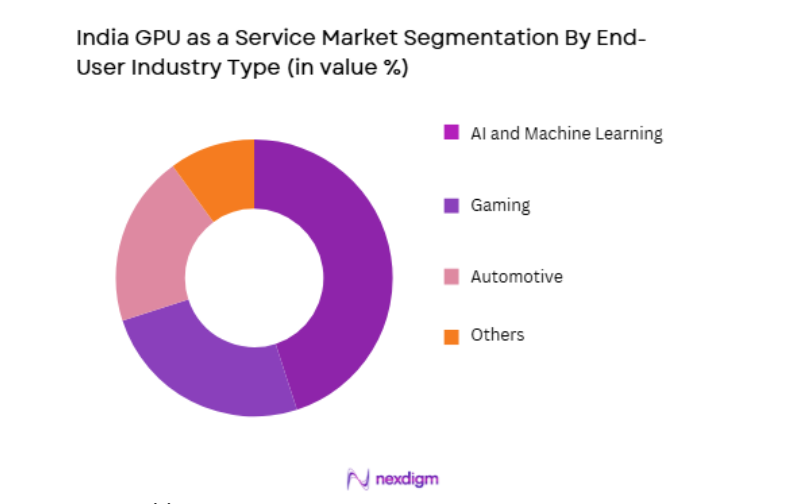
The India GPU as a Service market is segmented by end-user industry into AI and machine learning, gaming, automotive, and others. Recently, AI and machine learning have become the dominant sub-segment, driven by the increasing demand for GPU-powered computational power to train large-scale machine learning models. The ability of GPUs to handle parallel processing makes them ideal for AI tasks, such as natural language processing, image recognition, and predictive analytics. This has led to widespread adoption across industries, particularly in technology, finance, and healthcare sectors, where AI models are becoming essential for data-driven decision-making.
Competitive Landscape
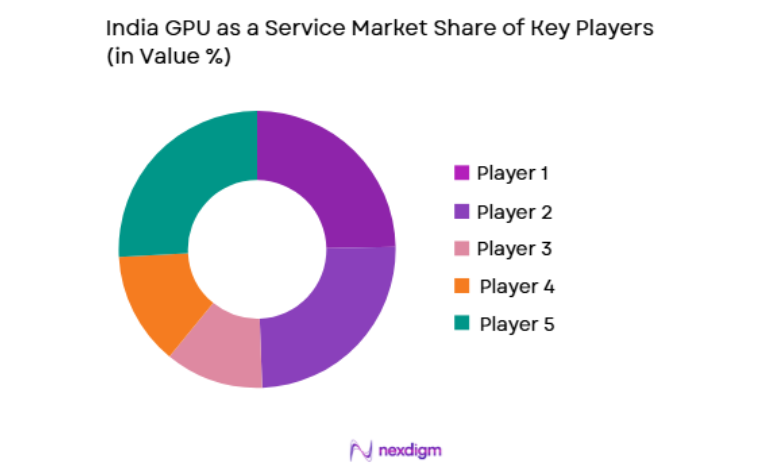
The competitive landscape of the India GPU as a Service market is driven by the presence of both global and local players. Global cloud service providers, such as Amazon Web Services (AWS), Microsoft Azure, and Google Cloud, dominate the market with their extensive GPU offerings. At the same time, local companies are emerging as significant players by providing tailored GPU services to meet the specific needs of the Indian market. The market is becoming increasingly competitive, with companies focusing on expanding their portfolios and improving the performance of their GPU-powered services to meet the growing demand from industries such as AI, gaming, and data analytics.
| Company Name | Establishment Year | Headquarters | Technology Focus | Market Reach | Key Products | Revenue (USD) | Additional Parameter |
| Amazon Web Services | 2006 | Seattle | ~ | ~ | ~ | ~ | ~ |
| Microsoft Azure | 2010 | Redmond | ~ | ~ | ~ | ~ | ~ |
| Google Cloud | 2008 | Mountain View | ~ | ~ | ~ | ~ | ~ |
| IBM Cloud | 2007 | Armonk | ~ | ~ | ~ | ~ | ~ |
| NVIDIA | 1993 | Santa Clara | ~ | ~ | ~ | ~ | ~ |
India GPU as a Service Market Analysis
Growth Drivers
Expansion of AI and Machine Learning Applications
The rapid growth of artificial intelligence (AI) and machine learning (ML) in India is a significant driver of the GPU as a Service market. As more businesses and industries adopt AI technologies for tasks such as predictive analytics, automation, and data analysis, the demand for powerful computing resources like GPUs has surged. GPUs, due to their parallel processing capabilities, are well-suited for training and inference in machine learning models. As AI adoption increases across sectors like healthcare, finance, and retail, the need for scalable and cost-efficient GPU resources has become critical. This growing dependence on AI has led companies to turn to GPU as a Service offerings, which allow them to access the computational power they need without having to invest in expensive physical hardware. The ability to quickly scale GPU resources on demand makes GPU as a Service an attractive option for companies seeking to stay competitive in the rapidly evolving AI landscape.
Growth of Cloud Computing Infrastructure
Cloud computing has become a major driver of the GPU as a Service market in India, with businesses of all sizes increasingly relying on cloud-based platforms for their computing needs. The growing adoption of cloud services across industries, including e-commerce, IT, and manufacturing, is creating significant demand for GPU resources to handle complex tasks such as data processing, machine learning, and virtual reality. Cloud service providers, such as AWS, Microsoft Azure, and Google Cloud, are responding to this demand by offering GPU-based instances as part of their infrastructure-as-a-service (IaaS) solutions. The ability to leverage GPU as a Service allows businesses to access high-performance computing resources without the upfront costs and maintenance requirements of owning physical hardware. This trend is expected to continue as more companies migrate to the cloud and seek flexible, scalable solutions for their computational needs.
Market Challenges
High Cost of GPU Resources
One of the primary challenges facing the India GPU as a Service market is the high cost of GPU resources. Although GPU as a Service offers flexibility and scalability, the cost of using GPUs on cloud platforms can be significantly higher than traditional CPU-based services. Businesses that rely on GPUs for tasks such as AI model training or high-performance computing may find the operational costs to be prohibitive, particularly for long-term or large-scale usage. This challenge is especially prominent for small and medium-sized enterprises (SMEs) that may not have the financial resources to invest in cloud-based GPU services. Additionally, the pricing structure of GPU cloud services can be complex and difficult for businesses to predict, making it harder to budget for these resources effectively. To overcome this challenge, cloud service providers must work to make GPU as a Service more affordable and transparent, enabling businesses of all sizes to leverage these resources without breaking their budgets.
Limited Availability of Specialized GPUs
While many cloud service providers offer general-purpose GPUs, there is a limited availability of specialized GPUs for specific applications such as deep learning, high-end graphics rendering, and scientific simulations. Companies that require highly specialized GPUs, such as those optimized for deep learning tasks or high-performance rendering, may find it difficult to source the right hardware through existing GPU as a Service offerings. This challenge is particularly relevant for industries such as autonomous vehicles, gaming, and healthcare, where specific GPU configurations are critical for performance. As the demand for specialized GPU resources grows, it will be essential for cloud service providers to expand their offerings to include a wider range of specialized GPUs that can meet the diverse needs of their clients.
Opportunities
Expansion of GPU-Optimized Cloud Solutions for Data Analytics and Big Data Processing
One of the key opportunities in the India GPU as a Service market lies in the increasing demand for GPU-optimized cloud solutions for data analytics and big data processing. With the exponential growth of data across industries, businesses are seeking powerful computing resources to process and analyze large volumes of information. GPUs, with their ability to perform parallel processing, are well-suited for handling the demands of big data applications. Cloud platforms offering GPU as a Service are well-positioned to capture this demand, enabling companies to scale their data analytics operations without the need for significant investment in physical infrastructure. This opportunity is especially relevant in industries such as finance, healthcare, and e-commerce, where the ability to derive actionable insights from large datasets is critical for success.
Rise of Virtual Reality (VR) and Augmented Reality (AR) Applications
The increasing adoption of virtual reality (VR) and augmented reality (AR) technologies presents a significant opportunity for the GPU as a Service market. VR and AR applications require significant computational power to render high-quality graphics and deliver immersive experiences. GPUs, with their ability to handle complex graphical tasks, are essential for powering VR and AR applications in industries such as gaming, education, and healthcare. As the demand for VR and AR solutions grows, especially in gaming and training simulations, GPU as a Service providers have a unique opportunity to cater to this demand by offering specialized GPU resources optimized for VR and AR workloads. This opportunity is expected to drive the adoption of GPU as a Service across a range of industries, creating new revenue streams for service providers.
Future Outlook
The future outlook for the India GPU as a Service market is positive, with continued growth expected in the coming years. Technological advancements in GPU hardware and the increasing demand for AI, machine learning, and cloud gaming applications will drive the market’s expansion. The rise of cloud computing and the shift toward flexible, on-demand computing resources will further accelerate the adoption of GPU as a Service. Additionally, the growing demand for specialized GPUs in areas like VR, AR, and big data analytics will create new opportunities for service providers to diversify their offerings. As more businesses adopt GPU-accelerated solutions, the market is poised to experience sustained growth, positioning GPU as a Service as a critical component of the future computing landscape.
Major Players
- Amazon Web Services (AWS)
- Microsoft Azure
- Google Cloud
- IBM Cloud
- Oracle Cloud
- NVIDIA
- Alibaba Cloud
- DigitalOcean
- Rackspace Technology
- Vultr
- Paperspace
- Linode
- G-Core Labs
- OVHcloud
- Tencent Cloud
Key Target Audience
- Investments and venture capitalist firms
- Government and regulatory bodies
- AI and machine learning developers
- Gaming companies
- Automotive manufacturers
- Healthcare providers
- Data analytics firms
- VR and AR developers
Research Methodology
Step 1: Identification of Key Variables
This step involves identifying critical market drivers such as AI growth, cloud computing, and the rising demand for GPUs in various industries.
Step 2: Market Analysis and Construction
Market trends are analyzed, segments are identified, and data is gathered to build a comprehensive market model that highlights key growth areas.
Step 3: Hypothesis Validation and Expert Consultation
Consultations with industry experts validate market assumptions, providing insights into the validity of the current trends and expected future developments.
Step 4: Research Synthesis and Final Output
All collected data is synthesized into a final report, offering actionable insights and detailed market forecasts based on rigorous analysis.

- Executive Summary
Market Snapshot – India GPU as a Service Market
Key Market Highlights (2025–2035)
Market Size & Growth Outlook
Key Growth Drivers
Key Challenges & Restraints
Emerging Opportunities
Competitive Landscape Snapshot
Strategic Recommendations

- Definition and Scope of GPU as a Service (GPUaaS)
- Industry Ecosystem Analysis
- Value Chain Analysis
- Evolution of GPUaaS in India
- Market Trends and Adoption Landscape
- Role of Cloud Computing & AI Workloads
Regulatory & Policy Landscape
- Data Localization & Data Sovereignty Regulations
- Digital Personal Data Protection Act (DPDPA) & Rules
- AI Governance Guidelines & Ethical AI Frameworks
- Cloud & Data Center Standards (BIS, Compliance Requirements)
Government Initiatives & Programs
- IndiaAI Mission & National AI Compute Infrastructure
- AIKosh Dataset Platform & AI Compute Portal
- National Supercomputing Mission (PARAM, AIRAWAT)
- State-Level AI Policies & Data Center Incentives
- Tax Incentives & Investment Policies for Data Centers
- Technology Landscape (AI/ML, HPC, Deep Learning)
- Impact of Macroeconomic Factors
- Demand-Supply Scenario in India

- Market Drivers
Rising Demand for AI & Machine Learning
Growth in Data Centers & Cloud Adoption
Increasing Demand for High-Performance Computing (HPC)
Digital Transformation Across Industries - Market Restraints
High Cost of GPU Infrastructure
Latency & Connectivity Challenges
Data Privacy & Security Concerns - Market Opportunities
Expansion of AI Startups & SaaS Ecosystem
Government Digital & AI Initiatives
Growth in Gaming, Media & Rendering - Industry Trends
Multi-cloud & Hybrid GPU Deployment
Subscription & Pay-per-use Models
Rise of Edge Computing
Porter’s Five Forces Analysis
PESTEL Analysis

- Market Size (USD Million) – Historical Analysis
- Number of GPUs (Installed/Usage / Compute Consumption Trends)
- Growth Rate Analysis (CAGR)
- Key Developments & Investments Timeline

By Component
Solutions
- Infrastructure-as-a-Service (IaaS GPU)
- Platform-as-a-Service (PaaS GPU)
Services
- Managed Services
- Professional Services
By Pricing Model
- Subscription-based
- Pay-per-use / On-demand
- Reserved Instances
By Organization Size
- Small & Medium Enterprises (SMEs)
- Large Enterprises
By Deployment Model
- Public Cloud
- Private Cloud
- Hybrid Cloud
By Industry Vertical
- BFSI
- Healthcare & Life Sciences
- IT & Telecom
- Media & Entertainment
- Gaming
- Manufacturing
- Automotive
- Energy & Utilities
- Others

Market Share Analysis (By Revenue, Active GPUs, Installed GPUs), 2025
Company Profiling
- Overview
- Product & Service Offerings
- Financial Performance
- Strategic Initiatives
- Installed / Active GPU Capacity
- Pricing Benchmarking
(Profiles to be covered: E2E, Yotta Shakti, NTT, ESDS, CYFuture, Tata Communications, Google Cloud, AWS, Microsoft Azure, Nebius Group, Oracle Cloud, Neev, Neysa, and others)
Key Players in India
- Global Cloud Providers
- Indian Data Center Players
- Emerging GPUaaS Startups
- Competitive Benchmarking
- Strategic Developments (M&A, Partnerships, Investments)
- SWOT Analysis

Demand by Industry Vertical
Use Case Analysis
- AI Model Training
- Data Analytics
- Rendering & Simulation
- Gaming & Streaming
- Buyer Behavior Analysis
- Adoption Barriers & Decision Criteria
- Pricing Sensitivity & Budget Allocation
- Case Studies / Use Cases

- Market Forecast (USD Million)
- Growth Rate (CAGR) Analysis
Forecast by Segment
- By Component
- By Pricing Model
- By Organization Size
- By Industry Vertical
- Scenario Analysis (Optimistic, Base, Pessimistic)
- Emerging Technologies Impact (AI, Edge, Quantum)
- Investment Outlook
- Strategic Opportunities for Market Entry


 Request a Sample
 Ask for Customization
 Get a Quote
 Enquire Now