
 Download PDF
Market Overview
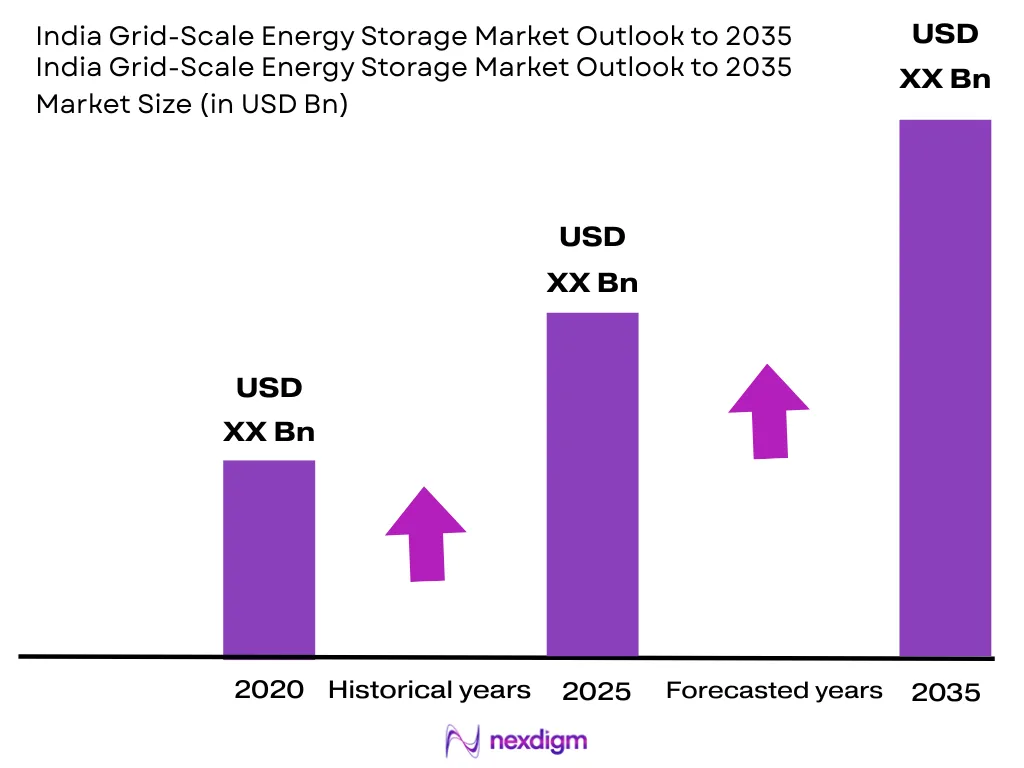
The India Grid-Scale Energy Storage Market was valued at USD ~ Billion in 2024 and is anticipated to expand at a CAGR of ~% during 2026–2035. The market is primarily driven by structural demand escalation quantified under the Government of India’s National Electricity Plan 2023, which projects national energy storage capacity requirements rising from 82.37 GWh in 2026-27 to 411.4 GWh by 2031-32, and further to 2,380 GWh by 2047. India’s broader battery energy storage system (BESS) market was valued at USD 1.54 billion in 2025 and is estimated to grow from USD 2.05 billion in 2026 to reach USD 8.59 billion by 2031, at a CAGR of 33.2%, as rapid renewable energy additions, sovereign incentives, and falling lithium-ion costs progressively tighten the gap between intermittent generation and grid-balancing capacity. Grid-scale storage applications dominate the broader energy storage systems market with nearly 35% share in 2026, anchored by large-scale tenders from the Solar Energy Corporation of India (SECI), NTPC Renewable Energy Limited, and the Gujarat Urja Vikas Nigam Limited (GUVNL) shaping national utility-scale procurement.
Market Segmentation
By Technology
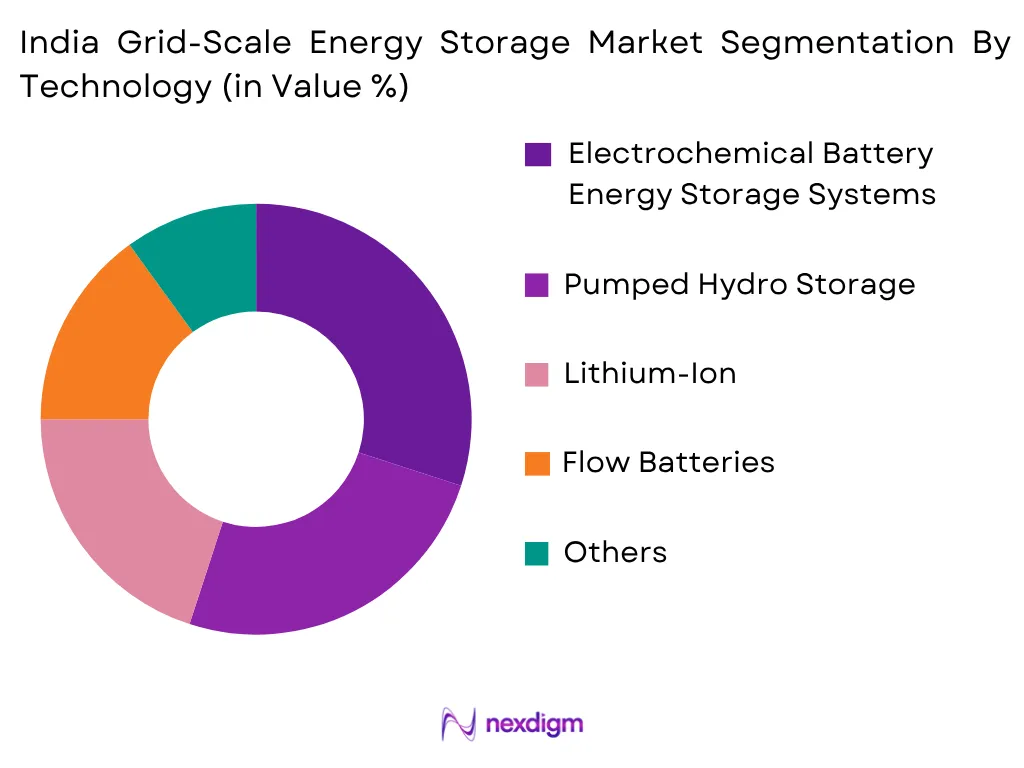
Electrochemical Battery Energy Storage Systems lead the technology segment with approximately 40% market share in 2026, driven predominantly by lithium-ion chemistries, both LFP and NMC, deployed across grid-scale, commercial and industrial, and distributed renewable integration projects. Domestic manufacturing capacity is scaling rapidly to serve this demand, exemplified by Waaree Energies’ 16 GWh gigafactory investment, while the Ministry of New and Renewable Energy has advanced a tender for 10 GWh of battery cell manufacturing capacity specifically earmarked for grid-scale stationary storage applications, with bid submissions due in October 2026, forming the final tranche of the broader 50 GWh National Programme on Advanced Chemistry Cell Battery Storage. Pumped Hydro Storage retains an important role for long-duration grid balancing applications, while Flow Batteries and other emerging chemistries represent a smaller but strategically important category as India’s storage requirements increasingly demand duration flexibility beyond what current lithium-ion deployments typically provide.
By Application
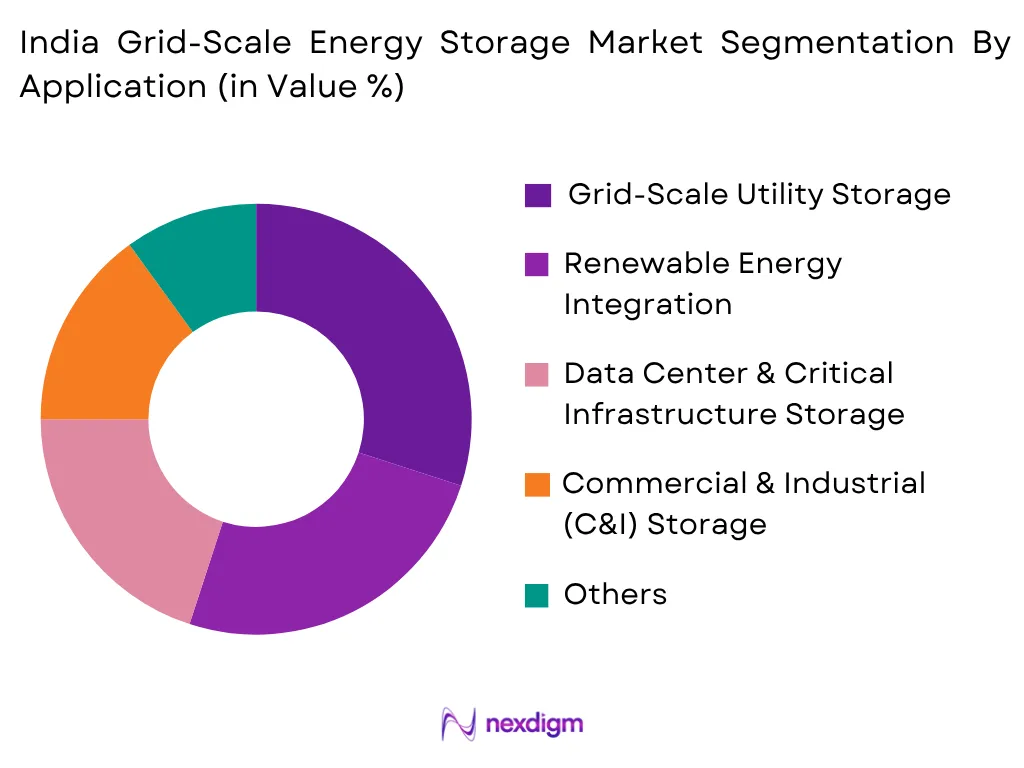
Grid-Scale Utility Storage represents the dominant application segment, accounting for nearly 35% of the broader India energy storage systems market in 2026 and anchored by large tenders from SECI, NTPC Renewable Energy Limited, and GUVNL that continue to shape national utility-scale procurement standards. Renewable Energy Integration represents the fastest-growing application segment, propelled directly by the Ministry of New and Renewable Energy’s mandate requiring new solar and wind projects to include battery storage starting at a minimum of 10% of plant capacity. Data Center & Critical Infrastructure Storage represents a distinct and currently underserved segment, where demand originates from data centers, industrial facilities, commercial complexes, and critical infrastructure operators with near-zero tolerance for downtime, requiring systems engineered specifically for reliability rather than optimized purely for lowest bid price, a segment increasingly targeted by specialized providers such as DC&T Global.
Competitive Landscape
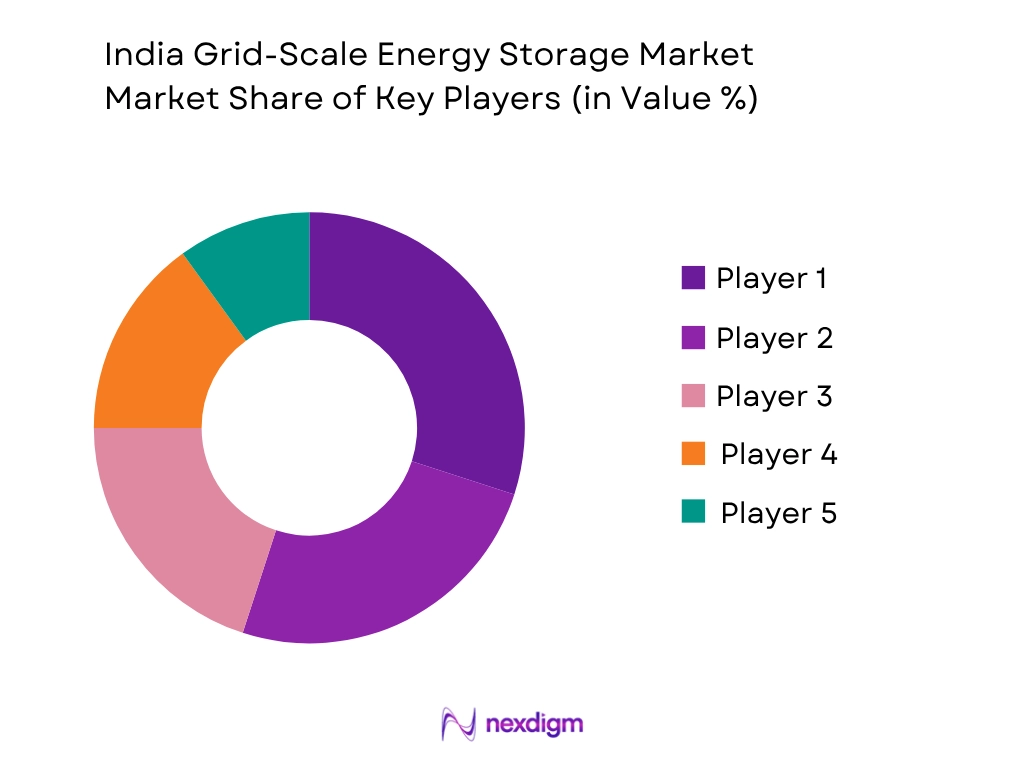
The India Grid-Scale Energy Storage Market is led by large, integrated domestic conglomerates strengthening their positions through project awards, manufacturing expansion, and gigafactory development. Tata Power Renewable Energy Limited stands as a pioneer in utility-scale battery storage in India, operating solar-plus-storage projects and pioneering innovative contracting models such as Battery-Backed Supply Purchase Agreements (BESPA); on March 7, 2026, the company announced plans to invest approximately INR 49,000 crore, equivalent to around USD 5.6 billion, to develop 7 GW of solar, wind, and hybrid renewable capacity, underscoring the scale of capital being deployed across the sector. Adani Energy Solutions Limited, JSW Energy Limited, and Amara Raja Energy and Mobility Limited are similarly strengthening their market positions through project awards, manufacturing localization, and integrated value chain investment, while Exide Energy Solutions has emerged as a dedicated lithium-ion cell manufacturing arm of the longstanding Exide Industries battery group. Global technology integrators are also entering the market, with AES Corporation operating through a joint venture structure and ENGIE securing large standalone BESS projects under state tenders, highlighting international confidence in India’s storage market even as competition intensifies around integrated value chain presence and project execution capability.
| Company | Establishment Year | Headquarters | Grid-Scale BESS Portfolio | Domestic Manufacturing Portfolio
|
Manufacturing Presence | Major End-Use Industries | Key Strategic Focus | Certifications & Compliance |
| Tata Power Renewable Energy Limited | 1915 | ~ | ~ | ~ | ~ | ~ | ~ | ~ |
| Adani Energy Solutions Limited | 1988 | ~ | ~ | ~ | ~ | ~ | ~ | ~ |
| JSW Energy Limited | 1994 | ~ | ~ | ~ | ~ | ~ | ~ | ~ |
| Amara Raja Energy & Mobility Limited | 1985 | ~ | ~ | ~ | ~ | ~ | ~ | ~ |
| Exide Energy Solutions Ltd. | 1947 | ~ | ~ | ~ | ~ | ~ | ~ | ~ |
India Grid-Scale Energy Storage Market Analysis
Growth Drivers
Structural Demand Escalation Under National Electricity Plan 2023
India’s Grid-Scale Energy Storage Market is underpinned by binding structural demand projections set out in the Government of India’s National Electricity Plan 2023, which quantifies national energy storage capacity requirements rising from 82.37 GWh in 2026-27 to 411.4 GWh by 2031-32, and further to 2,380 GWh by 2047. This escalation is directly reinforced by the Energy Storage Obligation framework, which requires obligated entities to source 1% of their energy from storage in FY24, scaling to 4% by FY30, alongside the Ministry of New and Renewable Energy’s mandate that new solar and wind projects include battery storage starting at a minimum of 10% of plant capacity. Together, these overlapping regulatory mechanisms establish long-term demand visibility that is attracting both domestic conglomerates and global technology integrators to commit capital to India’s grid-scale storage buildout.
Viability Gap Funding and ACC PLI Scheme De-Risking Investment
India’s Viability Gap Funding scheme for battery energy storage systems, which supports up to 40% of capital costs, has institutionalized a critical de-risking mechanism for a market still finding its pricing floor, with the 2024 and 2025 VGF schemes together supporting approximately 43 GWh of BESS project deployment. This project-side support runs alongside the manufacturing-side Production-Linked Incentive scheme for Advanced Chemistry Cells, a INR 18,100 crore (approximately USD 2.18 billion) program targeting 50 GWh of domestic ACC manufacturing capacity; of this target, 40 GWh has already been allocated to domestic manufacturers, predominantly for electric vehicle and consumer-electronics-grade cells, while a final 10 GWh tranche was specifically launched in July 2026 to support grid-scale stationary storage applications, with technical bids opened in October 2026 through a transparent, competitive two-stage process.
Market Challenges
Heavy Import Dependency on Chinese Battery Cells
Despite substantial policy support, India’s domestic lithium-ion battery manufacturing ecosystem remains nascent, with the majority of battery cells currently imported, predominantly from China, making the country’s grid-scale storage supply chain vulnerable to geopolitical disruption, currency fluctuation, and logistics delays. Building a robust indigenous supply chain capable of meaningfully reducing this import dependency is widely regarded as a decade-long endeavor that has only just begun, even as India’s own planning estimates put 2030 storage needs at roughly twenty times the capacity being built under the current round of ACC manufacturing tenders, underscoring the scale of the gap between domestic supply ambitions and actual near-term production capability.
Higher Cost of Capital Relative to Mature Renewable Technologies
India’s battery energy storage sector continues to carry a higher cost of capital than more mature renewable technologies such as solar and wind, reflecting the market’s relative immaturity and the technology and execution risks still associated with large-scale storage deployment. This higher cost of capital compounds the challenge facing project developers seeking to compete in the fiercely price-competitive tender environment run by SECI, NTPC Renewable Energy Limited, and GUVNL, where Viability Gap Funding support of up to 40% of capital costs provides meaningful but only partial mitigation, leaving developers to absorb residual financing cost premiums that mature renewable technologies no longer face to the same degree.
Market Opportunities
Domestic ACC Gigafactory Investment for Grid-Scale Applications
The explicit carve-out of a 10 GWh tranche within the National Programme on Advanced Chemistry Cell Battery Storage specifically for stationary grid-scale applications, following the allocation of 40 GWh predominantly toward electric vehicle and consumer-electronics-grade cells, signals a clear government intent to build dedicated domestic manufacturing capacity for grid storage rather than relying on cells developed primarily for other end uses. Waaree Energies’ 16 GWh gigafactory investment illustrates the kind of large-scale domestic manufacturing commitment increasingly likely to follow, creating substantial opportunity for battery manufacturers, cell developers, and integrated conglomerates capable of securing allocation under this final PLI tranche and establishing themselves as preferred domestic suppliers for India’s rapidly scaling grid-scale storage tender pipeline.
Underserved Data Center, Industrial and Critical Infrastructure Segment
While much of India’s BESS tender activity remains focused on utility-scale grid applications procured through competitive least-cost bidding, a large and currently underserved segment of demand exists among data centers, industrial facilities, commercial complexes, and critical infrastructure operators, where near-zero tolerance for downtime creates demand for systems engineered specifically for reliability rather than lowest bid price. Specialized providers such as DC&T Global, built specifically to serve this environment, illustrate the kind of differentiated, premium-positioned opportunity available to storage providers capable of offering the technical depth and reliability engineering this segment requires, distinct from the price-driven dynamics that dominate India’s utility-scale tender market.
Future Outlook
The India Grid-Scale Energy Storage Market is expected to witness sustained expansion over the forecast period, supported by continued structural demand growth under the National Electricity Plan 2023, progressive tightening of the Energy Storage Obligation toward 4% by FY30, and sustained Viability Gap Funding and ACC PLI support de-risking both project deployment and domestic manufacturing investment. Growing gigafactory investment, exemplified by Waaree Energies’ 16 GWh facility and the newly launched 10 GWh grid-scale ACC tranche, will further accelerate the transition toward reduced import dependency, while continued innovation in contracting models such as Tata Power’s Battery-Backed Supply Purchase Agreements is expected to reshape how utility-scale storage capacity is procured and financed. The market is also likely to benefit from India’s massive projected long-term storage requirement, rising to 2,380 GWh by 2047, as domestic conglomerates and global technology integrators alike continue to invest in the manufacturing capacity, project execution capability, and technology innovation required to serve one of the world’s largest emerging grid-scale energy storage opportunities.
Major Players
- Tata Power Renewable Energy Limited
- Adani Energy Solutions Limited
- JSW Energy Limited
- Amara Raja Energy & Mobility Limited
- Exide Energy Solutions Ltd.
- AES Corporation (Fluence JV)
- Reliance New Energy Limited
- HBL Power Systems Limited
- Waaree Energies Limited
- ENGIE
- IndiGrid Trust
- Gensol Engineering Limited
- SunGarner Energies Ltd.
- DC&T Global
- Greenko Group
Key Target Audience
- Battery and Energy Storage System Manufacturers
- Utilities and Distribution Companies (Discoms)
- Renewable Energy Developers
- Data Center and Industrial Infrastructure Operators
- EPC and Systems Integration Firms
- Investment and Venture Capitalist Firms
- Government and Regulatory Bodies (Ministry of Power, Ministry of New and Renewable Energy – MNRE, Solar Energy Corporation of India – SECI)
- Grid Modernization and Transmission Infrastructure Operators
Research Methodology
Step 1: Identification of Key Variables
The research process begins with identifying the complete ecosystem of the India Grid-Scale Energy Storage Market, including battery cell and component manufacturers, systems integrators, utilities and renewable energy developers, EPC contractors, and regulatory authorities. Extensive secondary research is conducted using company reports, government publications, trade associations, tender documentation, industry journals, and proprietary databases to determine the variables influencing market demand, pricing, capacity deployment, and technological developments.
Step 2: Market Analysis and Construction
Historical market information is collected and analyzed to estimate market size, installed capacity figures, application-wise demand, and pricing trends. A combination of top-down and bottom-up approaches is used to estimate market revenues and validate segment-level performance. Deployment patterns across grid-scale utility, renewable integration, commercial and industrial, and data center applications are evaluated to establish an accurate representation of the industry.
Step 3: Hypothesis Validation and Expert Consultation
The preliminary findings are validated through Computer-Assisted Telephone Interviews (CATIs) and structured discussions with battery manufacturers, utility procurement managers, project developers, regulatory experts, and senior executives operating within the Indian energy storage industry. These interviews help verify market assumptions, competitive developments, technology adoption trends, pricing dynamics, and future investment opportunities while refining the overall market estimates.
Step 4: Research Synthesis and Final Output
The final stage integrates insights obtained from primary interviews with quantitative information collected through secondary sources. Data triangulation techniques are applied to reconcile differences between supply-side and demand-side estimates, ensuring robust market forecasting. The report is then reviewed through multiple quality assurance checkpoints to deliver a comprehensive analysis covering market size, segmentation, competitive landscape, future outlook, and strategic recommendations for industry stakeholders.

- Executive Summary
- Research Methodology (Market Definitions and Assumptions, Abbreviations, Market Sizing Approach, Top-Down Analysis, Bottom-Up Analysis, Demand-Side Assessment, Supply-Side Assessment, Primary Industry Interviews, Secondary Research Validation, Data Triangulation, Forecasting Framework, Limitations and Future Conclusions)

- Definition and Scope
- Market Evolution and Industry Genesis
- Timeline of Major Industry Developments
- Energy Storage Industry Value Chain Analysis
- Supply Chain Analysis

- Growth Drivers (Structural Demand Escalation Under National Electricity Plan 2023, Viability Gap Funding and ACC PLI Scheme De-Risking Investment, Energy Storage Obligation Ramp-Up, MNRE Renewable-Storage Co-Location Mandate, Falling Lithium-Ion Costs, Large-Scale SECI, NTPC-REL and GUVNL Tender Activity)
- Market Challenges (Heavy Import Dependency on Chinese Battery Cells, Higher Cost of Capital Relative to Mature Renewable Technologies, Nascent Domestic Manufacturing Ecosystem, Grid Interconnection and Land Acquisition Delays, Currency and Raw Material Price Volatility, Skilled Workforce Shortages in Battery Manufacturing)
- Market Opportunities (Domestic ACC Gigafactory Investment for Grid-Scale Applications, Underserved Data Center, Industrial and Critical Infrastructure Segment, Long-Duration and Flow Battery Technology Development, Battery-Backed Supply Purchase Agreement (BESPA) Contracting Models, Pumped Hydro Storage Capacity Expansion, Public-Private Grid Modernization Partnerships)
- Market Trends (Import Substitution Through Domestic ACC Manufacturing, Growth of Solar-Plus-Storage and Wind-Plus-Storage Projects, Rise of Novel Contracting Models Such as BESPA, Entry of Global Technology Integrators via Joint Ventures, Gigafactory Development Across Domestic Conglomerates, Growing Focus on Reliability-Engineered Systems for Critical Infrastructure)
- Government Regulations (National Programme on Advanced Chemistry Cell (ACC) Battery Storage, Energy Storage Obligation (ESO) Framework, Viability Gap Funding (VGF) for BESS, MNRE Mandate for Storage Co-Location in Renewable Projects, National Electricity Plan 2023, Production-Linked Incentive (PLI) Scheme for ACC Manufacturing)
- Import and Export Analysis (Trade Volume, Major Import Sources for Battery Cells, HS Code Analysis, Currency Impact on Landed Costs, Trade Balance)
- Raw Material Availability Analysis (Imported Lithium-Ion Cell and Cathode Material Feedstocks, Domestic ACC Manufacturing Capacity Build-Out, Battery Management System Component Availability, Power Electronics and Inverter Supply Chain, Regional Critical Mineral Supply Chain Access)
- Technology Landscape (Lithium-Ion (LFP/NMC) Cell Technology, Pumped Hydro Storage Technology, Flow Battery Technology, Battery Management and Energy Management Systems, Grid Interconnection and Power Electronics Technology)
- Sustainability Assessment (Renewable Energy Integration Support, Grid Decarbonization Enablement, Domestic Manufacturing Carbon Footprint Reduction, End-of-Life Battery Recycling, Circular Economy Alignment)
- PESTLE Analysis
- SWOT Analysis
- Porter’s Five Forces Analysis
- Stakeholder Ecosystem
- Competition Ecosystem

- By Market Value (2020-2025)
- By Installed Capacity (2020-2025)
- By Average Cost Per MWh (2020-2025)

- By Technology (In Value %)
Lithium-Ion (LFP)
Lithium-Ion (NMC)
Pumped Hydro Storage
Flow Batteries
Other Emerging Chemistries - By Application (In Value %)
Grid-Scale Utility Storage
Renewable Energy Integration (Solar & Wind + Storage)
Commercial & Industrial (C&I) Storage
Distributed / Behind-the-Meter Storage
Data Center & Critical Infrastructure Storage - By Duration (In Value %)
Short Duration (Under 2 Hours)
Medium Duration (2–4 Hours)
Long Duration (Above 4 Hours) - By End User (In Value %)
Utilities & Distribution Companies (Discoms)
Renewable Energy Developers
Industrial & Data Center Operators
Government & Public Sector Programs
Commercial Real Estate - By Region (In Value %)
North India
South India
West India
East India

- Market Share of Major Players (By Value, Installed Capacity, Technology Type, Application, End User)
- Cross Comparison Parameters (Project Execution Track Record, Domestic Manufacturing Capacity, Integrated Value Chain Presence, Application Technical Support, Gigafactory Investment Scale, Regulatory Compliance & Certifications, Customer Base, Innovation & New Contracting Model Frequency)
- SWOT Analysis of Major Players
- Pricing Analysis by Technology Type and Duration
- Production Capacity Analysis
- Manufacturing Footprint Analysis
- Distribution Network Analysis
- Innovation Benchmarking
- Detailed Profiles of Major Companies
Tata Power Renewable Energy Limited
Adani Energy Solutions Limited
JSW Energy Limited
Amara Raja Energy & Mobility Limited
Exide Energy Solutions Ltd.
AES Corporation (Fluence JV)
Reliance New Energy Limited
HBL Power Systems Limited
Waaree Energies Limited
ENGIE
IndiGrid Trust
Gensol Engineering Limited
SunGarner Energies Ltd.
DC&T Global
Greenko Group

- Consumption Pattern Analysis (Installed Capacity Penetration, Project Scale Distribution, End-User Segment Adoption, Seasonal and Peak-Demand Impact, Tender-Driven Deployment Patterns)
- Purchasing Criteria (Cost Per MWh, Regulatory and VGF Eligibility, Reliability and Uptime Performance, Technology and Chemistry Selection, Grid Interconnection Readiness, Contracting Model Flexibility)
- Procurement and Supplier Selection Analysis
- Domestic vs Imported Cell Adoption Assessment
- Utility-Scale vs Data Center/Industrial Demand Comparison
- Product Attribute Preference Analysis (Cycle Life, Round-Trip Efficiency, Safety and Thermal Management, Reliability, Cost Efficiency, Grid Compatibility)
- Sustainability & ESG Influence on Procurement Decisions
- Pain Point Analysis
- Decision-Making Process

- By Market Value (2026-2035)
- By Installed Capacity (2026-2035)
- By Average Cost Per MWh (2026-2035)


 Request a Sample
 Ask for Customization
 Get a Quote
 Enquire Now