
 Download PDF
Market Overview
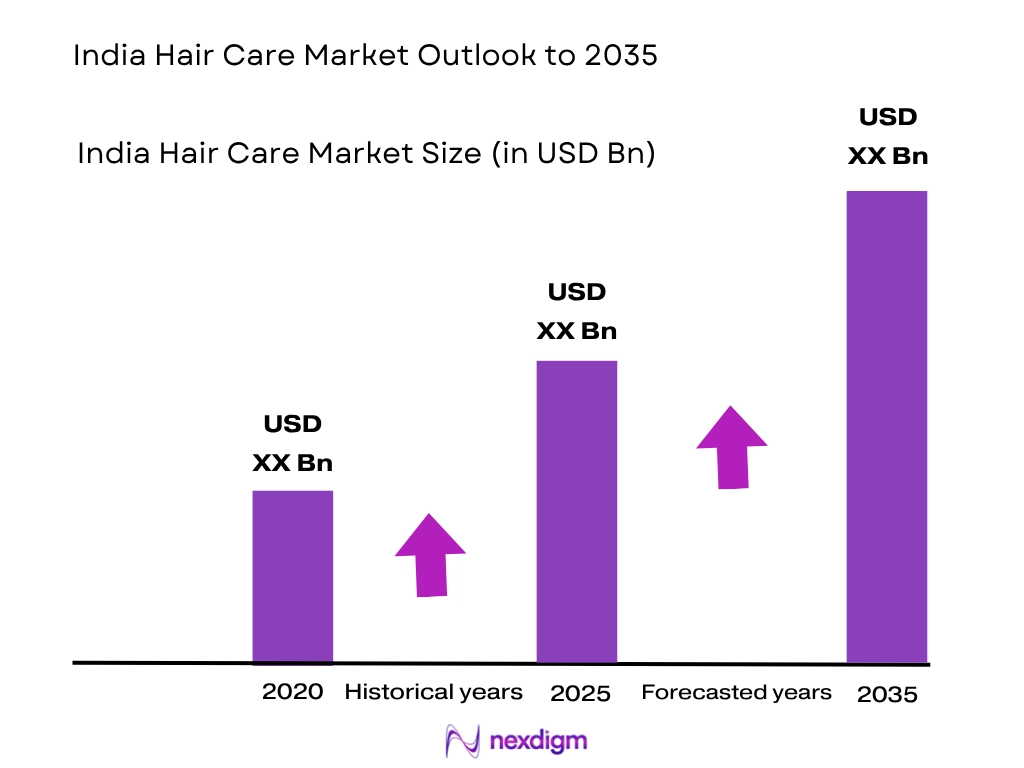
The India Hair Care Market is valued at USD ~ billion, based on a Nexdigm research that also places the market at USD ~ billion in the prior base period and shows continuing expansion through premium shampoos, hair oils, conditioners, hair colorants, styling products and treatment-led solutions. Growth is driven by higher grooming awareness, rising disposable income, urban middle-class consumption, hair fall and scalp-health concerns, and increasing adoption of premium and specialized hair care products. The forecasted CAGR for the 2026-2035 period is calculated at 5.09%, derived from the published 2025 and 2035 values.
The India Hair Care Market is led by major urban consumption clusters such as Mumbai, Delhi-NCR, Bengaluru, Chennai, Hyderabad, Pune and Ahmedabad, supported by high purchasing power, dense modern retail networks, premium salon penetration, beauty e-commerce adoption and quick-commerce availability. West and Central India are especially strong due to Mumbai, Pune and Ahmedabad, while North India benefits from Delhi, Chandigarh and Lucknow. Urban India records monthly per-capita consumption expenditure of INR ~, compared with INR~ in rural India, supporting higher premium hair care uptake.
Market Segmentation
By Product Type
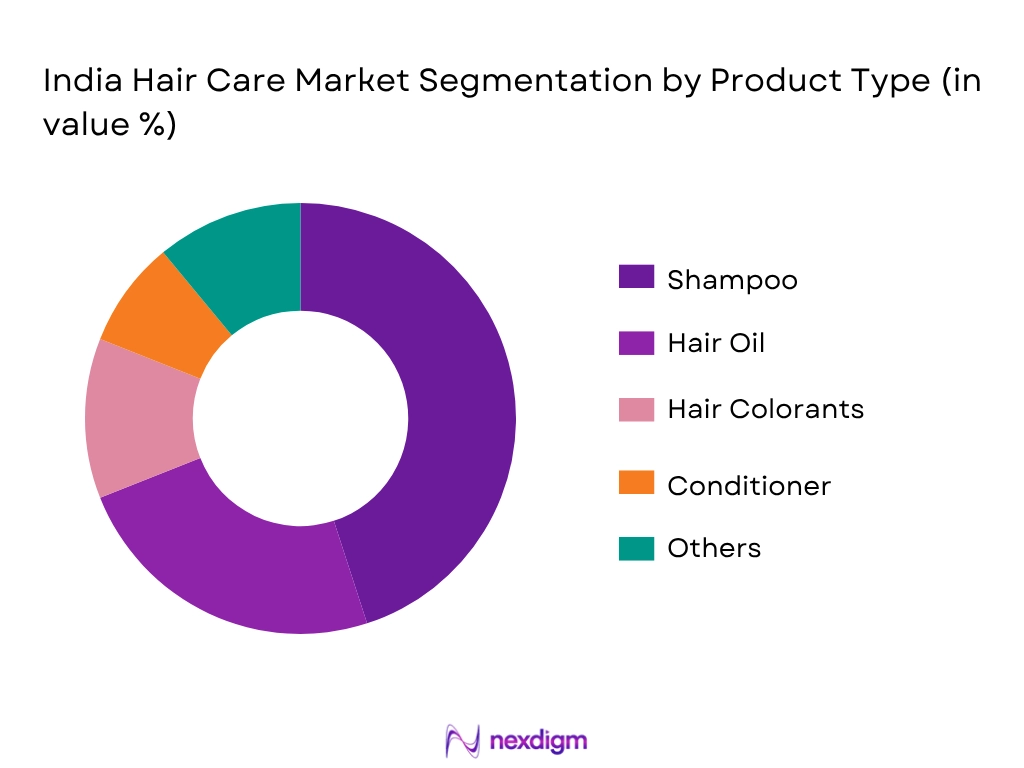
India Hair Care Market is segmented by product type into shampoo, hair oil, conditioner, hair colorants, hair styling products and hair treatment products. Recently, shampoo has maintained the dominant market share under product type segmentation, driven by its higher frequency of use, wider penetration across rural and urban households, sachet-led affordability, and strong participation of brands such as Clinic Plus, Dove, Sunsilk, Head & Shoulders, Pantene and Garnier. The segment benefits from anti-dandruff, hair fall control, damage repair, herbal, sulphate-free and premium salon-inspired variants, allowing it to serve both mass and premium consumers. Hair oils remain culturally entrenched and continue to gain from coconut, amla, almond and Ayurvedic propositions, but shampoo has broader consumption frequency and higher organized retail visibility. Market sources identify shampoo as the largest hair care segment, while specialized hair oils and treatment products are growing through premiumization and natural ingredient positioning.
By Distribution Channel
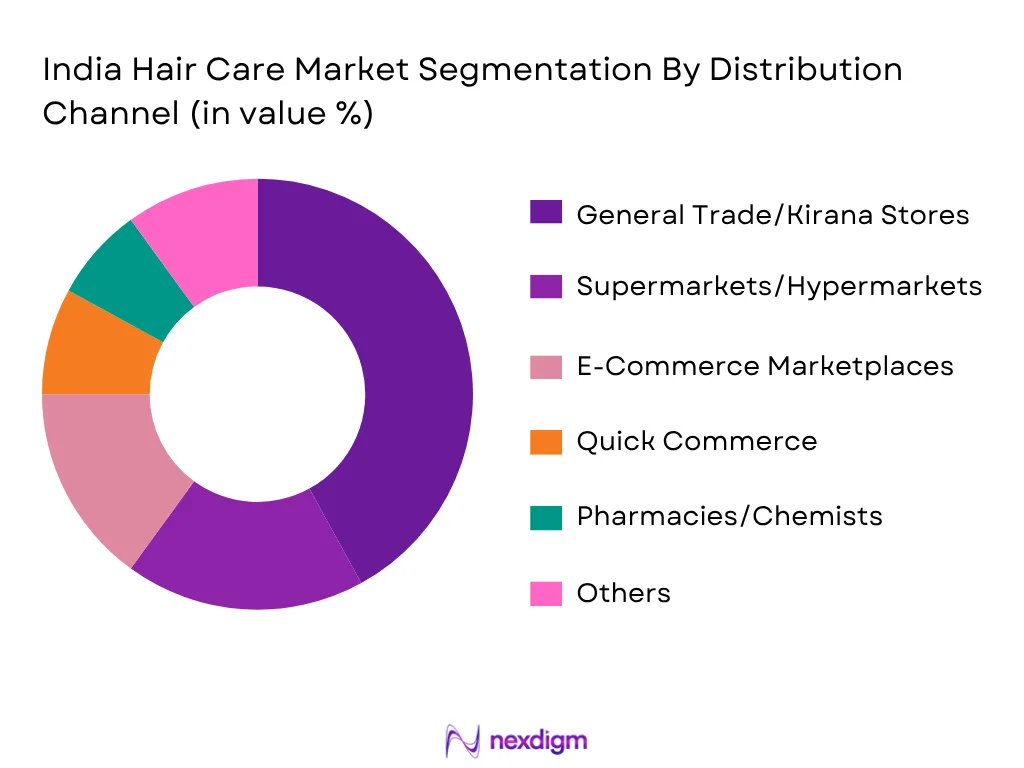
India Hair Care Market is segmented by distribution channel into general trade/kirana stores, supermarkets and hypermarkets, e-commerce marketplaces, quick commerce, pharmacies and chemists, beauty specialty stores, and salons/professional channels. Recently, general trade and kirana stores have held the dominant share because hair care remains a high-frequency FMCG category purchased through neighborhood retail, especially for sachets, small bottles, hair oils and mass shampoos. Kirana stores benefit from trust, credit familiarity, last-mile reach and daily household replenishment, particularly outside metros. However, e-commerce and quick commerce are reshaping premium discovery and repeat purchase behaviour, with urban consumers increasingly buying sulphate-free shampoos, scalp serums, masks, conditioners and salon brands online. Modern trade remains important for family packs and promotional bundles, while salons influence professional products, hair colorants and treatment-led purchases.
Competitive Landscape
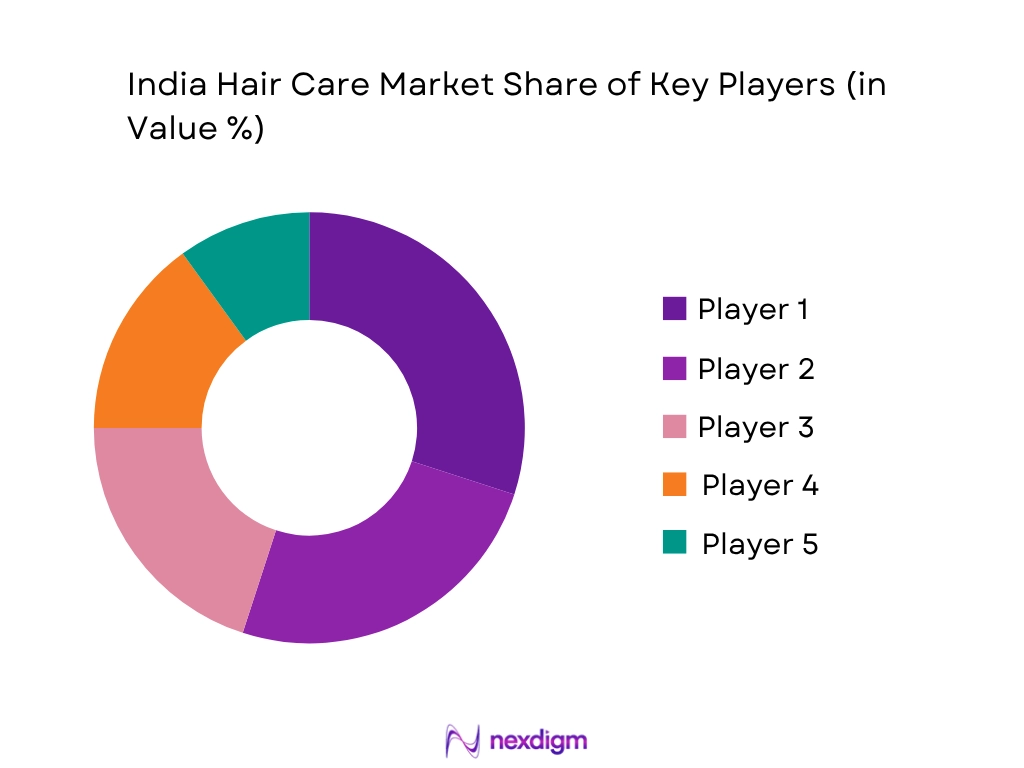
The India Hair Care Market is concentrated among large FMCG companies, hair oil specialists, global beauty groups, Ayurvedic players and emerging D2C brands. Hindustan Unilever, Procter & Gamble, L’Oréal India, Marico and Dabur hold strong positions through deep distribution, multi-price portfolios, mass-to-premium brand architecture and high advertising intensity. Competition is intensifying as D2C brands, salon-professional players and herbal/Ayurvedic companies target scalp health, hair fall, sulphate-free, onion oil, rosemary oil, keratin and bond-repair propositions.
| Company | Establishment Year | Headquarters | Core Hair Care Brands | Dominant Product Strength | Channel Strength | India Positioning | Ingredient/Claims Focus | Competitive Advantage |
| Hindustan Unilever Limited | 1933 | Mumbai, India | ~ | ~ | ~ | ~ | ~ | ~ |
| Procter & Gamble | 1837 | Cincinnati, USA | ~ | ~ | ~ | ~ | ~ | ~ |
| L’Oréal India | 1909 | Paris, France | ~ | ~ | ~ | ~ | ~ | ~ |
| Marico Limited | 1990 | Mumbai, India | ~ | ~ | ~ | ~ | ~ | ~ |
| Dabur India Limited | 1884 | Ghaziabad, India | ~ | ~ | ~ | ~ | ~ | ~ |
India Hair Care Market Analysis
Growth Drivers
Rising Grooming Spend
Rising grooming spend in the India Hair Care Market is supported by broader household consumption improvement, urban income concentration and higher participation of women in economic activity. World Bank data places India’s population at 1.45 billion, GDP at USD 3.91 trillion, GDP per capita at USD 2,694.7, and GDP growth at 6.5 in 2024, creating a large consumption base for daily-use FMCG categories such as shampoo, hair oil, conditioner, hair colour and scalp-care products. MoSPI’s Household Consumption Expenditure Survey records average monthly per-capita expenditure of ₹4,122 in rural India and ₹6,996 in urban India, with non-food expenditure at ₹2,183 in rural India and ₹4,220 in urban India; this matters for hair care because shampoos, conditioners, hair oils, hair colourants and serums sit within discretionary-plus-necessity personal care consumption. India also has 534,916,498 urban residents, according to World Bank-derived urban population data, which strengthens premium grooming demand in metro and Tier-I retail clusters where modern trade, salons, e-commerce and quick-commerce availability are higher. Workforce changes add another consumption layer: MoSPI’s PLFS reports female Worker Population Ratio rising to 40.3 for persons aged 15 years and above in 2023-24, while urban female LFPR reached 25.2 in October-December 2024. This supports more routine grooming, workplace-led appearance needs and repeat consumption of anti-frizz, hair fall control, anti-dandruff and post-wash products. TRAI data further shows 944.96 million broadband subscribers and 970.16 million total internet subscribers at the end of December 2024, enabling digital discovery of hair care routines, influencer-led product education and online replenishment.
Pollution-Led Hair Damage
Pollution-led hair damage is a market-specific growth driver because Indian consumers in dense cities are exposed to particulate matter, dust, sweat, hard-water routines and frequent outdoor commuting, which increases demand for anti-dandruff shampoos, anti-pollution shampoos, scalp cleansers, lightweight conditioners, hair masks and leave-in serums. The Ministry of Environment, Forest and Climate Change states that the National Clean Air Programme covers 131 non-attainment and million-plus cities across 24 States/UTs, confirming that air-quality stress is not limited to Delhi-NCR but spread across large urban demand centres. The programme’s target was revised to achieve up to 40 reduction in PM10 levels or meet the national standard of 60 µg/m³ by 2025-26, showing the scale of particulate exposure still being addressed. Delhi illustrates the commercial relevance for hair care: PIB reported that Delhi’s PM10 average for January-November stood at 205 µg/m³ in 2024, while another PIB update recorded PM2.5 averages at 83 µg/m³ during January-October 2024. These numbers are far above the clean-air benchmark used in public policy, and they support demand for products positioned around scalp cleansing, residue removal, dandruff control, itch reduction and pollution defence. India’s urban base of 534.9 million people magnifies this need because high-density cities concentrate construction dust, vehicular emissions and sweat-prone commuting. Hair care brands can therefore justify anti-pollution, detox, clarifying shampoo, scalp scrub, micellar shampoo and protective serum propositions using urban environmental exposure rather than generic beauty claims.
Market Challenges
High Price Sensitivity
High price sensitivity remains a structural challenge in the India Hair Care Market because the category serves a very large mass consumer base where shampoo, hair oil and hair colour are bought frequently but within tight household budgets. MoSPI’s HCES records rural monthly per-capita expenditure at INR 4,122 and urban monthly per-capita expenditure at INR 6,996, while the rural-urban consumption gap remains around 70 in 2023-24, indicating that premium hair masks, scalp serums, salon-grade shampoos and conditioners must compete with essential household categories for wallet share. The same HCES factsheet shows non-food monthly per-capita expenditure of INR 2,183 in rural India and INR 4,220 in urban India, meaning hair care competes within a broader non-food basket covering transport, clothing, rent, education, health, communication and household services. World Bank data adds that India’s GDP per capita stood at USD 2,694.7 in 2024 and consumer inflation at 5.0, creating pressure on discretionary upgrades even when grooming awareness is increasing. MoSPI CPI data for October 2024 shows the “personal care and effects” index at 205.1 compared with 201.4 in September 2024, signalling that personal care consumption is exposed to inflationary movement at the household level. For hair care companies, this creates a need for tight price ladders, entry packs, refill formats, sachets, small bottles and mass-premium bridges. Premium claims such as sulphate-free, onion oil, rosemary, keratin, biotin and scalp serum can gain traction, but conversion depends on affordability, visible benefit and low-risk trial formats.
Sachet Dependency
Sachet dependency is a market-specific challenge because India’s hair care penetration, especially for shampoo and conditioner trial, is still linked to low-unit packs that allow consumers to buy per wash rather than commit to larger bottles. World Bank-derived rural population data shows India had 916,019,293 rural residents in 2024, while MoSPI records rural MPCE at INR 4,122, compared with INR 6,996 in urban India. This large rural and semi-urban base supports sachet-led access for shampoos, hair colour sachets, small hair oil packs and trial conditioners, but it also limits premium upgradation and reduces full-size bottle conversion. The issue is not only rural: mass urban consumers also use sachets for convenience, travel, household sharing and brand trial. MoSPI’s HCES shows non-food expenditure at INR 2,183 in rural India and INR 4,220 in urban India, so a large-bottle shampoo, conditioner or serum purchase competes against multiple monthly non-food requirements. TRAI data shows rural internet subscribers at 406.97 million and urban internet subscribers at 563.19 million in the quarter ended December 2024, meaning brands can reach both rural and urban consumers digitally; however, digital influence does not automatically remove the affordability barrier. Sachets are therefore both an enabler and a constraint: they drive reach, trial and frequency in shampoo, but they also delay adoption of conditioners, masks, leave-in creams, scalp serums and treatment products that require consistent multi-use routines. For manufacturers, the challenge is to move consumers from sachet-only purchases to structured pack ladders without losing volume-led distribution depth.
Opportunities
Scalp Serums
Scalp serums represent a future-growth opportunity in the India Hair Care Market because consumer need is moving from basic hair cleansing to scalp-first routines addressing hair fall, dandruff, itch, oiliness, pollution residue and stress-linked hair concerns. The current macro base supports this shift. India’s working-age population stood at 989,967,399 in 2024, according to World Bank data, creating a large consumer pool exposed to work-related grooming, commuting, sweat, pollution and digital beauty education. India’s urban population reached 534,916,498, strengthening the addressable base for dermatology-led products in metros and Tier-I cities where chemists, beauty marketplaces, salons and quick-commerce platforms are active. Environmental exposure supports scalp-care positioning: MoEFCC’s NCAP covers 131 polluted cities across 24 States/UTs, and Delhi’s 2024 PM10 average for January-November was 205 µg/m³, showing continued particulate exposure in a leading premium hair care city. Digital access also supports education-heavy categories such as scalp serums: TRAI reported 970.16 million internet subscribers at the end of December 2024, with 944.96 million broadband subscribers. This is relevant because scalp serums require explanation around ingredients, application frequency and visible outcomes, making digital content, dermatologist videos, influencer demonstrations and e-commerce reviews commercially important. The opportunity is therefore strongest for lightweight, non-sticky, leave-on scalp products positioned around hair fall support, dandruff-prone scalp, oil balance, pollution cleansing routines and post-wash scalp nourishment. Brands with pharmacy, salon, e-commerce and quick-commerce presence can create premium repeat-use behaviour without depending only on shampoo-led volumes.
Curly Hair Care
Curly hair care is an emerging opportunity in the India Hair Care Market because frizz control, curl definition, leave-in conditioning, sulphate-free cleansing, deep conditioning and humidity protection are becoming more relevant in urban and digitally influenced grooming routines. The opportunity is supported by India’s demographic and climate context. World Bank data places India’s female population at 702,612.36 thousand in 2024 and total population at 1.45 billion, creating a large base for hair-type-specific care across wavy, curly and textured hair consumers. The working-age population of 989,967,399 adds a large cohort exposed to workplace grooming and routine styling needs. Climate also supports the category: the India Meteorological Department reported that India received 934.8 mm of rainfall during the southwest monsoon season in 2024, compared with a long-period average of 868.6 mm, while India’s annual mean land surface air temperature in 2024 was 0.65°C above the 1991-2020 long-term average. Humid monsoon periods and warmer temperatures increase frizz, dryness perception and styling difficulty, making curl creams, leave-in conditioners, anti-frizz serums, deep-conditioning masks and gentle shampoos more relevant. Digital infrastructure supports consumer education: TRAI recorded 970.16 million internet subscribers and 944.96 million broadband subscribers at the end of December 2024, allowing hair-type routines such as curl method, co-wash, plopping, diffuser styling and sulphate-free regimens to spread beyond salon communities. The opportunity is strongest for brands that combine climate-specific frizz control, Indian hair textures, affordable trial packs and digital routine education.
Future Outlook
The India Hair Care Market is expected to expand steadily as consumers move from basic cleansing and oiling routines toward treatment-led, ingredient-led and premium hair care. Growth will be supported by scalp-health awareness, hair fall solutions, anti-dandruff products, hair serums, sulphate-free shampoos, premium non-sticky hair oils and salon-grade home-use products. The market is also expected to benefit from quick commerce, beauty e-commerce, influencer-led discovery, dermatology-backed claims and wider Tier-II and Tier-III adoption. A published industry outlook from Nexdigm places the market at USD 6.70 billion by 2035, compared with USD 4.29 billion in 2025, supporting a calculated 2026-2035 CAGR of 5.09%. Key future themes include premiumization of shampoos and conditioners, faster adoption of scalp serums and masks, continued resilience of hair oils, and stronger competition between FMCG incumbents and digital-first brands. Urban markets will lead premium growth, while rural and semi-urban markets will remain volume engines through sachets, small bottles and value packs. Hair colorants will benefit from grey coverage and fashion color adoption, while professional hair care will grow through salon chains, at-home salon products and influencer-backed styling routines.
Major Players
- Hindustan Unilever Limited
- Procter & Gamble
- L’Oréal India
- Marico Limited
- Dabur India Limited
- Godrej Consumer Products Limited
- Himalaya Wellness Company
- Bajaj Consumer Care Limited
- Emami Limited
- Patanjali Ayurved Limited
- CavinKare Private Limited
- Wella Company
- Henkel India
- Kao Corporation
- Honasa Consumer Limited
Key Target Audience
- Hair care product manufacturers
- FMCG and personal care companies
- Salon chains and professional hair care distributors
- Beauty and personal care e-commerce platforms
- Quick-commerce and modern retail operators
- Contract manufacturers and private label producers
- Investments and venture capitalist firms
- Government and regulatory bodies (Central Drugs Standard Control Organisation, Bureau of Indian Standards, Ministry of Consumer Affairs, Food and Public Distribution, Advertising Standards Council of India, Goods and Services Tax Council)
Research Methodology
Step 1: Identification of Key Variables
The initial phase involves developing an ecosystem map of the India Hair Care Market, covering FMCG companies, D2C brands, salon-professional players, distributors, kirana stores, modern trade, e-commerce platforms, quick-commerce platforms, dermatology-led brands and regulatory bodies. Key variables include product type, channel mix, price positioning, pack size, ingredient claims, regional demand, hair concern and consumer cohort.
Step 2: Market Analysis and Construction
Historical data is compiled through published industry reports, company disclosures, retail price checks, product portfolio mapping, e-commerce listings and category-level sales indicators. Market sizing is constructed through a combination of top-down published market values and bottom-up SKU-level analysis across shampoos, hair oils, conditioners, colorants, styling products and treatment products.
Step 3: Hypothesis Validation and Expert Consultation
Market hypotheses are validated through interviews with FMCG distributors, salon owners, beauty retail buyers, e-commerce category managers, D2C brand operators and contract manufacturers. These consultations help verify product movement, channel margins, premiumization trends, pack-size preferences, salon influence and the pace of adoption for sulphate-free, herbal, scalp-care and treatment-led products.
Step 4: Research Synthesis and Final Output
The final phase integrates secondary research, primary validation and internal triangulation to prepare the India Hair Care Market report. The output includes market size, forecast CAGR, segmentation, competitive benchmarking, channel analysis, city-level demand interpretation, target audience mapping and future growth opportunities. Cross-checking is performed to align published market values with channel and product-level realities.

- Executive Summary
- Research Methodology (Market Definitions and Assumptions, Hair Care Category Taxonomy, SKU-Level Price Basket, Pack-Size Normalization, Value and Volume Sizing Approach, Retail Audit Approach, E-Commerce and Quick-Commerce Tracking, Salon Channel Validation, Distributor and Kirana Checks, Primary Interviews with FMCG Distributors/Salon Chains/Modern Trade Buyers/D2C Founders, Top-Down Market Sizing, Bottom-Up SKU and Channel Build-Up, Data Triangulation, Limitations and Future Conclusions)

- Definition and Scope
- Market Genesis
- Evolution of Hair Care Consumption in India
- Timeline of Major Players
- Business Cycle
- Supply Chain and Value Chain Analysis
- Consumer Purchase Journey
- Retail and Salon Ecosystem
- Regional Consumption Heat Map
- Role of Ayurveda, Botanicals and Dermatology-Led Formulations

- Growth Drivers(Rising Grooming Spend, Pollution-Led Hair Damage, Increasing Hair Fall Concerns, Premium Shampoo Adoption, Growth of Working Women Consumers, Men’s Grooming Expansion, Tier-II/Tier-III E-Commerce Penetration, Salon Professionalization)
- Market Challenges (High Price Sensitivity, Sachet Dependency, Ingredient Mistrust, Counterfeit Products, Channel Margin Pressure, Low Conditioner Penetration, Rural Distribution Gaps, Product Claims Scrutiny)
- Opportunities (Scalp Serums, Curly Hair Care, Anti-Pollution Hair Care, Dermatology-Backed Hair Care, Men’s Hair Styling, Kids’ Mild Hair Care, Premium Hair Oil, Professional Retail Take-Home Products, Grey Coverage Innovation)
- Trends (Dermatology Claims, Bond Repair, Rice Water, Rosemary Oil, Onion Oil, Caffeine Shampoo, Keratin, Biotin, Niacinamide, Peptide Hair Care, Influencer-Led Discovery, AI Scalp Diagnostics)
- Government Regulations and Product Standards (Cosmetic Rules, BIS Standards, Labelling Norms, Ingredient Restrictions, Claims Compliance, Import Compliance, Packaging Rules, Advertising Claims, E-Commerce Product Disclosure)
- SWOT Analysis (Brand Equity, Distribution Depth, Ingredient Innovation, Price Sensitivity, D2C Disruption, Salon Premiumization, Counterfeit Risk, Regulatory Scrutiny)
- Stakeholder Ecosystem (FMCG Companies, D2C Brands, Raw Material Suppliers, Fragrance Houses, Contract Manufacturers, Packaging Suppliers, Distributors, Kirana Retailers, Modern Trade Chains, E-Commerce Platforms, Quick-Commerce Platforms, Salons, Dermatologists, Influencers, Consumers)
- Porter’s Five Forces (Channel Bargaining Power, Supplier Dependence, Private Label Threat, D2C Substitution, Brand Loyalty, New Entrant Intensity, Regional Brand Competition)
- Competition Ecosystem (Mass FMCG Leaders, Ayurvedic Specialists, Hair Oil Leaders, Global Premium Brands, Salon Professional Brands, D2C Challengers, Regional Value Brands, Private Labels)
- Pricing and SKU Architecture (Sachet Pricing, Entry-Level Bottles, Family Packs, Premium Pump Packs, Serum Unit Pricing, Salon Pack Pricing, Promotional Bundles, Combo Packs)
- Route-to-Market Analysis (General Trade Distributor Network, Wholesale Mandis, Modern Trade Listing, Pharmacy Distribution, Salon Distributor Model, E-Commerce Fulfilment, Quick-Commerce Dark Store Supply)
- Consumer Behaviour Analysis (Wash Frequency, Oiling Frequency, Brand Switching, Claims Preference, Ingredient Preference, Pack-Size Preference, Online Review Dependence, Influencer Impact)

- By Value (2020-2025)
- By Volume(2020-2025)
- By Average Selling Price (2020-2025)
- By Per Capita Spend (2020-2025)
- By Retail Pack-Size Mix (2020-2025)
- By Urban and Rural Consumption Split (2020-2025)

- By Product Type (In Value%)
Shampoo
Conditioner
Hair Oil
Hair Colorants
Hair Styling Products
Hair Treatment Products
Hair Serum
Hair Mask - By Ingredient Type (In Value%)
Conventional/Synthetic
Natural/Herbal
Ayurvedic
Organic
Dermatology-Tested
Sulphate-Free
Paraben-Free
Silicone-Free
Vegan/Cruelty-Free - By Price Positioning (In Value%)
Mass Hair Care
Popular Mid-Market Hair Care
Masstige Hair Care
Premium Hair Care
Salon/Professional Hair Care - By Sales Channel (In Value%)
Kirana and General Trade
Modern Trade
Pharmacies and Chemists
Beauty Specialty Retail
Salons and Professional Channel
E-Commerce Marketplaces
Brand-Owned D2C
Quick Commerce - By End User (In Value%)
Women
Men
Kids
Teenagers and Gen Z
Professional Salon Users - By Hair Concern (In Value%)
Hair Fall Control
Anti-Dandruff and Scalp Care
Damage Repair
Frizz and Dryness Control
Grey Coverage and Hair Coloring
Curly and Textured Hair Care
Anti-Pollution Hair Care - By Pack Size (In Value%)
Sachets
Trial Packs
Small Packs
Regular Packs
Family Packs
Premium Pump Packs and Salon Sizes - By Region (In Value%)
North India
South India
West India
East India
Metro and Mini-Metro Clusters
Tier-II, Tier-III and Rural Clusters - By Usage Occasion (In Value%)
Daily Use
Weekly Nourishment
Repair and Treatment
Styling and Occasion Use
Color Maintenance - By Consumption Type (In Value%)
Retail/Home Use
Salon/Professional Use
Institutional Use
Subscription and Repeat-Commerce Use

- Market Share of Major Players (By Value Share, by Volume Share, by Category Share, by Shampoo Segment, by Hair Oil Segment, by Conditioner and Treatment Segment, by Hair Color Segment, by Sales Channel)
- Cross Comparison Parameters (Product Portfolio Breadth, Hero SKUs and Pack-Size Ladder, Hair Concern Coverage, Ingredient and Claims Architecture, General Trade Numeric Distribution, E-Commerce and Quick-Commerce Availability, Salon/Professional Channel Presence, Price per ml/g and Gross Margin Band)
- SWOT Analysis of Major Players (Brand Equity, Category Leadership, Innovation Speed, Distribution Reach, Premiumization Capability, D2C Readiness, Regional Penetration, Channel Dependence)
- Pricing Analysis Basis SKUs for Major Players (Shampoo Price Basket, Hair Oil Price Basket, Conditioner Price Basket, Hair Color Price Basket, Serum Price Basket, Hair Mask Price Basket, Sachet Price Points, Premium Pump Pack Price Points)
- Promotional and Trade Margin Analysis (MRP Discounting, Modern Trade Schemes, E-Commerce Promotions, Quick-Commerce Visibility Fees, Salon Incentives, Distributor Margins, Retailer Margins)
- Product Claims Benchmarking (Hair Fall Control, Anti-Dandruff, Damage Repair, Anti-Pollution, Natural/Herbal, Ayurvedic, Sulphate-Free, Paraben-Free, Dermatology-Tested, Salon-Grade)
- Detailed Profiles of Major Companies
Hindustan Unilever Limited
Procter & Gamble
L’Oréal India
Marico Limited
Dabur India Limited
Godrej Consumer Products Limited
Himalaya Wellness Company
Bajaj Consumer Care Limited
Emami Limited
Patanjali Ayurved Limited
CavinKare Private Limited
Wella Company
Henkel India
Kao Corporation
Honasa Consumer Limited

- Market Demand and Utilization (Shampoo Frequency, Hair Oil Usage, Conditioner Adoption, Serum Usage, Hair Color Frequency, Salon Treatment Frequency)
- Purchasing Power and Budget Allocation (Mass Monthly Basket, Premium Monthly Basket, Salon Spend, Online Basket Size, Quick-Commerce Basket Size)
- Needs, Desires and Pain Point Analysis (Hair Fall, Dandruff, Frizz, Damage Repair, Greying, Chemical Exposure, Sticky Hair Oil, Scalp Irritation, Product Overload)
- Decision-Making Process (Brand Trust, Dermatologist Recommendation, Influencer Recommendation, Family Usage, Retailer Push, Salon Recommendation, Online Reviews, Trial Pack Availability)
- Customer Cohort Analysis (Gen Z, Millennials, Working Women, Men’s Grooming Consumers, Mothers/Kids, Grey-Coverage Consumers, Premium Salon Users, Rural Value Consumers)
- Brand Switching and Loyalty Analysis (Discount-Led Switching, Ingredient-Led Switching, Hair Concern-Led Switching, Salon Influence, D2C Trial, Sachet-to-Bottle Migration)

- By Value (2026-2035)
- By Volume (2026-2035)
- By Average Selling Price (2026-2035)
- By Per Capita Spend (2026-2035)
- By Retail and Professional Split (2026-2035)
- By Online and Offline Split (2026-2035)


 Request a Sample
 Ask for Customization
 Get a Quote
 Enquire Now