
 Download PDF
Market Overview
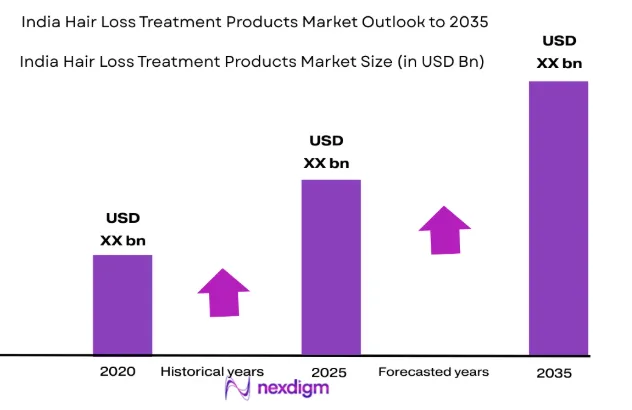
The India Hair Loss Treatment Products Market is valued at approximately USD ~ billion, driven by factors such as rising awareness about hair loss and growing concerns over appearance, particularly among the urban population. With increasing disposable income and advancements in hair loss treatments, consumers are opting for both over-the-counter and clinical treatments. The market’s growth is further supported by expanding retail channels, e-commerce platforms, and advancements in product formulations, which offer enhanced efficacy in treating hair loss.
Cities like Mumbai, Delhi, and Bangalore dominate the market, driven by the urban population’s high disposable income and a growing awareness of cosmetic treatments. These cities feature a higher concentration of clinics, salons, and retail outlets, facilitating accessibility to a wide range of hair loss treatment products. The rising demand is also supported by the increasing trend of online shopping, which allows consumers across different regions to access products more easily.
Market Segmentation
By Product Category Type
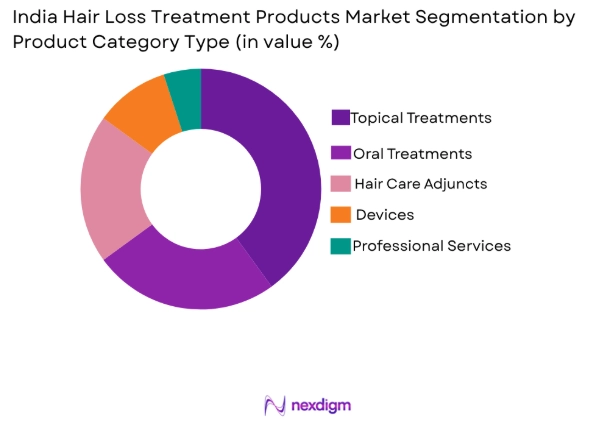
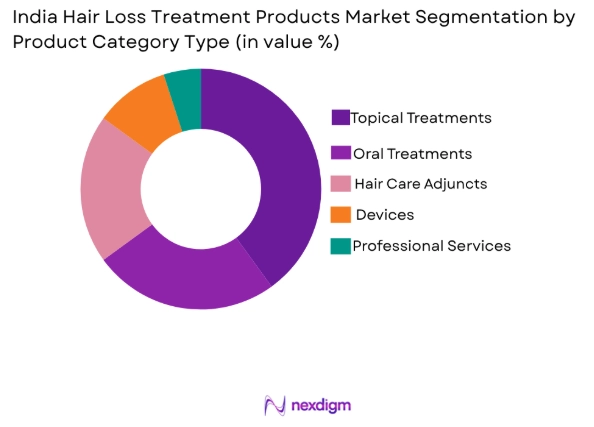
The India Hair Loss Treatment Products Market is segmented by product category into topical treatments, oral treatments, hair care adjuncts, devices, and professional services. hold a dominant market share due to their effectiveness and long-standing consumer trust. Minoxidil’s availability in various forms, including solutions and foam, has contributed to its sustained market dominance. The ease of application and clinical approval also boosts the trust factor among consumers.
By Customer Type
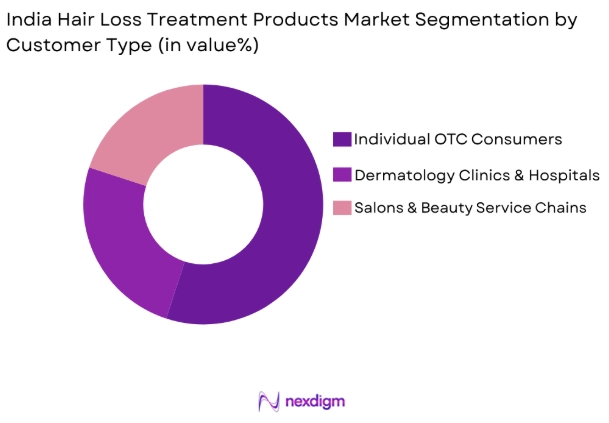
The market is further segmented by customer type into individual OTC consumers, dermatology clinics and hospitals, and salons & beauty service chains. Individual OTC consumers dominate this segment due to the widespread availability of over-the-counter treatments. Increased digital awareness and product marketing have contributed to this rise. Additionally, these consumers often prefer the convenience and affordability of OTC products for addressing hair loss concerns.
Competitive Landscape
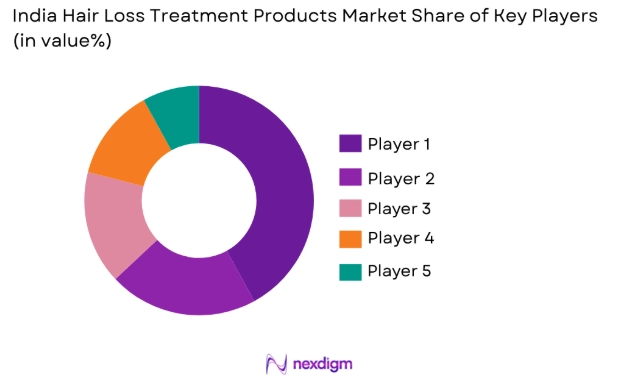
The India Hair Loss Treatment Products Market is competitive, with several local and international brands. Dominant players such as Himalaya Wellness, Dabur India, and Biotique are at the forefront, establishing strong brand loyalty. These companies dominate through their wide distribution networks, trust built through natural ingredients, and consistent product innovations. With increasing consumer awareness and demand, the competitive landscape continues to evolve, with brands focusing on enhancing their product offerings and improving consumer engagement.
| Company Name | Establishment Year | Headquarters | Product Portfolio | Distribution Channels | R&D Focus | Marketing & Branding Strategy | Regulatory Compliance |
| Himalaya Wellness | 1930 | Bangalore, India | ~ | ~ | ~ | ~ | ~ |
| Dabur India | 1884 | Ghaziabad, India | ~ | ~ | ~ | ~ | ~ |
| Biotique | 1992 | Chandigarh, India | ~ | ~ | ~ | ~ | ~ |
| P&G (Head & Shoulders) | 1837 | Cincinnati, US | ~ | ~ | ~ | ~ | ~ |
| Godrej Consumer Products | 1897 | Mumbai, India | ~ | ~ | ~ | ~ | ~ |
India Hair Loss Treatment Products Market Analysis
Growth Drivers
Rising Awareness About Hair Loss Solutions
India has seen a significant rise in awareness regarding hair loss solutions due to the increasing visibility of hair care advertisements and social media content related to beauty and health. A 2022 report from the Ministry of Health and Family Welfare highlighted that nearly 20% of the Indian population suffers from hair loss, which has driven demand for effective treatment options. Additionally, urban areas are seeing a greater shift towards aesthetic healthcare, with approximately 50% of India’s urban population actively seeking hair restoration treatments. This rising awareness is backed by the ongoing efforts from healthcare campaigns that aim to increase consumer education about available hair loss treatments. As per the World Health Organization’s report on Non-Communicable Diseases in India, awareness campaigns in urban regions have resulted in a growing inclination toward professional treatments, both over the counter and clinical.
Digital Influence
The rise of digital marketing and social media has drastically influenced the demand for hair loss treatments. According to the National Statistical Office, internet penetration in India is expected to reach 65% by 2025, contributing to an exponential increase in online consultations and product searches related to hair loss treatments. Additionally, platforms like Instagram and YouTube have seen a surge in influencers discussing personal experiences with hair loss and treatment options, making digital channels a key driver. Data from the Telecom Regulatory Authority of India (TRAI) shows that over 500 million people in India were internet users in 2022, with a significant percentage actively engaging in health-related content, leading to higher product visibility and increased consumer interest in hair care solutions.
Market Challenges
Side Effects of Treatments
One of the significant challenges for the hair loss treatment market is the occurrence of side effects associated with certain treatments. For instance, the use of Minoxidil, a commonly used topical treatment, can cause scalp irritation, itching, or unwanted hair growth in other areas. Data from the Central Drugs Standard Control Organization (CDSCO) shows that around 8-10% of patients report experiencing mild to moderate side effects when using certain over-the-counter hair loss solutions. Moreover, oral treatments like Finasteride have been reported to cause sexual dysfunction and other side effects, deterring potential consumers. A report from the Drug Control Department of India underlined that adverse reactions from these treatments are one of the major concerns for both consumers and medical practitioners.
Regulatory Hurdles in Product Approvals
Regulatory challenges remain a significant roadblock in the hair loss treatment market. The approval process for new hair loss treatment products in India is governed by the Drug Controller General of India (DCGI), which enforces strict guidelines for drug safety and efficacy. As per the DCGI’s 2023 report, approximately 15% of hair loss treatment products face delays in approvals due to stringent testing requirements. Furthermore, the regulatory process for importing active ingredients like Minoxidil and Finasteride can lead to extended waiting periods. This regulatory complexity often limits the market entry of new products, restricting consumer access to innovative solutions. As reported by the Ministry of Chemicals and Fertilizers, a considerable backlog of product approvals in the pharmaceutical sector has affected the hair loss treatment industry as well.
Market Opportunities
Surge in Demand for Natural and Organic Products
The demand for natural and organic hair loss treatments has seen a sharp rise in India, especially as consumers become more health-conscious and cautious about chemical-based products. As per the National Institute of Nutrition, the Indian consumer market is increasingly inclined towards products with herbal and organic ingredients. A report from the Ministry of AYUSH in 2023 found that the Indian herbal market is growing at a rapid pace, with organic products constituting around 35% of the total hair care product sales in India. Ayurvedic and plant-based ingredients such as hibiscus, neem, and bhringraj are increasingly being incorporated into hair loss solutions, supported by consumer preference for natural alternatives. This trend is expected to continue as consumers demand safer, chemical-free options for personal care and wellness.
Expanding Market for Gender-Specific Products
The market for gender-specific hair loss products is expanding, with significant demand emerging for both male and female-oriented treatments. A study by the National Institute of Health and Family Welfare in 2022 found that men represent the majority of consumers for hair loss treatments, but an increasing number of women are seeking products formulated specifically for their needs. Female-pattern baldness, which affects around 40% of women by the age of 50, is driving this shift. In response to growing demand, manufacturers are developing products with ingredients tailored for women’s specific hormonal needs. Moreover, government-backed health initiatives have focused on addressing gender-specific health concerns, making it an opportune time for businesses to innovate in this space.
Future Outlook
Over the next five years, the India Hair Loss Treatment Products Market is poised for significant growth, driven by continuous advancements in treatment technologies, an increase in the number of consumers seeking solutions for hair loss, and growing acceptance of non-surgical treatments. With increasing disposable income and evolving beauty standards, the demand for both over-the-counter and professional hair loss treatments is expected to grow exponentially. Additionally, the rise of digital platforms for marketing and retail is expected to fuel this growth, allowing for wider product reach and consumer engagement.
Major Players
- Himalaya Wellness
- Dabur India
- Biotique
- P&G
- Godrej Consumer Products
- Dr. Reddy’s Laboratories
- Sun Pharma
- Torrent Pharmaceuticals
- Revivogen
- Schwarzkopf
- L’Oréal India
- Johnson & Johnson
- Mankind Pharma
- Zed Black / Pure Chemistry Brands
- Local Indian MSME Specialty Brands
Key Target Audience
- Investment and Venture Capitalist Firms
- Government and Regulatory Bodies
- Dermatology Clinics
- Hospitals and Health Institutions
- Pharmacies and Retail Chemists
- E-commerce Platforms
- Hair Care Product Manufacturers
- Beauty and Wellness Service Providers
Research Methodology
Step 1: Identification of Key Variables
In this phase, key market variables like product categories, customer types, distribution channels, and regional preferences are identified. Thorough desk research is performed, combining secondary data from credible industry sources and proprietary databases to construct a comprehensive ecosystem map.
Step 2: Market Analysis and Construction
Historical data is gathered, focusing on market trends, growth drivers, and competitive strategies. This phase involves analyzing the market penetration of different hair loss treatment products and evaluating the supply chain and distribution channels.
Step 3: Hypothesis Validation and Expert Consultation
Market hypotheses are validated through consultations with industry experts, including dermatologists, clinicians, and marketers in the hair loss treatment sector. Insights gathered from expert consultations help refine the market assumptions and ensure data accuracy.
Step 4: Research Synthesis and Final Output
The final stage involves synthesizing the data from multiple sources, including direct engagement with market players, to validate findings. Detailed consumer preference analysis and competitor strategies are considered to generate comprehensive market forecasts.

- Executive Summary
- Research Methodology (Market Definitions and Assumptions, Industry Taxonomy, Data Sources, Market Sizing & Forecasting Approach, Qualitative Interview Framework, Limitations and Data Validation, Currency and Pricing Assumptions)

- Market Definition and Scope
- Market Genesis and Evolution
- Clinical and Consumer Demand Drivers
- Supply Chain and Distribution Flow
- Regulatory Environment
- Pricing Landscape
- Product Classification Logic

- Growth Drivers
Rising Awareness About Hair Loss Solutions
Digital Influence - Market Challenges
Side Effects of Treatments
Regulatory Hurdles in Product Approvals - Opportunities
Surge in Demand for Natural and Organic Products
Expanding Market for Gender-Specific Products - Trends
Integration of Advanced Technologies
Preference for Clinically Tested - Government Regulation
FDI and Import Tariffs
Quality Standards for OTC Hair Treatment Products - SWOT Analysis
- Porter’s Five Forces Analysis
- Competition Ecosystem

- By Revenue, 2020-2025
- By Volume, 2020-2025
- By Average Treatment Price, 2020-2025

- By Product Category (in Value %)
Topical Treatments
Oral Treatments
Hair Care Adjuncts
Devices
Professional Services - By Customer Type (in Value %)
Individual OTC Consumers
Dermatology Clinics and Hospitals
Salons and Beauty Service Chains - By Distribution Channel (in Value %)
Pharmacy & Retail Chemists
E‑commerce Platforms
Modern Trade
Professional Channels - By Price Tier (in Value %)
Economy / Mass Market
Mid‑Tier
Premium / Clinical Grade - By Geography (in Value %)
North India
South India
East India
West India
Central India

- Market Share by Revenue / Volume (By Segment)
- Competitive Benchmarking
- Cross Comparison Parameters (Company Overview, Product Portfolio Breadth, Pricing Positioning Strategy, Consumer Reach, Retailer / Clinic Channel Penetration, R&D Intensity, Marketing & Brand Recall Metrics, Distribution Network Scale, Backward Integration / Supply Security)
- SWOT Analysis of Leading Players
- Product Pricing Matrix by SKU and Channel
- Brand Positioning and Consumer Perception Mapping
- Detailed Company Profiles
Himalaya Wellness
Dabur India
Biotique
P&G
Godrej Consumer Products
Dr. Reddy’s Laboratories
Sun Pharma
Torrent Pharmaceuticals
Revivogen / Advanced Trichology Brands
Schwarzkopf / Henkel
L’Oréal India
Johnson & Johnson
Mankind Pharma
Zed Black / Pure Chemistry Brands
Local Indian MSME Specialty Brands

- Consumer Usage Patterns
- Clinical Channel Utilization
- Retail vs Online Purchase Trends
- Price Sensitivity and Spend Elasticity
- Unmet Needs and Pain Points
- Dermatologist / Professional Preference Patterns

By Revenue, 2026-2035
By Volume, 2026-2035
By Average Treatment Price, 2026-2035


 Request a Sample
 Ask for Customization
 Get a Quote
 Enquire Now