

 Download PDF
Market Overview
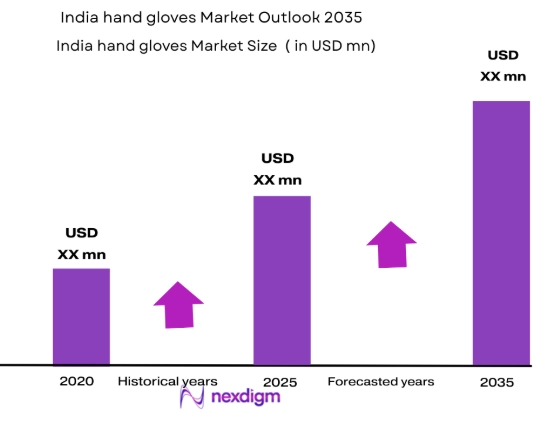
The India hand gloves market is valued at USD ~ million, based on Nexdigm’s hand protection equipment market outlook. The market is driven by rising demand from healthcare, pharma, food processing, chemicals, manufacturing, and construction. India also has 1,69,615 sub-centres, 31,882 PHCs, 6,359 CHCs, 1,340 SDHs, 714 district hospitals, and 362 medical colleges, creating recurring demand for examination, surgical, and protective gloves.
North India dominates the India medical gloves market due to dense hospital infrastructure, high procurement by public and private healthcare networks, and concentration of distributors serving Delhi-NCR, Uttar Pradesh, Punjab, Haryana, and Rajasthan. Industrial demand is also concentrated in Tamil Nadu, Gujarat, Maharashtra, Karnataka, and Uttar Pradesh, which rank among India’s top manufacturing states by factories, output, employment, or GVA, supporting durable and industrial glove usage.
Market Segmentation
By Product Type
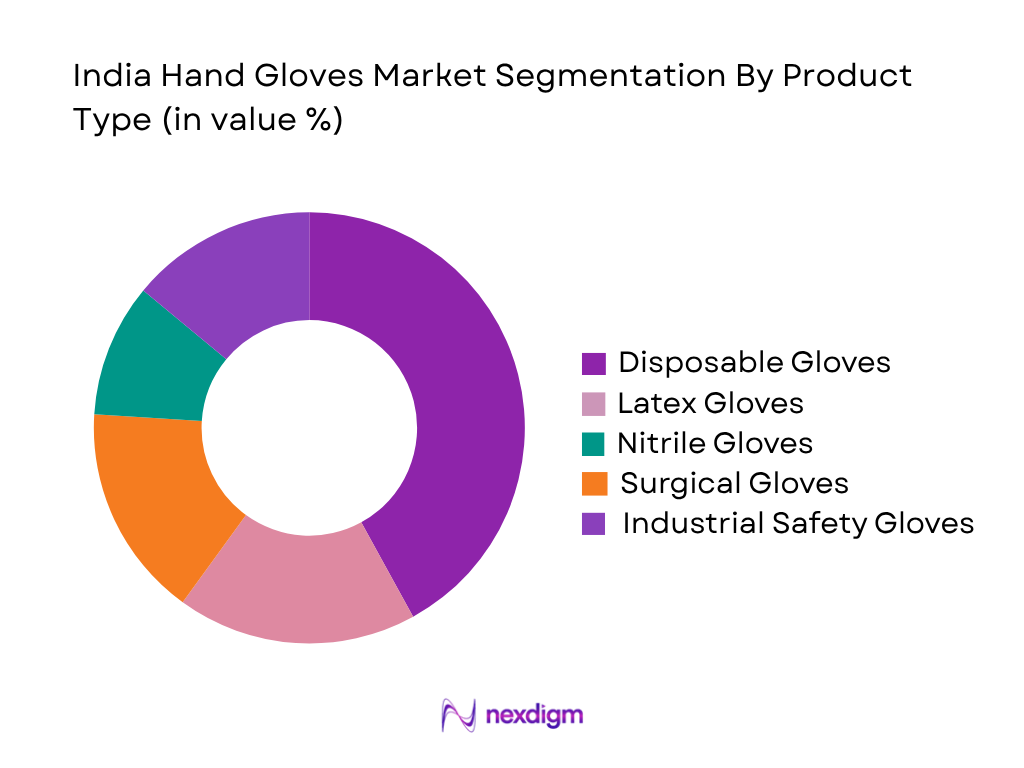
India hand gloves market is segmented by product type into durable gloves and disposable gloves. Durable gloves have a dominant market share in India under the product type segmentation, due to their wide use across construction, chemicals, manufacturing, automotive, oil & gas, metalworking, logistics, and food processing. Industrial buyers prefer reusable gloves because they reduce replacement frequency, support compliance with workplace safety practices, and are suited for cut resistance, chemical protection, heat resistance, grip, and abrasion control. Disposable gloves remain highly important in hospitals, diagnostic centres, laboratories, cleanrooms, and food handling, but durable gloves lead the broader hand protection category because India’s manufacturing base is large and continuously expanding. Grand View Research also identifies durable gloves as the largest and fastest-growing product segment in India’s hand protection equipment market.
By End User Type
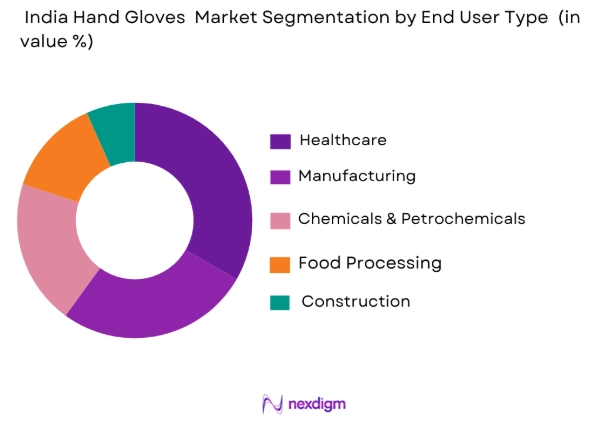
India hand gloves market is segmented by end user into healthcare, manufacturing, chemicals & petrochemicals, food processing, construction, pharmaceuticals, and others. Healthcare has a dominant market share under the end-user segmentation because gloves are essential consumables in hospitals, clinics, diagnostic laboratories, surgical centres, and ambulatory care settings. The scale of India’s public health system, including thousands of PHCs, CHCs, district hospitals, and medical colleges, creates recurring procurement needs for examination and surgical gloves. Healthcare demand is supported by infection-control protocols, higher patient footfall, rising diagnostic testing, and expansion of private hospitals. Industrial users are also significant, especially in manufacturing and chemicals, but healthcare leads due to repeat consumption and mandatory hygiene standards.
Competitive Landscape
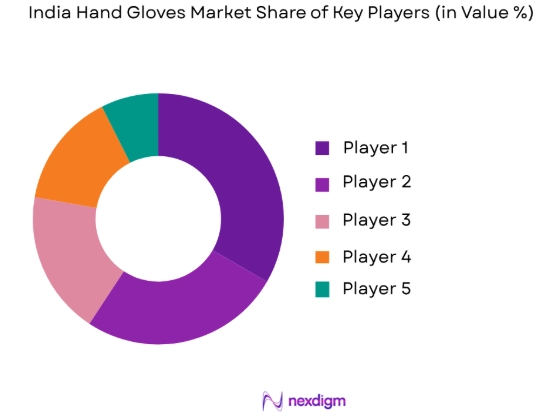
The India hand gloves market is moderately fragmented, with competition between domestic PPE manufacturers, medical glove suppliers, import-led distributors, and global brands. International players such as Ansell, Top Glove, Hartalega, Kossan, and Supermax influence premium nitrile and medical glove supply, while Indian companies such as Mallcom, Kanam Latex, RFB Latex, Sara Healthcare, and Primus Gloves compete through local manufacturing, institutional supply, industrial PPE portfolios, and export networks.
| Company | Establishment Year | Headquarters | Product Focus | India Presence | Distribution Strength | Key End Users | Manufacturing / Sourcing Model | Competitive Position |
| Mallcom India Ltd | 1983 | Kolkata, India | Industrial safety gloves, PPE | ~ | ~ | ~ | ~ | ~ |
| Kanam Latex Industries Pvt Ltd | 1986 | Kerala, India | Latex surgical and examination gloves | ~ | ~ | ~ | ~ | ~ |
| RFB Latex Ltd | 1989 | Kerala, India | Surgical and examination gloves | ~ | ~ | ~ | ~ | ~ |
| Ansell Ltd | 1893 | Richmond, Australia | Industrial and medical gloves | ~ | ~ | ~ | ~ | ~ |
| Top Glove Corporation | 1991 | Shah Alam, Malaysia | Disposable latex and nitrile gloves | ~ | ~ | ~ | ~ | ~ |
India hand gloves Market Analysis
Growth Drivers
Rising Healthcare Infrastructure and Hospitalization Rates
India hand gloves demand is supported by a large healthcare delivery base requiring recurring use of examination, surgical, and infection-control gloves. India has 1,69,615 Sub-Centres, 31,882 Primary Health Centres, 6,359 Community Health Centres, 1,340 Sub-Divisional/District Hospitals, 714 District Hospitals, and 362 Medical Colleges serving rural and urban areas. AB-PMJAY also authorized 6.11 crore hospital admissions, with 1.7 crore admissions authorized during Jan–Dec 2023 alone. India’s GDP expanded 8.2 in FY2023-24, while IMF projected India’s growth at 6.5 for 2025, supporting healthcare consumption capacity. Sources:
Expansion of Food Processing, Pharma, and Manufacturing Industries
India hand gloves demand is also driven by food processing, chemicals, pharmaceuticals, and registered manufacturing units where gloves are used for hygiene, chemical handling, worker protection, and contamination control. MoSPI’s ASI 2022-23 reported industrial output growth of more than 21 over the previous year, with food products, chemicals, basic metals, petroleum products, and motor vehicles contributing about 58 of factory-sector output. India’s food processing GVA reached ₹2.24 lakh crore in 2023-24, while processed food exports accounted for 20.4 of agricultural exports in 2024-25.
Market Challenges
Volatility in Raw Material Availability
India hand gloves manufacturers depend heavily on latex and synthetic rubber inputs, creating exposure to supply volatility. Rubber Board data shows India’s natural rubber production was 8,57,000 tonnes in 2023-24, while domestic consumption reached 14,16,000 tonnes, creating a large demand-supply gap. Production stood at 8,39,000 tonnes in 2022-23, while consumption was 13,50,000 tonnes. For glove makers using latex, nitrile, and blended rubber inputs, this gap affects procurement certainty and working-capital planning, especially when healthcare and industrial users require uninterrupted glove availability
Dependence on Imports for Critical Glove and Nitrile Inputs
India’s hand gloves market faces import dependency in both finished gloves and nitrile-linked raw materials. World Bank WITS data shows India imported 6,651,480 kg of surgical gloves in 2024, including 3,195,170 kg from Malaysia, 1,916,230 kg from Sri Lanka, and 756,637 kg from Thailand. India also imported 43,379,700 kg of acrylonitrile-butadiene rubber excluding latex in 2024, including 20,719,900 kg from Korea, 5,263,680 kg from Japan, and 6,606,010 kg from Russia. This dependency makes local supply chains vulnerable to shipping, currency, and supplier-side disruptions.
Opportunities
Growth in Exports of Indian Gloves
India has a clear export opportunity in medical and protective gloves due to its existing shipment base across Europe, the Middle East, North America, Africa, and neighbouring Asian markets. World Bank WITS data shows India exported 10,939,100 kg of surgical gloves in 2024, led by shipments to Spain, UAE, Poland, the United States, and Belgium. India also exported 1,232,700 kg of vulcanized rubber gloves excluding surgical gloves in 2024, with shipments to the United States, UAE, Nepal, Malaysia, Mozambique, Brazil, and Tanzania. Sources:
Increasing Demand for Nitrile and Non-Latex Gloves
Nitrile and non-latex glove demand is supported by healthcare, laboratories, food handling, pharma, and chemical-use cases where allergy reduction and chemical resistance are important. India’s 2024 imports of acrylonitrile-butadiene rubber excluding latex reached 43,379,700 kg, showing active industrial use of nitrile-linked material inputs. Surgical glove imports also reached 6,651,480 kg in 2024, while India exported 10,939,100 kg of surgical gloves in the same year. This two-way trade indicates scope for domestic manufacturers to strengthen non-latex glove production and reduce reliance on imported finished products.
Future Outlook
Over the next five years, the India hand gloves market is expected to grow steadily due to higher healthcare utilization, infection-control norms, workplace safety awareness, expansion of manufacturing, and demand from pharma, diagnostics, food processing, and chemicals. Growth will be supported by nitrile adoption, domestic PPE manufacturing, institutional procurement, e-commerce distribution, and improved compliance across organized industrial sectors.
The market is also expected to benefit from India’s position as a fast-growing Asia Pacific hand protection equipment market. Grand View Research expects India to reach USD 1,466.0 million by 2030, supported by strong growth in durable gloves and rising safety adoption across industrial applications.
Major Players
- Top Glove Corporation
- Hartalega Holdings Berhad
- Kossan Rubber Industries
- Ansell Limited
- Supermax Corporation
- Riverstone Holdings
- Mallcom India Limited
- TTK Healthcare Limited
- Sara Healthcare Pvt Ltd
- Kanam Latex Industries Pvt Ltd
- Primus Gloves Pvt Ltd
- RFB Latex Limited
- Kimberly-Clark Corporation
- Sempermed
- AMMEX Corporation
- New Life
- MRK Healthcare
- Phoenix
Key Target Audience
- Healthcare procurement departments
- Industrial safety equipment buyers
- Hospitals and diagnostic chains
- Pharmaceutical manufacturers
- Food processing companies
- Manufacturing and construction companies
- Investments and venture capitalist firms
- Government and regulatory bodies
Research Methodology
Step 1: Identification of Key Variables
The initial phase involves constructing an ecosystem map for the India hand gloves market. This includes manufacturers, importers, distributors, hospitals, industrial buyers, pharma companies, food processors, and regulatory bodies. The objective is to identify key variables such as product type, material, end user, region, pricing, imports, procurement channels, and compliance requirements.
Step 2: Market Analysis and Construction
In this phase, historical market data is compiled from credible secondary sources, company publications, government databases, trade data, and industry reports. The analysis evaluates value demand, volume movement, pricing trends, durable versus disposable consumption, and demand patterns across healthcare and industrial end users.
Step 3: Hypothesis Validation and Expert Consultation
Market hypotheses are validated through interviews with manufacturers, distributors, procurement managers, safety officers, hospital purchase teams, and regulatory experts. These consultations help verify demand trends, product preferences, pricing sensitivity, distribution margins, import dependency, and regional procurement patterns.
Step 4: Research Synthesis and Final Output
The final phase integrates secondary research, primary insights, market triangulation, and bottom-up estimation. Segment-level assumptions are cross-checked against company revenues, product portfolios, import trends, institutional procurement, and end-user demand to produce a validated market view for the India hand gloves market.

- Executive Summary
- Research Methodology (Market Definitions and Assumptions, Abbreviations, Market Sizing Approach, Consolidated Research Approach, Understanding Market Potential Through In-Depth Industry Interviews, Primary Research Approach, Limitations and Future Conclusions)

- Definition and Scope
- Market Dynamics Overview
- Market Genesis (Evolution of PPE & Gloves Industry in India)
- Major Players and Market Timeline
- Business Cycle and Trends
- Supply Chain and Value Chain Analysis

- Growth Drivers
Rising Healthcare Infrastructure and Hospitalization Rates
Increasing Awareness of Hygiene and Infection Control
Growth in Industrial Safety Regulations
Expansion of Food Processing and Pharma Industries - Market Challenges
Price Sensitivity and Intense Competition
Volatility in Raw Material Prices (Latex, Nitrile)
Dependence on Imports for Certain Raw Materials - Opportunities
Growth in Exports of Indian Gloves
Increasing Demand for Nitrile and Non-Latex Gloves
Expansion of E-commerce and B2B Platforms
Adoption of Sustainable / Biodegradable Gloves - Key Trends
Shift Toward Nitrile and Synthetic Gloves Over Latex
Rising Demand for Disposable and Single-Use Gloves
Increasing Focus on Eco-Friendly and Biodegradable Gloves
Product Innovation Including Antimicrobial and High-Durability Gloves - HORECA & Food Service Segment Analysis
Food Preparation Gloves
Food Handling & Serving Gloves
Cleaning & Sanitation Gloves
Disposable Examination Gloves
Reusable Protective Gloves - Government Regulations
BIS Standards and Certifications
Medical Device Regulations (CDSCO)
Occupational Safety Guidelines - SWOT Analysis
- Porter’s Five Forces

- By Value, 2020–2025
- By Volume, 2020–2025
- By Average Price, 2020–2025

- By Product Type (In Value %)
Disposable Gloves
Powdered Disposable Gloves
Powder-Free Disposable Gloves
Examination Gloves
Medical Disposable Gloves
Food Handling Gloves
Cleanroom & Laboratory Disposable Gloves
Latex Gloves
Blue/Colored Latex Gloves
Natural Latex Surgical Gloves
Powdered Latex Gloves
Powder-Free Latex Glove
Industrial Latex Gloves
Household Latex Gloves
Nitrile Gloves
Nitrile Examination Gloves
Nitrile Surgical Gloves
Medical-Grade Nitrile Gloves
Industrial-Grade Nitrile Gloves
Chemical-Resistant Nitrile Gloves
Disposable Nitrile Gloves
Vinyl Gloves
Powdered Vinyl Gloves
Powder-Free Vinyl Gloves
Medical Examination Vinyl Gloves
Food-Grade Vinyl Gloves
Industrial Vinyl Gloves
General-Purpose Vinyl Gloves
Surgical Gloves
Latex Surgical Gloves
Nitrile Surgical Gloves
Neoprene Surgical Gloves
Powder-Free Surgical Gloves
Orthopedic Surgical Gloves
Microsurgery Gloves
Industrial Safety Gloves
Cut-Resistant Gloves
Chemical Protection Glove
Heat & Flame Resistant Glove
Impact Protection Glove
Anti-Vibration Glove
Electrical Safety Gloves - By End User (In Value %)
Healthcare
Manufacturing
Chemicals & Petrochemicals
Food Processing
Construction - By Material (In Value %)
Natural Rubber (Latex)
Nitrile
Vinyl
Neoprene
Polyethylene - By Application / End Use (In Value %)
Healthcare (Hospitals, Clinics, Diagnostics)
Industrial (Manufacturing, Chemical, Construction)
Food Processing & Hospitality
Household & Retail
Others - By Form (In Value %)
Powdered Gloves
Powder-Free Gloves - By Distribution Channel (In Value %)
Online
Offline
Direct Sales
Distributors / Wholesalers
Retail Pharmacies & Stores - By Region (In Value %)
North India
South India
East India
West India

Delhi
- Growth Driver
High concentration of hospitals, diagnostic centers, and healthcare institutions
Strong demand from government and private healthcare facilitie
Growth of food delivery, restaurants, and hospitality sectors
Industrial and construction activities in NCR region - Market Challenges
Heavy dependence on imported raw materials and finished gloves
High price competition among suppliers
Limited local manufacturing base compared with other states - Opportunities
Rising adoption of premium nitrile gloves in healthcare
Expansion of specialty hospitals and medical tourism
Increasing demand from laboratories, dental clinics, and pharma companies - Key Trends
Expansion of specialty hospitals and medical tourism
Increasing demand from laboratories, dental clinics, and pharma companies
Shift from latex to nitrile gloves
Preference for powder-free medical gloves
Growth of organized procurement through hospital chains
Maharashtra
- Growth Driver
Largest industrial and commercial markets including Mumbai and Pune
Strong healthcare infrastructure with hospitals, pharma companies, and laboratories
Major automotive, chemical, food processing, and manufacturing industries
High consumption of medical and industrial gloves
- Market Challenges
Intense competition among domestic and international brands
Raw material price fluctuations
Regulatory pressure on medical consumable pricing and procurement transparency - Opportunities
Expansion of healthcare facilities and specialty hospitals
Increasing industrial safety compliance
Growth opportunities in pharma, chemical, and food processing sectors
- Key Trends
Rising preference for nitrile and chemical-resistant gloves
Increased bulk procurement by hospitals and industries
Growth of private-label glove brands
Karnataka
- Growth Driver
Bengaluru as a major healthcare, biotechnology, IT, and pharmaceutical hub
Presence of hospitals, research institutes, and diagnostic laboratories
Growing industrial safety demand from manufacturing sectors
Expansion of food service and hospitality industry - Market Challenges
Competition from low-cost glove suppliers
Limited domestic production compared with demand
Compliance requirements for medical-grade products - Opportunities
Growth in medical device manufacturing ecosystem
Increasing demand from biotech, pharma, and research labs
Opportunities in reusable industrial safety gloves - Key Trends
Increased use of high-performance nitrile gloves
Adoption of international quality certifications
Growth of sustainable and reusable protective gloves
Gujrat
- Growth Driver
Strong pharmaceutical, chemical, petrochemical, and manufacturing base
Large industrial workforce requiring protective gloves
Presence of pharma hubs such as Ahmedabad and Vadodara
Export-oriented industrial ecosystem - Market Challenges
Price sensitivity in industrial glove segment
Competition from imported low-cost products
Need for advanced manufacturing capabilities for premium gloves - Opportunities
Expansion of medical glove manufacturing
Rising demand from chemical, pharma, and food industries
Export opportunities due to strong logistics and port infrastructure - Key Trends
Growing adoption of chemical-resistant nitrile gloves
Increased workplace safety awareness
Demand for certified industrial protection gloves

- Market Share of Major Players by Value/Volume
- Market Share by Product Type
- Cross Comparison Parameters (Company Overview, Business Strategies, Recent Developments, Strengths, Weaknesses, Organizational Structure, Revenues, Product Mix, Distribution Channels, Dealer Network, Margins, Production Capacity, Unique Value Proposition and Others)
- SWOT Analysis of Major Players
- Pricing Analysis Based on Product Categories for Major Players
- Detailed Profiles of Major Companies
Top Glove Corporation
Hartalega Holdings Berhad
Kossan Rubber Industries
Ansell Limited
Supermax Corporation
Riverstone Holdings
Mallcom India Limited
TTK Healthcare Limited
Sara Healthcare Pvt Ltd
Kanam Latex Industries Pvt Ltd
Primus Gloves Pvt Ltd
RFB Latex Limited
New Life
MRK Healthcare
Phoenix

- Market Demand and Utilization Patterns
- Purchasing Power and Budget Allocations
- Regulatory and Compliance Requirements
- Needs, Desires, and Pain Point Analysis
- Decision-Making Process

- By Value, 2026–2035
- By Volume, 2026–2035
- By Average Price, 2026–2035

- Key Applications
Healthcare & Medical Applications
Hospitals & clinics
Government healthcare facilities
Private hospital chains
Diagnostic laboratories
Dental clinics
Surgical centers
Nursing homes
Home healthcare services
Pharmaceutical & Biotechnology Applications
Pharmaceutical manufacturing units
API manufacturingVaccine production
Biotechnology laboratories
Cleanroom applications
Research & development laboratories
Industrial Applications
Automotive manufacturing
Engineering & machinery
Chemical & petrochemical industries
Metal processing
Oil & gas
Construction
Electronics manufacturing - Competitive Landscape Analysis
Market Structure
Domestic manufacturers
International glove manufacturers
Importers and distributors
Private-label brands
Institutional suppliers
Medical Gloves
Nitrile examination gloves
Latex examination gloves
Surgical gloves
Industrial Gloves
Chemical protection gloves
Mechanical protection gloves
Heat-resistant gloves
Competitive Parameters
Product portfolio
Pricing strategy
Distribution network
Certifications & quality standards
Supply chain capability
Customer base
Import dependency - Key Players
Domestic Manufacturers
Medical glove manufacturers
Industrial glove manufacturers
PPE manufacturers
International Brands Operating in Maharashtra
Global medical glove companies
Industrial safety glove brands
Healthcare consumable suppliers
Distribution & Supply Chain Players
Medical distributors
Hospital procurement suppliers
Industrial safety equipment distributors
Online B2B platforms
Key Player Assessment
Company overview
Product portfolio
Manufacturing/distribution presence
Target industries
Market positioning - Maharashtra Market Outlook & Opportunities
Future Growth Opportunities
Expansion of private healthcare infrastructure
Increasing demand for premium nitrile gloves
Growth of pharmaceutical manufacturing
Medical device ecosystem expansion
Rising industrial safety adoption
Investment Opportunities
Local glove manufacturing plants
Disribution hubs
Healthcare supply chains
Industrial PPE solutions
Export-oriented production
Future Market Trends
Shift from latex to nitrile gloves
Increasing preference for certified medical gloves
Greater focus on traceability and quality compliance
Growth of application-specific gloves
Increasing adoption of sustainable glove solutions


 Request a Sample
 Ask for Customization
 Get a Quote
 Enquire Now