

 Download PDF
Market Overview
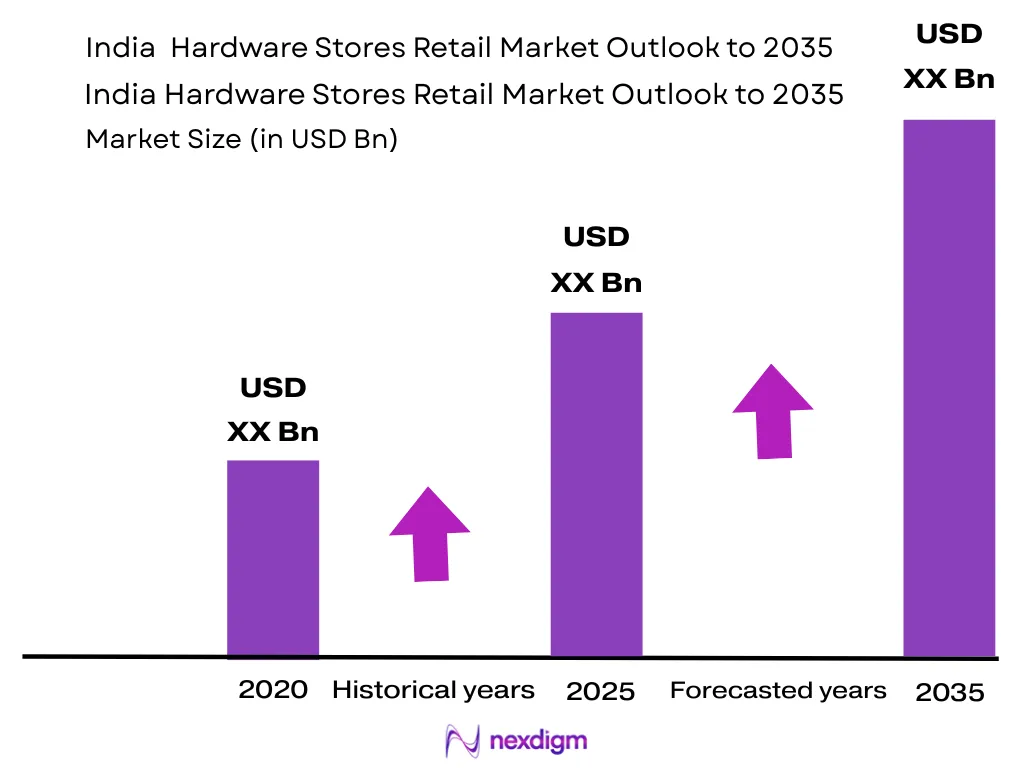
The India Hardware Stores Retail Market is valued at USD ~ billion, based on the broader home-improvement and hardware retail scope covering building materials, tools, hardware, paints, sanitaryware, electrical goods and renovation inputs. The market is driven by residential construction, repair-led purchases, contractor procurement and digital retail adoption. India’s GDP stood at USD ~ trillion, GDP per capita at USD 2,694.7, and GDP growth at 6.5, while nominal GVA rose from ~ lakh crore to ~ lakh crore across the latest two fiscal periods. Delhi NCR, Mumbai, Bengaluru, Hyderabad, Chennai, Pune, Ahmedabad, Surat, Jaipur, Lucknow and Kolkata dominate the India Hardware Stores Retail Market because these cities combine housing construction, apartment renovation, contractor density, dealer clusters, paint/sanitaryware showrooms and B2B procurement platforms. Demand is also concentrated in Maharashtra, Gujarat, Karnataka, Tamil Nadu, Telangana, Uttar Pradesh and Delhi NCR due to real estate activity, infrastructure corridors, industrial construction and urban repair demand. India’s urbanisation base is supported by World Bank data, while PMAY-U 2.0 has approved over 3.5 lakh new homes.
Market Segmentation
By Product Category
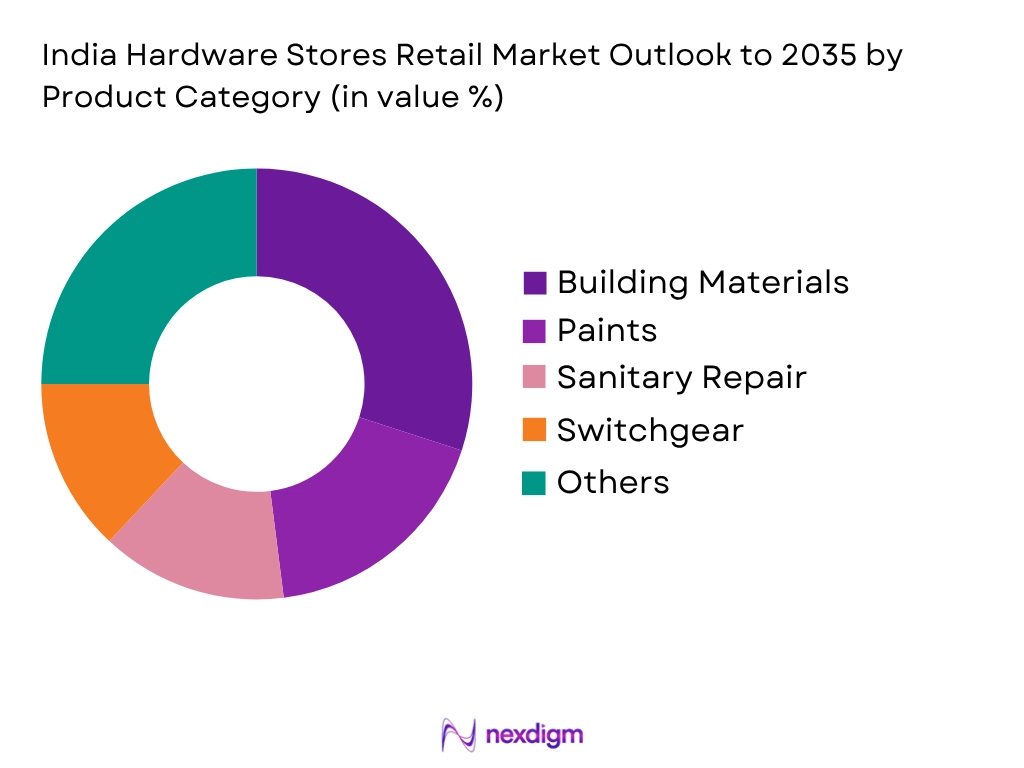
India Hardware Stores Retail Market is segmented by product category into building materials and masonry adjacency, paints and waterproofing, plumbing and sanitary repair, electrical and switchgear, tools, fasteners and ironmongery, and finishing hardware. Recently, building materials and masonry adjacency have held the dominant market share in India under product category, due to their role as the anchor basket for construction, repair, renovation and contractor-led procurement. Cement, steel, TMT bars, bricks, blocks, aggregates, adhesives, putty and construction chemicals generate higher-ticket purchase occasions and pull attached categories such as pipes, wires, waterproofing, tools, PPE, fasteners and paint accessories. The segment is also supported by affordable housing, urban apartment refurbishment and small-builder demand. India’s building-material market is valued at USD 44.4 billion in the latest published reference, indicating strong adjacency between hardware retail and construction-material channels.
By Store Format
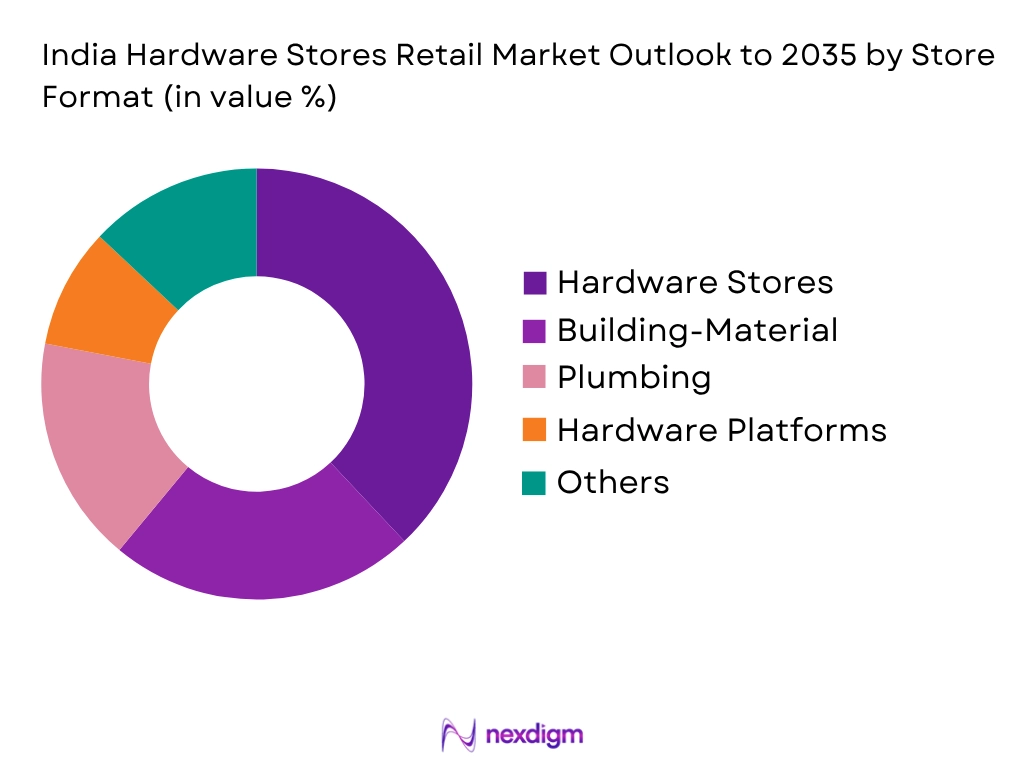
India Hardware Stores Retail Market is segmented by store format into traditional independent hardware stores, building-material dealers, specialist sanitary/electrical/paint dealers, B2B procurement platforms, online marketplaces and organized large-format home improvement stores. Recently, traditional independent hardware stores have held the dominant market share in India under store format, due to their proximity, contractor relationships, credit-led purchases, emergency repair access and SKU familiarity. Hardware buying in India remains strongly influenced by plumbers, electricians, carpenters, masons and painters who rely on local dealers for urgent parts, replacement fittings, tools, wires, pipes, locks, fasteners and adhesives. However, B2B platforms are reshaping procurement for larger buyers. Infra.Market positions itself as a technology-enabled building-materials platform with pan-India manufacturing capability, while Moglix focuses on B2B procurement for MRO, safety, electrical, lighting and power tools.
Competitive Landscape
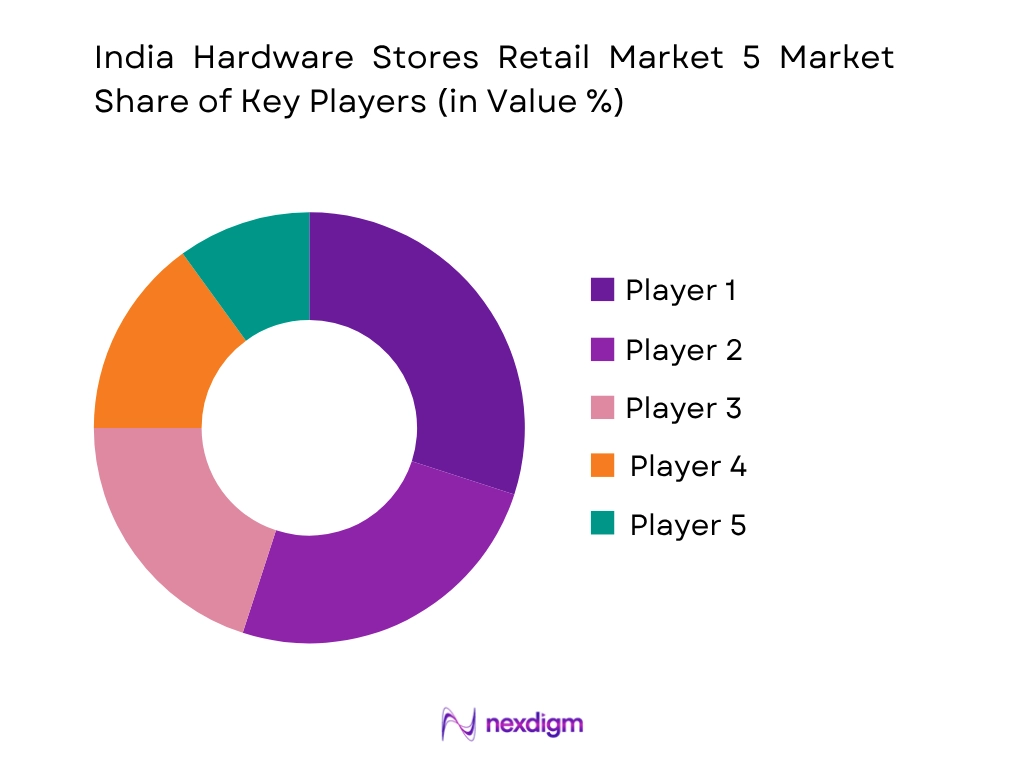
The India Hardware Stores Retail Market is highly fragmented, with traditional dealers and category-specific showrooms competing against B2B procurement platforms, brand-authorized stores and e-commerce marketplaces. Infra.Market, Moglix, OfBusiness, IndiaMART and Asian Paints Beautiful Homes represent the organized and digital end of the ecosystem. Their growth reflects a shift from purely relationship-led local retail toward platform-led procurement, GST-compliant billing, branded product discovery, digital catalogues and supply aggregation.
| Company | Establishment Year | Headquarters | Core Format | Core Categories | Customer Focus | Digital Capability | Market-Specific Strength | Competitive Position |
| Infra.Market | 2016 | Thane, India | ~ | ~ | ~ | ~ | ~ | ~ |
| Moglix | 2015 | Noida / Singapore-linked operations | ~ | ~ | ~ | ~ | ~ | ~ |
| OfBusiness | 2015 | Gurugram, India | ~ | ~ | ~ | ~ | ~ | ~ |
| IndiaMART | 1996 | Noida, India | B2B marketplace | ~ | ~ | ~ | ~ | ~ |
| Asian Paints Beautiful Homes | Asian Paints founded 1942 | Mumbai, India | Branded home-improvement and décor stores | ~ | ~ | ~ | ~ | ~ |
India Hardware Stores Retail Market Analysis
Growth Drivers
Housing and Construction Activity Supporting Hardware Store Demand
India Hardware Stores Retail Market is supported by residential construction, affordable housing and renovation-led procurement, which creates direct demand for cement-linked materials, fasteners, pipes, wires, switches, locks, tools, paints, waterproofing chemicals and sanitary fittings. PMAY-Urban official data reports 125.36 lakh houses sanctioned, 119.58 lakh houses grounded, 98.35 lakh houses completed, and ₹2.09 lakh crore central assistance committed, creating a broad construction-linked consumption base for local hardware dealers and building-material stores. MOSPI reported nominal GVA rising from ₹274.13 lakh crore in FY 2023-24 to ₹300.22 lakh crore in FY 2024-25, with construction sector growth estimated at 9.4 in FY 2024-25. World Bank reported India GDP at USD 3.91 trillion, GDP per capita at USD 2,694.7, and GDP growth at 6.5 in 2024, supporting household repair and contractor procurement capacity.
UPI and Digital Payments Supporting Store Formalisation and Omnichannel Ordering
India Hardware Stores Retail Market is increasingly supported by digital payments, WhatsApp ordering and GST-linked transaction formalisation, especially for local stores serving plumbers, electricians, masons, painters and small contractors. PIB reported that UPI annual transaction volume rose to over 24,162 crore transactions in FY 2025-26, while transaction value reached approximately ₹314 lakh crore. Another PIB release stated that digital payment transactions crossed 18,000 crore transactions in FY 2024-25. This matters for hardware retail because dealers can close transactions through QR payments, share invoices, record contractor dues, coordinate delivery and reduce cash-handling frictions for small-ticket SKUs such as screws, hinges, tapes, wires, fittings, adhesives and tool accessories. India’s macro base strengthens this shift: World Bank reported USD 3.91 trillion GDP, USD 2,694.7 GDP per capita and 6.5 GDP growth in 2024.
Market Challenges
Fragmented Contractor-Led Demand and Working-Capital Stress
India Hardware Stores Retail Market faces working-capital pressure because a large share of hardware purchases is contractor-led, credit-based and project-cycle dependent. Masons, plumbers, electricians, carpenters and painters frequently buy tools, pipes, wires, switches, fasteners, sealants, paints and fittings on relationship credit from neighbourhood stores. MOSPI’s 2026 release on unincorporated construction reported around 10.27 lakh operational units, with annual gross value of output of ₹16.25 lakh and GVA of ₹7.98 lakh per establishment. This fragmented construction base supports demand but also increases billing, collection and inventory risk for retailers. The pressure is relevant because local stores must finance stock and informal credit while serving small contractors with uncertain project payments. World Bank data shows India’s economy had USD 3.91 trillion GDP and USD 2,694.7 GDP per capita in 2024, but retail cash-flow discipline remains uneven at store level.
Import Dependence in Fasteners and Precision Hardware Components
India Hardware Stores Retail Market faces supply-chain exposure in fasteners, precision screws, tool parts and specialised hardware components. WITS/World Bank trade data shows India imported 94,545,900 kg of bolts or screws under HS 731815 in 2024, valued at USD 462,977.66 thousand. China supplied 43,117,300 kg, followed by Japan at 11,623,800 kg, Korea at 12,236,400 kg, Germany at 5,457,390 kg, and Thailand at 6,666,430 kg. This is market-specific because hardware stores need constant availability of screws, bolts, nuts, anchors, fittings and precision parts for urgent repairs and contractor jobs. Any import disruption, shipment delay or currency movement can affect SKU availability across distributors and local dealers. India’s macro base is large, with World Bank reporting USD 3.91 trillion GDP and 6.5 GDP growth in 2024, but small hardware retailers still remain vulnerable to imported long-tail SKU shortages.
Market Opportunities
Affordable Housing and Urban Repair Demand for Dealer-Led Expansion
India Hardware Stores Retail Market has a strong opportunity in affordable housing, urban repair and small-builder procurement because new and upgraded homes require continuous hardware consumption. PMAY-U official data reports 125.36 lakh houses sanctioned, 119.58 lakh houses grounded, and 98.35 lakh houses completed, while PMAY-U 2.0 is designed for implementation from 2024 to 2029. Current PMAY-U 2.0 updates also note additional approvals, including 1.47 lakh additional houses and total sanctioned houses reaching 8.56 lakh under the new phase. These figures support future demand for locks, hinges, pipes, wires, sanitary fittings, switches, waterproofing, paints, fasteners, tiles and basic tools through local dealers and building-material shops. MOSPI reported construction sector growth of 9.4 in FY 2024-25, and World Bank reported India GDP at USD 3.91 trillion in 2024.
B2B Procurement and GST-Compliant Digital Hardware Retail
India Hardware Stores Retail Market has a future growth opportunity in GST-compliant B2B procurement, digital catalogues, WhatsApp-assisted ordering, local delivery and platform-led aggregation for contractors and MSMEs. UPI scale provides transaction infrastructure: PIB reported over 24,162 crore UPI transactions and approximately ₹314 lakh crore in transaction value in FY 2025-26, while FY 2024-25 digital payment transactions crossed 18,000 crore. This enables hardware dealers to digitise quotations, accept QR payments, maintain customer purchase records and coordinate delivery for urgent SKUs such as PVC fittings, switches, fasteners, adhesives, locks and tools. The opportunity is reinforced by World Bank’s 2024 macro indicators: USD 3.91 trillion GDP, USD 2,694.7 GDP per capita and 6.5 GDP growth. B2B platforms and branded dealers can use this base to formalise procurement, reduce counterfeit risk and improve stock visibility.
Future Outlook
The India Hardware Stores Retail Market is expected to grow steadily over the forecast period, supported by residential construction, affordable housing, urban renovation, monsoon waterproofing, contractor replenishment, branded product adoption and B2B platform-led procurement. Traditional dealers will remain important because hardware demand is local, urgent and technically specific. Growth will be strongest in building materials, waterproofing, paints, plumbing, electrical products, sanitaryware, tools, fasteners, locks, modular kitchen hardware and furniture fittings. UPI and WhatsApp commerce will continue to formalize store-level workflows by enabling faster quotations, payment closure and order confirmation. NPCI data shows UPI processed 22,641.11 million transactions in March 2026, with transaction value of ₹29,52,542.05 crore, highlighting India’s digital retail payment infrastructure. B2B procurement platforms will expand in contractor, builder, MSME and developer segments by offering catalogue depth, GST invoices, working capital support, bulk sourcing and logistics coordination. Independent stores will defend share through proximity, product advice, small-ticket credit, local delivery and relationship-based repeat demand.
Major Players
- Infra.Market
- Moglix
- OfBusiness
- IndiaMART
- Amazon India
- Flipkart
- JioMart / Reliance Retail
- HomeTown
- IKEA India
- Asian Paints Beautiful Homes Stores
- Havells Galaxy Stores
- Jaquar World / Jaquar Dealers
- Kajaria Eternity / Kajaria Dealer Network
- Astral Pipes Dealer Network
- CERA Style Studios / CERA Dealers
Key Target Audience
- Traditional hardware store chains and independent hardware dealers
- Building-material dealers and construction-supply distributors
- Paint, plumbing, sanitaryware, electrical and tool manufacturers
- Contractors, builders and jobsite procurement operators
- B2B procurement platforms and e-commerce marketplaces
- Branded showroom and franchise retail operators
- Investments and venture capitalist firms
- Government and regulatory bodies
Research Methodology
Step 1: Identification of Key Variables
The initial phase involves constructing an ecosystem map encompassing all major stakeholders within the India Hardware Stores Retail Market. This includes independent hardware stores, building-material dealers, manufacturers, distributors, B2B platforms, contractors, plumbers, electricians, carpenters, homeowners and developers. The objective is to identify variables such as product category mix, credit cycle, GST billing, regional demand and fulfilment route.
Step 2: Market Analysis and Construction
In this phase, historical data is compiled and analyzed for the India Hardware Stores Retail Market. This includes home improvement market value, construction indicators, affordable housing activity, digital procurement penetration, dealer networks and category-level channel mapping. Market construction is validated through top-down sizing and bottom-up segmentation by store format, customer cohort and product category.
Step 3: Hypothesis Validation and Expert Consultation
Market hypotheses are developed and validated through computer-assisted telephone interviews with hardware dealers, building-material distributors, plumbers, electricians, masons, contractors, paint dealers, electrical dealers and B2B platform managers. These consultations provide insights into SKU movement, credit practices, contractor influence, brand preference, inventory gaps and WhatsApp-led ordering.
Step 4: Research Synthesis and Final Output
The final phase involves synthesizing secondary research, company mapping, product-basket benchmarking, trade interviews and regional demand analysis. Direct engagement with retailers and suppliers validates category segmentation, competitive positioning, growth drivers and operational challenges. The final output provides structured analysis on market size, segmentation, competition, outlook, target audiences and recommendations.

- Executive Summary
- Research Methodology (Market definitions and assumptions, abbreviations, hardware retail taxonomy, building-material retail inclusion, unorganized and organized retail scope, dealer-distributor mapping, market sizing approach, top-down and bottom-up triangulation, store audit methodology, contractor interview framework, homeowner repair survey approach, SKU basket benchmarking, distributor and wholesaler validation, limitations and future conclusions)

- Definition and Scope
- Overview Genesis
- Timeline of Major Players
- Business Cycle
- Supply Chain and Value Chain Analysis

- Growth Drivers (Affordable housing, urban repairs, contractor demand, renovation cycle, UPI payments, digital procurement, infrastructure activity, branded material penetration)
- Market Challenges (Fragmented retail, credit risk, counterfeit products, GST compliance, logistics complexity, imported tool dependence, price volatility)
- Opportunities (Organised dealer networks, Pro loyalty, private labels, quick delivery, digital catalogues, rural expansion, premium fittings, retrofit products)
- Market Trends (Dealer digitisation, branded retail counters, contractor-led purchase influence, premium fittings, marketplace discovery, GST formalisation)
- Government Regulation (GST, e-way bills, BIS standards, electrical safety, building codes, product certification, consumer protection, import rules)
- SWOT Analysis
- Stakeholder Ecosystem
- Porter’s Five Forces

- By Retail Sales Value (2020-2025)
- By Store Count (2020-2025)
- By Average Sales Per Store (2020-2025)

- By Product Category (In Value %)
Building Materials and Masonry Adjacency
Fasteners, Ironmongery and Door Hardware
Hand Tools, Power Tools and Accessories
Paints, Putty, Waterproofing and Surface Preparation - By Store Format (In Value %)
Traditional Independent Hardware Stores
Building-Material and Construction-Supply Dealers
Sanitaryware, Plumbing and Bath Fitting Stores
Electrical and Lighting Dealers
Paint and Waterproofing Dealer Stores - By Sales Channel (In Value %)
In-Store Walk-In Retail
Phone and WhatsApp-Assisted Ordering
Local Delivery From Store
Dealer Credit and Account-Based Sales - By Region (In Value %)
North India
West India
South India
East India
Central India

- Market Share of Major Players (Retail sales value, store count, dealer network, online contribution, contractor customer contribution, regional footprint)
- Cross Comparison Parameters (Store and dealer footprint, product category breadth, contractor and trade customer penetration, distributor and wholesaler network, GST-compliant billing capability, digital catalogue and ordering capability, private-label and exclusive brand portfolio, delivery and credit support strength)
- SWOT Analysis of Major Players
- Pricing Analysis Basis SKUs (Cordless drill, paint bucket, PVC pipe, switch, lockset, hinge, screw box, tap fitting, tile adhesive, waterproofing chemical)
- Detailed Profiles of Major Companies
Infra.Market
Moglix
OfBusiness
IndiaMART
Amazon India
Flipkart
JioMart / Reliance Retail
HomeTown
IKEA India
Asian Paints Beautiful Homes Stores
Havells Galaxy Stores
Jaquar World / Jaquar Dealers
Kajaria Eternity / Kajaria Dealer Network
Astral Pipes Dealer Network
CERA Style Studios / CERA Dealers

- Homeowner and DIY Repair Consumer Analysis
- Mason, Plumber, Electrician and Carpenter Analysis
- Small Contractor and Builder Analysis
- Real Estate Developer and Site Procurement Analysis
- Interior Designer and Renovation Contractor Analysis

- By Retail Sales Value (2026-2035)
- By Store Count (2026-2035)
- By Average Sales Per Store (2026-2035)


 Request a Sample
 Ask for Customization
 Get a Quote
 Enquire Now