

 Download PDF
Market Overview
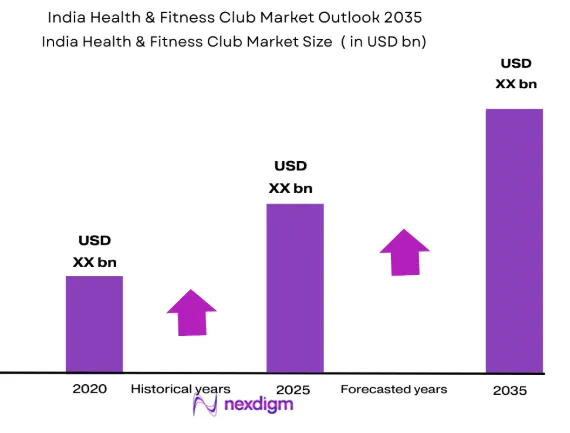
The India Health & Fitness Club Market recorded revenue of USD ~ billion based on a recent historical assessment, with revenue defined as membership fees paid to gyms, health clubs, and fitness clubs. Demand is being driven by rising health awareness, lifestyle-related disease concerns, higher spending on personal wellness, and strong adoption among millennial and Gen Z consumers, whose combined population base creates a large addressable fitness audience.
Mumbai, Delhi NCR, Bengaluru, Hyderabad, Chennai, Pune, and other large urban clusters dominate the India Health & Fitness Club Market because these cities combine higher disposable incomes, dense working-professional populations, premium real estate catchments, and greater exposure to organized fitness brands. Large metros also support boutique studios, personal training formats, and corporate wellness tie-ups more effectively than smaller cities due to stronger office concentration, lifestyle spending, and higher willingness to pay.
Market Segmentation
By Membership Model
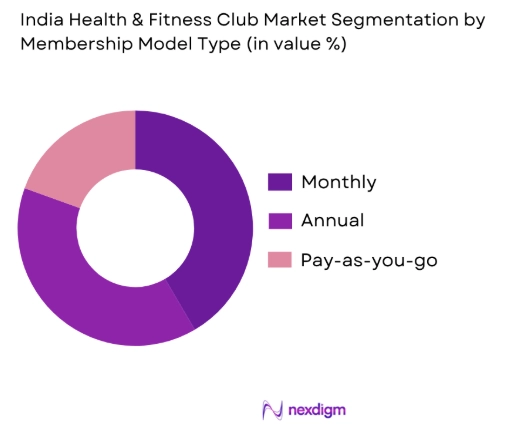
India Health & Fitness Club Market is segmented by membership model into Monthly, Annual, and Pay-as-you-go. Recently, Monthly has a dominant market share due to shorter consumer commitment cycles, affordability for first-time users, easier cancellation flexibility, and the strong preference among urban fitness consumers to test multiple gyms, boutique studios, and app-led fitness formats before moving into long-term plans. Monthly memberships also support the operating model of organized chains because they help maintain recurring cash flow while allowing brands to bundle gym access, group classes, app-based workouts, and promotional offers into one subscription. Annual memberships remain important for high-intent users and premium clubs, while pay-as-you-go formats serve occasional users, travelers, and consumers using aggregator platforms. Publicly accessible sources disclose the monthly segment value and total market value, but do not disclose full 2024 values for all remaining sub-segments; therefore, only the publicly calculable share is shown without unsupported estimation.
By Facility Type
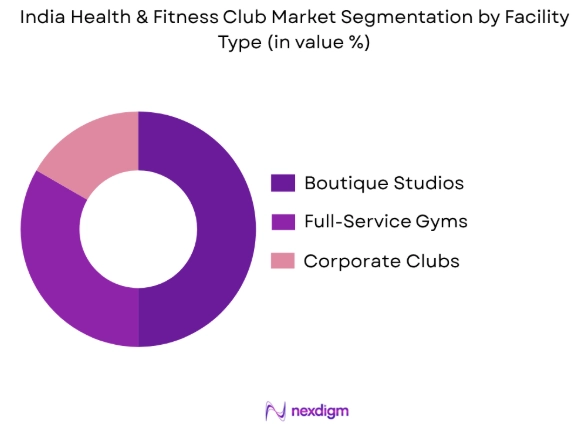
India Health & Fitness Club Market is segmented by facility type into Boutique Studios, Full-Service Gyms, and Corporate Clubs. Recently, Boutique Studios has a dominant market share due to rising consumer preference for specialized workouts, trainer-led formats, compact premium spaces, community-based engagement, and differentiated offerings such as yoga, Pilates, boxing, dance fitness, functional training, and high-intensity group sessions. Boutique studios are also well suited to dense urban neighborhoods where consumers seek convenience, premium ambience, and flexible class scheduling rather than large-format gym access alone. Full-service gyms continue to serve strength training, cardio, and general fitness demand, while corporate clubs are supported by workplace wellness programs and employer-led preventive health initiatives. However, public sources disclose only the boutique studio segment value and total market value, without giving all facility-type sub-segment values; therefore, the table avoids fabricated shares for undisclosed categories.
Competitive Landscape
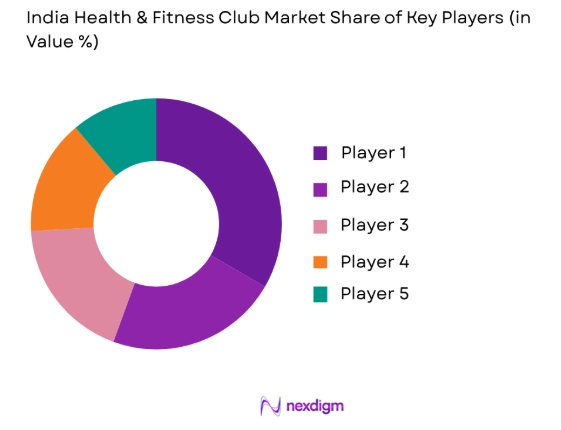
The India Health & Fitness Club Market is moderately fragmented, with organized chains competing against a large unorganized base of local gyms, independent studios, residential-club facilities, and trainer-led micro-studios. Consolidation is visible through brand acquisitions, master franchise models, and digital membership ecosystems, while leading players differentiate through multi-city networks, app integration, trainer quality, group-class programming, and premium or budget positioning. Deloitte and HFA highlight that the top urban centers account for a disproportionately high share of market revenue compared with their facility count, indicating that scale, location density, and brand visibility strongly influence competitive advantage.
| Company Name | Establishment Year | Headquarters | Technology Focus | Market Reach | Key Products | Revenue | India Club Footprint |
| Cult.fit | 2016 | Bengaluru, India | ~ | ~ | ~ | ~ | ~ |
| Gold’s Gym India | 2002 | Mumbai, India | ~ | ~ | ~ | ~ | |
| Anytime Fitness India | 2012–2013 India entry | New Delhi NCR, India operations | ~ | ~ | ~ | ~ | ~ |
| Fitness First India | 1993 global brand, India operations later | India operations under franchise/brand network | ~ | ~ | ~ | ~ | ~ |
| Snap Fitness India | 2003 global brand, India operations later | India operations through franchise network | ~ | ~ | ~ | ~ | ~ |
India Health & Fitness Club Market Analysis
Growth Drivers
Expansion of Organized Fitness Chains and Franchise Models
India’s health and fitness club market is supported by a larger urban consumer base and a service-led economy, which improves the commercial case for branded clubs, franchise gyms, and multi-location operators. The World Bank lists India’s GDP at USD 3.91 trillion and GDP per capita at USD 2,694.7, showing a broader income base for discretionary wellness services in large cities. India’s urban population is listed at about 513.3 million, creating dense catchments where gyms can operate near offices, residential clusters, malls, and transit corridors. The World Bank also reports India’s labor force at 607,691,498, which supports demand from working adults seeking accessible fitness formats before or after office hours. Government-backed sports infrastructure also supports the fitness ecosystem: PIB reported 1,045 Khelo India Centres, 34 Khelo India State Centres of Excellence, 306 accredited academies, and 326 approved sports infrastructure projects. For fitness chains, these indicators justify expansion through standardized formats, certified trainer deployment, digital booking, and franchise-led rollout in high-density urban markets. Sources: World Bank, PIB, NSDC.
Rising Health Awareness and Preventive Healthcare Spending
Preventive health awareness is a strong driver for India’s health and fitness club market because the country faces a large lifestyle-disease burden that directly connects with exercise, weight management, strength training, and structured wellness programs. PIB cited the ICMR-INDIAB study reporting 101 million people with diabetes and 136 million people with prediabetes in India, while other ICMR-linked findings report 315 million people with hypertension, 254 million people with generalized obesity, and 351 million people with abdominal obesity. These are not fitness-club revenue indicators, but they are highly relevant demand-side health indicators because gyms, personal trainers, yoga studios, and hybrid wellness clubs increasingly position themselves around prevention, metabolic fitness, body composition, and supervised physical activity. The macroeconomic base also supports this shift: India’s GDP is reported by the World Bank at USD 3.91 trillion, while GDP per capita is USD 2,694.7. With 1.45 billion people listed by the World Bank, even a small conversion of health-aware urban adults into paid fitness users can materially support organized clubs. The driver is therefore market-specific because chronic disease risk, urban work routines, and preventive-health messaging increase demand for recurring gym memberships, trainer-led programs, and wellness-focused club formats. Sources: PIB, ICMR-linked publication, World Bank.
Market Challenges
Shortage of Certified Trainers and Skilled Fitness Professionals
India’s health and fitness club market faces a skill-quality challenge because organized clubs need certified trainers for strength coaching, injury prevention, group classes, women-specific programs, senior fitness, rehabilitation-oriented routines, and member retention. The NSDC fitness-trainer qualification page lists 290 total training hours, including 60 theory hours, 190 practical hours, and 40 employability and entrepreneurship hours, showing that formal fitness training requires structured preparation rather than informal gym experience alone. NSDC also states that more than 60,000 trainers and 40,000 assessors have been certified through Training of Trainers and Training of Assessors programs across 36 states and union territories, but these figures cover the wider skilling ecosystem and not only private gym trainers. The scale of India’s demand base is much larger: the World Bank lists India’s labor force at 607,691,498 and its urban population at about 513.3 million. This mismatch creates pressure on organized operators to recruit, train, monitor, and retain skilled fitness professionals across multiple locations. For premium and boutique clubs, trainer credibility is especially important because members pay for guidance, form correction, personalized progression, and measurable outcomes, not only equipment access. Sources: NSDC, World Bank.
Competition from Informal and Unorganized Fitness Formats
The India health and fitness club market remains challenged by informal gyms, apartment-club facilities, trainer-led small studios, public open gyms, free digital workouts, and government-supported physical activity infrastructure, all of which compete for consumer attention and time. Government sports and fitness infrastructure is expanding: PIB reported 1,045 Khelo India Centres, 34 Khelo India State Centres of Excellence, 306 accredited academies, and 326 approved sports infrastructure projects, while the Khelo India dashboard lists 1,067 Khelo India Centres and 28,214 trainees. Fit India also promotes fitness as “easy, fun and free,” which supports public health but creates an alternative to paid clubs for casual users. The World Bank lists India’s urban population at about 513.3 million and total population at 1.45 billion, indicating very large demand potential, but the same scale also allows many low-formality operators to survive through localized pricing, neighborhood relationships, and limited infrastructure. Organized fitness clubs must therefore differentiate through hygiene standards, certified trainers, digital access, equipment quality, women-safe environments, personal coaching, and predictable service delivery. The challenge is market-specific because paid clubs compete not only with other branded gyms but also with free or low-formality physical activity options. Sources: PIB, Khelo India, Fit India, World Bank.
Opportunities
Expansion of Fitness Clubs in Tier Two and Tier Three Cities
Tier two and tier three expansion is a major opportunity for India’s health and fitness club market because the country’s urban base is no longer limited to the largest metros. The World Bank lists India’s urban population at about 513.3 million and total population at 1.45 billion, creating a large pool of consumers outside the top city clusters. Public sports infrastructure also shows wider geographic activation: PIB reported 1,045 Khelo India Centres, 34 Khelo India State Centres of Excellence, and 306 accredited academies, while the Khelo India dashboard lists 1,067 centres across 36 states and union territories. This creates a stronger cultural base for organized physical activity beyond Delhi NCR, Mumbai, Bengaluru, Hyderabad, Chennai, and Pune. The World Bank’s GDP per capita value of USD 2,694.7 also supports gradual expansion of discretionary wellness spending where employment, services, and urban lifestyles are rising. For fitness operators, the opportunity is to launch smaller-format gyms, women-friendly facilities, hybrid membership access, and franchise-led clubs that are more affordable and easier to scale than metro premium clubs. The data supports future growth because expanding urbanization and public sports infrastructure improve market readiness for private clubs in emerging cities. Sources: World Bank, PIB, Khelo India.
Increasing Demand for Hybrid and Digital Fitness Models
Hybrid and digital fitness models create an opportunity for India’s health and fitness club market because large urban and working populations need flexible workout access beyond fixed club visits. The World Bank reports India’s labor force at 607,691,498, GDP at USD 3.91 trillion, and GDP per capita at USD 2,694.7, indicating a large employed base and an improving economic foundation for app-based memberships, digital scheduling, and bundled offline-online fitness services. Fit India’s official platform highlights the Fit India mobile app with features such as fitness score checking, step tracking, sleep tracking, calorie tracking, event participation, and customized diet plans, showing government-backed normalization of digital fitness behavior. PIB also reported that Fit India Sundays on Cycle, launched in December 2024, reached 2.5 lakh participants across more than 5,000 locations by May 2025, showing that digital-public fitness campaigns can mobilize users across regions. For clubs, this supports future growth through hybrid memberships, app-led class booking, remote coaching, retention nudges, and online workout continuity when members cannot visit facilities. The opportunity is market-specific because hybrid models help solve India’s commute, schedule, and retention barriers while extending club relationships beyond the physical gym floor. Sources: World Bank, Fit India, PIB.
Future Outlook
The India Health & Fitness Club Market is expected to grow through wider organized-chain expansion, greater penetration in smaller cities, and stronger integration of digital membership systems with physical clubs. Demand will be supported by rising health awareness, young urban demographics, corporate wellness adoption, and increasing consumer willingness to pay for structured fitness outcomes. Technology will influence booking, coaching, retention, and progress tracking, while regulatory scrutiny around safety, registration, and trainer standards may gradually strengthen formal operators. Premium clubs, budget gyms, boutique studios, and hybrid fitness platforms are likely to coexist as consumers segment by price, convenience, workout type, and service expectations.
Major Players
- Cult.fit
- Gold’s Gym India
- Anytime Fitness India
- Fitness First India
- Snap Fitness India
- Talwalkars
- Ozone Fitness
- MultiFit
- Fitpass
- Plus Fitness India
- F45 Training India
- Nitrro Bespoke Fitness
- Fitness One
- The Gym
- Kris Gethin Gyms
Key Target Audience
- Fitness club operators
- Gym franchise owners
- Boutique fitness studio operators
- Corporate wellness buyers
- Real estate developers
- Investments and venture capitalist firms
- Government and regulatory bodies
- Fitness equipment manufacturers
Research Methodology
Step 1: Identification of Key Variables
The study begins by identifying variables affecting the India Health & Fitness Club Market, including membership revenue, facility type, club format, pricing model, city concentration, consumer demographics, trainer availability, and digital fitness integration. These variables are mapped against demand-side and supply-side indicators to define the market scope.
Step 2: Market Analysis and Construction
Market construction is developed by assessing publicly available industry data, company disclosures, fitness association releases, paid-report summaries, franchise information, and operator-level evidence. The model separates membership-led club revenue from broader wellness, sportswear, nutrition, and digital-only fitness activity wherever possible.
Step 3: Hypothesis Validation and Expert Consultation
Preliminary findings are validated through logical cross-checks across operator networks, membership trends, urban concentration, pricing structures, and industry commentary. Expert inputs from fitness operators, franchise stakeholders, trainers, corporate wellness buyers, and equipment suppliers are used to test demand assumptions and competitive dynamics.
Step 4: Research Synthesis and Final Output
The final output consolidates market size, segmentation, competitive landscape, growth drivers, challenges, opportunities, and future outlook into a structured research report. Conflicting data points are reconciled by prioritizing credible and recent sources, while unavailable public data is clearly marked rather than estimated without support.

- Executive Summary
- Research Methodology (Market Definitions and Assumptions, Abbreviations, Market Sizing Approach, Consolidated Research Approach, Understanding Market Potential Through In-Depth Industry Interviews, Primary Research Approach, Limitations and Future Conclusions)

- Definition and Scope
- Market Dynamics Overview
- Market Genesis
- Major Players and Market Timeline
- Business Cycle and Trends
- Supply Chain and Value Chain Analysis

- Growth Drivers
Expansion of Organized Fitness Chains and Franchise Models
Rising Health Awareness and Preventive Healthcare Spending
Increasing Disposable Income and Urban Lifestyle Adoption
Growth of Corporate Wellness and Employee Fitness Programs - Market Challenges
High Real Estate and Operating Costs
Low Membership Retention Rates
Price Sensitivity and Competition from Unorganized Gyms
Shortage of Certified Trainers and Skilled Fitness Professionals - Opportunities
Expansion of Fitness Clubs in Tier Two and Tier Three Cities
Increasing Demand for Hybrid and Digital Fitness Models
Growth of Women-Centric Fitness Centers
Integration of Wellness, Nutrition, and Recovery Services
Rising Adoption of Boutique Fitness Studios - Key Trends
Shift toward premium and boutique fitness experiences
Rising popularity of strength training and functional fitness
Growth in app-based fitness memberships
Increasing demand for personalized fitness coaching
Expansion of fitness franchising across India - Government Regulations
- SWOT Analysis
- Porter’s Five Forces

- By Value, 2020–2025
- By Number of Clubs, 2020–2025
- By Average Membership Fee, 2020–2025

- By Club Type (In Value %)
Premium Fitness Clubs
Mid-Market Fitness Clubs
Budget Gyms
Boutique Fitness Studios
Hotel and Residential Fitness Clubs - By Service Type (In Value %)
Gym and Strength Training
Cardio Fitness
Group Classes
Personal Training
Yoga and Pilates
Functional Training and CrossFit
Wellness and Recovery Services - By Membership Type (In Value %)
Monthly Memberships
Quarterly Memberships
Annual Memberships
Pay-Per-Session Memberships
Corporate Memberships - By End User (In Value %)
Men
Women
Teenagers and Young Adults
Working Professionals
Senior Citizens - By Revenue Stream (In Value %)
Membership Fees
Personal Training Fees
Group Class Fees
Merchandise and Supplements
Wellness and Spa Services
Digital Fitness Subscriptions - By Distribution Channel (In Value %)
Direct Walk-Ins
Online Membership Platforms
Mobile Applications
Corporate Tie-Ups
Aggregator Platforms - By Region (In Value %)
North India
South India
West India
East India
Central India

- Market Share of Major Players by Value
- Market Share of Major Players by Number of Clubs
- Market Share of Major Players by Club Type
- Cross Comparison Parameters (Company Overview, Business Strategies, Recent Developments, Strength, Weakness, Organizational Structure, Revenues, Revenues by Service Type, Number of Fitness Centers, Membership Base, Distribution Channels, Franchise Network, Average Membership Fees, Trainer Network, Unique Value Offering and Others)
- SWOT Analysis of Major Players
- Pricing Analysis Based on Membership Categories for Major Players
- Detailed Profiles of Major Companies
Cult.fit
Gold’s Gym India
Anytime Fitness India
Talwalkars
Fitness First India
Snap Fitness India
Ozone Fitness
Kris Gethin Gyms
Fitpass
MultiFit
Plus Fitness India
F45 Training India
Nitrro Bespoke Fitness
The Gym
Fitness One

- Market Demand and Utilization
- Purchasing Power and Membership Spending Patterns
- Health and Fitness Goals
- Needs, Desires, and Pain Point Analysis
- Decision-Making Proces

- By Value, 2026–2035
- By Number of Clubs, 2026–2035
- By Average Membership Fee, 2026–2035


 Request a Sample
 Ask for Customization
 Get a Quote
 Enquire Now