

 Download PDF
Market Overview
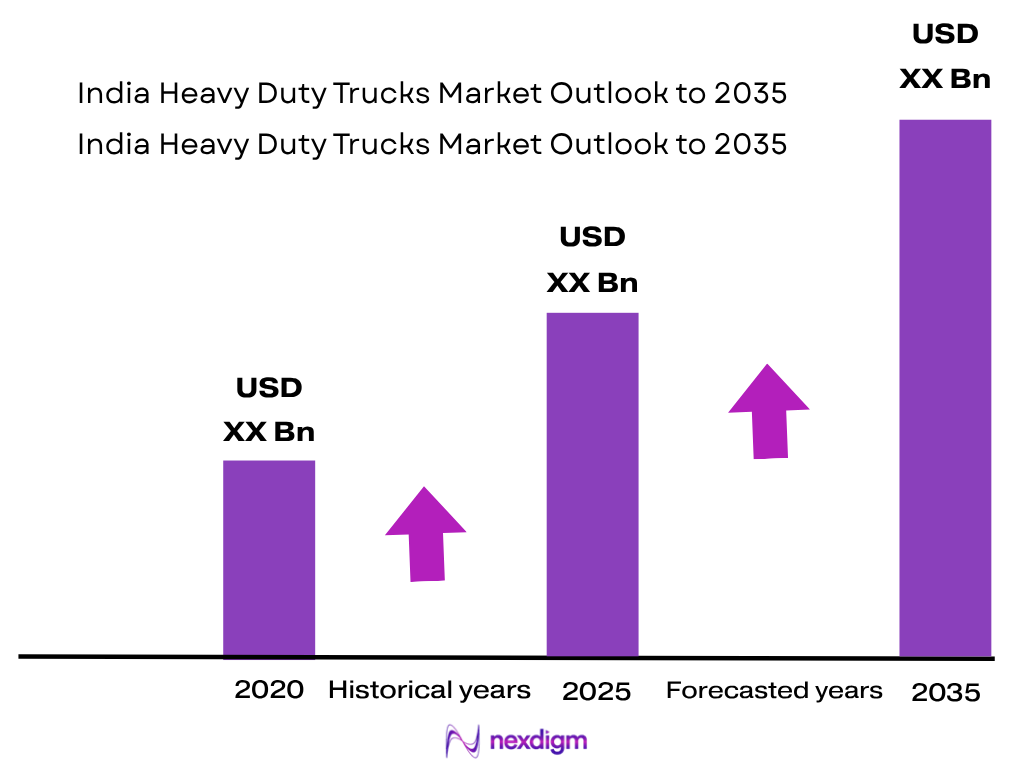
The India Heavy Duty Trucks Market is valued at approximately ~USD XX billion, based on historical industry assessment. Commercial-vehicle domestic sales moved from 969,000 units to 957,000 units, while commercial-vehicle production changed from 1,068,000 units to 1,033,000 units. Medium and heavy commercial vehicle sales remained at approximately 374,000 units in the latest period. Demand is primarily sustained by road freight, infrastructure construction, mining, cement, steel, container logistics and organized fleet replacement.
Jamshedpur, Chennai-Oragadam, Pune-Chakan, Pithampur and the Delhi-NCR logistics region are dominant centres in the India Heavy Duty Trucks Market because they combine OEM manufacturing, component ecosystems, freight corridors and fleet operations. Commercial-vehicle exports moved from 66,000 units to 81,000 units, while national commercial-vehicle production moved from 1,068,000 units to 1,033,000 units. Jamshedpur supports Tata’s heavy-truck and drivetrain manufacturing, Chennai anchors Ashok Leyland and BharatBenz, while Pune-Chakan hosts Mahindra’s heavy commercial vehicle manufacturing ecosystem.
Market Segmentation
By Truck Configuration
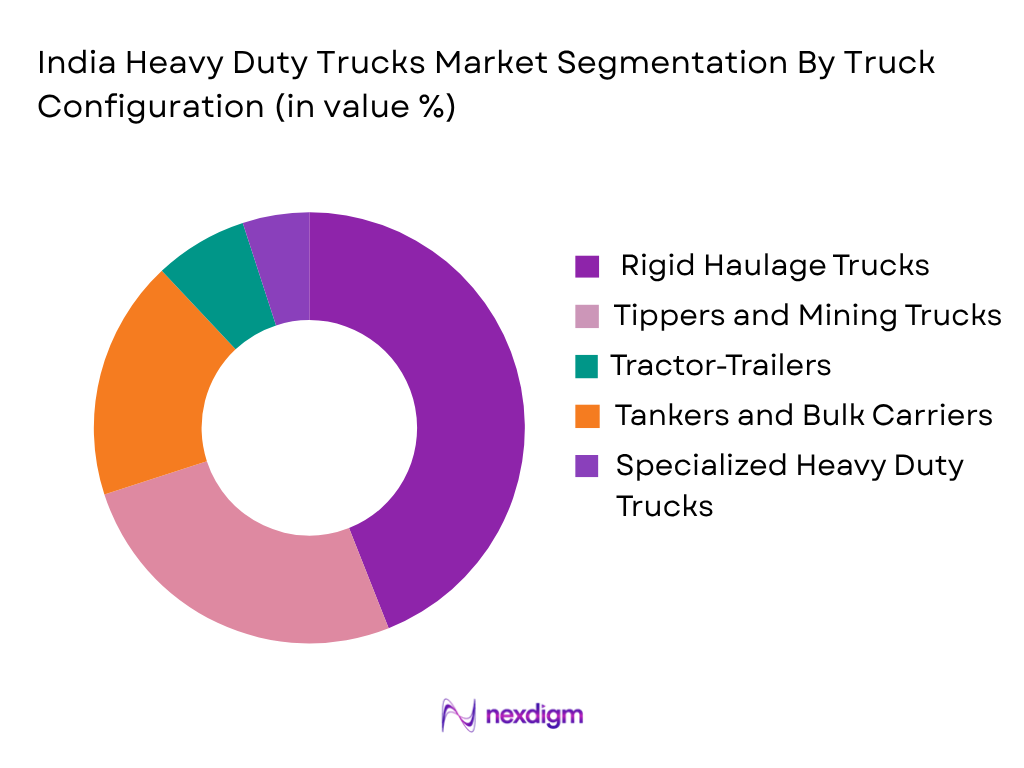
The India Heavy Duty Trucks Market is segmented into rigid haulage trucks, tractor-trailers, tippers and mining trucks, tankers and bulkers, and other specialized heavy trucks. Rigid haulage trucks account for the dominant share because Indian freight movement continues to rely heavily on multi-axle rigid platforms for cement, steel, agricultural commodities, market loads, industrial goods and regional transportation. The segment benefits from established 28-tonne, 35-tonne, 42-tonne and higher-GVW platforms offered through nationwide dealer networks. Road infrastructure is also increasingly compatible with higher-capacity trucks: India’s National Highway network reached 146,195 km, while 45,947 km consisted of four-lane-and-above National Highways excluding high-speed corridors. Tractor-trailers are gaining strategic importance in containers, automobiles, steel and organized long-haul freight, whereas tippers maintain a strong position in mining, road construction, aggregates and infrastructure. The improving highway network gradually supports movement toward higher-payload, more productive truck configurations.
By Application Type
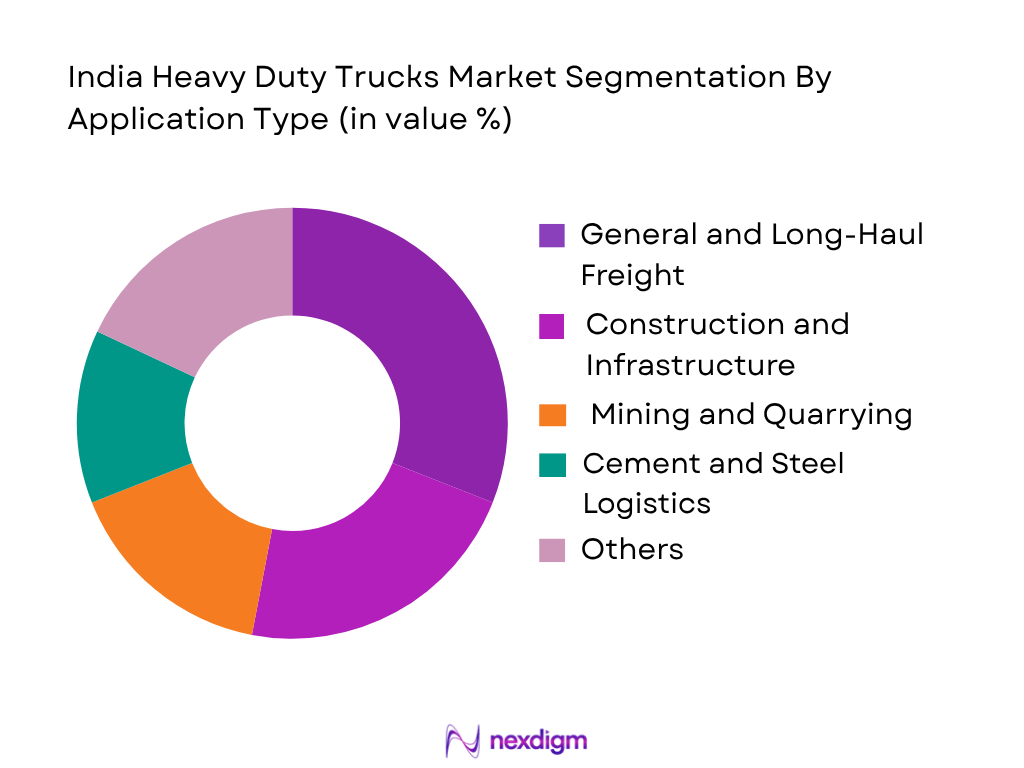
The India Heavy Duty Trucks Market is segmented into general and long-haul freight, construction and infrastructure, mining and quarrying, cement and steel logistics, container and port movement, petroleum and bulk transportation, and specialized applications. General and long-haul freight represents the dominant application because road transportation connects manufacturing clusters, consumption centres, ports, warehouses and agricultural markets across India. Government highway development continues to strengthen this use case. Bharatmala projects covering 26,425 km had been awarded and 18,714 km constructed, while the National Highway network stood at 146,195 km. The government also identified 59 critical port-connectivity infrastructure projects covering approximately 1,300 km, reinforcing truck demand around port and container movement. Construction and mining remain large heavy-truck applications because they require high-GVW tippers and specialized severe-duty vehicles. Cement and steel logistics increasingly favour multi-axle rigid trucks and tractor-trailers as fleets seek higher payload productivity and more predictable turnaround times.
Competitive Landscape
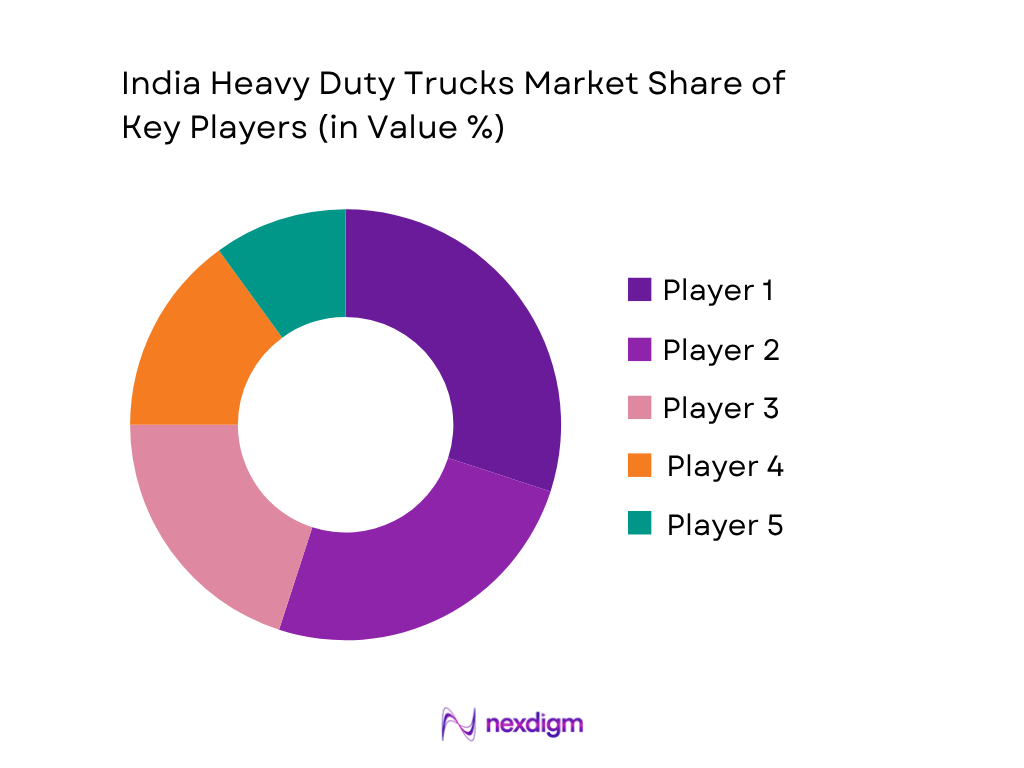
The India Heavy Duty Trucks Market is concentrated around established domestic commercial-vehicle manufacturers with extensive manufacturing, product and service capabilities. Tata Motors and Ashok Leyland maintain broad heavy-truck portfolios, while VE Commercial Vehicles combines Eicher’s domestic commercial-vehicle network with Volvo technology. BharatBenz targets modern heavy-duty haulage, construction and tractor applications through Daimler India Commercial Vehicles, while Mahindra Truck and Bus competes through its Blazo and heavy commercial vehicle portfolio. Competition increasingly centres on payload productivity, fuel efficiency, uptime, telematics, alternative-fuel capability and service accessibility rather than vehicle acquisition alone. VECV operates 9 manufacturing facilities and more than 990 touchpoints, while Mahindra states that its truck network is supported by more than 2,900 service points.
| Major Player | Establishment Year | Headquarters | Heavy Truck Portfolio | Manufacturing Footprint | High-GVW / Tractor Capability | Mining & Tipper Capability | Alternative-Fuel Readiness | Fleet / Service Capability |
| Tata Motors Commercial Vehicles | 1945 | Mumbai, Maharashtra | ~ | ~ | ~ | ~ | ~ | ~ |
| Ashok Leyland Limited | 1948 | Chennai, Tamil Nadu | ~ | ~ | ~ | ~ | ~ | ~ |
| VE Commercial Vehicles Ltd. | 2008 | Gurugram, Haryana | ~ | ~ | ~ | ~ | ~ | ~ |
| Daimler India Commercial Vehicles – BharatBenz | 2009 | Chennai, Tamil Nadu | ~ | ~ | ~ | ~ | ~ | ~ |
| Mahindra Truck and Bus Division | 1945 | Pune, Maharashtra | ~ | ~ | ~ | ~ | ~ | ~ |
India Heavy Duty Trucks Market Analysis
Growth Drivers
Expansion of National Highway and High-Speed Freight Infrastructure
India’s expanding highway infrastructure is strengthening heavy-duty truck utilization by improving long-haul connectivity, reducing route bottlenecks and enabling higher-GVW rigid trucks and tractor-trailers to operate efficiently between industrial and consumption centres. India’s National Highway network reached 146,195 km in 2024, while National High-Speed Corridors reached 2,474 km and four-lane-and-above National Highways excluding high-speed corridors reached 45,947 km. During FY2023–24, 12,349 km of National Highways were constructed, while another 5,853 km were completed during April–December 2024–25. The government also approved 8 high-speed corridor projects covering 936 km with capital expenditure of ₹50,655 crore. These corridors directly support long-haul freight, cement, steel, container and industrial-material transportation where heavy rigid trucks and tractor-trailers are extensively deployed. Medium and heavy commercial vehicle sales stood at approximately 3.74 lakh units in FY2024–25, demonstrating the scale of the addressable fleet. India’s 2024 GDP stood at USD 3,909.89 billion, while GDP per capita reached USD 2,694.7. These indicators support continuing freight generation and productive deployment of higher-capacity heavy trucks.
Mining and Bulk Commodity Movement Supporting Tipper and Heavy-Haul Demand
India’s expanding coal and bulk-material ecosystem is a direct growth driver for heavy-duty tippers, multi-axle trucks and tractor-trailers because mining output must move between mines, processing locations, power stations, steel facilities and industrial users. India recorded 1,039.59 million tonnes of coal production and 1,012.72 million tonnes of coal dispatch during calendar 2024. In FY2024–25, production reached 1,047.523 million tonnes, while coal supply reached 1,025.33 million tonnes. Calendar 2025 production subsequently stood at 1,042.90 million tonnes, with 1,016.14 million tonnes supplied to consumers. Captive and commercial mines alone produced 190.95 million tonnes and dispatched 190.42 million tonnes in FY2024–25, creating concentrated demand for severe-duty haulage between pitheads, loading points and industrial destinations. In March 2026, captive, commercial and other mines crossed 200 million tonnes of production for FY2025–26, including 194.17 million tonnes from captive and commercial mines. India’s 2024 GDP stood at USD 3,909.89 billion, while GDP per capita reached USD 2,694.7. This physical freight base directly supports demand for high-torque tippers, mining trucks and multi-axle haulage platforms.
Market Challenges
Commercial Vehicle Demand Volatility and Fleet Replacement Uncertainty
Heavy-duty truck manufacturers face demand volatility because fleet purchases depend closely on freight utilization, infrastructure execution, industrial activity and replacement decisions by transport operators. Overall commercial-vehicle domestic sales reached 9.57 lakh units in FY2024–25, while medium and heavy commercial vehicle sales stood at 3.74 lakh units. Commercial-vehicle production reached 1,032,645 units, demonstrating the substantial manufacturing capacity that OEMs must balance against cyclical fleet procurement. The replacement environment is also being reshaped by India’s organized vehicle-scrappage framework. In August 2024, India had more than 60 Registered Vehicle Scrapping Facilities across 17 States and Union Territories and more than 75 Automated Testing Stations across 12 States and Union Territories. Commercial vehicles increasingly move through fitness testing and scrappage-based replacement mechanisms, creating timing uncertainty for smaller fleet owners deciding whether to retain, replace or scrap existing trucks. India’s highway maintenance requirement adds another operating consideration, with substantial stretches requiring recurring maintenance and rehabilitation as freight traffic increases. India’s 2024 GDP stood at USD 3,909.89 billion, contextualizing the scale of freight activity within which fleet-replacement and utilization decisions are occurring.
Road-to-Rail Freight Diversion Creating Competitive Pressure on Long-Haul Trucking
The expansion of dedicated rail freight infrastructure presents a structural challenge for heavy-duty trucks concentrated in long-distance bulk transportation because a larger volume of suitable freight can shift from road to rail while trucks increasingly perform first-mile and last-mile movements. In January 2026, 306 Gati Shakti Multi-Modal Cargo Terminals had been approved with combined capacity of 192 million tonnes per annum, of which 118 terminals were already commissioned. These terminals had mobilized approximately ₹8,600 crore of private investment. Broader rail freight development has also enabled 2,672 million tonnes of freight to shift from road to rail since 2014. This modal transition particularly affects long-distance movement of commodities such as coal, steel, cement, containers and other bulk materials that also underpin heavy rigid-truck and tractor-trailer utilization. India nevertheless retains a major road freight requirement, supported by 146,195 km of National Highways and 45,947 km of four-lane-and-above National Highways excluding high-speed corridors. India’s 2024 GDP stood at USD 3,909.89 billion, while GDP per capita reached USD 2,694.7. Heavy-truck fleets therefore face pressure to reposition toward regional distribution, multimodal feeder services and time-sensitive freight rather than relying exclusively on long-haul bulk movement.
Market Opportunities
Electric Heavy-Duty Truck Deployment Creating a New Fleet Replacement Segment
Electric heavy-duty trucks represent a significant future opportunity as India establishes dedicated incentives, charging infrastructure and scrappage-linked replacement mechanisms for zero-emission freight vehicles. The PM E-DRIVE Scheme introduced in September 2024 carries an overall outlay of ₹10,900 crore. Within the programme, ₹500 crore was specifically allocated to e-trucks, with support structured for 5,643 electric trucks. Another ₹2,000 crore was allocated for public electric-vehicle charging infrastructure, while ₹780 crore was designated for upgrading vehicle-testing agencies. Importantly, the e-truck incentive requires submission of a scrapping certificate from an authorized vehicle-scrapping facility, directly linking electrification with replacement of older heavy commercial vehicles. India also operates an advanced automotive technology manufacturing programme with an outlay of ₹25,938 crore. As of December 2025, 8 Champion OEM applicants had received domestic-value-addition certification covering 94 variants, while 10 Component Champion applicants had certifications covering 37 variants. India’s 2024 GDP stood at USD 3,909.89 billion, providing the industrial and freight scale for progressive deployment of electric trucks across ports, cement, steel, mining and regional logistics operations.
Port Connectivity and Multimodal Logistics Creating Demand for High-Capacity Trucks
Port-led freight and multimodal logistics create a forward opportunity for high-capacity tractor-trailers, container carriers and specialized heavy trucks as India strengthens road connections between ports, industrial clusters, warehouses and inland logistics facilities. Indian ports handled 1,540.23 million tonnes of cargo in FY2023–24, comprising 819.23 million tonnes at major ports and 721.00 million tonnes at non-major ports. India identified 59 critical port-connectivity infrastructure projects covering approximately 1,300 km to improve last-mile access to operational and developing ports. In parallel, the national road logistics programme envisages a network of 35 Multi-Modal Logistics Parks, supporting consolidation of road, rail and warehousing operations. By January 2026, 306 Gati Shakti Multi-Modal Cargo Terminals had been approved, with 118 commissioned and combined approved capacity of 192 million tonnes per annum. These current assets provide a strong platform for future heavy-truck demand in container drayage, port-to-warehouse movement, automotive logistics and industrial feeder transportation. India’s 2024 GDP stood at USD 3,909.89 billion, while GDP per capita reached USD 2,694.7, supporting continued expansion of domestic manufacturing, logistics activity and trade-linked freight movement.
Future Outlook
The India Heavy Duty Trucks Market is projected to grow at approximately ~X.X% CAGR during 2026–2035. Growth will increasingly depend on higher-capacity road freight, infrastructure construction, mining activity, organized logistics, fleet replacement and the transition from conventional diesel platforms toward LNG and zero-emission heavy trucks. Highway development will remain an important structural enabler. India’s National Highway network reached 146,195 km, high-speed corridors expanded to 2,474 km, and 12,349 km of National Highways were constructed during FY2023–24. Wider and faster corridors improve the operating case for higher-GVW trucks and tractor-trailers by allowing fleets to increase average utilization and reduce delays between industrial clusters.
Freight corridor development will also encourage a gradual change in truck configuration. Long-haul freight in containers, steel, cement, automobiles and industrial materials is increasingly suitable for tractor-trailers rather than conventional lower-capacity rigid trucks. Bharatmala has already delivered 18,714 km of road infrastructure from awarded projects, while economic corridors, feeder routes and port-connectivity projects provide a larger addressable operating network for organized fleets.
Major Players
- Tata Motors Commercial Vehicles
- Ashok Leyland Limited
- VE Commercial Vehicles Limited – Eicher Trucks & Buses
- Daimler India Commercial Vehicles – BharatBenz
- Mahindra Truck and Bus Division
- Volvo Trucks India
- Scania Commercial Vehicles India
- Blue Energy Motors
- Montra Electric – eM&HCV
- Propel Industries
- SML Isuzu Limited
- Force Motors Limited
- Isuzu Motors India
- Olectra Greentech Limited
- EKA Mobility
Key Target Audience
- Heavy Duty Truck Manufacturers
- Automotive Tier-1 and Heavy Truck Component Suppliers
- Road Freight and Third-Party Logistics Operators
- Mining, Cement, Steel and Infrastructure Companies
- Commercial Vehicle Financing and Leasing Companies
- Heavy Truck Dealers, Distributors and Fleet Service Networks
- Investments and Venture Capitalist Firms
- Government and Regulatory Bodies (Ministry of Road Transport and Highways, Ministry of Heavy Industries, National Highways Authority of India, Automotive Research Association of India, International Centre for Automotive Technology, Ministry of Commerce and Industry)
Research Methodology
Step 1: Identification of Key Variables
The initial phase involves constructing an ecosystem map covering heavy-truck manufacturers, component suppliers, dealers, fleet operators, freight companies, financiers and infrastructure stakeholders. Critical variables include GVW, axle configuration, truck body type, application, powertrain, fleet ownership, freight route, annual utilization, replacement cycle and alternative-fuel readiness.
Step 2: Market Analysis and Construction
Historical commercial-vehicle production, domestic sales, registration and export information is compiled alongside infrastructure, freight and industrial activity. The top-down assessment is complemented by bottom-up analysis of rigid haulage vehicles, tractor-trailers, tippers and specialized heavy trucks across GVW classes and major end-use applications.
Step 3: Hypothesis Validation and Expert Consultation
Market hypotheses are validated through structured interactions with OEM representatives, fleet operators, dealers, component suppliers, logistics companies and commercial-vehicle financing participants. These interactions assess vehicle utilization, procurement preferences, payload requirements, replacement behaviour, service expectations and adoption barriers for LNG, electric and other alternative-fuel trucks.
Step 4: Research Synthesis and Final Output
The final stage triangulates OEM data, government registrations, industry sales, infrastructure development and primary-market observations. Findings from supply-side truck availability are reconciled with freight-demand requirements and fleet procurement behaviour to construct market segmentation, competitive positioning and future demand scenarios for the India Heavy Duty Trucks Market.

- Executive Summary
- Research Methodology (Market Definition and Scope, India Heavy Duty Truck Taxonomy, Medium and Heavy Commercial Vehicle Classification, Gross Vehicle Weight Mapping, Rigid Truck and Tractor-Trailer Classification, Fleet Population Assessment, New Heavy Duty Truck Registration Assessment, OEM Production and Retail Mapping, Freight Demand Assessment, Fleet Replacement Analysis, Diesel and Alternative Powertrain Mapping, Dealer and Service Network Assessment, Market Sizing Framework)

- Definition and Scope
- India Heavy Duty Truck Industry Evolution and Technology Development
- Heavy Duty Truck Manufacturing and Assembly Process
- Heavy Duty Truck Value Chain Analysis
- India Heavy Duty Truck Supply Chain Analysis
- Engine, Transmission, Axle, Cab and Chassis Ecosystem Analysis
- India Heavy Duty Truck Manufacturing Footprint and Localization Assessment
- Fleet Procurement, Dealer and Heavy Duty Truck Service Framework

- Growth Drivers (Expansion of National Highways and Expressways, Growth of Road Freight Activity, Rising Cement and Steel Transportation, Mining and Construction Activity, Fleet Replacement Demand, Organized Logistics Expansion, Higher-GVW Truck Adoption, Growth of Tractor-Trailer Operations)
- Market Challenges (Diesel Dependency, Freight Rate Volatility, Driver Availability Constraints, Fleet Financing Accessibility, Heavy Duty Truck Maintenance Requirements, BS-VI Emission System Complexity, Alternative-Fuel Infrastructure Constraints, Fleet Utilization Variability)
- Market Opportunities (LNG Long-Haul Trucks, Battery Electric Heavy Duty Trucks, Battery-Swapping Freight Applications, High-GVW Tractor-Trailers, Mining and Construction Tippers, Connected Fleet Telematics, Predictive Maintenance, Truck Leasing and Fleet-as-a-Service)
- Market Trends (Shift Toward Higher-GVW Trucks, Multi-Axle Truck Adoption, Tractor-Trailer Penetration, Automated Manual Transmission Adoption, Connected Truck Platforms, Sleeper Cabin Premiumization, Fuel-Efficiency Optimization, Alternative-Fuel Fleet Deployment)
- Regulatory and Standards Landscape (Ministry of Road Transport and Highways Commercial Vehicle Requirements, Central Motor Vehicles Rules, BS-VI Emission Standards, Gross Vehicle Weight and Axle Load Regulations, Vehicle Scrappage Policy, Automated Testing Station Requirements, National Logistics Policy, PM GatiShakti and Bharatmala Freight Infrastructure Framework)
- SWOT Analysis
- Porter’s Five Forces Analysis
- PESTLE Analysis
- Stakeholder Ecosystem
- Competition Ecosystem

- By Market Value (2020-2025)
- By New Heavy Duty Truck Sales Volume (2020-2025)
- By Rigid Haulage Truck Sales Volume (2020-2025)
- By Tractor-Trailer Sales Volume (2020-2025)
- By Tipper and Construction Truck Sales Volume (2020-2025)
- By Mining Heavy Duty Truck Sales Volume (2020-2025)

- By Gross Vehicle Weight (In Value %)
18.5–28 Tonne GVW Trucks
28–35 Tonne GVW Trucks
35–42 Tonne GVW Trucks
42–49 Tonne GVW Trucks
49–55 Tonne GVW / GCW Trucks
Above 55 Tonne Heavy Duty and Specialized Trucks - By Truck Configuration (In Value %)
Rigid Haulage Trucks
Multi-Axle Rigid Trucks
Tractor-Trailers
Tippers
Mining Tippers
Transit Mixers
Tankers
Bulkers
Car Carriers
Container Carriers
Special Application Heavy Duty Trucks - By Application Type (In Value %)
Long Haul General Cargo Transportation
Regional Freight Transportation
Express Logistics and Parcel Freight
Cement Transportation
Steel Transportation
Coal Transportation
Mining and Quarrying
Construction and Infrastructure
Container and Port Logistics
Petroleum and Chemical Tankers
Food Grain Transportation
Automobile Logistics
Industrial Raw Material Transportation
Market Load Transportation
Specialized Heavy Transport - By Powertrain Type (In Value %)
BS-VI Diesel Heavy Duty Trucks
Compressed Natural Gas Heavy Duty Trucks
Liquefied Natural Gas Heavy Duty Trucks
Battery Electric Heavy Duty Trucks
Battery-Swapping Electric Heavy Duty Trucks
Hydrogen Internal Combustion Engine Trucks
Hydrogen Fuel Cell Heavy Duty Trucks
Bio-CNG and Biomethane Compatible Trucks
Other Alternative Fuel Heavy Duty Trucks - By Fleet Ownership Type (In Value %)
Large Organized Fleet Operators
Medium Fleet Operators
Small Fleet Owners
Owner-Operators
Third-Party Logistics Fleets
Captive Industrial Fleets
Mining Contractor Fleets
Construction Contractor Fleets
Express Logistics Fleets
Government and Public-Sector Fleets
Leasing and Rental Fleets
Specialized Heavy Haul Fleets - By Region (In Value %)
North India
Delhi NCR
Uttar Pradesh
Rajasthan
Punjab
Haryana
West India
Maharashtra
Gujarat
Madhya Pradesh
South India
Tamil Nadu
Karnataka
Telangana
Andhra Pradesh
East India
West Bengal
Odisha
Jharkhand
Chhattisgarh
North-East India

- Market Share of Major Players (By Revenue, Unit Sales, Gross Vehicle Weight, Rigid Haulage Trucks, Tractor-Trailers, Tippers, Powertrain Type, Fleet Application)
- Cross Comparison Parameters (Heavy Duty GVW and Axle-Configuration Portfolio Breadth, Rigid-Haulage and Tractor-Trailer Product Coverage, Mining-Tipper and Construction Truck Capability, Engine-Power and High-Torque Drivetrain Capability, LNG-Electric and Alternative-Fuel Truck Readiness, India Manufacturing and Localization Footprint, Dealer-Service Network Parts Availability and Fleet-Uptime Support, Connected-Truck Telematics Fleet-Management and ADAS Capability)
- SWOT Analysis of Major Players
- Competitive Positioning Matrix
- Product and Technology Portfolio Benchmarking
- Pricing and Distribution Network Benchmarking
- Market Entry Strategy Assessment
- Detailed Profiles of Major Companies
Tata Motors Commercial Vehicles
Ashok Leyland Limited
VE Commercial Vehicles Limited – Eicher Trucks & Buses
Daimler India Commercial Vehicles – BharatBenz
Mahindra Truck and Bus Division
Volvo Trucks India
Scania Commercial Vehicles India
Blue Energy Motors
Montra Electric – eM&HCV
Propel Industries
SML Isuzu Limited
Force Motors Limited
Isuzu Motors India
Olectra Greentech Limited
EKA Mobility

- Fleet Buyer Segmentation
- Fleet Procurement Behaviour
- OEM and Dealer Selection Criteria
- Fleet Buyer Pain Points
- Powertrain and Technology Adoption Assessment
- Replacement and Repurchase Behaviour

- By Market Value (2026-2035)
- By New Heavy Duty Truck Sales Volume (2026-2035)
- By Rigid Haulage Truck Sales Volume (2026-2035)
- By Tractor-Trailer Sales Volume (2026-2035)
- By Tipper and Construction Truck Sales Volume (2026-2035)
- By Mining Heavy Duty Truck Sales Volume (2026-2035)


 Request a Sample
 Ask for Customization
 Get a Quote
 Enquire Now