
 Download PDF
Market Overview
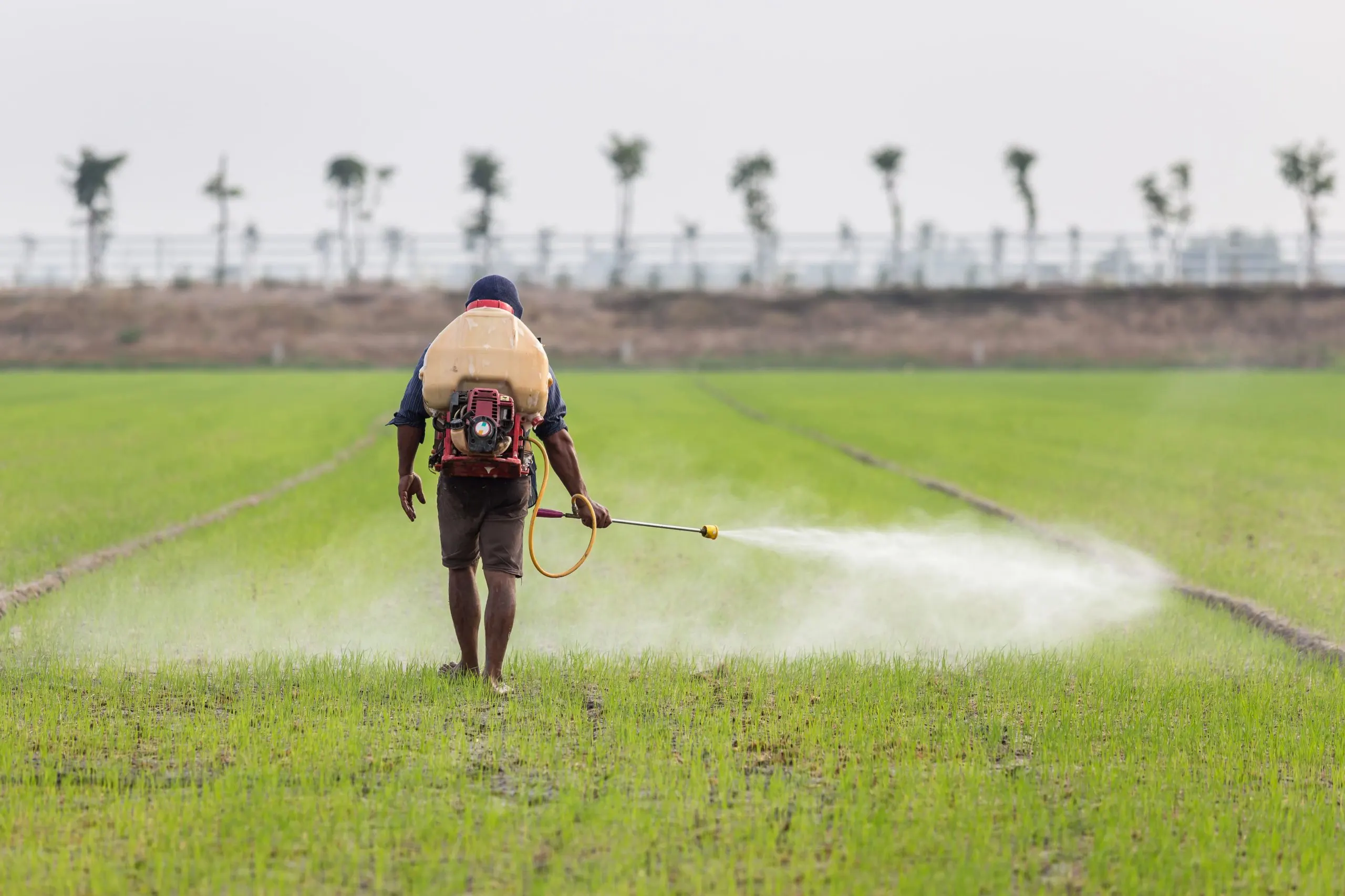
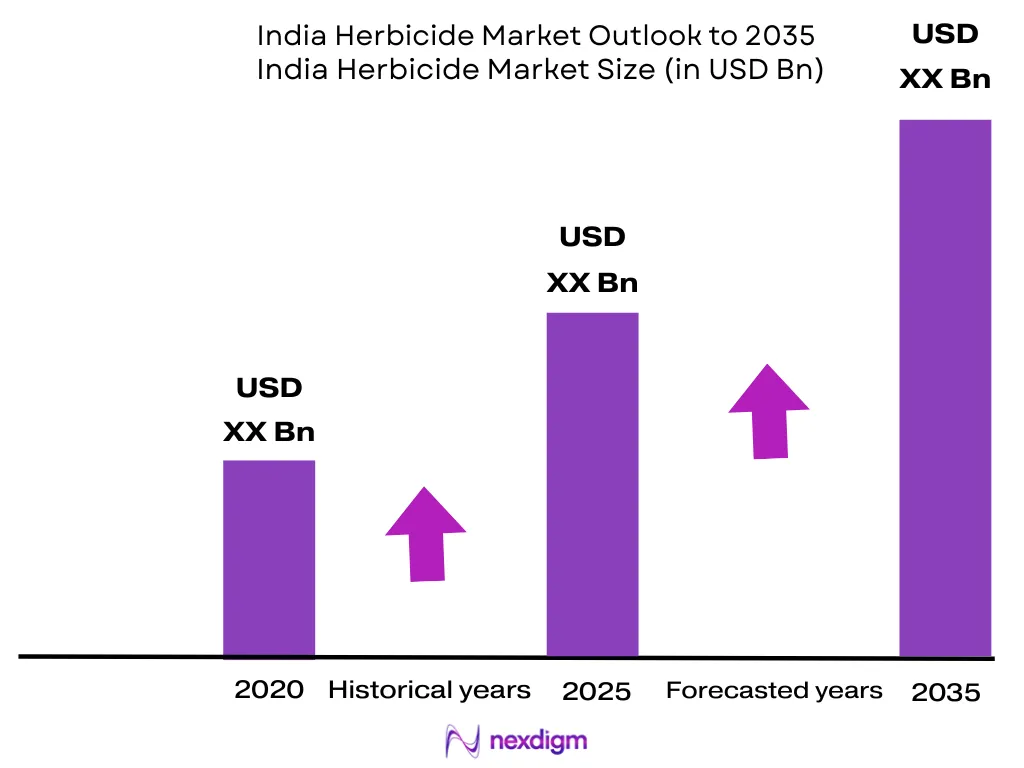
The India Herbicide Market is valued at USD ~ billion, based on historical product-level analysis of India’s pesticide market. Growth is driven by the replacement of manual weeding with chemical weed-control solutions, supported by rising labour costs, weed pressure in cereals and commercial crops, and adoption of mechanised and precision spraying. Herbicides also represent 22% of India’s domestic agrochemical mix, with the category growing at 10% CAGR during the latest available multi-year period. North India and West-Central India dominate the India Herbicide Market because rice, wheat, soybean, cotton and sugarcane cultivation creates high recurring weed-control intensity. Punjab, Haryana and Uttar Pradesh drive cereal herbicide consumption through rice-wheat systems, while Maharashtra, Madhya Pradesh, Gujarat and Telangana are important due to soybean, cotton and sugarcane acreage. Rice production reached 123.8 million metric tons and wheat reached 112 million metric tons in the latest government crop estimate, reinforcing herbicide demand in cereal belts.
Market Segmentation
By Crop Type
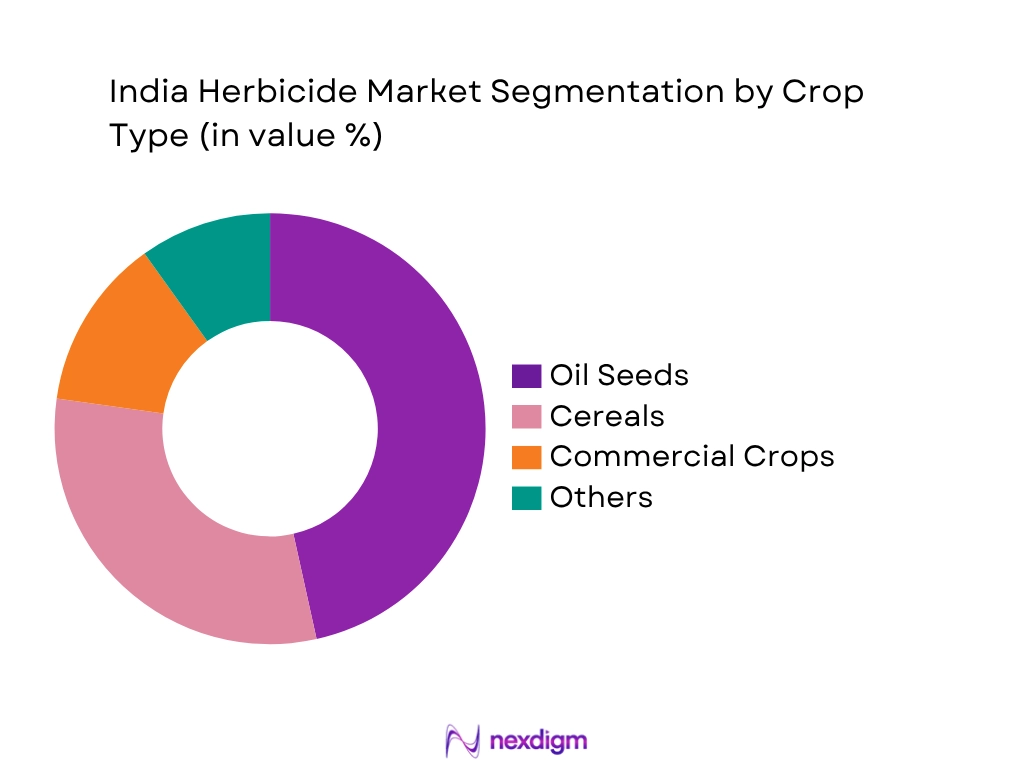
India Herbicide Market is segmented by crop type into cereals & grains, oilseeds & pulses, commercial crops, fruits & vegetables, and plantation & others. Cereals & grains hold the dominant share because rice and wheat cover very large cultivation areas and require repeated weed-control intervention across transplanted paddy, direct-seeded rice and wheat systems. Herbicides such as pretilachlor, butachlor, bispyribac sodium, metsulfuron methyl and 2,4-D are widely used in these crops due to grass weeds and broadleaf weed pressure. The rice-wheat belt also faces high seasonal labour demand, making chemical weed control more economical than manual weeding. Direct-seeded rice adoption, mechanised spraying and crop-establishment changes further support the dominance of cereals & grains in herbicide consumption.
By Herbicide Type
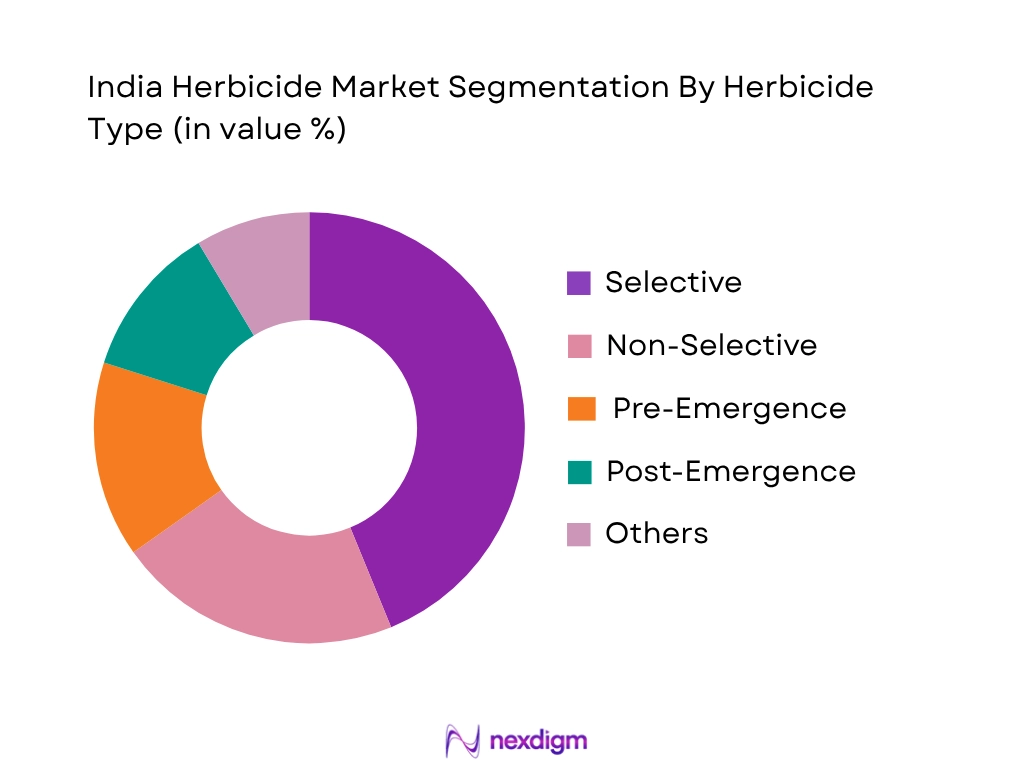
India Herbicide Market is segmented by herbicide type into selective herbicides, non-selective herbicides, pre-emergence herbicides, post-emergence herbicides, and bioherbicides & others. Selective herbicides dominate because India’s herbicide usage is crop-led rather than broad-acre fallow-led, with rice, wheat, soybean, maize and sugarcane requiring crop-safe solutions. Farmers prefer selective molecules where crop injury risk is lower and where labels are available for specific weed-crop combinations. Paddy herbicides such as pretilachlor and bispyribac sodium, wheat herbicides such as metsulfuron and clodinafop, and soybean herbicides such as pendimethalin and imazethapyr collectively create strong selective-herbicide demand. Regulatory scrutiny on some non-selective molecules, especially glyphosate usage restrictions, also supports the relative strength of selective crop-use herbicides.
Competitive Landscape
The India Herbicide Market is moderately consolidated at the branded end but fragmented across generic formulations. Multinational agrochemical companies compete through premium molecules, crop-specific advisory and label-backed products, while Indian companies compete through generic herbicide portfolios, cost-efficient formulation, dealer depth and regional crop clusters. Domestic agrochemical companies also benefit from India’s position as a major agrochemical producer and exporter; India’s domestic agrochemical market was valued at about Rs. 69,000 crore, with exports accounting for 51% by value.
| Company | Establishment Year | Headquarters | Herbicide Portfolio Strength | Key Crop Focus | Manufacturing / Sourcing Position | Distribution Strength | Registration Depth | Strategic Positioning |
| UPL Limited | 1969 | Mumbai, India | ~ | ~ | ~ | ~ | ~ | ~ |
| Bayer CropScience Limited | 1863 | Leverkusen, Germany / India operations in Thane | ~ | ~ | ~ | ~ | ~ | ~ |
| Syngenta India Limited | 2000 | Gurugram, India | ~ | ~ | ~ | ~ | ~ | ~ |
| BASF India Limited | 2000 | Mumbai, India | ~ | ~ | ~ | ~ | ~ | ~ |
| Dhanuka Agritech Limited | 1985 | Gurugram, India | ~ | ~ | ~ | ~ | ~ | ~ |
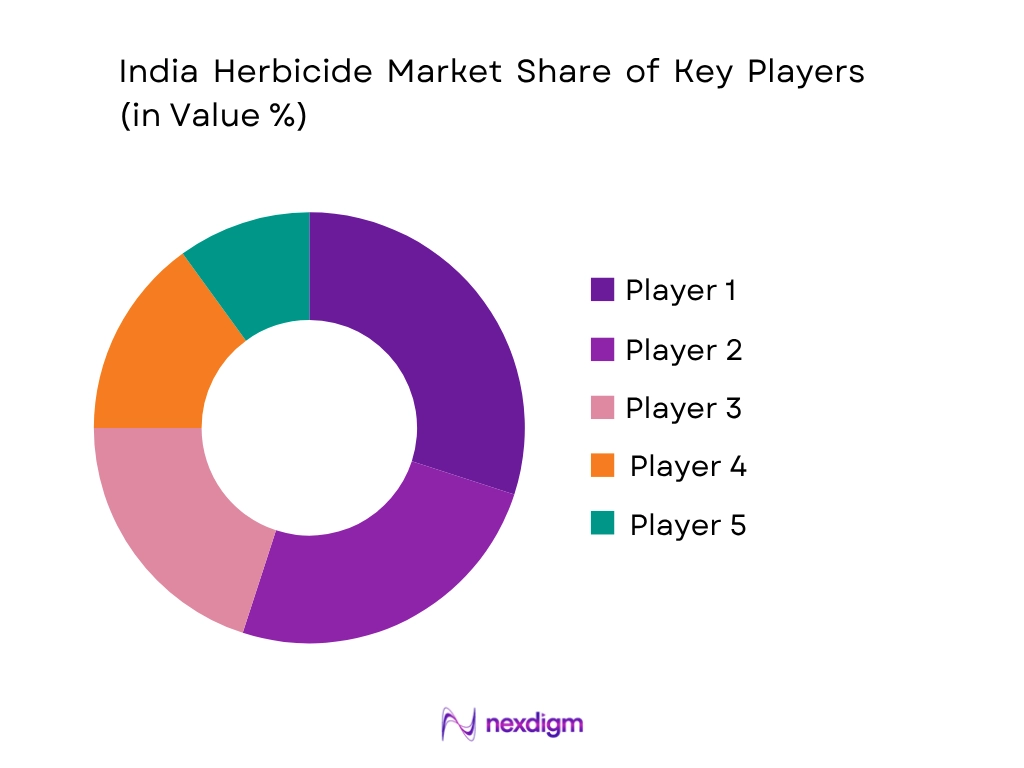
India Herbicide Market Analysis
Growth Drivers
Large Food grain Base is Creating Recurring Herbicide Demand in Rice-Wheat and Pulse Systems
India Herbicide Market is strongly supported by the country’s large crop production base, especially cereals and pulses where pre-emergence and post-emergence weed-control applications are recurring agronomic needs. Total foodgrain production stood at 3,577.32 lakh tonnes in the official final estimate, while cereals alone reached 3,320.50 lakh tonnes, creating a large treated-acreage base for herbicides used in rice, wheat, maize and coarse cereals. Total pulses production reached 256.83 lakh tonnes, supporting demand for selective herbicides used in gram, tur, urad and moong cultivation. This crop base is further supported by India’s macroeconomic scale: World Bank data places India’s GDP at USD 3.91 trillion and GDP per capita at USD 2,694.7, reflecting a large agriculture-linked economy with rising commercialisation of farm inputs. For herbicide suppliers, the key implication is that weed-control adoption is not dependent on one crop alone; it is anchored in multiple high-volume crop systems.
Mechanised and Service-Led Spraying is Expanding the Addressable Base for Herbicide Application
India Herbicide Market is being supported by farm mechanisation, custom hiring and drone-enabled pesticide application because these channels reduce dependence on manual spraying and improve access for small and marginal farmers. The Government’s Namo Drone Didi programme states that 15,000 drones will be provided to selected women self-help groups during 2024-25 to 2025-26 for rental services to farmers. Under crop-residue machinery support, government data shows 1,951,080 agricultural machines distributed and 52,531 custom hiring centres / farm machinery banks established up to 28 February 2025, creating a wider machinery ecosystem that can also support herbicide application services. The World Bank reports India’s rural population at 916,019,293 people, indicating the scale of rural service delivery required for mechanised crop-input application. For herbicide manufacturers, this creates an opportunity to align products with spray-service operators, drone-compatible formulations, crop-specific application protocols and dealer-led mechanisation networks rather than relying only on conventional retailer-to-farmer sales.
Market Challenges
Regulatory and Stewardship Pressure is Rising Due to Chemical Pesticide Use and IPM Prioritisation
India Herbicide Market faces a material challenge from regulatory scrutiny and safer-use expectations because herbicides are part of the larger chemical pesticide ecosystem monitored by the Directorate of Plant Protection, Quarantine & Storage. Chemical pesticide consumption stood at 67,221 MT technical grade in 2024-25, while biopesticide and neem-based pesticide consumption was 7,649 MT in the same period. The same government source notes that Integrated Pest Management is promoted to minimise crop losses while encouraging farmers to use ecologically sustainable pest-management approaches instead of relying only on chemical pesticides. This creates compliance pressure for herbicide companies on label claims, crop-specific dose, safe application, resistance management and farmer training. India’s agriculture, forestry and fishing value added reached USD 639,840,041,516, according to World Bank-linked data, meaning regulatory actions in crop protection affect a very large primary-sector base. For market participants, growth must therefore be tied to stewardship, compliant channels and residue-safe use.
Crop and Regional Volatility Can Distort Herbicide Demand Planning Across Key Crop Clusters
India Herbicide Market is exposed to production volatility across oilseeds, cotton and commercial crops, creating uncertainty in stock planning, molecule selection and regional sales allocation. Official second advance estimates show soybean production at 127.20 lakh tonnes for 2025-26, compared with 152.68 lakh tonnes in 2024-25, while cotton production is placed at 290.91 lakh bales against 297.24 lakh bales in the previous crop estimate. Sugarcane production, however, is estimated at 5,001.97 lakh tonnes, compared with 4,546.11 lakh tonnes earlier, showing that herbicide demand can shift sharply between crop clusters. This creates channel-level risk because soybean herbicides such as imazethapyr and pendimethalin, cotton-linked non-selective uses, and sugarcane herbicides such as atrazine and 2,4-D depend on crop-specific acreage and production conditions. IMF’s latest Article IV notes India’s real GDP growth expected at 6.5 for 2024/25 and 2025/26, but herbicide companies still face localised agricultural volatility beneath national macro stability.
Market Opportunities
Direct-Seeded, Cereal and Pulse Intensification Creates Scope for Crop-Specific Herbicide Programs
India Herbicide Market has a strong opportunity in crop-specific weed-control programs because cereal and pulse production volumes are large enough to support segmented portfolios, dealer training and application calendars. Final estimates place total cereals at 3,320.50 lakh tonnes, total pulses at 256.83 lakh tonnes, tur at 36.24 lakh tonnes, gram at 111.14 lakh tonnes, urad at 22.42 lakh tonnes and moong at 42.44 lakh tonnes. These crops require different herbicide timings, including pre-emergence control in rice and pulses, post-emergence control in wheat, and crop-safe selective molecules for legumes. The macro base is also supportive: World Bank data places India’s population at 1,450,935.79 thousand and GDP per capita at USD 2,694.7, indicating a large food-demand base and improving capacity for input intensification. The opportunity is not generic herbicide volume alone; it lies in building labelled, crop-stage-specific programs for rice, wheat, pulses and maize, combined with stewardship tools that reduce phytotoxicity and improve farmer confidence.
Sustainable Weed-Management and Bio-Input Adjacency Can Create Differentiated Herbicide Portfolios
India Herbicide Market has an opportunity to move from commodity herbicides toward integrated weed-management portfolios that combine safer chemistry, crop-specific advisory, biocontrol awareness and responsible-use positioning. PPQS data shows biopesticide and neem-based pesticide consumption at 7,649 MT in 2024-25, while India has 362 biocontrol laboratories / units, including 37 CIPMCs, 49 ICAR/SAU/DBT units, 98 state biocontrol labs and 141 private-sector labs. For herbicide companies, this does not mean replacing chemical herbicides; it creates scope for differentiated programs around lower-residue crops, export-sensitive horticulture, resistance management and integrated pest-management-compatible recommendations. The same PPQS source states that 87 crop IPM packages have been developed, covering rice, wheat, maize, pulses, cotton, sugarcane, vegetables, fruits and plantation crops. World Bank-linked data places agriculture, forestry and fishing value added at USD 639,840,041,516, supporting the commercial relevance of sustainable crop-protection transitions at scale.
Future Outlook
The India Herbicide Market is expected to expand steadily as growers shift from labour-intensive weeding to chemical and precision weed-control solutions. The market’s forecasted CAGR for the outlook period is 5.8%, supported by labour scarcity in rice-wheat systems, government support for mechanisation, and crop diversification. Future demand will be shaped by direct-seeded rice, soybean acreage, sugarcane mechanisation, drone spraying, and resistance-management herbicide programs. Selective herbicides will continue to gain relevance because crop safety and label-based application are becoming central to farmer adoption. Paddy, wheat, soybean and maize herbicides are expected to benefit from crop-specific recommendations, while ready-mix and sequential herbicide programs will grow as farmers seek wider weed-spectrum coverage. Companies with strong technical sourcing, registration depth, and rural channel control will be better positioned than small generic formulators. Non-selective herbicides will remain relevant in orchards, plantation crops, non-crop areas and pre-plant weed management, but regulatory oversight will influence growth. Glyphosate restrictions and paraquat safety concerns will shift some demand toward safer alternatives, glufosinate-type chemistry, directed spraying and integrated weed management. Bioherbicides will remain a small but emerging niche, mainly supported by residue-sensitive crops, organic farming clusters and sustainability-led procurement.
Major Players
- UPL Limited
- Bayer CropScience Limited
- Syngenta India Limited
- BASF India Limited
- FMC India Private Limited
- Corteva Agriscience India Private Limited
- ADAMA India Private Limited
- Dhanuka Agritech Limited
- Rallis India Limited
- PI Industries Limited
- Sumitomo Chemical India Limited
- Insecticides India Limited
- Crystal Crop Protection Limited
- NACL Industries Limited
- Meghmani Organics Limited
Key Target Audience
- Agrochemical manufacturers
- Herbicide formulators
- Technical-grade pesticide manufacturers
- Crop protection distributors and channel partners
- Agri-input retailers and dealer networks
- Investments and venture capitalist firms
- Government and regulatory bodies
- Drone spraying service providers and farm mechanisation companies
Research Methodology
Step 1: Identification of Key Variables
The initial phase involves mapping the India Herbicide Market ecosystem across technical manufacturers, formulators, importers, distributors, retailers, custom sprayers and farmers. Key variables include crop acreage, herbicide dose per acre, active ingredient pricing, formulation mix, application timing, CIB&RC registrations and regional weed pressure.
Step 2: Market Analysis and Construction
Historical data is compiled through product-level pesticide market analysis, company disclosures, trade statistics, agrochemical demand records and crop production data. The market is constructed using top-down allocation from crop protection chemicals and bottom-up validation through active ingredient consumption, SKU pricing and treated acreage.
Step 3: Hypothesis Validation and Expert Consultation
Market hypotheses are validated through structured interviews with agrochemical companies, distributors, technical suppliers, agronomists, retail dealers and large farmers. These consultations help test assumptions on selective herbicide dominance, crop-wise usage, regional demand intensity, price sensitivity and molecule substitution.
Step 4: Research Synthesis and Final Output
The final phase integrates secondary research, primary interviews and bottom-up modelling into a validated market view. Segment shares are adjusted through triangulation of crop acreage, usage intensity, channel feedback, herbicide type, active ingredient demand and regional application patterns to produce the final report output.

- Executive Summary
- Research Methodology (Market Definition, Herbicide Scope, Active Ingredient Coverage, Technical vs Formulation Mapping, Channel Interviews, Farmer-Level Demand Validation, Distributor Checks, Import-Export Triangulation, CIB&RC Registration Mapping, Molecule-Level Price Benchmarking, Crop Acreage Overlay, Limitations and Forecast Assumptions)

- Definition and Scope
- Market Genesis
- Evolution of Herbicide Adoption in India
- India Herbicide Market Business Cycle
- Herbicide Value Chain Analysis

- Growth Drivers (Labour Scarcity, Rising Manual Weeding Cost, Direct-Seeded Rice Adoption, Mechanised Spraying, Crop Intensification, Farmer Awareness, Dealer-Led Promotion, Yield Protection Economics)
- Market Challenges (Regulatory Restrictions, Glyphosate Channel Limitation, Weed Resistance, Spurious Products, Price Volatility, Farmer Misapplication, Crop Phytotoxicity, Technical Import Dependence)
- Opportunities (New Residual Chemistry, Glyphosate Alternatives, Mechanical and Chemical Integration, Precision Weed Control, Stewardship-Led Branding, Specialist Crop Programmes)
- Market Trends (Ready-Mix Formulations, Post-Emergence Growth, DSR Herbicide Demand, Drone Application, Low-Dose Molecules, Residue and Safety Compliance, Digital Farmer Advisory)
- SWOT Analysis
- Porter’s Five Forces

- By Value (2020-2025)
- By Volume (2020-2025)
- By Average Realisation (2020-2025)

- By Active Ingredient (In Value %)
Glyphosate
Paraquat Dichloride
Pretilachlor
Pendimethalin
Atrazine - By Crop Type (In Value %)
Rice
Wheat
Soybean
Sugarcane - By Sales Channel (In Value %)
Company Distributor
CNF Agent
Agrochemical Retailer
Cooperative Channel - By Region (In Value %)
North India
West India
Central India
South India

- Market Share of Major Players (Value Share, Volume Share, Herbicide Portfolio Share, Crop-Specific Share, Channel Reach)
- Cross Comparison Parameters (Herbicide Active Ingredient Portfolio, CIB&RC Registration Breadth, Crop-Wise Label Claims, Technical Manufacturing Integration, Formulation Capacity, Dealer and Retail Network Depth, Per-Acre Pricing Competitiveness, Resistance Management and Ready-Mix Pipeline)
- SWOT Analysis of Major Players
- Detailed Profiles of Major Companies
UPL Limited
Bayer CropScience Limited
Syngenta India Limited
BASF India Limited
FMC India Private Limited
Corteva Agriscience India Private Limited
ADAMA India Private Limited
Dhanuka Agritech Limited
Rallis India Limited
PI Industries Limited
Sumitomo Chemical India Limited
Insecticides India Limited
Crystal Crop Protection Limited
NACL Industries Limited
Meghmani Organics Limited

- Farmer Demand and Utilisation
- Purchasing Power and Budget Allocation
- Decision-Making Process
- Needs and Pain Points
- Adoption Barriers

- By Value (2026-2035)
- By Volume (2026-2035)
- By Average Realisation (2026-2035)


 Request a Sample
 Ask for Customization
 Get a Quote
 Enquire Now