
 Download PDF
Market Overview
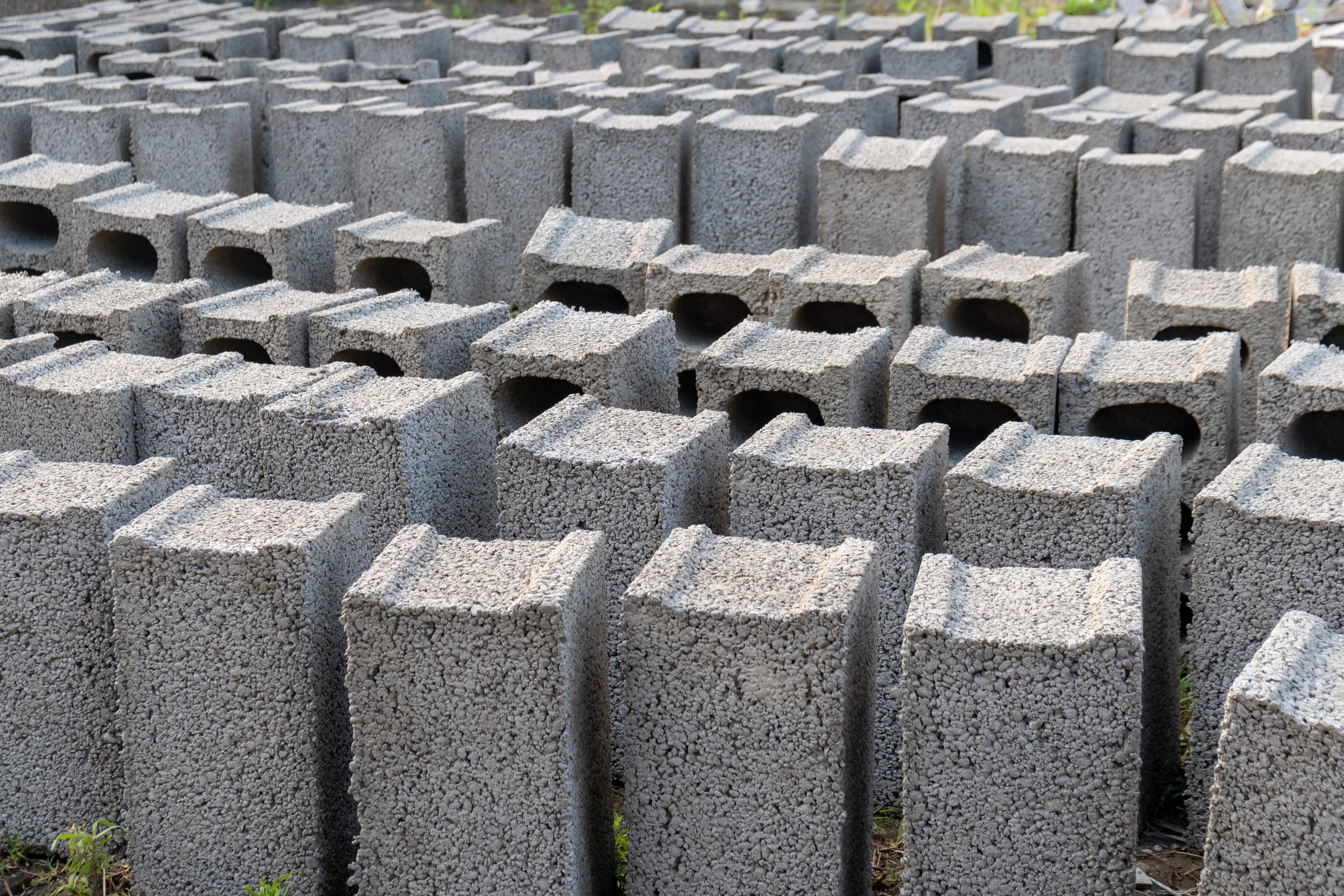
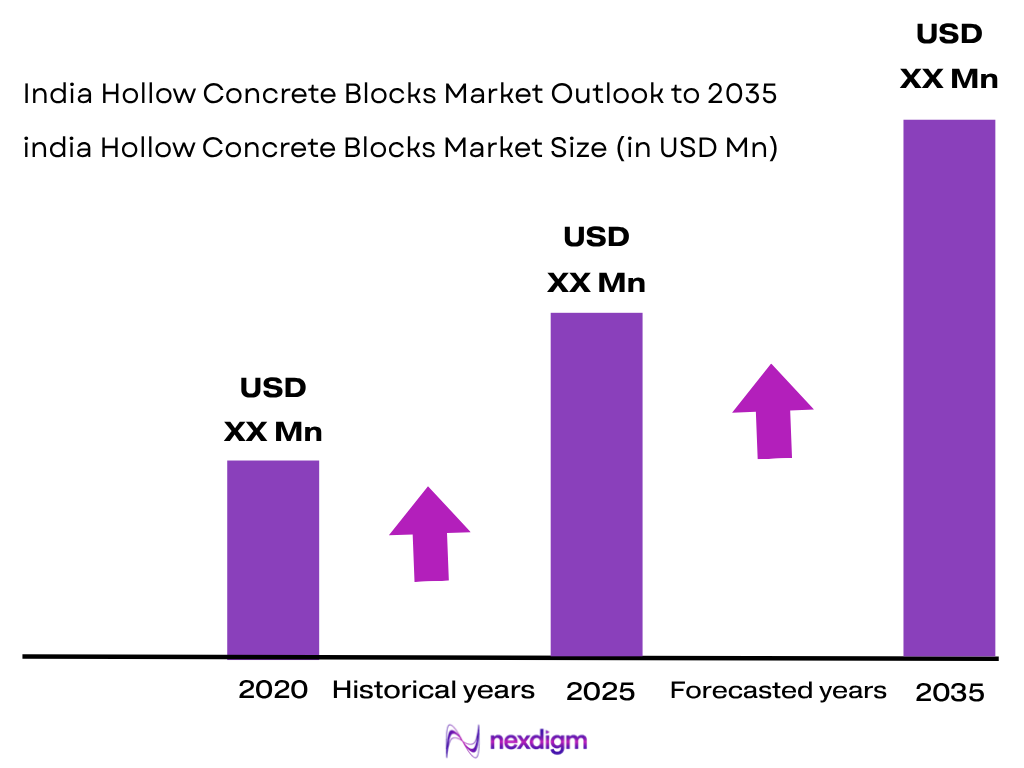
The India Hollow Concrete Blocks Market is valued at approximately USD ~ billion, based on a five-year historical analysis. Demand is supported by residential construction, commercial development, industrial buildings and replacement of conventional masonry materials. India’s cement production increased from approximately 374 million tonnes to 426 million tonnes, while central government capital expenditure increased from approximately INR 7.4 lakh crore to INR 10.0 lakh crore, supporting construction-material consumption and mechanized masonry adoption.
Maharashtra, Karnataka, Tamil Nadu, Telangana, Gujarat and Uttar Pradesh are important demand centers for the India Hollow Concrete Blocks Market because of their extensive housing, commercial, industrial and infrastructure construction ecosystems. India’s urban population increased from approximately 508 million people to 522 million people, while cement production increased from approximately 374 million tonnes to 426 million tonnes. Mumbai-Pune, Bengaluru, Hyderabad, Chennai and Ahmedabad additionally support hollow-block demand through high-rise, warehouse, industrial and institutional construction.
Market Segmentation
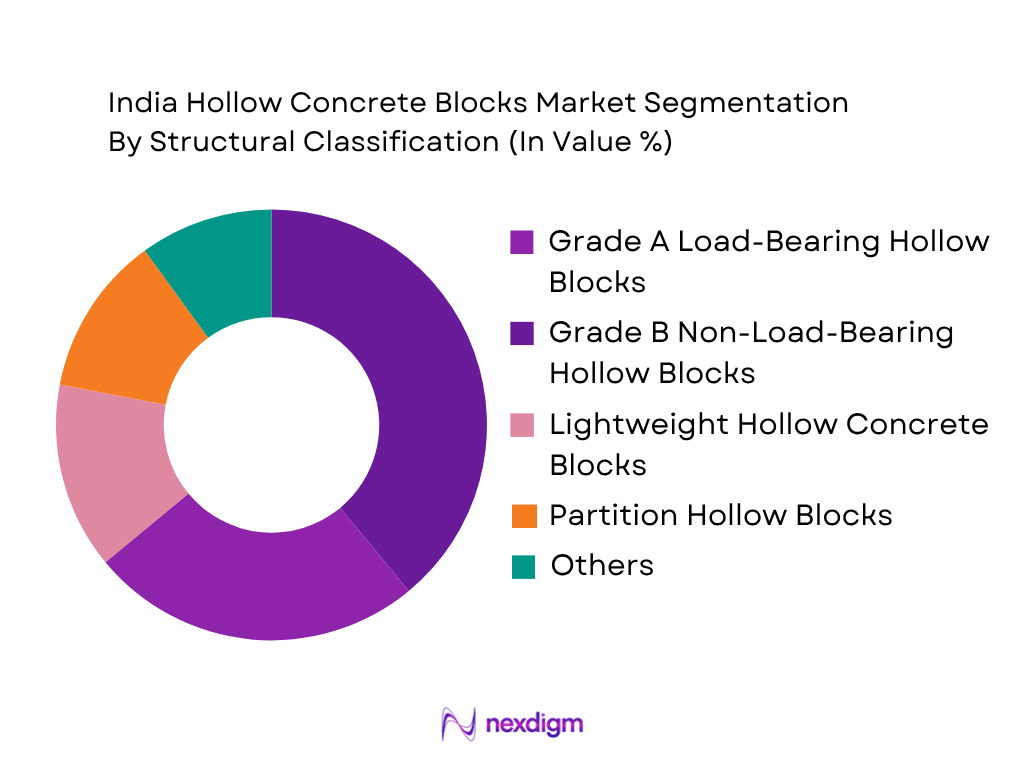
By Structural Classification
By Structural Classification: The India Hollow Concrete Blocks Market is segmented into Grade A load-bearing hollow concrete blocks, Grade B non-load-bearing hollow concrete blocks, lightweight hollow concrete blocks, partition blocks and specialty concrete masonry units. Recently, Grade A load-bearing hollow concrete blocks have a dominant market share in India under structural-classification segmentation in this report framework because their applications extend across external walls, structural masonry, low-rise construction, industrial buildings, boundary walls and selected institutional projects. IS 2185 Part 1 establishes the relevant framework for hollow and solid concrete blocks and differentiates concrete masonry according to structural and density requirements. Grade A blocks provide manufacturers with flexibility across multiple strength classifications while retaining hollow cavities that reduce material consumption relative to comparable solid units. Grade B products remain relevant for non-load-bearing walls and partitions, particularly where the masonry primarily functions as an enclosure rather than as a structural element.
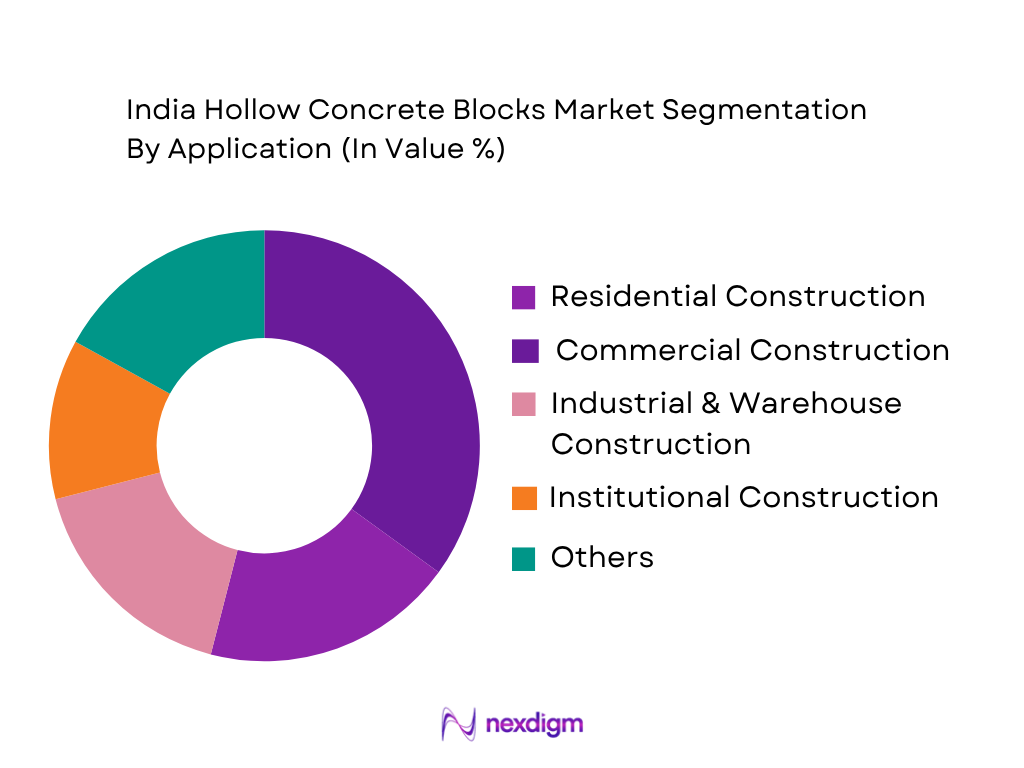
By Application
The India Hollow Concrete Blocks Market is segmented by application into residential buildings, commercial buildings, industrial and warehouse facilities, institutional construction, government buildings and other applications. Recently, residential construction has a dominant market share in India under application segmentation in this report framework because hollow concrete blocks can be used for external walls, internal partitions, compound walls and low-rise structural masonry. Rapid urban development also creates demand for standardized walling products that can reduce individual masonry-unit counts and support faster wall construction. Commercial and institutional projects provide additional opportunities where dimensional consistency and standardized wall thickness are important. Industrial and warehouse developments represent another strategic application because manufacturers can supply large quantities directly to projects within economical transportation distances. Competition remains strong from AAC blocks, fly-ash bricks and conventional clay bricks, making regional availability, compressive strength, block dimensions, breakage and contractor familiarity critical purchasing considerations.
Competitive Landscape
The India Hollow Concrete Blocks Market is fragmented, combining organized building-material companies with regional hollow-block manufacturers and project-focused concrete-product suppliers. Competition is strongly localized because block transportation economics favor production near construction centers. UltraTech Building Products, Nuvoco, Godrej Construction and specialized regional manufacturers participate across the broader engineered walling and concrete-products ecosystem, while numerous local plants compete through contractor relationships, customized dimensions, direct project supply and proximity to construction sites.
| Major Player | Establishment Year | Headquarters | Hollow/Concrete Masonry Exposure | IS-Compliant Product Capability | Automated Manufacturing | Fly-Ash/GGBS Capability | Project Supply Capability |
| UltraTech Cement | 1983* | Mumbai, Maharashtra | ~ | ~ | ~ | ~ | ~ |
| Nuvoco Vistas | 1999* | Mumbai, Maharashtra | ~ | ~ | ~ | ~ | ~ |
| Godrej Construction | 1985 | Mumbai, Maharashtra | ~ | ~ | ~ | ~ | ~ |
| Magicrete | 2008 | Surat, Gujarat | ~ | ~ | ~ | ~ | ~ |
| Conecc Concrete Solutions | 2016 | Bengaluru, Karnataka | ~ | ~ | ~ | ~ | ~ |
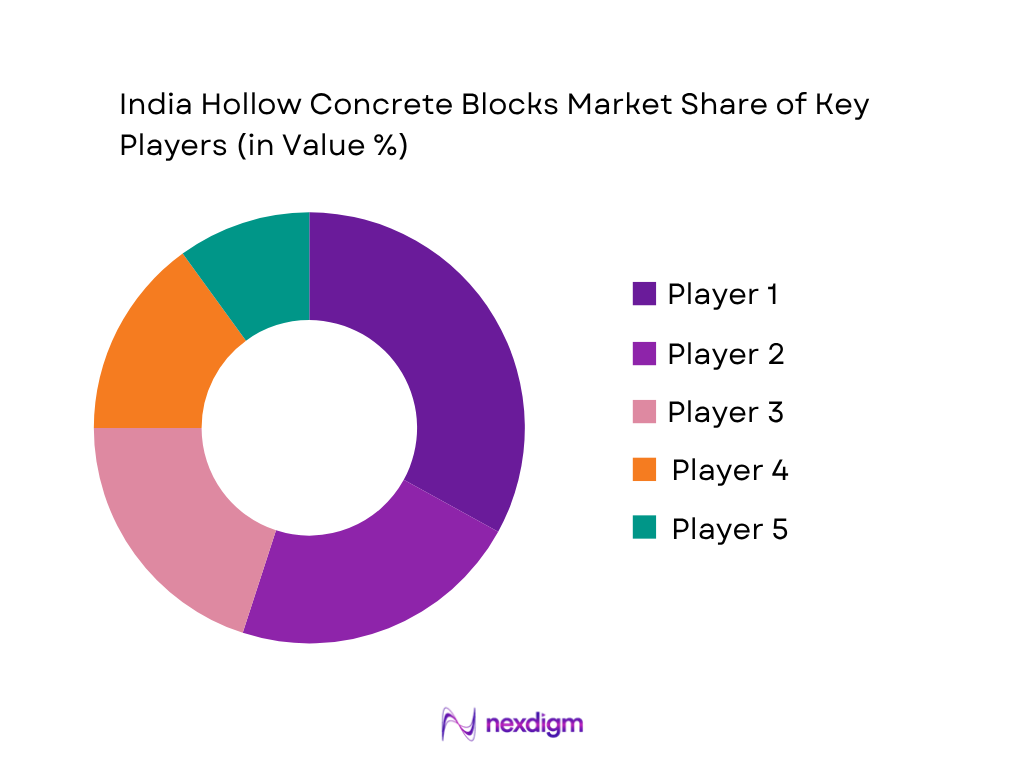
India Hollow Concrete Blocks Market Analysis
Growth Drivers
Urban Housing Construction and Affordable Housing Expansion
Urban and affordable housing activity provides a substantial demand foundation for the India Hollow Concrete Blocks Market because hollow blocks are applicable to external walls, internal partitions, compound walls and selected load-bearing masonry systems. In 2024, India’s PMAY-Urban program had 118.64 lakh houses sanctioned, 114.33 lakh houses grounded for construction and 85.04 lakh houses completed, creating a large installed pipeline of pucca housing where standardized walling materials can compete with clay bricks, fly-ash bricks and AAC blocks. The housing ecosystem extends beyond urban areas: as of December 2024, PMAY-Gramin had 3.22 crore houses sanctioned and 2.68 crore houses completed, demonstrating the scale at which masonry-intensive housing construction operates nationally. Under the urban program alone, sanctioned projects represented approximately ₹8.07 lakh crore of total investment in 2024. These figures are particularly relevant for hollow concrete block manufacturers because housing projects require high volumes of repeatable walling units and can support direct supply arrangements between block plants, developers and contractors. The broader macroeconomic environment also supported construction demand: India recorded USD 3.9099 trillion of GDP in 2024, while GDP per capita reached USD 2,694.7. More importantly for walling-material demand, construction generated ₹11.975 lakh crore of gross value added during April-September 2024, compared with ₹10.933 lakh crore during the corresponding preceding period. Hollow concrete blocks can benefit from this expanding construction base because standardized 100 mm, 150 mm and 200 mm units can serve partition, infill and external-wall applications across apartment projects and affordable housing. Hollow cavities reduce the amount of concrete required within each masonry unit relative to comparable solid units and can reduce wall dead load, an increasingly relevant consideration in multistorey construction. Their larger dimensions can also reduce the number of individual masonry units and joints required for a given wall area compared with conventional small-format clay bricks, supporting faster wall execution where contractor practices are aligned with concrete masonry. The demand opportunity is not confined to metropolitan high-rise projects. PMAY-Urban covered statutory towns and planning or development authority areas, while PMAY-Gramin extended the housing construction base across rural India. This geographic breadth supports localized block manufacturing because hollow concrete blocks are economically suited to regional production and short-to-medium delivery radii. Cement availability further strengthens the manufacturing ecosystem: India produced 453.572 million tonnes of cement during April 2024-March 2025, providing a deep domestic cementitious-material base for concrete masonry, precast products and other construction materials. Consequently, urbanization, affordable housing, pucca-house construction and the scale of India’s construction economy collectively create a measurable demand platform for hollow concrete blocks, particularly for manufacturers capable of supplying dimensionally consistent, strength-tested units close to major housing clusters.
Commercial, Industrial, Warehouse and Institutional Construction
Expansion of India’s broader construction economy is a second major driver for hollow concrete blocks because demand extends beyond residential walls into factories, warehouses, commercial properties, hospitals, government buildings, utility structures and institutional developments. Construction gross value added reached ₹11.975 lakh crore during April-September 2024, while manufacturing gross value added reached ₹19.457 lakh crore during the same period. The combination is important for hollow concrete block demand: construction activity creates direct masonry consumption, while an expanding manufacturing base generates factories, ancillary buildings, storage facilities, utility rooms and industrial infrastructure requiring durable walling systems. India’s overall GDP reached USD 3.9099 trillion in 2024, with real economic growth recorded at 6.5 on the World Bank’s annual growth measure. Hollow concrete blocks are well positioned within industrial and institutional construction because manufacturers can offer Grade A load-bearing units, Grade B non-load-bearing units and different wall thicknesses for external walls, internal partitions, service areas, boundary walls and utility buildings. Material availability supports this production model. All-India cement production reached 453.572 million tonnes during April 2024-March 2025, including 435.891 million tonnes from the private sector and 17.681 million tonnes from mini and white-cement production categories recorded in the relevant official production series. Production momentum continued into 2025: India manufactured 193.10 million tonnes of cement during April-August 2025, compared with 178.52 million tonnes during April-August 2024. This scale of cement production matters directly to hollow concrete blocks because cement is the principal binding input used with crushed aggregates, manufactured sand, fly ash, GGBS and admixtures in vibro-pressed concrete masonry. Industrial and warehouse developments can be especially attractive to regional block manufacturers because such projects often require large quantities of repetitive masonry delivered over concentrated construction schedules. Blocks can be supplied for perimeter walls, internal partitions, utility enclosures, ancillary structures, pump rooms, security buildings and other non-specialized wall applications. Institutional projects similarly provide demand for durable masonry in corridors, service areas, external envelopes and partitions where resistance to impact and routine wear is important. The growth of industrial construction also encourages investment in automated hollow-block manufacturing. Large vibro-press plants can standardize batching, moisture control, compaction and mould filling, enabling producers to supply contractors that require repeatable dimensions and compressive strength across substantial project volumes. India’s steel production index also rose from 200.4 in 2023-24 to 214.1 in 2024-25, while the cement index increased from 185.7 to 197.4, providing additional evidence of active construction-material production. For hollow-block manufacturers, this combination of commercial construction, industrial investment, institutional demand and a large domestic cement ecosystem supports expansion beyond fragmented residential retail sales toward direct project procurement and contractor-led bulk supply.
Market Challenges
AAC Blocks, Fly-Ash Bricks and Conventional Clay Masonry Competition
The India Hollow Concrete Blocks Market operates within one of the country’s most diverse walling-material environments, where concrete blocks compete directly with AAC blocks, fly-ash bricks, burnt clay bricks and solid concrete masonry. The scale of housing and construction demand attracts multiple walling technologies rather than guaranteeing adoption of hollow concrete blocks. In July 2024, PMAY-Urban alone had 118.64 lakh houses sanctioned, 114.33 lakh grounded and 85.04 lakh completed, while PMAY-Gramin had 3.22 crore houses sanctioned and 2.68 crore completed by December 2024. These numbers indicate the enormous addressable walling-material requirement, but they simultaneously create strong incentives for AAC, fly-ash brick and conventional brick producers to expand distribution. Hollow concrete block manufacturers therefore compete on project-level factors such as unit dimensions, wall weight, compressive strength, water absorption, breakage, mortar consumption, plaster requirements, installation productivity and local availability rather than merely on construction growth. Cement dependence also differentiates hollow blocks from alternative masonry systems. India produced 453.572 million tonnes of cement during April 2024-March 2025, including 46.820 million tonnes in March 2025 alone. While this deep supply base supports hollow-block manufacturing, cement remains a fundamental material input whose quality and availability directly influence block strength and production consistency. AAC producers, meanwhile, compete through lightweight units and large block dimensions, while fly-ash brick producers can position products around industrial by-product utilization. Conventional clay bricks retain advantages derived from established mason familiarity and extensive local distribution in many states. Hollow concrete blocks must therefore establish clearer application-specific advantages. Grade A units can target structural and higher-strength applications, while Grade B products can address partitions and non-load-bearing walls. Lightweight hollow blocks can reduce handling weight, and optimized cavities can reduce concrete consumption while maintaining required performance. Macroeconomic expansion does not eliminate this substitution challenge: India’s GDP stood at USD 3.9099 trillion in 2024, and construction GVA reached ₹11.975 lakh crore during April-September 2024, meaning alternative walling-material suppliers are competing within a large and attractive construction economy. The challenge becomes particularly acute in high-rise infill applications, where AAC blocks have strong relevance because reducing wall dead load is valuable. Hollow concrete block producers need to respond through optimized wall thicknesses, lightweight aggregates, better dimensional accuracy and technical documentation. In affordable housing, contractors may prioritize locally available materials and familiar construction methods, making distribution density and mason acceptance equally important. Consequently, substitution is not simply a product-performance issue; it is a competition between complete wall systems involving block weight, installation method, mortar, plaster, structural loading, supply reliability and contractor productivity.
Fragmented Manufacturing, Quality Consistency and Transportation Constraints
The fragmented nature of Indian hollow concrete block manufacturing creates a significant challenge because market performance depends on thousands of localized production and construction decisions rather than a uniform national supply structure. Hollow blocks are heavy products, and transportation economics encourage plants to serve relatively localized construction clusters. This becomes important against the scale of India’s building pipeline: PMAY-Urban had 114.33 lakh houses already grounded for construction in July 2024, while the rural housing program had 3.22 crore sanctioned houses by December 2024. Serving such geographically dispersed demand requires manufacturing capacity near end markets, but smaller regional plants can differ considerably in batching precision, aggregate grading, curing discipline, mould condition and quality-control practices. Cement production itself is not the principal capacity constraint nationally: India produced 453.572 million tonnes during April 2024-March 2025, and production reached 193.10 million tonnes during April-August 2025. The challenge is converting available cement, manufactured sand, aggregates and supplementary cementitious materials into blocks with consistent compressive strength, density, dimensional tolerance, water absorption and surface quality. Inadequate moisture control during batching can affect compaction, while poorly graded aggregates can influence surface finish and strength. Insufficient curing can produce blocks that enter construction sites before developing appropriate performance, increasing breakage and rejection risks. Dimensional inconsistency also has downstream consequences because deviations can increase mortar-joint variability and plaster requirements and reduce masonry productivity. The scale of India’s construction economy intensifies the requirement for standardization: construction GVA reached ₹11.975 lakh crore during April-September 2024, and manufacturing GVA reached ₹19.457 lakh crore in the same period. Larger developers and EPC contractors operating within this environment increasingly require predictable supply across thousands of units rather than accepting variable local production. Transportation adds another constraint. Hollow blocks occupy substantial truck volume and have enough unit weight that long-distance distribution can reduce their competitiveness against walling materials manufactured closer to a project. Loading, stacking and unloading practices also affect breakage, making logistics quality part of the delivered product proposition. Automated vibro-press equipment, controlled batching and mechanized handling can improve consistency, but producers must maintain sufficient plant utilization to justify such equipment. Regional manufacturers therefore face a structural balancing problem: plants need to be sufficiently close to construction demand to manage logistics while achieving enough throughput to support quality-control systems, curing infrastructure, mould maintenance and automation. This fragmentation makes certified performance, batch testing, dealer networks and dependable project delivery increasingly important differentiators.
Market Opportunities
High-Strength, Lightweight and Low-Carbon Hollow Concrete Blocks
Product engineering provides a substantial future opportunity for the India Hollow Concrete Blocks Market because the existing construction and cement ecosystem is large enough to support greater differentiation beyond conventional hollow masonry. India produced 453.572 million tonnes of cement during April 2024-March 2025, while cement output reached 193.10 million tonnes during April-August 2025. This domestic material base gives block manufacturers scope to develop specialized formulations using Portland cement, blended cement, manufactured sand, selected fly ash, GGBS and lightweight aggregates where technically suitable. The opportunity is particularly relevant because India’s construction GVA reached ₹11.975 lakh crore during April-September 2024, creating a substantial project base in which engineered masonry products can be specified. High-strength Grade A hollow blocks can address load-bearing masonry, industrial structures, external walls and applications requiring greater compressive performance. Lightweight hollow units can target high-rise infill and partition applications where reducing wall dead load is commercially important. These products can be designed around optimized cavities and carefully selected aggregates while retaining the dimensional standardization required for efficient masonry. Low-carbon formulations create another development pathway. Cement remains a major constituent of conventional concrete blocks, so manufacturers can investigate optimized binder content and technically suitable supplementary cementitious materials without compromising required block performance. The opportunity should be understood in the context of production scale rather than hypothetical future demand. India’s cement-production index reached 197.4 in 2024-25, compared with 185.7 in 2023-24, and the steel-production index reached 214.1, indicating a construction-material ecosystem capable of supporting more sophisticated manufactured products. Hollow blocks incorporating fly ash or GGBS can also provide manufacturers with a stronger resource-efficiency proposition than undifferentiated commodity blocks. Automated plants are particularly well positioned because precise batching, moisture control and vibro-compression allow mix designs to be reproduced more consistently than highly manual production. Product documentation can become another differentiator: compressive strength, block density, dimensional tolerances, water absorption, drying shrinkage and moisture movement can be systematically recorded for institutional customers. Lightweight products can additionally address contractor handling, while high-strength units can target applications where AAC or low-strength masonry is less suitable. The opportunity is therefore to move hollow concrete blocks from a predominantly local commodity product toward a family of engineered masonry units differentiated by strength, density, carbon intensity, wall thickness and application. Manufacturers that combine material optimization with standardized manufacturing can potentially compete across both conventional masonry replacement and higher-value engineered wall systems.
Automated Manufacturing, High-Rise Infill, Industrial Warehousing and Affordable Housing
The scale and diversity of India’s active building pipeline create a future opportunity for hollow concrete block producers that can industrialize production and align plants with high-volume construction clusters. In 2024, PMAY-Urban had 118.64 lakh houses sanctioned and 114.33 lakh grounded, while 85.04 lakh houses had already been completed. PMAY-Urban 2.0 was subsequently launched in 2024, establishing a new institutional framework for affordable urban housing, while the existing rural housing program had 3.22 crore sanctioned houses and 2.68 crore completed houses by December 2024. These current figures demonstrate the depth of India’s housing ecosystem without requiring future market projections. The opportunity for hollow-block manufacturers is to develop production models capable of supplying repetitive masonry units at project scale. Automated batching systems can control cement, aggregate, M-sand and water inputs; vibro-press machines can improve compaction consistency; standardized moulds can produce 100 mm, 150 mm and 200 mm walling units; and mechanized pallet handling can reduce damage between production and dispatch. Such capabilities are particularly relevant for high-rise residential and commercial projects where developers require predictable wall dimensions and delivery schedules. India’s construction GVA of ₹11.975 lakh crore during April-September 2024 demonstrates the size of the construction activity supporting these applications, while manufacturing GVA of ₹19.457 lakh crore indicates a substantial industrial economy generating factories, warehouses and ancillary facilities. Cement production of 453.572 million tonnes during April 2024-March 2025 further provides the raw-material foundation for scaled concrete masonry production. Industrial and warehouse projects represent an attractive application because large wall areas can support bulk procurement from plants positioned near industrial corridors. Hollow blocks can be used for internal partitions, external masonry, utility rooms, security buildings, compound walls and ancillary facilities. Affordable housing offers a different but complementary opportunity: standardized dimensions and larger masonry units can support repetitive construction where project designs are replicated across multiple dwellings. High-rise infill creates scope for lightweight hollow blocks designed to reduce wall dead load, while architectural blocks can address projects seeking exposed or differentiated concrete-masonry surfaces. The strongest future opportunity therefore lies not in simply adding more small block yards, but in building regional automated plants around dense construction corridors, maintaining documented product quality and integrating direct project supply with dealer distribution. This model can improve consistency, reduce breakage, support specialized block grades and allow hollow concrete blocks to compete more effectively with AAC, fly-ash bricks and traditional clay masonry across India’s evolving construction sector.
Future Outlook
The India Hollow Concrete Blocks Market is expected to expand at approximately ~% CAGR during 2026–2035, based on the report framework. Future development will depend on urban housing, industrial facilities, warehouses, commercial buildings and increasing adoption of engineered walling materials. Automated block manufacturing and greater use of manufactured sand should improve product consistency. Low-carbon cementitious blends, lightweight blocks and stronger quality standardization can further differentiate manufacturers from conventional masonry suppliers. The transition toward more mechanized construction-material production provides an important opportunity. Automated batching, vibro-compression and controlled curing can improve dimensional consistency and reduce variability between production batches. Manufacturers that demonstrate reliable compliance with applicable BIS requirements can strengthen relationships with institutional developers and large contractors.
Major Players
- UltraTech Cement Limited – Building Products Division
- Nuvoco Vistas Corporation Limited
- Godrej & Boyce Manufacturing Company Limited – Godrej Construction
- Magicrete Building Solutions Private Limited
- Biltech Building Elements Limited
- Buildmate Projects Private Limited
- Siporex India Private Limited
- Renacon AAC Blocks Private Limited
- Conecc Concrete Solutions Private Limited
- Finecrete Eco-Blocks Private Limited
- KJS Concrete Private Limited
- Sakthivel Precast Industries
- Parshwa Cement Products
- Chauhan Concrete Works
- Raja Brick & Tile Industries
Key Target Audience
- Hollow Concrete Block and Concrete Masonry Manufacturers
- Cement, Aggregate and M-Sand Producers
- Real Estate Developers and Property Groups
- EPC Contractors and General Building Contractors
- Building Material Distributors and Dealers
- Industrial and Warehouse Developers
- Investments and Venture Capitalist Firms
- Government and Regulatory Bodies (Bureau of Indian Standards, Ministry of Housing and Urban Affairs, Ministry of Environment Forest and Climate Change, Central Public Works Department)
Research Methodology
Step 1: Identification of Key Variables
The initial phase involves constructing an ecosystem map encompassing cement manufacturers, aggregate suppliers, block producers, machinery suppliers, dealers, developers and contractors within the India Hollow Concrete Blocks Market. Critical variables include block grades, density, dimensions, manufacturing capacity, raw-material composition, plant technology, regional construction activity, applications and competing walling products.
Step 2: Market Analysis and Construction
Historical India Hollow Concrete Blocks Market information is analyzed using construction activity, housing development, cement consumption, walling-material demand and manufacturer-level indicators. Top-down analysis evaluates India’s residential, commercial and industrial construction ecosystem, while bottom-up analysis assesses regional block plants, production capacities, product specifications, project supply and distribution channels to construct the market framework.
Step 3: Hypothesis Validation and Expert Consultation
Market hypotheses are validated through CATIs and structured interviews with hollow-block manufacturers, building-material dealers, contractors, developers, architects and raw-material suppliers. Consultations evaluate plant utilization, Grade A and Grade B demand, block dimensions, raw-material mixes, project procurement, transportation constraints and competition from AAC blocks, fly-ash bricks and clay bricks.
Step 4: Research Synthesis and Final Output
The final phase triangulates manufacturer information, construction indicators, BIS specifications, regional supply conditions and primary industry findings. Bottom-up plant and manufacturer assessments are reconciled with top-down construction demand to establish the India Hollow Concrete Blocks Market framework. Forecast assumptions incorporate urban housing, industrial construction, M-sand adoption, automated production, engineered masonry and lower-carbon cementitious materials.

- Executive Summary
- Research Methodology (Market Definitions and Assumptions, Hollow Concrete Block Classification, IS 2185 Product Mapping, Grade A and Grade B Assessment, Load-Bearing and Non-Load-Bearing Block Assessment, Block Density Mapping, Nominal Dimension Mapping, Manufacturing Plant Assessment, Installed Block-Making Capacity, Cement Consumption Assessment, Aggregate Consumption Assessment, Fly-Ash Utilization Assessment, Construction Activity Mapping, Housing Demand Assessment, Commercial Construction Assessment, Industrial Construction Assessment, Supply-Side Assessment, Demand-Side Assessment, Top-Down Market Sizing, Bottom-Up Manufacturer Assessment, Dealer and Contractor Interviews, Data Triangulation, Forecasting Framework)

- Definition and Scope
- India Hollow Concrete Block Industry Evolution
- Development of Concrete Masonry Units, Open-Cavity Blocks, Closed-Cavity Blocks, Load-Bearing Hollow Blocks, Non-Load-Bearing Hollow Blocks, Lightweight Hollow Blocks and Architectural Concrete Blocks
- Hollow Concrete Block Industry Value Chain Analysis
- Hollow Concrete Block Supply Chain Analysis

- Growth Drivers (Urban Housing Construction, Commercial Real Estate Development, Industrial and Warehouse Construction, Affordable Housing, Faster Wall Construction, Reduced Dead Load, Lower Mortar Consumption, M-Sand Availability, Fly-Ash Utilization, High-Rise Infill Wall Demand, Institutional Construction, Replacement of Conventional Clay Brick Masonry)
- Market Challenges (AAC Block Competition, Fly-Ash Brick Competition, Traditional Clay Brick Availability, Fragmented Regional Manufacturing, Inconsistent Block Quality, Cement Input Exposure, Aggregate Quality Variation, Transportation Radius, Low Plant Capacity Utilization, Contractor Awareness, Water Absorption Control, Dimensional Consistency)
- Market Opportunities (High-Strength Grade A Blocks, Lightweight Hollow Blocks, Fly-Ash-Blended Blocks, GGBS-Blended Blocks, Low-Carbon CMU, Automated Block Manufacturing, High-Rise Infill Applications, Industrial Warehousing, Affordable Housing, Insulated Hollow Blocks, Architectural Blocks, Recycled-Aggregate Blocks)
- Market Trends (Shift from Clay Bricks to Engineered Masonry, M-Sand Integration, Automated Vibro-Press Manufacturing, Fly-Ash Incorporation, Hollow-Core Optimization, Higher Dimensional Accuracy, Ready-Mix Concrete Integration, Low-Carbon Cementitious Blends, Mechanized Material Handling, Project-Level Bulk Procurement)
- Government Regulations and Standards (IS 2185 Part 1 Hollow and Solid Concrete Blocks, IS 2185 Part 2 Lightweight Concrete Blocks, IS 383 Concrete Aggregates, IS 456 Concrete Code, IS 10262 Concrete Mix Proportioning, BIS Product Testing Requirements, Compressive Strength Requirements, Water Absorption Requirements, Drying Shrinkage Requirements, Moisture Movement Requirements, Dimensional Tolerance Requirements, Fly-Ash Utilization Requirements, State Building Codes)
- SWOT Analysis
- Porter’s Five Forces Analysis
- PESTLE Analysis
- Stakeholder Ecosystem
- Competition Ecosystem

- By Market Value (2020-2025)
- By Hollow Concrete Block Production Volume (2020-2025)
- By Hollow Concrete Block Consumption Volume (2020-2025)
- By Installed Manufacturing Capacity (2020-2025)
- By Effective Production Capacity (2020-2025)
- By Capacity Utilization (2020-2025)
- By Grade A Hollow Block Volume (2020-2025)

- By Block Classification (In Value %)
Grade A Load-Bearing Hollow Concrete Blocks
Grade B Load-Bearing Hollow Concrete Blocks
Non-Load-Bearing Hollow Concrete Blocks
Lightweight Hollow Concrete Blocks
Specialty Hollow Concrete Masonry Units - By Block Width and Nominal Size (In Value %)
50–75 mm Partition Blocks
100 mm Hollow Concrete Blocks
150 mm Hollow Concrete Blocks
200 mm Hollow Concrete Blocks
250 mm Hollow Concrete Blocks
300 mm Hollow Concrete Blocks
Special-Size and Half-Length Blocks - By Raw Material and Aggregate Type (In Value %)
Natural Aggregate Hollow Concrete Blocks
Manufactured-Sand-Based Hollow Blocks
Fly-Ash-Containing Hollow Concrete Blocks
Lightweight Aggregate Hollow Blocks
Recycled Aggregate Concrete Blocks
Blended Cementitious Hollow Blocks - By Application (In Value %)
Load-Bearing Walls
External Infill Walls
Internal Partition Walls
Boundary and Compound Walls
Industrial and Warehouse Walls
Institutional Building Walls
Infrastructure and Utility Structures - By End-Use Construction (In Value %)
Residential Housing
Commercial and Mixed-Use Buildings
Industrial Factories and Warehouses
Institutional and Public Buildings
Hospitality and Healthcare Buildings
Infrastructure and Ancillary Construction - By Manufacturing Technology (In Value %)
Semi-Automatic Vibro-Press Manufacturing
Fully Automatic Vibro-Press Manufacturing
Hydraulic Press Block Manufacturing
Stationary Concrete Block Production
Mobile and Egg-Laying Block Production
Automated Batching and Material-Handling Systems
Steam/Controlled-Curing Production - By Customer Type (In Value %)
General Building Contractors
Industrial and Warehouse Developers
Individual House Builders
Government and Public Works Contractors
Institutional Construction Contractors
Building Material Dealers and Distributors - By Distribution Channel (In Value %)
Direct Project Sales
Authorized Dealers and Distributors
Building Material Retailers
Contractor Procurement
Institutional and Government Procurement
Factory-Direct Regional Sales - By Region (In Value %)
North India
South India
West India
East India
Central India
Northeast India

- Market Share of Major Players (By Market Value, Production Volume, Installed Capacity, Hollow Block Portfolio, Geographic Presence, Project Sales, Dealer Network, Construction Segment Exposure)
- Cross Comparison Parameters (Installed Hollow Block Manufacturing Capacity, IS 2185 Grade A and Grade B Product Coverage, 100-300 mm Block Size Portfolio, Normal-Weight and Lightweight Block Capability, Fly-Ash/GGBS and Low-Carbon Mix Capability, Automated Vibro-Press Manufacturing Capability, Plant-to-Project Distribution and Dealer Reach, Residential-Commercial-Industrial Project Penetration)
- SWOT Analysis of Major Players (Manufacturing Scale, Product Quality, Regional Footprint, Dealer Network, Raw-Material Integration, Project Relationships)
- Detailed Profiles of Major Companies
UltraTech Cement Limited – Building Products Division
Nuvoco Vistas Corporation Limited – Construction Development and Innovation Centre / Building Materials
Godrej & Boyce Manufacturing Company Limited – Godrej Construction
Magicrete Building Solutions Private Limited
Biltech Building Elements Limited
Buildmate Projects Private Limited
Siporex India Private Limited
Renacon AAC Blocks Private Limited
Conecc Concrete Solutions Private Limited
Finecrete Eco-Blocks Private Limited
KJS Concrete Private Limited
Sakthivel Precast Industries
Parshwa Cement Products
Chauhan Concrete Works
Raja Brick & Tile Industries

- Contractor Procurement Assessment
- Developer Specification Assessment
- Architect and Structural Engineer Assessment
- Substitution Assessment
- Block Plant Capacity Assessment
- Raw Material Assessment

- By Market Value (2026-2035)
- By Hollow Concrete Block Production Volume (2026-2035)
- By Hollow Concrete Block Consumption Volume (2026-2035)
- By Installed Manufacturing Capacity (2026-2035)
- By Capacity Utilization (2026-2035)
- By Grade A Hollow Block Volume (2026-2035)


 Request a Sample
 Ask for Customization
 Get a Quote
 Enquire Now
