

 Download PDF
 Download PDF
Market Overview
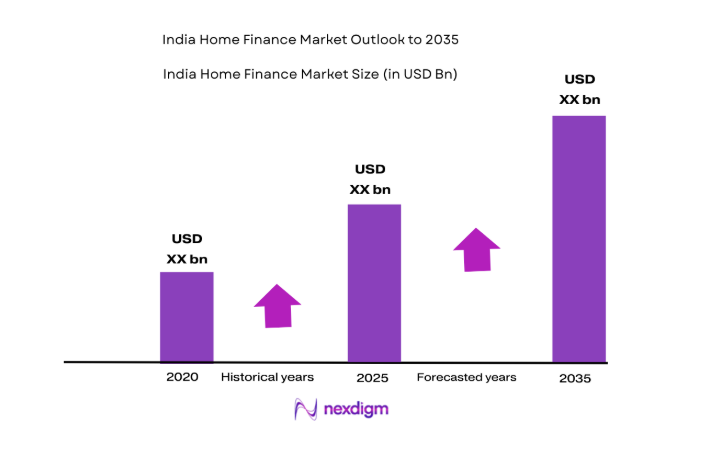
India’s home finance market reached approximately USD ~ billion in outstanding housing credit based on a recent historical assessment, according to Reserve Bank of India housing loan portfolio data. The market is driven by sustained residential demand, government-supported affordable housing programs, and expanding mortgage penetration across urban and semi-urban borrowers. Structural drivers include rising household formation, formalization of credit access, and lender expansion through housing finance companies and banks, strengthening mortgage origination and refinancing activity nationwide.
Dominant activity is concentrated in major metropolitan regions such as Mumbai, Delhi NCR, Bengaluru, Chennai, and Hyderabad, supported by high property transaction volumes, developer presence, and formal employment bases. These cities lead due to stronger borrower credit profiles, higher property values, and institutional lending infrastructure. Tier-2 urban clusters including Pune, Ahmedabad, and Kochi are emerging due to infrastructure investments and migration-driven housing demand, while affordable housing programs support growth across smaller cities and peripheral urban zones.
Market Segmentation
By Product Type
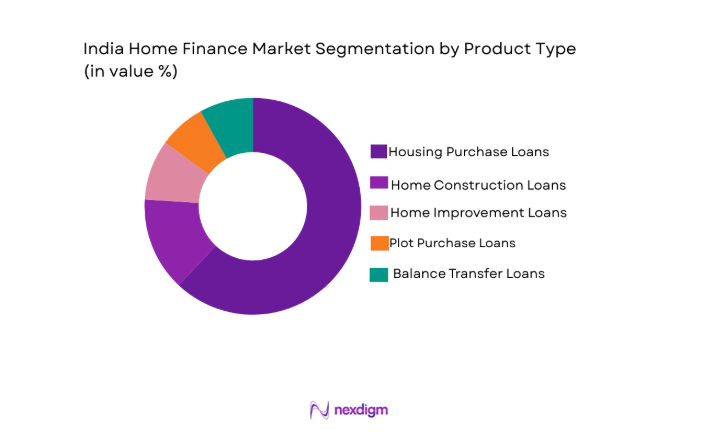
India home finance market is segmented by product type into housing purchase loans, home construction loans, home improvement loans, plot purchase loans, and balance transfer loans. Recently, housing purchase loans has a dominant market share due to factors such as demand patterns, brand presence, infrastructure availability, and consumer preference. High urban housing demand, primary residence acquisition, and developer-linked financing ecosystems sustain purchase loan dominance. Mortgage borrowers prioritize ready-to-move housing and new project financing, while lenders favor secured residential assets with clear collateral valuation. Government subsidies under affordable housing schemes also largely apply to purchase loans, reinforcing borrower uptake. Additionally, salaried households seeking ownership over renting contribute to sustained demand. Digital loan approvals and builder tie-ups further streamline purchase financing access, strengthening this segment’s share within total housing credit origination across metropolitan and tier-2 markets.
By Platform Type
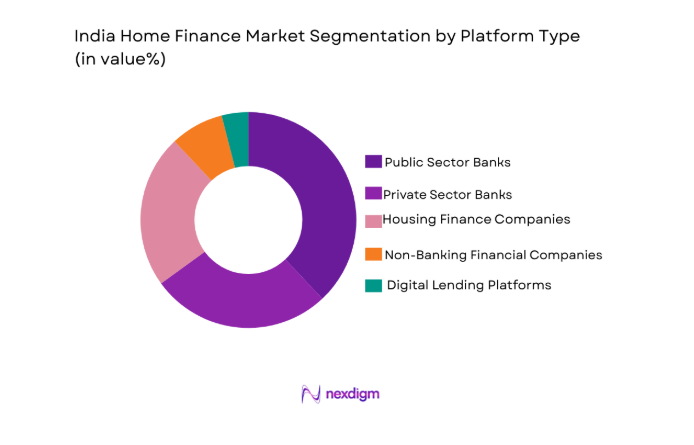
India home finance market is segmented by platform type into public sector banks, private sector banks, housing finance companies, non-banking financial companies, and digital lending platforms. Recently, public sector banks has a dominant market share due to factors such as demand patterns, brand presence, infrastructure availability, or consumer preference. Extensive branch networks, lower interest rates, and trust perception among borrowers sustain their dominance in mortgage lending. Public banks benefit from priority sector lending mandates supporting affordable housing finance, enabling deeper rural and semi-urban penetration. Government ownership enhances borrower confidence and access to subsidy-linked loan schemes. Large balance sheets and low-cost deposits enable competitive mortgage pricing compared with non-bank lenders. Additionally, long-standing developer relationships and salaried borrower tie-ups strengthen origination volumes, reinforcing their leading position across India’s housing finance ecosystem.
Competitive Landscape
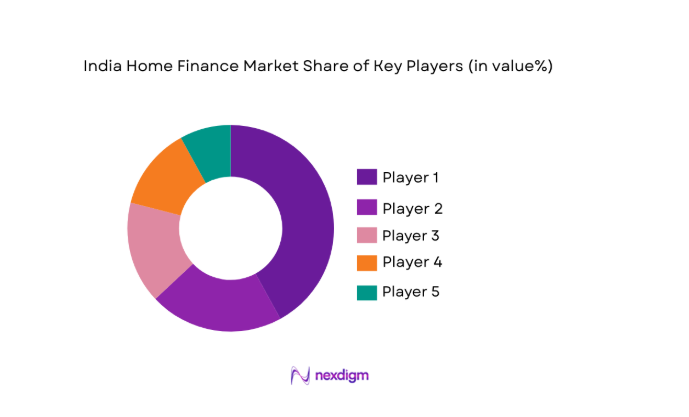
India’s home finance market exhibits moderate concentration led by large public and private banks alongside specialized housing finance companies. Institutional lenders dominate mortgage portfolios due to low-cost funding, nationwide reach, and regulatory alignment, while niche housing finance firms focus on affordable and self-employed borrower segments. Competitive differentiation is driven by interest rates, processing efficiency, underwriting flexibility, and digital origination capabilities, with consolidation occurring through co-lending partnerships and portfolio acquisitions.
| Company Name | Establishment Year | Headquarters | Technology Focus | Market Reach | Key Products | Revenue | Mortgage Portfolio Size |
| State Bank of India | 1955 | Mumbai | ~ | ~ | ~ | ~ | ~ |
| HDFC Bank | 1994 | Mumbai | ~ | ~ | ~ | ~ | ~ |
| ICICI Bank | 1994 | Mumbai | ~ | ~ | ~ | ~ | ~ |
| LIC Housing Finance | 1989 | Mumbai | ~ | ~ | ~ | ~ | ~ |
| PNB Housing Finance | 1988 | New Delhi | ~ | ~ | ~ | ~ | ~ |
India Home Finance Market Analysis
Growth Drivers
Urbanization and Rising Household Formation Driving Mortgage Demand
India’s accelerating urban transition and demographic household expansion are fundamentally increasing structural demand for home finance across metropolitan and emerging urban corridors. Rapid migration toward employment centers is generating sustained housing requirements among salaried and upwardly mobile populations seeking ownership over rental accommodation. Younger working-age cohorts entering the housing market are prioritizing long-term asset accumulation through mortgages, supported by rising formal employment and income visibility. Nuclear family trends and lifestyle aspirations are further expanding per-household dwelling demand, raising mortgage origination volumes. Urban infrastructure expansion including transit, industrial corridors, and smart city investments is opening new residential micro-markets, stimulating financed housing purchases. Developers are aligning supply toward mid-income and affordable segments compatible with mortgage eligibility thresholds, reinforcing credit-linked demand. Financial inclusion initiatives and credit bureau penetration are expanding borrower eligibility pools across previously underserved segments. Lenders are responding through tailored tenure structures and affordability-linked underwriting, improving loan accessibility. Combined demographic, economic, and urbanization forces therefore sustain long-term structural growth in India’s home finance portfolios.
Government Subsidies and Policy Support Expanding Affordable Housing Finance
Policy frameworks supporting affordable housing ownership are significantly enlarging the addressable borrower base within India’s home finance ecosystem. Interest subsidy programs and credit-linked incentives reduce effective borrowing costs, enabling lower-income households to qualify for mortgage financing. Priority sector lending mandates encourage banks to allocate capital toward housing loans within defined affordability thresholds, strengthening credit supply. Public housing missions and state-level incentives stimulate developer participation in subsidized housing projects aligned with mortgage affordability bands. Regulatory alignment of housing finance companies under central banking oversight has strengthened funding access and prudential standards, improving lender stability. Tax incentives on home loan interest and principal repayment enhance borrower affordability and encourage ownership financing. Government-backed refinance institutions provide liquidity support to housing lenders, enabling portfolio expansion. Digitization of subsidy disbursement and borrower verification has reduced delays and improved scheme utilization. Collectively, policy-driven affordability enhancement and institutional credit expansion are accelerating mortgage penetration across India’s lower- and middle-income housing segments.
Market Challenges
Interest Rate Sensitivity and Affordability Constraints in Urban Housing Markets
Mortgage demand in India remains highly sensitive to interest rate cycles and property price inflation, creating structural affordability pressures particularly in major urban regions. Rising benchmark lending rates directly increase equated monthly installment burdens, reducing borrower eligibility under income-based underwriting norms. Concurrent escalation in metropolitan property prices widens the affordability gap between borrower income levels and required loan sizes. Developers’ land and construction cost escalation further pushes housing prices upward, intensifying financing requirements. Interest rate volatility also affects lender funding costs, influencing mortgage pricing and risk appetite. Borrowers in floating-rate loans face repayment uncertainty during tightening cycles, discouraging loan uptake. High loan-to-value requirements in expensive urban markets necessitate large down payments, limiting access for first-time buyers. Affordability stress is particularly acute for mid-income households in Tier-1 cities where housing supply constraints persist. These structural dynamics collectively constrain mortgage demand elasticity and slow portfolio growth in high-cost urban housing segments.
Asset Quality Risks in Self-Employed and Informal Borrower Segments
A significant proportion of India’s housing demand originates from self-employed and informally employed borrowers whose income documentation and repayment predictability remain limited. Irregular cash flows and limited tax documentation complicate credit assessment and increase default risk within mortgage portfolios. Housing finance companies serving these segments rely on surrogate income evaluation and field-based underwriting, which introduces variability in credit quality. Economic disruptions affecting small enterprises or informal sectors directly impair borrower repayment capacity. Collateral realization risks also increase where property documentation or title clarity is weak, particularly in semi-urban and peripheral markets. Portfolio concentration in affordable housing borrowers with thin financial buffers elevates delinquency sensitivity to income shocks. Regulatory provisioning requirements for stressed assets impact lender capital adequacy and profitability. Funding costs for lenders specializing in higher-risk segments also remain elevated relative to mainstream banks. These factors collectively create persistent asset quality management challenges within India’s inclusive home finance expansion.
Opportunities
Expansion of Affordable Housing Finance in Tier-2 and Tier-3 Urban Regions
Rapid urbanization beyond major metropolitan centers is creating substantial untapped demand for structured housing finance across smaller Indian cities. Infrastructure development, industrial corridors, and regional economic clusters are generating new employment hubs and residential demand in these markets. Property prices in Tier-2 and Tier-3 cities remain relatively aligned with middle-income affordability thresholds, enabling higher mortgage eligibility. Government affordable housing programs and state incentives are increasingly directed toward these regions, stimulating project development. Housing finance companies with localized distribution models are well positioned to expand lending portfolios in underserved districts. Digital credit assessment and remote documentation technologies reduce origination costs and enable geographic expansion. Financial inclusion initiatives are improving credit histories and banking penetration among emerging urban households. Developers are also shifting supply toward these markets due to land availability and regulatory support. These structural dynamics create long-term scalable growth potential for home finance penetration outside major metropolitan regions.
Digital Mortgage Origination and Alternative Credit Assessment Technologies
Technological transformation across India’s financial sector is enabling new efficiencies and borrower inclusion within home finance origination and servicing processes. Digital onboarding, e-KYC, and electronic documentation significantly reduce processing time and operational costs for lenders. Automated underwriting models incorporating alternative data sources enable credit evaluation of borrowers lacking formal income documentation. Integration with property registries and valuation databases improves collateral verification accuracy and speed. Mobile platforms expand mortgage accessibility to geographically dispersed borrowers and younger digital-native segments. Co-lending platforms and fintech partnerships enable capital-efficient portfolio expansion by combining bank funding with non-bank origination capabilities. Data analytics improves risk monitoring and portfolio performance management. Digital servicing tools enhance borrower engagement and repayment tracking, reducing delinquency risk. These technological advancements collectively expand the reachable borrower base while improving operational scalability and profitability in India’s evolving home finance ecosystem.
Future Outlook
India’s home finance market is expected to sustain steady expansion driven by demographic housing demand, urbanization, and policy-backed affordable housing initiatives. Digital mortgage ecosystems and co-lending models will improve credit access and processing efficiency. Regulatory support for housing finance liquidity and subsidy frameworks will continue strengthening affordability. Expansion into emerging urban regions and technology-enabled underwriting will further deepen mortgage penetration across diverse borrower segments.
Major Players
- State Bank of India
- HDFC Bank
- ICICI Bank
- Axis Bank
- Punjab National Bank
- Bank of Baroda
- LIC Housing Finance
- PNB Housing Finance
- AavasFinancier
- Can Fin Homes
- Repco Home Finance
- Sundaram Home Finance
- Piramal Housing Finance
- Aditya Birla Housing Finance
- Tata Capital Housing Finance
Key Target Audience
- Mortgage lending institutions
- Housing finance companies
- Real estate developers
- Construction companies
- Affordable housing agencies
- Investments and venture capitalist firms
- Government and regulatory bodies
- Housing infrastructure funds
Research Methodology
Step 1: Identification of Key Variables
Housing credit portfolios, borrower demographics, interest rate structures, property price indices, regulatory policies, and subsidy frameworks were identified as core variables influencing India’s home finance market structure and growth dynamics.
Step 2: Market Analysis and Construction
Secondary data from central banking statistics, housing finance disclosures, developer supply trends, and urban housing demand indicators were synthesized to construct market size, segmentation, and competitive positioning frameworks.
Step 3: Hypothesis Validation and Expert Consultation
Industry experts including housing lenders, developers, and financial analysts validated demand drivers, affordability dynamics, credit risk patterns, and technological adoption impacts across borrower segments and regions.
Step 4: Research Synthesis and Final Output
Validated datasets and qualitative insights were integrated to produce segmentation shares, competitive benchmarking, and forward outlook scenarios reflecting structural housing finance trends across India.

- Executive Summary
- Research Methodology (Definitions, Scope, Industry Assumptions, Market Sizing Approach, Primary & Secondary Research Framework, Data Collection & Verification Protocol, Analytic Models & Forecast Methodology, Limitations & Research Validity Checks)

- Market Definition and Scope
- Value Chain & Stakeholder Ecosystem
- Regulatory / Certification Landscape
- Sector Dynamics Affecting Demand
- Strategic Initiatives & Infrastructure Growth

- Growth Drivers
Urban housing demand expansion supported by demographic growth
Government subsidy schemes improving borrower affordability
Rising mortgage penetration across tier-2 and tier-3 cities
Expansion of housing finance companies and NBFC lending capacity
Digitalization reducing loan processing time and costs - Market Challenges
Interest rate volatility affecting borrower eligibility and demand
Asset quality risks in affordable housing segments
Regulatory capital requirements tightening lender balance sheets
Property title and documentation issues in semi-urban areas
High property prices in metropolitan regions constraining uptake - Market Opportunities
Affordable housing finance expansion in underserved regions
Green housing finance and energy-efficient home loans
Co-lending partnerships between banks and NBFCs - Trends
Shift toward digital mortgage origination and servicing
Growth of co-lending and securitization structures
Increasing share of affordable housing portfolios
Adoption of alternative credit scoring models
Expansion of women-focused home loan products - Government Regulations & Defense Policy
Pradhan Mantri Awas Yojana subsidy frameworks
RBI housing finance company regulatory alignment
Affordable housing priority sector lending norms - SWOT Analysis
- Stakeholder and Ecosystem Analysis
- Porter’s Five Forces Analysis
- Competition Intensity and Ecosystem Mapping

- By Market Value, 2020-2025
- By Installed Units, 2020-2025
- By Average System Price, 2020-2025
- By System Complexity Tier, 2020-2025

- By System Type (In Value%)
Housing Loans for New Property Purchase
Home Construction Loans
Home Improvement and Renovation Loans
Plot Purchase Loans
Balance Transfer and Top-Up Loans - By Platform Type (In Value%)
Public Sector Banks
Private Sector Banks
Housing Finance Companies
Non-Banking Financial Companies
Digital Lending Platforms - By Fitment Type (In Value%)
Fixed Interest Rate Loans
Floating Interest Rate Loans
Hybrid Interest Rate Loans
Step-Up Repayment Loans
Flexible Tenure Loans - By End User Segment (In Value%)
Salaried Urban Households
Self-Employed Professionals
Rural and Semi-Urban Borrowers
Affordable Housing Beneficiaries
Non-Resident Indian Borrowers - By Procurement Channel (In Value%)
Direct Branch Origination
Digital Loan Applications
DSA and Broker Networks
Developer Tie-Ups
Corporate Salary Tie-Ups

- Market structure and competitive positioning
Market share snapshot of major players - Cross Comparison Parameters (Loan Portfolio Size, Interest Rate Range, Geographic Reach, Customer Segment Focus, Digital Capability)
- SWOT Analysis of Key Competitors
- Pricing & Procurement Analysis
- Key Players
State Bank of India
HDFC Bank
ICICI Bank
Axis Bank
Punjab National Bank
Bank of Baroda
LIC Housing Finance
PNB Housing Finance
Aavas Financiers
Can Fin Homes
Repco Home Finance
Sundaram Home Finance
Piramal Housing Finance
Aditya Birla Housing Finance
Tata Capital Housing Finance

- Salaried households driving stable mortgage demand
- Self-employed borrowers requiring flexible underwriting models
- Affordable housing beneficiaries expanding first-time ownership
- NRIs supporting premium and urban housing finance demand

- Forecast Market Value, 2026-2035
- Forecast Installed Units, 2026-2035
- Price Forecast by System Tier, 2026-2035
- Future Demand by Platform, 2026-2035


 Request a Sample
 Ask for Customization
 Get a Quote
 Enquire Now