

 Download PDF
Market Overview
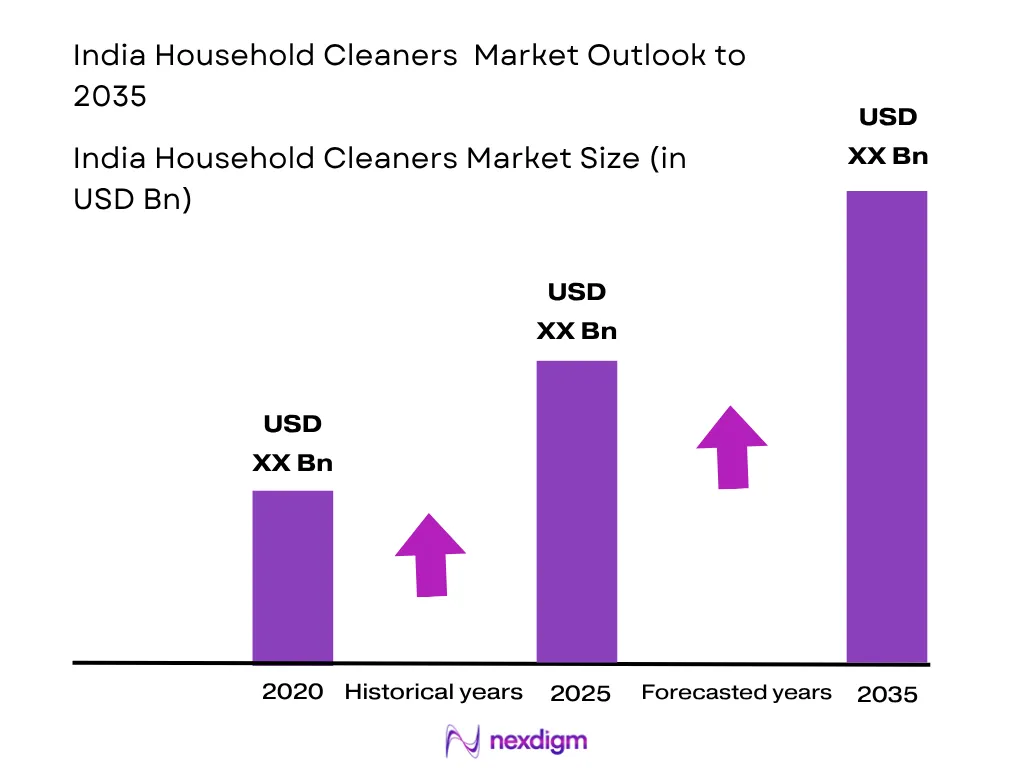
The India Household Cleaners Market is valued at approximately USD ~ billion in 2025, driven by several key factors, including a growing middle class, increased disposable income, and heightened awareness of hygiene and cleanliness. Consumer behavior in India has shifted towards regular use of cleaning products, especially in urban households, where products such as surface cleaners, disinfectants, and multi-purpose cleaners are seeing increased demand. Government initiatives, including promoting sanitation and hygiene in both urban and rural areas, also bolster the demand for household cleaners. Retail growth, particularly in e-commerce and supermarkets, coupled with the availability of household cleaners in a range of formats, further supports the market’s expansion. India’s rapid urbanization, which is expected to continue, and an increasingly health-conscious population continue to fuel demand for effective and accessible cleaning solutions.
In India, major metropolitan cities like Delhi, Mumbai, Bengaluru, and Kolkata dominate the household cleaners market due to their dense populations, higher disposable income, and increasing urbanization. These cities also exhibit a trend of higher hygiene awareness and greater access to modern retail channels, including supermarkets, hypermarkets, and online stores. The presence of multinational retail chains and the growth of online e-commerce platforms have made it easier for consumers to access a variety of household cleaning products. Furthermore, the Western and Southern regions of India are major growth hubs, primarily driven by affluence and a rising preference for premium, branded cleaning products. The expansion of organized retail in tier 2 and tier 3 cities is also contributing significantly to the market’s growth, while the demand for eco-friendly products is rising as consumer awareness around sustainability increases.
Market Segmentation
By Product Type
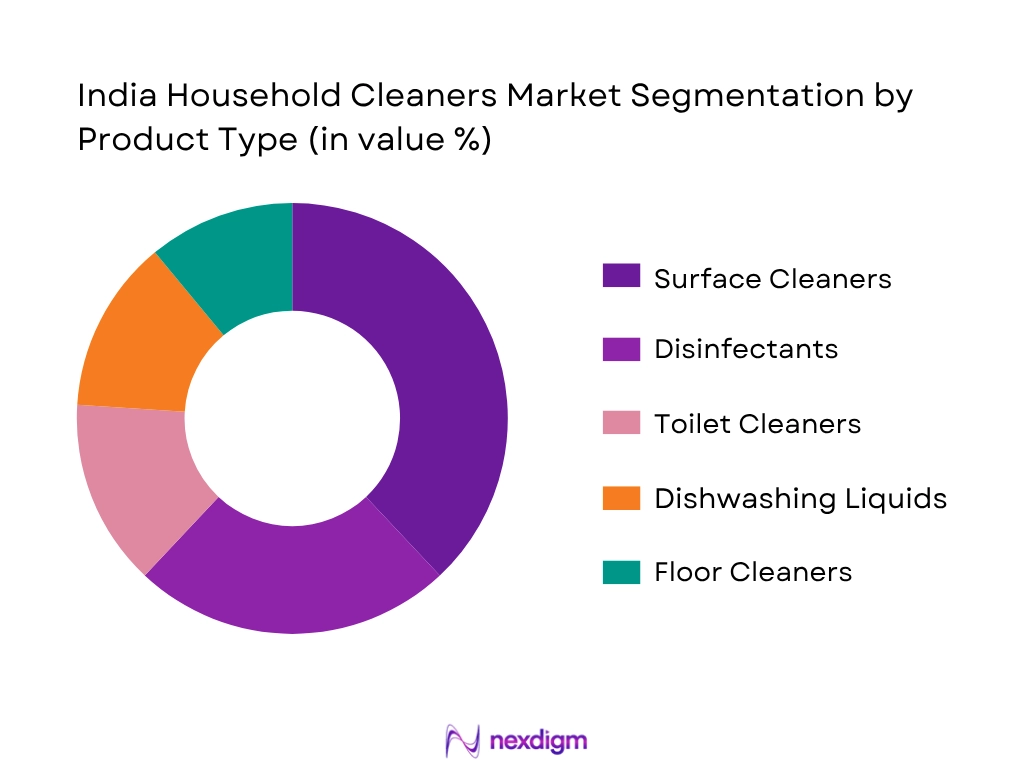
India’s household cleaners market is segmented by product type into surface cleaners, disinfectants, toilet cleaners, dishwashing liquids, and floor cleaners. Surface cleaners, particularly multi-surface variants, currently dominate the market share due to their versatility and widespread use. The strong brand presence of products like Domex, Cif, and Lysol, which have ingrained themselves in Indian households over the years, significantly contributes to the dominance of this sub-segment. As more consumers opt for all-in-one solutions that can be used on a variety of surfaces in their kitchens, bathrooms, and living areas, the demand for surface cleaners has consistently increased. Brands offering convenience, affordability, and effectiveness in cleaning are gaining a competitive edge, making surface cleaners the largest and fastest-growing segment in the Indian market.
By Distribution Channel
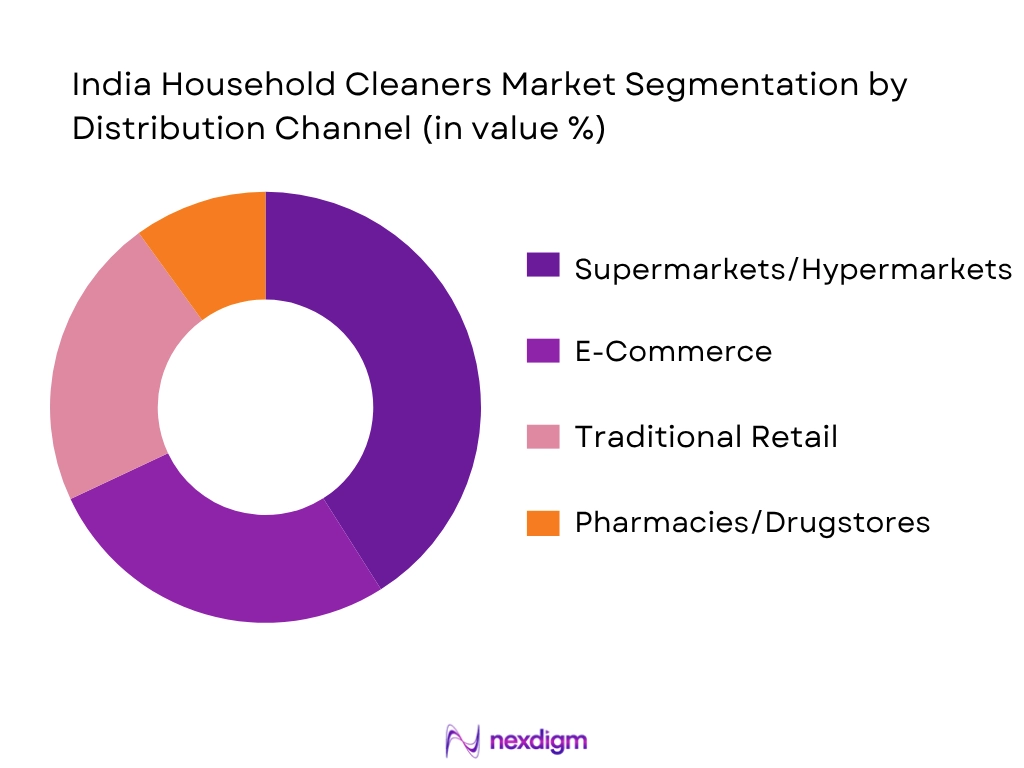
The India Household Cleaners Market is also segmented by distribution channels, including supermarkets/hypermarkets, e-commerce, traditional retail, and pharmacies. Supermarkets and hypermarkets dominate the retail landscape, benefiting from the increasing preference for large-scale shopping environments. These retail formats offer a wide range of household cleaning products, with an increasing focus on premium, branded products. E-commerce has experienced significant growth, particularly in urban areas, driven by the convenience it offers and the expansion of digital payment solutions. The rise of online platforms like Amazon and Flipkart has made household cleaners more accessible to consumers across the country. Traditional retail remains strong, especially in rural and semi-urban areas, where accessibility to large retail chains may be limited, and consumers tend to buy smaller pack sizes. E-commerce and modern retail formats are expected to continue growing as more consumers in smaller towns and cities embrace online shopping.
Competitive Landscape
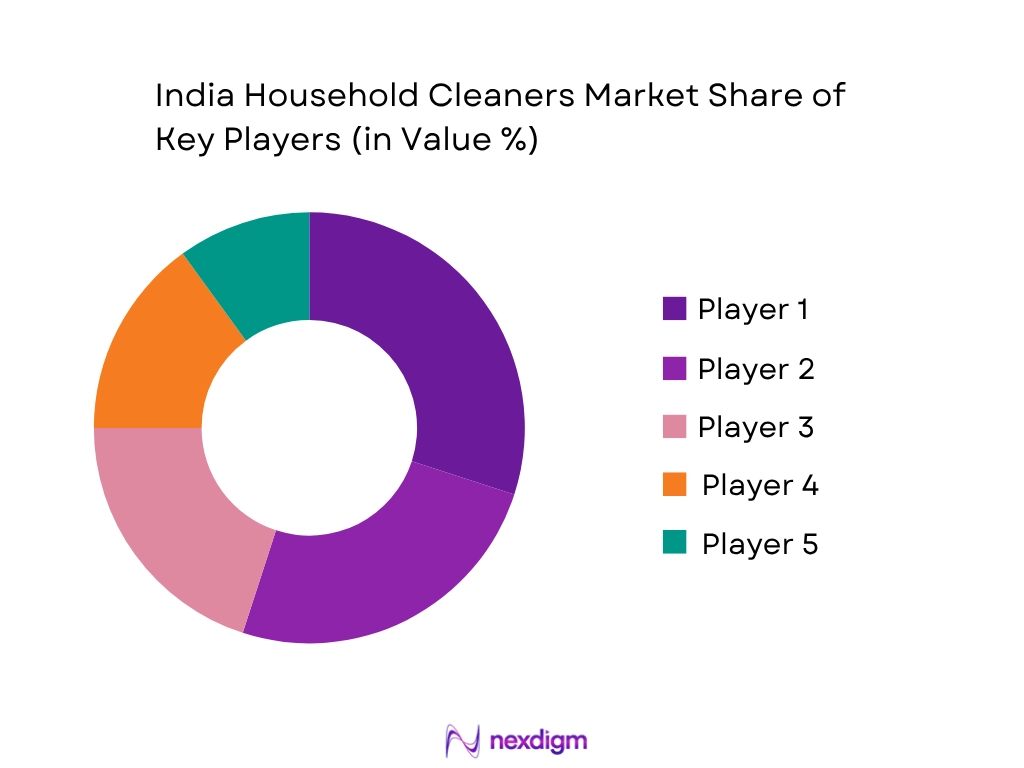
The India Household Cleaners Market is dominated by a few major players, including multinational brands like Hindustan Unilever, Procter & Gamble, and Reckitt Benckiser, alongside strong regional brands like Godrej and Jyothy Labs. These companies have a significant presence in both urban and rural areas, and their ability to adapt to changing consumer preferences and market dynamics has enabled them to maintain a competitive edge. The market also sees the entry of niche players focusing on eco-friendly, sustainable products, catering to the growing demand for environmentally conscious products. Furthermore, increasing investment in product innovation and marketing strategies has intensified competition among these companies, driving them to offer superior value in terms of product quality and consumer engagement.
| Company | Establishment Year | Headquarters | Product Portfolio | Market Position | R&D Investment | Distribution Network | Sustainability Initiatives | Pricing Strategy |
| Hindustan Unilever | 1933 | Mumbai, India | ~ | ~ | ~ | ~ | ~ | ~ |
| Procter & Gamble | 1837 | Mumbai, India | ~ | ~ | ~ | ~ | ~ | ~ |
| Reckitt Benckiser | 1823 | Mumbai, India | ~ | ~ | ~ | ~ | ~ | ~ |
| Godrej Consumer Products | 1897 | Mumbai, India | ~ | ~ | ~ | ~ | ~ | ~ |
| Jyothy Labs | 1983 | Bengaluru, India | ~ | ~ | ~ | ~ | ~ | ~ |
India Household Cleaners Market Analysis
Growth Drivers
Urbanization and Rising Disposable Income
India’s rapid urbanization continues to drive the demand for household cleaning products. The urban population is projected to increase significantly in the coming years, with the urbanization rate estimated at 35.8% in 2024, according to the World Bank. As cities grow, so does the demand for household cleaning products, driven by changing lifestyles, higher living standards, and a more significant proportion of dual-income households. This trend is particularly evident in metropolitan cities such as Mumbai, Delhi, Bengaluru, and Hyderabad, where income levels are rising, thus creating a larger consumer base for premium cleaning products. Additionally, disposable income in India is expected to rise by approximately 7.8% in 2024, according to the International Monetary Fund (IMF). This increase in disposable income allows consumers to spend more on branded, effective, and convenient cleaning products. Rising disposable income also enables consumers to move away from traditional, homemade cleaning solutions toward specialized, branded products such as surface cleaners, disinfectants, and floor cleaners. As a result, the purchasing power in urban households is leading to greater adoption of household cleaning products, which will further fuel the market’s growth in the coming years.
Hygiene Awareness and Post-Pandemic Impact
Hygiene awareness has significantly increased across India, particularly after the COVID-19 pandemic, which highlighted the importance of cleanliness and sanitation. The Indian government has been actively promoting health and hygiene through various initiatives, allocating around USD 1.79 billion for Swachh Bharat Abhiyan (Clean India Mission) in 2024. The focus on cleanliness has led to increased demand for household cleaning products, such as disinfectants, surface cleaners, and sanitizers, in both urban and rural areas. According to a report from the Ministry of Health, sanitation awareness programs have led to improved cleanliness habits among urban populations, with a rising emphasis on using branded cleaning solutions for enhanced effectiveness. The post-pandemic impact has been noticeable in the rising consumption of products like floor cleaners, disinfectants, and surface wipes as consumers continue to prioritize hygiene in their daily routines. This trend is particularly evident in high-density urban areas, where sanitation is a critical concern due to crowded living conditions. The increased awareness of personal and household hygiene is expected to sustain demand for cleaning products well into the future.
Market Challenges
Raw Material Price Fluctuations
Fluctuations in raw material prices pose a significant challenge to the Indian household cleaners market. Prices for essential cleaning ingredients such as surfactants, disinfectants, and packaging materials have seen volatility, driven by global supply chain disruptions and inflationary pressures. According to the Indian Ministry of Commerce and Industry, inflation in essential chemical raw materials has been a major concern for manufacturers in 2024, with prices of key ingredients like sodium hydroxide and surfactants rising by around 6-8% in the last year. These price increases directly affect the cost of producing household cleaners, forcing brands to either absorb the cost or pass it on to consumers, which may impact demand, especially in price-sensitive segments. Furthermore, fluctuations in packaging costs, such as for plastic bottles, pouches, and aerosol cans, have added an additional layer of complexity for manufacturers. India’s reliance on imported raw materials for the production of household cleaners exacerbates this issue, as exchange rate fluctuations further amplify price volatility. As a result, managing raw material costs without sacrificing product quality or increasing prices becomes a critical challenge for market players.
Regulatory Challenges and Compliance Costs
The regulatory landscape in India presents several challenges for the household cleaners market. The country’s regulatory bodies, including the Bureau of Indian Standards (BIS) and the Central Drugs Standard Control Organization (CDSCO), have stringent regulations regarding the composition, labeling, and marketing of household cleaning products. Companies must comply with these standards to ensure their products meet health and safety requirements. The compliance process often involves extensive testing, certification, and documentation, leading to increased costs for manufacturers. Moreover, with India’s growing emphasis on environmental sustainability, manufacturers must also adhere to the extended producer responsibility (EPR) guidelines under the Plastic Waste Management Rules, 2021. These regulations require companies to take responsibility for the recycling and disposal of their packaging waste, which adds to the operational cost of production. In 2024, the government’s push to reduce plastic usage has led to additional scrutiny over the use of plastic packaging in household cleaning products, making it crucial for manufacturers to invest in eco-friendly alternatives, further increasing costs. These regulatory pressures create barriers to entry for smaller brands and challenge established players in maintaining cost-effective operations while ensuring compliance with all regulations.
Opportunities
Expansion of E-Commerce and Retail Channels
The rapid expansion of e-commerce and retail channels in India presents a significant opportunity for growth in the household cleaners market. The Indian e-commerce market is projected to reach USD 70 billion in 2024, according to the Indian Ministry of Commerce. This surge in online shopping provides an excellent platform for household cleaning brands to reach a broader audience, especially in rural and semi-urban areas where access to physical retail outlets may be limited. E-commerce platforms like Amazon, Flipkart, and BigBasket have expanded their cleaning product offerings, making it easier for consumers to purchase cleaning solutions from the comfort of their homes. Additionally, supermarkets and hypermarkets in urban areas are increasingly dedicating more shelf space to cleaning products, offering a diverse range of brands and product categories. This growth in both online and offline retail channels enables manufacturers to reach a wider consumer base and diversify their distribution strategies. The growth of organized retail in tier 2 and tier 3 cities is also expected to contribute significantly to market growth as consumer preferences shift towards convenience and branded products.
Demand for Eco-friendly and Sustainable Products
The growing demand for eco-friendly and sustainable household cleaning products offers significant opportunities in India’s cleaning market. Indian consumers, especially in urban areas, are becoming increasingly aware of the environmental impact of chemical-based cleaning products. This shift toward sustainability is reflected in the rising sales of products made with biodegradable ingredients and recyclable packaging. According to the Indian Ministry of Environment, the country’s plastic waste generation is expected to reach 9.46 million tons by 2024, making the push for sustainable alternatives even more critical. As a result, consumers are now more inclined to purchase products that have minimal environmental impact, leading brands to develop and market eco-friendly cleaners that align with consumer preferences for green solutions. Companies that can effectively introduce environmentally conscious products, such as plant-based cleaning agents, refillable packaging, and zero-waste alternatives, stand to gain a competitive edge. Furthermore, with increasing government regulations to minimize plastic waste, brands offering sustainable products are better positioned to cater to both regulatory requirements and consumer demands for environmentally responsible choices.
Future Outlook
Over the next five years, the India Household Cleaners Market is expected to show robust growth, driven by continuous urbanization, an increasing number of working women, and rising health and hygiene awareness. The market will also benefit from the growing demand for eco-friendly and sustainable products, as well as innovations in product formulations. The increasing use of e-commerce and modern retail channels will further expand the reach of household cleaners to rural and semi-urban markets. Moreover, as disposable incomes continue to rise, there will be a stronger inclination toward premium products, including specialized cleaners with unique features like antibacterial properties, non-toxic ingredients, and biodegradable packaging. The Indian government’s continued focus on sanitation and hygiene, along with initiatives promoting sustainability, will create a conducive environment for the growth of the household cleaners market in the coming years.
Major Players
- Hindustan Unilever
- Procter & Gamble
- Reckitt Benckiser
- Godrej Consumer Products
- Jyothy Labs
- Amway India
- Marico
- SC Johnson
- Dabur India
- ITC Limited
- Colgate-Palmolive
- Vellano
- Metro Brands
- Britannia Industries
- Bajaj Consumer Care
Key Target Audience
- Manufacturers of Household Cleaning Products
- Investments and Venture Capitalist Firms
- Retailers (Supermarkets, Hypermarkets, E-commerce Platforms)
- Government and Regulatory Bodies (e.g., Ministry of Health, Ministry of Environment)
- Suppliers of Raw Materials for Household Cleaners
- Private Label Brands
- Distributors and Wholesalers of Household Cleaners
- Brand Managers and Marketing Teams of Consumer Goods Companies
Research Methodology
Step 1: Identification of Key Variables
The initial phase involves identifying the major drivers and inhibitors within the India Household Cleaners Market, utilizing secondary data from government sources and industry reports. Key factors such as consumer behavior, economic indicators, and retail dynamics are analyzed to understand the market’s structure.
Step 2: Market Analysis and Construction
In this phase, historical data is compiled to create a comprehensive picture of the market’s current state and future trajectory. This includes understanding product sales volumes, price trends, and market share within each segment, focusing on distribution channels and regional penetration.
Step 3: Hypothesis Validation and Expert Consultation
In-depth interviews and surveys with key industry experts, distributors, and market participants are conducted to validate assumptions made during the analysis. Expert consultations ensure accuracy in predictions and offer real-time market insights.
Step 4: Research Synthesis and Final Output
In the final phase, findings are synthesized into a comprehensive report that includes recommendations for stakeholders in the India Household Cleaners Market. The research is backed by primary data, ensuring that the report reflects the most current market dynamics.

- Executive Summary
- Research Methodology (Market Definitions and Assumptions, Abbreviations, Market Sizing Approach, Consolidated Research Approach, Understanding Market Potential Through In-Depth Industry Interviews, Primary Research Approach, Limitations and Future Conclusions)

- Definition and Scope
- Market Genesis and Evolution
- Timeline of Major Household Cleaner Brands
- Business Cycle and Replacement Cycle
- Market Size, Growth, and Forecasts
- Supply Chain and Value Chain Analysis
- Market Segmentation Overview
- Dominant Distribution Channels and Retail Landscape

- Growth Drivers(Urbanization and Rising Disposable Income, Hygiene Awareness and Post-Pandemic Impact, Growth in Online Retail and E-Commerce)
- Market Challenges(Raw Material Price Fluctuations, Regulatory Challenges and Compliance Costs)
- Opportunities(Expansion of E-Commerce and Retail Channels, Demand for Eco-friendly and Sustainable Products)
- Market Trends (Multi-Purpose Cleaners and Convenience, Health-Conscious and Sustainable Product Preferences)
- Government Regulation(Regulatory Policies for Household Cleaners, Packaging and Environmental Laws)
- SWOT Analysis (Scale Advantage, Regulatory Barriers, Regional Fragmentation, Eco-Format Opportunity)
- Porter’s Five Forces (Supplier Power, Retailer Power, Substitution Risk, Entry Barriers, Rivalry Intensity)
- Stakeholder Ecosystem (Manufacturers, BIS, CPCB, IFMA, Retailers, Distributors, E-Commerce Platforms, Raw Material Suppliers)
- Competitive Landscape

- By Value (2020-2025)
- By Volume (2020-2025)
- By Average Selling Price (2020-2025)
- By Purchase Frequency (2020-2025)
- By Unit Sales (2020-2025)

- By Product Type (In Value %)
Surface Cleaners
Disinfectants
Toilet Cleaners
Dishwashing Liquids
Floor Cleaners - By Application (In Value %)
Kitchen Cleaning
Bathroom Cleaning
Surface Cleaning
Floor Cleaning
Multi-Surface and General Use - By Formulation Type (In Value%)
Ready-to-Use Liquids
Concentrates and Dilutables
Trigger Sprays
Gels and Thickened Liquids
Powders and Abrasives
Wipes and Pre-Moistened Formats
Aerosol Cleaners - By Distribution Channel (In Value %)
Supermarkets/Hypermarkets
E-Commerce
Traditional Retail
Pharmacies/Drugstores - By Packaging Type (In Value %)
Bottles
Pouches
Cans
Refill Packs
Sachets - By Price Tier (In Value%)
Economy
Mass
Value-Plus
Premium
Eco/Natural Premium
Professional-at-Home - By Region (In Value %)
North Region
South Region
West Region
East Region

- Market Share of Major Players (In Value/Volume, By Product Type, Distribution Channel)
- Cross Comparison Parameters (Company Overview, Business Strategies, Recent Developments, Strengths and Weaknesses, Revenues, Distribution Channels, Marketing Strategies, Production Capabilities)
- Competitive Benchmarking Matrix (Brand Recall, Product Efficacy, Price/Liter, Distribution Reach, Innovation Cadence, Promo Intensity, Private Label Exposure)
- SWOT Analysis of Major Players(Strength, Weakness, Opportunity, Threat by Company)
- Pricing Strategy for Major Household Cleaners Brands(Multiuso Bottle, Disinfectant Liter Pack, Bleach Pack, Dishwashing Liquid, Bathroom Spray, Refill Pouch)
- Brand Positioning Map (Economy, Mass, Premium, Eco/Natural, Heavy-Duty, Fragrance-Led)
- Recent Developments (Product Launches, Packaging Changes, Retail Partnerships, Sustainability Claims, Capacity Expansion)
- Detailed Profiles of Major Companies
Hindustan Unilever
Procter & Gamble
Reckitt Benckiser
Godrej Consumer Products
SC Johnson
Dabur India
Marico
Amway India
Jyothy Labs
Colgate-Palmolive
ITC Limited
Britannia Industries
Vellano
Bajaj Consumer Care
Metro Brands

- Market Demand and Utilization (Rooms Cleaned, Cleaning Frequency, Product Repertoire, Monthly Basket Size)
- Purchasing Power and Budget Allocations(Monthly Cleaning Spend, Bulk Purchase, Stock-Up Cycles, Small-Pack Dependence)
- Regulatory and Compliance Requirements
- Needs, Desires, and Pain Point Analysis(Efficacy, Price, Fragrance, Surface Safety, Child Safety, Pet Safety, Eco-Claims)
- Consumer Decision-Making Process (Brand Trust, Price Promotions, Pack Size, Fragrance Testing, Retail Availability)
- Brand Loyalty and Switching Behavior (Promo Sensitivity, Private Label Trial, Regional Brand Adoption, Premium Trade-Up)

- By Value (2026-2035)
- By Volume (2026-2035)
- By Product Type (2026-2035)
- By Unit Sales (2026-2035)
- By Average Selling Price (2026-2035)
- By Household Penetration (2026-2035)


 Request a Sample
 Ask for Customization
 Get a Quote
 Enquire Now