
 Download PDF
Market Overview
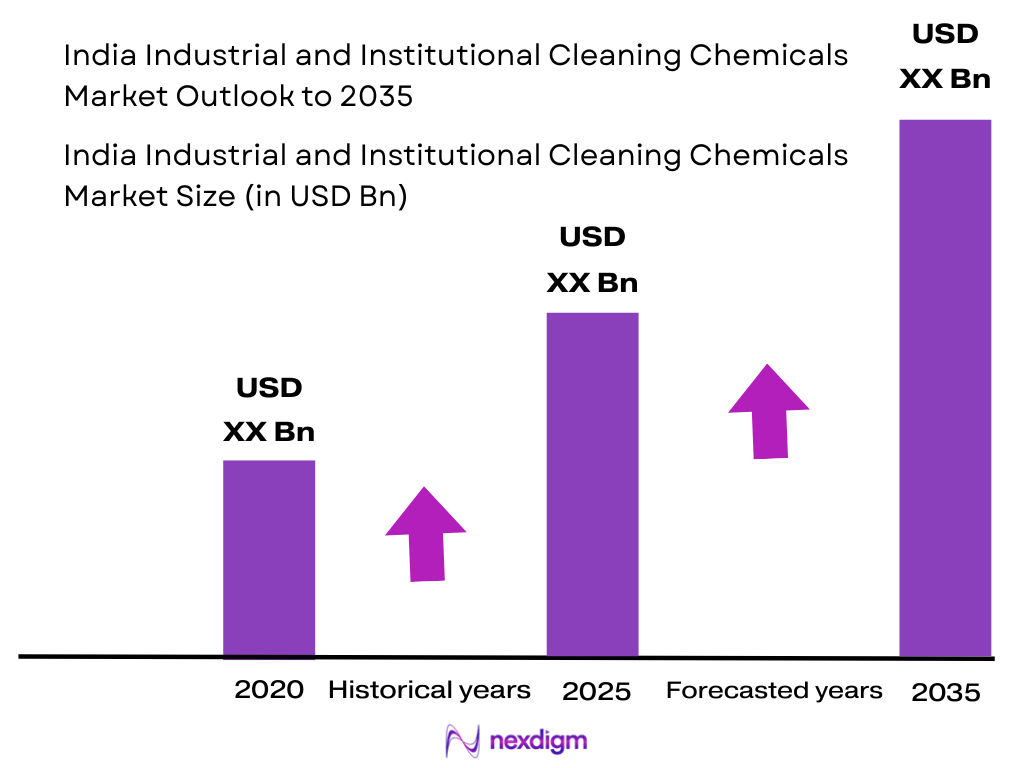
The India Industrial and Institutional Cleaning Chemicals Market is valued at ~USD XX million in 2024, with the final figure to be populated from the defined market-sizing model. Demand is supported by healthcare, food processing, pharmaceuticals, hospitality, manufacturing, commercial real estate and professional facility-management operations. India’s GDP reached approximately USD 3.91 trillion in 2024, compared with about USD 3.57 trillion in 2023, according to World Bank data. Manufacturing value added was approximately INR 41.49 trillion in 2024, providing a substantial industrial base for degreasers, equipment cleaners, disinfectants and specialized cleaning chemicals.
Mumbai, Delhi-NCR, Bengaluru, Chennai, Hyderabad, Pune and Ahmedabad represent the principal demand clusters for the India Industrial and Institutional Cleaning Chemicals Market. Mumbai and Pune combine large manufacturing, healthcare, commercial and hospitality ecosystems, while Ahmedabad and surrounding Gujarat industrial clusters support chemical, pharmaceutical and manufacturing demand. Bengaluru and Hyderabad provide significant technology, pharmaceutical and healthcare facilities, while Chennai combines automotive, engineering, logistics and port-linked industrial activity. Healthcare infrastructure also creates a large institutional demand base: India had 1,67,275 sub-centres, 26,636 primary health centres, 6,155 community health centres and 759 district hospitals as of June 2024.
Market Segmentation
By Product Type
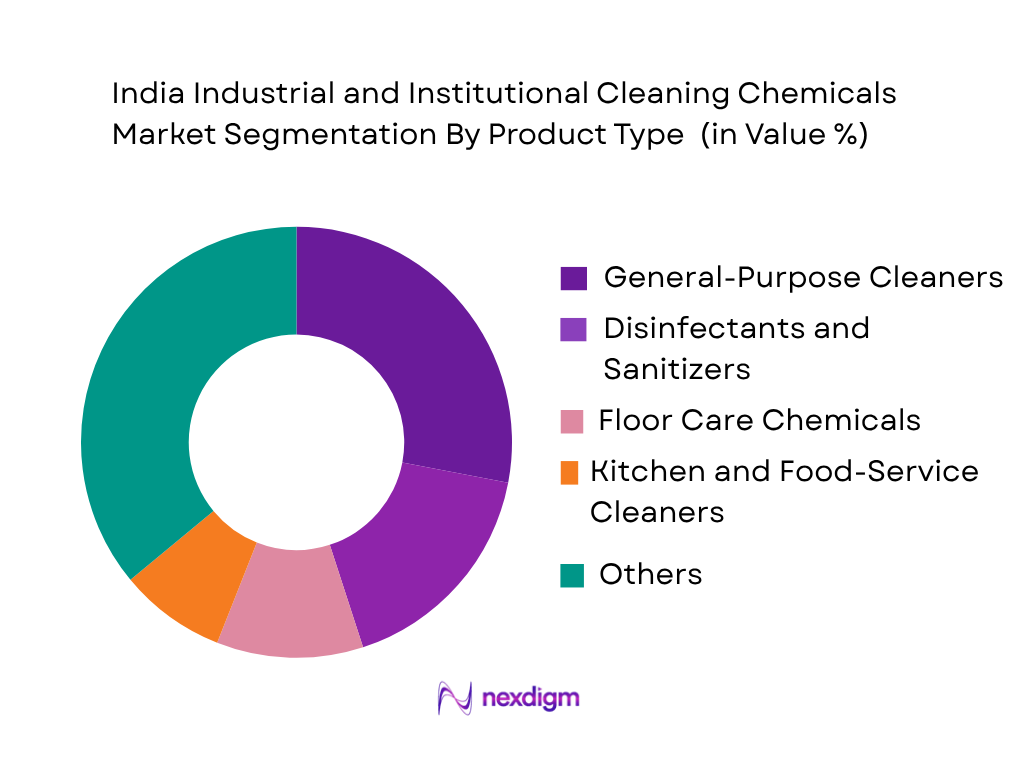
The India Industrial and Institutional Cleaning Chemicals Market is segmented by product type into general-purpose cleaners, disinfectants and sanitizers, floor-care chemicals, kitchen and food-service cleaners, laundry chemicals, warewashing chemicals, industrial degreasers, carpet and upholstery cleaners, glass and surface cleaners, restroom cleaners and specialty cleaners. General-purpose cleaners are positioned as the leading product category because they can be deployed across a wide range of facilities, including offices, hospitals, hotels, factories, retail properties and institutional buildings. Their broad surface compatibility supports frequent recurring consumption, while concentrated formulations enable professional cleaning contractors and facility managers to control dilution and chemical usage. Disinfectants and sanitizers remain strategically important because healthcare, food-processing and high-touch institutional environments require microbial-control applications in addition to routine soil removal. Industrial degreasers have stronger relevance within manufacturing, engineering and automotive facilities where oils, grease and process residues must be removed from machinery and components. The increasing professionalization of cleaning operations is also supporting movement toward standardized commercial-grade formulations and application-specific chemistry.
By End-Use Industry
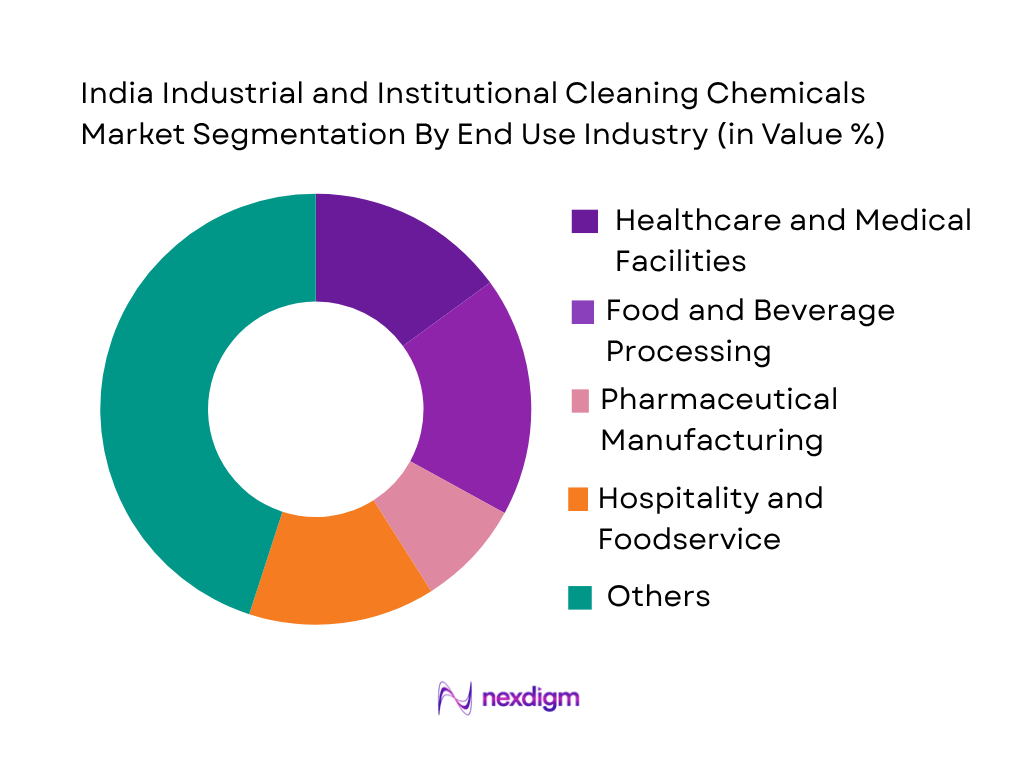
The India Industrial and Institutional Cleaning Chemicals Market is segmented by end-use industry into healthcare and hospitals, food and beverage processing, pharmaceutical manufacturing, hospitality and foodservice, industrial and manufacturing facilities, commercial offices, retail facilities, education and institutional facilities, transportation and logistics, and government and public facilities. Healthcare and hospitals represent a leading application segment because cleaning and disinfection are embedded within infection-control, patient-area sanitation, operating-room hygiene, medical-equipment cleaning and healthcare laundry procedures. Food and beverage processing facilities require continuous cleaning of production equipment, food-contact surfaces and processing environments, while pharmaceutical plants require controlled cleaning and residue management. Hospitality establishments consume chemicals across housekeeping, laundry, kitchens, restaurants and washrooms. Manufacturing plants require industrial degreasers, machinery cleaners and maintenance chemicals. India’s healthcare infrastructure provides a particularly broad institutional demand base, with 3,49,473 healthcare facilities registered on the Health Facility Registry by November 2024, according to the Government of India.
Competitive Landscape
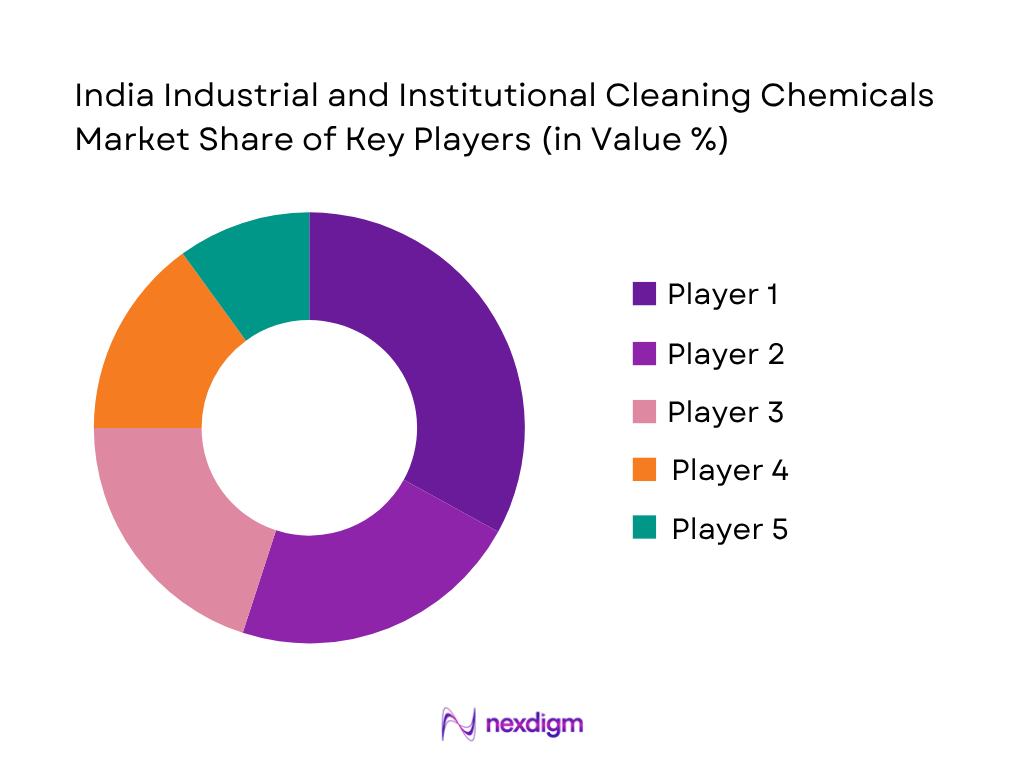
The India Industrial and Institutional Cleaning Chemicals Market includes global hygiene and specialty-chemical companies, diversified Indian consumer-goods manufacturers, professional cleaning-equipment suppliers and specialized domestic formulators. Competitive differentiation is based on professional product breadth, formulation technology, direct institutional relationships, janitorial and industrial distribution coverage, technical support, dispensing capabilities and sustainability credentials. Large multinational suppliers generally compete through integrated cleaning programs combining chemicals, equipment, dosing and technical services, while domestic companies can compete through regional distribution, localized formulations and customer-specific solutions. The market is also moving toward concentrated chemistry, automated dosing, sustainable formulations and specialized cleaning programs for healthcare, food processing, pharmaceutical and industrial customers.
| Company | Established | Headquarters | Core I&I Portfolio | Key Applications | Distribution Reach | Dosing / Technical Capability | Sustainability Position |
| Ecolab Inc. | 1923 | St. Paul, USA | ~ | ~ | ~ | ~ | ~ |
| Diversey | 1923 | Fort Mill, USA | ~ | ~ | ~ | ~ | ~ |
| Reckitt | 1823 | Slough, UK | ~ | ~ | ~ | ~ | ~ |
| Hindustan Unilever Limited | 1933 | Mumbai, India | ~ | ~ | ~ | ~ | ~ |
| 3M India Limited | 1987 | Bengaluru, India | ~ | ~ | ~ | ~ | ~ |
India Industrial and Institutional Cleaning Chemicals Market Analysis
Growth Drivers
Healthcare Hygiene Intensity
India’s healthcare ecosystem provides a substantial recurring demand base for disinfectants, surface cleaners, instrument cleaners, floor-care chemicals and other institutional hygiene products because hospitals, clinics, laboratories and diagnostic facilities require routine cleaning across patient areas, operating rooms and high-touch surfaces. India’s current health expenditure reached ₹8.15 lakh crore in the latest National Health Accounts release covering the available expenditure period, while government hospitals accounted for ₹1.03 lakh crore and private hospitals for ₹1.69 lakh crore of current health expenditure. The healthcare base is also being supported by continued public investment in medical infrastructure and expansion of private healthcare capacity. At the broader economic level, India’s nominal GDP reached approximately US$3.76 trillion in 2024, according to the World Bank, reinforcing the scale of economic activity supporting institutional infrastructure. For I&I cleaning chemicals, this translates into demand for disinfectants, sanitizers, restroom cleaners, floor cleaners, glass and surface cleaners, laundry chemicals and specialized cleaning formulations. Increasing emphasis on infection prevention, hygiene protocols, healthcare accreditation and controlled cleaning procedures further strengthens consumption intensity, particularly where cleaning must be performed repeatedly rather than periodically.
Food-Processing Expansion
India’s expanding food-processing ecosystem is a major structural demand driver for industrial and institutional cleaning chemicals because food manufacturers require frequent cleaning and sanitation of processing equipment, production floors, conveyors, storage areas, utensils, drains and food-contact surfaces. Government data show that 558 food-processing units had been taken up for implementation under the Central Sector Scheme for Infrastructure for Agro-Processing Cluster by December 2024, with 283 units completed and 275 units at various implementation stages. The completed units represented approximately 5.987 million tonnes per annum of processing capacity, creating additional facilities requiring chemical cleaning and sanitation. The government also reported total project costs of ₹89.63 billion for these 558 units, including ₹68.07 billion of private investment. The Production Linked Incentive Scheme for Food Processing Industries targets incremental processed-food sales of ₹1,202.67 billion and additional investment of ₹60.57 billion, demonstrating continued policy support for manufacturing capacity. This expansion directly increases requirements for degreasers, alkaline cleaners, acid cleaners, sanitizers, CIP chemicals, floor cleaners and specialty formulations capable of controlling organic residues, fats, proteins, biofilms and microbial contamination.
Market Challenges
Raw Material Dependency
India’s I&I cleaning chemicals industry remains exposed to fluctuations and availability constraints across surfactants, solvents, specialty additives, chelating agents, fragrances, enzymes and other chemical intermediates, with imported inputs creating additional supply-chain sensitivity for specialized formulations. Government trade data illustrate the scale of India’s external chemical trade: exports of organic and inorganic chemicals reached US$9.66 billion during the April–July period of the referenced fiscal year, while imports reached US$9.73 billion over the corresponding period. The broader chemical-material ecosystem therefore remains closely connected to international supply chains. This exposure becomes particularly important for high-performance institutional and industrial formulations requiring specialized surfactants, enzymes, biocides, solvents or functional additives that may have limited domestic manufacturing alternatives. India’s manufacturing base is expanding, with the World Bank recording nominal GDP of approximately US$3.76 trillion in 2024, but the cleaning-chemical industry must simultaneously manage the availability of imported specialty inputs and domestic production constraints. Supply interruptions can affect formulation consistency, lead times and product qualification, particularly for large hospitals, food processors, pharmaceutical plants and industrial facilities operating validated cleaning protocols. Raw-material substitution is also constrained where customers require established performance specifications, compatibility with equipment and documented cleaning efficacy.
Chemical Compliance and Worker Exposure Controls
Increasing regulatory attention to chemical handling, workplace exposure, hazardous-substance management, labeling, storage and wastewater discharge creates compliance complexity for manufacturers and professional users of I&I cleaning chemicals. The challenge is particularly relevant to concentrated disinfectants, caustic cleaners, acids, solvents, degreasers and specialty formulations used in industrial and institutional facilities. India’s environmental-management requirements also intersect with a large wastewater-treatment gap: Central Pollution Control Board data report sewage generation of approximately 61,754 million litres per day, compared with sewage-treatment capacity of 22,963 million litres per day, leaving roughly 38,791 million litres per day untreated in the cited national assessment. Although this figure covers municipal sewage rather than industrial wastewater alone, it illustrates the broader pressure on India’s water-treatment infrastructure and the importance of chemical management in discharge-intensive operations. Cleaning formulations increasingly need to balance cleaning performance with worker safety, effluent compatibility, biodegradability and controlled chemical dosing. Facilities therefore face additional requirements around chemical segregation, personal protective equipment, automated dilution, wastewater treatment and documentation. These requirements can complicate adoption of aggressive formulations and increase the technical qualification burden for suppliers serving healthcare, food processing, pharmaceutical and manufacturing customers.
Market Opportunities
Green Cleaning Chemistry
The transition toward environmentally preferable cleaning systems creates an opportunity for Indian I&I chemical suppliers to develop formulations that reduce hazardous ingredients while maintaining industrial cleaning performance. The opportunity is supported by the scale and continuing modernization of India’s manufacturing and institutional economy. World Bank data place India’s 2024 nominal GDP at approximately US$3.76 trillion, while government food-processing programs alone had 558 processing units under implementation by December 2024, including 283 completed facilities. Such facilities provide a large installed base in which manufacturers can introduce biodegradable surfactants, enzyme-based cleaners, low-VOC formulations, concentrated products and lower-impact disinfectants. Green chemistry can also address operational requirements associated with wastewater treatment, worker exposure and chemical storage by reducing unnecessary chemical loads and improving controlled dosing. The food-processing sector is particularly relevant because cleaning products must manage fats, proteins, carbohydrates, mineral deposits and microbial contamination without compromising food-contact requirements. Pharmaceutical manufacturing and healthcare provide additional opportunities for validated formulations with controlled residues and documented efficacy. Suppliers capable of combining biodegradability, low-VOC chemistry, concentrated dosing and application-specific cleaning performance can differentiate themselves beyond conventional commodity cleaners. The opportunity therefore extends from product reformulation into complete sustainable-cleaning systems, including dilution equipment, dosing controls, packaging redesign and technical application support.
Automated Dosing and Water-Efficient Cleaning
Automation, concentrated formulations and precision chemical dispensing represent a significant opportunity because industrial and institutional customers increasingly need consistent cleaning performance while controlling chemical consumption, worker handling and water usage. India’s wastewater infrastructure illustrates the importance of improving water efficiency: the Central Pollution Control Board identifies approximately 61,754 million litres per day of sewage generation against 22,963 million litres per day of installed treatment capacity. This creates a strong operating rationale for cleaning systems that reduce unnecessary water use and limit chemical loading in wastewater streams. The opportunity is particularly relevant to hospitals, hotels, food-processing plants, pharmaceutical facilities, manufacturing sites and large commercial buildings where cleaning occurs repeatedly across extensive floor areas and equipment. Automated dosing systems can standardize dilution ratios, reduce manual chemical handling and improve repeatability across shifts and locations. Concentrated formulations can further reduce packaging volumes and logistics requirements, while enzymatic and low-temperature cleaning technologies can support resource-efficient operations where appropriate. The expanding food-processing infrastructure provides a concrete industrial application base: government programs recorded 283 completed food-processing units and approximately 5.987 million tonnes per annum of processing capacity from those completed units. Suppliers combining chemistry with smart dispensing, dosing controls, equipment integration and application-specific protocols can therefore move toward higher-value facility solutions rather than competing solely on chemical formulation.
Future Outlook
The India Industrial and Institutional Cleaning Chemicals Market is expected to increasingly shift toward concentrated formulations, specialized chemistry, sustainable cleaning systems and application-specific products. Healthcare, food processing, pharmaceutical manufacturing and hospitality are likely to remain important demand centers because of recurring cleaning requirements. Facility-management outsourcing should support centralized procurement and standardized chemical programs across multi-site customers. Demand for low-VOC, biodegradable and water-efficient chemistry is also expected to strengthen as large organizations incorporate environmental considerations into procurement. Automated dosing, smart dispensing and precision-cleaning technologies can further improve chemical utilization and consistency, while domestic formulation and regional distribution can create opportunities for suppliers seeking greater market penetration.
Major Players
- Ecolab Inc.
- Diversey
- Reckitt
- The Procter & Gamble Company
- Hindustan Unilever Limited
- 3M India Limited
- Godrej Consumer Products Limited
- Jyothy Labs Limited
- Buzil Rossari Private Limited
- Kärcher India
- Taski India
- SC Johnson Professional
- Kimberly-Clark Professional
- Sealed Air Corporation
- Zep Inc.
Key Target Audience
- Industrial and institutional cleaning chemical manufacturers
- Facility management and contract-cleaning companies
- Healthcare and hospital procurement organizations
- Food and beverage processing companies
- Pharmaceutical manufacturing companies
- Hospitality, hotel and foodservice operators
- Investments and venture capitalist firms
- Government and regulatory bodies (Ministry of Environment, Forest and Climate Change; Central Pollution Control Board; Bureau of Indian Standards; Food Safety and Standards Authority of India)
Research Methodology
Step 1: Identification of Key Variables
The initial phase establishes the India Industrial and Institutional Cleaning Chemicals Market ecosystem across chemical manufacturers, formulators, distributors, facility-management companies and institutional end users. Product categories, chemistry types, applications, facility types and procurement structures are mapped to define the market boundary. The framework specifically identifies recurring chemical consumption and cleaning intensity across major end-use environments.
Step 2: Market Analysis and Construction
Historical and current information is compiled across product categories, formulations, end-use industries, applications and distribution channels. The analysis evaluates consumption requirements within healthcare, food processing, pharmaceuticals, hospitality, manufacturing and commercial facilities. Bottom-up calculations assess facility-level demand and utilization patterns, while top-down analysis provides an independent market-level validation.
Step 3: Hypothesis Validation and Expert Consultation
Market hypotheses are validated through discussions with manufacturers, formulators, distributors, facility-management providers and institutional procurement stakeholders. Interviews focus on product adoption, cleaning frequency, formulation preferences, purchasing criteria, chemical substitution and sustainability requirements. These inputs are used to refine demand assumptions and validate competitive and channel dynamics.
Step 4: Research Synthesis and Final Output
The final stage integrates primary findings with secondary information and quantitative market calculations. Data is triangulated across product types, end-use industries, applications, channels and geographic clusters. The resulting framework provides a structured assessment of current market conditions, competitive positioning, demand drivers, challenges, opportunities and the long-term outlook.

- Executive Summary
- Research Methodology (Market Definition and Scope, Product Inclusion and Exclusion Criteria, Market Sizing Methodology, Top-Down Assessment, Bottom-Up Assessment, Demand-Side Assessment, Supply-Side Assessment, Primary Interviews, Distributor Validation, End-User Validation, Cleaning-Intensity Mapping, Consumption-Based Estimation, Data Triangulation, Forecasting Framework, Sensitivity Analysis, Assumptions and Limitations)

- Definition and Scope
- Market Evolution and Development of Professional Cleaning Chemistry
- India Industrial and Institutional Cleaning Chemicals Ecosystem
- Industry Value Chain

- Growth Drivers (Healthcare Hygiene Intensity, Food-Processing Expansion, Pharmaceutical Manufacturing, Industrial Production, Hospitality Development, Facility-Management Outsourcing, Commercial Real Estate, Institutional Sanitation, Cleaning Automation)
- Market Challenges (Raw Material Dependency, Specialty Chemical Import Exposure, Chemical Compliance, Worker Exposure Controls, Wastewater Management, Fragmented Distribution, Product-Quality Variability, Skilled Cleaning Workforce)
- Market Opportunities (Green Cleaning Chemistry, Bio-Based Surfactants, Enzymatic Cleaning, Concentrated Formulations, Low-VOC Chemistry, Water-Efficient Cleaning, Automated Dosing, Smart Dispensing, Sustainable Packaging, Precision Industrial Cleaning)
- Market Trends (Green Procurement, Bio-Based Chemistry, Concentration Optimization, Enzyme Adoption, Low-Residual Disinfection, Automated Dosing, Smart Dispensing, Water Reduction, Refill Systems, Sustainable Packaging)
- Government Regulations and Compliance Framework (Chemicals Management, Hazardous Chemical Storage and Handling, Environment Protection, Hazardous Waste Management, Plastic Waste Management, Occupational Safety, Food Hygiene, Healthcare Infection Control, BIS Standards, Pollution Control Board Requirements)
- SWOT Analysis
- Porter’s Five Forces Analysis
- PESTLE Analysis

- By Market Value (2020-2025)
- By Volume Consumption (2020-2025)
- By Product Category (2020-2025)
- By Chemistry Type (2020-2025)
- By Formulation Type (2020-2025)

- By Product Type (In Value %)
General-Purpose Cleaners
Disinfectants and Sanitizers
Floor Care Chemicals
Kitchen and Food-Service Cleaners
Laundry Chemicals
Warewashing Chemicals
Industrial Degreasers
Carpet and Upholstery Cleaners
Glass and Surface Cleaners
Restroom and Washroom Cleaners
Specialty and Precision Cleaners - By Chemistry Type (In Value %)
Surfactant-Based Chemistry
Acid-Based Chemistry
Alkaline Chemistry
Solvent-Based Chemistry
Enzyme-Based Chemistry
Biocide and Antimicrobial Chemistry
Chelating-Agent-Based Chemistry
Bio-Based Cleaning Chemistry - By Formulation Type (In Value %)
Ready-to-Use Liquids
Concentrated Liquids
Powders
Gels
Foams
Tablets and Solid Doses
Wipes and Pre-Moistened Formats - By End-Use Industry (In Value %)
Healthcare and Hospitals
Food and Beverage Processing
Pharmaceutical Manufacturing
Hospitality and Foodservice
Industrial and Manufacturing Facilities
Commercial Offices and Business Parks
Retail and Shopping Facilities
Education and Institutional Facilities
Transportation and Logistics
Government and Public Facilities - By Cleaning Application (In Value %)
Hard-Surface Cleaning
Floor Cleaning and Maintenance
Equipment and Machinery Cleaning
Clean-in-Place Cleaning
Manual Dishwashing
Automatic Warewashing
Industrial Degreasing
Parts and Component Cleaning
Laundry and Textile Cleaning
Restroom Sanitation
High-Touch Surface Disinfection
Precision Equipment Cleaning - By Distribution Channel (In Value %)
Direct Manufacturer Sales
Janitorial and Sanitation Distributors
Industrial Chemical Distributors
Wholesale Distributors
Facility Management Procurement
Specialist B2B Cleaning Suppliers
Online B2B Channels

- Market Share Analysis of Major Players (By Value, Product Category, Chemistry Type, End-Use Industry, Application, Distribution Channel)
- Cross Comparison Parameters (Product Portfolio Breadth, Professional SKU Coverage, Domestic Manufacturing Footprint, Specialty Chemistry Capability, Sustainable Chemistry Portfolio, Automated Dosing Capability, Distribution Network Reach, Facility-Management Customer Coverage)
- SWOT Analysis of Major Players
- Detailed Profiles of Major Companies
Ecolab Inc.
Diversey India
Reckitt
The Procter & Gamble Company
Hindustan Unilever Limited
3M India Limited
Godrej Consumer Products Limited
Jyothy Labs Limited
Buzil Rossari Private Limited
Kärcher India
Taski India
SC Johnson Professional
Kimberly-Clark Professional
Sealed Air Corporation
Zep Inc.

- Industrial and Institutional Buyer Behavior
- Purchase Frequency and Replenishment Patterns
- Procurement Channel Preferences
- Sustainability and Product Preference
- Facility Management Influence
- Regional Purchasing Behavior

- By Market Value (2026-2035)
- By Volume Consumption (2026-2035)
- By Product Category (2026-2035)
- By Chemistry Type (2026-2035)
- By Formulation Type (2026-2035)


 Request a Sample
 Ask for Customization
 Get a Quote
 Enquire Now