
 Download PDF
Market Overview
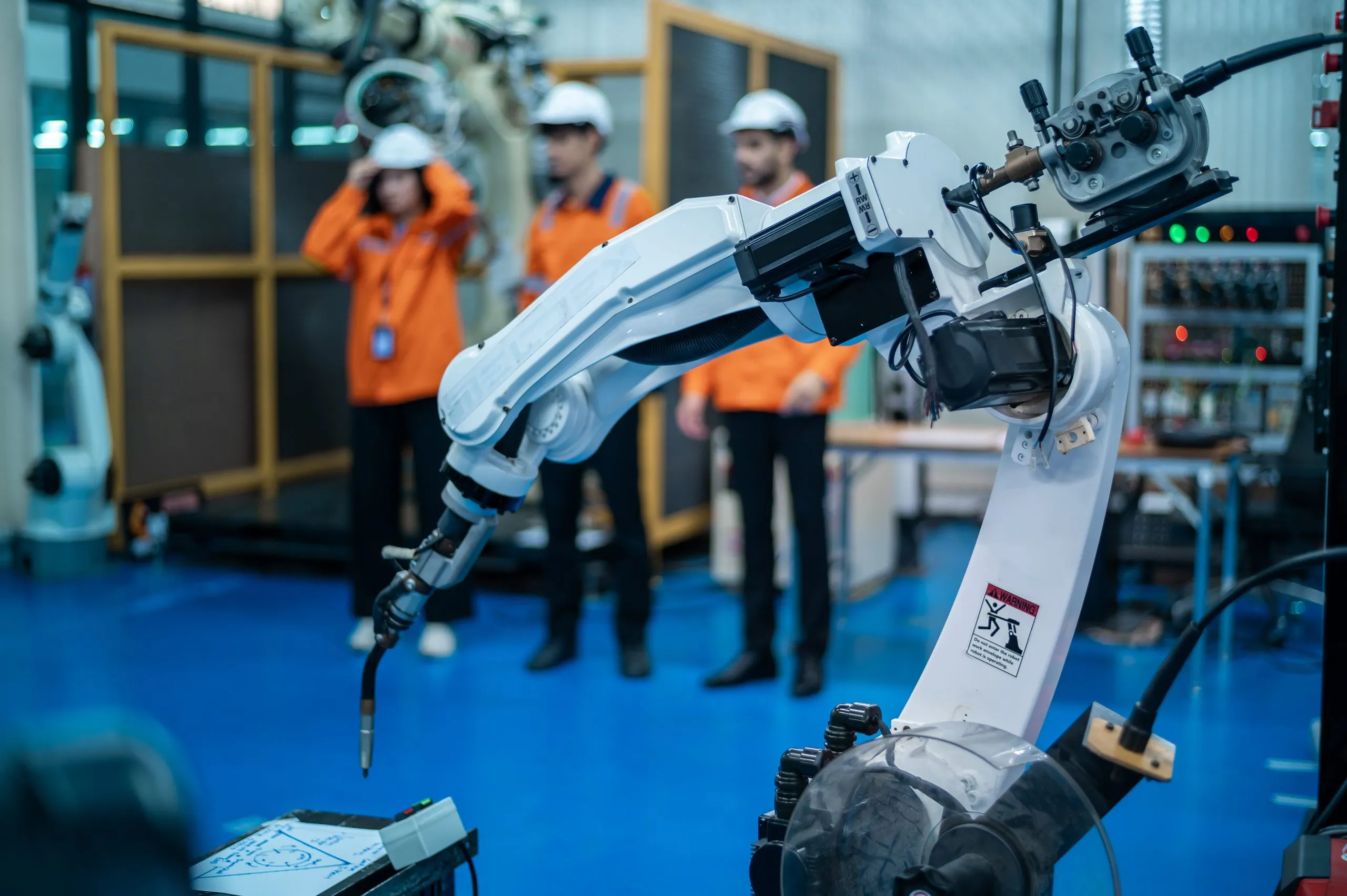
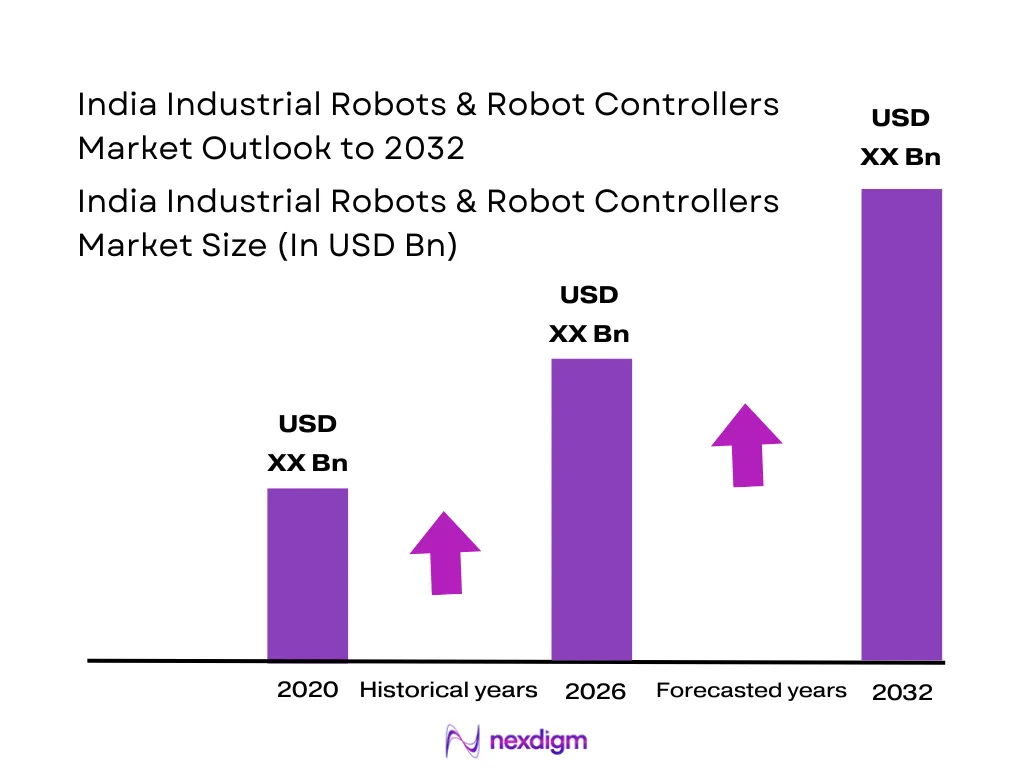
The India Industrial Robots & Robot Controllers Market is supported by rapid industrial automation adoption across automotive, electronics, semiconductor, packaging machinery, and machine tool manufacturing industries. Industrial robot installations crossed 8,500 units, while the operational stock exceeded 44,900 units according to international robotics statistics. Manufacturing value added in India surpassed USD ~ billion, supported by expanding smart factory investments, increasing industrial electricity consumption, and rising adoption of Industry 4.0 technologies. Growth in electronics production, EV manufacturing, and warehouse automation has accelerated deployment of articulated robots, collaborative robots, AI-enabled robot controllers, and machine vision systems across industrial facilities.
Industrial hubs including Pune, Chennai, Bengaluru, Sanand, Noida, Gurugram, and Sriperumbudur dominate the India Industrial Robots & Robot Controllers Market due to concentration of automotive OEMs, semiconductor investments, electronics manufacturing facilities, and advanced industrial corridors. Southern and western India remain key automation centers because of strong supplier ecosystems, export-oriented production, and established machine maker networks. Countries such as Japan, Germany, and China continue to dominate robotics technology supply owing to advanced precision engineering capabilities, large-scale industrial automation manufacturing, and strong global exports of robotic components and intelligent control systems.
Market Segmentation
By Robot Type
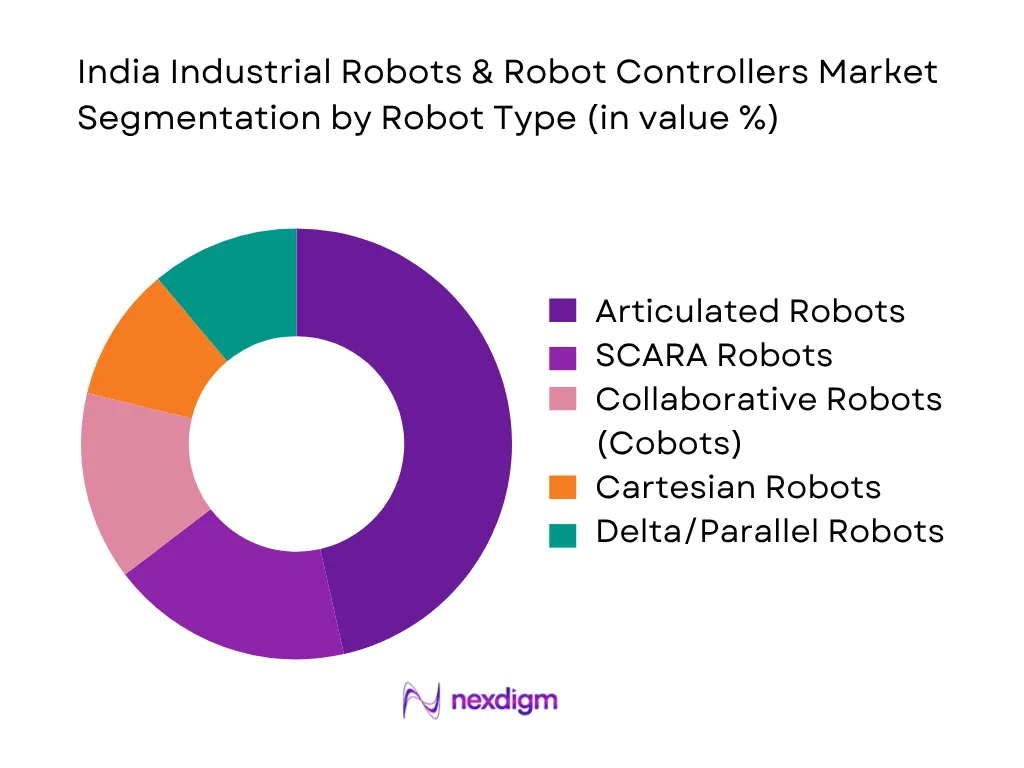
The India Industrial Robots & Robot Controllers Market is segmented by robot type into articulated robots, SCARA robots, collaborative robots, Cartesian robots, delta robots, and cylindrical robots. Articulated robots dominate the market because of their extensive usage in automotive welding, machine tending, palletizing, assembly, and material handling applications. These robots provide multi-axis flexibility, higher payload handling capability, and compatibility with AI-enabled automation systems. Automotive and EV manufacturing plants increasingly deploy articulated robotic systems to improve production throughput, reduce downtime, and maintain quality consistency. Their integration with industrial IoT platforms and predictive maintenance systems further strengthens adoption across smart manufacturing facilities. Collaborative robots are also witnessing strong growth because of rising deployment within SMEs and flexible manufacturing environments.
By Industrial Vertical
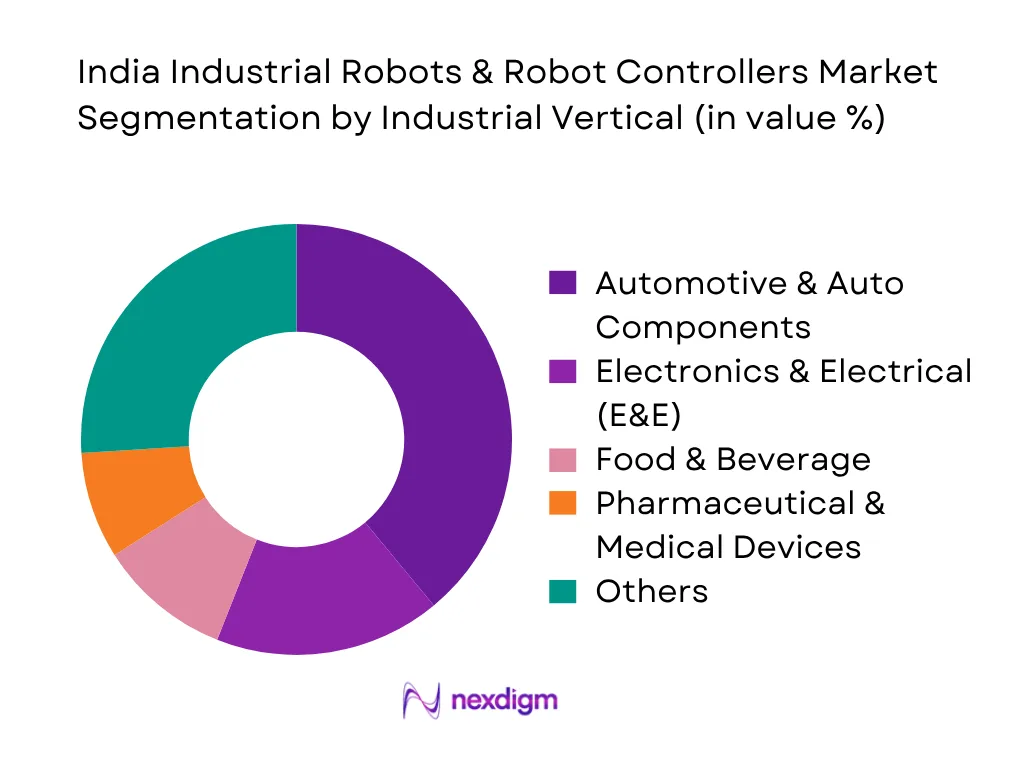
The India Industrial Robots & Robot Controllers Market is segmented by industrial vertical into automotive & auto components, electronics & electrical, semiconductor manufacturing, food & beverage, pharmaceuticals, packaging machinery, plastics & rubber, machine tools & heavy engineering, textile & apparel, HVAC manufacturing, logistics & warehousing, and other automation-intensive industries. Automotive & auto components dominate the market because of high automation intensity across welding, assembly, painting, and inspection processes. The expansion of EV production facilities and battery manufacturing plants has accelerated robotics adoption across vehicle assembly lines. Electronics and semiconductor industries are also emerging as major adopters because of increasing requirement for micron-level precision manufacturing, automated inspection systems, and cleanroom-compatible robotic solutions.
Competitive Landscape
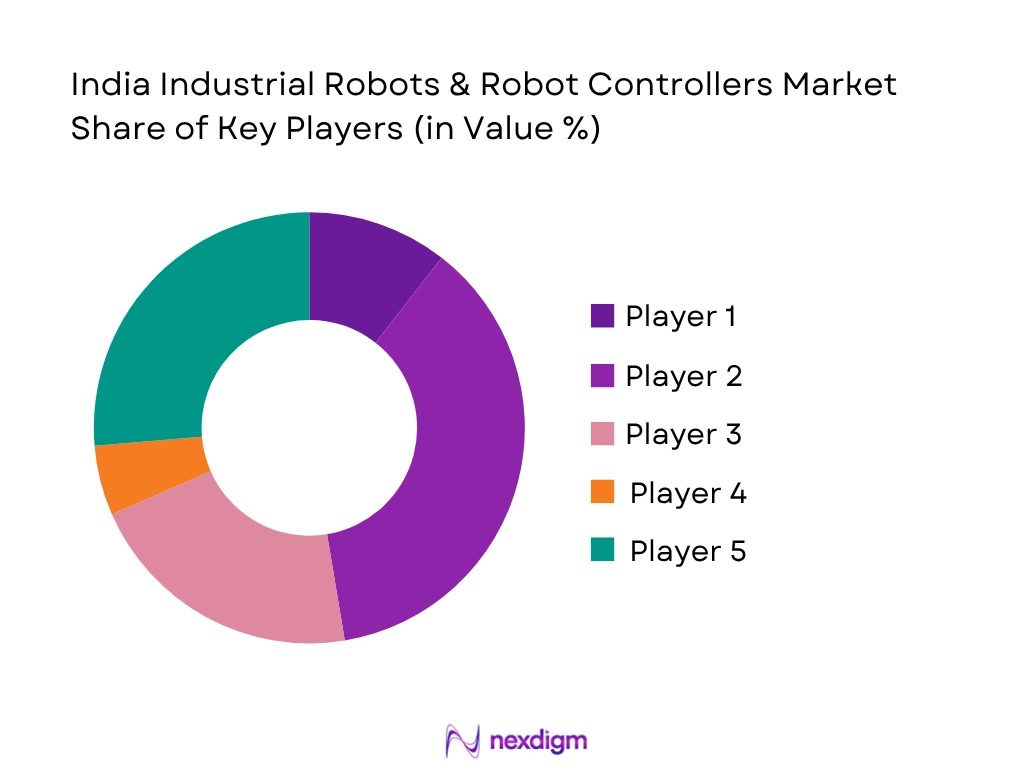
The India Industrial Robots & Robot Controllers Market is moderately consolidated with strong participation from global industrial automation companies possessing advanced robotics technologies, intelligent robot controller systems, and established OEM partnerships. Market participants are focusing on AI-enabled robotics, collaborative robot systems, localization initiatives, and expansion of smart factory integration capabilities. Increasing competition is also emerging from system integrators and automation solution providers supporting SME automation and industrial digitalization projects.
| Company | Establishment Year | Headquarters | Robot Portfolio | Manufacturing Presence | AI Integration Capability | Industrial Vertical Presence | Service Network Strength | Localization Strategy |
| ABB Ltd. | 1988 | Zurich, Switzerland | ~ | ~ | ~ | ~ | ~ | ~ |
| Fanuc Corporation | 1972 | Yamanashi, Japan | ~ | ~ | ~ | ~ | ~ | ~ |
| Yaskawa Electric Corporation | 1915 | Kitakyushu, Japan | ~ | ~ | ~ | ~ | ~ | ~ |
| KUKA AG | 1898 | Augsburg, Germany | ~ | ~ | ~ | ~ | ~ | ~ |
| Mitsubishi Electric Corporation | 1921 | Tokyo, Japan | ~ | ~ | ~ | ~ | ~ | ~ |
India Industrial Robots & Robot Controllers Market Analysis
Growth Drivers
Rising Smart Factory Adoption and Manufacturing Expansion
India’s industrial robotics market is being significantly driven by rapid expansion in manufacturing activity and increasing smart factory investments across automotive, electronics, machine tools, semiconductors, and packaging industries. Manufacturing value added in India surpassed USD 459 billion, while industrial electricity consumption crossed 490 billion kWh, indicating expansion of factory operations and industrial production activity. Automotive production exceeded 28 million vehicles, while electronics production crossed INR 9.5 lakh crore, creating substantial demand for robotic welding, machine tending, automated inspection, and material handling systems. Increasing adoption of Industry 4.0 technologies, predictive maintenance software, and industrial IoT integration is accelerating deployment of AI-enabled robot controllers and advanced automation infrastructure across industrial manufacturing facilities.
Expansion of Semiconductor and Electronics Manufacturing Ecosystem
The rapid development of semiconductor and electronics manufacturing in India is significantly increasing deployment of industrial robots and intelligent robot controllers. Electronics production exceeded USD 115 billion, while electronics exports crossed USD 29 billion, supported by mobile manufacturing and semiconductor assembly investments. Government-approved semiconductor projects exceeding INR 1.2 lakh crore are creating demand for cleanroom robotics, automated wafer handling systems, and precision inspection technologies. Industrial automation is increasingly required within semiconductor fabrication, PCB manufacturing, and consumer electronics assembly facilities because of rising production complexity, micron-level accuracy requirements, and high-volume manufacturing operations.
Market Challenges
High Import Dependency for Core Robotic Components
India’s industrial robotics ecosystem remains highly dependent on imported servo motors, harmonic reducers, drives, industrial sensors, and advanced robot controllers sourced from Japan, Germany, China, and South Korea. Imports of electrical machinery and industrial electronic equipment exceeded USD 89 billion, increasing operational risks related to currency fluctuations and global supply chain disruptions. Limited domestic manufacturing of precision automation components increases lead times and procurement costs for robotics OEMs and system integrators. Semiconductor shortages and international logistics disruptions have also affected deployment timelines for automation-intensive industries including automotive, semiconductor, and electronics manufacturing.
Limited Availability of Skilled Robotics Workforce
The shortage of skilled robotics engineers, automation technicians, and industrial AI specialists continues to affect deployment of industrial robots across Indian manufacturing sectors. Formal skill training coverage remains limited relative to the size of India’s manufacturing workforce, while advanced expertise in PLC integration, robotics programming, machine vision systems, and predictive maintenance remains insufficient. Automotive, semiconductor, and electronics facilities increasingly require specialized professionals capable of managing smart factory infrastructure and connected automation systems. SMEs particularly face operational challenges because of limited access to highly trained robotics personnel and industrial automation engineers.
Market Opportunities
Localization of Robotics Manufacturing and Component Ecosystem
India presents strong opportunities for localization of industrial robot manufacturing and robotic component production due to increasing industrial infrastructure investment and government-backed manufacturing incentives. Gross fixed capital formation exceeded USD 1 trillion, while engineering goods exports crossed USD 109 billion, reflecting expanding industrial manufacturing capability. Increasing establishment of semiconductor clusters, industrial corridors, and electronics manufacturing parks is creating opportunities for domestic production of robot controllers, industrial sensors, servo systems, and machine vision technologies. Localization can reduce import dependency while strengthening supply chain resilience for industrial automation deployments.
Rising Automation Penetration Across SMEs and Emerging Industries
India’s SME sector, comprising more than 63 million enterprises, presents substantial opportunities for industrial robotics adoption across packaging machinery, plastics, food processing, textiles, HVAC manufacturing, and logistics industries. Food processing output exceeded USD 400 billion, while India’s logistics sector handled over 4.6 billion tonnes of freight, increasing demand for automated material handling, robotic palletizing, and warehouse automation systems. Collaborative robots and compact automation solutions are increasingly becoming suitable for SMEs because of easier deployment, flexible manufacturing compatibility, and lower integration complexity.
Future Outlook
The India Industrial Robots & Robot Controllers Market is expected to witness strong expansion due to increasing smart factory investments, growing adoption of AI-enabled automation systems, and rapid industrial digitization across manufacturing sectors. Expansion of semiconductor fabrication facilities, electronics assembly plants, EV manufacturing units, and warehouse automation infrastructure is expected to accelerate deployment of articulated robots, collaborative robots, and intelligent robot controllers. Increasing government support for domestic manufacturing and localization initiatives is likely to strengthen indigenous automation capabilities and reduce import dependency. Technological advancements in machine vision systems, industrial IoT integration, predictive maintenance software, and cloud-connected robot controllers are expected to improve operational efficiency and factory productivity across industrial facilities. SMEs are also anticipated to emerge as a major growth segment because of increasing affordability and scalability of collaborative robotic systems. Additionally, growth in packaging machinery, pharmaceuticals, logistics automation, and food processing industries is expected to generate substantial long-term opportunities for industrial robotics manufacturers and automation solution providers in India.
Major Players
- ABB Ltd.
- Fanuc Corporation
- Yaskawa Electric Corporation
- KUKA AG
- Mitsubishi Electric Corporation
- Kawasaki Heavy Industries Ltd.
- DENSO Corporation
- Universal Robots
- Omron Corporation
- Siemens AG
- Rockwell Automation Inc.
- Schneider Electric SE
- Stäubli International AG
- Nachi-Fujikoshi Corp.
- Delta Electronics Inc.
Key Target Audience
- Automotive OEMs and EV Manufacturers
- Electronics and Semiconductor Manufacturing Companies
- Industrial Automation System Integrators
- Packaging Machinery and Machine Tool Manufacturers
- Pharmaceutical and Food Processing Companies
- Investments and Venture Capitalist Firms
- Government and Regulatory Bodies
- Warehouse Automation and Logistics Solution Providers
Research Methodology
Step 1: Identification of Key Variables
The initial stage involved identifying key variables influencing the India Industrial Robots & Robot Controllers Market, including automation penetration, industrial manufacturing expansion, semiconductor investments, smart factory adoption, robotics localization, and industrial IoT integration. Extensive secondary research was conducted using government publications, industrial automation databases, manufacturing statistics, and trade reports to map the industry ecosystem and stakeholder network.
Step 2: Market Analysis and Construction
Historical analysis was conducted using industrial robot installation data, automation spending trends, manufacturing output statistics, and import-export trade flows related to industrial automation equipment. Market estimation was developed through bottom-up calculations based on robot shipments, installed base analysis, industrial vertical demand, and hardware-software-services revenue mapping across Indian manufacturing industries.
Step 3: Hypothesis Validation and Expert Consultation
The preliminary findings were validated through interviews with industrial robot manufacturers, automation distributors, factory managers, OEMs, and system integrators operating within automotive, electronics, semiconductor, packaging, and machine tool industries. These consultations provided operational insights regarding deployment trends, pricing dynamics, localization strategies, and future industrial automation investments.
Step 4: Research Synthesis and Final Output
The final phase involved consolidating quantitative and qualitative findings to produce a comprehensive market assessment. Cross-validation was conducted using industrial production statistics, robotics installation databases, trade data, and manufacturer disclosures to ensure reliability of market estimates, segmentation analysis, competitive benchmarking, and future growth assessment for the India Industrial Robots & Robot Controllers Market.

- Executive Summary
- Research Methodology (Market Definitions and Assumptions, Abbreviations, Research Framework, Bottom-Up Market Estimation, Top-Down Validation, Industrial Automation Penetration Mapping, OEM and System Integrator Analysis, Import-Export Trade Flow Assessment, Primary Interviews with Manufacturers and Automation Providers, Forecasting Model, Limitations and Assumptions)

- Definition and Scope
- Evolution of Industrial Automation in India
- Industrial Robotics Ecosystem and Stakeholder Mapping
- Supply Chain and Value Chain Analysis
- Industrial Robot Manufacturing and Assembly Flow
- Robot Controller Architecture and Integration Overview

- Growth Drivers
Rising Smart Factory Adoption and Manufacturing Expansion
Expansion of Semiconductor and Electronics Manufacturing Ecosystem
Increasing Automotive and EV Production Automation
Growth in AI-Enabled Industrial Automation Systems
Government Push Towards Make in India and PLI Schemes - Market Challenges
High Import Dependency for Core Robotic Components
Limited Availability of Skilled Robotics Workforce
High Initial Capital Investment Requirements
Complex Integration with Legacy Manufacturing Systems - Market Opportunities
Localization of Robotics Manufacturing and Component Ecosystem
Rising Automation Penetration Across SMEs and Emerging Industries
Growth of Collaborative Robots in Flexible Manufacturing
Expansion of Warehouse and Logistics Automation
Increasing Adoption of AI and Machine Vision Technologies - Market Trends
AI-Enabled Predictive Robotics
Human-Robot Collaboration Systems
Cloud-Integrated Robot Controllers
Digital Twin and Industrial IoT Integration
Energy Efficient Robotics Systems
Machine Vision-Based Inspection Automation - Government Regulations
Industrial Safety and Factory Automation Standards
PLI Schemes for Electronics and Semiconductor Manufacturing
Import Duty Structure on Automation Equipment
Industrial Data Security and Cybersecurity Compliance
Electronics Manufacturing and Localization Policies - Porter’s Five Forces Analysis
- Pricing Analysis
- Trade Flow and Import Dependency Analysis
- Competition Ecosystem
- Automation Maturity Benchmarking

- By Value, 2020-2025
- By Shipment Volume, 2020-2025
- By Installed Base, 2020-2025

- By Robot Type (in Value %)
Payload Handling Capacity
Axis Flexibility
Cycle Time Efficiency
Application Suitability - By Robot Controller Type (in Value %)
Processing Speed
Connectivity Capability
AI Integration Level
Industrial Compatibility - By Application Type (in Value %)
Automation Intensity
Operational Throughput
Precision Requirement
Machine Integration Rate - By Industrial Vertical (in Value %)
Robot Density
Factory Automation Adoption
Production Scalability
Smart Manufacturing Penetration - By Component Type (in Value %)
Localization Ratio
Procurement Dependency
Technology Complexity
Replacement Cycle - By Enterprise Size (in Value %)
Automation Budget Allocation
Deployment Scale
Factory Digitization Level
ROI Realization Period - By Sales Channel (in Value %)
OEM Penetration
Distributor Reach
Service Capability
Customer Retention Rate - By Region (in Value %)
North India
South India
West India
East India

- Market Share Analysis of Major Players on the Basis of Revenue, Shipment Volume, and Installed Base
- Cross Comparison Parameters (Company Overview, Industrial Robot Portfolio, Robot Controller Capability, Manufacturing Footprint, Localization Strategy, AI Integration Capability, System Integrator Network, Production Capacity, Service Network Strength, Industrial Vertical Presence, Smart Factory Integration Capability, Strategic Partnerships, Product Innovation Pipeline, Customer Base, Pricing Positioning, Import Dependency Ratio)
- Competitive Benchmarking Matrix
- SWOT Analysis of Major Players
- Pricing Analysis by Robot Type and Payload Capacity
- Detailed Profiles of Major Companies
ABB Ltd.
Fanuc Corporation
Yaskawa Electric Corporation
KUKA AG
Mitsubishi Electric Corporation
Kawasaki Heavy Industries Ltd.
DENSO Corporation
Universal Robots
Omron Corporation
Siemens AG
Rockwell Automation Inc.
Schneider Electric SE
Stäubli International AG
Nachi-Fujikoshi Corp.
Delta Electronics Inc.

- Automation Spending Analysis
- Factory Digitization Assessment
- Operational Efficiency Improvement Analysis
- Production Throughput Optimization
- Downtime Reduction Analysis
- Purchase Decision Parameters

- By Value, 2026-2032
- By Shipment Volume, 2026-2032
- By Installed Base, 2026-2032


 Request a Sample
 Ask for Customization
 Get a Quote
 Enquire Now